HAL Id: hal-02503843
https://hal.archives-ouvertes.fr/hal-02503843
Submitted on 12 Nov 2020
HAL is a multi-disciplinary open access
archive for the deposit and dissemination of
sci-entific research documents, whether they are
pub-lished or not. The documents may come from
teaching and research institutions in France or
abroad, or from public or private research centers.
L’archive ouverte pluridisciplinaire HAL, est
destinée au dépôt et à la diffusion de documents
scientifiques de niveau recherche, publiés ou non,
émanant des établissements d’enseignement et de
recherche français ou étrangers, des laboratoires
publics ou privés.
Correlations between structural changes and dielectric
behavior of thermally aged XLPE
Youcef Kemari, Abdelouahab Mekhaldi, G. Teyssedre, Madjid Teguar
To cite this version:
Youcef Kemari, Abdelouahab Mekhaldi, G. Teyssedre, Madjid Teguar. Correlations between
struc-tural changes and dielectric behavior of thermally aged XLPE. IEEE Transactions on Dielectrics and
Electrical Insulation, Institute of Electrical and Electronics Engineers, 2019, 26 (6), pp.1859-1866.
�10.1109/TDEI.2019.008189�. �hal-02503843�
Correlations Between Structural Changes and Dielectric
Behavior of Thermally Aged XLPE
Youcef Kemari
1, Abdelouahab Mekhaldi
1, Gilbert Teyssèdre
2andMadjid Teguar
11 Laboratoire de Recherche en Electrotechnique, Ecole Nationale Polytechnique d’Alger, 10 Avenue Hassen Badi, B.P 182,
El-Harrach, 16200 Algiers, Algeria.
2 LAPLACE (Laboratoire Plasma et Conversion d’Énergie), Université de Toulouse, CNRS; Bat 3R3, 118 route de Narbonne,
F-31062 Toulouse cedex 9, France.
ABSTRACT
This study aims at elucidating the correlations between structural changes and the variation of dielectric properties of cross-linked polyethylene (XLPE) during thermal aging. For this purpose, thermal aging experiments were carried out on XLPE samples at 80, 100, 120 and 140 °C for different aging times for a maximum total duration of 5040 hours. Chemical changes were assessed by Fourier Transform Infrared Spectrum (FTIR). Besides, the crystallinity ratio and the melting temperature were evaluated using Differential Scanning Calorimetry (DSC). Frequency domain dielectric spectroscopy was used to investigate the evolution of the dielectric constant and losses of XLPE during aging. The results show that aging at 80 and 100 °C could help to improve the crystalline state of XLPE which leads to the decrease of the dielectric constant. However, for higher thermal stress, the main aging mechanism of XLPE is thermal oxidation which leads to deteriorate the morphology and increase both the polarization and losses, mainly at low frequencies. It has been found also that in some cases, the non-homogeneity of the color of XLPE seems to indicate the increase of interfaces in the material which could lead to increase the dielectric losses due to the interfacial polarization.
Index Terms — power cable insulation, cross-linked polyethylene insulation, aging, Fourier spectroscopy, calorimetry, dielectric measurements, dielectric materials
1
INTRODUCTION
P
OWER cables represent an important part of electrical transmission and distribution networks. Moreover, the use of polymeric insulation materials in underground cables offers a significant reduction of the electrical system volume [1] Therefore, special attention has been paid to the continuous development of insulating materials used in power cables. Among these materials, cross-linked polyethylene (XLPE) remains a material of choice for medium and high-voltage cables [2]. In fact, XLPE presents many advantages such as a low dissipation factor of about 0.03 % at 20 °C, low dielectric constant of 2.2-2.5, good thermo-mechanical properties and high operating temperature of about 90 °C [3].However, irreversible changes may occur after the exposure of the cable to a variety of stresses. Among them, the thermal constraint is considered as one of the most severe factors leading to change the properties of the insulation and then to the deterioration of the cable [4]. To address these issues, many researchers have focused on physicochemical analyses
to study the morphology changes in XLPE due to aging [5-7]. These studies showed that the main degradation mechanisms in XLPE are thermal oxidation and scission of the molecular chains. In addition, some researchers have investigated the dielectric response of XLPE during thermal aging [4, 8-9] This approach has revealed the evolution of some dielectric parameters (e.g. conductivity, losses factor, dielectric constant...) with aging.
To our knowledge, the large number of works already done in this area were based on experimental databases collected from samples that have been aged in a very accelerated manner or for short periods [10, 11] which could lead to skip some intermediate changing states of XLPE properties during the aging process. Besides, some aging mechanisms not in operation in normal service conditions can be triggered by overstressing. Especially the evolution of the material can substantially change when going through the melting temperature range.
The study of correlations between structural changes and dielectric properties represents an important task for the development of more resistant materials and additives in order to increase the insulation lifetime. Such a study could help to predict the dielectric properties according to physicochemical
changes and vice versa and to contribute to the development of diagnosis tools for aging monitoring.
Through this paper, we focused in particular on the physicochemical and the dielectric behaviors of XLPE material versus aging. The selected material is a commercial XLPE used for the insulation of medium voltage cables. Samples were subjected to a controlled thermal aging at four different temperatures ranging from 80 to 140 °C and at different aging times for a maximum total duration of 5040 hours (210 days).
Moreover, our work consists of evaluating the physicochemical and dielectric properties of the samples before and after aging in order to characterize the degree of degradation of XLPE. Besides, we aim to study the correlations between these different properties, which leads to a better understanding of aging and degradation mechanisms.
2
EXPERIMENTAL
2.1 MATERIALS AND SAMPLES PREPARATION The studied material is intended for the extrusion of power cables operated in phase to phase voltage of U = 30 kV (i.e. U0
= 18 kV between the phase and the screen). The base materials are pellets of cross-linkable resin (LE4201R, manufactured by Borealis company). These pellets are loaded with di-cumyl peroxide (DCP) as cross-linking agent with 2 % in content. The material contains also di-tert-butyl peroxide and Irganox antioxidant. Samples were manufactured in thick plaque form and supplied by ENICAB Subsidiary company of General Cable of Biskra, Algeria.
For manufacturing the XLPE plaques, the pellets were preheated for 5 minutes at 125 °C then molded and cross-linked at 185 °C under a pressure of 300 MPa using a pressurized heat press. These conditions (300 MPa and 185 °C) are maintained for about 10 minutes to ensure complete cross-linking of the material. At the end, the press is cooled with water by maintaining always the same pressure.
The diameter of the obtained circular plates of XLPE is 12.9 cm, whereas their thickness is (2 ± 0.2) mm. In order to perform physicochemical and electrical experiments, the XLPE plates were cut into circular shaped samples with a diameter of about 46 mm and a thickness of (2 ± 0.2) mm. Samples were cut using a cutting press with a circular cutting die tool.
2.2 THERMAL AGING EXPERIMENTS
Accelerated thermal aging was performed according to IEC 60216 standard [12]. The circular samples were vertically arranged inside air-circulating ovens at aging temperatures of 80, 100 and 120 °C. Samples were taken out every 1008 hours (42 days) for total aging time of 5040 hours (210 days).
Moreover, since the degradation process of XLPE is very fast at 140 °C, samples were taken out every 504 hours (21 days) for a total period of 1512 hours (63 days). All these samples are intended for FTIR and dielectric spectroscopy tests. On the other hand, DSC characterization was performed on unaged and aged samples that have been taken at the final stage of aging at each temperature (after 5040 hours at 80, 100
and 120 °C and after 1512 hours at 140 °C).
2.3 FOURIER TRANSFORM INFRARED SPECTRUM CHARACTERIZATION (FTIR)
FTIR characterizations were carried out using a Vertex 70 FTIR spectrometer from Bruker equipped with a platinum diamond accessory. Moreover, our samples present relatively large thickness of about 2 mm which imposed us to use FTIR analysis in Attenuated Total Reflection (ATR) mode.
All samples were analyzed and each experiment started with a background spectrum acquisition without the sample. Then, 24 scans were recorded in the wavenumber range of 430-5000 cm-1 with a resolution of 2 cm-1 for each sample.
The obtained ATR-FTIR spectra represent the average of three spectra recorded from three different samples that have been aged in the same conditions (temperature and time).
2.4 DIFFERENTIAL SCANNING CALORIMETER (DSC)
The variations of phase transitions of XLPE due to thermal aging have been monitored using differential scanning calorimetry DSC 2010 TA Instruments with a computer data system. Samples of about 10 mg of weight were analyzed by two repeated heating and cooling cycles at a constant rate of 10 °C/min under nitrogen atmosphere in the temperature interval 20-150 °C. The DSC thermogram obtained in the first heating run is strongly influenced by the thermal history of the material. Therefore, we based the analysis on the second heating/cooling cycle to determine the DSC parameters such as the crystallinity rate and the melting temperature.
2.5 FREQUENCY DOMAIN DIELECTRIC SPECTROSCOPY
The dielectric spectroscopy measurements were performed using Novocontrol Alfa-A High Performance Analyzer dielectric spectrometer with a ZGS active sample cell. The system can control the temperature under nitrogen atmosphere by a Quatro cryosystem within ± 0.1 °C. In addition, the control and the evaluation of dielectric measurements were done using WinDETA® software. Prior to the dielectric measurements, gold electrodes were deposited onto both surfaces of the XLPE circular samples by sputtering. The diameter and the thickness of the sputtered electrodes are respectively 35 mm and 30 nm. For the sake of evaluating the dielectric response of XLPE samples with thermal aging, dielectric constant ε’r and dielectric losses tan() were
measured in the frequency range 10-2 to 105 Hz at 20 °C.
4 RESULTS
AND
DISCUSSIONS
4.1 COLOR CHANGES
Figure 1 shows the changes in aspect of XLPE samples at different aging stages. We observe that the color changed from gray before aging to light yellow after 5040 h at 80 °C and then to light orange after 5040 h at 100 °C. On the other hand, the color has become darker at 120 °C. Also, it can be noticed that after 5040 h at 120 °C and 504 h at 140 °C, XLPE color is a dark orange that is not uniformly distributed over the surface of the aged sample.
Moreover, the change in color at 140 °C is much faster and a dark-brown color has been obtained after 1512 h. These changes have been attributed to the formation of vinylidene and vinyl groups due to degradation by thermal oxidation [10, 13]. It could correspond to the reaction of the antioxidant during the oxidation phase [14].
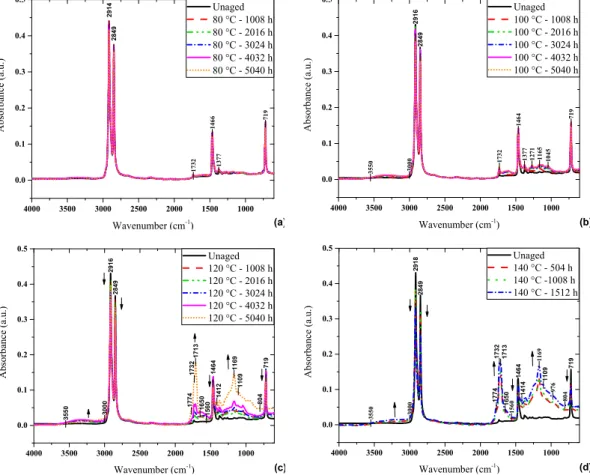
4.2 ATR-FTIR SPECTROSCOPY ANALYSIS The FTIR spectra of XLPE samples before and after thermal aging are presented in Figure 2. Before identifying the
chemical functions related to the degradation of the material, the characteristic bands of the virgin XLPE have been found. The peak at wavelength of 719 cm-1 corresponds to the
rocking methylene groups -CH2. The peak at 1466 cm-1 is
attributed to the wag vibration of -CH2. The other peaks at
2849 cm-1 and 2914 cm-1 correspond respectively to
symmetric and asymmetric stretching vibration of -CH2 group
[15].
No significant change in the FTIR spectra of XLPE was observed after aging at 80 and 100 °C. However, due to thermo-oxidative reactions, the main obtained changes in the FTIR spectra after aging at 120 and 140 °C consist in the formation of C=O carbonyl groups. Three bands characteristic to the C=O group are observed between 1650 and 1800 cm-1.
The first one at 1713 cm-1 shows an absorption of the
carboxylic acid and ketones [RC(=O) OH, RC(=O) R'], where R and R' represent a chain of the aged polymer and its fragment, respectively. The second band at 1732 cm-1
characterizes the absorption of aldehyde or the ester [RC(=O) OR']. The third band corresponds at 1774 cm-1 and is
attributed to the carboxylic anhydride [16].
On the other hand, the decrease of the IR absorption in the XLPE characteristic bands (719, 1466, 2849 and 2914 cm-1)
after aging, could be a result of molecular chains scission. In addition, an increase of the IR absorption band between 800 and 1128 cm-1 is observed with aging. This band could be
associated with the C=C double bond of the unsaturated 4000 3500 3000 2500 2000 1500 1000 0.0 0.1 0.2 0.3 0.4 0.5 719 1377 1466 28 49 291 4 1732 A bso rb anc e (a.u.) Wavenumber (cm-1) Unaged 80 °C - 1008 h 80 °C - 2016 h 80 °C - 3024 h 80 °C - 4032 h 80 °C - 5040 h (a) 4000 3500 3000 2500 2000 1500 1000 0.0 0.1 0.2 0.3 0.4 0.5 719 116 5 12 71 13 77 14 64 2 849 29 16 1045 1732 30 00 3550 (b) A bso rbance (a.u.) Wavenumber (cm-1) Unaged 100 °C - 1008 h 100 °C - 2016 h 100 °C - 3024 h 100 °C - 4032 h 100 °C - 5040 h 4000 3500 3000 2500 2000 1500 1000 0.0 0.1 0.2 0.3 0.4 0.5 71 9 804 11 09 116 9 1412 1464 17 13 284 9 29 16 1732 1774 3000 35 50 1650 1560 (c) A bsor bance ( a.u.) Wavenumber (cm-1) Unaged 120 °C - 1008 h 120 °C - 2016 h 120 °C - 3024 h 120 °C - 4032 h 120 °C - 5040 h 4000 3500 3000 2500 2000 1500 1000 0.0 0.1 0.2 0.3 0.4 0.5 719 804 976 1109 1169 141 4 1464 17 13 1732 2849 2918 1774 1560 16 50 3000 3550 (d) Absorbance ( a.u. ) Wavenumber (cm-1) Unaged 140 °C - 504 h 140 °C -1008 h 140 °C - 1512 h
Figure 2. ATR- FTIR spectra of different XLPE samples aged at: (a) 80 °C, (b) 100 °C, (c) 120 °C and (d) 140 °C. The up and down arrows indicate
respectively the increase and the decrease of the chemical group absorbance. (a) (b) (c)
(d) (e) (f)
Figure 1. Color change of XLPE samples: (a) before aging, (b) aged at 80 °C
for 5040 h, (c) aged at 100 °C for 5040 h, (d) aged at 120 °C for 5040 h, (e) aged at 140 °C for 504 h, (e) aged at 140 °C for 1512 h
groups, vinylidene and trans-vinyl [15, 17]. Also, the C=C bond of the vinylene group could be found between 1560 and 1650 cm-1 [18]. Moreover, it is suggested that the increase in
absorption between 1169 and 1414 cm-1 is associated with the
vibrations of the -C-O-C- bond [15]. Finally, in the region between 3000 and 3500 cm-1, a slight increase in the
absorption of the -OH function of the hydroxyl groups could be noticed after aging [15, 17].
Also, the IR absorption of the Irganox antioxidant, which is characterized by the presence of the C-O-C bond, was not detectable through ATR-FTIR analysis. This feature could be explained by the fact that the antioxidant absorption is superimposed on the IR absorption peaks of the oxidation products which occur at about 1078, 1159 and 3604 cm-1 [15].
During thermo-oxidative reactions, the radicals generated by chains scission of the polymer could react in the presence of oxygen with another polymer chain in order to generate a peroxyl radical ROO°. Then, this last radical could capture hydrogen atoms from other polymer chains to generate hydroperoxide (ROOH) and alkyl (R°) radicals and keep the oxidative reactions auto-accelerated [17]. The termination step involves all possible reactions between the two radicals ROO° and R°. Also, it has been shown in reference [19] that peroxyl radicals could lead to the formation of a pair of alkoxy radicals (RO°) in a cage. In references [19-20], several possible reaction paths are explored leading to a termination and also to a non-terminating combination (diffusion out of the cage leading to the priming of a new oxidation chain). Moreover, the reactions of alkoxy radicals could result in the formation of more polar and carbonyl groups such as aldehydes and ketones [21].
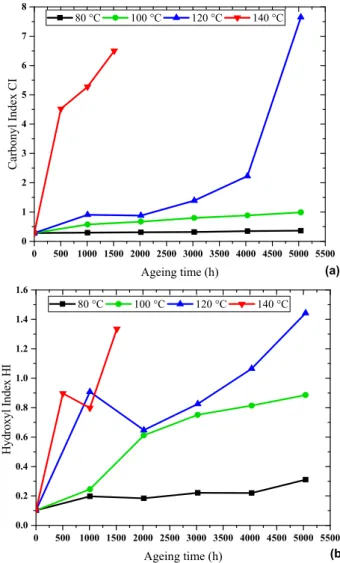
For the sake to obtain qualitative information concerning the chemical changes caused by the thermal aging, carbonyl products were evaluated by the carbonyl index CI, characterized by the ratio of the relative intensities absorbed at 1732 cm-1 (absorption of the aldehyde) and 1466 cm-1
(methylene uptake). In addition, hydroxyl index HI was calculated as the ratio of the peak area of hydroxyl groups in the region between 3000 and 3500 cm-1, CI and HI are shown
in Figure 3.
The presence of carbonyl groups has been observed in all samples, before and after aging. The CI of the virgin sample is low and it is caused by impurities from the manufacturing process. At aging temperatures of 80 and 100 °C, the growth rate of hydroxyl groups started earlier than that of carbonyl where HI begins to increase significantly after about 1008 h at 100 °C (Figure 3b). On the other hand, thermal aging at 80 and 100 °C had a very weak effect on CI which exceeded slightly the values of the virgin sample.
For aging temperature of 120 °C, the thermo-oxidation process becomes more intense, which is reflected by a significant increase of both indexes. In addition, it has been noticed that CI increases rapidly at 120 °C after 4032 h of thermal aging. Moreover, the rise of CI is very fast at the beginning of aging at 140 °C. It has been found also that after 504 h at 140 °C, CI increases with aging time with a relatively slow rate (Figure 3a). Increasing the aging temperature obviously increases the rate of oxidation reaction and thus
accelerates the generation of aging products.
Aging of XLPE at temperatures higher than the melting point (which is around 105 °C) could facilitate the oxygen diffusion into the space between the molecular chains and then leads to accelerate thermo-oxidative reactions. As a result, CI and HI at high aging temperature are significantly greater than those at lower temperatures.
4.3 DSC RESULTS
The DSC thermograms corresponding to the second heating and cooling cycles of the unaged and the aged XLPE samples are shown respectively in Figures 4 and 5. To provide quantitative analysis, we considered the melting (Tm) and the
crystallization (Tc) temperatures, the enthalpies of fusion Hm
and of crystallization Hc, the endothermic peak shape and the
lamellar thickness.
The crystallinity rate is calculated using the Equation 1:
%
100
0
H
H
m c
(1) where H0 is the theoretical melting enthalpy for the
0 500 1000 1500 2000 2500 3000 3500 4000 4500 5000 5500 0 1 2 3 4 5 6 7 8 C arbonyl I ndex CI Ageing time (h) 80 °C 100 °C 120 °C 140 °C (a) 0 500 1000 1500 2000 2500 3000 3500 4000 4500 5000 5500 0.0 0.2 0.4 0.6 0.8 1.0 1.2 1.4 1.6 (b) H yd ro xy l I nd ex H I Ageing time (h) 80 °C 100 °C 120 °C 140 °C
Figure 3. Evolution of (a) Carbonyl index and (b) Hydroxyl index, versus
complete crystallinity PE, H0=287.3 J/g [15]. Besides, the
average lamellar thickness was calculated based on Thompson-Gibbs equation as follows:
m e m m m
H
T
T
T
L
2
0 0
(2) where Tm0 is the equilibrium melting temperature of an
infinitely thick crystal Tm0 = 414.6 K, Tm is the melting point,
∆Hm is the enthalpy of fusion and e = 60.9×10⁻³ J.m-2 is the
surface free energy per unit area of basal face [22] The obtained results by DSC experiments are presented in Table 1.
The DSC thermograms in Figure 4 show an endothermic peak associated with the melting of the crystalline part in XLPE material. As the degradation goes on, the area and the intensity of the melting and crystallization peaks decrease while it moves to lower temperatures. Additionally, one main exothermic peak, characterizing the XLPE crystallization temperature, appeared on all the thermograms of Figure 5. This peak is shifted toward lower temperatures after aging at 120 and 140 °C. Therefore, based on DSC results, two steps of XLPE aging process could be distinguished.
The first step corresponds to aging temperatures below the melting point (80 and 100 °C), thermo-oxidation is inhibited by the antioxidant. Meanwhile, small parts of the lamellar crystals may melt and the oxidation mainly affects the amorphous regions. The lamellar thickness was practically not affected. In addition, low molecular weight segments could appear in the amorphous regions due to the scission of the ends of the macromolecular chains. These resulting segments crystallize and could act to enhance crystallization. This is known as a post-cross-linking phenomenon, which leads to higher homogeneity in the crystalline region. Hence, melting temperature, enthalpy of fusion, and crystallinity may increase slightly [17].
The second phase corresponds to the higher aging temperatures (120 and 140 °C), the oxidation becomes auto-accelerated rapidly since the antioxidant has been consumed. Also, more small chain segments and dangling bonds would be released as a consequence of the main chain scissions in XLPE [18]. The crystalline parts, then tend to disappear, which makes the diffusion of oxygen faster [8, 17].
4.4 RESULTS OF THE FREQUENCY DIELECTRIC SPECTROSCOPY TEST
4.4.1 DIELECTRIC CONSTANT
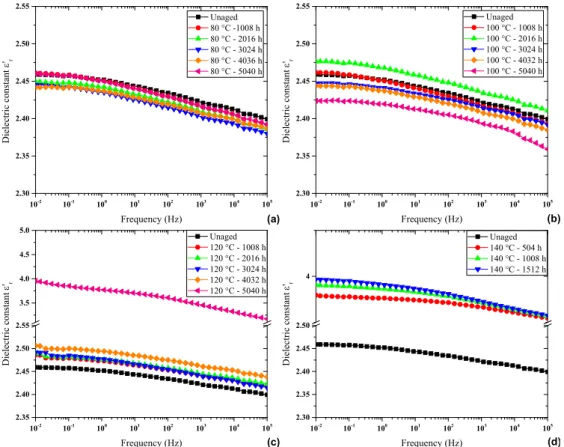
Figure 6 shows the evolution of the dielectric constant of XLPE samples at 20 °C for different aging conditions. The dielectric constant increases slightly as the frequency decreases. This increase is a little faster between about 10 and 105 Hz, which corresponds to the orientation polarization of
dipoles [4].
Under 10 Hz, the interfacial polarization (Maxwell-Wagner-Sillars) associated with the accumulated charges on the surfaces of the electrodes occur and the dielectric constant tends to a constant value. Moreover, the dielectric constant remains practically unchanged as the aging time increases at 80 °C (Figure 6a). At this temperature, the material is in a state of scleroid solidity and thermal oxidation has a negligible effect on the dielectric constant of XLPE [8].
On the other hand, Figure 6b shows that the dielectric constant for the sample aged for 2016 h at 100 °C is greater than before aging. After that, it decreases with aging time and reaches a minimum after 5040 h with a value that is smaller than the unaged one. In fact, it can be assumed that when aging at temperatures below the melting point of the virgin sample (about 105 °C), the combined effects of thermal oxidation and post-cross-linking occur simultaneously during aging as shown by FTIR and DSC tests.
Table 1.RESULTS OBTAINED FROM DSC MEASUREMENTS (SECOND SCAN).
Unaged 5040 h 80 °C, 100 °C, 5040 h 120 °C, 5040 h 140 °C, 1512 h Tm (°C) 104.43 104.41 104.80 82.77 70.09 Tc (°C) 91.17 90.52 91.30 61.85 51.05 Hm (J.g-1) -111.30 -112.70 -118.70 -67.40 -35.87 Hc (J.g-1) 113.80 110.80 117.40 66.80 39.75 c (%) 39.75 40.25 42.39 24.08 12.81 L (nm) 4.74 4.73 4.78 2.99 2.45 30 40 50 60 70 80 90 100 110 120 130 140 150 -16 -14 -12 -10 -8 -6 -4 -2 0 2 H eat f lo w (m W) Temperature (°C) Unaged 80 °C - 5040 h 100 °C - 5040 h 120 °C - 5040 h 140 °C - 1512 h Endothermic
Figure 4. DSC heating thermograms of XLPE samples before and after
thermal aging at 80, 100, 120 and 140 °C.
30 40 50 60 70 80 90 100 110 120 130 140 -5 0 5 10 15 20 Exodothermic Heat flo w (mW) Temperature (°C) Unaged 80 °C - 5040 h 100 °C - 5040 h 120 °C - 5040 h 140 °C - 1512 h
Figure 5. DSC cooling thermograms of XLPE samples before and after
Thermal oxidation reactions lead to the formation of polar groups, such as carbonyl, peroxide and hydroxyl groups, which contribute to increasing the dielectric constant. Nevertheless, the post-cross-linking could optimize the crystallinity of the samples leading to mitigate the accumulation of space charges and to make molecular orientation polarization more difficult [18]. Therefore, to our point of view the influence of thermal aging on XLPE samples would depend on which process is playing the dominating
role, thermal oxidation or post-cross-linking and
recrystallization. At the aging temperature of 100 °C, small parts of the crystalline regions are melted and certain aging time is necessary (longer than 2016 h) for the post-cross-linking to wield the dominant influence on the dielectric constant, which decreases with aging time [8,18].
In contrast, when samples were aged at 120 °C, the degradation process by thermo-oxidative reactions is quickly dominating. First, the dielectric constant increases slowly at the beginning of aging and remains almost unchanged until 3024 h but it then begins to increase over time, reaching a higher value after 5040 h (Figure 6c). At 140 °C, chain scission by thermal oxidation overwhelms the post-cross-linking which leads to increase the amorphous phase and make the macromolecule chains more flexible to interact under the polarization effect. At the same time, more polar groups are being generated resulting in increasing the dielectric constant drastically.
Moreover, it can be seen in Figure 6d that the dielectric constant curves at 140 °C are very close at the high frequency
end (> 1 kHz) and they are spaced out as the frequency decreases. In other words, the variation of the dielectric constant as a function of aging time is more important at low frequencies due to the local accumulation of space charges in XLPE [23].
4.4.2 DIELECTRIC LOSSES FACTOR As far as the dielectric losses are concerned, we present in Figure 7 the variations of tan () of the XLPE for different
thermal aging temperatures and durations. It can be observed that tan () is almost constant versus frequencies above 102
Hz. This is associated with the relaxation due to the movement of molecular chains in the amorphous phase of XLPE [4, 23]. In this range, the dielectric losses are attributed to the orientation polarization of dipoles. Also, it is well known that dielectric losses are generally related to interfacial polarization and to conduction at low frequencies.
During aging at 80 and 100 °C, combined effects of thermal oxidation and recrystallization occur simultaneously, but remain practically without effect on the dielectric loss factor which shows a minimum peak around 0.1 Hz. On the other hand, when the degradation becomes more accentuated, at 140 °C and after 5040 h at 120 °C, the losses significantly rise. This behavior results from the generation of polar groups due to the decomposition of the material by thermal degradation.
In fact, it could be affirmed according to the DSC results that the clarity of the relaxation at high frequencies in the most degraded samples is due to the decrease of XLPE crystallinity after aging (increase of the amorphous part). 10-2 10-1 100 101 102 103 104 105 2.30 2.35 2.40 2.45 2.50 2.55 Diele ctric c ons tant 'r Frequency (Hz) Unaged 80 °C -1008 h 80 °C - 2016 h 80 °C - 3024 h 80 °C - 4036 h 80 °C - 5040 h (a) 10-2 10-1 100 101 102 103 104 105 2.30 2.35 2.40 2.45 2.50 2.55 (b) Diele ctric c ons tant 'r Frequency (Hz) Unaged 100 °C - 1008 h 100 °C - 2016 h 100 °C - 3024 h 100 °C - 4032 h 100 °C - 5040 h 10-2 10-1 100 101 102 103 104 105 2.35 2.40 2.45 2.50 2.55 3.5 4.0 4.5 5.0 (c) D ielect ri c con stan t 'r Frequency (Hz) Unaged 120 °C - 1008 h 120 °C - 2016 h 120 °C - 3024 h 120 °C - 4032 h 120 °C - 5040 h 10-2 10-1 100 101 102 103 104 105 2.30 2.35 2.40 2.45 2.50 4 (d) D ielect ri c con stan t 'r Frequency (Hz) Unaged 140 °C - 504 h 140 °C - 1008 h 140 °C - 1512 h
Figure 6. Variation of the dielectric constant of XLPE samples versus frequency at aging temperatures of: (a) 80 °C, (b) 100 °C, (c) 120 °C and (d) 140 °C, for
For instance, the sample aged for 5040 h at 120 ° C has a crystallinity degree of 24.07 % (against 39.75 % for the unaged sample as shown in Table 1) and relaxation peak intensity higher than that of the unaged XLE.
Moreover, in the case of samples aged at 120 ° C for 5040 h and at 140 ° C for 504 h, the displacement of tan ( ) curves towards high frequencies (as indicated by arrows in Figure 7) could be attributed to the non-homogeneity of the physical structure of the material which could also be reflected by the non-homogeneity of the color of the samples (Figure 1d and 1e). The non-homogeneity of the XLPE color seems to indicate the effect of increasing the interfacial zones and then promoting losses by Maxwell-Wagner-Sillars polarization at short times (high frequencies). This result remains very important indicating the advanced degradation state of XLPE material.
5 CONCLUSION
The physicochemical changes occurring in XLPE samples during thermal aging were investigated and put in relation to changes in the dynamic dielectric behavior of the insulating material. The results can be summarized as follows:
1) FTIR characterization results show that the chemical degradation of XLPE during thermal aging includes mainly the consumption of the antioxidant followed by
thermo-oxidative reactions. Chemical degradation is accompanied by the generation of polar groups such as carbonyl, peroxide and hydroxyl groups.
2) The color change of XLPE to dark orange may reflect the beginning of the material deterioration. This change is attributed to the formation of vinylidene and vinyl groups. 3) DSC experiments show that the physical degradation consists in the deterioration of the crystalline structure of XLPE and decreasing of the melting temperature.
4) Post-cross-linking reactions could occur at the beginning of aging which leads to improve the thermal and dielectric properties due to the recrystallization of some parts in XLPE as shown by DSC results.
5) As the thermal stress increases, thermo-oxidative reactions cause molecular chain scission and generation of more polar groups.
6) Through the dielectric spectroscopy measurements, it was found that analysis at the low frequencies range seems to be more useful for evaluating the advanced degradation of XLPE samples.
7) The origin of dielectric losses at low frequencies is the interfacial polarization due to the space charge accumulated in the volume of the insulation, in particular, near the electrodes. 8) The non-homogeneity of XLPE color seems to indicate the increase of interfaces in the material which could lead to rise the dielectric losses due to the interfacial polarization.
10-2 10-1 100 101 102 103 104 105 10-4 10-3 10-2 10-1 100 (a) F act eu r de P er te s di él ec tr iq ues tan ( ) Fréquence (Hz) Non vieilli 80 °C -1008 h 80 °C - 2016 h 80 °C - 3024 h 80 °C - 4036 h 80 °C - 5040 h 10-2 10-1 100 101 102 103 104 105 10-4 10-3 10-2 10-1 100 (b) Fa cteur de Pe rtes diélec trique s t an( ) Fréquence (Hz) Non vieilli 100 °C - 1008 h 100 °C - 2016 h 100 °C - 3024 h 100 °C - 4032 h 100 °C - 5040 h 10-2 10-1 100 101 102 103 104 105 10-4 10-3 10-2 10-1 100 (c) Fa ct eur de Pe rt es di él ect ri que s t an( ) Fréquence (Hz) Non vieilli 120 °C - 1008 h 120 °C - 2016 h 120 °C - 3024 h 120 °C - 4032 h 120 °C - 5040 h 10-2 10-1 100 101 102 103 104 105 10-4 10-3 10-2 10-1 100 (d) Fact eur de P er te s di él ect ri ques ta n( ) Fréquence (Hz) Non vieilli 140 °C - 504 h 140 °C - 1008 h 140 °C - 1512 h
Figure 7. Variation of the dielectric constant of XLPE samples versus frequency at aging temperatures of: (a) 80 °C, (b) 100 °C, (c) 120 °C and (d) 140 °C, for
To sum up, the aging process can be divided into two phases: at the beginning of aging, the mechanisms of degradation are inhibited by the antioxidant introduced into the material. Also, post-cross-linking reactions could occur which leads to decrease the polarization due to the recrystallization of some parts in XLPE. During the second phase of aging, as the thermal stress increases, thermo-oxidative reactions take the leading role, which causes molecular chain scission and generation of more polar groups. This implies a significant increase in the dielectric constant and the dielectric losses, mainly at low frequencies. The non-homogeneity color (structure) of aged XLPE could be very dangerous as it may indicate the appearance of more interface areas that enhances space charges accumulation.
REFERENCES
[1] T. Liu, “Dielectric Spectroscopy of Very Low Loss Model Power Cables,”. PhD dissertation, Dept. of Eng., University of Leicester, England, Feb. 2010.
[2] G. Teyssedre and C. Laurent, “Advances in High-Field Insulating Polymeric Materials Over the Past 50 Years,” IEEE Electr. Insul. Mag., vol. 29, no.5, pp. 26-36, Oct. 2013.
[3] I. A. Metwally, “The Evolution of Medium Voltage Power Cables,” IEEE Potentials., vol. 31, no. 3, pp. 20-25, May. 2012.
[4] M. Nedjar, ““Effect of thermal aging on the electrical properties of cross-linked polyethylene,” J. Appl. polymer Sci., vol. 111, no. 4, pp. 1985-1990, Feb. 2009.
[5] D. Andjelkovic, and N. Rajakovic, “Influence of accelerated aging on mechanical and structural properties of cross-linked polyethylene (XLPE) insulation,” IEEE, Electr. Eng., vol. 83, no. 1-2, pp. 83-87, Feb. 2001. [6] J. V. Gulmine, and L. Akcelrud, “Correlation between structure and
accelerated artificial aging of XLPE,” Eur. Polym. J., vol. 42, no. 3, pp. 553-562, Mar. 2006.
[7] H. Li, J. Li, Y. Ma, Q. Yan, and B. Ouyang “The role of thermo-oxidative aging at different temperatures on the crystal structure of cross-linked polyethylene,” J. Mater. Sci: Mater. Electron., vol. 29, no. 5, pp. 3696– 3703, Mar. 2018.
[8] D. He J. Gu, W. Wang, S. Liu, S. Song, and D. Yi, “Research on mechanical and dielectric properties of XLPE cable under accelerated electrical-thermal aging,” Polym. Advan. Technol., vol. 28, no. 8, pp. 1020-1029, Sep. 2017.
[9] C. Kim, Z. Jin, P. Jiang, Z. Zhu, and G. Wang, “Investigation of dielectric behavior of thermally aged XLPE cable in the high-frequency range,” Polym. Test., vol. 25, no. 4, pp. 553-561, Jun. 2006.
[10] J. Li, H. Li, Q. Wang, X. Zhang, B. Ouyang and J. Zhao, “Accelerated inhomogeneous degradation of XLPE insulation caused by copper-rich impurities at elevated temperature,” IEEE Trans. Dielectr. Electr. Insul., vol. 23, no. 3, pp. 1789-1797, Jun. 2016.
[11] C. C. Zhang, Y. F. Li, M. Y. Hu, F. L. Ma, H. Zhao and B. Z. Han, “Conductivity properties of XLPE insulation used for HVDC cable after accelerated thermal aging,” 12th Inter. Conf. Prop. Appl. Dielect. Mater. (ICPADM), Xi'an, 2018, pp. 500-503.
[12] Guide for the determination of thermal endurance properties of electrical insulating materials. Part 1: General guidelines for aging procedures and evaluation of test result, IEC Standard 60216, 1991.
[13] Y. Kemari, A. Mekhaldi and M. Teguar, “Experimental investigation and signal processing techniques for degradation assessment of XLPE and PVC/B materials under thermal aging,” IEEE Trans. Dielectr. Electr. Insul., vol. 24, no. 4, pp. 2559-2569, Sep. 2017.
[14] G. Teyssedre and C. Laurent, “Semi-quantitative analysis of photoluminescence in thermoelectrically aged cables: I-identification of optical signatures,” IEEE Trans. Dielectr. Electr. Insul., vol. 16, no. 4, pp. 1180-1188, Aug. 2009.
[15] A. M. Nobrega, M. L. B. Martinez et A. A. A. de Queiroz, “Investigation and analysis of electrical aging of XLPE insulation for medium voltage covered conductors manufactured in Brazil,” IEEE Trans. Dielectr. Electr. Insul., vol. 20, no. 2, pp. 628-640, Apr. 2013. [16] C. Stancu, P. V. Notingher, P. Notingher et M. Lungulescu, “Space
charge and electric field in thermally aged multilayer joints model,” IEEE Trans. Dielectr. Electr. Insul., vol. 23, no. 2, pp. 633-644, Apr. 2016.
[17] B. Ouyang, H. Li, X. Zhang, S. Wang and J. Li, “The role of micro-structure changes on space charge distribution of XLPE during thermo-oxidative aging,” IEEE Trans. Dielectr. Electr. Insul., vol. 24, no. 6, pp. 3849-3859, Dec. 2017.
[18] Y. Liu, H. Liu, L. Yu, Y. Li and L. Gao, “Effect of thermal stress on the space charge distribution of 160 kV HVDC cable insulation material,” IEEE Trans. Dielectr. Electr. Insul., vol. 24, no. 3, pp. 1355-1364, Jun. 2017.
[19] M. Da Cruz, L. Van Schoors, K. Benzarti, and X. Colin, “Thermo‐oxidative degradation of additive free polyethylene. Part I. Analysis of chemical modifications at molecular and macromolecular scales.” J. Appl. Polym. Sci., vol. 133, no. 18, 43287, Jan. 2016. [20] N. Fuse, H. Homma and T. Okamoto, “Remaining issues of the
degradation models of polymeric insulation used in nuclear power plant safety cables,” IEEE Trans. Dielectr. Electr. Insul., vol. 21, no. 2, pp. 571-581, Apr. 2014.
[21] N. Khelidj, X. Colin, L. Audouin, J. Verdu, C. Monchy-Leroy, V. Prunier, “Oxidation of polyethylene under irradiation at low temperature and low dose rate. Part I. The case of "pure" radiochemical initiation,” Polym. Degrad. Stab., vol. 91, no. 7, pp. 1593-1597, Jul. 2006.
[22] L. Contat-Rodrigo, and AR. Greus, “Biodegradation studies of LDPE filled with biodegradable additives: Morphological changes. I,” J. Appl Polym. Sci., vol. 83, no.8, pp. 1683-1691, Feb. 2002.
[23] J. Y. Li, X. T. Zhao, G. L. Yin, S. T. Li, J. K. Zhao, and B. H. Ouyang, “The effect of accelerated water tree aging on the properties of XLPE cable insulation,” IEEE Trans. Dielectr. Electr. Insul., vol. 18, no. 5, pp. 1562- 1569, Oct. 2011.
Youcef Kemari (S’17) was born in 1991. He
obtained the degree of Engineer and the MSc degree in Power Electrical Engineering in 2013 from Ecole Nationale Polytechnique (ENP) in Algiers, Algeria. He is currently pursuing his Ph.D. degree at the Electrical Engineering Department at ENP. During his research, he focused on polymeric cables insulation, signal processing methods, artificial intelligence techniques and the optimization of grounding systems.
Abdelouahab Mekhaldi (SM’07) received the degree
of Engineer in 1984 in electrical engineering, the MSc degree in 1990 and a Ph.D. in high voltage engineering in 1999 from Ecole Nationale Polytechnique (ENP) of Algiers. He is currently a Professor at ENP. His main research areas are in discharge phenomena, outdoor insulators pollution, polymeric cables insulation, lightning, artificial intelligence application in high voltage insulation diagnosis and electric field calculation.
Gilbert Teyssedre was born in May 1966 in Rodez,
France. He received his Engineer degree in materials physics and graduated in solid state physics in 1989 at the National Institute for Applied Science (INSA). Then he joined the Solid State Physics Lab in Toulouse and obtained the Ph.D. degree in 1993 for work on ferroelectric polymers. He entered the CNRS in 1995 and has been working since then at the Electrical Engineering Lab (now LAPLACE) in Toulouse. His research activities concern the development of luminescence techniques in insulating polymers with focus on chemical and physical structure, degradation phenomena, space charge and transport properties. He is currently Research Director at CNRS in a team working on the reliability of dielectrics in electrical equipment.
Madjid Teguar has obtained a first degree in
electrical engineering in 1990, the MSc degree in 1993 and a Ph.D. in high voltage engineering in 2003 from Ecole Nationale Polytechnique (ENP) of Algiers. He is now a Professor in electrical engineering at ENP. His research interests are in insulation systems, insulation coordination, earthing of electrical energy systems and polymeric cables insulation.