Cohort Selection and Sampling Techniques to
Balance Time-Series Retrospective Studies
by
Brian Bell Jr
S.B., Massachusetts Institute of Technology (2013)
Submitted to the Department of Electrical Engineering
and Computer Science
in partial fulfillment of the requirements for the degree of
Master of Engineering in Electrical Engineering and Computer Science
at the
MASSACHUSETTS INSTITUTE OF TECHNOLOGY
February 2017
c
Brian Bell Jr, MMXVII. All rights reserved.
The author hereby grants to MIT permission to reproduce and to
distribute publicly paper and electronic copies of this thesis document
in whole or in part in any medium now known or hereafter created.
Author . . . .
Department of Electrical Engineering
and Computer Science
January 29, 2017
Certified by . . . .
Una-May O’Reilly
Principal Research Scientist
Thesis Supervisor
Accepted by . . . .
Christopher Terman
Chairman, Masters of Engineering Thesis Committee
Cohort Selection and Sampling Techniques to Balance
Time-Series Retrospective Studies
by Brian Bell Jr
Submitted to the Department of Electrical Engineering
and Computer Science on January 29, 2017, in partial fulfillment of the requirements for the degree of Master of Engineering in Electrical Engineering and
Computer Science
Abstract
Comparing irregular and event-driven time series data points is beyond the capabil-ities of most statistical techniques. This limits the potential to run insightful retro-spective studies on many cross-sectional time-series datasets. In order to unlock the value of these datasets, we need techniques to standardize observations with irregular events enough to compare them to each other, and ways to select and sample them so as to produce class balances for each strata at modeling time that lend themselves to statistically sound analysis.
In this study, we have developed two selection techniques and three sampling techniques for a characteristic cross-sectional time-series dataset. We found that using a Fluid-Balance Similarity-Based Dynamic Time Warp selection procedure with nearest neighbor parameter k=1 and using a Gamma distribution for sampling days produced consistently better class balance than all other methods when bootstrapped over 100 independent runs. We have written, documented and published open source MATLAB code for each selection and sampling technique, along with our bootstrap test.
To evaluate our results, we have developed the Class Imbalance Penalty, a new metric that gives the lowest scores to the selection and sampling runs that produce most comparable counts of treatment and non-treatment observations for all strata.
We validated our methods in the context of a study of diuretics treatment ef-fects in ICU patients with Sepsis, drawn from the MIMIC II database. Starting from a group of 3,503 unique ICU stays from 2,341 study patients, with a Diuretics-treatment cohort of 349 unique ICU stays from 332 patients, we tested each selection and sampling technique, observing the trends across our different methods. We ob-served that sampling day was the stronger predictor of good class balance compared with selection technique, that the strongest similarity level (k=1) with the shortest history we considered produced the best results, and using a Gamma distribution for timepoint sampling most closely matched the distribution of actual administration days. Ultimately, we found strong evidence that our study lacked an important co-variate, physician-id, to more fully account for seemingly unpredictable assignments to Diuretics-treatment in our dataset.
Thesis Supervisor: Una-May O’Reilly Title: Principal Research Scientist
Acknowledgments
This thesis would not have been possible without my advisor, Una-May O’Reilly. Una-May is a driven, passionate master at her craft. Without her help I would not have been able to finish.
It also would not have been possible without the help and guidance of Kalyan Veeramachaneni, who supervised the early experimentation and software development phase of the project.
Thanks are due to Leo Celi M.D. (MIMIC Project Lead) and John Danziger M.D. for their assistance and medical advice in helping me formulate my characteristic problem and defining it.
I'd also like to thank my wife Carla, my grandmother, and my parents for all their support, love and tireless encouragement.
Contents
1 Introduction 15
1.1 Overview . . . 15
1.2 Medical Background & Data Source . . . 17
1.3 Research Questions & Contributions . . . 18
1.4 Roadmap . . . 20
2 Methods 21 2.1 Overview . . . 21
2.2 Source Data . . . 22
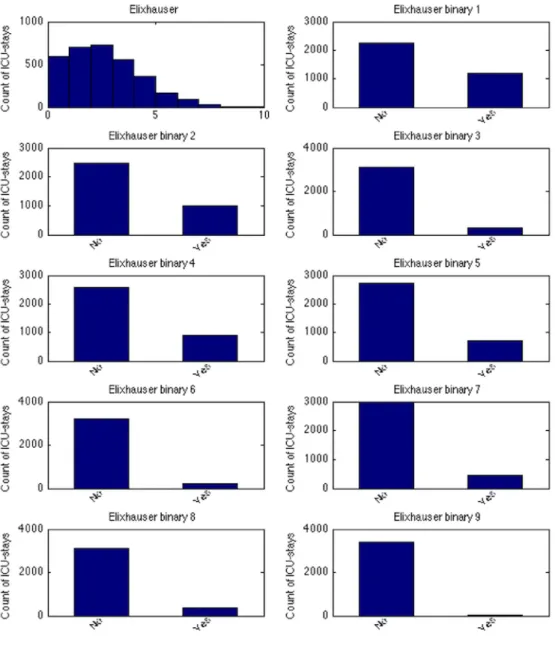
2.3 Patient-day Matrix: A Representation For Normalizing Patient Records 23 2.3.1 Description of Features . . . 25 2.3.2 Identifier Variables . . . 26 2.3.3 Non-temporal Variables . . . 27 2.3.4 Temporal Variables . . . 29 2.3.5 Elixhauser Variables . . . 31 2.3.6 Variable Distributions . . . 33
2.4 Experimental procedure: Propensity Scoring & Matching . . . 37
2.4.1 Experimental Structure . . . 38
2.5 Cohort Selection and Sampling Techniques . . . 40
2.5.1 D- Patient Selection Method 1: Random Selection . . . 40
2.5.2 D- Patient Selection Method 2: Fluid Balance Similarity-Based (FBSB) Selection . . . 41
2.5.4 D- Patient Sampling Method 2: Patient-Day Bucket Sampling 42
2.5.5 D- Patient Sampling Method 3: Gamma Sampling . . . 43
2.6 Measuring our results: Class Imbalance Penalty . . . 43
3 Results 47 3.1 Overview . . . 47
3.2 Discussion . . . 51
3.3 Experimental Results . . . 54
3.3.1 Random Selection, Median Sampling . . . 54
3.3.2 Random Selection, Patient-Day Sampling . . . 56
3.3.3 DTW Sliding KNN Selection, Patient-Day Sampling k = 1 . . 57
3.3.4 DTW Sliding KNN Selection, Patient-Day Sampling k = 10 . 60 3.3.5 DTW Sliding KNN Selection, Patient-Day Sampling k = 20 . 63 3.3.6 DTW Sliding KNN Selection, Patient-Day Sampling k = 100 . 66 3.3.7 Random Selection, Gamma Distribution Sampling . . . 69
3.3.8 DTW Sliding KNN Selection, Gamma Distribution Sampling k = 20 . . . 70
3.3.9 DTW Sliding KNN Selection, Gamma Distribution Sampling k = 1 . . . 73
4 Research Findings and Contributions 77 4.1 Research Findings and Contributions . . . 77
4.2 Software . . . 78
4.3 Future work . . . 78
List of Figures
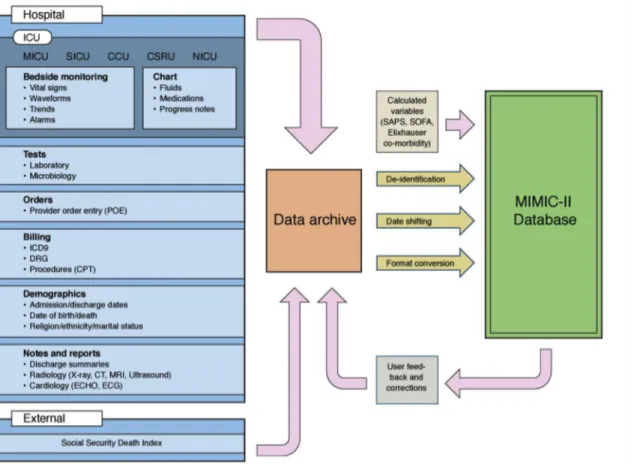
2-1 Diagram of the MIMIC II Database and its component parts. . . 22
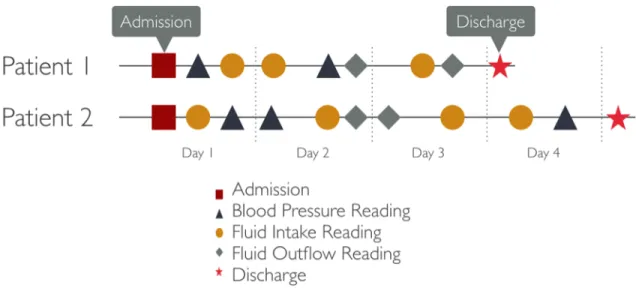
2-2 Diagram of two example patient timelines. Even in the case where patients have very similar event types, counts and timelines, small differences in timing can make analysis complex. . . 24
2-3 Matrix of days for each ICUSTAY. The Patient-Day column indicates the number of days since admission. The Post-Diuretics Length-Of-Stay or LOS column indicates the number of days the patient remained in the ICU after the first diuretics administration, including the first administration day. . . 24
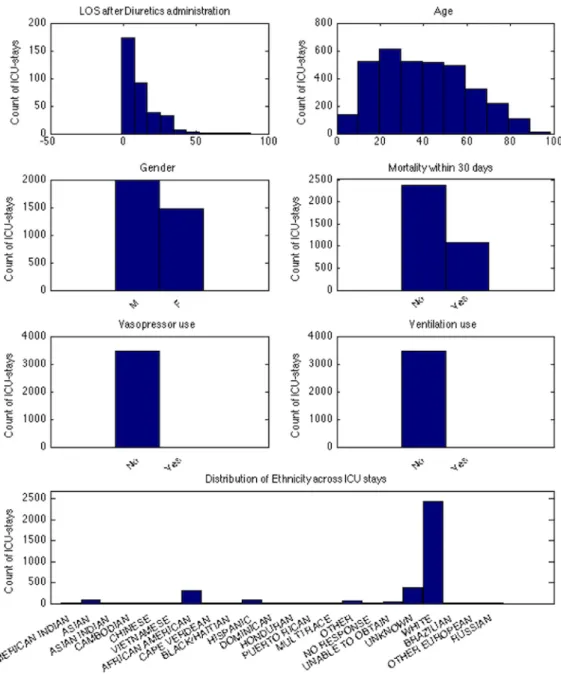
2-4 Non-temporal variable distributions. . . 34
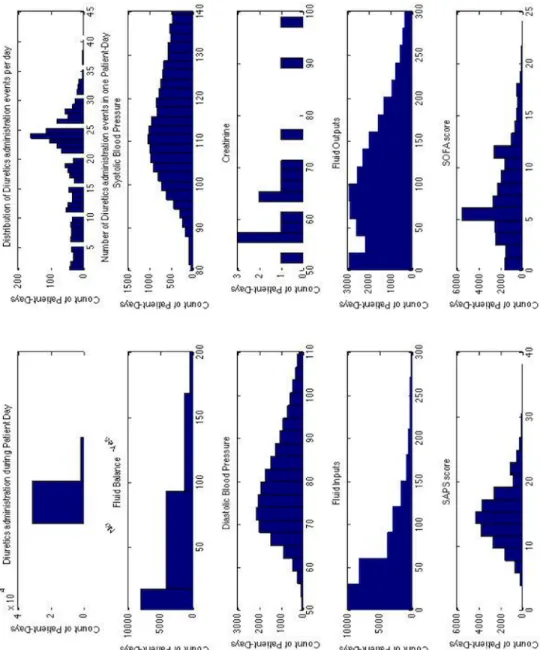
2-5 Temporal variable distributions. . . 35
2-6 Elixhauser variable distributions. . . 36
2-7 Building the Propensity Score model. Figure by Rammazotti [8] . . . 39
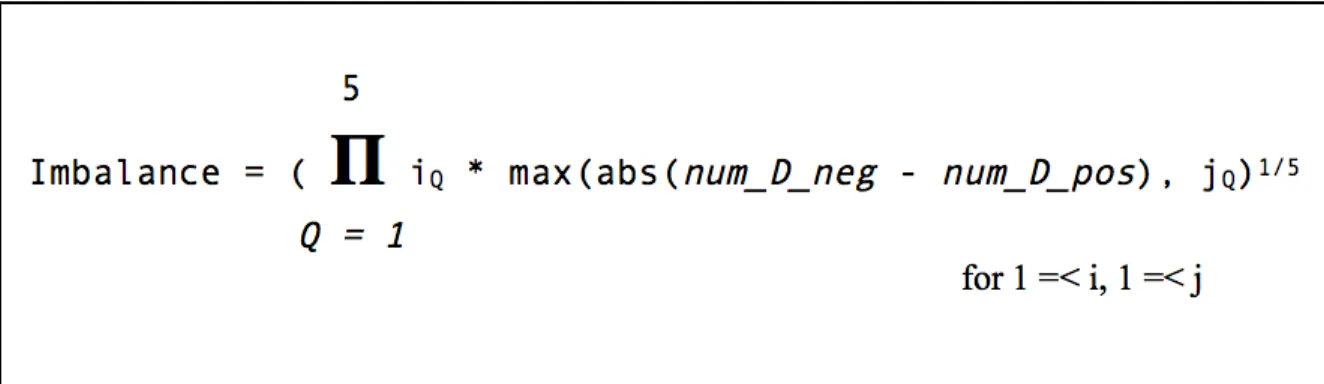
2-8 Class Imbalance Penalty equation . . . 43
3-1 Plot of Imbalance Penalty scores for all experimental results. Parame-ter A refers to the number of consecutive lag days considered in FSBS DTW Selection. Parameter k refers to the number of closely matched patients considered to be tied at the end of the selection procedure we randomly select the final cohort of D- from these k observations. . . . 49
3-2 Fitting a Gamma curve (in red) to the histogram of treatment patient administration days. . . 50
List of Tables
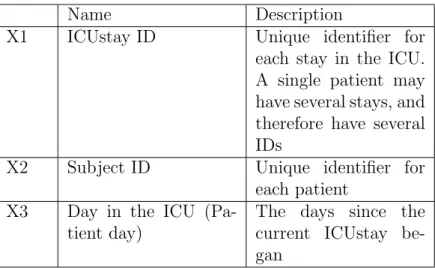
2.1 Identifier variables and descriptions. . . 26
2.2 Non-temporal Variables and descriptions. . . 28
2.3 Temporal Variables and descriptions. . . 30
2.4 Elixhauser Variables and descriptions. . . 32
2.5 List of crowd-proposed, self-extracted covariates . . . 38
3.1 Table of Imbalance Penalty values in order of increasing class balance 48 3.2 Quintiles - Random Selection, Median Sampling . . . 54
3.3 LOS - Random Selection, Median Sampling . . . 54
3.4 Mortality - Random Selection, Median Sampling . . . 55
3.5 Quintiles - Random Selection, Patient Day Sampling . . . 56
3.6 LOS - Random Selection, Patient Day Sampling . . . 56
3.7 Mortality - Random Selection, Patient Day Sampling . . . 56
3.8 Quintiles - DTW KNN (lag=5, k=1) . . . 57 3.9 LOS - DTW KNN (lag=5, k=1) . . . 57 3.10 Mortality - DTW KNN (lag=5, k=1) . . . 57 3.11 Quintiles - DTW KNN (lag=4, k=1) . . . 58 3.12 LOS - DTW KNN (lag=4, k=1) . . . 58 3.13 Mortality - DTW KNN (lag=4, k=1) . . . 58 3.14 Quintiles - DTW KNN (lag=3, k=1) . . . 59 3.15 LOS - DTW KNN (lag=3, k=1) . . . 59 3.16 Mortality - DTW KNN (lag=3, k=1) . . . 59 3.17 Quintiles - DTW KNN (lag=5, k=10) . . . 60
3.18 LOS - DTW KNN (lag=5, k=10) . . . 60 3.19 Mortality - DTW KNN (lag=5, k=10) . . . 60 3.20 Quintiles - DTW KNN (lag=4, k=10) . . . 61 3.21 LOS - DTW KNN (lag=4, k=10) . . . 61 3.22 Mortality - DTW KNN (lag=4, k=10) . . . 61 3.23 Quintiles - DTW KNN (lag=3, k=10) . . . 62 3.24 LOS - DTW KNN (lag=3, k=10) . . . 62 3.25 Mortality - DTW KNN (lag=3, k=10) . . . 62 3.26 Quintiles - DTW KNN (lag=5, k=20) . . . 63 3.27 LOS - DTW KNN (lag=5, k=20) . . . 63 3.28 Mortality - DTW KNN (lag=5, k=20) . . . 63 3.29 Quintiles - DTW KNN (lag=4, k=20) . . . 64 3.30 LOS - DTW KNN (lag=4, k=20) . . . 64 3.31 Mortality - DTW KNN (lag=4, k=20) . . . 64 3.32 Quintiles - DTW KNN (lag=3, k=20) . . . 65 3.33 LOS - DTW KNN (lag=3, k=20) . . . 65 3.34 Mortality - DTW KNN (lag=3, k=20) . . . 65 3.35 Quintiles - DTW KNN (lag=5, k=100) . . . 66 3.36 LOS - DTW KNN (lag=5, k=100) . . . 66 3.37 Mortality - DTW KNN (lag=5, k=100) . . . 66 3.38 Quintiles - DTW KNN (lag=4, k=100) . . . 67 3.39 LOS - DTW KNN (lag=4, k=100) . . . 67 3.40 Mortality - DTW KNN (lag=4, k=100) . . . 67 3.41 Quintiles - DTW KNN (lag=3, k=100) . . . 68 3.42 LOS - DTW KNN (lag=3, k=100) . . . 68 3.43 Mortality - DTW KNN (lag=3, k=100) . . . 68
3.44 Quintiles - Random Selection, Gamma Distribution Sampling . . . 69
3.45 LOS - Random Selection, Gamma Distribution Sampling . . . 69
3.46 Mortality - Random Selection, Gamma Distribution Sampling . . . . 69
3.48 LOS - DTW KNN Gamma (lag=5, k=20) . . . 70
3.49 Mortality - DTW KNN Gamma (lag=5, k=20) . . . 70
3.50 Quintiles - DTW KNN Gamma (lag=4, k=20) . . . 71
3.51 LOS - DTW KNN Gamma (lag=4, k=20) . . . 71
3.52 Mortality - DTW KNN Gamma (lag=4, k=20) . . . 71
3.53 Quintiles - DTW KNN Gamma (lag=3, k=20) . . . 72
3.54 LOS - DTW KNN Gamma (lag=3, k=20) . . . 72
3.55 Mortality - DTW KNN Gamma (lag=3, k=20) . . . 72
3.56 Quintiles - DTW KNN Gamma (lag=5, k=1) . . . 73
3.57 LOS - DTW KNN Gamma (lag=5, k=1) . . . 73
3.58 Mortality - DTW KNN Gamma (lag=5, k=1) . . . 73
3.59 Quintiles - DTW KNN Gamma (lag=4, k=1) . . . 74
3.60 LOS - DTW KNN Gamma (lag=4, k=1) . . . 74
3.61 Mortality - DTW KNN Gamma (lag=4, k=1) . . . 74
3.62 Quintiles - DTW KNN Gamma (lag=3, k=1) . . . 75
3.63 LOS - DTW KNN Gamma (lag=3, k=1) . . . 75
Chapter 1
Introduction
1.1
Overview
Retrospective studies are very important for both pre-study analysis and for situations where running a full RCT maybe to too expensive, dangerous or unethical. How do we study things like the impact of putting a new police outpost in a given neighborhood, or the effect of AIDS therapy upon mortality? In either case, we cannot setup a normal RCT and randomly assign stations or therapy. Our best course of action would be to examine prior cases, then carefully model and account for each feature with respect to our response, and then we may be able to find some trends between the treatment-negative and treatment-positive groups that are significant and persistent. Accounting for factors that are correlated with both the dependent variables and the independent variable, known as confounders, in a modeling problem poses diffi-cult challenges to retrospective studies, and is a major focus of many retrospective study procedures. Improving upon existing techniques to better account for these confounders would increase the generalizability of subsequent retrospective analysis. Also, modifying these techniques to grapple with variables that vary over time, or time-series, is important for generalizing to a wide range of important problems. In recent years there has been an explosion in available time series datasets as collection mechanisms have improved and the expectations for publicly available data have risen. This enables many insightful and never-before-possible retrospective studies, if only
researchers can be equipped with practical techniques for analysis and comparison. Traditionally, time series data has seen its best applications in Univariate modeling settings, through the application of ARIMA and exponential smoothing techniques. This is not the way forward though for the vast majority of datasets — the other collected features need to be included in the modeling process if we are to build use-ful, realistic and generalizable models of the world, which can adequately deal with confounders. This kind of setup is called a cross-sectional time series problem.
This thesis centers around the two most significant data science hurdles for cross-sectional time series in a retrospective study. We address them as our two experimen-tal questions. For event-based data, the timeline of results that we wish to consider as a single case or observation can vary widely. One observation may have 12 events spanning 12 hours, one per hour, while another observation may have 5 events in 1 hour and 1 event 36 hours later. Comparing these two observations is beyond the capabilities of many statistical techniques used in retrospective studies. This leads us to our first question:
• Question 1: How should we represent event-driven and irregular time-series data for use in a retrospective study?
Retrospective studies begin with a hypothesis about a given treatments effect on measured outcomes and a set of source data. Ultimately the goal of the study is to produce many comparable sets of treatment and non-treatment observations to use in evaluating the validity of the hypothesis. In a healthcare retrospective study, comparable usually means that each patient in the treatment group is matched with patients in the non-treatment group that have equivalent health status, and that we can achieve class balance across all levels of health status. Our second question concerns this class balance:
• Question 2: How do we select and sample cohorts from our study group to produce strata wherein observations have comparable features and likelihood of treatment at all levels (henceforth referred to as class balanced quintiles) despite the influence of confounding variables?
As a characteristic problem to explore and test new techniques for answering these questions, we have chosen to study a sepsis-patient study group from the MIMIC II database, extracting event records used to inform diuretics-related care decisions. First we tackle Question 1 the representation problem inherent in cross-sectional time-series datasets using a lag variable and binning approach, and examine the resulting matrix. Then we address Question 2, comparing and analyzing a number of cohort selection/sampling procedures for that matrix to test how to achieve excellent class balance for non-treatment observations in this data. The ultimate aims are to build and evaluate practical tools for addressing these fundamental questions and unlock the promise in many new and interesting datasets.
1.2
Medical Background & Data Source
Sepsis is a specific condition described as severe full body inflammation in response to a serious infection. Patients diagnosed with sepsis suffer from a long list of symptoms: very low blood pressure and heart racing, swelling, flushing, fever and hyperventila-tion. These patients are routinely treated through IV and thus their body fluid levels are elevated for a time. [3] Sometimes these patients’ bodies resolve this issue them-selves quickly and naturally, but when they do not doctors are left with a choice: wait until the patient’s body is able to process the fluids and bring them under control (risky for the patient if this is too slow), or prescribe a diuretic drug to induce the patient’s body to reduce fluid levels back to normal. [3] When the body has difficulty dealing with these conditions and these fluid levels remain high or unstable, drugs called diuretics are commonly used to reduce them by causing the patient to urinate out the excess water. These diuretics work by inducing the kidneys to expel sodium, in turn causing the body to release water from the bloodstream. Treatment of many conditions such as kidney failure, hypertension, heart failure, etc., regularly involve the use of diuretics.
Given how common and important this decision point is, investigating it through our ICU dataset is interesting and relevant — a researcher might want to use
tech-niques like the ones we propose to check if use of diuretics is beneficial or harmful for sepsis patients. Is it better to allow critical sepsis patients to resolve elevated fluid levels without drugs or to prescribe diuretics? Different doctors might judge the same situation very differently; given this grey area, lets see if our study results clearly identify any best practices regarding diuretics use.
This thesis will run a retrospective analysis into diuretics use as a characteristic problem and setting for building and testing new techniques. Our focus was on a set of 332 sepsis patients who received diuretics, as found in the MIMIC2 database compiled from Beth Israel Deaconess Medical Center in Boston, MA. From this we extracted several features that our medical partners identified as key indicators for diuretics treatment.
The next challenge was to assemble sepsis patients who did not receive diuretics who could be balanced with the ones who did. This can be done with a variety of selection and sampling techniques. One technique is better than another if it achieves better overall class balance across all 5 quintiles, that is, when the entire D+, D- group is stratified based on propensity, there are sufficient relative quantities of D+, D- in each strata of health status to make statistically sound comparisons. We used the Propensity Score modeling technique by Rosenbaum and Rubin [7] as our modeling procedure, allowing us to experiment with several selection and sampling techniques. Several of the proposed techniques appear competent at constructing class balanced quintiles of treatment and non-treatment patients with moderate amounts of data, and set the stage for making similar kinds of analysis straightforward with our software tools.
1.3
Research Questions & Contributions
This thesis asks the following questions for data science and statistical analysis in a cross-sectional time-series retrospective study:
– We smoothed our event-based data on days, taking mean and median for each variable, for each day. This makes previously incomparable observa-tions comparable despite different timing and events.
• Which selection and sampling techniques produce the most balanced quintiles? – We developed two selection and three sampling techniques for preparing retrospective studies on irregular time-series data, and software for per-forming bootstrap iterations for combinations of techniques. We found that using a Fluid-Balance Similarity-Based Dynamic Time Warp selec-tion procedure with nearest neighbor parameter k=1 and using a Gamma distribution for sampling days produced consistently better class balance than all other methods when bootstrapped over 100 independent runs. • How can we quantitatively measure the balance of a set of quintiles?
– We developed the Class Imbalance Penalty, a class balance metric for se-lecting quintiles for statistically sound comparisons, which enables relative ranking of stratified matching procedures. We have demonstrated that it gives low scores for the procedures that produce the most class-balanced quintile results for all strata and lend themselves to statistically sound future analysis.
For our retrospective study on Diuretics treatment effects for Sepsis patients, we ask the following questions for our study’s context:
• What differences in class balance do we observe for the tested selection and sampling techniques?
– We found that sampling had a stronger effect on class balance than se-lection, and that using a Gamma distribution fit to pick sampling days produced more statistically comparable quintiles than all other methods, for any selection procedure.
• Is Fluid-Balance Similarity-Based selection effective as a health status similarity technique for sepsis patients?
– We found that Fluid-Balance Similarity-Based DTW selection with k=1 and lag=3 in combination with Gamma distribution sampling is the best combination among the tested methods, but purely Random sampling out-performs it for many other values of k.
• What do our experimental procedure results mean for our study’s context? – We found strong evidence suggesting that physician and provider data are
key missing covariates for predicting Diuretics administration in the ICU.
1.4
Roadmap
This thesis proceeds as follows:
• In Chapter 2 we detail our data and the experimental procedures used in this thesis, including the Patient-Day Matrix, Dynamic-Time-Warp selection, Gamma Selection and the Imbalance Penalty
• In Chapter 3 we present the results from our experiments and discuss our findings
• In Chapter 4 we present our conclusions and describe opportunities for future work
• In Chapter 5 we provide a glossary of terms used in this thesis • Finally, we provide a bibliography of our sources
Chapter 2
Methods
2.1
Overview
This chapter outlines the methods and experimental procedures used in this thesis. To answer our 4 experimental questions, we need to both develop a test problem to use as a benchmark and construct an experimental procedure around the selection strategies we want to evaluate for optimal class balance. Each of the sections below will describe how a certain procedure was conducted or how a given step in the analysis was performed. It proceeds as follows:
• In Section 2.2 we describe the source data and reasons behind the selection of the dataset we use as our characteristic problem.
• In Section 2.3 we describe a transform to a new data representation called the Patient-Day Matrix
• In Section 2.4 we describe the experimental procedure, involving bootstrapping and Propensity Score matching on quintiles
• In Section 2.5 we describe the non-treatment selection and sampling procedures used within the experimental procedure
• In Section 2.6 we describe the metric used to evaluate class balance quantita-tively
2.2
Source Data
The data used in our study was taken from the MIMIC II database (Multiparameter Intelligent Monitoring in Intensive Care), which has de-identified physiological data from thousands of patients who visited the ICU between 2001 and 2007 at Beth Israel Deaconess Medical Center (BIDMC) in Boston, Massachusetts. [5] This database is a good starting point for this study for many reasons: it is freely available to referenced researchers in relevant fields, contains data from a wide range of inter-hospital perspectives (medical ICU, surgical ICU, cardiac care unit, cardiac surgery recovery unit), and contains high temporal resolution in many areas. Medical data is a very common setting for time-series retrospective studies, so this dataset is very realistic test problem for developing and evaluating new techniques.
Figure 2-1: Diagram of the MIMIC II Database and its component parts.
(usually on an hourly basis), nurses notes, IV medications, fluid balances, demograph-ics, physician orders, discharge summaries, ICD9 codes and more. These values were collected within the hospital using a Phillips CareVue Clinical Information System deployed in all the study ICUs. [5] Significant post-processing has been done by the team compiling the dataset at the hospital, to obtain integrated and unified records for each patient, and de-identify it in compliance with HIPAA (Health Insurance Portability and Accountability Act) standards.
Our study utilizes data gathered from the 32,000 patients represented in the Clini-cal Database. This database has records, which are recorded as events for example, a record for an administered medication would be identified by several features: Subject ID, Hospital Admission ID, ICUSTAY ID, the name of the drug, and a timestamp. We can think of these events as forming a time-series of data about the patient, describing the patients physiological changes and intervention events.
2.3
Patient-day Matrix: A Representation For
Nor-malizing Patient Records
Event-driven time series data present a representation problem: how do we express and record changes in each time-bound feature in a consistent way across all patients in the dataset?
Figure 2-2 shows two hypothetical patient timelines with different intervals and sequences of events. Without any smoothing, an event from Patient 1 is tough to compare with a similar event for Patient 2 since they may occur at different times and have very different preceding and succeeding events. By smoothing over days, the contents of each day become comparable between the two patients.
We call the transformation applied in this study the Patient-Day-Matrix (PDM). For all patients in the study with recorded temporal events, we generate a new row in the dataset for each 24-hour period they have been in the ICU, and report the means and medians for each feature, for each day. Figure 2-3 shows an
Figure 2-2: Diagram of two example patient timelines. Even in the case where patients have very similar event types, counts and timelines, small differences in timing can make analysis complex.
Figure 2-3: Matrix of days for each ICUSTAY. The Patient-Day column indicates the number of days since admission. The Post-Diuretics Length-Of-Stay or LOS column indicates the number of days the patient remained in the ICU after the first diuretics administration, including the first administration day.
example, with the incrementing Patient-Day column indicating the number of days since admission, beginning at 1. Two ICUSTAYs are considered to be independent, even if they record events for the same patient this indicates that the patient has been in the ICU multiple times.
2.3.1
Description of Features
After first exploring the data available in MIMIC II we wrote scripts to extract our new time-series interval features. Our aim with this extraction was to characterize general patterns in the data and smooth out the very noisy and irregular events from MIMIC II into a time-series of regular intervals, exposing seasonality, cyclicality and trending in the each patients record. The features fall into several categories:
• Identification features such as ICUstay and Patient-day are the primary keys for identifying a row of data. Each tuple of these is unique in the dataset and represents the interval for which the other features in the row apply.
• Non-temporal features consist of values describing descriptive characteristics of the patient for the entire ICUstay. They are recorded in each row such that the row represents a complete snapshot (to permit cross-sectional analysis) but remain constant for all the patient days in a given ICUstay.
• Temporal features consist of values that change over the interval and across intervals. For each temporal feature, the value recorded in the data is formed by querying for all the events (say, medications administered) falling between T and T-1 24-hour periods since admission to the ICU and computing the mean. If there are no events occurring in the interval, we record NaN to represent a null value.
• Exlihauser-related features consist of measurements recorded at hospital admis-sion, screening for risks affecting patient outcomes. They are recorded as one overall score and several binaries variables for the presence of each condition. They are designed to record important comorbidities or conditions present on admission that are not related directly to the main reason for hospitalization, but that increase the intensity of resources used or increase the likelihood of a poor outcome. [4]
2.3.2
Identifier Variables
Table 2.1 summarizes the identifier variables in the extracted features. ICUstay and Patient day uniquely identify each row in the dataset.
Name Description
X1 ICUstay ID Unique identifier for each stay in the ICU. A single patient may have several stays, and therefore have several IDs
X2 Subject ID Unique identifier for each patient
X3 Day in the ICU (Pa-tient day)
The days since the current ICUstay be-gan
2.3.3
Non-temporal Variables
Table 2.2 summarizes the non-temporal variables in the extracted features. Non-temporal variables in the study refer to characteristic information about the patient and the ICUstay that dont vary across each day in the recorded ICU visit.
• X4, X5, X9 : These features are gathered from the patient demographic table in MIMIC II based upon subject ID.
• X6, X7 : These two features are compiled by looking for any events of the given type listed for that ICUstay ID. If there is at least one event on record, we record a 2 in each row for that ICUstay otherwise we record a 1.
• X8 : Mortality within 30 days is calculated using the timestamp for discharge from the ICU, and any available listing for date of death. For patients without any listing, we record 1 for No, and for those with a listing with a difference of less than 30 days from discharge time we record a 2.
• X10 : Post-Diuretics-Length-Of-Stay is an experimentally specific variable, ex-pressing the number of patient-days the patient stays in the ICU following the first treatment of diuretics. It is a number strictly less than or equal to the number of total patient days for a given ICUSTAY. For a patient discharged on the same day as they received diuretics for the first time, this value is one. Note that for D- patients there is no administration and therefore no first ad-ministration day, so we record NaN for this feature. Later during preparation for modeling, we impute the administration days for D- patients using one of the tested sampling techniques, so both D+ and D- patients have values at modeling time.
Name Description
X4 Gender Encoded as 1 for Male, and 2 for Female X5 Ethnicity Our MIMIC sample
includes 15 spe-cific racial groups, in addition to the following special categories: ’MULTI RACE ETHNICITY’, ’OTHER’, ’PATIENT DECLINED TO ANSWER’, ’UN-ABLE TO OBTAIN’, ’UNKNOWN/NOT SPECIFIED’ X6 Vasopressors given
during ICU stay
Encoded as 1 for No or 2 for Yes
X7 Ventilation given dur-ing ICU stay
Encoded as 1 for No or 2 for Yes
X8 Mortality Mortality within 30 days of the last day in ICU, with 1 for No and 2 for Yes
X9 Age Age of each patient, recorded in MIMIC at time of admission X10 Post Diuretics Length
of Stay given during ICU stay
Length of Stay in the ICU after first admin-istration of diuretics Table 2.2: Non-temporal Variables and descriptions.
2.3.4
Temporal Variables
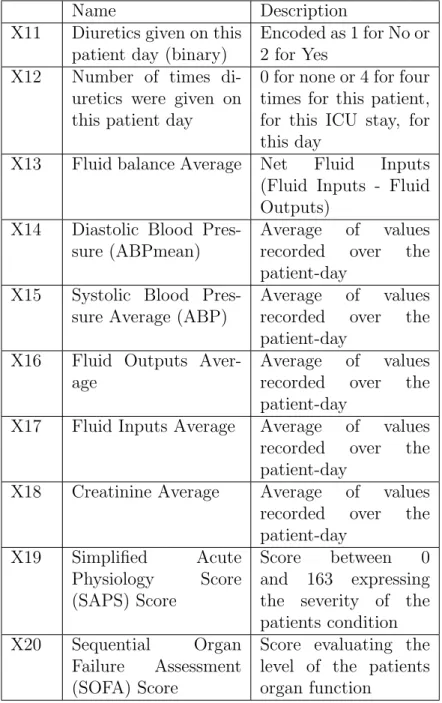
Table 2.3 summarizes the temporal variables in the extracted features. These are recorded as events in the MIMIC II source data, and are binned into features based upon the patients start day and day-length time intervals.
• X11 : If there are any diuretics medication events (from the medications table in MIMIC II) for this day, we record a 2 for yes otherwise we record 1 for an empty query.
• X12 : From the query for X11 if there are positive results we record the count of distinct administrations in the query for that day, greater than or equal to 1 administration. For patient days without any administrations, we record NaN. • X13 : This feature is the simple arithmetic difference between Fluid Inputs and Fluid Outputs (Net Fluid Inputs or (mean(X17) - mean(X16)). This is some simple feature engineering since Fluids are important features when analyzing Diuretics administration and patients with Sepsis.
• X14, X15 : Systolic and Diastolic blood pressure averages are recorded sepa-rately. Each is a mean of all recorded values during the Patient-Day.
• X16, X17 : Fluid Inputs and Outputs are computed by averaging all the input and output events listed for a particular Patient-Day.
• X18 : Creatinine administered to the patient is averaged across the patient-day interval, or is listed as zero if there are no recorded administrations.
• X19 : SAPS score to asses the severity patients current condition this is a temporal variable since it is reassessed daily during the ICUstay. [9]
• X20 : SOFA score to asses the patients organ function this is a temporal variable that is reassessed for each Patient-Day. [11]
Name Description X11 Diuretics given on this
patient day (binary)
Encoded as 1 for No or 2 for Yes
X12 Number of times di-uretics were given on this patient day
0 for none or 4 for four times for this patient, for this ICU stay, for this day
X13 Fluid balance Average Net Fluid Inputs (Fluid Inputs - Fluid Outputs)
X14 Diastolic Blood Pres-sure (ABPmean)
Average of values recorded over the patient-day
X15 Systolic Blood Pres-sure Average (ABP)
Average of values recorded over the patient-day
X16 Fluid Outputs Aver-age
Average of values recorded over the patient-day
X17 Fluid Inputs Average Average of values recorded over the patient-day
X18 Creatinine Average Average of values recorded over the patient-day X19 Simplified Acute Physiology Score (SAPS) Score Score between 0 and 163 expressing the severity of the patients condition X20 Sequential Organ
Failure Assessment (SOFA) Score
Score evaluating the level of the patients organ function
2.3.5
Elixhauser Variables
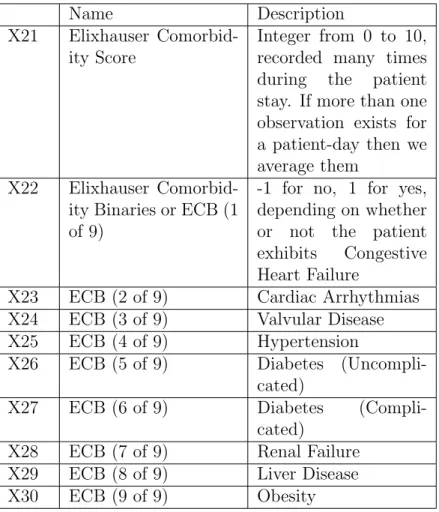
Table 2.4 summarizes the Elixhauser-related variables in the extracted features. The Elixhauser Comorbidity Score is a rating expressing the presence of factors contribut-ing to patient death, independent of the other aspects of the patients condition. [4] Each of these factors has been empirically demonstrated to correlate with substantial increases in length of stay, hospital charges, and mortality both for heterogeneous and homogeneous disease groups. [4] In addition to the overall score, several of the 30 individual components making up the Elixhauser Comorbidity Score that are sus-pected to have a relationship with Sepsis and its treatment have been included as binary variables.
• X21 : Score from 0 to 10 expressing concurrent presence of nonmalignant dis-eases.
• X22 through X30 : Binary variables indicating the concurrent presence of a specific disease along with the Sepsis we have filtered for in our sample.
Name Description X21 Elixhauser
Comorbid-ity Score
Integer from 0 to 10, recorded many times during the patient stay. If more than one observation exists for a patient-day then we average them
X22 Elixhauser Comorbid-ity Binaries or ECB (1 of 9)
-1 for no, 1 for yes, depending on whether or not the patient exhibits Congestive Heart Failure
X23 ECB (2 of 9) Cardiac Arrhythmias X24 ECB (3 of 9) Valvular Disease X25 ECB (4 of 9) Hypertension
X26 ECB (5 of 9) Diabetes (Uncompli-cated)
X27 ECB (6 of 9) Diabetes (Compli-cated)
X28 ECB (7 of 9) Renal Failure X29 ECB (8 of 9) Liver Disease X30 ECB (9 of 9) Obesity
The finalized Patient Data Matrix has these characteristics: • 2,341 unique patients
• 3,503 unique ICU stays • 2,807 unique hospital stays
• 332 unique patients prescribed Diuretics
• 349 unique ICU stays with Diuretics prescribed • 32,678 unique Patient-Days
• 10,100 Patient-Days within 30 days of mortality
We wrote several robust scripts to extract various groups of features and then concatenated them into a single matrix. For each variable we then sampled and checked that the events in the patient record were being binned and summarized appropriately across the patient days, before finally saving the matrix as a MATLAB struct. This is a convenient format for later use in our experimental procedure. Figures 2-4, 2-5 and 2-6 show the distribution for each feature in the set of features (identifier variables such as ICUstay ID, and Subject ID are excluded). Please refer to the open source software on Github at the following link for more details:
• github.mit.edu/ALFAGroup/Clinical Time Series For Diuretics brian bell
2.4
Experimental procedure: Propensity Scoring
& Matching
With our data matrix constructed, we move on to building a flexible and reusable experimental procedure to evaluate outcomes for observational study data. For our Observational Study, its key that we are able to compare and assert that the pa-tients in the D+ treatment group and D- non-treatment group are similar in terms of likelihood to receive diuretics. We could achieve this by forming many sub-groups of patients and evaluating that all features are balanced among the groups. Un-fortunately, for studies with more than a few features this balance becomes much more complex and it can also be difficult to achieve in cases where the data has a big imbalance in count of treatment versus non-treatment cases (like in our dataset). Ad-ditionally, our studys event-based data makes this balancing much more challenging because the difference in timing represents a big dimensional increase in the variation of the patient records, dramatically increasing the feature space to balance, to the point of being intractable.
Propensity Score Matching, first proposed by Rosenbaum and Rubin in 1984, has become a widely accepted technique for reducing bias when estimating the impact of treatment effects in an Observational Study. [1][7][8] It uses statistical modeling techniques to express the likelihood of a particular patient being assigned to a treat-ment, across all features. Then we are able to effectively work with observed data even if the assignment of patients to treatments is not random, and even if there are important differences in the patient characteristics between the treatment group and the control.
We will use Propensity Score Matching as our ’typical’ observational study model, and test different non-treatment patient selection and sampling techniques to obtain class balance findings for each within the model. The next section outlines our pro-cedure.
2.4.1
Experimental Structure
We have employed Rosenbaum and Rubins core approach in the heart of our study. Their method involves the 4 steps in Bold - the steps before and after are the addi-tional evaluation, bootstrap and benchmarking steps we perform for this study:
Procedure
Given an initial D+ patient cohort While num runs <100
• Step 1: Select D- patient cohort from Study Group • Step 2: Sample D- cohort to select administration days
• Step 3: Build a propensity model on D+ U D- and select initial features
• Step 4: Stratify and assess balance (Two-way ANOVA for F-Ratios) • Step 5: Refine the model (Add features and interactions)
• Step 6: Decide whether the desired balance is achieved or go back to Step 3
• Step 7: Assign propensity value to each patient in the D+ U D-cohort. Rank patients by propensity and stratify into quintiles • Step 8: Save quintile values to a data structure
Step 9: For each quintile, compute its mean over 100 runs
Step 10: Score the mean quintile using the Class Imbalance Penalty to assess balance Table 2.5: List of crowd-proposed, self-extracted covariates
Inside Rosenbaum and Rubins procedure is an internal health status balance as-sessment that performs forward feature selection for a Logistic Regression model. [2][7] This is a separate goal, and necessary precondition for Class Balance. If the ANOVA F-Ratio for a feature not in the model is high, then it is added to the model, and if it remains high then its interactions are also added to the model. The ultimate health status balance achieved at the end of the procedure (as measured by the Im-balance Penalty) is a function of the input data and the procedure. By holding the dataset and procedure constant, we can modify Steps 1 and 2 to test their influence on the results.
Propensity score prediction is performed on the dataset using the binary column for diuretics administration as Y, and holding out the variable for number of admin-istrations (which would add serious leakage if left in the model). With the model fit and scores for each row computed, the patients are stratified into equally sized quintiles based upon ordinal ranking of scores. The propensity scoring process results in quintiles that are balanced on features and balanced on the likelihood of diuretics administration. Stratifications without both Treatment and Non-treatment patients in each quintile are rejected and the entire process (beginning with D- patient selec-tion) is re-run until there are both types of patients in each quintile when stratified by propensity scores. We expect from Rosenbaum and Rubin approximately 90% reduction in bias for each of the features when we stratify on the quintiles of the pop-ulation propensity score, so we stratify on our estimated propensity score to achieve some of this reduction. [7][8] In any particular subclass that is relatively homogenous based upon propensity score, the distributions of the features are approximately the same between the treatment and non-treatment groups (approximately so because the propensity scores are binned rather than being exactly the same). Figure 2-7 illustrates the Rosenbaum and Rubin procedure:
To reduce the bias in our results, we have repeated the above process (with replace-ment) 100 times from initial sampling of patients through the collection of quintile data, and then aggregated the results. Since each run involved selecting D- patients and sampling, our aggregated results reduce the uncertainty of sampling and give us more stable imbalance penalty values to compare across techniques.
2.5
Cohort Selection and Sampling Techniques
To obtain our cohort, we need to select comparable non-treatment patients to include in our propensity scoring, and we need to sample the comparable slice of data for when each D- patient would have received diuretics. We need to somehow find the precise slices of D- patient data that we will take as representative cases. Even among the diuretics patients, there are a lot of rows we shouldnt include in the model. In this thesis we have considered 2 different methods of patient selection and 3 different methods for selecting non-treatment patient timepoints; each is described in detail below.
2.5.1
D- Patient Selection Method 1: Random Selection
The first Patient selection method we use is Random Selection. This is not a selection of any D- patient in the set. We must exclude patients who have NaNs on their administration days, and exclude patients with fewer Patient-Days than the sampling model we have chosen. For example, for median day sampling we are only randomly sampling from the subset of D- patients who have at least that many patient days, which is a much smaller set. In the Patient bucket sampling approach, for each D+ patient we will random select one D- patient from the subset who have at least as many patient days.
By using day-length slices exclusively, random selection treats each day in the ICUstay record like a fully independent observation, assuming that only the data for a single day is being used to select patients for treatment. If data across multiple days is what is actually relevant, then we arent constructing our cohort with matches
that are comparable based upon the most important factors.
2.5.2
D- Patient Selection Method 2: Fluid Balance
Similarity-Based (FBSB) Selection
Fluid Balance Similarity-Based (FBSB) selection based upon each D+ patients times-series is the more strict patient selection method we tested. We use Dynamic Time Warping to measure the nearness of each D- patient to a given D+ patient, based upon a series of consecutive days Fluid Balance feature (univariate time series approach). For the lag=A days leading up to first administration of diuretics, we collect the time-series of Fluid Balance values for each D+ patient, discarding those with missing Fluid Balance values for this range. Then for each remaining D+ patient, we loop through all the PDM rows corresponding to D- patients and use a sliding window to find the optimal match of lag=A sequential days. The DTW scores allow us to select the k number of patients which show the closest match for the lag=A consecutive days. Then we select a patient at random from the top k to sample for inclusion in the cohort.
Unlike random selection, matching based upon time-series has the potential to account for non-independent patient days. By matching each treatment patient with a non-treatment patient that shares not only the same pre-diuretics stay length (if combined with same-day sampling), but also similar statistical makeup in the days prior, we may be able to achieve a better matching. Selecting how many prior days to consider is a challenge matching too closely leads to overfitting, and could also cause us to include confounding data from other overlapping medical conditions (other than sepsis) that a patient may have during longer ICU stays. For this reason, we perform a parameter search over number of lag days from 3-5 (parameter A). We also search over k, the number of patients we randomly select from after recording DTW similarity scores.
2.5.3
D- Patient Sampling Method 1: Median Day Sampling
Collecting features based upon on the median administration day of the Treatment group is a straightforward way to select timepoints for Non-treatment patients. First, we collect all treatment patients and add their first diuretics administration to the propensity scoring dataset. Then we take the median of the patient day column to find the median day timepoint of administration. Given that the median day for all diuretics administrations was the 11th day, we sample all non-treatment patients in our cohort on the 11th day for the propensity scoring dataset. This method doesn’t take into account how factors such as length of stay may affect the treatment decision. Sampling Method 2 is designed to take some of these concerns into account.
2.5.4
D- Patient Sampling Method 2: Patient-Day Bucket
Sampling
The length of stay in the ICU might be an important variable when analyzing the effects of diuretics. A patient that has only been in the ICU for a short while might have vastly different signals at the time of administration compared with a patient that has been in the ICU for a long time. If a patient is rushed a diuretic, then that patient likely has sepsis issues as a primary condition, versus a patient who is given a diuretic after a few weeks; such a patient may have been admitted to the ICU with a different condition and slowly developed a sepsis condition later on. By matching each first-administration day from the Treatment group with a Non-treatment patient day at the same timepoint (e.g. both sampled on the 12th day in the ICU), we ensure that any effects of earlier or later adminis-tration are indeed represented in both the drug and control groups, improving on the Median day selection in Sampling Method 1. In addition, we also ensure that there are a wide variety of administration timings in our sample, while keeping the same distribution between treatment and non-treatment groups.
2.5.5
D- Patient Sampling Method 3: Gamma Sampling
For this method, we fit a Gamma distribution to the histogram of first-administration days for D+ patients. With a good fit on the first-administration days, we can take a sample of timepoints from the distribution, which we will use as the sampling days for our D- patients. Given N non-treatment patients that have been selected by one of the patient selection procedures, we select N timepoints from the Gamma distribution. Looping over the N non-treatment patients, we can sample the first patient on the day given by the first Gamma timepoint value, sampling the second patient on the second Gamma value, and so forth. In this way we will approximate the population distribution of diuretics administration timepoints from the sample of D+ in our study group, and then ensure that our non-treatment patients administration days match.
2.6
Measuring our results: Class Imbalance Penalty
To interpret our quintile results quantitatively, we propose the following class imbal-ance penalty to minimize:
This score has several properties that are desirable for this kind of measure-ment. First, the multiplicative sum will penalize an observation with multiple poorly balanced quintiles more heavily than an observation with a single poorly class-balanced quintile, even if that single quintiles balance is much worse in terms of magnitude. This is an important feature, since many poorly balanced quintiles leaves us with few good ones to extract insights from in a retrospective study. Put another way, it is better to have 4 excellent quintiles and 1 very poor quintile to exclude from analysis than to have 5 mediocre quintiles that are of questionable statistical quality. We intend to design a penalty that we can minimize to identify quintiles that are of excellent statistical quality for use in retrospective studies. Next, the penalty within the quintile takes the absolute value of the difference between the D+ and D- treat-ment, which removes directionality from our metric. Directionality in class-balance doesnt matter to us since both D- skewed and D+ skewed quintiles will be of low statistical quality for later analysis. We tested our class imbalance metric numerous times on varying quintile data, to verify that the relative ranking of excellent to poor class balance functioned as expected.
There are 2 tunable parameters in this metric, i and J. These two are used to modulate the penaltys impact for certain kinds of class imbalances. In our work i is set to 1, but could be increased to widen the distance between observations. i could also be varied across quintiles to penalize errors in some quintiles more than others, if a study is primarily concerned with errors on the high or low end of the propensity score range. An example would be a study concerned with whether the patients who are most likely to receive treatment are more likely to receive very aggressive and destructive therapies in comparison to patients with lower propensity scores. For such a study, we would intend to identify selection and propensity scoring techniques that produce good quintiles in the upper range, and rank them more highly than others.
J allows the researcher to set a threshold for how much imbalance they will tolerate in their study. In studies with very large N, an imbalance in the thousands may not have any significant effect on the results, so we can rank results like those equally. In
this study, we set J to 1 since our N is small and bounded by the number of sepsis patients with clean data in the MIMIC II dataset. If a researcher has done a variance analysis and has a known level for statistically significant deviations in the balance of a particular quintile or of all the quintiles in their study, J can be set to that level to cleanly differentiate values inside and outside the interval for statistical significance.
Chapter 3
Results
3.1
Overview
In Chapter 2 we outlined the selection and sampling techniques that we used within our experimental procedure. In this chapter we present results from 21 bootstrapped procedural runs, each with a different set of parameters or pair of included techniques. Each result consists of the counts of treatment and non-treatment patients that fall in the five quintiles, the value of the Imbalance Penalty for those counts, and the average Length of Stay and 30-day Mortality of the patients in each treatment-quintile subgroup (2 x 5). Figure 3.1 shows the Imbalance Penalties for all 21 runs plotted against each other, and Table 3.1 displays the raw values, ranked from top to bottom in order of increasing class balance (lower is better).
Selection type, Sampling type
Imbalance Penalty
Imbalance Penalty for lag A=3
Imbalance Penalty for lag A=4
Imbalance Penalty for lag A=5 Random, Me-dian 42.77 FSBS DTW k=10, Patient-day Bucket 36.7333 40.0994 39.9688 FSBS DTW k=20, Patient-day Bucket 35.7359 38.7192 41.3027 FSBS DTW k=100, Patient-day Bucket 35.6175 37.4682 39.7104 FSBS DTW k=1, Patient-day Bucket 33.9095 33.7424 32.885 Random, Patient-day Bucket 32.5034 FSBS DTW k = 20, Gamma 30.4246 30.2361 26.6094 Random, Gamma 27.2375 FSBS DTW k = 1, Gamma 20.0551 21.7113 23.2082
Figure 3-1: Plot of Imbalance Penalty scores for all experimental results. Parameter A refers to the number of consecutive lag days considered in FSBS DTW Selection. Parameter k refers to the number of closely matched patients considered to be tied at the end of the selection procedure we randomly select the final cohort of D- from these k observations.
Figure 3-2: Fitting a Gamma curve (in red) to the histogram of treatment patient administration days.
3.2
Discussion
In our results, we see evidence that better balance is achieved when there is more randomness in the sampling scheme. If we think of each technique as a step up or step down in randomness in comparison to its sibling techniques, we can develop an intuitive understanding for why some schemes produce better balances than others. In addition we discuss some reasons why we may be seeing these results, interpreted for the medical context and the complexities of treatment assignment in the clinic in general.
Before we get to sampling lets first consider our selection techniques. For DTW k=10,20 and 100, we see penalties trend downward with decreases in lag (we wish to minimize the penalty). With smaller lags, we are less strict with the fit that we require, allowing patients to be slightly less similar to each other. Being less strict with the patient criteria increases the balance, which can be interpreted as an improvement in selecting comparable patients across risk levels.
This selection pattern actually points to the fact that there may be some real differences picked up by the model between the D+ and D- patients, but unfortunately the covariates we would need are probably outside our dataset. If this is the case, then we might see the same pattern in the inability to achieve balanced quintiles because the D+ and D- patients are substantively different in a component which has a pervasive but unclear signal in the dataset i.e. we dont have these other missing covariates to include in the model to achieve the balance we want.
Also in the DTW results, we see that for k=10, 20 and 100, increases in k generally lead to lower balance scores across all lag levels. This supports the prior interpretation that more randomness/less strict selection criteria leads to better balance because strict selection is finding some real differences that we arent able to account for in our model. With stricter selection, we find that our D- patient likelihoods of treatment are distributed too differently from D+ patient likelihoods to compare in a straightforward way.
covari-ate/randomness performs better is the fact that adding Gamma sampling to pick the administration day shifts the otherwise-predictable DTW procedures imbalance down dramatically. Both selection and sampling procedures are ordered according to this trend and improving randomness leads to consistently superior results compared to other strategies.
The one big exception in the results is for k=1. With k=1, we see a low balance score, with seems to shift less in response to changes in lag length. K=1 may perform differently from the other DTW settings because it is deterministic given a set of D+ patients — for each patient, the 1 D- patient in the set of sliding window samples that has the minimum error between the D+ and D- is chosen. We could suggest that choosing the best selection outperforms a random choice from a set of k good samples, but there is another possible explanation: given that randomness seems to give better balance than methods which more clearly differentiate the D+ from D- patients, and as seen in the other DTW methods, higher k (more randomness) gives better results, perhaps what we are seeing here is overfitting to the point of being very random. The fact that a given sample produces the closest match is just fitting to noise in the data — which gives us lower scores in similar vein with how the Gamma distribution sampling gives better balance results than the Patient-day bucket (we want to be random enough to fit the larger D+ population over a number of bootstrapped runs, not exactly fit the sample of D+ patients each and every time).
Comparing sampling techniques, we see that Random selection with Gamma sam-pling is vastly better than both Patient-day-bucket and Median samsam-pling (and all non-Gamma DTW runs). In the randomness-is-better worldview, this makes sense since the Gamma distribution fit is a completely random selection of D- patients, which are then sampled on days determined by the distribution after it had been fit to the D+ administration days. It is only surpassed by another Gamma sampling pro-cedure in our test (FSBS DTW with k=1). The patient-day bucket method is similar to Gamma, but may be overfitting to the exact sample of D- patients administration days since it enforces an exact match day-for-day, while the Gamma performs better because it attempts to model the larger population of D+ patients rather than exactly
match the sample. The same may be true of the Median sampling technique, which has the worst balance of any method attempted in this study. Perhaps the variance in the population sampling days is quite high, so then rigidly enforcing the median is a very poor way to mimic realistic sampling.
Our results suggest that the sampling day choice is very significant for achieving balance. The Median is the worst-fit for sampling day and shows the worst results overall across all methods. Meanwhile the Gamma fit ought to be among the best for sampling the administration day and we see that it shows the best overall, for both FSBS DTW and for Random selection. The DTW/Patient-day and Random/Patient-day bucket runs both fit to the sample of D+ patients observation-for-observation and show middling results, while the same DTW selection with Gamma sampling shows excellent performance for both k values tested. The ordering of the results follows the ordering of sampling techniques, and switching the selection technique gives a smaller magnitude change in performance compared with switching the sampling technique. What do these results mean in a medical context? In the clinic, doctors assign treatments in psuedo-random ways. Evidence shows that simply varying the care provider may significantly influence treatment decisions, timing, and outcomes after controlling for confounding factors. [10] A previous study also concluded that physi-cian’s differing knowledge and opinions may have significant outcome effects, and that the physician should be modeled as part of the overall problem. [6] Given that two different doctors may see the same patient, but differ in their diagnosis or administra-tion of diuretics, its not surprising that we find that we are able to model the results best when we select in more random ways. Said another way, the patient may be given or not given the treatment based upon the random assignment of doctor, so the physician ID is a crucial variable we are missing. In addition, the same doctor may change their opinions and decisions overtime as they see noteworthy cases, in some sense overfitting to their own sample, but only affecting the treatment of subsequent patients.
It is telling that the results seem to be ordered based upon how the patients administration days are sampled, and the greater effect of sampling compared to
selection on imbalance. The strong influence of sampling day is very likely related to the circumstances of our study setting: patients are admitted to the ICU for any number of reasons, and may have developed sepsis while already in the ICU. Many of the patients in our study have significant pre-conditions which caused them to be admitted to the ICU (sepsis may be a secondary diagnosis) and these conditions are both serious enough to put them into the ICU and only crudely approximated by covariates like the Elixhauser comorbidity score. More randomness in the sampling procedure is a better approximation for how diuretics are actually administered in the hospital: somewhat randomly, based upon preconditions, assignment to physicians, and inconsistent evaluation criteria.
3.3
Experimental Results
3.3.1
Random Selection, Median Sampling
Median Day selection for 100 loops
Treatment Q1 Q2 Q3 Q4 Q5 Totals 0 4.3400 84.600 92.1200 80.6700 56.2700 318 1 123.6600 42.4000 34.8800 46.3300 70.7300 318 Totals 128 127 127 127 127 636 Balance Score 42.770
Table 3.2: Quintiles - Random Selection, Median Sampling
Treatment LOS Q1 LOS Q2 LOS Q3 LOS Q4 LOS Q5 0 NaN 7.1388 8.1089 8.9593 9.4173 1 17.5891 11.2570 15.2871 13.9724 14.5147 Mean NaN 9.1979 11.698 11.4659 11.966
Treatment MOR Q1 MOR Q2 MOR Q3 MOR Q4 MOR Q5 0 NaN 0.2589 0.3066 0.3727 0.4197 1 0.3241 0.3380 0.3940 0.3810 0.3983 Mean NaN 0.2985 0.3503 0.3769 0.409
3.3.2
Random Selection, Patient-Day Sampling
Patient Day selection for 100 loops
Treatment Q1 Q2 Q3 Q4 Q5 Totals 0 19.6400 93.4500 83.2600 67.9200 53.7300 318 1 108.3600 33.5500 43.7400 59.0800 73.2700 318 Totals 128 127 127 127 127 636 Balance Score 32.5034
Table 3.5: Quintiles - Random Selection, Patient Day Sampling
Treatment LOS Q1 LOS Q2 LOS Q3 LOS Q4 LOS Q5 0 9.3591 7.5019 8.6239 9.0622 9.8048 1 16.3745 12.5455 14.7165 15.2783 15.2927 Mean 12.8668 10.0237 11.6702 12.1703 12.5488
Table 3.6: LOS - Random Selection, Patient Day Sampling
Treatment MOR Q1 MOR Q2 MOR Q3 MOR Q4 MOR Q5 0 0.4183 0.2509 0.2960 0.3474 0.3677 1 0.3664 0.2229 0.2802 0.3914 0.4287 Mean 0.3924 0.2369 0.2881 0.3694 0.3982 Table 3.7: Mortality - Random Selection, Patient Day Sampling
3.3.3
DTW Sliding KNN Selection, Patient-Day Sampling k
= 1
DTW Sliding KNN Selection for 100 loops (lag=5, k=1)
Treatment Q1 Q2 Q3 Q4 Q5 Totals 0 27.00 80.50 56.50 38.00 29.00 231 1 74.50 19.00 43.00 61.50 70.50 268.5 Totals 101.5 99.5 99.5 99.5 99.5 499.5 Balance Score 32.885
Table 3.8: Quintiles - DTW KNN (lag=5, k=1)
Treatment LOS Q1 LOS Q2 LOS Q3 LOS Q4 LOS Q5 0 11.487 5.6297 11.3739 11.3684 12.6223 1 15.7675 11.5833 12.1405 15.7879 15.6023 Mean 13.6273 8.6065 11.7572 13.5782 14.1123
Table 3.9: LOS - DTW KNN (lag=5, k=1)
Treatment MOR Q1 MOR Q2 MOR Q3 MOR Q4 MOR Q5 0 0.2771 0.0372 0.1795 0.2500 0.3359 1 0.4549 0.2361 0.2771 0.3414 0.4231 Mean 0.366 0.1367 0.2283 0.2957 0.3795
DTW Sliding KNN Selection for 100 loops (lag=4, k=1) Treatment Q1 Q2 Q3 Q4 Q5 Totals 0 19.5 78.00 62.50 42.50 33.00 235.5 1 82.00 21.50 37.00 57.00 66.50 264 Totals 101.5 99.5 99.5 99.5 99.5 499.5 Balance Score 33.7424
Table 3.11: Quintiles - DTW KNN (lag=4, k=1)
Treatment LOS Q1 LOS Q2 LOS Q3 LOS Q4 LOS Q5 0 9.6395 9.0314 9.6414 11.0557 10.9081 1 14.4631 14.7412 14.7838 15.4259 15.0791 Mean 12.0513 11.8863 12.2126 13.2408 12.9936
Table 3.12: LOS - DTW KNN (lag=4, k=1)
Treatment MOR Q1 MOR Q2 MOR Q3 MOR Q4 MOR Q5 0 0.3842 0.1094 0.1758 0.4008 0.3943 1 0.4571 0.1414 0.3243 0.3296 0.4500 Mean 0.4206 0.1254 0.2501 0.3652 0.42215
DTW Sliding KNN Selection for 100 loops (lag=3, k=1) Treatment Q1 Q2 Q3 Q4 Q5 Totals 0 27.50 78.50 57.50 32.50 34.50 230.5 1 74.50 20.00 41.00 66.00 64.00 265.5 Totals 102.0 98.5 98.5 98.5 98.5 496.0 Balance Score 33.9095
Table 3.14: Quintiles - DTW KNN (lag=3, k=1)
Treatment LOS Q1 LOS Q2 LOS Q3 LOS Q4 LOS Q5 0 7.9033 8.3818 8.5537 12.3238 10.2786 1 14.5570 11.0750 15.0854 15.2785 15.2074 Mean 11.2302 9.7284 11.8196 13.8012 12.743
Table 3.15: LOS - DTW KNN (lag=3, k=1)
Treatment MOR Q1 MOR Q2 MOR Q3 MOR Q4 MOR Q5 0 0.2767 0.1337 0.2433 0.2762 0.3777 1 0.4568 0.3000 0.2439 0.3125 0.4847 Mean 0.36675 0.21685 0.2436 0.2944 0.4312
3.3.4
DTW Sliding KNN Selection, Patient-Day Sampling k
= 10
DTW Sliding KNN Selection for 100 loops (lag=5, k=10)
Treatment Q1 Q2 Q3 Q4 Q5 Totals 0 25.2200 90.5300 77.9400 63.6300 40.0700 297.39 1 87.0100 19.7600 32.3500 46.6600 70.2200 256 Totals 112.123 110.29 110.29 110.29 110.29 553.39 Balance Score 39.9688
Table 3.17: Quintiles - DTW KNN (lag=5, k=10)
Treatment LOS Q1 LOS Q2 LOS Q3 LOS Q4 LOS Q5 0 8.0482 6.6644 6.2519 7.1738 8.1898 1 15.7117 14.5676 12.8737 14.9575 14.8806 Mean 11.880 10.616 9.5628 11.0657 11.5352
Table 3.18: LOS - DTW KNN (lag=5, k=10)
Treatment MOR Q1 MOR Q2 MOR Q3 MOR Q4 MOR Q5 0 0.4396 0.1180 0.1730 0.2543 0.3245 1 0.4631 0.2280 0.2613 0.4008 0.3587 Mean 0.4514 0.173 0.2171 0.3276 0.3416
DTW Sliding KNN Selection for 100 loops (lag=4, k=10) Treatment Q1 Q2 Q3 Q4 Q5 Totals 0 26.1200 90.4900 77.4700 63.8500 39.4600 297.39 1 86.1900 19.7800 32.8000 46.4200 70.8100 256 Totals 112.31 110.27 110.27 110.27 110.27 553.39 Balance Score 40.0994
Table 3.20: Quintiles - DTW KNN (lag=4, k=10)
Treatment LOS Q1 LOS Q2 LOS Q3 LOS Q4 LOS Q5 0 7.9097 6.7577 6.1272 7.1692 8.4025 1 15.6664 15.1871 12.7955 14.6762 14.9731 Mean 11.7881 10.9724 9.4614 10.9227 11.6878
Table 3.21: LOS - DTW KNN (lag=4, k=10)
Treatment MOR Q1 MOR Q2 MOR Q3 MOR Q4 MOR Q5 0 0.4235 0.1162 0.1808 0.2508 0.3334 1 0.4666 0.2081 0.2658 0.3970 0.3606 Mean 0.4451 0.1622 0.2233 0.3239 0.347
DTW Sliding KNN Selection for 100 loops (lag=3, k=10) Treatment Q1 Q2 Q3 Q4 Q5 Totals 0 27.2500 87.3700 75.8000 62.4900 40.8400 297.39 1 84.1400 22.2200 33.7900 47.1000 68.7500 256 Totals 111.39 109.59 109.59 109.59 109.59 549.75 Balance Score 36.7333
Table 3.23: Quintiles - DTW KNN (lag=3, k=10)
Treatment LOS Q1 LOS Q2 LOS Q3 LOS Q4 LOS Q5 0 7.6368 6.5729 6.7216 7.9647 8.5307 1 16.0547 13.8960 13.1424 14.0822 15.1833 Mean 11.8458 10.2345 9.932 11.0235 11.857
Table 3.24: LOS - DTW KNN (lag=3, k=10)
Treatment MOR Q1 MOR Q2 MOR Q3 MOR Q4 MOR Q5 0 0.4393 0.0918 0.1590 0.2564 0.3238 1 0.4861 0.1624 0.2633 0.3984 0.3610 Mean 0.4627 0.1271 0.2112 0.3274 0.3424
3.3.5
DTW Sliding KNN Selection, Patient-Day Sampling k
= 20
DTW Sliding KNN Selection for 100 loops (lag=5, k=20)
Treatment Q1 Q2 Q3 Q4 Q5 Totals 0 25.44 87.43 78.63 66.37 40.65 298.52 1 87.00 23.09 31.89 44.15 69.87 256.0 Totals 112.44 110.52 110.52 110.52 110.52 554.52 Balance Score 41.3027
Table 3.26: Quintiles - DTW KNN (lag=5, k=20)
Treatment LOS Q1 LOS Q2 LOS Q3 LOS Q4 LOS Q5 0 7.4793 7.5384 6.4885 7.3945 8.1202 1 15.2045 16.2707 12.5663 15.4497 14.7366 Mean 11.3419 11.9046 9.5274 11.4221 11.4284
Table 3.27: LOS - DTW KNN (lag=5, k=20)
Treatment MOR Q1 MOR Q2 MOR Q3 MOR Q4 MOR Q5 0 0.4235 0.1316 0.1532 0.2038 0.3041 1 0.4905 0.2101 0.2865 0.3899 0.3320 Mean 0.4570 0.1709 0.2199 0.2969 0.3181
DTW Sliding KNN Selection for 100 loops (lag=4, k=20) Treatment Q1 Q2 Q3 Q4 Q5 Totals 0 26.53 86.44 76.81 66.16 42.80 298.74 1 86.13 24.08 33.71 44.36 67.72 256.00 Totals 112.66 110.52 110.52 110.52 110.52 554.74 Balance Score 38.7192
Table 3.29: Quintiles - DTW KNN (lag=4, k=20)
Treatment LOS Q1 LOS Q2 LOS Q3 LOS Q4 LOS Q5 0 7.2046 7.4306 7.0458 7.8608 8.3544 1 15.4672 14.8185 13.1088 15.5117 14.6441 Mean 11.3359 11.1246 10.0773 11.6863 11.4993
Table 3.30: LOS - DTW KNN (lag=4, k=20)
Treatment MOR Q1 MOR Q2 MOR Q3 MOR Q4 MOR Q5 0 0.4149 0.1310 0.1635 0.2169 0.2850 1 0.4962 0.2063 0.3052 0.3872 0.3224 Mean 0.4556 0.16865 0.23435 0.30205 0.3037
DTW Sliding KNN Selection for 100 loops (lag=3, k=20) Treatment Q1 Q2 Q3 Q4 Q5 Totals 0 28.50 85.57 76.91 63.22 42.85 297.05 1 83.67 24.65 33.31 47.00 67.37 256.0 Totals 112.17 110.22 110.22 110.22 110.22 553.05 Balance Score 35.7359
Table 3.32: Quintiles - DTW KNN (lag=3, k=20)
Treatment LOS Q1 LOS Q2 LOS Q3 LOS Q4 LOS Q5 0 6.7148 7.3655 7.1231 7.9791 8.5633 1 15.2830 14.1629 13.5118 15.00 15.2797 Mean 10.9989 10.7642 10.3175 11.4896 11.9215
Table 3.33: LOS - DTW KNN (lag=3, k=20)
Treatment MOR Q1 MOR Q2 MOR Q3 MOR Q4 MOR Q5 0 0.4270 0.1180 0.1542 0.2374 0.2912 1 0.4895 0.1827 0.2956 0.4025 0.3387 Mean 0.45825 0.1503 0.2249 0.31995 0.31495
3.3.6
DTW Sliding KNN Selection, Patient-Day Sampling k
= 100
DTW Sliding KNN Selection for 100 loops (lag=5, k=100)
Treatment Q1 Q2 Q3 Q4 Q5 Totals 0 22.22 91.25 74.42 65.05 42.12 295.06 1 89.44 18.60 35.43 44.80 67.73 256.0 Totals 111.66 109.85 109.85 109.85 109.85 551.06 Balance Score 39.7104
Table 3.35: Quintiles - DTW KNN (lag=5, k=100)
Treatment LOS Q1 LOS Q2 LOS Q3 LOS Q4 LOS Q5 0 7.1924 12.2795 9.6569 8.2640 8.0489 1 15.4171 18.7420 14.2674 12.7498 14.9097 Mean 11.30475 15.5108 11.96215 10.5069 11.4793
Table 3.36: LOS - DTW KNN (lag=5, k=100)
Treatment MOR Q1 MOR Q2 MOR Q3 MOR Q4 MOR Q5 0 0.4137 0.1182 0.2128 0.2461 0.2904 1 0.4835 0.2016 0.2016 0.3632 0.3939 Mean 0.4486 0.1599 0.2072 0.30465 0.34215
DTW Sliding KNN Selection for 100 loops (lag=4, k=100) Treatment Q1 Q2 Q3 Q4 Q5 Totals 0 24.67 89.10 73.20 64.17 42.32 293.46 1 86.83 20.39 36.29 45.32 67.17 256.0 Totals 111.5 109.49 109.49 109.49 109.49 549.46 Balance Score 37.4682
Table 3.38: Quintiles - DTW KNN (lag=4, k=100)
Treatment LOS Q1 LOS Q2 LOS Q3 LOS Q4 LOS Q5 0 7.3111 12.3164 9.3260 8.2009 7.9107 1 15.3751 18.2712 14.2527 12.8592 14.9620 Mean 11.3431 15.2938 11.78935 10.5301 11.4364
Table 3.39: LOS - DTW KNN (lag=4, k=100)
Treatment MOR Q1 MOR Q2 MOR Q3 MOR Q4 MOR Q5 0 0.4167 0.1476 0.2158 0.2507 0.2756 1 0.4856 0.2006 0.2004 0.3717 0.3964 Mean 0.45115 0.1741 0.2081 0.3112 0.3360
![Figure 2-7: Building the Propensity Score model. Figure by Rammazotti [8]](https://thumb-eu.123doks.com/thumbv2/123doknet/14361225.502663/39.918.137.780.679.861/figure-building-propensity-score-model-figure-rammazotti.webp)