HAL Id: hal-00298245
https://hal.archives-ouvertes.fr/hal-00298245
Submitted on 25 Jul 2006HAL is a multi-disciplinary open access
archive for the deposit and dissemination of sci-entific research documents, whether they are pub-lished or not. The documents may come from teaching and research institutions in France or abroad, or from public or private research centers.
L’archive ouverte pluridisciplinaire HAL, est destinée au dépôt et à la diffusion de documents scientifiques de niveau recherche, publiés ou non, émanant des établissements d’enseignement et de recherche français ou étrangers, des laboratoires publics ou privés.
A calibrated radiocarbon database of late Quaternary
volcanic eruptions
R. U. Bryson, R. A. Bryson, A. Ruter
To cite this version:
R. U. Bryson, R. A. Bryson, A. Ruter. A calibrated radiocarbon database of late Quaternary volcanic eruptions. eEarth Discussions, 2006, 1 (2), pp.123-134. �hal-00298245�
eED
1, 123–134, 2006 A cal 14-C late quaternary eruption database R. U. Bryson et al. Title Page Abstract Introduction Conclusions References Tables Figures J I J I Back CloseFull Screen / Esc
Printer-friendly Version Interactive Discussion
EGU eEarth Discuss., 1, 123–134, 2006
www.electronic-earth-discuss.net/1/123/2006/ © Author(s) 2006. This work is licensed under a Creative Commons License.
eEarth Discussions
eEarth Discussions is the access reviewed discussion forum of eEarth
A calibrated radiocarbon database of late
Quaternary volcanic eruptions
R. U. Bryson1, R. A. Bryson2, and A. Ruter2
1
National Park Service, Mojave National Preserve, 2701 Barstow Road, Barstow, CA 92311, USA
2
Center for Climatic Research, University of Wisconsin-Madison, 1225 W. Dayton St., Madison, WI 53706, USA
Received: 24 May 2006 – Accepted: 17 July 2006 – Published: 25 July 2006 Correspondence to: A. Ruter ([email protected])
eED
1, 123–134, 2006 A cal 14-C late quaternary eruption database R. U. Bryson et al. Title Page Abstract Introduction Conclusions References Tables Figures J I J I Back CloseFull Screen / Esc
Printer-friendly Version Interactive Discussion
EGU Abstract
Researchers at the Center for Climatic Research (CCR) at the University of Wisconsin-Madison have revised and calibrated a global volcanic database compiled from more than 2000 radiocarbon-dated eruptions from the late Pleistocene and Holocene. The updated database is available online as an appendix to this correspondence 5
(http://www.electronic-earth-discuss.net/1/123/2006/eed-1-123-2006-supplement.zip). We briefly describe the database, suggest some potential applications, and invite other researchers in the geologic and atmospheric sciences to both use and help refine the archive by incorporating additional data as it becomes available.
1 Introduction 10
Volcanic eruptions inject SO2into the atmosphere where it oxidizes to H2SO4. These aerosolized droplets of sulfuric acid scatter incoming solar radiation. Although complex, the net effect of these aerosols is increased albedo, which cools the planet (Robock, 2000). The cooling produced by individual eruptions may last only a few years, but the cumulative effect of multiple eruptions may significantly modulate the more grad-15
ual climatic oscillations driven by orbital forcing (Bryson, 1988; Bryson and Goodman, 1980; Hammer et al., 1980; Robock, 2000; Zielinski, 2000). Conversely, these low frequency oscillations in the planet’s orbital geometry force the accumulation of con-tinental glaciers. Several recent studies on the Pacific coast of North America and the North Atlantic (Jellinek et al., 2004; Maclennan et al., 2002; Mortensen et al., 20
2005; Sigvaldason et al., 1992; Slater et al., 1998) have linked significant increases in volcanism to the isostatic rebound resulting from the ablation of these ice masses. Additionally, several general circulation model (GCM) experiments also suggest that hemispheric cooling of significant amplitude and duration can be expected from the combined effects of multiple eruptions (Kirchner and Graf, 1995; Pollack et al., 1993). 25
eED
1, 123–134, 2006 A cal 14-C late quaternary eruption database R. U. Bryson et al. Title Page Abstract Introduction Conclusions References Tables Figures J I J I Back CloseFull Screen / Esc
Printer-friendly Version Interactive Discussion
EGU contributed to high frequency temperature oscillations during the Holocene as well.
Nearly thirty years ago researchers at the Center for Climatic Research compiled an archive of radiocarbon-dated volcanic eruptions to track variation in global volcanism during the Holocene and late Pleistocene (Bryson and Goodman, 1980; Bryson and Bryson, 1998). The goal was to estimate changes in the rate of global eruptions 5
and to begin to evaluate the role of volcanism in Holocene climate change. An early iteration of the database was made available through the NOAA Paleoclimate archive in the 1990s:ftp://ftp.ncdc.noaa.gov/pub/data/paleo/climate forcing/bryson1988/. This uncalibrated database comprised about 1000 eruptions. The current record has been enlarged and revised and now contains 2021 entries. The following briefly 10
describes the database, the calibration method used, and presents two indices calculated from the data. The new database is available as an online appendix (http://www.electronic-earth-discuss.net/1/123/2006/eed-1-123-2006-supplement.zip) to this correspondence in Excel format. It provides the coordinates, countries, probable source eruption, radiocarbon age and standard deviation, and calibrated ranges at 68 15
and 95 percent probabilities, as well as notes and references.
The product should be of interest to researchers examining possible periodicities in the rates of regional or global volcanism (Jupp et al., 2004), those interested in the dynamics of glacial loading and volcanism, and climate scientists interested in high fre-quency variations driven by volcanic aerosols. We have worked to keep the database 20
current, incorporating new dates as they became available, but new research (espe-cially marine coring projects) has the potential to significantly increase the number of eruptions dated to the late Quaternary.
2 The database
Some researchers have argued that a representative record of global volcanism cannot 25
be derived from terrestrial sediments because of the irregular preservation and recov-ery of ejecta (Zielinski et al., 1996). We acknowledge these reservations but argue
eED
1, 123–134, 2006 A cal 14-C late quaternary eruption database R. U. Bryson et al. Title Page Abstract Introduction Conclusions References Tables Figures J I J I Back CloseFull Screen / Esc
Printer-friendly Version Interactive Discussion
EGU that the geological record is important, because it may preserve a component of the
global volcanic signal that is less evident in ice cores due to the irregular advection of volcanic aerosols. Greenland’s volcanic record, for example, is known to be strongly in-fluenced by Icelandic volcanoes (Hammer et al., 1980). Although significant inter-pole correspondence has been demonstrated (Bay et al., 2006), high latitude records have 5
a general bias toward their respective hemispheres (Robock, 2000). The geological in-dex presented here is relatively unbiased; eruptions in the geological database range from 54◦S to 79◦N latitudes. Volcanoes located north of 45◦N comprise only 24% of the record, while fully 39% are from the tropics. Bay et al. (2004) found significant correspondence between a volcanic index calculated from our geological database 10
(described below) and the rates of volcanic dust accretion in ice cores from both poles, suggesting that the index may track the global signal in both records.
Simkin and Siebert have compiled an extensive general volcanic database (1994), but it is primarily historic. Out of the total 9112 eruptions reported, 3599 erupted after 1900 (39%), and only 27% erupted before AD 1500. The most recent version (online at 15
http://www.volcano.si.edu/world/) includes 1297 radiocarbon-dated eruptions of which 338 are calibrated. We have compared our database with the Smithsonian archive for correspondence and redundancy but have not incorporated any prehistoric dates from methods other than radiocarbon. We have culled all duplicate dates so that single eruptions are not recorded more than once.
20
According to Simkin and Siebert, eruptions in remote regions were not consis-tently reported prior to about 1950. Thus a historical survey of global eruptions re-liable enough to calculate a rate spans only the last 50 years (Simkin and Siebert, 1994). Their database lists nearly 2000 eruptions between 1950 and 1994 (Siebert and Simkin, 2002). However, according to the volcanic explosivity index (VEI) that 25
they provide, most of these were minor eruptions producing only small quantities of ejecta and aerosols. Ancient eruptions of this magnitude probably left little trace in the geological or cryological records. Comparison with the Smithsonian historical archive suggests that our geological database is apt to be a very small sample of the total
eED
1, 123–134, 2006 A cal 14-C late quaternary eruption database R. U. Bryson et al. Title Page Abstract Introduction Conclusions References Tables Figures J I J I Back CloseFull Screen / Esc
Printer-friendly Version Interactive Discussion
EGU number of eruptions during the last 40 000 years, as Zielinski et al. (1996) suggest. Yet
it may be more representative of the most explosive eruptions, which produced a large volume of well-dispersed ejecta and inject SO2 into the stratosphere where it can be broadly circulated.
Temporal resolution in a radiocarbon database is likewise limited by the errors asso-5
ciated with the age estimation and calibration. We used the batch calibration function in the Cologne Radiocarbon Calibration & Paleoclimate Research Package, or Cal-Pal. We chose this program because it calculates a summed probability distribution of the calibrated 14C-ages, along with a single weighted intercept. This produces a highly robust calibrated value for each conventional date, with associated one and two-10
sigma distributions instead of multiple intercepts. Details of this method are given by Weninger (1986). Further information and a comparison with other calibration tech-niques are provided in the literature library on the CalPal site (http://www.calpal.de/). We have included the radiocarbon ages and standard deviations as columns in the database if more conventional calibration methods are preferred.
15
The database has been incorporated into the CalPal program as part of its paleo-climate archive. CalPal allows interactive plotting of the data against a range of other paleoclimate proxies including SO2records from the GRIP, NGRIP, and Vostok cores.
Our version of the database is an Excel workbook with three worksheets. The first consists of columns with the name of the source followed by its geographic region, 20
latitude, longitude, and elevation when available. We have assigned a number to each entry to aid sorting. The radiocarbon age and standard deviation is followed by a cali-brated single weighted intercept and its one sigma range. A two sigma calicali-brated age range is provided in a separate column followed by the date’s laboratory sample num-ber, abbreviated references, and comments. The second sheet has the same format 25
but consists of those dates that could not be calibrated because no standard deviations were reported. The third worksheet lists the complete references alphabetically.
eED
1, 123–134, 2006 A cal 14-C late quaternary eruption database R. U. Bryson et al. Title Page Abstract Introduction Conclusions References Tables Figures J I J I Back CloseFull Screen / Esc
Printer-friendly Version Interactive Discussion
EGU 3 Index of the volcanic rate
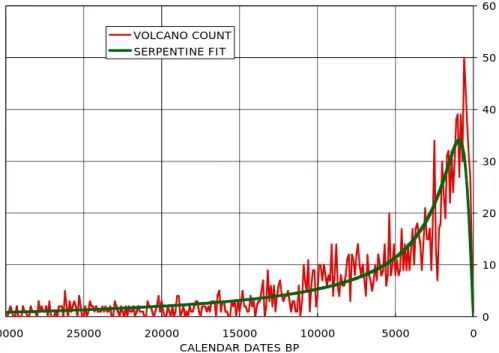
We have calculated two indices after detrending to control for the effects of erosion and recovery of the older material. The earliest version of the index fitted a power law curve to the data to remove the trend due to preservation bias; the new index fits a serpentine curve (given by the Cartesian equation y=abx/x2+a2; Beyer, 1987:225), 5
because it matches both the decay due to erosion and the fall off in radiocarbon dates on recent and historic eruptions (Fig. 1).
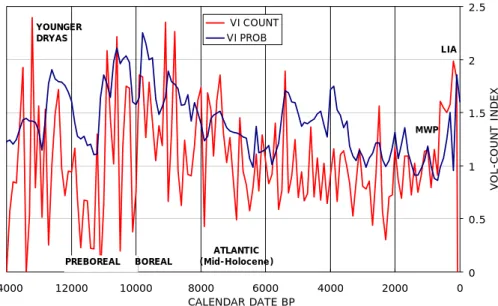
The departure from the curve (i.e. variance in the residuals) is expressed as a gen-eral index of the rate of volcanism over the past 14 000 years in Fig. 2. Here we graph both the summed probability under the curve and a frequency distribution using century 10
bins.
A period of apparent increased volcanism associated with Northern Hemisphere deglaciation is evident in the index as well as in the SO2 record in the GRIP core (Zielinski et al., 1996; Zielinski and Mershon, 1997). Variation in the indices appears to correspond with some well described climatic fluctuations in the Holocene, including 15
the 4.1 K event, the Medieval Warm Period, and the Little Ice Age, suggesting that vari-ation in global volcanism may have contributed to these events, consistent with other research (Hammer et al., 1980; Lamb, 1970; Robock, 2000; Robock and Free, 1996; Zielinski, 2000).
The index has been systematically incorporated into macrophysical climate models 20
(Bryson and Bryson, 2000) to simulate late Quaternary variation due to volcanism. In the macrophysical models the variation in atmospheric albedo due to volcanism is es-timated by correlating a record of measured optical depth with the record of historic eruptions for the same period of the 19th and 20th centuries (Goodman, 1978, 1984). A recent study (Ruter et al., 2004) compared a set of compiled paleoclimate studies 25
from the American tropics with simulations from four separate GCMs and the macro-physical model. The macromacro-physical retrodictions compared favorably with the compiled proxies and showed greater accuracy than most GCMs (all of which lacked a volcanic
eED
1, 123–134, 2006 A cal 14-C late quaternary eruption database R. U. Bryson et al. Title Page Abstract Introduction Conclusions References Tables Figures J I J I Back CloseFull Screen / Esc
Printer-friendly Version Interactive Discussion
EGU component). The effects of single and multiple eruptions at various spatial and regional
scales have been the focus of several GCM experiments. However, with few recent ex-ceptions (e.g. Mann et al., 2005), simulations of longer Holocene climate sequences typically omit volcanism. We note that just as some GCMs have been improved by the incorporation of coupled ocean and vegetation feedbacks, the addition of volcanic mod-5
ulation could further refine those GCMs attempting to simulate high-frequency climatic variation during the late Quaternary.
Despite the development of various volcanic indices (Goodman, 1984; Lamb, 1977, 1983; Mitchell, 1970; Robock and Free, 1995, 1996; Sato et al., 1993), significant discrepancies remain between the various methods used to estimate both atmospheric 10
optical depth and the proportion of its variation that can be explained by fluctuation in historic volcanism (Robock, 2000). This problem will not be easily resolved.
In conclusion, we know that this geologic archive is quite small given the general level of volcanism. We have reservations as to the representativeness of the record in its current form and realize that polar ice holds the best archive of paleovolcanism. 15
However current research involving the recovery and dating of volcanic ejecta from terrestrial contexts and marine cores (particularly those from the tropical Pacific) offer valuable new sources of additional data that should be incorporated. We hope that with further dissemination and augmentation this archive may develop into a useful complementary proxy for late Quaternary fluctuations in global volcanism.
20
References
Bay, R. C., Bramall, N., and Price, P. B.: Bipolar correlation of volcanism with millennial climate change, Proc. Natl. Acad. Sci., 101(17), 6341–6345, 2004.
Bay, R. C., Bramall, N., Price, P. B., Clow, G. D., Hawley, R., Udisti, R., and Castellano, E.: Globally synchronous ice core volcanic tracers and abrupt cooling during the last glacial
25
period, J. Geophys. Res., 111, D11108, doi:1029/2005JD006306, 2006. Beyer, W. H.: CRC Standard Mathematical Tables, 28th ed, CRC Press, 1987.
eED
1, 123–134, 2006 A cal 14-C late quaternary eruption database R. U. Bryson et al. Title Page Abstract Introduction Conclusions References Tables Figures J I J I Back CloseFull Screen / Esc
Printer-friendly Version Interactive Discussion
EGU
Bond, G., Kromer, B., Beer, J., Muscheler, R., Evans, M. N., Showers, W., Hoffmann, S., Lotti-Bond, R., Hajdas, I., and Bonani, G.: Persistent Solar Influence on North Atlantic Climate during the Holocene, Science, 294, 2130–2136, 2001.
Bryson, R. A.: Late Quaternary Volcanic Modulation of Milankovitch Climate Forcing, Theor. Appl. Climat., 39, 115–125, 1988.
5
Bryson, R. A. and Bryson, R. U.: Site-Specific High-Resolution Models of the Monsoon for Africa and Asia, Global Planet. Change, 26, 77–84, 2000.
Bryson, R. A. and Goodman, B. M.: Volcanic Activity and Climatic Changes, Science, 207(7), 1041–1044, 1980.
Bryson, R. U. and Bryson, R. A.: Application of a Global Volcanicity Time-Series on
High-10
Resolution Paleoclimatic Modeling of the Eastern Mediterranean, in: Water, Environment and Society in Times of Climatic Change, edited by: Issar, A. S. and Brown, N., Kluwer Academic Publishers, Netherlands, 1–19, 1998.
Goodman, B. M.: Secular Variations of the Mean Annual Atmospheric Transparency in the Northern Hemisphere, MS thesis, University of Wisconsin-Madison, 1978.
15
Goodman, B. M.: The Climatic Impact of Volcanic Activity, PhD thesis, University of Wisconsin-Madison, 1984.
Hammer, C. U., Clausen, H. B., and Dansgaard, W.: Greenland ice sheet evidence of post-glacial volcanism and its climatic impact, Nature, 288, 230–235, 1980.
Jellinek, A. M., Manga, M., and Saar, M. O.: Did melting glaciers cause volcanic eruptions in
20
eastern California? Probing the mechanics of dike formation, J. Geophys. Res., 109(B9), B09206, doi:10.1029/2004JB002978, 2004.
Jupp, T., Pyle, D., Mason, B., and Dade, B.: A statistical model for the timing of earthquakes and volcanic eruptions influenced by periodic processes, J. Geophys. Res., 109, B02206, doi:10.1029/2003JB002584, 2004.
25
Kirchner, I. and Graf, H.-F.: Volcanos and El Ni ˜no: signal separation in Northern Hemisphere winter, Climate Dyn., 11(6), 341–358, 1995.
Lamb, H. H.: Volcanic Dust in the Atmosphere; with a Chronology and Assessment of Its Meteorological Significance, Philos. Trans. R. Soc. London. Ser. A, 266(1178), 425–533, 1970.
30
Lamb, H. H.: Supplementary volcanic dust veil index assessments, Clim. Monit., 6, 57–67, 1977.
eED
1, 123–134, 2006 A cal 14-C late quaternary eruption database R. U. Bryson et al. Title Page Abstract Introduction Conclusions References Tables Figures J I J I Back CloseFull Screen / Esc
Printer-friendly Version Interactive Discussion
EGU
Monit., 12, 79–90, 1983.
Maclennan, J., Jull, M., McKenzie, D., Slater, L., and Gr ¨onvold, K.: The link between volcanism and deglaciation in Iceland, Geochem. Geophys. Geosyst., 3(11), 1062, doi:10.1029/2001GC000282, 2002.
Mann, M., Cane, M. A., Zebiak, S. E., and Clement, A.: Volcanic and Solar Forcing of the
5
Tropical Pacific over the Past 1000 Years, J. Clim., 18, 447–456, 2005.
Mitchell, J. M.: A preliminary evaluation of atmospheric pollution as a cause of the global temperature fluctuation of the past century, in: Global Effects of Environmental Pollution, edited by: Singer, S. F., D. Reidel, Norwell, MA, 139–155, 1970.
Mortensen, A. K., Bigler, M., Gr ¨onvold, K., Steffensen, J. P., and Johnsen, S. J.: Volcanic ash
10
layers from the Last Glacial Termination in the NGRIP ice core, J. Quat. Sci., 20(3), 209–219, 2005.
Pollack, J. B., Rind, D., Lacis, A., Hansen, J. E., Sato, M., and Ruedy, R.: GCM Simulations of Volcanic Aerosol Forcing. Part I: Climate Changes Induced by Steady-State Perturbations, J. Clim., 6(9), 1719–1742, 1993.
15
Robock, A.: Volcanic Eruptions and Climate, Rev. Geophys., 38(2), 191–219, 2000.
Robock, A. and Free, M. P.: Ice cores as an index of global volcanism from 1850 to the present, J. Geophys. Res., 100(D6), 11 549–11 567, 1995.
Robock, A. and Free, M. P.: The volcanic record in ice cores for the past 2000 years, in: Climatic Variations and Forcing Mechanisms of the Last 2000 Years, edited by: Jones, P. D., Bradley,
20
R. S., and Jouzel, J., Springer-Verlag, New York, 533–546, 1996.
Ruter, A., Arzt, J., Vavrus, S., Bryson, R. A., and Kutzbach, J. E.: Climate and environment of the subtropical and tropical Americas (NH) in the mid-Holocene: comparison of observations with climate model simulations, Quat. Sci. Rev., 23, 663–679, 2004.
Sato, M., Hansen, J. E., McCormick, M. P., and Pollack, J. B.: Stratospheric Aerosol Optical
25
Depths, 1850–1990, J. Geophys. Res., 98(D12), 22 987–22 994, 1993.
Siebert, L. and Simkin, T.: Volcanoes of the World: an Illustrated Catalog of Holocene Volca-noes and their Eruptions, Smithsonian Institution, Global Volcanism Program Digital Infor-mation Series, GVP-3, (http://www.volcano.si.edu/world/), 2002.
Sigvaldason, G. E., Annertz, K., and Nilsson, M.: Effect of glacier loading/deloading on
vol-30
canism: postglacial volcanic production rate of the Dyngjufj ¨oll area, central Iceland, Bull. Volcanol., 54(5), 385–392, 1992.
(A94-eED
1, 123–134, 2006 A cal 14-C late quaternary eruption database R. U. Bryson et al. Title Page Abstract Introduction Conclusions References Tables Figures J I J I Back CloseFull Screen / Esc
Printer-friendly Version Interactive Discussion
EGU
10876 01-91), 427–452, 1993.
Simkin, T. and Siebert, L.: Volcanoes of the World: A Regional Directory, Gazetteer, and Chronology of Volcanism During the Last 10,000 Years, Geoscience Press, Inc., 1994. Slater, L., Jull, M., McKenzie, D., and Gr ¨onvold, K.: Deglaciation effects on mantle melting
under Iceland: results from the northern volcanic zone, Earth Planet. Sci. Lett., 164(1), 151–
5
164, 1998.
Weninger, B.: High-precision calibration of archaeological radiocarbon dates, Acta Interdisci-plin. Archaeol., 4, Nitra, 11–53, 1986.
Zielinski, G. A.: Use of paleo-records in determining variability within the volcanism-climate system, Quat. Sci. Rev., 19, 417–438, 2000.
10
Zielinski, G. A., Mayewski, P. A., Meeker, L. D., Whitlow, S., and Twickler, M. S.: A 110,000-Yr Record of Explosive Volcanism from the GISP2 (Greenland) Ice Core, Quat. Res., 45(2), 109–118, 1996.
Zielinski, G. A. and Mershon, G. R.: Paleoenvironmental implications of the insoluble micropar-ticle record in the GISP2 (Greenland) ice core during the rapidly changing climate of the
15
eED
1, 123–134, 2006 A cal 14-C late quaternary eruption database R. U. Bryson et al. Title Page Abstract Introduction Conclusions References Tables Figures J I J I Back CloseFull Screen / Esc
Printer-friendly Version Interactive Discussion
EGU
no standard deviations were reported. The third worksheet lists the complete references alphabetically.
3 Index of the volcanic rate
We have calculated two indices after detrending to control for the effects of erosion and recovery of the older material. The earliest version of the index fitted a power law curve to the data to remove the trend due to preservation bias; the new index fits a serpentine curve (given by the Cartesian equation y = abx/x2 + a2 (Beyer 1987:225)), because it matches both the decay due to erosion and the fall off in radiocarbon dates on recent and historic eruptions (Figure 1).
VOLCANIC COUNT DATA
0 10 20 30 40 50 60 0 5000 10000 15000 20000 25000 30000 CALENDAR DATES BP VOLCANO COUNT SERPENTINE FIT
Figure 1 A frequency distribution of the calibrated ages with the fitted serpentine curve used to detrend the data. The residual variance (Figure 2) is the volcanicity index.
Fig. 1. A frequency distribution of the calibrated ages with the fitted serpentine curve used to
detrend the data. The residual variance (Fig. 2) is the volcanicity index.
eED
1, 123–134, 2006 A cal 14-C late quaternary eruption database R. U. Bryson et al. Title Page Abstract Introduction Conclusions References Tables Figures J I J I Back CloseFull Screen / Esc
Printer-friendly Version Interactive Discussion
EGU
The departure from the curve (i.e. variance in the residuals) is expressed as a general index of the rate of volcanism over the past 14,000 years in Figure 2. Here we graph both the summed probability under the curve and a frequency distribution using century bins.
ESTIMATED VOLCANIC INDEX SERPENTINE NORMALIZATION 0 0.5 1 1.5 2 2.5 0 2000 4000 6000 8000 10000 12000 14000 CALENDAR DATE BP VO L-C O U NT I ND E X VI COUNT VI PROB PREBOREAL YOUNGER DRYAS LIA MWP BOREAL ATLANTIC (Mid-Holocene)
Figure 2 Two detrended indices for late Quaternary volcanism from the database. The summed probability under the curve (VI PROB) is in blue, and a frequency distribution using century bins (VI COUNT) in red. Selected climatic periods and events including the Little Ice Age (LIA) and the Medieval Warm Period (MWP) are indicated.
A period of apparent increased volcanism associated with Northern Hemisphere
deglaciation is evident in the index as well as in the SO2 record in the GRIP core (Zielinski, et al.
1996, Zielinski and Mershon 1997). Variation in the indices appears to correspond with some well described climatic fluctuations in the Holocene, including the 4.1 K event, the Medieval Warm Period, and the Little Ice Age, suggesting that variation in global volcanism may have
Fig. 2. Two detrended indices for late Quaternary volcanism from the database. The summed
probability under the curve (VI PROB) is in blue, and a frequency distribution using century bins (VI COUNT) in red. Selected climatic periods and events including the Little Ice Age (LIA) and the Medieval Warm Period (MWP) are indicated.