Distributed Naming in a Factored Operating
System
by
Nathan Beckmann
MASSACHUSETTS INSTITUTE OF TECHNOLOGYOCT
5 2010
LIBRARIES
B.S. Computer Science, University of California, Los Angeles (2008)
B.S. Mathematics, University of California, Los Angeles (2008)
Submitted to the Department of Electrical Engineering and Computer
Science
in partial fulfillment of the requirements for the degree of
Master of Science in Electrical Engineering and Computer Science
at the
MASSACHUSETTS INSTITUTE OF TECHNOLOGY
September 2010
ARCHNES
©
Nathan Beckmann, MMX. All rights reserved.
The author hereby grants to MIT permission to reproduce and
distribute publicly paper and electronic copies of this thesis document
in whole or in part.
Author ...
Departm2
Certified by...
of Efctrical Engineering and Computer Science
S ptember 3, 2010
...
. . . .
Anant Agarwal
Professor
Thesis Supervisor
A ccepted by ...
...
Terry Orlando
Chairman, Department Committee on Graduate Theses
Distributed Naming in a Factored Operating System
by
Nathan Beckmann
Submitted to the Department of Electrical Engineering and Computer Science on September 3, 2010, in partial fulfillment of the
requirements for the degree of
Master of Science in Electrical Engineering and Computer Science
Abstract
A factored operating system (fos) is a new operating system design for manycore and
cloud computers. In fos, OS services are separated from application code and run on distinct cores. Furthermore, each service is split into a fleet, or parallel set of cooperating processes that communicate using messages.
Applications discover OS services through a distributed, dynamic name service. Each core runs a thin microkernel, and applications link in a user-space library called
libfos that translates service requests into messages. The name service facilitates
message delivery by looking up service locations and load balancing within service
fleets. libfos caches service locations in a private cache to accelerate message delivery,
and invalid entries are detected and invalidated by the microkernel.
As messaging is the primary communication medium in fos, the name service plays a foundational role in the system. It enables key concepts of fos's design, such as fleets, communication locality, elasticity, and spatial scheduling. It is also one of the first complex services implemented in fos, and its implementation provides insight into issues one encounters while developing a distributed fos service.
This thesis describes the design and implementation of the naming system in fos, including the naming and messaging system within each application and the dis-tributed name service itself. Scaling numbers for the name service are presented for various workloads, as well as end-to-end performance numbers for two benchmarks. These numbers indicate good scaling of the name service with expected usage pat-terns, and superior messaging performance of the new naming system when compared with its prior implementation. The thesis concludes with research directions for future work.
Thesis Supervisor: Anant Agarwal Title: Professor
Acknowledgments
I would like to thank Prof. Agarwal for being an excellent advisor and my colleagues
on the fos project for discussing ideas and providing the system in which this research was conducted. In particular, I would like to thank Harshad Kasture for discussing numerous bootstrapping issues and design decisions, and Charles Gruenwald III for discussing usage of the name service.
I would like to thank my girlfriend, Deirdre Connolly, as well as my family, Ed,
Shelley, and Jessica, for providing love and support. Finally, I would like to thank Leela Cat for providing a much-needed distraction.
Contents
1 Introduction 13 2 Overview of fos 17 2.1 System architecture . . . . 17 2.2 Messaging . . . . 19 2.3 F leets . . . . 21 2.3.1 Elasticity .. . . . . . . . . 23 2.3.2 Scheduling . . . . 23 2.4 Implementation . . . . 243 Motivation for a Name Service 27 4 Design 29 4.1 Application Interface . . . . 29
4.2 Messaging . . . . 34
4.2.1 Mailbox Structure . . . . 34
4.2.2 Name Service . . . . 36
4.2.3 User-space Name Cache . . . . 37
4.2.4 Message Delivery . . . . 38
4.3 Name Service . . . . 40
4.4 Distributed State . . . . 44
4.4.1 Programming Model . . . . 45
4.4.3 Concrete Example . . . . 52 4.4.4 Management. . . . . 53 4.4.5 Summary . . . . 55 5 Implementation 57 5.1 Scop e . . . . 57 5.2 Bootstrapping . . . . 59 5.3 Development Issues . . . . 62 5.4 Experiences . . . . 65 6 Results 67 6.1 Methodology . . . . 67 6.2 Micro-benchmarks . . . . 68 6.3 End-to-End . . . . 72 6.4 Discussion . . . . 74 7 Future Work 77 7.1 Expectations versus Reality . . . . 77
7.2 Local Sub-domains . . . . 77
7.3 Fairness in Conflict Resolution . . . . 78
7.4 Bootstrapping Cloud Computers.. . . . . .. 79
8 Related Work 81 8.1 Full System . . . . 81
8.2 Naming and Distributed Data . . . . 83
List of Figures
1-1 Introduction to name service . . . . 14
2-1 System overview . . . . 18
2-2 Messaging system . . . . 20
4-1 Two-phase commit code listing . . . .. . . . 47
4-2 Arbiter code listing . . . . 49
4-3 Insert code listing . . . . 52
6-1 Lookup results . . . . 68
6-2 Registration results . . . . 69
6-3 Registration results under contention . . . . 71
6-4 Messaging performance . . . . 72
List of Tables
4.1 M essaging API . . . . 30
4.2 Nam e service API. . . . . 35
4.3 Name service management API . . . . 41
4.4 Distributed data store API. . . . . 42
4.5 Microkernel name registration API . . . . 43
4.6 Distributed data store management API . . . . 45
Chapter 1
Introduction
fos is a new research operating system targeted at manycore processors and cloud computers. These two emerging areas have introduced unprecedented hardware par-allelism to the OS. In multicore, research chips from major manufacturers already have 32 or 48 cores, and embedded vendors currently offer general-purpose processors with 64 or 100 cores. Within a decade, chips will be available with hundreds of cores, and research prototypes will have thousands. Similarly, the cloud has brought large numbers of cores within a single logical system. However, current cloud solutions create artificial barriers in the management of these systems by introducing a virtual machine layer. fos eliminates these barriers by using a single OS image across multiple computers in a cloud.
Traditional, monolithic OSes were designed in an era of uniprocessors, and their design reflects this. These OSes time multiplex OS processing with application code via a system call interface. This design is extremely efficient with processor time, but it neglects other factors which are increasingly important in multicore; e.g., data locality (cache behavior), unnecessary data sharing, and performance degradation due to lock contention within a single service. Massive parallelization efforts have begun in the monolithic OS community, but it remains unlikely that monolithic OSes represent the optimal design for manycore and cloud computers.
fos addresses these scalability challenges by factoring the operating system into individual services, each of which run independently of each other on separate physical
5~ File System Fleet File System
)O
(D
Server #1 Name Server File System Server #2 .--- IFigure 1-1: Using the name service to access a file system. Application requests are translated through libfos into messages, whose routing is facilitated by the name service.
cores. Additionally, fos splits each service into a fleet of cooperating processes, which in aggregate implement the service. For example, in a fos system there will be a name service fleet, a scheduling service fleet, a file system fleet, etc.. Factoring the OS into fleets provides a natural framework in which to address scalability, as each service is now an independent entity. In summary, fos is a collection of distributed systems which collectively implement a traditional OS interface.
fos services interact with applications and each other exclusively through messages (in particular, they do not share memory). This is done to clearly expose sharing of data, which can often become scalability bottleneck, as well as to provide a com-munication mechanism that can be implemented on a variety of architectures. This is important in order to support cloud computers, embedded non-shared-memory systems, and future architectures where global shared memory may prove inviable.
Applications link in a user-space library, libfos, that translates requests to services into messages. libfos maintains a cache of service locations that are discovered via a dynamic, distributed name service. Figure 1-1 shows the name service in action.
The system contains an application, a name service fleet with a single member, and a file system fleet with two members. The application makes a request to the file system, which is translated into a message in libfos. libfos messages the name service to resolve a member of the file system fleet, and the name server responds with a specific member of the fleet. This member is subsequently messaged and responds to complete the request.
As messaging is the primary communication medium in fos, the name service plays a foundational role in the system. Its performance is paramount, as the service is often on the critical path to message delivery. Furthermore, the name service enables some of the main ideas in fos: service fleets, by load balancing among several members of a fleet; spatial scheduling, or layout of processes within the system; and elasticity, or dynamically growing and shrinking fleets to reflect the current environment. Finally, the name service simplifies the construction of some services (e.g., network stack) by allowing them to offload some of their distributed state into the naming system.
This thesis discusses the design and implementation of the naming system in fos. This includes both the name service itself and the naming/messaging library in libfos. In order to give high performance, it is necessary for applications to privately cache responses from the name service. However, since the name space is being constantly updated, these cached entries will become invalid. Therefore, there must exist error detection and recovery mechanisms to guarantee correct behavior. This design spans the messaging library and the name service, and both must enter into a contract in order to yield a functional system.
The name service is also one of the first complex services implemented in fos, and certainly the service that has the most distributed state. The experience of its implementation therefore gives insight into developing distributed OS services. The implementation involved several bootstrapping issues unique to the name service, but many of the difficulties were generally applicable.
The major contributions of contained herein are as follows:
o This thesis presents the complete design of the naming system, including the name service fleet and messaging in libfos. It demonstrates how the name service
enables fleets and simplifies their construction.
" This thesis presents the design of the first distributed key-value store in fos, and
experiences gained from its development.
" This thesis serves as evidence that fleets are a viable design for foundational OS
services, and that their performance and scalability can exceed naive, monolithic implementations.
This thesis is organized as follows: Chapter 2 overviews the design of fos to give context for later discussion. Chapter 3 motivates the name service in light of fos's design. Chapter 4 covers the design of the name service, including its external in-terface and internal algorithms and data structures. Chapter 5 discusses experience gained while implementing the name service. Chapter 6 presents results for the name service. Chapter 7 discusses future research directions. Chapter 8 discusses related work, and Chapter 9 concludes.
Chapter 2
Overview of fos
fos addresses OS scalability by implementing OS services as independent distributed systems running on separate cores from applications. fos employs a microkernel de-sign in order to factor traditional OS services into user-space, where they are further split into fleets. A user-space library, libfos, provides messaging functionality for both applications and services and transparently multiplexes different message deliv-ery mechanisms behind a unified messaging API. This chapter gives an overview of fos's system architecture that enables this goal. The central concepts in designing fos services are discussed next, and the state of the current fos implementation con-cludes. This chapter is a review of the fos project and represents the work of many contributors. Details can be found in [26, 27].
2.1
System architecture
Figure 2-1 shows a high-level depiction of a manycore fos system. Several applications are running, and OS services run on distinct cores from the applications. The OS is split into individual services, each of which is further parallelized into a fleet of cooperating servers. Fleet members are distributed throughout the chip to minimize communication costs with applications. For example, consider the file system fleet (shown as FS in the figure). This fleet has four members which are dispersed over the chip. The fleet members must collaborate in order to provide the interface of a
PA
.. . . .File systempF
libfos U ' microkernel Name Server libfosK
1 1microkernel Application 5File System Server, fleet member libfos Block Device Driver
Process Management server, fleet member Name server, fleet member
Network Interface
E]
Page allocator, fleet member ApplicationsFigure 2-1: A depiction of a typical manycore fos system.
single file system to applications.
For the remainder of the thesis, "fleet member" and "server" both refer to pro-cesses that implement an OS service, as opposed to an "application," and "process" is used when discussion applies equally to servers and applications.
Within a single core, each application or service runs atop a minimal microkernel as shown in Figure 2-1. This microkernel provides protection (e.g., of page tables) via a capability system and a basic messaging delivery mechanism. The microkernel must also handle hardware interrupts, faults, and certain bootstrapping operations. This thesis improves upon previously published work in fos [26, 27] by factoring naming out of the microkernel into libfos.
Whenever possible, functionality is moved into user-space in order to exploit fos's service model. For example, the handling of network packets is exported to the network interface service. The microkernel receives interrupts from the network card and messages the network interface service with the raw data, where processing takes
place. The process management service also handles many tasks that are typically found in the kernel, even in microkernel designs, such as setting up the page table of a new process.
Applications interact with fos via a library layer, libfos. libfos consists of two parts: (i) common code that is needed by all applications and services, such as mes-saging and naming; and (ii) library components from each OS service that provide local functionality for applications (e.g., caching) and translate requests into messages to the service. OS services themselves are implemented atop libfos, but do not com-monly exercise the library components of other services. However, because the OS is implemented as essentially unprivileged, user-space processes, services can make full use of other components of the OS if needed. For example, the process management service uses the file system to load programs off disk, and all services use the name service identically to implement messaging.1
2.2
Messaging
The name service is intimately related to fos's messaging system, and the behavior of the name service is heavily influenced by the guarantees that the messaging system provides. Therefore, it will be discribed in some depth to give proper context for later discussion.
fos uses messages as the primary communication medium between applications and the OS as well as within fleets themselves. Although fos supports shared memory for applications, OS services interact exclusively through messages. This is done for several reasons: Although perhaps more difficult to implement, messaging explicitly shows what data must be shared, and therefore it can lead to better encapsulation and early consideration of scalability bottlenecks. More importantly, messaging can be implemented on a wide variety of architectures and systems. In particular, for multiple-machine fos systems (e.g., cloud computers) shared memory is unavailable, and one is forced to use a message-passing model. Embedded systems are often
implemented without shared memory support, and it also may be the case that global shared memory proves unscalable in large multicores. Message-passing provides the greatest flexibility in the underlying hardware.
fos's messaging system uses a mailbox-based application program interface (API).
A service (or application) creates a mailbox on which it can receive messages. These
mailboxes are registered with the name service using a hierarchical name space much like a UNIX path or web address. For example, the file system may register its mailbox as /sys/f s. In order to send to a service, the sender must have the name2 of its mailbox and an associated capability. These capabilities are created upon mailbox creation, or can be manually created and added by request. The messaging API then contacts the name service and microkernel as necessary to complete message delivery.
Application
fos
server
libc POSIX 2b libc POSIX
4. -Userland Messaging (URPC) 4.0 -Userland Messaging (URMt)
-0P User-Space Naming Cache (UNC 04 se-Sggeg.Nagning Q~che Microkernel -uk Naming Cachecoene ain ah
Core 1
Core 2
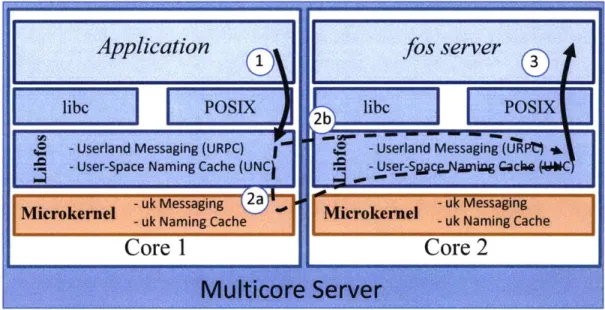
Figure 2-2: fos's messaging system. This figure shows the paths followed by a message sent within a multicore. Two paths are possible, either through the microkernel or through an optimized user-space channel.
As shown in Figure 6-4, fos currently supports two implementations of the mes-saging system within a multicore. These delivery mechanisms are transparently mul-tiplexed behind the messaging API, so an application need not concern itself with the physical placement of services with which it communicates. For performance reasons, however, this may be important. Therefore, a key focus of fos is proper allocation of
2
For performance, the system actually uses hashes of the textual name, termed an alias.
cores to OS services and placement of services to minimize communication costs. The default delivery mechanism uses the microkernel to deliver messages from the sender directly into the receiver's mailbox. This mechanism traps into the microker-nel, which checks the capabilities by reading from the destination's address space, and delivers the message by copying the data into the mailbox's receive buffer.
For shared memory machines, an optimized path exists that avoids the overhead of trapping into the microkernel. In this mechanism, a page is shared between the sending and receiving processes, called a channel. This page is treated as a circular queue, and messages are sent by copying data into the page. Messages are received
by copying data out of the queue into a buffer. The second copy is necessary to
free space for further messages and guarantee that the message isn't modified by the sender after delivery. This mechanism requires a channel to be established by the microkernel. Upon creation, appropriate capability checks are performed. If the capabilities of the mailbox are modified, then all channels must be unmapped to give proper behavior. Although creating the channel is a fairly expensive operation, the steady-state performance of messaging is greatly improved.
A third delivery mechanism exists for multi-machine fos systems. This uses a
sep-arate proxy service and network connections (TCP/IP) to deliver messages between machines. By bridging messaging across machines, fos can transparently span mul-tiple machines under a single OS.3 This aspect of fos is not the focus of this thesis, however, but is discussed further in [27].
2.3
Fleets
An OS service in fos is constructed as a fleet: a cooperative set of processes which, in aggregate, provide a single service. For example, within a single fos system, there will be a name service fleet, a page allocation fleet, a file system fleet, etc.. Because of the message-passing architecture of fos, services are effectively implemented as distributed
systems. Fleets are the main contribution of fos over previous microkernel operating
system designs, and we believe they are the key to scaling services to hundreds or thousands of cores. These ideas are discussed at length in [26], but this section briefly discuss the main ideas. This discussion describes the high-level goals, and the next chapter demonstrates how the name service enables each concept in this section.
In order for this design to function well in a multicore environment, the right ser-vices must be available when and where they are needed. There must be mechanisms to change fleet size dynamically to meet changing demand in the system. In fos, this is termed elasticity. Furthermore, once cores are divided among fleets, they must be spatially scheduled in the best manner to minimize communication overheads.
Because of the scale of future multicores and the cloud, it is necessary to parallelize within each OS service; factoring the OS into separate services alone is insufficient. Many important workloads in the cloud (e.g., memcached, Apache) spend the majority of their time in the OS even on present multicores
[7].
As core count increases, the demand on the service will increase proportionally.Therefore fleets are designed with scalability foremost in mind. Services must scale from relatively few cores to hundreds or thousands. This is necessary in order to span differently-sized multicores and the cloud, where essentially arbitrarily large amounts of resources can be under management. As such, all services are designed from square one to be parallel as well as scalable. This often leads to fundamentally different design decisions than a simple sequential approach to the service.
In order to simplify handling simultaneous transactions, fleets are written using a light-weight cooperative threading model. This threading model provides a dispatcher that integrates with the messaging system to provide threads for each transaction processed by the service, and the ability to sleep until a response message arrives for remote procedure call (RPC) semantics. This model also enables lock-less de-sign, as unlike kernel-level threading, threads are never preempted by other threads. fos also provides an RPC generation tool that parses standard C header files and generates marshalling routines to enable function-oriented code. This model allows non-conflicting transactions to be pipelined in the service to maximize utilization.
envi-ronment, and adapt their behavior accordingly. Although some external actions will control behavior, such as the allocation of cores to the service and the spatial layout of processes, fleets have many actions they can perform internally to adapt behavior. For example, active transactions can be migrated to under-utilized members or mem-bers that would have lesser communication cost. Additionally, if the scheduler has allocated a fleet fewer cores than it has members (i.e., some members are being time-multiplexed on a single core), the fleet can shrink its size in order to avoid context switches.
2.3.1
Elasticity
In addition to handling peak demand, OS services must scale to match changing demand. Demand on the OS is rarely constant. Changes are due to phases in appli-cation behavior, new appliappli-cations being run, or changes in dynamic workload (e.g.a web server).
Fleets are elastic, meaning they grow and shrink in order to match demand in the environment. This requires support from fleets themselves in order to add and remove members dynamically, including migrating state of active transactions.
Elasticity is closely related to resource allocation, specifically the allocation of cores to services and applications. A scheduling service makes decisions based on per-formance metrics (service utilization, message patterns, application heartbeats [16], etc.) on how to allocate cores in the system. Fleets then grow or shrink to meet their allocation.
2.3.2
Scheduling
Closely related to elasticity is spatial scheduling. The scheduling service in fos decides the spatial layout of processes in order to maximize utilization and minimize commu-nication costs. Due to the increasing heterogeneity in commucommu-nication costs within a multicore and the disparity of intra- and inter-machine communication, placing pro-cesses in a way that maximizes locality is important to performance. Early results
have shown that a modest heterogeneity of 48% can lead to end-to-end performance difference of 20% for some OS benchmarks [26]. Future multicores and the cloud have much higher heterogeneity, and therefore good scheduling is extremely important.
The scheduling problem in fos relates to spatial layout of processes, but fos does support basic time multiplexing. The microkernel on each core provides a simple process scheduler. This is useful for placing low-utilization, non-performance-critical services on a single core to maximize core availability. It is also much less expensive to migrate processes onto a single core than to transfer state between processes. There-fore, a "cheap" way to scale fleet size is to change the number of cores allocated to the service (i. e., forcing time multiplexing) without changing the number of processes in the fleet. Depending on the granularity with which layout is updated, this could be an important tool to prevent thrashing fleet size while still controlling the layout effectively. It is also possible that some services will require a member to stay active (say, because of a pending transaction) and will not be able to shrink on demand.
Scheduling can be divided into two (possibly interdependent) problems: allocation
and layout. The allocation is problem is how many cores to allocate each
service/ap-plication. The layout problem is how to place processes in the system to optimize
performance, power, etc.. This is currently an active area of research in fos.
2.4
Implementation
An implementation of fos is under development and currently boots on x86 multicores. The implementation runs as a paravirtualized OS under Xen [4] in order to facilitate its goals as a cloud OS, as the cloud management platforms Eucalyptus [20] and Amazon EC2 [13] only support Xen virtual machine images. Running under Xen has the additional advantage of limiting the need to develop hardware drivers, which is a challenge for any research OS.
Several services have been implemented: network stack, file system, process man-agement, page allocator, proxy service, etc.. Of these, the network stack, name service, and page allocator are implemented as proper fleets that demonstrate good
scalability. A read-only file system fleet has been implemented to prototype ideas in fleet design and gather initial numbers.
The current implementation contains a port of libc from OpenBSD, with support for file descriptors, socket interface, etc.. Some full-featured applications have been run, in particular a video transcoder that uses ffmpeg and exercises the file system and network stack. The present limiting factor on applications is support for kernel-level multi-threading, on which many applications rely. This is on the road map to be implemented in the near future.
Chapter 3
Motivation for a Name Service
This section discusses the name service and demonstrates the foundational role it plays in the fos ecosystem.
Messaging is the main communication medium in fos, and the name service plays a crucial role in the messaging system. For this reason alone, the name service is a central component of fos. The name service finds the closest fleet member for a given service when the service is requested. It does this by routing messages from their symbolic name to a destination mailbox. Using a level of indirection for mailboxes provides an important convenience to users of the messaging system. This allows the
high-level purpose of the mailbox (i.e., the associated service) to be exposed and the location to reflect the dynamic placement of the mailbox.
The name service plays many other roles in fos that heighten its importance. It provides a mechanism for registering fleets in the name space, whereby multiple fleet members can be registered under a single name. To take a simple example, a file
system fleet with two members could register the names /sys/f s/1 and /sys/f s/2 for the individual members, and each of these names would be registered under /sys/f s, the "global" file system name. When a message is sent to /sys/f s, the name service will return one of the fleet members, say /sys/f s/i, and the message will be sent accordingly (see example in Figure 1-1). Mappings from one name to another (e.g., /sys/f s to /sys/f s/i) are termed indirect, as the name mapping resolves to another name rather than a mailbox. Likewise, name-to-mailbox mappings are termed direct.
This functionality is important to disguise from applications the precise number of servers active in a fleet. This allows for transparent growing and shrinking of fleets, enabling elasticity.
In servicing requests to these names, the name service effectively load balances the fleet. The name service implements load balancing policy, but it does not determine policy. Load balancing policy is specified by a service providing a mailbox which responds to requests for load balancing information. Alternately, the name service provides a default load balancing policy that favors names with lower communication cost.
This should not be taken to claim that indirect aliases offer a completely generic load balancing framework. Later in this thesis, I discuss instances where this policy must be circumvented, and fos's approach to these problems. However, in many cases this simple form of load balancing is sufficient, and furthermore gives equivalent performance to static mapping that is aware of each fleet member [26]. At worst, name service load balancing provides a good way to balance the initial request to a service among members before the final load balancing decision takes place.
The name service also plays an important role in scheduling (layout). The primary mechanism for scheduling is process migration, whereby processes are migrated to minimize global communication cost. This can result in changing the location of a mailbox, particularly when processes are migrated between machines.1 Consequently,
the name mapping must change to reflect the new location. The name service provides explicit support for migration by allowing a name to become "inactive" during the period of migration, so that messages sent to the name do not result in a fatal error. The name service therefore plays a crucial role in scheduling, by providing the essential level of indirection to enable process migration.
The name service plays a key role in many areas of fos, including the main active research areas in general OS design: resource allocation (elasticity) and scheduling
(spatial layout).
'When mailbox locations must change depends on the scheme used for mailbox locations. On shared memory machines, intra-machine migration need not change the mailbox location. More discussion follows later in this thesis.
Chapter 4
Design
This section discusses the design of the name service and messaging system as it relates to the name service. It begins with a high-level discussion of the messaging interface and the different expected usage scenarios. Next, the design of the messaging system is discussed imagining the name service as a black box. This section concludes with the internals of the name service, and in particular a detailed discussion of the distributed data store which stores the name space itself.
4.1
Application Interface
The main customer of the name service is the messaging system within fos, and some of the design choices in the name service affect the usage of the messaging system itself. The primary function of the messaging system is allowing applications and services to send and receive messages. This is done by a libfos component that is present in all processes. To send messages, libfos contacts the name service to resolve the destination mailbox. libfos must also contact the name service to register and unregister mailboxes, as well as a few other operations that are useful in particular cases.
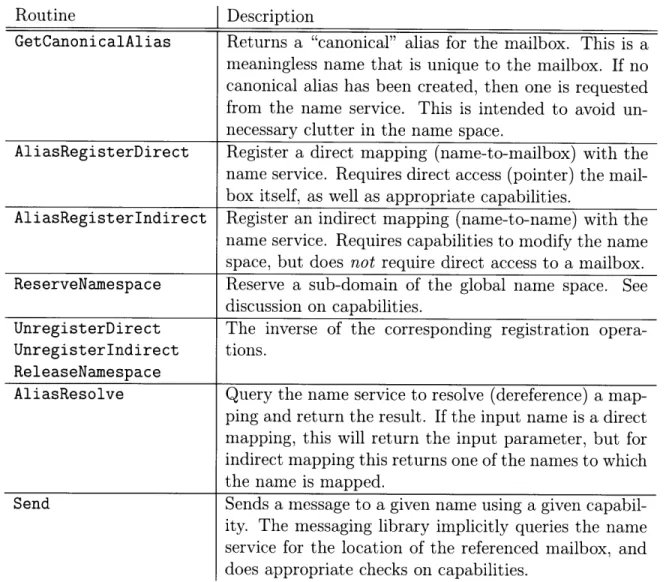
Table 4.1 shows the relevant portion of the messaging API. The API includes routines which explicitly modify the name space by registering or unregistering mail-boxes, as well as operations to read state from the name service and resolve mappings.
Routine Description
GetCanonicalAlias Returns a "canonical" alias for the mailbox. This is a meaningless name that is unique to the mailbox. If no canonical alias has been created, then one is requested from the name service. This is intended to avoid un-necessary clutter in the name space.
AliasRegisterDirect Register a direct mapping (name-to-mailbox) with the name service. Requires direct access (pointer) the mail-box itself, as well as appropriate capabilities.
AliasRegisterIndirect Register an indirect mapping (name-to-name) with the name service. Requires capabilities to modify the name space, but does not require direct access to a mailbox. ReserveNamespace Reserve a sub-domain of the global name space. See
discussion on capabilities.
UnregisterDirect The inverse of the corresponding registration opera-UnregisterIndirect tions.
ReleaseNamespace
AliasResolve Query the name service to resolve (dereference) a map-ping and return the result. If the input name is a direct mapping, this will return the input parameter, but for indirect mapping this returns one of the names to which the name is mapped.
Send Sends a message to a given name using a given capabil-ity. The messaging library implicitly queries the name service for the location of the referenced mailbox, and does appropriate checks on capabilities.
Table 4.1: Selected subset of the fos messaging API. These operations either explicitly or implicitly involve the name system.
Other operations implicitly involve the name service, for example sending a message, which performs an implicit lookup through the name service. Note that in the API, names are referred to as "aliases," because the messaging system actually deals with hashes of mailbox names.
The bulk of the operations in Table 4.1 involve modifications to the name space, which are guarded by capabilities. The name space itself is split into sub-domains, just as a UNIX file system is split into folders. For example, the name /sys/f s/1 has sub-domains of /sys/f s/1/*, /sys/f s/*, /sys/*, and /*.' The last name is referred to as the root of the name space. In order to modify a portion of the name space,
one must have the capability to modify at least one of its sub-domains. Therefore a process in possession of the root capability has complete ownership of the name space. These operations are essentially forwarded to the name service directly, and bookkeeping is done within the mailbox structure itself if the operation succeeds (next section).
The operations that explicitly modify the name space are the registration and unregistration operations. These are used to register services in the name space, and there are two versions: RegisterDirect and RegisterIndirect. RegisterDirect creates a direct mapping, and is used to register individual fleet members or services that only have a single member. It requires that the process that owns the mailbox makes the request. This is done in order to guarantee permissions to create the mapping and to bootstrap the registration process.2 RegisterIndirect registers an indirect mapping, and is used to register the global name for a service fleet. It is a versatile mechanism that can also be used to assist in building some services, as will be shown later. It does not require any special capabilities for the destination name. This does not introduce a security problem because capabilities are required to modify the name space (so an adversary can not modify sub-domains of the name space that it does not own), and the registration process does not create additional capabilities to send messages. To clarify, one must draw a distinction between capabilities that allow modifications to the name space and capabilities that allow one to send messages to a mailbox. RegisterIndirect does not create any message-sending capabilities, so it does not allow any communication to take place that could not happen regardless. Finally, ReserveNamespace creates a capability for a sub-domain of the name space and claims the sub-domain in the name service.
The remaining operation, GetCanonicalAlias, makes implicit modifications to the name space. GetCanonicalAlias provides an arbitrary, "canonical" name for the mailbox. This is useful for local mailboxes that are owned by libfos and used to receive responses from services. These mailboxes don't represent a meaningful
2An alternative would be to use the mailbox location to bootstrap, but the mailbox location structure is never exposed in the messaging API, and this approach would require additional capa-bilities.
service, so they don't need a meaningful name; they just need a way to be addressed
by the messaging system so that a response can be sent. If the canonical alias has not
been created, then the name service is queried to generate a new name. This name is cached in the mailbox structure and subsequent operations incur no cost.
The last two operations involve reading the name space, and it is expected (and indeed observed) that these constitute the majority of traffic to the name service. These operations are AliasResolve and Send. The purpose of Send and its relation to naming are rather obvious: in order to deliver a message, the messaging system must resolve the name to a mailbox. When the destination name is a direct map-ping, then the messaging system simply resolves the name to its mailbox location and sends the message. When an indirect mapping is passed in, the messaging system will resolve the name to one of the mailboxes that it eventually points to, but there are no guarantees as to which mailbox the message will go to. In particular, there is no guarantee that the same mailbox will receive consecutive messages, nor that different mailboxes will receive consecutive messages. At a higher level, this means that Send may send requests to different servers, which can interrupt stateful trans-actions. Additionally, consecutive requests may go to the same server, so Send alone does not provide fine-grain load balancing. This behavior allows maximum flexibility in the name service and messaging system, but can cause problems for certain types of services.
In order to illustrate this issue, consider a file system. fos's current prototype file system implements a parallel read-only fleet. This fleet is parallelized in the most naive fashion possible - simply by spawning multiple copies of the service and registering them under a single name. There is no sharing of state between the fleet members, and therefore if a request to a file that is opened on one member arrives at a different member, then the request will fail. There must be some way to guarantee that subsequent messages arrive at the same fleet member. This is an example where name server load balancing, although desirable for the initial open() request, must be circumvented for the remainder of the transaction.
map-ping so that the final, direct mapmap-ping can be cached by the application for subsequent message sends. The libfos file system component performs an AliasResolve on the
global file system name, and caches the result for future requests with that file. In the example of the prototype file system, the cached result is refreshed only if no files are open, although this could be optimized to have separate caches for each open file.3
The name service can also be used to track distributed state and greatly simplify the implementation of some services. This is in some sense related to the prior example, but in this case the state is being cached within the name space itself. In this model, each transaction registers a new name to track which fleet member is responsible for it. The prime example of this behavior is the network stack service, which registers a new indirect mapping in the name space for each active connection
(e.g., /sys/netstack/connections/12345678). The final portion of the name is a
unique identifier for the transaction - in this case, a hash of the source IP, source port, destination IP, and destination port. This mapping points to the mailbox of the fleet member who is responsible for the connection.
This behavior is desirable in order to simplify the implementation of the network interface service, the service which receives raw data packets from the wire. The network interface service is responsible for routing packets to the correct network stack, but is not part of the network stack fleet proper. Consequently, it does not immediately know which member of the network stack fleet was assigned a connection when the connection is established. It can, however, easily compute the name that is associated with the connection by inspecting the packet.
Prior to using the name service, the network interface service had to maintain a shared, distributed structure with the network stack fleet to track the active connec-tions. This task alone greatly complicated the network interface service, especially since there was no way to predict which member of the network interface service would service the next packet from the wire. By moving the complexity of shared state into the name service, the network interface service can focus on its assigned
3The file system name cache is distinct from the messaging name cache, although both reside in
libfos. The file system cache only deals with open files, and which file system server is responsible
task, and its implementation is greatly simplified.
These examples demonstrate two contrasting uses of the name service. The key difference is that in the file system, the originator of requests is a member of the fos ecosystem and can cache name service lookups directly, whereas the network interface service receives messages in an opaque manner from the wire. One can imagine the file system using the same method of registering names for each open file, however this is unnecessarily complex because libfos can cache the name lookup itself. Significantly, the method employed by the network interface service changes the expected usage of the name service to favor more registrations and unregistrations. There are likely as-yet-undiscovered opportunities to offload distributed state into the name service that may exacerbate this issue. For a service that is optimized for read-only workloads (as the name service currently is), this poses challenges. However, there are some promising directions of investigation to mitigate or eliminate this problem (Chapter 7).
4.2
Messaging
As far as naming is concerned, the messaging system consists of four parts: the mail-box structure, the name service external API, the user-space name cache within libfos, and the message delivery mechanisms. This section discusses the responsibilities as-signed to each component in order to create a functional, high-performance messaging implementation.
4.2.1
Mailbox Structure
The mailbox structure is discussed first, as this structure is used by the remaining components and can be discussed in isolation. Mailboxes are generally created in order to provide a service, as in a file system registering its mailbox as /sys/f s. Mailboxes can also be created for internal fleet traffic, as the name server does to manage updates to the name space (discussed later in this chapter). Lastly, as mentioned in the discussion of GetCanonicalAlias, mailboxes can be created within libfos as
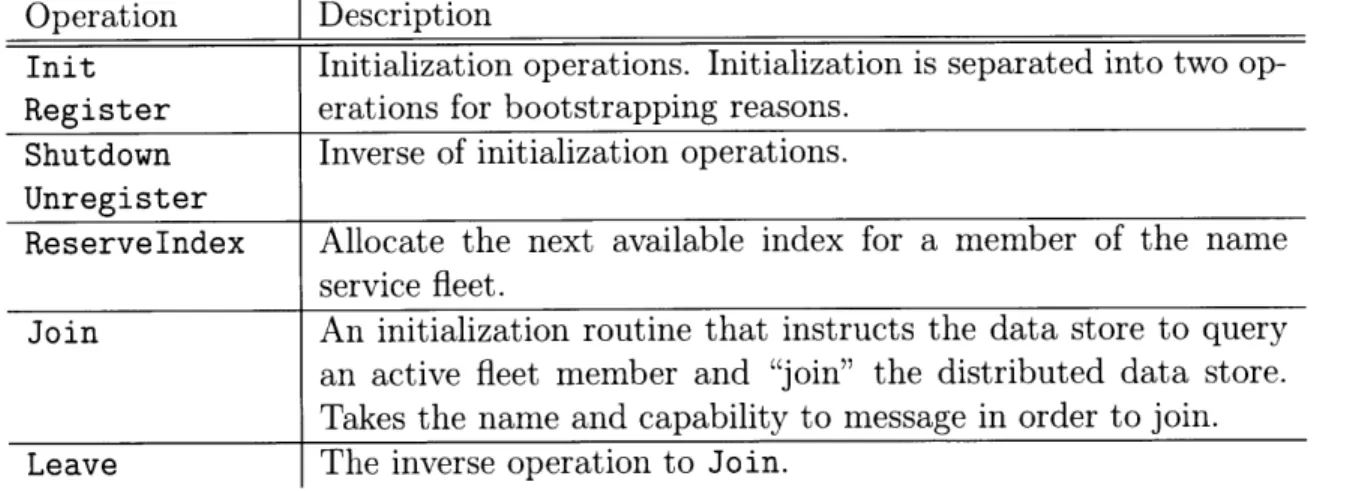
Operation Description
Lookup Read the information stored for a given name.
Register Register a new name. Requires capabilities to modify the
name space, information to be registered, an optional load balancer, and some flags. Returns a capability to unregister this name.
Unregister Unregister a name. Requires capability for that name
re-turned by Register.
RegisterTemporary Allocate a meaningless, unique name and register the given
destination under this name. Returns the name and associ-ated capabilities.
Reserve Reserve a sub-domain of the name space. Requires
capabil-ities for a parent domain and returns a new capability for the sub-domain.
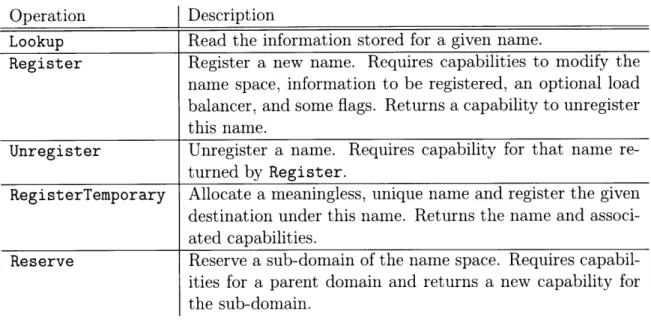
Table 4.2: The public interface of the name service.
essentially anonymous structures that are used to receive messages from services.
A new mailbox structure is instantiated for each mailbox created, and this struc-ture is always registered with the microkernel. The mailbox strucstruc-ture contains buffers for different message delivery mechanisms and the location of the mailbox. In order to validate message sends, it also contains a list of valid capabilities for the mail-box and a list of valid names for the mailmail-box. The delivery buffers are specific to each of the intra-machine delivery mechanisms: microkernel and user-space channels. These fields are platform-specific, and on x86 they are implemented as shared memory regions. For microkernel messaging, the message queue is allocated upon mailbox cre-ation and guarded by locks. An overview of user-space channels was given previously, and details are outside the scope of this thesis.
When a mailbox is created, it is registered with the microkernel. The microkernel keeps a table of all mailboxes in the system in order to validate message sends and channel creations. The microkernel fills in the location field when the mailbox is registered and inserts the mailbox into its table.
4.2.2
Name Service
In the context of this discussion, the name service is treated as a black box and plays a simple role. The public interface of the name service is given in Table 4.2. Lookup queries the name service for information that is stored for a given name. This is used by Send and AliasResolve to read the global name space. If Lookup succeeds, it returns a structure that contains: the type of mapping (direct or indirect), the destination mapped to (mailbox location or another name), and an expiration time for the result. The expiration time is included so that the user-space name cache will refresh the name at regular intervals. This is good practice in order to load balance more effectively and to preemptively detect stale mappings for infrequently-used names that may have changed. The expiration interval is set to be fairly large in order to incur minimal overhead.
Register writes a new name to the name space. This collapses the direct and indirect operations in the messaging API. This operation either registers a new name, if it has not been previously registered, or updates a previous registration, say in the case of adding a new destination to an indirect mapping. If the name has been registered for a direct mapping, then Register will fail. It requires capabilities for modifying the name space, and if a name is being updated then the capability for the name must be presented as well. For example, imagine one tries to register /sys/f s to point to /sys/f s/2, and it already points to /sys/f s/1. Then one must present capabilities for both /sys/fs/* (or a parent sub-domain) and /sys/fs.
Register also accepts an optional load balancer parameter. This parameter is a name and capability for a mailbox that will respond to queries for load balancing names. If this load balancer is not provided, then the name service defaults to a load balancing policy that serves names in approximate inverse proportion to the communication costs.4
Unregister is the inverse operation of Register and deletes a specific name-to-destination mapping. In the case of an indirect mapping with multiple name-to-destinations,
4
Some heuristics are used to avoid crossing discrete jumps in communication cost, so that local fleet members are favored.
a single Unregister operation will not delete the name entirely.
Register and Unregister also accept flags that can activate or de-activate an existing registration. This is useful during process migration to temporarily disable a registration without causing fatal errors in the messaging system, as the name will re-appear eventually and the Send should not fail.
RegisterTemporary is used in the registration of canonical names, and simply registers a unique but meaningless name to a given destination and returns the name. Finally, Reserve is the corresponding operation to ReserveNamespace in the mes-saging API, and simply claims a sub-domain of the name space. It is listed separately from Register because it requires far fewer parameters. Unregister is also respon-sible for removing sub-domain reservations.
This API is given presently for descriptive purposes in the discussion of the messag-ing system. The next section (Section 4.3) discusses the design behind this interface.
4.2.3
User-space Name Cache
Every fos process contains a user-space name cache in libfos. This cache is private to the process and accelerates message delivery by eliminating a round-trip delay to the name service in order to send messages. Some caching of name lookups is necessary for messaging performance, and having a per-process cache offers advantages over a global cache. A per-process (or per-thread) cache improves load balancing over a global cache by having multiple, different responses cached for a given name. It is also potentially faster than a global cache by keeping all data within the process's hardware cache. This comes at the cost at missing more frequently in the name cache, as names are not shared between processes. However, since the name cache does not need to evict names due to capacity or conflicts, the only misses occur because invalid entries or names that have never been accessed. Because most applications have a well-defined, limited set of names they access, this overhead is negligible.
The name cache stores responses to Lookups from the name service. Additionally, the name cache stores whether any channels have been created for a particular name. This latter function necessarily occurs in the address space of the process, as the sole
purpose of user-space channels is to avoid overhead of trapping into the microkernel. The name cache is filled on Send and AliasResolve as needed, or whose entries have expired. When a Send occurs on an indirect mapping, then multiple Lookups to the name service may be required to resolve the name to a final mailbox location.
The main design principle is that the name cache only pulls from the name service. Stated another way, the name service never pushes updates or invalidations to the name cache. This greatly simplifies and optimizes the implementation of the name service, as it limits the distributed state under management by the name service to the name service fleet itself.
The approach taken by the messaging system is to optimistically assume that all cache entries are valid. What this requires for correctness is that the message delivery mechanisms provide error detection and recovery mechanisms. The delivery mecha-nism must detect when a cache entry becomes invalid and, if possible, successfully deliver the message.
4.2.4
Message Delivery
This section discusses the error detection and recovery for microkernel and user-space message delivery. Error detection is tailored to each delivery mechanism, but each mechanism share common themes. The basic idea is that the system must guarantee whenever a message is sent that (i) the destination mailbox is registered under the name to which the message was sent, and (ii) the capability is valid for the mailbox. Error recovery is provided by the messaging library in a delivery-agnostic manner. Complexities arise from the distributed nature of the name caches and the semantics of indirect mappings. To illustrate this, consider the following scenarios:
An application wishes to make a request to the file system. It has previously interacted with the file system, and at that time /sys/fs resolved to /sys/fs/2, and this result is cached by the application in libfos. However, the fleet member registered as /sys/f s/2 still exists but has unregistered the indirect mapping, so that in the global name space /sys/f s no longer maps to /sys/f s/2. When the application goes to make a request to /sys/f s, it will resolve in its private name
cache to /sys/f s/2. When the message is sent, then /sys/f s/2 points to a valid mailbox which is registered under this name, and the application has a valid capability for said mailbox, so the delivery succeeds. This is an error, because /sys/f s is no longer a valid name for the mailbox, and probably with good cause (fault detected, member is over-saturated, it is being migrated, etc.).
Another scenario involves user-space channels. Suppose an application sends mes-sages to a mailbox and a user-space channel is created between the application and this mailbox. The channel is cached in the name cache of the application under the name of the mailbox. At some point, the owner of the mailbox invalidates the ca-pability that the application is using to send messages. Without error detection, the application can continue to deliver messages to the mailbox, even though this has circumvented the security mechanisms.
These are examples of invalid operations that could plausibly succeed in imple-mentations of the messaging system (indeed, they would have succeeded in previous incarnations of fos messaging). The former represents a semantic error, and the latter a security flaw. The former is not a security flaw, because as the mailbox is still reg-istered as /sys/f s/2, an application could send to this name if they so desired. The solution in the first case is that the messaging system in the application must state its destination as /sys/f s, not /sys/f s/2, and the delivery mechanism must check that this is a valid name for the mailbox. The solution to the latter is that either capabilities must be checked when the message is received (the sender does not have reasonable access to the valid capabilities), or the channel must be destroyed when the capability is invalidated.
These solutions are the reasons that the mailbox structure contains a list of valid names and capabilities. Because the microkernel contains a table of all mailboxes, it has the wherewithal to validate names and capabilities, and it provides the routines to do so. Next, I discuss the specific error detection schemes for each delivery mechanism.
Microkernel. The interface to microkernel messaging is a single system call, UkSend.
and the data to send. This system call performs all error checks by confirming that the name and capability are valid for the mailbox at the given location. The messag-ing library must pass the original, intended destination as the destination name. That is, in the first example above, the messaging library must call UkSend with /sys/f s as the destination, not /sys/fs/2.
User-space. user-space messaging performs name and capability checks upon
chan-nel creation. Chanchan-nel creation occurs through system calls, and these routines per-form the same checks as does UkSend. When a capability or name is removed from a mailbox, then another system call allows a channel to be shot down. This guarantees that any time a channel is active, the name and capability it was created under are valid for the mailbox. This addresses the second example, because the channel is destroyed when the capability is removed. Finally, when a channel is created it must be stored in the name cache with the intended destination (e.g., /sys/f s), not the resolved mailbox (e.g., /sys/f s/2).
These methods provide error detection. The messaging library provides error recovery by refreshing the name cache via the name service. If the Lookup fails, then the name has been unregistered and the Send fails. Otherwise, the name cache is updated, and another send is attempted. If this second attempt fails, then the Send fails because subsequent refreshes of the name cache will result in the same behavior.
4.3
Name Service
The name service is divided into two components: the logic of the naming system, and the distributed data store that manages the global name table. The distributed data store consumed the bulk of the design effort, and for that reason merits its own section. This section discusses the design of the naming system logic, and the support required from the microkernel. In addition to the API given in Table 4.2, the name service supports management routines that are given in Table 4.3.
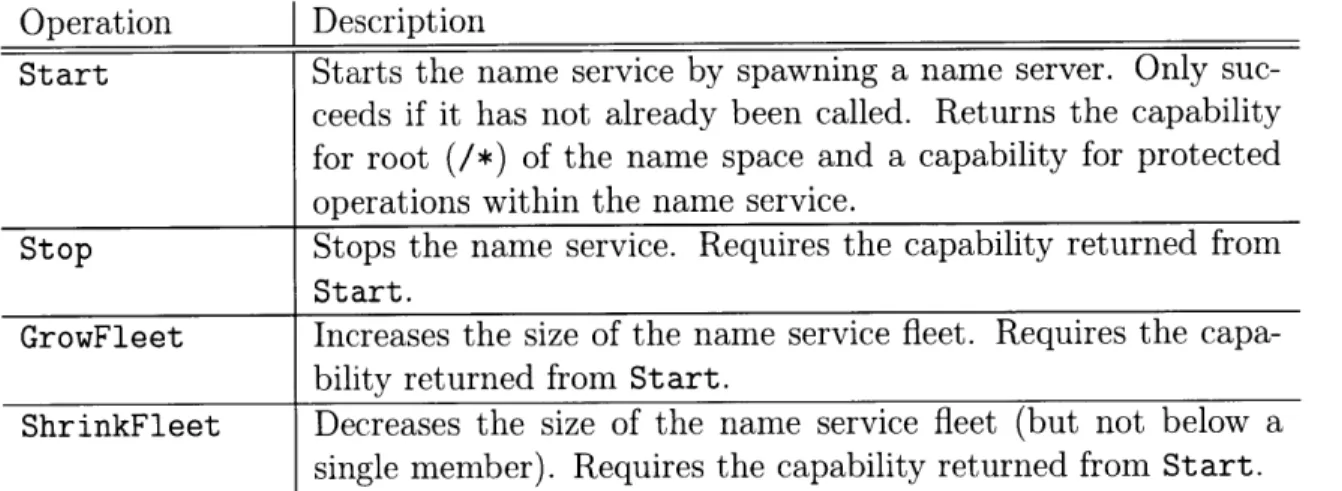
Operation Description
Start Starts the name service by spawning a name server. Only
suc-ceeds if it has not already been called. Returns the capability for root (/*) of the name space and a capability for protected operations within the name service.
Stop Stops the name service. Requires the capability returned from
Start.
GrowFleet Increases the size of the name service fleet. Requires the
capa-bility returned from Start.
ShrinkFleet Decreases the size of the name service fleet (but not below a
single member). Requires the capability returned from Start. Table 4.3: The management interface for the name service.
Start initializes the name service and returns capabilities for the root of the name space and a capability that protects other management tasks. Start will only succeed the first time it is called, and therefore it (and the other management operations) are not used by libfos within a typical application. Rather, Start is called at system boot as the first service started because messaging forms the foundation for all services in fos. Similarly, Stop is called on system shutdown. GrowFleet and ShrinkFleet are currently called in an ad hoc manner within the name service or in stress tests, but ultimately these will be called by a separate elasticity service that determines core allocation.
The name service is implemented in a completely distributed manner. No mem-ber of the name service is distinguished in any way, except for initialization that is performed by the first member spawned. In order to implement the API used by the messaging system (Table 4.2), the name service interacts with a distributed data store that contains the global name space. Its interface is given in Table 4.4. The data store runs as an independent entity within the name service, and registers its own mailbox to handle updates. Updates are processed in separate threads, as the name service runs on top of the dispatcher.
All of the operations in Table 4.4 accept a name (key) and an entry (value). For Insert and Update, the value is the new data that should be in the store. For Delete, the value is required to confirm the version of the data that the name service was
Operation Description
Insert Inserts a new entry into the data store. Update Updates an existing entry with new data. Delete Deletes an entry from the data store. Get Retrieves data from the data store.
Table 4.4: Interface to the distributed data store that manages the global name space.
operating on. Get accepts a pointer to a value structure to fill in. Entries in the data store contain: the entry type (direct, indirect, or a reservation5); the capability that
protects modifications to the entry; and lastly, the destination mapped to the alias (a mailbox location, or a list of names).
Next, the implementation of operations in Table 4.2 are discussed, including the support provided by the microkernel.
Lookup. This is the simplest of the operations. It performs a Get on the data store, and checks the type of the returned entry. If the entry is a direct mapping, then it returns the mailbox location; if it is an indirect mapping, it randomly selects one of the destination names and returns it; if it is a reservation then the name service treats it as though the entry was not present (messages can't be sent to sub-domains). For indirect aliases, random selection occurs using weights specified by the load balancer (if present for this name) or a default scheme that favors local names.
All of the remaining operations modify the name space in some fashion. Because
of the distributed nature of the data store, it can return an error code that signifies an inconsistent state. In these cases, the name service must restart the transaction. This is accomplished by rewinding all changes in the current operation and recursing.
Register. Registration modifies the name space by adding new entries or modifying existing ones. This corresponds to Insert and Update operations on the data store. The registration process begins by checking the data store (via Get) to see if the name exists. If so, then it checks the type of the entry and flags that were passed.