HAL Id: tel-00759808
https://tel.archives-ouvertes.fr/tel-00759808
Submitted on 2 Dec 2012
HAL is a multi-disciplinary open access
archive for the deposit and dissemination of sci-entific research documents, whether they are pub-lished or not. The documents may come from teaching and research institutions in France or abroad, or from public or private research centers.
L’archive ouverte pluridisciplinaire HAL, est destinée au dépôt et à la diffusion de documents scientifiques de niveau recherche, publiés ou non, émanant des établissements d’enseignement et de recherche français ou étrangers, des laboratoires publics ou privés.
Approach for Information Systems Semantic
Interoperability in Supply Chain Environment
Yan Lu
To cite this version:
Yan Lu. Approach for Information Systems Semantic Interoperability in Supply Chain Environment. Computer Aided Engineering. Zhejiang University, 2012. English. �tel-00759808�
分类号: TP14 单位代码: 10335 密 级 公开 学 号: 10508042
博士学位论文
中文论文题目:
供应链环境下的信息系统语义互
操作方法
英文论文题目:Approach for Information Systems Semantic
Interoperability in Supply Chain Environment
申请人姓名: 吕艳
指导教师: 顾新建 教授
合作导师: Hervé Panetto
专业名称: 机械制造及自动化
研究方向: 制造业信息化
所在学院: 机械系
论文提交日期 2012-04-17
Abstract
Multiple enterprises are usually involved in supply chain network, while almost each enterprise has its own information systems and databases (enterprise legacy systems). There are large quantities of information and data intersecting or even repeating with each other, which calls for system integration. Meanwhile in the cooperative process of supply chain, the whole product line or product family is involved in the enterprise systems, including PDM, ERP, SCM, and CRM et al, which also need interaction and integration. Although many data integration methods and corresponding tools have been applied to the business cooperation in the environment of supply chain, however the interoperability of enterprise information systems is becoming more and more complex, because of the restriction from lots of factors, such as the complexity of enterprise application systems and the diversity of heterogeneous data sources, especially the new application demands of enterprises,.
In this dissertation, the interoperability method of networked enterprise information systems in the environment of supply chain is studied, from the point of theoretical modeling and application. The main research contents are as follows:
Chapter 1 states the research background of the dissertation, analyzes the domestic and overseas research status of supply chain integration, and proposed semantic interoperation is an effective solution to deal with the integration of enterprise information systems. Meanwhile it analyzes and summarizes the research status of correlated techniques involved in semantic interoperation. Finally, the organizational chart of the dissertation is provided, stating the foundation, content and significance of research.
Chapter 2 analyzes the SoS (System-of-Systems) characteristic of networked enterprises in the environment of supply chain, proposed the SoNE (Systems-of-Networked Enterprises) paradigm. And then it analyzes the distinction between the interoperability and integration of enterprise information systems. Finally, it proposes the information system interoperability framework of supply chain
enterprises based on the demand of information system interoperability in the environment of supply chain.
Chapter 3 studies the developing method of product ontology. Based on some international standards related to enterprise system integration (such as IEC 62264, ISO 10303 and STEP-PDM et al.), the model-driven ontology developing method is adopted to integrate the business information and technology data related to product life cycle, including product design, make, deliver and et al, into a common shared product ontology.
Chapter 4 discusses the building method of supply chain ontology. Adopting SCOR model as the basic concepts and framework for supply chain ontology, the SCOR supply chain ontology is built by Protégé seven-step method. Meanwhile the semantic description is made by OWL DL. Taking make-to-order of main machine bed as an example, an instance of SCOR supply chain ontology is given. Finally, a simple evaluation system is illustrated about SCOR supply chain ontology.
Chapter 5 researches the ontology merging and semantic interoperability methods. The method combining ontology mapping based on WordNet with reasoning based on rules is adopted to realize the merging of product ontology and supply chain ontology, to achieve a product-centric supply chain ontology. The information systems interoperability of supply chain enterprises is realized by the mapping among ontology and the mapping between databases and ontology. Finally, an instance is put forward in this chapter.
Chapter 6 takes the supply chain process of the double column CNC guideway&surface grinding machine in Machine Tool Company as an example to validate the method for information systems interoperability of supply chain enterprises. Meanwhile, according to interoperability principle, an information systems interoperability platform prototype of supply chain enterprises is developed, to provide as a feasible way for the information integration of supply chain enterprises.
Chapter 7 makes a summary for the whole dissertation, and looks into the future direction about this research topic.
Keywords: ontology; semantic interoperability; SCOR; supply chain; enterprise
Index
Abstract ... 1 Index ... 4 1 Introduction ... 8 1.1 Introduction ... 8 1.2 Research Background ... 101.2.1 Problems of systems integration in supply chain environment ... 10
1.2.2 The state-of-art of theroy for supply chain integration ... 11
1.2.3 The state-of-art of technique for supply chain integraion ... 14
1.3 Ontology and semantic interoparability ... 18
1.3.1 Ontology general question ... 18
1.3.2 Ontology development method ... 20
1.3.3 Semantic matching ... 24
1.3.4 Semantic interoperability ... 26
1.4 Conclusion of literature review ... 29
1.5 Research contents and meanings ... 30
1.5.1 Research foundation and meanings ... 30
1.5.2 Main content and structure ... 31
1.6 Conclusion ... 34
2 Model and framework of enterprise information systems interoperability in supply chain ... 36
2.1 Introduction ... 36
2.2 System-of-Systems (SoS) Paradigm of networked enterprise in supply chain……….36
2.3 System interoperability ... 40
2.3.1 Interoperability definition and classfication ... 40
2.3.2 Difference between system integration and interoperability ... 41
2.4 Models of Enterprise information system interoperability in supply chain44
2.4.1 Problem model ... 44
2.4.2 Solution and Models ... 45
2.5 Framework of product-centric supply chain information system interoperability ... 47
2.5.1 Key elements in supply chain environment ... 47
2.5.2 Framework of product-centric supply chain information system interoperability ... 49
2.6 Conclusion ... 54
3 Model-Driven based Product Ontology Development ... 55
3.1 Introduction ... 55
3.2 Standards based Product information model ... 55
3.2.1 Standards for Product Data Integration ... 55
3.2.2 Standard based Product Ontology Model (ONTO-PDM) ... 58
3.3 Model Driven Engineering and Ontology Development ... 60
3.3.1 Model Driven Ontology development method ... 60
3.3.2 Model Driven Engineering and Model Driven Architecture ... 62
3.3.3 Ontology Definition Metamodel (ODM) ... 64
3.3.4 Model transformation language (ATL) ... 67
3.4 Model-Driven based Product Ontology Development ... 68
3.4.1 Model-Driven based Ontology development framework ... 68
3.4.2 Mapping between UML Metamodel and OWL Metamodel ... 69
3.4.3 Instance of Product Ontology Development based on Model-Driven Method……….72
3.5 Conclusion ... 77
4 SCOR based Supply Chain Ontology Development ... 79
4.1 Introduction ... 79
4.2 Standards of Supply Chain Integration ... 79
4.3 Structure of Supply Chain Operations Reference Model (SCOR) ... 81
4.4.1 Method of SCOR Supply Chain Ontology Development ... 84
4.4.2 Structure and semantic representation of SCOR Supply Chain Ontology88 4.5 Process Instance of Supply Chain Ontology ... 91
4.6 Performance Measure based on SCOR Supply Chain Ontology ... 93
4.7 Conclusion ... 96
5 Ontology based System Interoperability in Supply Chain ... 97
5.1 Introduction ... 97
5.2 Basic Theory of Ontology Matching ... 97
5.2.1 Concept of Ontology Matching ... 97
5.2.2 Pretreatment of Ontology ... 100
5.3 Mapping between ONTO-PDM Product Ontology and SCOR Supply Chain Ontology ... 101
5.3.1 Strategy of Ontology Matching ... 101
5.3.2 Ontology Matching Process ... 103
5.4 Mapping between Database and Ontology ... 110
5.4.1 Transformation from XML file to OWL ontology ... 111
5.4.2 Ontology Matching Algorithm ... 113
5.5 Mechanism of Semantic Interoperability ... 114
5.6 Conclusion ... 116
6 Instance of Supply Chain Information System Interoperability and Prototype Development ... 117
6.1 Introduction ... 117
6.2 Instance of Supply Chain Information System Interoperability ... 117
6.2.1 A Scenario example of supply chain ... 117
6.2.2 Interoperability process of supply chain information system ... 120
6.3 Prototype design and development ... 133
6.3.1 Framework of prototype system ... 133
6.3.2 Function module of prototype system... 134
6.4 Conclusion ... 137
7.1 The main work conclusion ... 138 7.2 Future works ... 140 Reference ... 142
1 Introduction
1.1
Introduction
With the advent and continuously enhancing of global economic from the 1990s, the information industry has raised and develop continuously by the promoting of technological revolution represented by computer technology, biotechnology and microelectronics technology, which has leaded to the rapid transformation from traditional industrial economy to knowledge and information economy. In the global economic environment, the markets and global manufacturing are changing rapidly, which brings great changes to the competitive environment, management mode, business pattern, technical approach and other aspects, causing huge pressure for enterprises. In order to respond to such pressure, enterprises build closer relationship with suppliers and distributors. which exist not only in large international enterprises, but also appears in small and medium-sized enterprises. Enterprises cannot be viewed as being isolated, and enterprise collaboration is no longer just between two partners; they have evolved to what has been described as ‘enterprise networks’, in forms of
supply chain partnerships, extended enterprises and virtual enterprises [Jagdev, 2001].
Supply chain is a system with organization, people, technology, activity, information and resource involved in, to deliver a product or service from suppliers to customers. Supply chain activity transforms natural resources, raw materials and components into final products, and delivers them to customers. A network is composed by the enterprises and enterprise departments involved in this process. The most basic request of supply chain operation is to minimize the inventory and preparation time of whole supply chain, while the following premises should be satisfied when achieving this goal [Jagdev, 2001]:
(1) The clear understanding among supply chain partners must be reached, while the opposite expectation and request should be comprehended clearly.
(2) Seamless material and information system.
manufacturing plan and manufacturing control and et al. of each node.
(4) The information exchange among all nodes must be very effective, ensuring the high efficiency of supply chain.
(5) The information and decision support system of node must be fast response, satisfying the constantly changing demand and the communication with corresponding nodes.
(6) With the converting of industry from product orientation to client orientation, supply chain need make corresponding operation change.
(7) Some issues just like quality management and its incessant improvement consist of a part of the treaty, which are established at the time when supply chain is built.
In the premises mentioned above, the most core demand is that the enterprises in supply chain could interact effectively Although there has been substantial research literature on supply chain interactions, these perspectives and proposed approaches vary greatly. One common tenet is that competitive success depends on managers’ ability to recognize changes in the competitive environment and then to structure organizational, and where appropriate, supply chain resources to effectively meets customers’ real needs[Stanley,2001]. This is a fundamental tenet of Supply Chain Management (SCM)implementation.
Meanwhile in industrial companies, rapidly developed ICT (Information and Communications Technology) is being adopted to handle supply chain management issues, ranging from ERP (Enterprise Resource Planning) to MPC (Manufacturing Planning and Control) and MES (Manufacturing Execution System), facilitating various aspects of the supply chain [Kollberg,2006]. It provides a new way to store, process, distribute and exchange information both within companies and with customers and suppliers in the supply chain. This environment has increasing demands for information or knowledge exchange among enterprises. Therefore in informationalized supply chain, the effective interaction among enterprises mainly depends on the interaction among the information systems of enterprises, which is usually realized by enterprises integration or system integration.
1.2
Research Background
1.2.1 Problems of systems integration in supply chain environment
Supply chain network is usually involved in various enterprises, while almost each enterprise has its own applications and databases (enterprise legacy system). An approach is needed to make the existing applications and databases adjusted to new environment, bring benefit in new environment. There are plenty of information and data intersecting and even repeating with each other, which calls for system integration. Meanwhile during the cooperation process of supply chain, the involved enterprise system is not a single software, but the whole product line or product family about each aspect of enterprise management, including PDM, ERP, SCM and CRM et al, which all call for system interaction and integration. System heterogeneity among quantities of enterprise systems is caused by the difference of developers, application platform, development platform, ,communication protocol and data format used for external exchange etc. Integration of heterogeneous data source is the typical problem in database field. Although at present, there are lots of data integration methods and corresponding tools used for the business cooperation application in the environment of supply chain, the restriction exist from many aspects such as the complexity of enterprise information system, the diversity of heterogeneous data source. And especially the new application demands of enterprises lead to the complexity of enterprise data integration process.
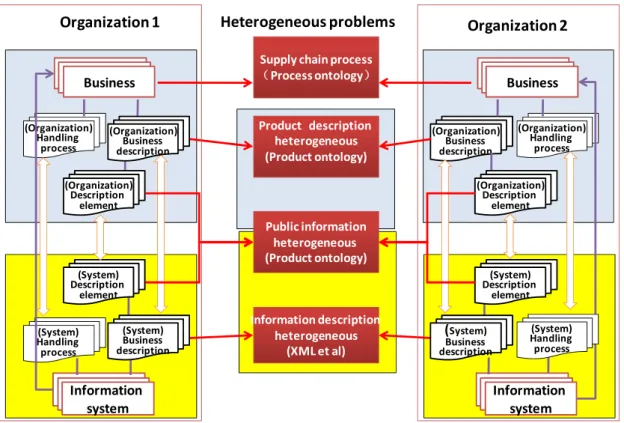
Meanwhile the high demands of information exchange in supply chain environment, and mass information or knowledge spread out in various formats among different enterprise systems, which lead to semantic heterogeneity issues between the existing enterprises information systems. Semantic heterogeneity is a essential problem existing in any application involved two or more groups. The heterogeneity of these systems and the disunity of knowledge expression methods are becoming barriers for the knowledge acquisition by stakeholders. While these collaborations are being adopted, there would be excessive knowledge accumulated,
unorganized and decentralized, which could lead to a considerably low efficiency and inconsistency in their treatments. All these issues will definitely affect everyone’s comprehension when enterprises collaborate in the context of supply chain.
The system heterogeneity and information semantic heterogeneity obstruct the automation of information exchange among enterprises in supply chain, increase the cost of enterprise cooperation and block the development and innovation of supply chain. In the environment of global supply chain, one of the difficult points faced by enterprises is the lack of interoperability between software and information system [Farinha, 2007] [Jardim-Goncalves, 2006a] [Panetto, 2006a].
1.2.2 The state-of-art of theroy for supply chain integration
Manufacture supply chain is a complex network composed by manufacturing enterprises, logistics enterprises, customers and other entities in manufacture field, while the logistics flow, workflow, fiance flow and information flow are all exist in the network. These entities include some management companies, manufacturing enterprises, transshipment warehoouse, suppliers of raw materials and components, logistics companies, distribution center, retailers and end users. Integrated supply chain is the hot research topic both overseas and domestic all the time. Stanley et al. considered that building a completed integrated supply chain system, and dividing it into different types to serve for different market, which could improve the survival and competitive capability of enterprise [Stanley et al., 2002]. Supply chain integration brings positive effects to enterprises for enacting and adopting correct competition policy, which plays an irreplaceable role in enhancing enterprise working performance and improving achievement [Narasimhan, 2002].
There have various views about supply chain integration. Ming-gang Sui et al considered that integrated supply chain referred to a “virtual organization” composed of members with a common goal in supply chain, optimizing the organization target by information sharing and the coordination and cooperation of finance and resource among the members of the organization [Ming-gang Sui, 2002]. Prabir et al
considered that supply chain integration is that the circumstance that in the certain environment of sociality, economy and technology, the market, resource, information and organization form related to enterprises are recognized and selected effectively by enterprises to achieve management integration, to make the supply chain networked, smart, flexible, individual and optimized [Prabir, 2005b]. Togar et al. emphasized the importance of supply chain integration and proposed four definition models: logistics synchronization, information sharing, incentive consistent and collective learning, which are interrelated, interdependent and interactive, and form a supply chain network system [Togar, 2004]. Barua et al considered that supply chain integration referred to the circumstance that based on the integration of data information and business process inside enterprise, the scope of integration is expanded to enterprise external to link information systems inside enterprise with systems from business partner. Each member in supply chain can coordinate its own business operation according to the correct information of whole supply chain, in order to realize the enterprise integrating including customer service and support, plan and forecast, product development, production manufacturing, purchase and human resource et al [Barua, 2011].
With the change of development pattern of manufacturing industriy, the appearing technology of integrated manufacturing, green manufacturing, agile manufacturing, intelligent manufacture, networked manufacturing and mass customization manufacturing enhance the outstanding effect of supply chain integration and management on aspects of resource management, logistic transportation, organization structure and performance measurement [Guo-ning Qi, 2001] [Guo-ning Qi, 2004] [Xin-jian Gu, 2001] [Xin-jian Gu, 2002]. Xin-jian Gu et al disused on the development strategy of Chinese enterprise cluster integrated manufacturing based on the comparison of various integrated manufacturing patterns of enterprise cluster such as supply chain integrated manufacturing system and strategic alliance integrated manufacturing system et al. And they pointed out the significance of supply chain integration and detailed summarized on the function structure and specific application of manufacturing supply chain integration system
[Xin-jian Gu, 2003].
About the supply chain integration models under various manufacturing modes, Yun-bo Zhang et al proposed the supply chain flexible system integration model for the supply chain in manufacturing. According to supply and demand principle, use systematic analytical method to analyze the flexible generation and development motive of supply chain in its life cycle, and the dynamic characteristics of supply chain flexibility. And then six flexible sub system models were built, including research, resource, manufacturing, logistics, information and decision, while the supply chain flexible system integration model was built based on the inner relationships among each sub systems [Yun-bo Zhang, 2004]. Yong-jun Sun et al fully borrowed ideals from available CIM modeling method, aiming at the characters of agile supply chain, analyzed about the essence of agile supply chain, proposed the integration modeling method on agile supply chain and general model of agile supply chain, which was based on hierarchical control thought and multiple views modeling theory. The multiple views model of agile supply chain was built to analyze the characteristics of each view model and the relationships among them.
Fundamentally speaking, the views mentioned above are all based on information integration. The information integration of supply chain was divided into three hierarchies in [Bu-tong Zhang, 2003] [Ting-bin Chen, 2005]: data level, information level and knowledge and decision level, while the integration details and integration process were illustrated in Table 1-1:
Integration
hierarchy Integration process Integration details Data level Inner data integration of
bottom
The seamless integration of information flow is realized inside core enterprises of supply chain. The key points of integration are to settle down to the data acquiring, data flow and data consistency. Distributed and multilayer structures are adopted to realize the seamless integration.
Information level
Enterprise system integration
The concordance between enterprise heterogeneous systems and data sources is realized inside enterprise. The information exchange between new and old systems is realized by adopting asynchronous information mode inside enterprise, to realize the integration with Legacy system, which is the main component of traditional EAI (Enterprise Application Integration).
System concordance of supply chain enterprise
The information exchange and transaction procedure automation among enterprises is realized based on Web service, XML-RPC and other ways. The synchronization and coordination of upstream and downstream enterprises are realized by adopting service-oriented integration, and realize the workflow of supply chain, in order to achieve the dynamic alliance of supply chain enterprises: B2Bi(Business to Business Integration).
knowledge and decision
level
Business process management
Take the operational programs inside enterprise to coordinate with upstream and downstream enterprises and realize the customer-driven dynamic integration system. Make B2C, B2B, CRM, ERP and SCM integrated together and improve the response ability and flexible management of enterprise, to realize real-time and intelligent management for whole supply chain: BPM (Business Process Management).
Knowledge discovery and decision support
Realize the sharing and management in knowledge level by integration of multi data sources, to support the whole decision and optimization of supply chain.
1.2.3 The state-of-art of technique for supply chain integraion
technology support and data representation at present. The relatively main methods include dynamic integration technology of loosely coupling modularization, supply chain intelligent integration method based on Agent and supply chain integration method based on knowledge representation.
The dynamic integration technology of loosely coupling modularization includes some workflow management technology such as Internet/Intranet technology, Web technology, electronic data interchange (EDI) and CIMS technology, distributed components and XML centric information technology et al. As to dynamic integration, the dynamic integration technology of loosely coupling modularization realizes the multilevel enterprise structure of inner enterprise mainly by modularization technology, and solves the problems of data flow integration inside supply chain enterprise, which provides an excellent solution for supply chain information integration [Bu-tong Zhang, 2003]. As to the integration of loosely coupling modularization supply chain system, a typical application was proposed by Sahuguet et al to realize the enterprise solution of complex problems by the combination of J2EE multi-layer structure and XML and Web Services [Sahuguet, 2001]. The enterprise application integration (EAI) based on internet or intranet is effectively supported by the combination of these technologies. The J2EE provides the support for Web service and realizes the dynamic integration based on XML among supply chain enterprises, which effectively supports Business to Business Integration (B2Bi). Thomas proposed using XML and relevant technologies to realize the message-oriented asynchronous mode, to solve the problems on EAI and realizing Service-Oriented Integration (SOI) based on Web service, which then solved the problems on B2Bi [Thomas, 2004]. After analyzing the research status of manufacturing industry supply chain integration systems, Chen et al. proposed a kind of expandable platform based on Service-Oriented Architecture (SOA) for the collaborative integration manufacturing of enterprises, to realize the information integration among manufacturing enterprises, which mainly through building the basic system structure of electronic business and supply chain enterprises application by Web Services to provide the dynamic application integration inside and outside
enterprises based on service [Chen, 2006]. On the analysis the status of enterprise supply chain and the evolution of electronic pivot systems, Zeng et al proposed a way based on B2B electronic pivot systems to realize enterprise information integration, which makes the seamless merging between electronic pivot systems and mature information technology such as ERP and CRM, and then removes the difference and limit among enterprises and supply chain members during supply chain process to realize information integration [Zeng, 2003].
Supply chain intelligent integration method based on Agent is to simulate, optimize, implement and control the integrated working process of supply chain by using intelligent agents which have abilities of reasoning independently and deciding independently, and multi-agent systems composed. In 1993, Fox et al built the research project named by “Integrated Supply Chain Management”, which image that managing the supply chain inside enterprise by intelligent and independent objects instead of people to realize the integration on the knowledge and decision of supply chain process, and build the corresponding multi-agent system framework model [Fox, 1993]. Nissen studied the supply chain integration based on Agent, proposed a suit of supply chain intelligent agent system to express and conduct the commercial activities among product users, buyers and suppliers automatically, and made comparison between this method and integration methods based on EDI and Web Service respectively, drawing a conclusion about the application necessity of different methods under different enterprise supply chain environment [Nissen, 2002]. On the base of analyzing the effective ways to deal with challenges under complex and changeful global market environment for manufacturing industry, Zhang et al discussed the defects of existing technology systems such as MES, SCM and ERP et al in responding to these challenges, and proposed combining the multi-agent systems with agile manufacturing systems and electronic manufacturing systems and building the physical model and simulation framework based on Agent to realize the effective integration for enterprise supply chain process and supply chain network was the best approach to deal with these problems [Zhang, 2006]. Wang et al studied the effective integration of enterprise supply chain under the environment of electronic business,
proposing an approach based on agent intermediary to realize the supply chain integration of electronic business, which could coordinate and process the information and data flow effectively during the supply chain service process and could be combined to the business activities under the condition adding to various constraints, and then could respond to the changeful and uncertain operation environment of enterprise activity process effectively [Wang, 2008]. As to the complex and changeful environment of business process for each link of enterprise supply chain, virtual market was introduced by Kaihara to propose a kind of multi-agent system based on supply chain, which could be used to solve product configuration problems, build discrete resource configuration mathematical model and match corresponding algorithm under indeterminacy condition, and then realize the complex and accurate supply chain integration management [Kaihara, 2003].
Supply chain integration method based on knowledge representation is mainly embodied in using knowledge transforming technologies such as XML (Extensive Markup Language) to study the knowledge integration of Supply chain heterogeneous systems and realize the visit to enterprise information. XML is the markup language used to mark electronic documents and make them own constitutive property, which could be used to mark data and define data type. Meanwhile, XML is a kind of source language allowing users to define their own markup expression, providing unified approach to describe and exchange structured data independent in application softwares or suppliers, which is very fit for web transmission and information integration. Nurmilaakso et al studied the supply chain information integration under electronic business by using main XML technologies, constructed mathematical model, and discussed the application of information integration system based on XML in practical enterprise supply chain in detail, and how XML technologies could and in which conditions could realize the concordance for the business process of all partners in supply chain such as source, make, sale and finance et al, while conducting standardized archiving for the use of XML technologies in supply chain process and discussing the defects of present supply chain information integration application based on XML [Nurmilaakso, 2002a] [Nurmilaakso, 2004b]. Prabhir et al researched
the integration of information technology and organizational management in enterprise supply chain process, pointed out the significance of knowledge transformation and data interaction in integration based on the analysis of the faced problems for some aspects of logistic process such as deliver, source, stock control, assignment management and customer service et al, and discussed the concrete application of supply chain process management and communication technologies in each link of supply chain, which include XML, RDF and EDI (Electronic Data Interchange) et al [Prabhir, 2003a].
The integration technologies of supply chain systems mentioned above could realize the supply chain integration to a certain extent and , while for solving the problems involved in supply chain system integration in wider scope or more effectively, it’s necessary to concern about system integration on semantic.
1.3
Ontology and semantic interoparability
1.3.1 Ontology general question
Ontology is a subject originated from philosophy and formal logic. The concept of ontology is originated from philosophy field, being as a research branch of philosophy for a long time. Ontology is defined as “systematic description to the objective existence in real world, exactly the ontologie” by Aristotle, the ancient Greek philosopher, which means that ontology is the systematic explanation or statement of objective existence, concerning about abstract essence of objective reality.
In the 1980s, ontology was introduced in artificial intelligence field to describe the concepts in real world and given new definition. Thereinto, the most famous definition is from Gruber that an ontology is an explicit and formal specification of a shared conceptualization [Gruber, 1993a]. Ontology could formally express knowledge as a set of concepts and their relationships in certain area, to keep its the semantic. In detail, ontology provides lexical concepts in object domain and hierarchy classification of concepts for compute readable and processiable. Ontology not only
defines the class, relationship and classification, but also uses formal ontology representation language to express them. It’s a kind of structured language, which can support various consistency check and interoperability between different applications. Therefore, ontology is a promising method to describe knowledge of different types and forms through unifying the metamodels of knowledge representation.
According to the difference of application fields, ontologies of different types should be defined to meet applications’ demands. Metadata ontology is used as knowledge expression language, such as Dublin Core [Weibel, 1995]. Upper ontology is used to provide the ontologies about common sense in objective world. Domain ontology is about ontologies in specific subject areas. Problem and method ontology is used to provide the terms involved in specific tasks or the concepts and relationships used for the problem reasoning of specific tasks. Application ontology contains the ontologies used for specific application knowledge modeling. Thereinto, domain ontology is the most widely defined and used in engineering applications.
In early artificial intelligence field, ontology representation language is based on first-order logic or description logic, such as KIF (Knowledge Interchange Format) [Genesereth, 1992], Ontolingua [Farquhar, 1997] and Loom [MacGregor, 1991]. At present the widely used ontology representation language is the semantic web
ontology language established by W3C1 group, including RDF, RDF Schema, OIL,
DAML+OIL and OWL et al. Thereinto, OWL is the most widely used ontology representation language presently. The famous softwares and tools used for ontology
development include Protégé2, DUET (DAML UML Enhanced Tool) [DUET, 2008],
XP [deVos, 2001a] [deVos, 2001b] and VOM (Visual Ontology Modeler)3 et al.
The application fields of ontology are mainly involved in the following aspects: (1) Knowledge management. A unified framework or a standard model is built by ontology to reduce the diversity of concepts and terms. Ontology can be reused to avoid the repeated analysis of knowledge domain. For different people have different knowledge structures especially on the multi-discipline knowledge management,
1 http://www.w3.org/
2 http://protege.stanford.edu/
ontology can provide a unified knowledge framework as a common and shared knowledge reference. In the application of intelligent information retrieval, ontology is usually acting as a domain model about customer interested domain. Besides, it also used as the knowledge representation language system and standard for annotating documents uniformly. Except for information retrieval, ontology can support the filtration and maintenance of knowledge and the generation of automation documents.
(2) Support the interoperability among different systems. Ontology can realize interoperability and integration among different systems by translating and mapping among different modeling methods, paradigms, languages, softwares and tools. The information from variously different and dispersive sources can be integrated by ontology. When the distributed applications need knowledge from different applications, forms and granularity, ontology can be used to support the information integration and automatic acquisition process. Ontology is the sharing and clear expression, so it can be used in the annotation of multiple data resources, not only in the form of webpage, but also XML document and relationship database et al.
(3) Support networked electronic business. In the Web based electronic business, the ontology exists as the tool providing knowledge sharing and reusing on knowledge layer and the support for semantic search. Building standard ontology in business fields can provide the transformation service of different data structures based on ontology and support the automatic and electronic business data transmission.
1.3.2 Ontology development method
The ontology development method contains a set of rules, processes, practices, approaches and activities of ontology design, construction, evaluation and application. Presently, the most of ontology development methods are about ontology construction, while few are about ontology reuse, maintenance and evolution. Gruber proposed the five principles of ontology construction: clarity, coherence, extendibility, minimal encoding bias and minimal ontological commitment, which have been the influential
theory about ontology construction so far [Gruber 1995].
No any ontology development method is the best or most correct. Ontology development must be a repeated circular process, and calls for a strictly standard flow. However, on one hand, ontology modeling engineering has still stayed in a relatively immature stage; on the other hand, for the difference of fields, the scope and depth of ontology application in engineering are also different. Therefore many ontology modeling projects have their own unique methods. The common used ontology development methods include IDEF5, Skeletal Methodology, TOVE, Seven-step Method developed by Stanford University and Methontology Framework et al. Among them, Methontology Framework standardizes the whole life cycle of ontology from ontology definition, which not only supports the ontology construction starting from scratch, but also supports reusing other ontologies [Fernández-López, 1999].
There are some ontology development methods having great differences from typical ontology construction methods mentioned above. Devedžić proposed a method adopted object-oriented software analysis and design philosophy [Devedžić, 2002]. Its basic principle is that ontology should express the concept, property of concept and the value of property, meanwhile expressing the event and the reason, influence, process and time of the event. Ontology has the hierarchical relationship, and most of ontologies support the relationships such as generalization, inheritance, aggregation and instance. Therefore ontology construction begins with assembling domain vocabularies and adopts object-oriented analyzing method, and then generates domain ontology related to application systems. Paslaru et al proposed a way to develop ontology by reusing knowledge resource, which firstly expressed the concepts coming from outside knowledge resources, defined universal term vocabulary and concepts, and then selected corresponding relationships [Paslaru, 2005]. This approach could improve the efficiency of ontology development and reduce the cost of development. Web 2.0 technology raised in recent years was introduced into ontology development by O’Reilly, which adopted Folksonomy as the foundation of ontology development to reduce the time of development [O’Reilly, 2005]. Folksonomy comes from the tags by cooperative construction, which is the relatively fuzzy information classification
for ontology. Although folksonomy can provide a kind of ecosystem to change the classification results dynamically, it can’t be used effectively in the knowledge classification and sharing. Because it lacks of solid structure, only a set of terms [Gruber, 2005c].
Object-oriented software design philosophy is applied to ontology development by the model-driven modeling and developing of MDA. Introducing UML into ontology engineering was firstly proposed by Cranefield, which has become the knowledge representation and exchange approach to bridge software engineering and ontology engineering [Cranefield, 2001a]. Cranefield defined the ontology development method based on UML and used OCL to express ontology constraint. For UML lacked normative definition, Cranefield then proposed the method to integrate UML and RDF(S), which was based on a series of standards such as XML, RDF(S), XSLTs and XMI et al [Cranefield, 2001b]. Baclawski et al also proposed two ontology development methods based on UML [Baclawski, 2002a] [Baclawski, 2002b]. The first one defined the mapping rules of UML and DAML+OIL in concept level, and expanded UML metamodel based on the corresponding concepts of DAML+OIL. For the first method had introduced some new concepts into UML metamodel, then they developed an independent ontology metamodel UOF (Unified Ontology Language) based on MOF, which was an inspiration of current ODM proposal. Falkovych et al proposed the mapping method from UML to DAML+OIL by XSTL [Falkovych, 2003]. The problems involved in network ontology development and evolution life cycle in distributed application were researched in the
NeOn4 project of the 6th framework of European Union. It developed a series of tools
and relevant methodologies and trying to provide a kind of economically feasible method to manage the lifecycle of new generation semantic application, especially developed some ontology metamodels relevant to OWL ontologies, rules, mapping and module ontologies [Haase, 2007].
Although the research on ontology development has lasted for a very long time
and various ontology development methods have been explored and practiced. For the ontology engineering still in the developing stage without mature application, there are quantities of problems existing in building and development process of domain ontology.
(1) Construction process is not normative.
Currently, the common construction methods are all summarized from the development process of specific domain ontologies, with limited application field. Most of them have few correlation techniques, and rough detail, while there is no method completely according to life cycle development method. In addition, for no unified construction principle existing as a guide, it’s hard for the whole construction process of ontology to be organized normatively.
(2) Demand analysis is insufficient and construction process is planless.
The concrete demand of ontology development, especially the ontology development of a specific field, could not be described clearly, which will directly lead to the lack of plan and control for the whole ontology construction process.
(3) There is no unified evaluation criterion.
There is no unified evaluation criterion about ontology result, also any standard test set, which make it hard to evaluate the construction result of ontology reasonably and will bring negative effect to ontology application and further expansion.
(4) The method of ontology further expansion is absent.
With the continuous developing and changing of the domain, there must be more and more domain concepts and relationships to be introduced into core ontology. It will expand the existing ontology and provide stronger semantic representation ability. However, the maintenance and expansion of existing ontology have been not yet researched and supported.
(5) The sharing and reusing of ontology cannot be full ensured.
The purpose of domain ontology is to provide the semantic basis for different systems when communicating with each other. Meanwhile, ontology construction process is also the robotic accumulation process of human knowledge. Therefore, sharing and reusing are the essential requirements of ontology. How to ensure that
during the construction process of domain ontology is very important.
1.3.3 Semantic matching
The research field of ontology is mainly involved in three aspects: agent-based software interoperation, knowledge acquiring and nature language processing. Among them, semantic matching is based on above-mentioned aspects and is the important means to employ ontology. Ontology matching methods can be divided into four types according to input data process: terminological technology, structural technology, extensional technology and semantic technology [Euzenat, 2007] [Giunchiglia, 2004].
(1) Terminological technology is a name based method, and seeks the similarity by comparing the character string of input elements such as tags, concept names and annotation et al. According to the difference of data process, it can be subdivided into string-based method and linguistic-based method. String-based method adopts some approaches such as string standardization, edit-distance and string comparison et al to estimate similarity. This method is suitable for the comparison of very similar words. Thereinto, a series of means of string standardization such as switching between uppercase and lowercase, abbreviation and removing space et al, are also the data pretreatment methods. The means adopted by linguistic-based method is nature language processing, which need recognize the grammatical structure and sequence of terms, usually with the help of external resources such as dictionary. It is situtable for processing the phrase similarity.
(2) Structure-based technology can be applied to calculate the similarity between ontologies, including the method on comparing internal structure and the relational structure. Internal structure contains concept names, annotation, property, property domain, data type of property and mulitiplicities et al. Internal structure provides a basis which algorithms can rely. Comparing one type of structure singly can’t reflect the similarity between ontologies, so this method is usually not used alone. Relational structure contains the relationship between class and subclass, hyponymy and
property relationship et al. The most universal structure relationship is the taxonomic relationship. The method on comparing relationship structure can add the relationships among entities of ontology to the similarity comparison, which is usually used together with terminological method.
(3) Expansion method is usually used in the situation that the ontologies share set of individuals, which seek the relationships among concepts by comparing individuals. Statistics and individuals similarity can be used here..
(4) The characteristic of semantic-based technology is that model-theoretic semantics is used to justify their results, which is a deductive method. It cannot be used alone, and usually acting as a complementary approach to ensure the completeness of mapping. Some common means contain: adopting external data source such as some upper ontologies including DOLCE, Cyc and SUMO et al [Lenat, 1990] [Niles, 2001] [Gangemi, 2003]; propositional method and description logic technology et al. There are a few such technology developed and used at present.
Based on the analysis of ontology matching technology from articles such as [Euzenat, 2007b] [Bruijn, 2003] [Kalfoglou, 2003b], the existing ontology matching methods is classified according to the criteria of above-mentioned four matching technologies and the matching automaticity, which is shown in Table 1-2.
Table 1-2 The classification of ontology matching technology
Terminologyical technology
Structural technology Extensional technology Semantic technology Match ing au toma tic ity Automa tic ma tch in g MOMIS[Bergamaschi, 2001] IF-Map[Kalfoglou, 2002] QOM[Ehrig, 2004] S-Match[Giunchiglia, 2004] Artemis[Castano, 2000] H-Match[Castano, 2006] Tess[Lerner, 2000] Cupid[Madhavan, 2001] Falcon-AO [Jian, 2005] MoA [Kim, 2005] XClust [Lee, 2002] ASCO [Bach, 2004] BayesOWL [Pan, 2005] MOMIS[Bergamaschi, 2001] IF-Map[Kalfoglou, 2002] QOM[Ehrig, 2004] Artemis[Castano, 2000] H-Match[Castano, 2006] Tess[Lerner, 2000] Cupid[Madhavan, 2001] Falcon-AO [Jian, 2005] XClust [Lee, 2002] ASCO [Bach, 2004] BayesOWL [Pan, 2005] OMEN [Mitra, 2005] DCM [Chang, 2005] QOM[Ehrig, 2004] S-Match[Giunchiglia, 2004] Artemis[Castano, 2000] H-Match[Castano, 2006] Cupid[Madhavan, 2001] Falcon-AO [Jian, 2005] MoA [Kim, 2005] XClust [Lee, 2002] ASCO [Bach, 2004] BayesOWL [Pan, 2005] OMEN [Mitra, 2005] OntoMap[Kiryak ov, 2001] S-Match[Giunchi glia, 2004] Semi-aut omat ioc m atc hi ng MAFRA[Maedche, 2000] PROMPT[Natalya, 2003] GLUE [Doan, 2002] CAIMAN[Lacher, 2001] Hovy[Hovy, 1998] TranScm[Milo, 1998] DIKE[Palopoli, 2003] SKAT[Mitra, 1999] Clio [Miller, 2000] MAFRA[Maedche, 2000] PROMPT [Natalya, 2003] OntoMorph[Chalupksy, 2000] Hovy [Hovy, 1998] TranScm [Milo, 1998] DIKE [Palopoli, 2003] SKAT [Mitra, 1999] Clio [Miller, 2000] TranScm[Milo, 1998] DIKE[Palopoli, 2003] SKAT[Mitra, 1999] ONION[Mitra, 2002] OntoMorph[Chal upksy, 2000] Man ual DELTA[Clifton, 1997] CtxMatch[Bouquet, 2003] OntoBuilder[Modica, 2001] COMA[Do, 2002] FCA-Merge[Stumme, 2001] COMA[Do, 2002] ToMAS[Velegrakis, 2004] MapOnto[An, 2006] RDFT[Omelayenko, 2001] OntoMerge[Dou, 2005] CtxMatch[Bouquet, 2003] ToMAS[Velegrakis, 2004] OntoBuilder[Modica, 2001] COMA[Do, 2002] MapOnto [An, 2006] OBSERVER[Me na, 1998] CtxMatch[Bouqu et, 2003] 1.3.4 Semantic interoperability
representation of various domains by methods referring to and mapping of knowledge system (representation for concept, constraint, relationship and axiom), to make information systems have the semantic interaction ability. As a kind of high-level interoperability idea and problems urgent for user demand, semantic interoperability is one of research hotspots currently. Realizing semantic interoperability can make the information between human, between machine and man and even between machine and machine to communicate with each other accessibly, and also can make machine understand the meaning of information. It would realize the high automation and intelligence of information exchange and sharing, improve and promote the exchange mode and quality of information thoroughly. Many scholars have done researches on semantic interoperability, mainly on structured and formal expression on knowledge.
Paolo et al bridged the gap between HTML based internet and RDF based semantic web by linking the words of original text to concepts of ontologies, and developed fully automated methods for mapping equivalent concepts of imported RDF ontologies (for this prototype WordNet, SUMO and OpenCyc). These methods will thus allow the seamless integration of domain specific ontologies for concept based information retrieval in different domains [Paolo, 2003]. Jacob et al proposed the knowledge-based approach to solve heterogonous problem, using fusion rule to manage the semi-structured information that is input for merging. The integrated usage of fusion rules with a knowledgebase offers a practical and valuable technology for merging conflicting information [Jacob, 2006]. Anthony firstly used a series of analysis techniques to distinguish similar model elements such as relationship and attribute. And then the statistical analysis technique was applied to a preliminary integrated data set to estimate the relationship among model elements more accurately, using repetitive process to realize the integration of heterogeneous data sources [Anthony, 2006]. Zhao et al presented algorithms to resolve schematic discrepancies by transforming metadata into the attribute values of entity types, keeping the information and constraints of original schemas. Although focusing on the resolution of schematic discrepancies, the technique works seamlessly with the existing techniques resolving other semantic heterogeneities in schema integration [Zhao,
2006].
Meanwhile, many researches introduced ontology into semantic interoperability. Qi proposed a semantic-driven integration method named a priori approach. The innovation was that each data source participated in integration process contains an ontology, and this method could ensure all data sources quote the sharing ontology, to realize the automation of integration process. Qi proposed two integration algorithms: one is sharing ontology, which would be expanded during the integration process; the other is the instance of ontology data source built on the sharing ontology. At the end, Qi pointed out that this method could integrate automatic electronic classification and enterprise engineering data by using PLIB ontology model [Qi, 2006]. Bellatreche proposed a kind of formalized ontology acting as a relevant role in interoperation framework of information system. Class and attribute were used by this ontology to describe the communication behavior among agents. Bellatreche also proposed communication behavior ontology provided interoperability support, by recognizing the communication behavior of a kind of agent communication language for the communication behavior instance of another communication language. This ontology used OWL to describe attribute and class [Bellatreche, 2006]. Bermúdez expounded the demand of enterprise business process and built the research foundation, proposing a concept model. And then, the current status and future trend of business process modeling and process interoperability were reviewed based on this model. At last, Bermúdez proposed a kind of innovative semantic web technology and a agent-based framework to facilitate the business process cooperation [Bermúdez, 2007]. Ruinan proposed the three-step method to enhance the interoperability of heterogeneous semantic resources. Firstly, referring to the original representation language for semantic representation, adopted OWL DL of fulcrum form to construct the heterogeneous representation. Secondly, mappings were built among these standard resource concepts, and then stored in an ontology named clarity. Thirdly, an approach to rank these mappings was needed to satisfy user’s demand, which was developing in Semantic Resources “Interoperabilisation” and Linking System (SRILS) [Ruinan, 2006]. Silva et al studied the structure of semantic XPath processor, which
defined the mapping from XML to RDF and allowed the interoperability on semantic layer for XML documents. Model mapping method was used in RDF to express XML instance and XML mode. Opposite to the common structural mapping approaches, this expression could keep the structural order. And this processor could generate feedback for unlimited XML model and RDFS/OWL ontology [Silva, 2006].
1.4
Conclusion of literature review
Based on above-mentioned summary of research status about supply chain integration theory and related technology, there still exist some problems in current research:
(1) There are many theoretical researches on supply chain integration framework, but the not on semantic level, and there is no actually used system for semantic interoperability of heterogeneous information systems.
(2) There are many researches on ontology development method, but most of them are from bottom layer, with big construction workload and high difficulty. Meanwhile, the reuse degree of ontology is low, and there is not any good ontology putting into use inside the country.
(3) The research on ontology mapping is the foundation to realize semantic interoperability. But looking at the current research status, one heterogeneous problem is solved by one specific method. And as to the semantic interoperability of heterogeneous information systems in complex supply chain environment, there is not any method that adopts different mapping methods to solve semantic mapping according to different knowledge structures, knowledge objects and heterogeneous systems.
(4) The ontology covers all aspects of supply chain environment is rarely appeared.
1.5
Research contents and meanings
1.5.1 Research foundation and meanings
The dissertation is supported by supported by Chinese Science and Technology Support Plan Project (2006AA04Z157) “Research and application on ontology-based business cooperation oriented heterogeneous systems integration technology”, Chinese National Natural Science Foundation Project (61175125) “Semantic interoperability of heterogeneous systems in supply chain based on SCOR”, and Zhejiang Provincial Natural Science Foundation Project (Y107360) “Research and application on business cooperation oriented semantic interoperability mechanism”. Meanwhile this work combines with the research results from the research group of professor Panetto in CRAN at Nancy in French. and researches on the interoperability of enterprise information systems in the environment of supply chain.
The research group of professor Panetto in CRAN has the long-term research accumulation about product-driven systems and system interoperability. Product is set as the centre of enterprise system integration, and Product-Driven Paradigm is proposed for tracing the information of product life cycle, in order to promote the integration of product manufacturing and business process. Morel proposed applying SoS (System-of-Systems) paradigm to the research on enterprise integration and interoperability, which regards enterprise systems as components of system and studies the principle of enterprise system interoperability and guides the engineering application from SoS paradigm [Morel, 2007]. Under SoS paradigm, based on some international standards such as IEC 62264 and ISO 10303 STEP-PDM, Turis constructed the product ontology model ONTO-PDM to realize the product-driven interoperability of enterprise manufacturing systems [Tursi, 2009a].
Although there are quantities of researches on supply chain system integration, however realizing the semantic integration of networked enterprise information systems in supply chain environment is always a difficulty, and meanwhile there is not any effective integration project on semantic level applied to practice. Based on
above foundation, the information system interoperability mechanism and related techniques of networked enterprises in the environment of manufacturing enterprise supply chain are studied in this dissertation. Adopting ontology and standard based semantic interoperability method to deal with the complex business cooperation and heterogeneous systems in supply chain, which is an effective approach to realize the semantic integration of networked enterprise information systems. The purpose of the dissertation is to solve the interaction of heterogeneous information systems of networked enterprises, improve the correctness and effectiveness of information interaction and send the correct feedbacks to enterprise decision level, which would not only improve the production value of single enterprise, but also optimize the whole supply chain network. Interoperation is used to deal with the information interaction among various enterprises in supply chain environment, and when a new system enters into the enterprise system network, the original enterprise system can work side by side with the new system, which would reduce the cost to introduce new technology. Adopting ontology to formalize and standardize production information and supply chain model can realize the supply chain information model combining product and process, and enhance the interoperability of enterprise information system to semantic level. The sharing ontology can concentrate the explicit knowledge resources from various media such as text, diagram, article, patent, standard, application system, source code, product data model and product drawing et al, and systems, together with the tacit knowledge from human brain to realize knowledge ordering and then improve the efficiency of information interaction, knowledge sharing and knowledge reusing among enterprises.
1.5.2 Main content and structure
In this dissertation, the interoperability method of networked enterprise information systems in the environment of supply chain was studied, from the point of theoretical modeling and application. The main research contents are as follows:
interoperability in supply chain environment. Starting from the demand of information system interoperability, we propose the framework of supply chain enterprise information system interoperability.
(2) Based on the product ontology model ONTO-PDM developed by the CRAN ( the laboratory of Nancy First University in France) and some international standards related to enterprise system integration such as IEC 62264 and ISO 10303 STEP-PDM et al, takeing product as the core of enterprise value chain in the environment of supply chain, we concentrate the related business information and technology data of about product life cycle, such as product design, manufacturing and deliver et al., to a commonly used product ontology.
(3) Research supply chain operation reference model SCOR, and take it as the foundation to build a supply chain ontology including definition of the whole supply chain process, basic elements involved in the process and performance metrics of supply chain.
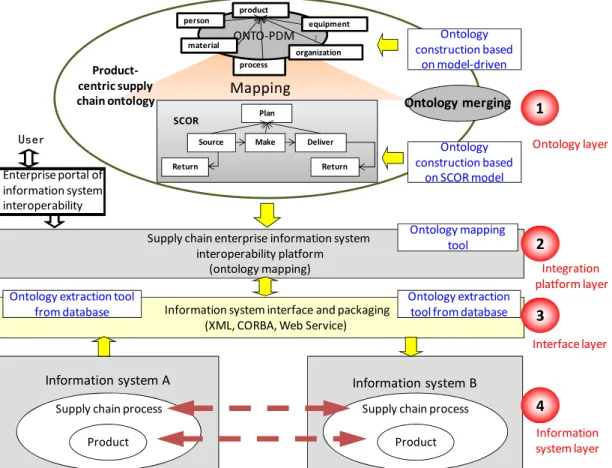
(4) Adopt the method combining ontology mapping based on WordNet and the reasoning method based on the rule to realize ontology merging of product ontology and supply chain process ontology, in order to build the product-centric supply chain ontology. Realize the interoperability of supply chain enterprise information system from two aspects: the mapping among ontology bases and the mapping between data base and ontology base.
Figure 1.1 The structure of dissertation
Chapter 1 stated the research background of the dissertation, analyzed the domestic and overseas research status of supply chain integration, and proposed semantic interoperability is an effective solution to deal with the integration of enterprise information systems in supply chain environment. Meanwhile analyzed and summarized the research status of correlated techniques involved in semantic interoperation. Finally, the structure of dissertation was provided, stating the foundation, content and meaning of the research.
Chapter 2 analyzed the SoS (System-of-Systems) characteristic of networked enterprises in the environment of supply chain, proposed the SoNE (Systems-of-Networked Enterprises) paradigm. And then it analyzed the distinction between the interoperability and integration of enterprise information systems. Finally, proposed the information system interoperability framework of supply chain enterprises based on the demands in the environment of supply chain.
Chapter 3 studied the developing method of product ontology. Based on some international standards involved in enterprise system integration (such as IEC 62264, ISO 10303 and STEP-PDM et al.), the model-driven ontology developing method was
Ap p ro ac h fo r In fo rm at io n Sys te m s Se m an tic In te ro p e ra b ilit y in Su p p ly Cha in En vir o n m e n t Chapter 1 Introduction Chapter 2 Chapter 5 Ontology based system Interoperability in supply chain Chapter 4 SCOR based supply chain ontology development Instance of supply chain information system Interoperability and prototype development Chapter 7 Conclusion and future works Research status Proposing problems Model and system framework Key technology research System development and application Summary and prospect Chapter 3 Model‐driven based product ontology development Model and framework of enterprise information system interoperability in supply chain Chapter 6
adopted to integrate the business information and technology data related to product life cycle, including product design, manufacturing, deliver and et al, into a common shared product ontology.
Chapter 4 discussed the building method of supply chain ontology. Adopting SCOR model as the basic concepts and framework of supply chain ontology, the SCOR supply chain ontology was built by using Protégé seven-step method. Meanwhile the semantic meaning was described by OWL DL. Taking make-to-order of main machine bed as an example, an instance of SCOR supply chain ontology was given. Finally, an evaluation system of SCOR supply chain ontology was simply illustrated.
Chapter 5 researched the ontology merging and semantic interoperability methods. The method combining ontology mapping based on WordNet with reasoning based on rules was adopted to realize the merging of product ontology and supply chain ontology, to achieve product-centric supply chain ontology. The information systems interoperability of supply chain enterprises was realized by the mapping among ontology and the mapping between data bases and ontology. Finally, an instance was put forward in this chapter.
Chapter 6 took the supply chain process of numerical control guide grinding machine as an example to validate the method for information systems interoperability of supply chain enterprises. Meanwhile, according to interoperability principle, a prototype of information systems interoperability platform for supply chain enterprises was developed, providing as a feasible method for the information integration of supply chain enterprises.
Chapter 7 made a conclusion for the whole dissertation, and looked into the future works.
1.6 Conclusion
This chapter stated the research background of dissertation, analyzed the existing problems of enterprise information integration in supply chain environment and the
domestic and overseas research status of supply chain integration, then proposed that semantic interoperability was an effective solution to deal with the enterprise information system integration in supply chain environment. After, it analysed and summarized about the research status of related technology involved in semantic interoperability. At last, the structure of dissertation was provided, stating the research foundation of dissertation, research content and research meanings.
2 Model and framework of enterprise information systems
interoperability in supply chain
2.1
Introduction
Supply chain management is the complex and dynamic environment jointly participated by organization, human, technology, activity, information and resource et al to shift one product or service. In the past twenty years, supply chain management (SCM) has been devoting to better deploying supply chain according to different purposes, such as enterprise integration, outsourcing manufacturing and service et al. Presently, SCM not only concerns about the business process of traditional value chain, but also have an insight into the process network related to organization, which is also the form of cooperation and the relationship among partner organizations. On this occasion, the research emphasis of SCM turns from the inside enterprise to the relationships among enterprises, seeking the interoperability between operating system and applications among enterprises [Jardim-Goncalves, 2011]. The continuous change of market makes the demandings of enterprise, business, function and quality always being continuously changing, so enterprise system should have enough flexibility to adapt to this changes. The enterprises in supply chain are connected together and composed to a system network, thus the corresponding solution can be proposed by analyzing the characteristics of this system network.
2.2
System-of-Systems (SoS) Paradigm of networked enterprise in
supply chain
The term System-of-Systems (SoS) is widely recognized and has become quite studied since a decade. Its application area spans from original military to other domains, especially system engineering. Researchers tried to formalise this new paradigm in the field of information system, complex system in military and
enterprise since many years[Kotov, 1997][Pei, 2000][Sage, 2001][Carlock, 2001]. Further, various efforts have been made to give a common definition to specify the characteristics or principles of the paradigm. Widely cited definitions are for example Systems-of-Systems (SoS) are large-scale concurrent and distributed systems, the components of which are complex systems themselves.” [Kotov, 1997][Sage, 2001]. Whichever definition is used, there are several principles that distinguish SoS from monolithic systems. The classical five principles are known as Maier’s criteria: operational independence of the constituent systems, managerial independence of the constituent systems, geographical distribution of the constituent systems, evolutionary development, and emergent behavior. Based on the characteristics mentioned by Boardman [Boardman, 2006] and DeLaurentis [DeLaurentis, 2004], Auzelle [Auzelle, 2009]summarized and extracted six characteristics of SoS, as shown in Figure 2.1.
Figure 2.1 SoS characteristics
Each characteristic means respectively:
(1) Autonomy: exercised by constituent systems in order to fulfil the purpose of the SoS
(2) Evolution: The SoS adapts to fulfil its (possibly evolving) mission as a whole
Autonomy Evolution Connectivity Emergence Diversity Belonging Operation independence Managerial independence Geographical distribution Evolutionary development Emergent behavior Networks of systems Inter‐disciplinary Heterogeneity Autonomy Emergence Connectivity Diversity Belonging Boardman Maier De Laurentis