UNIVERSITY OF SHERBROOKE
La lecture récréative de romans et les compétences en littératie au niveau collégial
Recreational Long-form Fiction Reading and College-level Literacy Achievement
By Dana E. Bath
Masters paper submitted to the Faculty of Education In partial fulfillment of the requirements for the degree of
Masters of Education (M.Ed.) Master Teacher Program (PERFORMA)
August 2018 © Dana E. Bath, 2018
UNIVERSITY OF SHERBROOKE
La lecture récréative de romans et les compétences en littératie au niveau collégial
Recreational Long-form Fiction Reading and College-level Literacy Achievement
By Dana E. Bath
A été évalué par un jury composé des personnes suivantes:
Carolyn Lewis-Dellah, Ph.D. Directrice de l’essai Stephen G. Taylor, Ph.D. Évaluateur de l’essai
SUMMARY
This study aimed to examine habits around – and, secondarily, attitudes toward – recreational reading of long-form fiction (novels) in a multi-cultural, multi- lingual student population with a broad range of academic ability, and to determine whether there was any association between such variables and the students' levels of literacy skill. The purpose of the study was to provide English teachers at CEGEP Vanier College and beyond with information about students' reading backgrounds that might help them to make more informed decisions about their curriculum and pedagogy. It was hypothesized that students placed in higher-level 101 courses would report stronger recreational novel-reading habits and more positive attitudes toward reading fiction than those in lower levels.
A sample of Vanier College students in fall-semester English 101 courses in 2016 completed a survey questionnaire in which they provided demographic information, as well as information on their recreational reading preferences; their attitudes toward reading books, especially books of fiction; their novel-reading habits in the previous year, and their family of origin's reading habits and attitudes toward reading. Their responses were cross-tabulated with their 101 course placement levels (non-remedial, first-tier remedial, and second-tier remedial) to reveal associations. Students' qualitative responses were examined, and some interesting cases were isolated and treated as case studies. The data showed that there are indeed some important associations between a student's literacy level and the student's attitudes and preferences regarding reading novels for recreation. Associations between student reading habits and literacy level remained unsubstantiated, but warrant further study with a more comprehensive sample.
4
Reader-response theory (Daniels, 2002) posits that students cannot take an analytical approach to literature before experiencing literature personally, and examining and understanding their own responses to it. It could be argued, based on this theory and the data collected in this study, that teachers of remedial courses should endeavour to provide their students with experiences that will help them develop a love of reading and an inclination to do more of it in their own time. Such an argument would entail re-examining not only teachers’ individual curricula and pedagogy, but also Ministerial objectives for CEGEP English courses. Further research would be needed in order to determine ways that teachers might best respond productively to this difference in background reading experiences and attitudes, but some examples from the existing literature on fostering recreational reading habits, enjoyment and skill are provided here for consideration.
The hope is that, by looking at overall associations between recreational long- form fiction reading and 101 course placement, as well as by examining particular cases of students' literacy skills and reading habits and attitudes around reading, this study of a very particular college in a very particular cultural and academic context will provide Vanier College English teachers with information that can help them examine their own curricular choices and pedagogical approaches, both in their 101 courses and beyond. It is also hoped that this information, analysis and reflection will prove useful to English teachers at other Quebec CEGEPs, as well as to Quebec educators generally, and to post-secondary English educators beyond the Quebec system who work in similar settings.
RESUME
La présente recherche vise principalement l'étude des habitudes et ensuite des attitudes concernant la lecture récréative de romans dans un milieu étudiant multiculturel et multilingue où l’on retrouve une vaste gamme de compétences académiques. Ce travail cherche à découvrir un lien entre ces variables et les compétences étudiantes en littératie au niveau collégial. Le but est de fournir aux enseignants du cégep, et du département d’anglais du collège Vanier en particulier, des informations concernant le contexte de lecture de leurs étudiants afin que ces enseignants puissent planifier leur curriculum et leur pédagogie de façon mieux informée. L'hypothèse de départ est qu’un étudiant placé à un niveau plus élevé de cours d’anglais 101 indiquera une tendance plus élevée à lire des romans pour leur plaisir et qu’il aura une attitude plus positive envers la lecture de romans en général, comparé aux étudiants placés à des niveaux moins élevés.
Le collège Vanier est un cégep (collège d'étude générale et professionnelle) anglophone situé à Montréal, dans la province canadienne de Québec. La population étudiante démontre une grande diversité culturelle et linguistique et représente une grande gamme de compétences académiques. Les nouveaux étudiants suivent un de trois niveaux d’anglais 101: 101-MA pour l’étudiant qui démontre un niveau de littératie adéquate aux études collégiales; 101-MB pour l’étudiant qui démontre des difficultés de compréhension, d’analyse, ou d’expression écrite; et 101-MC pour l'étudiant qui démontre des difficultés linguistiques évidentes et importantes, y inclus les erreurs majeurs de deuxième langue. La répartition des élèves est décidée par les résultats du test de placement (Vanier College Placement Test). Les compétences ministérielles sont néanmoins identiques pour les trois niveaux du cours 101 (en effet, d’autres cégeps font la division de différentes façons ou n’ont aucune répartition du cours 101). Un des principaux objectifs de chaque niveau est qu’un étudiant rédige un
6
analyse littéraire de 750 mots, mais le contenu du cours est en grande partie laissé à la discrétion de l’enseignant. La répartition des élèves en anglais 101 vise à régler certains problèmes de littératie, mais il n’y a aucune répartition de ce genre dans les cours qui suivent, dont trois cours de littérature ou les élèves doivent démontrer les mêmes compétences d’analyse littéraire et de compréhension, peu importe leur niveau de compétence, leur historique et leur contexte, ou leur exposition à la lecture. En automne 2016 un échantillon d'élèves du collège Vanier inscrits en anglais 101 a complété un questionnaire fournissant des données démographiques; des informations portant sur leur préférences de lecture récréative et leurs habitudes récentes de lecture de romans; et des informations portant sur les préférences de lecture, les habitudes de lecture, et les attitudes envers la lecture de leur famille d’origine. Les réponses à ce questionnaire ont alors été croisées aux niveau d’anglais 101 (MA, MB, MC) pour révéler des associations. Les réponses qualitatives des étudiants ont été examinées et analysées, et certains cas particuliers ont par la suite été traités comme études de cas. Les données ont démontrées qu’il y a en effet certaines associations importantes entre le niveau de littératie et les attitudes étudiantes envers la lecture récréative de romans. Par contre, les associations entre le niveau de littératie et les habitudes de lecture ne sont pas étayées, mais celles-ci méritent d'être étudiées en profondeur avec un échantillon plus vaste .
Selon la théorie de la réponse du lecteur (Daniels, 2002), les étudiants ne peuvent adopter une démarche analytique envers la littérature qu'après avoir eu, examiné et compris une expérience littéraire plus personnelle. L’enseignant qui cherche à développer un échafaudage efficace qui permettra à l'étudiant d'acquérir de nouveaux connaissances et compétences doit comprendre qu’il ne sert à rien de demander à l'étudiant de compléter des tâches qui n’ont aucun lien avec ses schémas existants. Par contre, mieux connaître les expériences et les pratiques courantes des étudiants concernant la lecture récréative pourrait aider aux enseignants à réajuster leurs attentes et à adapter leurs choix pédagogiques et curriculaires, pour pouvoir mieux répondre aux lacunes de connaissances, compétences et motivation chez ceux- ci. S’appuyant sur cette théorie et les données recueillies, on pourrait faire valoir que
7
ceux qui enseignent les cours d’appoint se doivent d’offrir aux étudiants des expériences promouvant l’amour de la lecture et une volonté accrue de lire dans leurs temps libre. Un tel argument entraînerait non seulement une réexamination des pratiques pédagogiques et des choix curriculaires des enseignants, mais aussi des objectifs ministérielles des cours d’anglais au cégep. Des recherches supplémentaires pourraient établir comment mieux répondre aux différentes contextes de lecture, mais certains exemples tirés de la documentation existante sont fournis ici, en particulier à propos de l’encouragement d’habitudes, d'habiletés et de l'appréciation de la lecture récréative.
Il est à espérer qu’en examinant les associations entre le lecture récréative de romans et la répartition d'étudiants en anglais 101, en plus d’examiner des cas particuliers de compétences littéraires, d’habitudes de lecture et d’attitudes envers la lecture, cette étude de la situation précise et particulier pourra fournir aux enseignants du département d’anglais de Vanier les données et l’information nécessaires pour une réexamination de leurs choix pédagogiques et curriculaires, autant pour leurs enseignement du cours 101 que pour d’autres cours. De plus, l’information, l’analyse et la réflexion présenté pourra être utile aux enseignants du cégep, aux enseignants québécois en général et à tout enseignant d’anglais postsecondaire qui fait face à des situations semblables.
TABLE OF CONTENTS
TITLE PAGE ... 1
LIST OF EXAMINING BOARD MEMBERS ... 2
SUMMARY ... 3
RESUME ... 6
LIST OF TABLES ... 12
LIST OF ABBREVIATIONS, INITIALISMS AND ACRONYMS ... 14
DEDICATION ... 15
ACKNOWLEDGEMENTS ... 16
INTRODUCTION: DO THEY READ? DOES IT MATTER? ... 17
CHAPTER ONE: STATEMENT OF THE PROBLEM ... 20
1. CONTEXT ... 20
2. PROBLEM ... 21
3. GENERAL OBJECTIVE OF STUDY ... 23
CHAPTER TWO: CONCEPTUAL FRAMEWORK ... 24
CHAPTER THREE: LITERATURE REVIEW AND RESEARCH QUESTIONS ... 31
1. INTRODUCTION ... 31
2. THEMES ... 32
2.1. Can Recreational Reading be Associated with Literacy Skills and Achievement? ... 32
2.1.1. Overall Literacy Achievement ... 33
2.1.2. Reading Achievement ... 33
2.1.3. Writing Achievement ... 35
2.1.5. Overall Academic Achievement ... 36
2.2. Is Fiction Reading Associated with Cognitive Skills that Contribute to Literacy Achievement?... 37
2.3. How Much Recreational Reading Do Adolescents Do? ... 39
3. CONCLUSION AND RESEARCH QUESTIONS ... 41
3.1. Primary Research Question ... 42
3.2. Secondary Research Question ... 43
3.3. Hypotheses ... 43
3.4. Definitions of Main Constructs ... 43
3.4.1. Recreational Reading ... 44
3.4.2. Quantity/Frequency/Enjoyment/Desired Frequency ... 44
3.4.3. Fiction ... 44
3.4.4. Long-form ... 44
3.4.5. Literacy Skills ... 44
CHAPTER FOUR: METHODOLOGY ... 46
1. INTRODUCTION ... 46
2. POPULATION AND SAMPLING ... 47
2.1. Population and Type of Sample ... 47
2.2. Description of Sample ... 47
3. DATA COLLECTION AND INSTRUMENTATION ... 53
3.1. Survey Questionnaire ... 53
3.2. Diagnostic Test: Ranking and Content Analysis to Measure Literacy Achievement ... 55
4. ETHICAL CONSIDERATIONS ... 58
5. PROCEDURES: TIMETABLE ... 58
6. DATA ANALYSIS ... 59
1. INTRODUCTION ... 60
2. RECREATIONAL READING HABITS AND ATTITUDES TOWARD READING ... 60
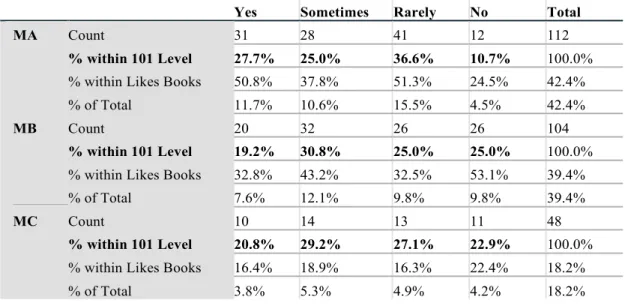
2.1. Do You Like to Read Books? ... 60
2.2. What Kinds of Books Do You Like To Read? ... 63
2.3. What Else Do You Like To Read? ... 65
2.4. In What Language(s) Do You Read Recreationally? ... 66
2.5. How Much Recreational Reading of Fiction Do You Do? ... 66
2.5.1. How Many Books of Fiction Did You Read for Fun This Past Year? ... 67
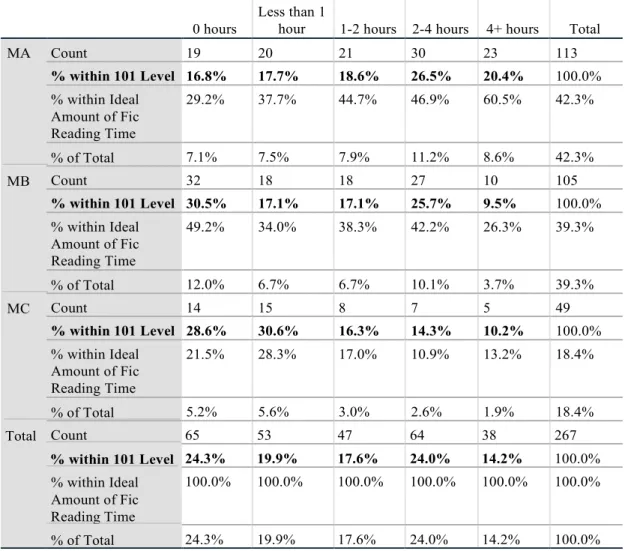
2.5.2. How Many Hours a Week Did You Spend Reading Fiction? 68 2.5.3. How Many Hours Would You Spend Reading Fiction Each Week if You Could? ... 70
3. READING HABITS AND ATTITUDES TOWARD READING IN THE FAMILY HOME 73 3.1. Family Reading Habits and Attitudes Toward Reading ... 74
3.2. Parental Encouragement of Reading Habits ... 76
3.3. Differences Between Students’ Attitudes Toward Reading and their Parents’ ... 77
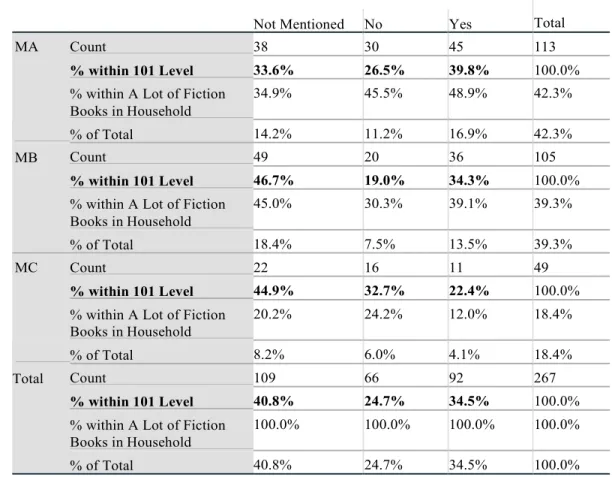
3.4. Print Exposure in the Home ... 78
3.5. Other Observations and Comments about Reading in the Family ... 81
3.5.1. Lack of Time for Reading ... 81
3.5.2. Students' Perceptions of Reasons for and Impact of Recreational Reading ... 82
3.5.3. Influence of Current Technologies and Other Entertainment/Activities on Reading Habits ... 82
4. CASE STUDIES ... 84
5. SUMMARY OF RESULTS... 89
5.1. Primary Research Question ... 90
5.1.1. Quantity ... 90
5.2. Secondary Research Question ... 91
5.2.1. Enjoyment ... 91
5.2.2. Desire ... 91
5.3. Additional Results ... 92
5.4. Family Reading Habits and Attitudes Toward Reading ... 92
CHAPTER SIX: ANALYSIS AND DISCUSSION ... 94
1. ANALYSIS ... 94
2. DISCUSSION ... 96
CHAPTER SEVEN: CONCLUSION ... 101
1. SUMMARY ... 101
2. APPLICABILITY OF FINDINGS ... 102
3. LIMITATIONS OF STUDY ... 103
4. SOME IMPLICATIONS ... 104
5. SUGGESTIONS FOR FURTHER RESEARCH ... 107
6. CONCLUDING REMARKS ... 108
BIBLIOGRAPHICAL REFERENCES ... 109
APPENDIX A: SURVEY QUESTIONNAIRE ... 112
APPENDIX B: CONSENT FORM ... 120
APPENDIX C: LETTER OF APPROVAL FROM THE VANIER COLLEGE RESEARCH ETHICS COMMITTEE ... 123
LIST OF TABLES
... 67
By Cohort ... 67
Cohort ... 69
week reading books of fiction for fun?”: By Cohort ... 71
By Cohort ... 72
Cohort ... 74
Table 1a 101-MA: Mother Tongue ... 48
Table 1b 101-MB: Mother Tongue ... 49
Table 1c 101-MC: Mother Tongue ... 49
Table 2a 101-MA: Language Spoken at Home ... 50
Table 2b 101-MB: Language Spoken at Home ... 50
Table 2c 101-MC: Language Spoken at Home ... 51
Table 3a 101-MA: Language of High School Study ... 51
Table 3b 101-MB: Language of High School Study ... 52
Table 3c 101-MC: Language of High School Study ... 52
Table 4 “Do you like to read books in your spare time for fun?” ... 61
Table 5 “Do you like to read books in your spare time for fun?”: By Cohort 62 Table 6 "Do you like to read fiction?": By Cohort ... 64
Table 7 "How many books of fiction have you read for fun in the last year?" Table 8 "How many books of fiction have you read for fun in the last year?": Table 9 “How many hours per week did you spend reading fiction?” ... 69
Table 10 “How many hours per week did you spend reading fiction?”: By Table 11 “Given unlimited free time, how many hours would you spend per Table 12 Would Spend More Time Reading Fiction if had Unlimited Free Time: Table 13 "At least one member of my immediate family enjoys reading": By Table 14 "There were a lot of books in my household": By Cohort ... 79
Table 15 "When you were growing up, were there a lot of books of fiction in your household?": By Cohort ... 80
13
Table 16a “Do you like to read personal narrative?”: By Cohort ... 126
Table 16b “Do you like to read other non-fiction?”: By Cohort ... 127
Table 16c “I do not like reading any kind of book”: By Cohort ... 128
Table 16d “Do you like to read print newspapers?”: By Cohort ... 129
Table 16e “Do you like to read magazines?”: By Cohort ... 130
Table 16f “Do you like to read online journalism?”: By Cohort ... 131
Table 16g “Do you like to read blogs?”: By Cohort ... 132
Table 16h “Do you like to read comics?”: By Cohort ... 133
LIST OF ABBREVIATIONS, INITIALISMS AND ACRONYMS
101-MA (or MA) At Vanier College, a stream of English 101 (ministerial number 603-101-MQ) for students who need little to no remedial help. 101-MB (or MB) At Vanier College, a stream of English 101 for students who
need remedial help with expression, logical organization, or comprehension.
101-MC (or MC) At Vanier College, a stream of English 101 students who need significant remedial help with expression (sometimes including severe second-language-type errors), logical organization, or comprehension. CEGEP Collège d'enseignement général et professionnel (College for pre-
university and professional education).
FVR Free Voluntary Reading: non-directed reading in which one reads books of one's own choosing for the pleasure of reading alone.
SSR Sustained Silent Reading: a school-based type of Free Voluntary Reading (FVR; see above) in which students read books of their own choosing for extended periods of time during school hours.
DEDICATION
For the students and colleagues whom I have tried my best to serve, and to Scott, for his patience.
ACKNOWLEDGEMENTS
Many thanks to Dr. Carolyn Dellah for her suggestions, advice, and stimulating conversations. Thanks also to Dr. Shernaz Choksi for her patient tutelage concerning the many challenges of SPSS data analysis. Merci to my friend and colleague Marianne Lynch for speedy and impressive translations (and for everything else she does that makes my life easier). Gratitude to Karen White and the Vanier Research Ethics Board for their help with condensing, focusing and perfecting what was initially an unwieldy survey questionnaire. And thanks to Justine Bell for providing her MTP M.Ed. paper as a helpful guide to formatting and organization.
Thank you to my colleagues in Vanier’s Faculty of Social and Cultural Studies, Maria-Sophia Grabowiecki and Sandy Khalifa, for allowing me to pilot my survey questionnaire in their Research Methodology classes in the winter semester of 2016. A big thank you to my English Department colleagues Stacey DeWolfe, Nancy Giacomini, Renee Karp, Spiridoula Photopoulos, Mariopi Spanos and Vanessa Vandergrift for allowing me to conduct surveys during their class time during the 2016 fall semester. Thanks also to my friend and colleague Stephen Dinsmore for his gentle, considerate, and unrelenting inquiries and encouragement, and his curiosity about every angle of the results. And eternal gratitude to the Vanier College English Department as a whole for their support of not only my research, but also the important research many of our colleagues are doing for the benefit of our students and students everywhere.
Finally, thank you to the students of Vanier College for their participation and constant inspiration.
INTRODUCTION: DO THEY READ? DOES IT MATTER?
I first began pondering the place of literature and literary analysis in the post- secondary English classroom in 1994, when I read a collection of essays called Reasonable creatures: Essays on women and feminism, by one of my favourite opinion columnists, Katha Pollitt (1994). In an article called “Why we read: Canon to the right of me…” Pollitt, a writer for The Nation and other important American publications, explores a question that plagued university English departments of that day: what should we require students to read in their English courses?
One faction insisted that students should be exposed to as many classic canonical texts as possible. The other countered that young people were bored and frustrated by such texts, and should be encouraged to read contemporary works with characters, plots and settings with which they could identify. Pollitt outlines the various justifications for both sides, and then explains why both miss the point: none of this would matter if students regularly read for their own enjoyment outside the classroom.
[T]he assumption underlying the canon debate is that the books on the [course] list are the only books that are going to be read….[A]ll agree not to mention certain things that they themselves, as highly educated people and, one assumes, devoted readers, know perfectly well. For example, that if you read only twenty-five, or fifty, or a hundred books, you can’t understand them….And that if you don’t have an independent reading life…you won’t like reading the books on the list and will forget them the minute you finish them. (p. 22)
In his book Outliers: The story of success, Malcolm Gladwell (2008) puts forth neurologist Daniel Levitin’s theory of “10,000 hours”: to become a “world-class” expert at anything, we must invest at least 10,000 hours in practicing that skill (p. 40).
18
In order to navigate the world of college studies, particularly the literary analysis tasks at the centre of the English literature courses that are core curriculum at Anglophone colleges, students may not need to be “world-class” experts in reading and writing. However, they need to read, understand, and write with a basic expertise – college-level competency – and this basic expertise seems to elude large numbers of them. Why is this? Could it be related to a lack of reading practice outside of the classroom? Could it be that they have invested so much less than 10,000 hours in reading that they are not even competent readers and writers, much less experts?
A number of recent studies draw connections between fiction reading, specifically, and cognitive abilities that might have an impact on literacy achievement. Is it possible that young people who read a lot of novels in their spare time have an academic advantage over those who don’t? Is it possible that reading novels is more strongly associated with literacy skills than reading textbooks, newspapers or blogs?
CEGEP English teachers, their students, and the wider educational community all have an important stake in these questions. If recreational fiction- reading habits, and/or attitudes toward reading fiction (that is, enjoyment of reading fiction and desire to do so), are closely associated with literacy skills, then students who read little fiction on their own and/or dislike reading fiction may be ill-equipped to perform some of the tasks we ask of them in the English classroom, and in their other classes as well.
In this study, I hope to examine a sample of the incoming student population of Vanier College in order to determine two things:
1. How much long-form fiction reading students habitually do outside of school assignments;
19
2. Whether there is an association between the amount/frequency of this reading and students’ literacy skills.
What follows will include a statement of the problem that this study intends to examine, an overview of the conceptual framework upon which this study has been based, a review of the literature on this topic and a statement of the main questions and hypotheses upon which this research was built, a description of the methodology and results of the study, and an analysis and discussion of these results, along with some suggestions for future research on the topic of recreational fiction reading and its association with literacy and academic achievement.
CHAPTER ONE: STATEMENT OF THE PROBLEM
1. CONTEXT
All students entering an Anglophone CEGEP in Quebec must complete four English Literature courses before graduation. According to Ministerial objectives, all these courses must include the reading of literary texts and the production of essays analyzing those texts. Some English courses, especially 101 courses, also incorporate explicit instruction on written expression (grammar etc.), and most incorporate some work on essay composition, but the main thrust of these courses is the appreciation, understanding and analysis of literary forms, genres, techniques and themes.
These tasks are, in my experience and that of many English teachers with whom I’ve discussed this problem, pedagogically and intellectually valuable for students who already have strong literacy skills and plenty of reading experience. However, for students with poor literacy skills, literary analysis often becomes a series of hoops to jump through and tropes to imitate. At best, they blindly follow five-paragraph essay templates and plug in technical terms like “imagery” and “appeal to authority,” dutifully followed by somewhat random quotations as evidence, while having little overall understanding of a text’s arguments or themes, craft, and emotional resonance. At worst, they are unable to write literary analysis essays at all, or even to demonstrate a basic understanding of the texts they are required to read.
The Vanier student population is particular in a few ways: it is an unusually demographically diverse college (especially with regard to cultural background, mother tongue, home language and socio-economic factors), many of our students have received most of their previous school instruction in French and not English,
21
and students’ academic skills range from very weak (weak enough to make admission to some other colleges unlikely) to very strong. Within this multi-ethnic, multi- lingual, multi-level context, identifying any particular variables that might contribute to the strength or weakness of a student's literacy skills is very challenging. However, such a specific and special context does provide an opportunity to examine whether the results of previous research, carried out in very different contexts, is consistent here. What can we find out about these particular students' recreational fiction- reading habits and attitudes toward reading fiction? Are there associations between these variables and these students' literacy levels? If so, what can teachers at this institution learn from these associations, and how can they apply what they learn to their curriculum and pedagogy in order to better support their students, and provide more effectively for their students' needs? Finally, can any of these findings be generalized, to similar contexts and beyond?
2. PROBLEM
A paucity of recreational fiction reading might help explain a number of student difficulties, both in English classes and across the curriculum, including:
1. Lack of motivation to read assigned literary (and other) texts; 2. Deficits in terms of reading comprehension;
3. Lack of intuitive ability when it comes to understanding techniques, themes and arguments in texts;
4. Lack of basic writing skills, including natural understanding of grammar, sentence structure, spelling, vocabulary and paragraph structure.
Competence in all these skills – completing and comprehending readings, including long ones; understanding of the craft of literary technique as practiced by
22
authors; expressing oneself fluently and accurately in written language; organizing one’s ideas into paragraphs and essays – is a basic requirement of college-level first- language English courses. Students who often read recreationally may arrive in college with stronger skills than those who do not; what is more, as will be discussed later in these pages, recent research shows that those who often read fiction may have certain cognitive advantages that make them even more capable than those who read widely in other areas. Students whose reading practice is restricted to texts assigned to them in school, on the other hand, may be ill-equipped to undertake the tasks we are asking of them.
When students are accepted at Vanier College, they write an English Placement Test. Their score on the Placement Test determines their 101 English course level: students with strong scores are placed in 101-MA, students with weaker scores in 101-MB, and students with very poor scores in 101-MC (and those with the very weakest scores are streamed into a pre-101 non-credit course called Preparation for College English.) The Ministerial objectives for all three 101 levels are the same (in fact, other CEGEPs stream 101 courses differently or not at all), but while the required course outcomes, such as the ability to produce a 750-word literary analysis essay, are consistent across streams and across CEGEPs, the content of English courses at Vanier - including assigned texts, learning activities, and most assessments - is, aside from some general guidelines given by the English department, largely up to the discretion of the individual teacher. What is more, after an initial streaming into English 101 courses meant to address literacy deficits, Vanier students are required to take three more English literature courses in which they are all asked to demonstrate the same literary analysis and comprehension skills, regardless of their background and level of competence. Therefore, the 101 course provides an opportunity for teachers to begin addressing previous deficits in students' literacy experiences. A fifteen-week course is not enough time in which to compensate for a lifetime of little recreational reading, but there may be measures that teachers, especially of remedial courses, can take to plant some seeds. Teachers of post-introductory courses should
23
also be aware of the diversity of their students' past recreational reading experiences, the impact that deficits in this experience could have on students' skills, and possible pedagogical and curricular decisions they as teachers could make in order to maximize the learning potential of students who are coming in with little experience of reading as a recreational activity (and little desire to read for any reason).
If English teachers wish to make effective decisions about how to help our students acquire new knowledge and skills – that is, how to scaffold material so our students can learn from it - there is no point in asking students to carry out tasks that are so removed from their current schemata that no connections can be made. Thus, information about their background experiences and ongoing practices where recreational reading is concerned may help us adjust not only our expectations but also our pedagogical and curricular choices, in order to provide for deficits in our students' knowledge and skills. According to the literature on this topic, there is much evidence that recreational reading, especially of long-form fiction (novels), can contribute positively to literacy skills. If it turns out that there is an association for students in remedial English courses at Vanier College - that is, that such students are indeed less likely to enjoy recreational reading and regularly read for fun than are their peers in non-remedial courses - then it could be argued that teachers of remedial courses should endeavour to provide their students with experiences of literature that will help them develop a love of reading and an inclination to do more of it in their own time. This might mean providing these students with experiences that they might have, under different circumstances, been exposed to at home or in school at an earlier age. Such experiences might include choosing their own books, reading freely, sharing their reading experiences with others, and being exposed to a wide variety of books that are accessible and appealing to them.
24
3. GENERAL OBJECTIVE OF STUDY
Knowledge about these student difficulties, about student recreational fiction (and other) reading habits as well as their attitudes around reading fiction, and about the possible associations between them, might help us make some predictions about the nature of our students’ literacy problems. If given more information about our students’ background experience in reading, and if willing to make changes to pedagogical approaches based on a clearer understanding of our students’ prior knowledge and skills, teachers will be better equipped to lead students to success. The general objective of this study is to gather this information and identify these associations, with the hope that it will lead to further discussion, and possibly even to reconsideration of Ministerial and college curriculum requirements.
CHAPTER TWO: CONCEPTUAL FRAMEWORK
The major theoretical approach that underpins this investigation is Constructivism, both social and psychological. If we embrace a Constructivist approach to learning, we need to understand, first of all, the social context in which our domain and our curricula have evolved, in order to examine the knowledge, skills and tasks we require of our students and the reasons for asking these things of them. Secondly, we need to have and make use of psychological information about our students’ background knowledge and skills in order to effectively scaffold material so our students may acquire new knowledge and skills.
Social Constructivism posits that what we consider “knowledge” is in fact a human construct – we have, as a society, decided what constitutes knowledge, and this “knowledge” is not an objective representation of reality. (Richardson, 2003) English literature became a subject of academic study only in the late 1800s; at the time of its origin, English literary studies might have had much in common with today’s Communication Studies programs. Students of English literature would have been engaging, albeit with more profound attention and analysis, in an activity – reading books – that they had been turning to casually for enjoyment for much of their lives, much as our students might turn to film, Netflix, video games or social media. In fact, English as a field of study was not taken terribly seriously at first, as English literature was seen as “entertainment for gentlefolk, to be simply enjoyed or absorbed.” (Donald, 2002, p. 234) Over time, university English studies split into two disciplines, literary scholarship and rhetoric (composition), and then a variety of approaches emerged within literary scholarship: historical, theoretical, humanistic, etc.
CEGEP English courses, being generalist, may cover a wide variety of approaches and usually integrate work on composition as well, but CEGEP English
26
teachers, including those who over the years have developed the Ministerial objectives for CEGEP English studies, have almost without exception been formed in the crucible of university literary scholarship, and so the texts and approaches they tend to value come from a tradition that may lack resonance for, or may even be unrecognizable to, many CEGEP students. Also, college curricula in the domain of English studies were first developed in the late 1960s, when the CEGEPs were established. Decisions were made at that time about what constituted “value” in an English literature education, and this included mostly canonical literary texts that many teachers still focus on in their courses today. At that time, acceptance to a CEGEP pre-university program presumed a certain level of background knowledge and literacy skill on the part of the student. An English teacher would assume that students had, at the very least, read and understood certain literary texts in high school; she might also take for granted that many students spent at least some of their free time reading books for recreation. (There were no video games, no YouTube, and no social media. Where film and television were concerned, there were no streaming services like Netflix, easy purchasing services like iTunes, or illegal downloads over the internet. There were also no online media outlets for print media like newspapers and magazines, and no such thing as a blog. Most students were likely to pick up a book for entertainment once in a while.) This presumption no longer holds true: students are accepted into CEGEP today who might not have graduated from high school thirty years ago, and we can no longer assume that a student in our English class has ever read a book for pleasure. However, some of us are still operating as though conditions have not changed since the 1960s or, for that matter, since the 1800s.
Social Constructivism also assumes that associations will be made between the social context we know and the unfamiliar contexts we encounter in new materials. Beach et al. (2006), in their discussion of reading and socio-cultural learning theory, explain that one of the main attractions and rewards of reading literature is the possibility of “constructing text worlds as social worlds” – that is,
27
identifying with characters through an understanding of “the historical and cultural forces shaping a world” – and applying that understanding to our own lives, as well as to future reading (p. 12). If students arrive in college without a background in constructing “textual/social worlds” in response to texts, especially texts that are meaningful and enjoyable for them, they will not have practiced this cognitive skill enough to apply it to more challenging required texts.
According to Psychological Constructivism, meaning is constructed within an individual mind, and is dependent upon the learner’s background knowledge – new knowledge must be attached to the learner’s previous schemata in order for the knowledge to be assimilated (Richardson, 2003). According to Atwell (2007), construction of knowledge through reading is a major element of what makes us engaged and capable readers.
[Reading] fills up the file drawers of long-term memory, increases our vicarious experience, and improves our comprehension of the world and the word. The more we read, the more that has the possibility of making sense to us, and the better we understand what we read…Children read in order to become smarter about the world and how it works. (p. 60, p. 130)
Atwell attempts to address deficits in her students’ prior reading experience by running her middle-school English classes as “reading workshops,” wherein students choose their own texts from the classroom library and spend class time reading freely and engaging in book-club-type presentations and discussions. Thus, she allows students to respect their own schema and build upon them accordingly.
Stephen Krashen (2004) is one of the champions of recreational reading and its academic, cognitive and literacy benefits, and his arguments and research have many Social and Psychological Constructivist underpinnings. Krashen goes so far as to insist that many hours of school time should be devoted to Sustained Silent
28
Reading (SSR), a program in which, at set times of day, students, teachers and even staff drop everything and read books they have chosen for themselves. He declares that language is too complex to be learned in detached pieces, in the way reading skills are often taught in classrooms: vocabulary, spelling, comprehension etc. are approached as though they are discrete skills that the student’s brain can then magically combine to produce reading competence:
Our problem in language education is that we have confused cause and effect. We have assumed that we first master language “skills” and then apply these skills….Rather, reading for meaning, reading about things that matter to us, is the cause of literate language development. (p. 150)
Therefore, Krashen says, we need to give students the opportunity and inclination to read for themselves, by providing them with plenty of reading material and time to read, allowing them to choose their own books, modeling recreational reading for them, and valuing the pleasure derived from reading as much as we do the skills it fosters. This approach is clearly, even if not explicitly, Constructivist: when it comes to reading, students need to be given opportunities to gravitate to texts that are meaningful and suitable for them, enabling them to construct their own skills and knowledge based on the skills and knowledge they already possess.
Pedagogical strategies such as Krashen’s (2004) SSR free voluntary reading programs and Atwell’s (2007) reading workshops all engage students in a “reader- response” approach to the study of literature. Reader-response theory was first championed by Louise Rosenblatt, who pointed out the difference between efferent (information-acquiring) and aesthetic (enjoyment-seeking) modes of reading (Atwell, 2007) and who discouraged the quest for “correct” interpretations, positing that interpretations are entirely dependent on the reader’s prior experience (Daniels, 2002). According to reader-response theory, it is impossible for students to approach literature analytically without first experiencing, examining and understanding their
29
own personal response (Daniels, 2002). Even writers examining the study of literature at university recognize the role that early engagement with reading plays in their students’ current worldview and ability to learn through literature. Donald (2002) reminds us that we want to preserve and even enhance that reading engagement; describing the state of mind university teachers hope their students will bring to literary study, she reflects on what brought us to teach literature in the first place:
the attachment to literature found among teachers of English is reminiscent of a reader’s early attitude of receptivity, plasticity, and innocence before the text…our hesitations, pleasures and self-forgetfulness are the material for all subsequent intellectual reflection. (p. 241)
From this point of view, we may be making cognitive demands on students for which many of them are not prepared. Can a student conduct a sensible and insightful literary analysis of a complex canonical text when he/she is not even accustomed to reading light novels for fun? My study hypothesizes that the answer is a qualified no – that if a student is not practiced in fluidly and unconsciously decoding text for his/her own enjoyment, his/her literacy skills will be impaired, and expecting him/her to engage in insightful literary analysis is not appropriate.
In such cases, we have a few avenues of recourse:
1. We can attempt to provide intensive scaffolding through direct literacy instruction in order to move students from their current level of knowledge and skill to one where they can accomplish the tasks of deep comprehension, insightful analysis, logical organization and accurate expression;
2. We can focus more on approaches and activities that will help students develop their capacity to enjoy reading, including and especially long-form fiction, and to therefore do more of it in their own free time so that their skills
30
will continue to develop beyond the fifteen weeks they spend in our classroom;
3. We can reconsider the current Ministerial objectives for CEGEP English courses, including the literary analysis test (English Exit Exam) required for graduation.
Given what we know about where our students are coming from, we may need to think more carefully about where we expect them to go over the short time they are with us.
CHAPTER THREE: LITERATURE REVIEW AND RESEARCH QUESTIONS
1. INTRODUCTION
Although the theoretical orientation of the articles reviewed in this study is not always explicitly constructivist, an underlying premise is that recreational reading supports future learning and skill development, and that a student’s background experience as a reader will have an effect on his or her preparedness for school activities, especially literacy activities. These studies cover all levels of age and schooling, from children to mature adults, but most focus on adolescents or young adults, or middle school to university students. Most of the studies were conducted in literacy-related fields and involved English teachers, or literature and language teachers in other languages, or librarians. The original studies often used mixed methods, but with emphasis on quantitative findings; some of the books (Krashen, 2004) and articles (Cullinan, 2000) were mainly syntheses of previous studies, including the authors’ own.
Three main themes arise in these books and articles:
1. What associations can be found between recreational reading and literacy skills/achievement? It is very difficult to find direct empirical evidence for associations between recreational reading habits and levels of academic and literacy achievement. When such associations are found, it is usually impossible for any causal effect to be identified. However, Belgar et. al. (2012) and Flowers (2003) have conducted interesting classroom studies comparing the use of self-directed pleasure reading with the use of assigned texts, and their results point to the possibility that reading for pleasure might
32
in fact have a stronger impact on literacy skills than mandatory reading assignments do;
2. What associations can be made between fiction reading, specifically, and cognitive skills that may influence literacy skills/achievement? Djikic et. al. (2013) and Ross (2000) have focused attention on the possible cognitive impact of fiction reading, demonstrating that reading literary fiction may help us develop cognitive skills like a reduced need for cognitive closure (a need to seize on answers/solutions before they are necessarily well founded) and an increased capacity for Theory of Mind (the ability to understand what others are experiencing internally). Both Ross and Gilbert & Fister (2011), however, raise concerns about these cognitive skills and their possible negative effect on analytical abilities;
3. How much, and what kind of, recreational reading do young people do? Although there is an assumption in the culture at large, and in the culture of English teachers more specifically, that young people are reading less and less, the research on this topic is inconclusive. Nevertheless, looking at a few surveys conducted over the past years by Galik (1999), Hopper (2005), Gilbert & Fister (2011), and Howard (2011) can give us a sense of what, why and how much particular groups of adolescents and young adults have been reading, and whether there has been a general evolution in young people’s reading habits. It might also give us a sense of whether a particular population (Vanier College students) is typical in its reading habits, or whether it presents specific challenges.
33
2. THEMES
2.1 Can Recreational Reading be Associated with Literacy Skills and Achievement?
2.1.1. Overall Literacy Achievement
Echols et al. (1996) wished to determine whether children’s literacy activities could predict not only verbal cognitive skills, but also the growth of those skills over time. They collected data from 123 students from fourth, fifth and sixth grades in a rural American elementary school and middle school. The researchers operationalized “literacy activities” through measures of print exposure – the amount of print material children encountered in their day-to-day lives – and they measured this print exposure through two highly reliable and validated standardized tests: the Title Recognition Test and the Author Recognition Test. In these tests, participants receive a list of book titles or author names and indicate the ones they recognize (the tests include foils that help eliminate participants who provide unreliable data based on guessing.) They operationalized “verbal cognitive skills” as vocabulary, spelling, reading comprehension and general knowledge, and measured these skills through a series of adaptations of standardized tests. They measured “growth” by administering these tests to the same children three times over the space of 18 months. The TRT, ART and verbal cognitive skills tests all showed a Cronbach’s alpha reliability estimate of .75 or more. The authors found that levels of print exposure can predict growth of verbal cognitive abilities during this developmental period, and they claim that, because their calculations and controls have eliminated some confounding variables, they can cautiously affirm that print exposure can not only predict but also contribute to growth in the domain of literacy skills.
34
2.1.2. Reading Achievement
Not all studies, however, are so confident about making such connections. Nell (1988) finds that “there is very little empirical evidence that relates reading ability to reading habits.” (p. 9) He does examine studies that provide indirect and anecdotal evidence that there is a strong co-occurrance of reading skill and recreational reading; more often than not, however, the evidence seems to suggest that greater reading ability leads to more recreational reading, and not the other way around. He conducted his own study of 129 South African university students and 33 “ludic readers” (subjects who read extensively for their own pleasure) of varying ages. Nell hypothesized that reading comprehension speed would be positively associated with both quantity of books read and time spent in reading books for pleasure, but not with newspaper and magazine reading. By testing reading comprehension speed, and surveying ludic reading habits through a questionnaire, he did find strong support for this hypothesis, but cautions that no causal inferences can be drawn from this information.
Krashen (2004) interprets the myriad studies he examines as evidence that time spent reading books is associated with superior reading skills. For example, he quotes Anderson, Wilson and Fielding as saying that “among all the ways children spend their time, reading books was the best predictor of several measures of reading achievement” (p. 8). Other researchers have supported Krashen’s findings: Flowers (2003) found that among African-American students, reading for pleasure was strongly associated with scores on standardized reading achievement tests.
In one interesting study that might provide more direct evidence for the power of recreational reading to positively impact reading skill, Beglar et al. (2012) compared 80 Japanese ESL students whose classes required mostly self-chosen pleasure reading, including monitored extra-curricular reading, with 17 students
35
whose classes consisted mostly of intensive direct reading instruction. The pleasure readers made much greater gains in reading rate, with no discernible loss of reading comprehension, as measured by a 32-item reading rate test. The authors equate this with a gain in “reading fluency.” This could suggest more directly that pleasure reading contributes to reading fluency in ways that reading instruction does not.
2.1.3. Writing Achievement
Krashen (2004) believes that extensive recreational reading leads to gains in writing achievement. In the studies he examined, frequent readers tended to be better spellers and to have a firmer grasp of grammar. For example, in one study of Spanish students, the subjects’ amount of recreational reading was the only predictor of their ability to correctly use the Spanish subjunctive; a study of ESL learners in the United States and their ability to use the relative clause in English had similar findings. Another study showed that “each time readers read a passage containing words they cannot spell, they make a small amount of progress in acquiring the correct spelling.” (Krashen, 2004, p. 16)
2.1.4. Vocabulary
In one famous study, students read the novel A Clockwork Orange, a book written in an invented dialect filled with many words that do not exist in standard English. When later tested on the vocabulary from the novel, students demonstrated that by simply reading the words in context, they had learned the words and their meanings (Krashen, 2004). Krashen concludes that this demonstrates a direct causal relationship between reading fiction and vocabulary growth.
36
Cullinan (2000) compiles a number of studies that conclude that recreational reading is a positive contributor to vocabulary growth:
[S]tudents in grades 3–12 learn about 3,000 new words a year…. [They] acquire knowledge of some vocabulary words as the result of direct instruction, but that could only account for a modest proportion of the total. To learn 3,000 words a year would require learning about fifteen words every school day–more than even the most enthusiastic teacher would attempt to teach. Vocabulary is learned from reading. (p. 7)
2.1.5. Overall Academic Achievement
The findings concerning associations between recreational reading and overall academic achievement are varied and mostly inconclusive. For example, Galik (1999) conducted a study in which she surveyed 139 freshman and upper-level writing students at a private liberal arts college. She found an insignificant (r = .08) correlation between cumulative GPA and recreational reading during school sessions, and a “weak but statistically significant” correlation between GPA and holiday recreational reading. Her conclusion? “Pleasure reading in itself is not a strong predictor of achievement in college.” (p. 486) She found no important differences between reading habits of average students, students with learning disabilities, and Honours students, further suggesting that it may not be possible to draw connections between the amount of recreational reading students do and their achievement in school.
Moje et al. (2008) had similar results, but with one important difference. They conducted a large and complex study to examine and challenge preconceptions about how much adolescents read, what motivates them to read, and what impact this reading may have on their lives, particularly their school achievement. Two samples (Wave 1: 329 students, and Wave 2: 716 students) were drawn from middle schools in a mostly Latino neighbourhood of a large American city. The researchers
37
operationalized time spent reading for pleasure by first a seven-tiered and then a three-tiered Likert-type scale. They used a variety of instruments to represent students’ literacy practices, attitudes and achievements: computer-based surveys, interviews, observations, and school records. They operationalized their dependent variable, school achievement, as overall cumulative GPA as well as grades in specific subject areas. Of all literacy activities participants engaged in, only novel reading associated positively to increased academic achievement. This raises some interesting questions about whether fiction reading has effects on literacy skill that other types of reading do not.
2.2. Is Fiction Reading Associated with Cognitive Skills that Contribute to Literacy Achievement?
Some interesting recent research explores other cognitive skills that may, directly or indirectly, impact achievement on literacy tests. Studies of these skills focus particularly on the reading of fiction. Djikic et al. (2013) found that reading a literary short story created a short-term reduction in subjects’ need for “cognitive closure.” They operationalized “literary texts” as short fiction; in their study, they chose early-20th-century stories from anthologies, and used nonfiction essays as
control texts. They defined “cognitive closure” as a need to arrive at solutions quickly and avoid ambiguity; they describe subjects who need cognitive closure as “seizing” on a possible conclusion and then “freezing” on that conclusion, even when complicating or contradictory information is introduced. The authors explain that this need for cognitive closure has a detrimental effect on an individual’s critical and rational thinking abilities. The authors operationalized the construct of “cognitive closure” through the Need for Closure Scale, a self-reporting questionnaire with 42 items measuring such characteristics as preference for order, predictability and close- mindedness. This scale has been successfully tested for convergent and discriminant validity, and has a Cronbach’s alpha reliability estimate of .84. A number of controls were put into place to further ensure the validity and reliability of the data collected.
38
The sample was of one hundred University of Toronto students, both native and non- native speakers of English, who responded voluntarily to recruitment posters. The researchers found that reading a short story did indeed diminish, in the short term (that is, immediately following the experiment), a participant’s need for cognitive closure, and more so than reading an essay, but the effect was not the same for everyone: habitual frequent readers (of either fiction or nonfiction) experienced this effect more strongly than other participants. The authors propose that further research is needed to reveal whether such diminished need for closure is sustained over the long term or might even be cumulative. If frequent reading makes us more susceptible to relinquishing our need for cognitive closure, it may be an important ingredient in developing a flexibility of mind that can lead to advanced literacy skills such as logically organized thought, the ability to substantiate and revise arguments based on evidence, and so forth.
Ross (2000) reports that “heavy readers” are able to identify with fictional stories that bear little obvious similarity to their own lives, while non-readers have difficulty making connections between their own experience and fictional ones. She conducted a qualitative interview-based study of 194 adult “heavy readers,” and found from previous research that infrequent readers “seem not to make a connection between the book in front of them and the text of their own life” (p. 5) This speaks to a larger psychological concept, that of Theory of Mind, the mechanism through which we are able to interpret and predict the thoughts and feelings of others through their words and behaviours (Marraffa). The activity of literary analysis requires this capacity: students who are less cognitively advanced often have difficulty separating their own emotional and personal responses to texts from the ideas and techniques authors are employing, and have difficulty analyzing literary characters because they find their behaviours “weird” or immoral. According to Ross’s study, students who read a great deal may be better equipped to understand and analyze the words, thoughts and behaviours of others, whether it be in an argument or in a fictional world.
39
However, Ross obliquely raises a concern about this. “Unlike literary critics who deconstruct the notion of character and prefer the distanced contemplation of the aesthetic signifier, most pleasure readers expect books to represent characters…whose lives offer models for living.” (p. 7) Gilbert and Fister (2011) present this question more explicitly: they wonder whether recreational reading of fiction may actually interfere with critical and analytical skills:
Critical reading requires avoiding being absorbed in a story…if that emotional involvement inhibits analysis. As one English professor put it, students need to learn that reading, which may seem effortless [my emphasis], is actually quite difficult. Students’ enjoyment in reading literature, he reported, “…created a kind of ‘transparency effect’…, preventing students from getting very far toward reading in deliberate and self-conscious ways.” …A goal of his teaching is to turn naïve readers into sophisticated ones, learning to go beyond discussing the story to focus on how the story works. (p. 475)
This might suggest that students who do not already have “ingrained reading practices” could be at an advantage! These students often do not find reading “effortless,” as more habitual readers do, and thus might find it easier to take a critical distance.
2.3. How Much Recreational Reading Do Adolescents Do?
Looking chronologically at surveys of young people’s recreational reading habits would ideally give us some sense of whether large changes have occurred in this phenomenon, but the reality is more complicated; most studies are small and target a specific population (a private liberal arts college or a large public university, for example), and so the conclusions drawn by researchers are difficult to generalize. If we begin in 1991, a survey of 300 liberal-arts college seniors from a single school found that 88% read for pleasure regularly (Gilbert & Fister, 2011). However, in
40
Galik’s (1999) survey at a similar school a few years later, 63% of the 139 students she surveyed reported less than 2 hours per week of recreational reading during the school session, and 48% said that they read less than 2 hours per week during the holidays; only 13% reported 6 or more hours per week of school-session pleasure reading, and only 25% reported reading recreationally for 6 or more hours per week when school was out. Seventy-six percent said that they would read more if they had time, but this was not borne out by the holiday reading statistic. Given the size and specificity of these samples, it is difficult to draw meaningful conclusions, but the fact that the populations surveyed were similar suggests that there may be something to be learned from the change in results over time.
Many studies demonstrate that most young people do some recreational reading. In Burak’s 2004 survey of 201 students, 63% reported reading a book for enjoyment during the semester (Gilbert & Fister, 2011); Howard (2004) found that 84% of Nova Scotia teenagers surveyed read at least one book a year for fun. (Whether reading one book per semester or per year for fun constitutes a strong recreational reading habit is of course open to discussion.) Hopper (2005) surveyed a convenience sample of 707 mostly 11-to-15-year-olds about their reading habits in 2002, and discovered that 61% were reading a book for fun during the week of the study; in her analysis of all her data about the participants and their reading, she concluded that “there has been no significant decline in adolescent habits of reading fiction compared with previous studies” (p. 117). Hari and Joliffe conducted a 2008 survey in which they determined that public university students averaged 25 minutes per day in recreational print reading and about 50 minutes per day reading online sources (Gilbert & Fister, 2011). In a 2009 survey, 539 students demonstrated that, although internet use was more popular than print reading, it did not decrease print reading time (Gilbert & Fister, 2011).
41
In Gilbert and Fister’s 2009 study of 717 undergraduate students at small liberal arts college, 93% of participants reported enjoying reading, but results were quite different according to program. For example, 99% of humanities majors – the program with the highest percentage - said that they liked to read for entertainment; the lowest result was for pre-professional and social science majors, at 90%. The most popular genre for recreational reading was general fiction, followed by mysteries, classics and nonfiction. Very little recreational reading was done during the school year, although 1 in 5 humanities majors reported reading recreationally for 3 or more hours per week. Almost 50% of pre-professionals and fine arts students, 1 out of 3 natural science and social science majors, and 1 out of 5 humanities majors read for less than 1 hour per week during the school session; the primary obstacle to reading for recreation was cited as a lack of time. The researchers concluded that
college students enjoy reading for pleasure to a far greater degree than previous reports would indicate….Clearly, our students feel the reading they do for classes competes with voluntary reading, but their enjoyment in reading and their expressed desire to read material of their own choosing indicates that reading is, in fact, thriving. (p. 490)
All these studies offer food for thought, but perhaps the most important observation to be made is that none target a population with the characteristics of Vanier College, a CEGEP with a hugely diverse population in terms of academic achievement, linguistic and cultural background, and socioeconomic status. This points to a need to survey our students directly about their recreational reading habits, as previous studies give us little data that we can generalize to the particularities of our student body.
42
3. CONCLUSION AND RESEARCH QUESTIONS
Despite valiant and sometimes opinionated struggles to establish links between recreational reading and literacy skill, researchers have yet to formulate any clear conclusions. As teachers, we make certain assumptions about how much students read recreationally, what kinds of texts they read, and how this reading (or lack thereof) affects their literacy skill, without having much in the way of direct evidence.
It would be useful for Vanier College teachers to have data about the fiction- reading backgrounds and habits, as well as their enjoyment of and desire to read fiction, of the particular students entering our classrooms, and about any, even tentative, associations between those reading backgrounds and the literacy skills they display. If Gladwell’s (2008) assertion is true – that 10,000 hours of practice is the minimum requirement for real expertise – then knowing how far our students fall short of that is essential information: we may not wish for our students to become world-class experts in reading necessarily, but many of the studies above suggest that the more time we spend reading, the more expert we will become, not only at reading but at writing, at thinking, and at navigating many of our personal, professional and academic challenges. Although we can try to explicitly teach our students plenty of ways to tackle language, composition and literature, if they are avid readers, they will learn these skills at least partly without our help, and will continue to develop them when they leave us.
Such knowledge would be a starting point for a truly Constructivist college English studies curriculum. If we want to build strong scaffolds in order to bring our students to where we would like them to be, we need to start where they are: we can’t do that if we don’t know where that is.
43
Therefore, my study addressed the following research questions and hypotheses:
3.1. Primary Research Question
For Vanier College students in English 101 classes, to what extent are quantity and frequency of recreational reading of long-form fiction positively associated with literacy achievement in English?
3.2. Secondary Research Question
As the study progressed, in addition to variables of quantity and frequency of recreational long-form fiction reading, a third and fourth variable presented themselves: reported enjoyment of reading long-form fiction and reported desire to read long-form fiction if only time allowed. These new, unexpected findings led to the creation of an additional research question:
For Vanier College students in English 101 classes, to what extent is enjoyment of reading long-form fiction, and desire to do so, positively associated with literacy achievement in English?
3.3. Hypotheses
The research questions lead to the following hypotheses:
1. Quantity of recreational reading of long-form fiction is positively associated with literacy achievement in English.
2. Frequency of recreational reading of long-form fiction is positively associated with literacy achievement in English.
44
3. Enjoyment of recreational reading of long-form fiction is positively associated with literacy achievement in English.
4. Desire to read long-form fiction is positively associated with literacy achievement in English.
3.5. Definitions of Main Constructs
3.5.1. Recreational Reading: For the purposes of this study, “recreational reading” is reading undertaken voluntarily for personal enjoyment, and not for school, work or other mandatory assignments.
3.5.2. Quantity/Frequency/Enjoyment/Desired Frequency:
1. “Quantity” refers to the number of books of fiction read for enjoyment per year. This included print and electronic books. ("Books" are works of fiction of at least 100 pages);
2. “Frequency” refers to the average number of hours spent reading fiction for enjoyment;
3. "Enjoyment" refers to the degree to which the student self-identified as "liking" books, fiction or other kinds of texts;
4. "Desired frequency" refers to the number of hours the student said they would want to spend reading books of fiction if their free time was unlimited.
3.5.3. Fiction: “Fiction” is imaginative narrative writing. Nonfiction narrative writing (such as memoirs) has many of the same characteristics of fictional narrative, and could easily have been included, but limiting the study to fiction has made it more manageable, and the literature reviewed above points to a number of reasons that fiction may be a particularly interesting genre where literacy skills are concerned.
45
3.5.4. Long-form: "Long-form" was defined in this study as any written work of 100 or more pages. A long-form work of fiction, for example, is a novel.
3.5.5. Literacy Skills: These skills include levels of facility with a) reading comprehension and insight, b) logical written organization, and c) accurate written expression in English (including recognition of sentence-level errors), as measured by the Vanier College Placement Test and as further diagnosed by first-week writing samples in English 101 classes.