Valorization of Olive Mill Wastewater by the Yeast Yarrowia
lipolytica
Carla Araujo, Mário Aguedo, Nelma Gomes, José A. Teixeira, Isabel Belo*
Centro de Engenharia Biológica, Universidade do Minho, 4710-057 BRAGA, Portugal Keywords: Olive Mill Wastewater, Yarrowia lipolytica, LipaseTopic: Chemical Engineering and Quality of Life – Biochemical Engineering Abstract
The aim of this work was to study the ability of two different strains of the yeast Yarrowia lipolytica to grow on Olive Mill Wastewater (OMW) and their potential to produce high-value products such as lipases. Factors affecting cellular growth and OMW degradation were studied, such as nitrogen supplementation, cells concentration and surfactant addition. Both strains used were able to grow in a OMW with a COD of 19 g/L and total phenols concentration of around 800 mg/L. The strain W29 presented the highest potential for extracellular lipase production from OMW. Lipase productivity was improved by the medium supplementation with ammonium sulphate up to 6 g/L, leading to 80 % of COD degradation and 70 % of total phenols reduction. The surfactant Tween 80 enhanced cell growth and COD degradation, but had no significant effect on lipase productivity. The results evidenced that the conditions that favoured lipase production differ from the conditions that improve COD removal from OMW.
1 Introduction
Olive oil production is a traditional agricultural industry in Mediterranean countries, that accounts for about 95% of the world production (Al-Malah at al, 2000) and among which Portugal is one of the ten major producers. A large amount of liquid waste results from olive oil extraction. Quality and quantity of the constituents of olive mill wastewater (OMW) are dependent on many factors: type of olives, type of soil, cultivation system and production process. Generally, one tonne of olives yields one to two tonnes of OMW. Batch (press) and continuous operation are the main methods used in olive oil production. The continuous process can be classified in two- or three-phase process, the latter being the most popular one and the major source of OMW (Azbar et al., 2004). The total quantity of OMW produced in Mediterranean countries amounts 30 millions of cubic meters per year and is produced in a short period of time (D’Annibale et al., 2004). OMW are characterised by an intensive brown to dark colour, a strong acidic smell and a high organic content (COD values up to 220 g L-1). The great
variety of components found in OMW (carbohydrates, polysaccharides, sugars, lipids and phenolic compounds) makes difficult their treatment, and the disposal presents a critical environmental problem (Niaounakis and Halvadakis, 2004). Thus, these wastewaters have a great importance from an environmental and an economical point of view and can be considered as both a resource to be recovered and a waste to be treated.
Many methods have been proposed for the treatment of OMW, including physicochemical, chemical, biological (aerobic and anaerobic) (D’Annibale et al., 2004), evaporation (natural or forced) and land application (Cabrera et al., 1996). However, the most common method applied has been the storage of OMW in lagoons, followed by liquid evaporation during summer season (Azbar et al., 2004).
The OMW treatment in traditional biological plants is limited by the inhibitory effects of phenolic and lipidic compounds on biomass activity. Some proposals have been reported to reduce this problem, including the use of aerobic microorganisms isolated in OMW (fungi and yeasts) but no valorization of the OMW was attempted (Eusébio et al., 2002). The anaerobic biological degradation of OMW can lead to methane production but large periods of biomass adaptation and low phenolic compounds degradation have been reported as a disadvantage of the process (Marques, 2001). Detoxification of OMW by polyphenols reduction has been tested by chemical (Fenton’s reagent) and enzymatic
(laccase) methods. Phenolic compounds degradation in OMW by yeasts has also been reported (Ettayebbi et al, 2003).
Particularly, yeasts such Yarrowia lipolytica are good candidates for the OMW treatment and recovery because it can grow well on lipids; it can possibly consume the organic material, degrade lipids and polyphenols; at the same time it can possibly produce biomass and other valuable products (Scioli and Vollaro, 1997). Nevertheless, the efficiency of organic and polyphenolic content reduction, as well as organic acids or lipases production from OMW is strongly dependent of the yeast strain (Lanciotti et al. 2005).
2 Materials and methods 2.1. Microorganisms and media
The strains of Yarrowia lipolytica W29 (ATCC20460; CLIB89) and the wild type IMUFRJ 50682 (Hagler and Mendonça-Hagler, 1981) were used. Cells were pre-grown in glucose medium as previously described (Aguedo et al. 2005).
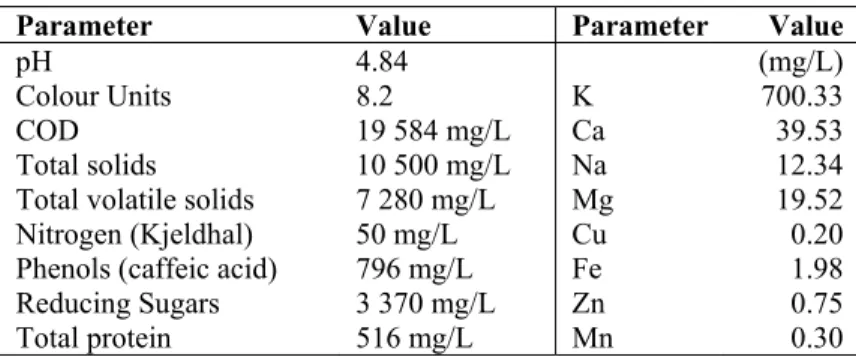
The OMW was obtained from an olive oil mill of Vila Flor, Portugal. Table 1 shows the composition of OMW.
Table 1. Analysis of initial OMW.
2.2 Culture conditions
Cells were harvested (6000 g, 5 min) from the glucose pre-culture and resuspended in the OMW medium. Batch cultures were carried out with the two strains in 500 mL Erlenmeyer flasks with 200 mL of sterilized medium. The pH of the medium was adjusted to 5.6 prior to sterilization. OMW were supplemented with 6 g/L and 12 g/L of ammonium sulphate and 1 g/L of yeast extract, in order to counteract the lack of nitrogen and vitamins (Scoli and Vollaro, 1997). The cultures with an initial concentration of 2 x 10⁶ cells/mL were incubated at 27 oC and 240 rpm of stirring rate. Additional
experiments with W29 strain were performed in baffled conical flasks with an increased initial cell concentration (108 cells/mL) and with the presence of 1 g/L of Tween 80. An experiment without
OMW medium supplementation was also performed.
Cultures were incubated for around 100 h and samples were taken along time to monitor and correct pH values. Cell density was immediately determined by cell counting and samples were stored at -20
oC for further analysis.
2.3. Analytical methods
Initial OMW were analysed for the following parameters: Chemical Oxygen Demand (COD), Solids (total and volatile), Colour, Nitrogen (Kjeldahl) were determined according to Standard Methods (Clesceri et al, 1989). Total phenols were assessed by the Folin-Ciocalteau Method (Commission Regulation (EEC) Nº 2676/90) using caffeic acid as a standard. Reducing sugars were measured by DNS method. Protein concentration was estimated according to Bradford’s method using bovine serum albumin as a standard.
Metals concentrations were determined in a chemically-digested sample by atomic absorption spectrometry (method EP 3051).
Samples were analysed for COD, sugars and total phenols by the methods used for OMW caractherization. Lipase activity in samples was estimated by a spectrophotometric assay method with
Parameter Value Parameter Value
pH
Colour Units COD Total solids Total volatile solids Nitrogen (Kjeldhal) Phenols (caffeic acid) Reducing Sugars Total protein 4.84 8.2 19 584 mg/L 10 500 mg/L 7 280 mg/L 50 mg/L 796 mg/L 3 370 mg/L 516 mg/L K Ca Na Mg Cu Fe Zn Mn (mg/L) 700.33 39.53 12.34 19.52 0.20 1.98 0.75 0.30
p-nitrophenyl-butyrate (pNPB) as the substrate (Morín et al, 2003). One unit of enzyme activity was
defined as the amount of enzyme that liberated 1 µmol of p-nitro-phenol per minute at 25 oC and pH
7.3.
3 Results and discussion
3.1 Effect of ammonium concentration
Both strains of Y. lipolytica studied were able to grow in the OMW supplemented with yeast extract and ammonium sulphate (Fig. 1.A). The growth curve of the two strains were identical for the same culture conditions and a cell number increase of 15-fold was obtained after 110 h of cultivation for the lowest value of ammonium sulphate concentration used. The increase of ammonium supplementation did not improve cell growth. On the contrary, a reduction of 30 % on final cell density was obtained for 12 g/L of ammonium added. The increase on ammonium concentration had also a negative effect on extracellular lipase production for both strains (Fig. 1.B).
Figure 1. A. Growth of Y. lipolytica strain W29 (closed symbols) and strain IMUFRJ 50682 (open symbols) on OMW media with 6 g/L (◊) and 12 g/L (□) of ammonium sulphate at 240 rpm and 27 oC.
B. Time course of extracellular lipase activity.
The strain IMUFRJ 50682 has been reported has an efficient lipase producer (Pereira-Meirelles et al., 2000), but the strain W29 showed a higher potential for lipase production from OMW (Table 1). In fact, this strain has been recently reported as good candidate for the utilization of OMW for lipase production (Lanciotti et al., 2005), on the other hand no data was previously available about the behaviour of the IMUFRJ 50682 strain in OMW. Both strains were able to consume the reducing sugars present in OMW (Table 2), but a higher consumption was obtained for the lowest amount of ammonium supplied, that is in accordance with the cell growth profile (Fig.1A). This was also observed for phenolic compounds degradation. However, the increase in ammonium supply slightly improved the COD degradation. The maximum values of COD degradation obtained were similar with the values previously reported for other strains (Scioli and Vollaro, 1997). The ammonium concentration selected for the next experiments was 6 g/L, because even when it is intended to optimize the waste degradation the goal should include the minimization of chemicals addition.
Table 2. Percentage of total degradation of sugars, phenols and COD; maximum values of lipase activity and productivity for the cultures of strains W29 and IMUFRJ 50682, supplemented with 6 g/L (N6) and 12 g/L (N12) of ammonium sulphate.
Reducing
sugars (%) Phenols (%) COD (%) Lipase Activity (U/L) Productivity (U/L h) W29-N6 W29-N12 IMUFRJ-N6 IMUFRJ-N12 90 63 90 76 72 57 68 39 61 79 75 80 77.7 48.8 27.2 16.1 3.67 2.03 0.43 0.36 10 100 1000 0 40 80 120 Tim e /h C e ll sx10 -6/m L 0 10 20 30 40 50 60 70 80 90 100 0 40 80 120 Tim e /h L ip ase act iv it y/ (U /L ) B A
3.2 Effect of cell concentration and surfactant
In this study, the major goal was the use of OMW as substrate for cell growth and lipase production, thus the strain W29 was selected for further studies of the influence of culture conditions on the process, since the higher values of lipase productivity were obtained for this strain compared to the other strain used (Table 2). In the batch cultures of Fig. 2 the initial cell concentration was increased (108 cells /mL) and baffled flasks were used. For these culture conditions an increase on final cell
density was obtained (1.5 fold) but a 36 % reduction in the maximum value of extracellular lipase activity was found (Fig. 2.B) compared to values with lower cell density. The addition to the medium of 1 g/L of Tween 80 strongly improved cell growth and slightly favoured the kinetics of lipase production.
Figure 2. A. Growth of Y. lipolytica W29 on OMW media in baffled conical flasks with an initial cell concentration of 108 cells/mL at 240 rpm and 27 oC. B. Time course of extracellular lipase activity.
(▲) OMW without supplementation, (♦) OMW supplemented with 1 g/L yeast extract and 6 g/L (NH4)2SO4, (■) OMW supplemented as the previous one and with the addition of 1g/L of Tween 80.
Cell growth on OMW without any supplementation was also studied. The result obtained shows the ability of Y. lipotyica W29 to grow on OMW, as well as the induction of lipase production by OMW without medium modification, which is in accordance with the work of Lanciotti et al. (2005). These authors did not reported data about OMW degradation by this strain. The results in Table 3, shows that this strain degrades COD and phenols without medium supplementation. However, the low nitrogen content of the medium (Table 1) and the lack of some vitamins may limited the lipase production. Table 3. Percentage of total degradation of sugars, phenols and COD; maximum values of lipase activity and productivity for W29 cultures, supplemented with 6 g/L (N6) of ammonium sulphate, with 1 g/L of Tween 80 (N6 – T) and without supplementation (N0).
Reducing sugars (%)
Phenols (%) COD (%) Lipase Activity (U/L) Productivity (U/L h) N6 N6-T N0 86 88 75 70 47 43 54 74 63 49.7 31.5 25.8 1.08 1.13 0.60
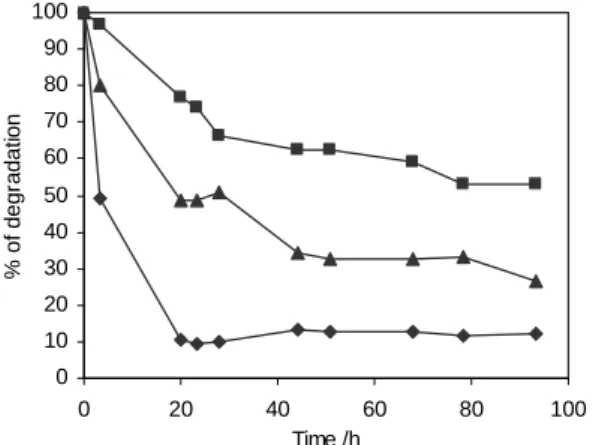
The addition of surfactant to the supplemented medium also improved organic load degradation but not total phenols reduction. Fig. 3 show the variation of sugars, phenols and COD during cultivation time in the presence of Tween 80. Identical profiles were obtained for other conditions, showing in all cases that the first substrates consumed were sugars and the most difficult to consume were the phenolic compounds. The high percentage (around 70 %) of degradation of total phenols achieved at the same conditions that also favoured the lipase productivity, indicates that the use of OMW by
100 1000 0 20 40 60 80 100 Tim e /h C e ll s x10 -6/m L A 0 10 20 30 40 50 60 70 80 90 100 0 40 80 120 Tim e /h L ip ase a c ti vi ty /( U /L ) B
Yarrowia lipolytica has an important potential for its valorization and degradation, since the
detoxification by phenols decrease is a crucial step for further treatment in biological plants.
0 10 20 30 40 50 60 70 80 90 100 0 20 40 60 80 100 Time /h % o f de gr ada tio n Conclusion
The results of this study confirmed the potential application of the yeast Y. lipolytica for OMW valorization by its use as culture medium for biomass and enzymes production. The strain W29 showed better performance in this hostile medium than the wild type strain IMUFRJ 50682, which shows the great field of application in bioprocesses of this the first strain, particularly in media with lipidic components (Aguedo et al., 2004). The utilization of olive mill wastewasters for biological production of high value products may have an positive impact on the environmental problem of OMW management, since it can act also as a first step of effluent treatment.
Acknowledgment
The authors are grateful to Prof. Maria Alice Coelho from the UFRJ, Brasil, for the supply of the strain IMUFRJ 50682.
References
Aguedo M, Ly MH, Belo I, Teixeira JA, Belin J-M, Waché Y (2004) The use of enzymes and microorganisms for the production of aroma compounds from lipids. Food Technol. Biotechnol. 42(4): 327-336.
Aguedo M, Waché Y, Belin J-M, Teixeira JA (2005) Surface properties of Yarrowia lipolytica and their relevance to γ-decalactone formation from methyl ricinoleate. Biotechnol. Lett. 27: 417-422. Azbar, N., Bayram, A., Filibeli, A., Muezzinoglu, A., Sengul, F., Ozer, A. (2004) A review of waste
management options in olive oil production. Crit. Rev. Env. Sci. Technol., 34, 209-247.
Bradford, M.M., 1976. A rapid and sensitive method for the quantification of microgram quantities of protein using the principle of protein-dye binding. Anal. Biochem. 72, 248-255.
Cabrera, F., López, R., Martinez-Bordiú, A., Dupuy de Lome, E., Murillo, J.M. (1996). Land treatment of Olive mill wastewater. Int. Biodeterioration & Biodegradation, 215-225
Clesceri, L.S., Greenberg, A. E., Trussel, R. R. (1989) Standards Methods for the examination of water and wastewater, 17th Ed., American Public Health Association, NY.
D’Annibale, A., Ricci, M., Quaratino, D., Federici, F., Fenice, M. (2004). Panus tigrinus efficiently removes phenols, color and organic load from olive-mill wastewater. Research in Microbiology, 155, 596-603.
Ettayebbi, K., Errachidi, F., Jamai, L., Tahri-Jouti, M:A, Denside, K., Ettayebbi, M. (2003) Biodegradation of polyphenols with immobilized Candida tropicalis. FEMS Microbiology, 223, 215-21.
Eusébio, A., Almeida-Vara, E., Sena-Martins, G., Mateus, M., Cardoso Duarte, J. (2002). Microbial treatment of olive oil wastewater. Proc. International Worshop on Water in the Mediterranean
Basin: Resources and sustainable development. 210-217.
Figure 3. Time course of degradation of reducing sugars (♦), COD (▲) and phenols (■), obtained in cultures of Y. lipolytica W29 in OMW supplemented with 6 g/L of ammonium
sulphate, 1 g/L of yeast extract and 1 g/L of Tween 80. Cultures were grown in baffled flasks.
Hagler, A.N., Medonça-Hagler, L.C. (1981) Yeasts from marine and estuarine waters with
different levels of pollution in the State of Rio de Janeiro, Brazil. Appl. Environ.
Microbiol., 41, 173-178.
Lanciotti, R., Gianotti, A., Baldi, D., Angisani, R., Suzzi, G., Mastrocola, D., Guerzoni, M. E. (2005). Use of Yarrowia lipolytica strains for the treatment of olive mill wastewater. Bioresource
Technology, 96, 317-322.
Marques, I.P (2001) Anaerobic digestion treatment of olive mill wastewater for effluent re-use in irrigation. Desalination, 137, 233-239.
Miller, G.L., 1959. Use of dinitrosalicylic acid reagent for determination of reducing sugar. Anal.
Chem. 31, 426-428.
Morín, M., Gonzalez, F.J., Domínguez, A. (2003) Lipase assay in Yarrowia lipolytica. in:
Non-Conventional Yeasts in Genetics, Biochemistry and Biotechnology. K. wolf, K. Breunig, Barth, G.
(Eds.), Springer-Verlag, Berlin Heidelberg.
Niaounakis, M., Halvadakis, C. P. (2004). Olive-Mill Waste Management: Literature Review and
Patent Survey, Typothito – George Dardanos, Greece.