ORIGINAL PAPER
Effect of graphene oxide on the properties of compatibilized
polypropylene/ethylene-propylene-rubber blend
Zahir Guezzout1&Rachida Doufnoune1&Nacerddine Haddaoui2
Received: 29 March 2017 / Accepted: 24 July 2017 # Springer Science+Business Media B.V. 2017
Abstract In this work, the effect of graphene oxide (GO) and its derivatives on the mechanical, thermal and morphological properties of nanocomposites based on polypropylene/ ethylene-propylene rubber (PP/EPR) were investigated. In or-der to achieve a better dispersion of the nanofiller and to en-hance its interaction with the polymer matrix, amine and al-cohol grafted polypropylene were used as compatibilizers. These compatibilizers were synthesized by the reaction of polypropylene-grafted anhydride maleic (PP-g-MAH) with 1,12-dodecanediamine and 1,12-dodecanediol, respectively in the presence of dicumyl peroxide (DCP) by melt mixing. The nanocomposites were prepared via melt blending masterbatch process using Brabender mixer. The addition of functionalized GO and compatibilizers improved the tensile strength and Young’s modulus of PP/EPR nanocomposite. While the elongation and Izod impact strength were adversely affected. Furthermore, the TGA analysis showed that the in-corporation of GO and compatibilizers improve significantly the thermal stability. SEM micrographs of the fractured sur-faces of the nanocomposites revealed a good dispersion of functionalized GO in the polymer matrix.
Keywords PP . EPR . Graphene oxide . Intercalation . Coupling agents . Nanocomposites
Introduction
Over the last few decades, interest in a new class of carbon-based nanomaterials, such as carbon nanotubes (CNTs) and fullerene have rapidly gained more attention as nanofillers for polymer nanocomposites. This is due to their potential for improving physical and structural properties compared to con-ventionally carbon black filled polymers [1,2].
Graphene is the most recent addition to members of the carbon family. As the building blocks for CNTs and other carbon nanomaterials, graphene structure consists of a flat
monolayer of sp2-hybridized carbon atoms, hexagonally
arrayed. This unique structure provides this material with ex-ceptional properties, in particular high ultimate strength (130 GPa) and Young’s modulus (1TPa). In addition, graphene also have high specific surface area of 2630– 2965 m2/g, high aspect ratio and low mass density. The dis-persion of small quantity of such materials in polymer matri-ces produmatri-ces nanocomposites with superior mechanical prop-erties [3, 4]. However, nowadays, there are still some big technical challenges, e.g., high cost of manufacturing pure monolayer graphene. Moreover, due to its strong van der Waals interactions and high specific surface area, it is very difficult to disperse a large quantity of graphene into polymer matrices. While the graphene oxide (GO), consisting of graphene derived sheets and other oxygen functional groups are showing more potential for practical applications [5].
GO can be produced by the oxidation and exfoliation of
graphite with strong oxidative reagents such as HNO3,
H2SO4, H2O2, KMnO4, KClO3, NaNO3... [6]. GO consists of oxygen functional groups on the basal plane and at the edges. In the majority of cases, it is believed that epoxy and hydroxyl groups are on the basal plane, whereas carbonyl and carboxylic acid groups are at the edges [6,7]. The functional-ities on the surface of GO can promote complete exfoliation of * Rachida Doufnoune
1
Unité de Recherche sur les Matériaux Emergents–Sétif- URMES, Equipe de Valorisation des Polymères, Université Ferhat ABBAS Sétif-1, Sétif, Algérie
2 Laboratoire de Physico-Chimie des Hauts Polymères (LPCHP),
Département de Génie des Procédés, Faculté de Technologie, Université Ferhat ABBAS Sétif-1, Sétif, Algérie
graphene oxide sheets in polymeric matrices and enhance the interfacial interaction notably [5,8].
GO has been employed in many polymer matrix-nanocomposites (PNCs) because it has a potentially effective reinforcement. However, GO is highly hydrophilic and most engineering polymers are hydrophobic. The dispersion of GO in most cases is not easily achieved due to the intrinsic incom-patibility of GO and engineering polymers [9,10]. In order to have a successful development of PNCs, it is necessary to mod-ify GO so that it can be compatible with a given polymer matrix. Because the rich chemistry of hydroxyl, carboxyl, and ep-oxy groups, GO has been selected very often as the starting material for the formation of GO derivatives through the co-valent organic groups grafted on its surface [6,11]. Numerous GO derivatives can be obtained based on the reaction with epoxy and carboxylic acid groups on GO sheets. Nucleophilic substitution, acylation and esterification are
fre-quently used as approaches to modify GO. Yuan [12]
employed p-phenylenediamine (PPD) for the modification of GO through the reaction with epoxy groups generating GO-PPD. Then, GO-PPD is modified with cyanuric chloride (CC) and grafted with maleic anhydride-g-polypropylene to pro-duce functionalized GO/PP (fGO/PP) nanocomposites. It has been shown that the conductivity, thermal stability and me-chanical properties of the nanocomposites are enhanced effec-tively by the addition of fGO.
Ren et al. [13] reported a method to efficiently convert the hydrophilic groups of GO and reduced graphene oxide (RGO) into alkyl groups by nucleophilic substitution and amidation reaction with dodecylamine (DA). The resulting functional-ized nanomaterials (DA-GO) and (DA-RGO) can be homoge-neously dispersed in high density-polyethylene (HDPE). The crystallinity, dynamic mechanical, gas barrier, and thermal stability properties of HDPE were greatly enhanced by the addition of a low concentration of DA-GO or DA-RGO.
Polyolefin nanocomposites based on GO nanosheets offer opportunities for the improvement of polyolefins (POs) with relatively small amounts of nanofiller concentration [14–17]. PP is the polymer that probably offers the best price/ performance ratio among all POs. With a tonnage representing over 21% of total plastics it is estimated to have an average annual growth rate of 4% for the period from 2010 to 2020 [18]. This is one of the most widely used materials after poly-ethylene, polystyrene and polyvinyl chloride. It is used for large automotive exterior applications requiring durability, and ductile impact properties at low temperature. Applications include bumpers and other large exterior parts due to its low density, easy processing, thermal stability, resis-tance to corrosion and good resisresis-tance to impact [19].
Polypropylene is often produced and marketed in the form of PP/elastomer compounds such as PP/EPR (ethylene-propylene rubber), PP/EPDM (ethylene-propylene-diene monomer) and PP/POE (polyethylene-octene) blends. They are characterized
by an increased impact resistance in a wide temperature range from ambient to - 40 °C. However, their use is limited when the thermo-mechanical properties combined with high stiffness and temperature resistance are required. It appears desirable to com-bine the advantages of the two systems and to elaborate ternary nanocomposites, which contain both an elastomer and nanofiller [20, 21]. However, the main challenge in the fabrication of nanocomposites is dispersion of the individual GO nanosheets in the polymer blends, due to the incompatibility of hydrophobic matrix with hydrophilic GO. Therefore, surface modifications of the GO nanoparticles and the addition of functional compatibilizers are often required to achieve the intercalation and exfoliation morphologies necessary for reaching the best mechanical performances.
The main objective of this paper is to examine the effect of GO nanoparticles and compatibilizers on the properties of PP/ EPR/GO nanocomposites prepared by melt compounding mixing process (masterbatch dilution technique) using Brabender mixer. The influences of GO loading and surface modifications of GO with hexadecylamine and silane coupling agents on the mechanical, thermal and structural properties of the nanocomposites were investigated.
Experimental
MaterialsThe materials used in this work are presented in Table 1.
Natural graphite powder particles (10 μm) were supplied
from Qingdao Xinghe Graphite co. Ltd., China. The chemicals used for the synthesis of graphene oxide, sulfu-ric acid (H2SO4, 98%), fumed nitric acid (HNO3, 68%),
hydrogen peroxide (H2O2, 30%), and hydrofluoric acid
(HF, 48%) were obtained from Sigma-Aldrich without any further purification. Hexadecylamine (HDA, 98%)
was supplied from Fluka. γ-glycidoxytrimethoxysilane
(GPTMS, > 98%) was purchased from Sigma-Aldrich
and γ-aminopropyltriethoxysilane (AMPTES, > 99%) was
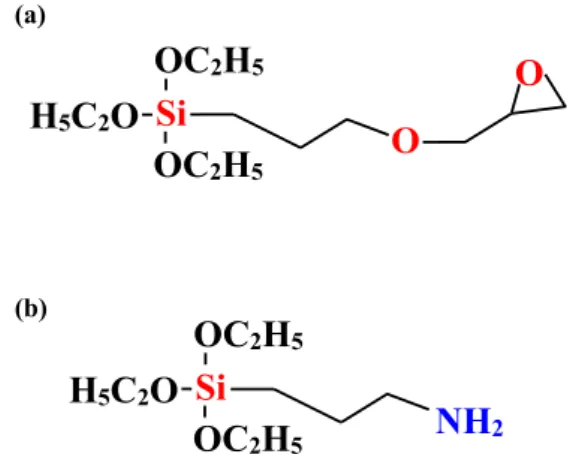
generously donated by Witco Corp. (USA). The chemical formulas of the silane coupling agents are presented in
Fig. 1. The polypropylene (ISPLEN PP040 G1E) used as
the matrix is an isotactic homopolymer obtained from Repsol Quimica S.A. (Spain). The Ethylene-Propylene Rubber (EPR) employed in this study is a commercial grade product (Vistalon) from Exxon Mobil Chemical. The ethylene/propylene ratio of this material is 70/30. Maleic anhydride (MAH, 99%) and dicumyl peroxide (DCP, 98%) were supplied from Sigma-Aldrich. The di-amine (1,12-dodecanedidi-amine, 99%) and dialcohol (1.12-dodecanediol 99%) purchased from Sigma-Aldrich were used to functionalize PP. All other reagents which were laboratory grade and supplied from Sigma-Aldrich were
used without further purification unless otherwise speci-fied. The maleic, amine and alcohol functionalized compatibilizers were prepared in our laboratory.
Synthesis of graphene oxide
The natural graphite was first purified following two consecutives steps: an oxidative treatment in air at 350 °C for 30 min followed by a chemical one using a mixed aqueous solution containing 30 wt% of hydro-gen peroxide and 30 wt% of hydrofluoric acid at a temperature of 80 °C.
GO powders were prepared via a chemical approach ac-cording to the following procedure: 10 g of purified powder graphite was dispersed in a mixture of concentrated sulfuric acid and fuming nitric acid in a ratio of 60:40. The obtained mixture was refluxed under vigorous stirring for 72 h. Afterwards, 200 ml of distilled water was added to the reac-tion vessel. The diluted slurry was then stirred for an addireac-tion- addition-al 5 h. The product was filtered and washed with distilled water in order to remove the impurities. The resulting GO
was then dried in a vacuum oven at 65 °C for 36 h and then grinded in fine particles.
Intercalation and functionalization of graphene oxide Intercalation of GO with octadecylamine was performed by the following procedure: Typically, 6 g of octadecylamine was dissolved in 100 ml ethanol and added dropwise to a suspen-sion of 2 g of GO in 300 ml of water under vigorous stirring. The reaction lasted for 24 h at 80 °C and the intercalated GO was collected by filtration and thoroughly washed with 25:75 warm water/ethanol mixtures three times. The obtained prod-uct was filtered then dried at 60 °C for 72 h prior to charac-terization. The modified GO which was ground to fine parti-cles was named ODA-GO.
To functionalize GO, the silane agents were dissolved in a 200 ml mixture of water/methanol at a ratio of 75:25, then 2 g of the ODA-GO was added to the vessel and the suspension was stirred during 5 h at 80 °C. The functionalized particles were filtered, washed subsequently with methanol, then with 50:50 water/methanol mixtures for at least three times to remove any unreacted silanes. Finally, the modified particles were dried in a vacuum oven at 105 °C for 24 h, then ground, pulverized and stored for further use. The functionalized GOs prepared from the silanes were denoted as AMPTES-GO and GPTMS-GO.
Preparation of functionalized polypropylene
The modification reaction was carried out in the molten state by using a 50 ml Brabender PL2100 mixer. PP, 2 wt% of MAH, and 0.1 wt% of DCP were introduced in the preheated mixer at 180 °C and mechanically mixed at 30 rpm for 10 min. The product was granulated and kept firmly away from the humidity in plastic bags. The grafting fraction was determined by titration of the acid groups from the anhydride functions according to the previously reported procedure [22]. The grafting fraction was found to be 1 wt% of maleic anhydride groups.
Table 1 Materials used in this study
Materials Commercial designation Supplier Properties
Graphite Natural graphite Qingdao Xinghe Graphite co. Ltd d50= 10μm
PP ISPLEN PP040 G1E Repsol Quimica S.A. MFI = 3 g/10 min, d = 0.902 g/cm3
EPR Vistalon Exxon Mobil Chemical ML(1 + 4) = 30 at 125 °C, d = 0.88 g/cm3
MAH Maleic anhydride Sigma-Aldrich bp = 202 °C, d = 1.48 g/cm3
DCP Dicumyl peroxide Sigma-Aldrich bp = 31-°C, d = 1.56 g/cm3
ODA n-Octadecylamine Fluka bp = 232 °C, mp = 52 °C
GPTMS GLYMO Sigma-Aldrich d = 1.069 g/cm3, bp = 120 °C
AMPTES Silquest A-1100 Witco Corp. d = 0.95 g/cm3, bp = 92 °C
Diamine 1,12-dodecanediamine Sigma-Aldrich bp = 67 °C
Dialcohol 1,12-dodecanediol Sigma-Aldrich bp = 79 °C
OC
2H
5 (b)OC
2H
5H
5C
2O
NH2
Si
(a)OC
2H
5OC
2H
5H
5C
2O
O
Si
O
Fig. 1 Chemical formulas of silane coupling agents (a) GPTMS and (b) AMPTES
The amine and alcohol functionalized polypropylene were prepared by the reaction of PP-g-MAH with 1,12-dodecanediamine and 1,12-dodecanediol, respectively. First, the PP-g-MAH was melted in a Brabender mixer for 3 min at 190 °C and 40 rpm, then 2 wt% of the diamine or dialcohol was added. After mixing for another 7 min, samples were removed from the Brabender, solidified and grinded into pel-lets. The obtained material was dissolved and purified in xy-lene for 24 h in order to remove any remaining diamine or dialcohol. Finally, the product was dried in vacuum at 60 °C to constant weight. The functionalized PP prepared from
di-amine and dialcohol were denoted as PP-g-NH2and
PP-g-OH, respectively.
Elaboration of nanocomposites
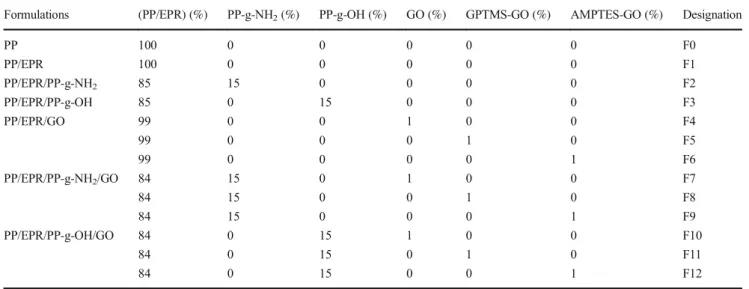
The various formulations and their respective designations used in this study are shown in Table2. Nanocomposites were prepared in a two-step compounding process. First, a predispersed GO and functionalized GO masterbatchs were prepared using a Brabender mixer at 190 °C and a rotor speed of 30 rpm. The masterbatchs were then incorporated into PP/ EPR matrix in a 95/5 proportion and allowed to mix for 8 min at 200 °C and 60 rpm in the Brabender PL2100 mixer. The resulting PP/EPR/GO nanocomposite is hence composed of
1 wt% GO and 15 wt% of compatibilizers (PP-g-NH2and
PP-g-OH). After pelletizing, the composite granules were com-pression molded using a hydraulic press at 200 °C and 200 Kg/cm2for 6 min.
Characterization
ATR-FTIR spectroscopy was used to confirm the formation and functionalization of GO. About 50 mg of the GO were compacted into thin pellets using a hydraulic press under a
force of 5 tons maintained for about 4 min Samples were analyzed by signal averaging 16 scans at a resolution of
4 cm−1using a JASCO-IR spectrometer. FTIR analysis was
also performed to confirm the grafting reaction of MAH, amine and alcohol onto PP. Thin films were obtained from the samples by compression molding between two Teflon sheets using a compression machine at 200 °C and 180 kg/ cm2. The spectra were recorded on a Shimatzu spectrometer in a transmission mode at 4 cm−1with the coaddition of 32 scans with a spectral range of 4000–400 cm−1.
XRD analyses of the GOs samples were performed using a BRUCKER D8 Advance diffractometer. The
ra-diation frequency used was the Kα1 line from Cu
(1.54 Å), with a power supply of 40 kV and 40 mA. The interlaminar distances of the sheets were obtained from the (002) reflection which were recorded in the 2-theta (2θ) range from 5 to 40° at steps of 0.01° and intervals of 6 s per step, using Bragg’s eq. [23].
Mechanical properties of the nanocomposites were evaluated by tensile and impact strength measurements. Tensile properties were measured using an Instron MTC 500 machine at a cross head speed of 20 mm/min. The tensile strength, Young’s modulus and elongation at yield and break were determined from the stress-strain curves according to ASTM D 638 specifications. Impact testing was carried out using a Ceat impact pendulum tester with an impact energy of 7.5 Kj according to
ASTM D 256–88. The hammer velocity was set at
2.88 m/s while the weight of the hammer was 1.8 Kg. All measurements were made in five replicants and the values were averaged.
The morphology of the nanocomposites was analysed using with a Quanta 200 Scanning Electron Microscope at an acceleration voltage of 10 kV. Test specimens, produced
by compression molding at 200 °C and 180 Kg/cm2, were
Table 2 Composition and designation of Polymer/GO nanocomposites
Formulations (PP/EPR) (%) PP-g-NH2(%) PP-g-OH (%) GO (%) GPTMS-GO (%) AMPTES-GO (%) Designation
PP 100 0 0 0 0 0 F0 PP/EPR 100 0 0 0 0 0 F1 PP/EPR/PP-g-NH2 85 15 0 0 0 0 F2 PP/EPR/PP-g-OH 85 0 15 0 0 0 F3 PP/EPR/GO 99 0 0 1 0 0 F4 99 0 0 0 1 0 F5 99 0 0 0 0 1 F6 PP/EPR/PP-g-NH2/GO 84 15 0 1 0 0 F7 84 15 0 0 1 0 F8 84 15 0 0 0 1 F9 PP/EPR/PP-g-OH/GO 84 0 15 1 0 0 F10 84 0 15 0 1 0 F11 84 0 15 0 0 1 F12
frozen by immersion in liquid nitrogen to obtain brittle frac-tured specimen.
TGA of both GOs and polymer nanocomposite samples was conducted using a Setaram SETSYS TG-DTA thermal analyser under nitrogen atmosphere at a flow rate of 20 ml/ min. About 10 to 20 mg of each sample was heated from 30 to 500 °C with a heating rate of 10 °C/min.
Results and discussion
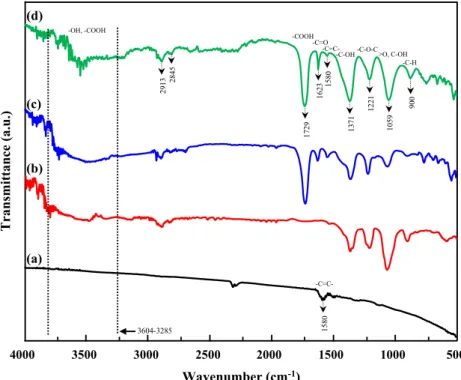
In order to prove the formation of GO, ATR-FTIR measurement was conducted. Figure2 shows the FTIR results of pristine graphite, purified graphite and graphene oxide. While no ab-sorption bands observed suggests the functional groups in pris-tine graphite (Fig. 2a), purified graphite (Fig. 2b, c) and graphene oxide (Fig. 2d) was found to exhibit several char-acteristic absorption bands of oxygen-containing groups (Fig.
2b, c). The broad band at 3604–3285 cm−1is characteristic
of the stretching vibration of the O-H and –COOH groups.
The intense band at 1729 cm−1is attributed to the –C = O
stretching of –COOH group. The bands located at
1623 cm−1 and 1371 cm−1 may refer to the stretching of
the C = O bond of carbonyl groups and O-H bond of alcohol functions, respectively. The absorption band at 1580 cm−1 is attributed to skeletal vibrations of unoxidized graphitic domains. The band at 900 cm−1corresponds to the
aromatic C-H bonds. The bands present at 1221 cm−1 and
1059 cm−1 are attributed to the presence of ethers, phenols and epoxy functions. This shows that the purification treat-ments of the graphite also create oxygenated functions even
on the surface of mineral. The low intensity bands at 2913 and 2845 cm−1were attributed to the stretching vibration of the aliphatic sp3, C-H, which prove the oxidation process.
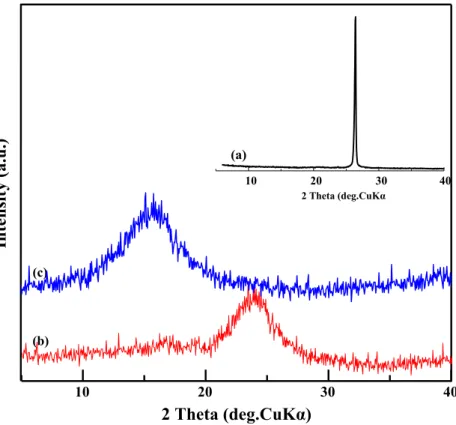
The XRD patterns of purified graphite and GO as well as that of raw graphite are shown in Fig.3. The pattern of the raw graphite shows a very strong (002) peak at 2θ = 26.5°, for a typical graphitic structure with a layer spacing of 0.345 nm. However, after purification, it is obvious that the characteristic graphitic peak completely disappears and a new diffraction peak appears at about 2θ = 24° with a layer spacing of 0.385 nm. This slight increase is attributed to the formation of oxygenated groups and to the intercalation of water mole-cules within carbon layer structure. These results are in good agreement with those obtained by FTIR spectroscopy.
In the case of GO, the peak corresponding to (002) plane of graphite vanishes with the appearance of a new peak at around 2θ = 15.2°, which corresponds to a (001) plane. The average d-spacing between the graphene planes is observed at 0.583 nm.
TGA is a complementary technique that can reveal the composition and changes in thermal stability of the samples. TGA analyses of pristine graphite, purified graphite and GO are illustrated in Fig.4. It is observed that the pristine graphite is highly stable up to 500 °C. The thermal degradation profile for the purified graphite exhibits one weight loss step at 250 °C. The TGA curve obtained for GO sample shows two weight loss steps around 100 °C and 250 °C. The former is due to the release of physisorbed water molecules and the decomposition of the labile oxygen-containing functional
groups such as -COOH,−OH and -C = O groups, yielding
CO, CO2, and steam [24].
Wavenumber (cm-1) Transmittance (a.u.) 4000 3500 3000 2500 2000 1500 1000 500 -OH, -COOH -C-OH -C-H >O, C-OH -COOH -C=O -C=C- -C-O-C 10 59 90 0 12 21 13 71 15 80 16 23 17 29 -C=C- 1580 (a) (b) (c) (d) 3604-3285 29 13 28 45
Fig. 2 ATR-FTIR spectra of (a) pristine graphite, (b) purified graphite by oxidative treatment in air (c) purified graphite by oxidative treatment in solution and (d) Graphene oxide
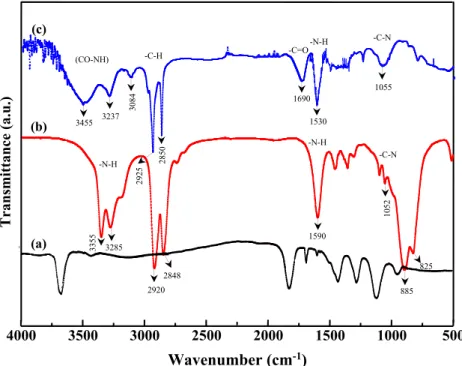
Figure5shows the FTIR spectra of ODA-GO in compar-ison to pure HDA and GO spectra. The spectrum of ODA-GO
(Fig. 4c) exhibits two strong bands at 2925 cm−1 and
2850 cm−1which correspond to -CH asymmetric and
sym-metric stretching of -CH2groups in ODA. This confirms its successful grafting on GO surface.
The bands appearing at 3455 cm−1and 3236 cm−1 are
assigned to the vibration of the NH-CO, which means that the ODA interacts onto the surface with the -COOH functional
groups of GO. The band related to the -C = O stretching of–
COOH groups appearing at 1729 cm−1in the spectrum of GO
shifts to 1690 cm−1with a decrease in the band intensity and reveals the formation of CO-NH linkage in the surface of GO. The bands at 1530 cm−1and 1055 cm−1are attributed to the vibration of N-H and C-N bonds corresponding to the second-ary amide.
Figure6presents the FTIR spectra of GPTMS-GO in
com-parison to the reference spectra, which are those of the pure
500 100 200 300 400 50 60 70 80 90 100 Weight (%) (a) (b) (c) Temperature (°C)
Fig. 4 TGA curves of (a) pristine graphite, (b) purified graphite and (c) graphene oxide (a) (b) (c)
2 Theta (deg.CuKα)
Intensity (a.u.)
10 20 30 40 10 20 30 40 2 Theta (deg.CuKα Fig. 3 XRD patterns of (a)pristine graphite, (b) purified graphite and (c) graphene oxide
GPTMS and GO. In the GPTMS-GO spectrum (Fig.5c), the broad band centered at 3655 cm−1results from the–OH func-tional groups of Si-OH and water. The band positioned at 1640 m−1is also attributed to the–OH bond of water. The strongest bands which appeared at 2940 cm−1and 2838 cm−1 are attributed to the -CH2- groups of the GPTMS propyl
seg-ments. The absorption bands located at 1130 cm−1 and
1044 cm−1are assigned to the siloxane bonds resulting from the condensation of silane molecules. The bands at 1455 cm−1 and 874 cm−1 are attributed to the -CH2- of the glycidoxy groups and the epoxy ring, respectively.
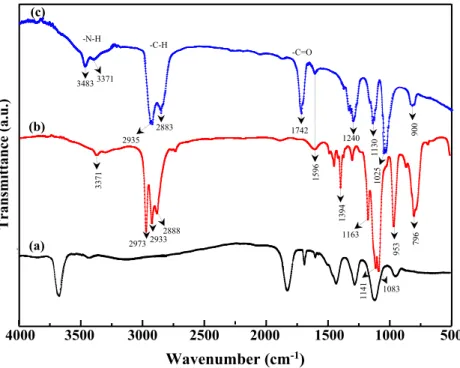
Figure7shows the FTIR spectra of AMPTES-GO, in
com-parison to the reference spectra, which are those of the pure AMPTES and GO. The spectrum of AMPTES-GO exhibits
two intense bands at 2981 cm−1and 2898 cm−1which are
attributed to the stretching vibrations of the C-H bonds of the methylene groups of the aminopropyl segment. The band po-sitioned at 1742 cm−1is assigned to the vibrations of the esters
carbonyl group C = O. The bands located at 3483 cm−1and
3371 cm−1and the band positioned at 1596 cm−1correspond to the N-H bond which are characteristics of primary amine
func-tions. The bands centered at 1130 cm−1and 1025 cm−1are
Transmittance (a.u.)
Wavenumber (cm
-1)
500 4000 3500 3000 2500 2000 1500 1000 (a) (b) (c) -C-H 29 25 28 50 3455 3237 3084 (CO-NH) -N-H -N-H 1590 2920 2848 33 55 3285 10 52 -C-N 1530 -C=O 1690 -N-H -C-N 1055 885 825 Fig. 5 ATR-FTIR spectra of (a)GO, (b) pure ODA and (c) ODA-GO 500
Wavenumber (cm
-1)
4000 3500 3000 2500 2000 1500 1000 (a) (b) (c) Transmittance (a.u.) 1086 870 > O 2940 2838 1462 1193 14 55 11 30 874 10 44 164 0 -O-H -C-H -Si-O-Si- -C-H -OH Fig. 6 ATR-FTIR spectra of (a)GO, (b) pure GPTMS and (c) GPTMS-GO
characteristic of the siloxane bonds. This result suggests that the AMPTES reacts rather via the silanol functional groups with -COOH or -OH functional groups forming a polysiloxane network.
The successful grafting of GO with ODA, GPTMS and AMPTES is further corroborated with TGA results (Fig.8). The loss observed at the temperature range 120–250 °C for HDA-GO sample, is attributed to the transformation of some oxygen-containing groups which react with HDA. Decomposition of the alkyl groups in ODA occurs between 300 °C and 460 °C.
The thermal decomposition profiles for GPTMS-GO and AMPTES-GO exhibit one weight stage at 325 °C and 350 °C, respectively. This is due to the release of silane molecules. The higher combustion temperature of silylated materials in com-parison with ODA-GO demonstrates the higher thermal sta-bility of these samples because of the reduction of defects created during the formation of GO.
Figure9shows the X-ray diffraction patterns of HDA-GO, GPTMS-GO and AMPTES-GO samples. After intercalation of GO with HDA (Fig.9a), the diffractogram shows a shift of 2θ angle to lower values. The peak position at 2θ = 12.1°, corresponds to a layer spacing of 0.73 nm. The increase of the layer spacing is attributed to the intercalation of amine mole-cules within the structure of graphitic layer. After silanization
of HDA-GO with GPTMS (Fig.9b), the peak position does
Transmittance (a.u.)
Wavenumber (cm
-1)
4000 3500 3000 2500 2000 1500 1000 500 (c) (a) (b) 2973 2933 2888 139 4 1163 1083 95 3 796 1141 2883 2935 1742 159 6 1240 11 30 90 0 3483 337 1 -C-H -C=O 3371 -N-H 10 25Fig. 7 ATR-FTIR spectra of (a) GO, (b) pure AMPTES and (c) AMPTES-GO 2 Theta (deg.CuKα) (c) (b) (a) Intensity (a.u.) 10 20 30 40
Fig. 8 XRD patterns of (a) HDA-GO, (b) GPTMS-GO and (c) AMPTES-GO Weight (%) 500 100 200 300 400 50 60 70 80 90 100 (a) (c) (b) Temperature (°C)
Fig. 9 TGA curves of (a) ODA-GO, (b) GPTMS-GO and (c) AMPTES-GO
not change, which that suggests the interlayer space has not expanded. Also, silanization of HDA-GO with AMPTES (Fig. 9c) shifts to lower values. The peak position for the sample at 2θ = 8.3° value, corresponds to a layer spacing of 1.1 nm. This is explained by the ability of the aminosilane to be grafted on the internal surfaces of the graphene oxide and the polycondensation of these grafted molecules in a three-dimensional siloxane network.
The grafting of PP was also confirmed using ATR-FTIR
spectroscopy. The FTIR spectra of PP-g-MAH, PP-g-NH2and
PP-g-OH are shown in Fig.10. The spectrum of PP-g-MAH
(Fig.10a) shows two bands at 1782 cm−1and 1710 cm−1, which are characteristic of cyclic anhydride groups. The spectrum of PP-g-NH2(Fig.10b) displays four bands due to the formation of the imide groups. The band at 1771 cm−1is assigned to the asymmetrical stretching of carbonyl groups in imide. The band at 1712 cm−1is attributed to the stretching of carbonyl groups in carboxylic acid. The strong intensity of this band is attributed to the symmetrical stretching of the carbonyl groups in imide. The
two bands appearing at 1650 cm−1and 1550 cm−1correspond to the vibration of the secondary amide groups. The spectrum of
PP-g-OH (Fig.10c) shows one band at 1740 cm−1which is
characteristic of the ester carbonyl groups. Mechanical properties of the nanocomposites
One of the major deficiencies of PP is its low stiffness at high temperature, as well as low impact resistance, especially at low temperature because of its relatively high glass transition temperature. An alternative was developed in order to im-prove the impact toughness of PP by adding both soft and rigid particles [25–27].
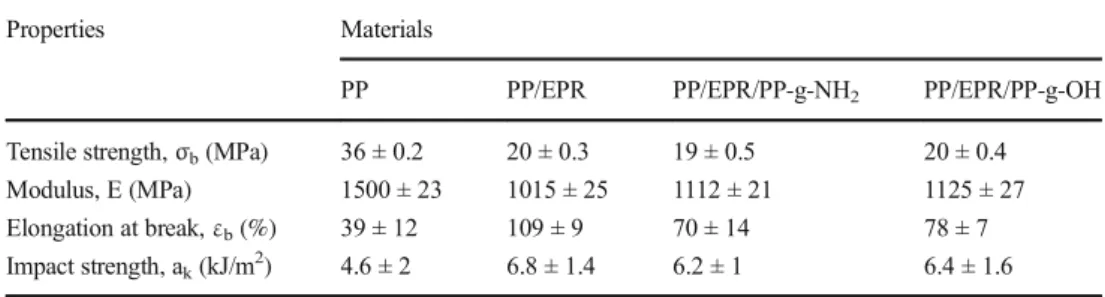
The tensile and Izod impact strength results of the different nanocomposites are presented in Table3. As expected it is shown that the addition of EPR led to a substantial improvement in ductility. This was indicated by the elongation at break of PP which increased by 180%, whereas Young’s modulus and tensile strength decreased by 92% and 44%, respectively. The Izod
Wavenumber (cm
-1)
2000
1900
1800
1700
1600
1500
Tra
n
smi
ttance (a.u)
1710 1782 1712 1771 17 40 (a) (b) (c) -C=O (anhydride) 1650 1550 -NH-C=O (secondary amide) R-O-C=O (ester)Fig. 10 FTIR spectra in the range 2000–1500 cm−1of (a) PP-g-MAH, (b) PP-g-NH2and (c)
PP-g-OH
Table 3 Tensile properties of neat PP, PP/EPR and compatibilized blends
Properties Materials
PP PP/EPR PP/EPR/PP-g-NH2 PP/EPR/PP-g-OH
Tensile strength,σb(MPa) 36 ± 0.2 20 ± 0.3 19 ± 0.5 20 ± 0.4
Modulus, E (MPa) 1500 ± 23 1015 ± 25 1112 ± 21 1125 ± 27
Elongation at break,εb(%) 39 ± 12 109 ± 9 70 ± 14 78 ± 7
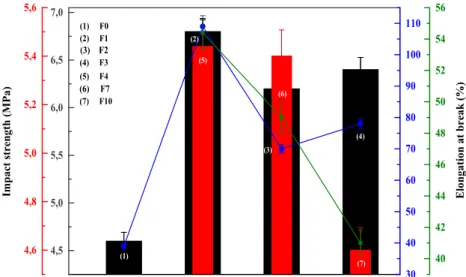
impact strength increased from 4.6 kJ/m2up to 6.8 kJ/m2, which corresponds to an increase of about 47% compared to neat PP. These results were generally observed in various blends and have been attributed to the softening or diluting influence of the addi-tion of soft elastomeric particles to the polymeric matrix [28,29]. Introducing the compatibilizers in PP/EPR blend increased slightly the modulus value, decreased the elongation at break while maintaining the impact strength constant. It is believed that the reduction of the elongation at break may result from a higher adhesion at the interface between the two phases, PP and EPR.
Table4presents the results of the tensile and Izod impact strength of the nanocomposites modified by the addition of GO and the compatibilizers. It was found that the incorpora-tion of GO has improved the tensile strength and Young’s modulus. Tensile strength and Young’s modulus increased by about 7% and 14%, respectively. In addition, the elonga-tion at break and impact strength (Fig.12) decreased by about 50% and 20% respectively as compared to the unfilled blend. This can be explained by the lack of interfacial adhesion be-tween the non-polar PP/EPR matrix and the polar layered GO. The addition of compatibilizers resulted in an improvement of the tensile strength and Young’s modulus. It was also found that while the tensile strength and modulus of PP/EPR/PP-g-OH/GO increased by about 35% and 30% those of PP/EPR/
PP-g-NH2/GO increased by only 21% and 10%, respectively
as compared to the unfilled blend. However, it is important to note that the PP-g-NH2compatibilized nanocomposites showed
higher elongation at break and impact strength as compared to PP-g-OH compatibilized nanocomposites (Fig.11). It was also noted that the incorporation of compatibilizers into nanocom-posites caused a slight increase of both elongation at break and Izod impact strength.
The improvement in the mechanical properties by the ad-dition of compatibilizers; particularly PP-g-OH, results from greater adhesion at the interface between PP, EPR and GO. The interface would be the base of important interactions be-tween the two phases due to the presence of the compatibilizer which concentrates preferentially at this level during the de-velopment of the blend phases.
It is noteworthy that the most important factor that can possibly contribute to the enhancement of the mechanical properties for materials with nanofillers is the dispersion and interaction of the polymer matrix with nanoparticles. Better dispersion of the filler within the matrix and a strong nanofiller-matrix interaction ensures effective load transfer between the components.
It is clear that the performance of a GO/polymer nanocom-posite depends on the dispersion of GO in the matrix and interfacial interactions between the GO and the polymer ma-trix. However, several studies have not been able to provide consensus on the factors governing the nanofillers/matrix in-terface of composites. The functionalization of GO using non covalent and covalent methods can provide useful functional groups which make GO soluble in different organic solvents. Table 4 Tensile properties of PP/
EPR/GO and compatibilized nanocomposites
Properties Materials
PP/EPR/GO PP/EPR/PP-g-NH2/GO PP/EPR/PP-g-OH/GO
Tensile strength,σb(MPa) 21.4 ± 0.1 23 ± 0.4 27 ± 0.2
Modulus, E (MPa) 1155 ± 20 1225 ± 25 1454 ± 23 Elongation at break,εb(%) 51.4 ± 7 49 ± 9 41 ± 5 Impact strength, ak(kJ/m2) 5.44 ± 1.8 5.4 ± 1.2 4.9 ± 1 4,5 5,0 5,5 6,0 6,5 7,0 4,6 4,8 5,0 5,2 5,4 5,6 (7) (6) (5) (4) (3) (2) Elongation at break (%)
Impact strength (MPa)
(1) (4) F3 (3) F2 (2) F1 (1) F0 (7) F10 (6) F7 (5) F4 30 40 50 60 70 80 90 100 110 40 42 44 46 48 50 52 54 56
Fig. 11 Impact strength and elongation at break of (1) PP, (2) PP/EPR, (3) PP/EPR/PP-g-NH2, (4) PP/EPR/PP-g-OH, (5) PP/ EPR/GO, (6) PP/EPR/PP-g-NH2/ GO and (7) PP/EPR/PP-g-OH/ GO
As for the nanofillers-reinforced polymer composites, the load-deformation behaviour illustrates the intrinsic material properties. The efficiency of load transfer depends on the in-terfacial bonds between the filler and the polymer matrix.
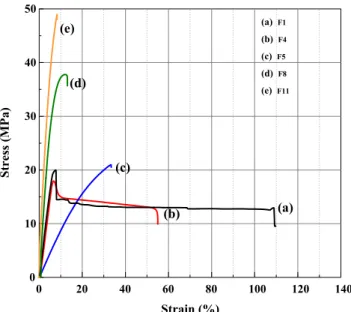
Figure12depicts the typical stress-strain curves of the PP/ EPR blend and its nanocomposites compatibilized with PP-g-OH and reinforced with pristine and functionalized GO. The detailed data of the mechanical tests of the materials are sum-marized in Table5. It is observed that the incorporation of GO improves the tensile strength and the Young’s modulus; the reinforcement is more pronounced with the modified GO nanocomposites. Plastic deformation with necking was ob-served in only PP/EPR matrix and PP/EPR/GO. Yielding was observed at lower deformation for all compatibilized nanocomposites than for the non-compatibilized system. Such an evolution is evident and could be an indication that the rigid nanofiller phase was unable to deform and that an interfacial adhesion between the components of the nanocom-posite took place.
The results showed that the functionalization of GO by means of GPTMS has improved the tensile strength from
18.6 MPa to 21 MPa which corresponds to an increase of about 12% for this non-compatibilized nanocomposite. In the case of the compatibilized nanocomposites the tensile strength showed an important improvement. For instance it increased by 82% for the PP/EPR/PP-g-OH/GPTMS-GO as compared to the same system without the coupling agents.
Similar improvements in Young’s modulus were also ob-served with all materials. The modulus values obtained for the compatibilized nanocomposites with PP-g-OH were greater than those for the other compositions. In these systems, the Young’s modulus increased by about 20% and 16% for the nanocomposites with GPTMS-GO and APTMS-GO, respec-tively compared to the nanocomposites without silane cou-pling agents. Several studies have attributed the reinforcement obtained in polymer-nanofiller hybrids to the restriction of mobility of the polymer chains as a result of strong interfacial interactions [30–33].
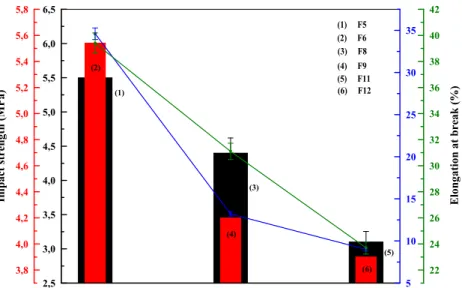
From Table5it can also be observed that the elongation at break and impact strength (Fig.13) showed a decrease for all the nanocomposite systems with coupling agents compared to those without coupling agents. The lowest elongation at break and impact strength were observed with the compatibilized nanocomposites with PP-g-OH. The elongation at break and impact strength of PP/EPR/PP-g-OH/GPTMS-GO decreased by about 78% and 30%, respectively compared to the nano-composites without coupling agents. The reason for this be-haviour can be explained by the improvement of the interac-tions between the polymer matrix and GO particles owing to the compatibilizers and the silane coupling agent’s action. The glycidoxy and amino groups anchored on GPTMS-GO and AMPTES-GO surface were expected to react with the func-tional groups of the compatibilizers, resulting in an improved compatibility of the GO with the polymer matrix.
Thermogravimetric analysis of the nanocomposites Figure14illustrates the thermogravimetric analysis of neat PP, blends and nanocomposites with and without the compatibilizers and coupling agents. It can be seen that the addition of the compatibilizer does not induce any significant variation in terms of decomposition in comparison with the
Strain (%) Stress (MPa) 0 20 40 60 80 100 120 140 0 10 20 30 40 50 (a) (b) (c) (d) (e) (a) F1 (b) F4 (c) F5 (d) F8 (e) F11
Fig. 12 Typical stress-strain curves of (a) PP/EPR, (b) PP/EPR/PP-g-OH, (c) PP/EPR/GO, (d) PP/EPR/PP-g-NH2/GPTMS-GO and (e) PP/
EPR/PP-g-OH/GPTMS-GO
Table 5 Tensile properties of PP/EPR/GO and compatibilized nanocomposites with and without coupling agents
Properties Materials
PP/EPR/GO PP/EPR/PP-g-NH2/GO PP/EPR/PP-g-OH/GO
GPTMS AMPTES GPTMS AMPTES GPTMS AMPTES
Tensile strength,σb(MPa) 18.8 ± 0.2 16.3 ± 0.5 37 ± 0.5 33 ± 0.2 49.2 ± 0.1 42.6 ± 0.4
Modulus, E (MPa) 879.4 ± 10 875.7 ± 12 1315 ± 15 1283 ± 20 1740 ± 12 1679 ± 10
Elongation at break,εb(%) 34.6 ± 6 39.4 ± 3 13.2 ± 6 31.1 ± 8 9 ± 3 23.7 ± 4
neat matrix. This result is well illustrated with two tempera-tures characterizing these thermograms. The first of which is the temperature of the onset decomposition (Tonset) that takes place at 360 °C. The second is the one that marks the constant weight reached that corresponds to the maximum temperature of decomposition (Tmax) around 455 °C.
For PP/EPR/GO sample, the Tonset and Tmax shifted
to-wards higher temperatures, indicating that the addition of GO can improve the thermal stability significantly. The results
show that the Tonset and Tmax of PP/EPR/GO sample are
400 °C and 465 °C, respectively corresponding to an increase by 40 °C and 10 °C, respectively, compared to the neat matrix. The process of the decomposition in PP/EPR/GPTMS-GO sample and for all other materials containing compatibilizers and silane coupling agents exhibited a similar behaviour. The
Tonsetand Tmaxshifted to 430 °C and 490 °C, respectively with
an increase of 40 °C and 35 °C respectively, compared to the neat matrix. The improved thermal stability is due to the bar-rier effect of GO particles against volatile gases formed during thermal degradation. This effect is amplified in the presence of the compatibilizers and coupling agents. This may be attrib-uted to a uniform dispersion and distribution of the GO parti-cles throughout the matrix. It may also be attributed to an adsorption effect at the filler surface of the released gases which slowed down the polymer decomposition. Similar re-sults were obtained for the polymer/nanoclay and polymer/ CaCO3composites [34,35]. The reason of the improvement of the thermal stability can also be attributed to the better adhesion between polymer the matrix and GO particles owing to the compatibilizer and silane coupling agent’s effects. SEM analysis of the nanocomposites
Figure15shows the SEM photomicrographs of neat PP, PP/
EPR and PP/EPR/PP-g-OH blends. Figure15a shows that the
PP exhibits a brittle fracture since the surface was rather smooth. The SEM photomicrograph of PP/EPR blend (Fig.
15b) clearly shows the formation of a two phase
matrix-particle microstructure. The blending of PP with EPR lead to two immiscible systems where the minor phase of the elasto-mer disperses as spherical particles throughout PP. Several studies of PP/Elastomer blends report a phase separation be-tween PP and EPR phases, well obviously when PP is a major phase [36–38]. In addition, the voids observed in the PP/EPR blend are believed to be due to the elastomeric particles dislodged from the fractured surface, reflecting a poor adhe-sion with the matrix. Similar morphology was observed in PP/ EPR/PP-g-OH blend, but with a finer dispersion of the elas-tomeric particles in the matrix.
The SEM photomicrographs of nanocomposites are illus-trated in Fig.16. Agglomeration of particles can be seen when 2,5 3,0 3,5 4,0 4,5 5,0 5,5 6,0 6,5 3,8 4,0 4,2 4,4 4,6 4,8 5,0 5,2 5,4 5,6 5,8 5 10 15 20 25 30 35 22 24 26 28 30 32 34 36 38 40 42 (5) (3) (1) (6) (2) Elongation at break (%)
Impact strength (MPa)
(3) F8 (2) F6 (1) F5 (4) (6) F12 (5) F11 (4) F9
Fig. 13 Impact strength and elongation at break of (1) PP/ EPR/GPTMS-GO, (2) PP/EPR/ APTMS-GO, (3) PP/EPR/PP-g-NH2/GPTMS-GO, (4) PP/EPR/ PP-g-NH2/AMPTES-GO, (5) PP/ EPR/PP-g-OH/GPTMS-GO and (6) PP/EPR/PP-g-OH/AMPTES-GO Temperature (°C) 0 100 200 300 400 500 600 0 15 30 45 60 75 90 105 Weight (%) F1 F3 F4 F5 F6 F10 F11 F12
Fig. 14 TGA curves of PP/EPR, PP/EPR/PP-g-OH, PP/EPR/GO, PP/EPR/GPTMS-GO, PP/EPR/AMPTES-GO, PP/EPR/PP-g-OH/GO, PP/EPR/PP-g-OH/GPTMS-GO and xPP/EPR/PP-g-OH/AMPTES-GO
the unmodified GO was incorporated in the matrix (Fig.16a). This phenomenon is visibly reduced when the modified GO with the silane coupling agents was incorporated (Fig.16b and Fig.16c). However, a better dispersion of GO particles was observed with the incorporation of silane modified GO, due to the reduction of the surface of the attraction forces between the particles.
Conclusions
Blends of polypropylene (PP) and ethylene-propylene rubber (EPR) were investigated to determine the influence of GO and its derivatives on the mechanical, thermal and morphological properties. The compatibilization effects imparted by amine a n d a l c o h o l g r a f t e d p o l y p r o p y l e n e f o r P P / E P R
nanocomposites were also investigated. Amine and alcohol functionalized polypropylene systems were elaborated using maleic anhydride functionalized polypropylene with 1,12-dodecanediamine and 1,12-dodecanediol in the presence of dicumyl peroxide (DCP). A significant improvement of the tensile strength and Young’s modulus was observed when GO was incorporated in the matrix. The reinforcing effect was more pronounced for compatibilized nanocomposites and functionalized GO. In these nanocomposites higher strength and modulus were subsequently accompanied by a decrease in the elongation at break and impact strength. This was ex-plained as the consequence of the enhancement of the adhe-sion at the interface due to a better disperadhe-sion of functionalized GO and chemical bonding between organofunctional groups in GO and the functionalized polypropylene. The thermal
50 µm 50 µm 50 µm (a) (c) (b)
Fig. 15 SEM images of (a) PP, (b) PP/EPR and (c) PP/EPR/PP-g-OH
(a) 50 µm 50 µm (b) 50 µm (c)
Fig. 16 SEM images of (a) OH/GO, (b) PP/EPR/PP-g-O H / G P T M S - G PP/EPR/PP-g-O a n d ( c ) P P / E P R / P P - g - PP/EPR/PP-g-O H / A M P T E S - G PP/EPR/PP-g-O nanocomposites
behaviour determined by TGA showed a higher thermal sta-bility for nanocomposites with functionalized GO in compar-ison with pristine GO. It was also found that the compatibilized nanocomposites exhibited the highest thermal stability compared to the non compatibilized nanocomposites. SEM photomicrographs of the fractured surfaces of the nano-composites confirmed a good dispersion of the functionalized GO in the polymer matrix, resulting in an enhancement of the mechanical properties.
References
1. Kroto HW, Heath JR, O’Brien SC, Curl RF, Smalley RE (1985) C60: Buckminsterfullerene Nature 318:162–163
2. Iijima S (1991) Helical microtubules of graphitic carbon Nature 354:56–58
3. Galpaya D, Wang M, Liu M, Motta N, Waclawik E, Ya C (2012) Recent advances in fabrication and characterization of graphene-polymer nanocomposites Graphene 1:30–49
4. Viculis LM, Mack JJ, Mayer OM, Hahn HT, Kaner R (2005) Intercalation and exfoliation routes to graphite nanoplatelets J Mater Chem 15(9):974–978
5. Cui Y, Kundalwal SI, Kumar S (2016) Gas barrier performance of graphene/polymer nanocomposites Carbon 98:313–333
6. Lerf A, He H, Forster M, Klinowski J (1998) Structure of graphite oxide revisited J Phys Chem B 102(23):4477–4482
7. He H, Klinowski J, Forster M, Lerf A (1998) A new structural model for graphite oxide Chem Phys Lett 287(1–2):53–56 8. Bhawal P, Ganguly S, Chakia TK, Das NC (2016) Synthesis and
characterization of graphene oxide filled ethylene methyl acrylate hybrid nanocomposites RSC Adv 6(25):20781–20790
9. Stankovich S, Dikin DA, Dommett GHB, Kohlhaas KM, Zimney EJ, Stach EA, Piner RD, Nguyen ST, Ruoff RD (2006) Graphene-based composite materials Nature 442:282–286
10. Alireza A, Hossein R, Reza B (2015) Preparation and characteriza-tion of funccharacteriza-tionalized graphene oxide/carbon fiber/epoxy nanocom-posites Polym Test 48:82–88
11. Yang H, Li F, Shan C, Han D, Zhang Q, Niu L, Ivaska A (2009) Covalent functionalization of chemically converted graphene sheets via silane and its reinforcement Mater Chem 19(26):4632–4638 12. Yuan B, Bao C, Song L, Hong N, Liew KM, Hu Y (2014)
Preparation of functionalized graphene oxide/polypropylene nano-composite with significantly improved thermal stability and studies on the crystallization behavior and mechanical properties Chem Eng J 237:411–420
13. Ren PG, Wang H, Huang HD, Yan DX, Li ZM (2014) Characterization and performance of dodecyl amine functionalized graphene oxide and dodecyl amine functionalized graphene/high-density polyethylene nanocomposites: a comparative study J Appl Polym Sci 131(2):39803–39812
14. Tripathi SN, Srinivasa Rao GS, Mathur AB, Jasra R (2017) Polyolefin/graphene nanocomposites: a review RSC Adv 38(7): 23615–23632
15. Hu W, Zhan J, Wang X, Hong N, Wang B, Song L, Stec AA, Hull TR, Wang J (2014) Effect of functionalized GO with hyper-branched flame retardant on flammability and thermal stability of cross-linked PE Ind Eng Chem Res 53(8):3073–3083
16. Steurer P, Wissert R, Thomann R, Mulhaupt R (2009) Functionalized graphenes and thermoplastic nanocomposites
based upon expanded graphite oxide Macromol Rapid Commun 30(4–5):316–327
17. Chen Y, Qi Y, Tai Z, Yan X, Zhu F, Xue Q (2012) Preparation, mechanical properties and biocompatibility of graphene oxide/ ultrahigh molecular weight polyethylene composites Eur Polym J 48(6):1026–1033
18. Aizenshtein EM (2008) Polypropylene fibers and yarns in the cur-rent state of development Fiber Chem 40(5):399–405
19. Stumberger N, Gospocic A, Bratulic C (2005) Polymeric materials in automobiles Promet Traffic Traffico 17(3):149–160
20. Mehta S, Mirabella FM, Rufener K, Bafna A (2004) Thermoplastic olefin/clay nanocomposites: morphology and mechanical proper-ties J Appl Polym Sci 92(2):928–936
21. Lim JW, Hassan A, Rahmat AR, Wahit MU (2006) Rubber-toughened polypropylene nanocomposite: effect of polyethylene octene copolymer on mechanical properties and phase morphology J Appl Polym Sci 99(6):3441–3450
22. Sánchez-Valdes S, Zapata-Domínguez AG, Martinez-Colunga JG, Mendez-Nonell J, Ramos de Valle LF, Espinoza-Martinez AB, Morales-Cepeda A, Lozano-Ramirez T, Lafleur PG, Ramirez-Vargas E (2016) Influence of functionalized polypropylene on polypropylene/graphene oxide nanocomposite properties. Polym Composhttp://www.chemeurope.com. Accessed 12 Oct 2016 23. David IF, Shankland K, McCusker LB, Baerlocher C (2002)
Structure determination from powder diffraction data. Oxford University Press Inc, New York,
24. Stankovich S, Dikin DA, Piner RD, Kohlhaas KA, Kleinhammes A, Jia Y, Ruoff SBT (2007) Synthesis of graphene-based nano-sheets via chemical reduction of exfoliated graphite oxide Carbon 45:1558–1565
25. Hidayah IN, Mariatti M, Ismail H, Kamarol M (2015) Evaluation of PP/EPDM nanocomposites filled with SiO2, TiO2and ZnO
nanofillers as thermoplastic elastomeric insulators Plast Rub Compos: Macromol Eng 44(7):259–264
26. Hamzah MS, Jaafar M, Mohd Jamil MK (2014) Electrical insula-tion characteristics of alumina, titania, and organoclay nanoparticles filled PP/EPDM nanocomposites J Appl Polym Sci 131(23): 41184–41184
27. Ranel AV, Abitha VK (2015) Study of mechanical, thermal and micro structural properties of EPDM/polypropylene/Nanoclay composites with variable compatibilizer dosage J Mater Environ Sci 6(1):60–69
28. Tam WY, Cheung T (1996) Li RKY (1996) an investigation on the impact fracture characteristics of EPR toughened polypropylene Polym Test 15(4):363–379
29. Van der Wal A, Nijhof R, Gaymans RJ (1999) Polypropylene-rubber blends: 2 the effect of the Polypropylene-rubber content on the deformation and impact behaviour Polymer 40(22):6031–6044
30. Doufnoune R, Haddaoui N, Riahi F (2006) Elaboration and char-acterization of an organic/inorganic hybrid material: effect of the interface on the mechanical en thermal behavior of PP/CaCO3
com-posites Int J Polym Mater 55(10):815–834
31. Doufnoune R (2005) Contribution à l’étude du comportement des mélanges Polymères/charges en présence d’agents de couplage. Ph.D thesis, Université Ferhat-ABBAS, Sétif, Algeria
32. Hanemann T, Vinga Szabó D (2010) Polymer-nanoparticle composites: from synthesis t o modern applications Materials 3:3468–3517
33. Layek RK, Nandi AK (2013) A review on synthesis and properties of polymer functionalized graphene Polymer 54(19):5087–5103 34. Frounchi M, Dadbin S, Salehpour Z, Noferesti M (2006) Gas
bar-rier properties of PP/EPDM blend nanocomposites J Membrane Sci 282:142–148
35. Doufnoune R, Haddaoui N, Riahi F (2008) The effects of coupling agents on the mechanical, rheological and thermal properties of
calcium carbonate-filled LDPE compatibilized with maleic anhydride-g-LDPE (part II) Int J Polym Mater 57(7):690–708 36. Gong L, Yin B, Li LP, Yang MB (2012) Morphology and properties
of PP/EPDM binary blends and PP/EPDM/nano-CaCO3ternary
blends J Appl Polym Sci 123(1):510–519
37. Babu RR, Singha NK, Naskar K (2010) Interrelation ships of mor-phology, thermal and mechanical properties in uncrosslinked and
dynamically crosslinked PP/EOC and PP/EPDM blends Express Polym Lett 4(4):197–209
38. Da Silva Ana Lúcia N, Rocha Marisa CG, Coutinho Fernanda MB, Rosário B, Scuracchio C (2000) Rheological, mechanical, thermal, and morphological properties of polypropylene/ethylene-octene co-polymer blends J Appl Polym Sci 75(5):692–704