HAL Id: tel-02386039
https://tel.archives-ouvertes.fr/tel-02386039v2
Submitted on 29 Nov 2019HAL is a multi-disciplinary open access
archive for the deposit and dissemination of sci-entific research documents, whether they are pub-lished or not. The documents may come from teaching and research institutions in France or abroad, or from public or private research centers.
L’archive ouverte pluridisciplinaire HAL, est destinée au dépôt et à la diffusion de documents scientifiques de niveau recherche, publiés ou non, émanant des établissements d’enseignement et de recherche français ou étrangers, des laboratoires publics ou privés.
Real time intelligent decision making from
heterogeneous and imperfect data
Hela Sfar
To cite this version:
Hela Sfar. Real time intelligent decision making from heterogeneous and imperfect data. Ubiqui-tous Computing. Université Paris Saclay (COmUE), 2019. English. �NNT : 2019SACLL013�. �tel-02386039v2�
Real time intelligent decision
making from heterogeneous and
imperfect data
Thèse de doctorat de l'Université Paris-Saclay préparée à Télécom SudParis École doctorale n°580 Science et Technologie de l’Information et de la Communication (STIC) Spécialité de doctorat: Informatique
Thèse présentée et soutenue à Evry, 9 Juillet 2019 , 14h, par
Hela Sfar
Composition du Jury :
Nazim Agoulmine, Professeur, Université d’ EVRY val d’Essonne Président
Mehdi Ammi, Professeur, Université Paris8 Rapporteur
Farah Chehade, Maitre de conférences HDR,
Université de Technologie de Troyes Rapporteur
Gérard Dray, Professeur, IMT Mines Alès Examinateur
Amel Bouzeghoub, Professeur, Télécom SudParis Directeur de thèse
Jérôme Boudy, Professeur, Télécom SudParis Encadreur de thèse
Yves Permantier, Ingénieur de recherche,
Université d’Orléans Invité
Pascal Doré, Chef de projet recherche, Legrand Invité
Hassane Essafi, Coordinateur de programme, CEA Invité
C L L 0 1 3
NNT: 2019SACLL013
Université Paris-Saclay
Espace Technologique / Immeuble Discovery
Route de l’Orme aux Merisiers RD 128 / 91190 Saint-Aubin, France
Titre : La prise de décision intelligente en temps réel à partir de données hétérogènes et imparfaites
Mots clés : Environnement intelligent, reconnaissance d’activité, détection d’anomalies,
segmentation de données de capteurs
Résumé : De nos jours, l'informatique
omniprésente fait face à un progrès croissant. Ce paradigme est caractérisé par de multiples capteurs intégrés dans des objets du monde physique. Le développement d'applications personnelles utilisant les données fournies par ces capteurs a conduit à la création d'environnements intelligents, conçus comme un framework de superposition avancé qui aide de manière proactive les individus dans leur vie quotidienne. Une application d’environnement intelligent collecte les données de capteurs deployés d'une façon en continu , traite ces données et les analyse avant de prendre des décisions pour exécuter des actions sur l’environnement physique. Le traitement de données en ligne consiste principalement en une segmentation des données pour les diviser en fragments. Généralement, dans la littérature, la taille des fragments est fixe. Cependant, une telle vision statique entraîne généralement des problèmes de résultats imprécis. Par conséquent, la segmentation dynamique utilisant des tailles variables de fenêtres d’observation est une question ouverte. La phase d'analyse prend en entrée un segment de données de capteurs et extrait des
connaissances au
moyen de processus de raisonnement ou d'extraction. La compréhension des activités quotidiennes des utilisateurs et la prévention des situations anormales sont une préoccupation croissante dans la littérature, mais la résolution de ces problèmes à l'aide de données de petite taille et imparfaites reste un problème clé. En effet, les données fournies par les capteurs sont souvent imprécises, inexactes, obsolètes, contradictoires ou tout simplement manquantes. Par conséquent, l'incertitude liée à la gestion est devenue un aspect important. De plus, il n'est pas toujours possible et trop intrusif de surveiller l'utilisateur pour obtenir une grande quantité de données sur sa
routine de vie. Les gens ne sont pas souvent ouverts pour être surveillés pendant une longue période. Évidemment, lorsque les données acquises sur l'utilisateur sont suffisantes, la plupart des méthodes existantes peuvent fournir une reconnaissance précise, mais les performances baissent fortement avec de petits ensembles de données.
Dans cette thèse, nous avons principalement exploré la fertilisation croisée d'approches d'apprentissage statistique et symbolique et les contributions sont triples: (i) DataSeg, un algorithme qui tire parti à la fois de l'apprentissage non supervisé et de la représentation ontologique pour la segmentation des données. Cette combinaison choisit de manière dynamique la taille de segment pour plusieurs applications, contrairement à la plupart des méthodes existantes. De plus, contrairement aux approches de la littérature, Dataseg peut être
adapté à toutes les
fonctionnalités de l’application; (ii) AGACY
Monitoring, un modèle
hybride de reconnaissance d'activité et de gestion des incertitudes qui utilise un apprentissage supervisé, une inférence de logique possibiliste et une ontologie permettant d'extraire des connaissances utiles de petits ensembles de données; (iii) CARMA, une méthode basée sur les réseaux de Markov et les règles d'association causale pour détecter les causes d'anomalie dans un environnement intelligent afin d'éviter leur apparition. En extrayant automatiquement les règles logiques concernant les causes d'anomalies et en les intégrant dans les règles MLN, nous parvenons à une identification plus précise de la situation, même avec des observations partielles. Chacune de nos contributions a été prototypée, testée et validée à l'aide de données obtenues à partir de scénarios réels réalisés.
Université Paris-Saclay
Espace Technologique / Immeuble Discovery
Route de l’Orme aux Merisiers RD 128 / 91190 Saint-Aubin, France
Title : Real time intelligent decision making from heterogeneous and imperfect data
Keywords : Intelligent environment, Activity recognition, Anomaly detection, Sensor Data
segmentation
Abstract : Nowadays, pervasive computing is
facing an increasing advancement. This paradigm is characterized by multiple sensors highly integrated in objects of the physical world.The development of personal applications using data provided by these sensors has prompted the creation of smart environments, which are designed as an overlay advanced framework that proactively, but sensibly, assist individuals in their everyday lives. A smart environment application gathers streaming data from the deployed sensors, processes and analyzes the collected data before making decisions and executing actions on the physical environment. Online data processing consists mainly in data segmentation to divide data into fragments. Generally, in the literature, the fragment size is fixed. However, such static vision usually brings issues of imprecise outputs. Hence, dynamic segmentation using variable sizes of observation windows is an open issue. The analysis phase takes as input a segment of sensor data and extracts knowledge by means of reasoning or mining processes. In particular, understanding user daily activities and preventing anomalous situations are a growing concern in the literature but addressing these problems with small and imperfect data is still a key issue. Indeed, data provided by sensors is often imprecise, inaccurate, outdated, in contradiction, or simply missing.
In this thesis, we mainly explored cross-fertilization of statistic and symbolic learning approaches and the contributions are threefold: (i) DataSeg, an algorithm that takes advantage of both unsupervised learning and ontology representation for data segmentation. This combination chooses dynamically the segment size for several applications unlike most of existing methods. Moreover, unlike the literature approaches, Dataseg is able to be adapted to any application features; (ii) AGACY Monitoring, a hybrid model for activity recognition and uncertainty handling which uses supervised learning, possibility logic inference, and an ontology to extract meaningful knowledge from small datasets; (iii) CARMA, a method based on Markov Logic Networks (MLN) and causal association rules to detect anomaly causes in a smart environment so as to prevent their occurrence. By automatically extracting logic rules about anomalies causes and integrating them in the MLN rules, we reach more accurate situation identification even with partial observations. Each of our contributions was prototyped, tested and validated through data obtained from real scenarios that are realized.
Acknowledgements
This thesis has been an enriching and tough journey, full of ups and downs. It felt like chasing down different rabbit holes. Fortunately, I was surrounded by many supportive people, who have given me strength to go through the difficult times. So, it is a great pleasure to thank them all for their positive impact during this quest.
Naturally, my first thanks come back to my supervisors, Amel and Jérôme, who had the patience and the will to push me forward over those three years. It is obvious that the thesis would not be what it is without their work and help, for the research, but also personally. Moreover, I want to thank all the partners of the project CoCaps who’s worked with me. Thank you for the collaborative work that has been done.
I would like to thanks also the jury of my defence, for their remarks, questions and the evaluation of my work. I am also grateful for the lab with all its members, that welcomed me.
I thank the team and the persons that worked with me: Nathan, Badran, and others. I warmly thank my PhD-mates, and now friends, Monika, Wafa, Fethi, Safa, Mohammed, Asma and Wided that cheered me up, and with whom I shared numerous memories.
I am forever grateful to my parents, Radhia and Taher, and my brothers, Walid, Mo-hammed Ali, and Anouar for their love, support and care, that where more than necessary during this thesis. Thank you for having faith in me even when doubting myself. I’m also thankful for my second family, my parents in law Aidouda and Azouz, my sister in law Hanouta, and my brother in law Khaled to be in my side for every difficult moment that I faced. I am deeply thankful to my soul-mate and loving husband Khalifa for his help, patience and understanding. Thank you for putting up with my temper and for helping me getting through the tough times. Thank you my son Malek to be the best gift in my life.
Abstract
Nowadays, pervasive computing is facing an increasing advancement. This paradigm is characterized by multiple sensors highly integrated in objects of the physical world. The development of personal applications using data provided by these sensors has prompted the creation of smart environments, which are designed as an overlay advanced framework that proactively, but sensibly, assists individuals in their every day lives. A smart environment application gathers streaming data from the deployed sensors, processes and analyzes the collected data before making decisions and executing actions on the physical environment. The analysis allows to extract knowledge from the sensor data by means of reasoning or mining processes. In particular, understanding user daily activities and preventing anomalous situations are a growing concern in the literature but addressing these problems with small and imperfect data is still a key issue. Indeed, data provided by sensors is often imprecise, inaccurate, outdated, in contradiction, or simply missing. Hence, handling uncertainty became an important aspect. Moreover, monitoring the user to obtain a large amount of data about his/her life routine is not always possible and too intrusive. People are not often open to be monitored for a long period of time. Obviously, when the acquired data about the user are sufficient, most existing methods can provide precise recognition but the performances decline sharply with small datasets.
Before the online analysis of a streaming sensor data, the latter should be processed and then segmented. Data segmentation is to divide data into fragments. Generally, in the literature, the fragment size is fixed. However, such static vision usually brings issues of imprecise outputs. Hence, dynamic segmentation using variable sizes of observation windows is an open issue.
In this thesis, we mainly explored cross-fertilization of statistic and symbolic learning approaches and the contributions are threefold: (i) AGACY Monitoring, a hybrid model for activity recognition and uncertainty handling which uses supervised learning, possibilistic logic inference, and an ontology to extract meaningful knowledge from small datasets; (ii) Caredas, a method based on Markov Logic Networks (MLN) and causal association rules to detect anomaly causes in a smart environment so as to prevent their occurrence. By automati-cally extracting logic rules about anomalies causes and integrating them in the MLN rules,
8
we reach a more accurate situation identification even with partial observations; (iii) DataSeg, an algorithm that takes advantage of both unsupervised learning and ontology representation for data segmentation. This combination chooses dynamically the segment size for several applications unlike most of existing methods. Moreover, unlike the literature approaches, DataSeg is able to be adapted to any application features. Each of our contributions was prototyped, tested and validated through data obtained from real scenarios that are realized.
Résumé
De nos jours, l’informatique omniprésente est en constante progression. Ce paradigme est caractérisé par la présence de multiples capteurs intégrés dans des objets du monde physique. Le développement d’applications personnelles utilisant les données fournies par ces capteurs a conduit à la création d’environnements intelligents pour aider de manière proactive les individus dans leur vie quotidienne. Ces applications collectent de façon continue les données des capteurs deployés, traitent ces données et les analysent avant de prendre des décisions pour exécuter des actions sur l’environnement physique.
L’analyse de données pour la reconnaissance des activités quotidiennes des utilisateurs et la prévention des situations anormales représentent des défis non encore complètement relevés en parti. En effet, la résolution de ces problèmes à l’aide de données de petite taille et imparfaites reste un problème clé. Effectivement, les données fournies par les capteurs sont souvent imprécises, inexactes, obsolètes, contradictoires ou tout simpement manquantes. Par conséquent, l’incertitude liée à la gestion est devenue un aspect important. De plus, il n’est pas toujours possible et trop intrusif de surveiller l’utilisateur pour obtenir une grande quantité de données sur sa routine de vie. Les gens ne sont pas souvent ouverts pour être surveillés pendant une longue période. Évidemment, lorsque les données acquises sur l’utilisateur sont suffisantes, la plupart des méthodes existantes peuvent fournir une reconnaissance précise, mais les performances baissent fortement avec de petits ensembles de données.
Parmi les étapes de traitement de données en ligne est la segmentation des données pour les diviser en fragments. Généralement, dans la littérature, la taille des fragments est fixe. Cependant, une telle vision statique entraîne généralement des problèmes de résultats imprécis. Par conséquent, la segmentation dynamique utilisant des tailles variables de fenêtres d’observation est une question ouverte.
Dans cette thèse, nous avons principalement exploré la fertilisation croisée d’approches d’apprentissage statistique et symbolique et les contributions sont triples : (i) AGACY Monitoring, un modèle hybride de reconnaissance d’activité et de gestion des incertitudes qui utilise un apprentissage supervisé, une inférence de logique possibiliste et une ontologie permettant d’extraire des connaissances utiles de petits ensembles de données ; (ii) Caredas, une méthode basée sur les réseaux de Markov et les règles d’association causale pour détecter les causes d’anomalie dans un environnement intelligent afin d’éviter leur apparition. En extrayant automatiquement les règles logiques concernant les causes d’anomalies et en les intégrant dans les règles MLN, nous parvenons à une identification plus précise de la situation,
10
même avec des observations partielles ; (iii) DataSeg, un algorithme qui tire parti à la fois de l’apprentissage non supervisé et de la représentation ontologique pour la segmentation des données. Cette combinaison choisit de manière dynamique la taille de segment pour plusieurs applications, contrairement à la plupart des méthodes existantes. De plus, contrairement aux approches de la littérature, DataSeg peut être adapté à toutes les fonctionnalités de l’application. Chacune de nos contributions a été prototypée, testée et validée à l’aide de données obtenues à partir de scénarios réels réalisés.
11
Thesis publications
1. Journal papers
1. Hela Sfar, Amel Bouzeghoub, Badran Raddaoui. Early Anomaly Detection in smart home: a causal association rules-based approach. Artificial intelligence in Medicine (ArMED), vol. 91, Elsevier, 2018
2. Hela Sfar and Amel Bouzeghoub, Activity Recognition for Anomaly Detection. Inno-vation and Research in Biomedical Engineering (IRBM), Elsevier, 2019 To APPEAR 2. Conference papers
1. Hela Sfar, Anja Habacha Chaibi, Amel Bouzeghoub, Henda Ben Ghézala. Gold Standard based ontology evaluation for ontology learning techniques. Symposium on Applied Computing (SAC), ACM, 2016
2. Hela Sfar, Amel Bouzeghoub, Nathan Ramoly, Jérôme Boudy. AGACY Monitoring: A Hybrid Model for Activity Recognition and Uncertainty Handling. Extended Semantic Web Conference (ESWC), Springer, 2017
3. Hela Sfar, Nathan Ramoly, Amel Bouzeghoub, Béatrice Finance. CAREDAS: Context and Activity Recognition Enabling Detection of Anomalous Situation. Artificial Intelligence in Medicine in Europe (AIME), Springer, 2017
4. Hela Sfar, Amel Bouzeghoub, Nathan Ramoly, and Jérôme Boudy. Novel Hybrid Model for activity recognition. Modeling Decisions for Artificial Intelligence (MDAI), Springer, 2017
5. Nathan Ramoly, Hela Sfar, Amel Bouzeghoub, and Béatrice Finance, LEAF: Semantic Based Experience to Prevent Task Failures. Field on Service Robotics (FSR), Springer, 2017
6. Hela Sfar, Badran Raddaoui, and Amel Bouzeghoub, Reasoning under conflicts for Smart Environment. International Conference On Neural Information Processing (ICONIP), Springer, 2017
7. Hela Sfar and Amel Bouzeghoub. Dynamic Streaming Sensor Data Segmentation in smart environments. International Conference On Neural Information Processing (ICONIP), Springer, 2018
12
8. Hela Sfar and Amel Bouzeghoub. DataSeg: Dynamic Streaming Sensor Data Seg-mentation for Activity Recognition. Symposium on Applied Computing (SAC), ACM, 2019
Contents
List of Figures 17 List of Tables 19 1 Introduction 1 1.1 Research Context . . . 1 1.2 An illustrative scenario . . . 4 1.3 Challenges . . . 6 1.4 Contributions . . . 81.4.1 AGACY Monitoring for activity recognition and uncertainty handling 8 1.4.2 Caredas for early anomaly Detection . . . 9
1.4.3 DataSeg: Dynamic streaming sensor data segmentation . . . 9
1.4.4 Conflict Detection and Resolution . . . 9
1.4.5 Overall view about this thesis contributions . . . 10
1.5 Thesis organization . . . 11
2 State of the art 13 2.1 Introduction . . . 13 2.2 Smart Environments . . . 14 2.2.1 Acquisition . . . 16 2.2.2 Processing . . . 17 2.2.3 Analysis . . . 17 2.2.4 Applications . . . 18
2.3 Techniques for data analysis and processing . . . 18
2.3.1 Data driven techniques . . . 19
2.3.2 Knowledge based techniques . . . 22
2.3.3 Hybrid techniques . . . 25
14 Contents
2.4.1 Activity recognition . . . 26
2.4.2 Anomaly detection . . . 29
2.4.3 Sensor data segmentation . . . 31
2.5 Conclusion . . . 33
3 AGACY Monitoring: a hybrid model for activity recognition and uncertainty handling 35 3.1 Introduction . . . 35
3.2 Definitions . . . 36
3.3 The AGACY Monitoring architecture overview . . . 37
3.4 Knowledge-based layer . . . 38
3.4.1 Ontological modeling . . . 38
3.4.2 Semantic reasoning . . . 40
3.5 Data driven layer . . . 41
3.5.1 Time & Uncertainty-based features extraction . . . 41
3.5.2 Dempster-Shafer theory for activity classification . . . 43
3.5.3 Activities instances inferring under uncertainty . . . 44
3.6 Experimental evaluations . . . 46
3.6.1 Dataset . . . 46
3.6.2 Implementation and experimental setup . . . 47
3.6.3 Evaluation and results . . . 47
3.7 Conclusion . . . 50
4 Caredas: Early Anomaly Detection in Smart Homes, a Causal Association Rule-based Approach 53 4.1 Introduction . . . 53
4.2 Background and Related Work . . . 55
4.2.1 Markov Logic Network . . . 55
4.2.2 Association Rules and Causal Association Rules . . . 57
4.3 Definitions . . . 59
4.4 Methods . . . 60
4.4.1 Rules Management . . . 62
4.4.2 Markov Logic Network . . . 67
4.5 Experimental evaluations . . . 72
4.5.1 Evaluation of Caredas . . . 72
4.5.2 Evaluation of CARMA with medical dataset . . . 75
Contents 15
5 DataSeg: Dynamic Streaming Sensor Data Segmentation for Smart
Environ-ment Applications 79 5.1 Introduction . . . 79 5.2 Method . . . 80 5.2.1 Clustering . . . 81 5.2.2 Ontology Updater . . . 82 5.2.3 Window manipulator . . . 84 5.3 Experimental evaluations . . . 86 5.3.1 Datasets . . . 86 5.3.2 Evaluation Result . . . 86 5.4 Conclusion . . . 88 6 Conclusion 89 6.1 Introduction . . . 89 6.2 Thesis contributions . . . 89
6.3 The need for both learning and reasoning . . . 91
6.4 Perspectives . . . 93
Bibliography 97 Appendix A Reasoning under Conflicts in Smart Environment 105 A.1 Introduction . . . 105
A.2 Argumentation Framework for rules-based methods . . . 107
A.2.1 Rule-based knowledge representation . . . 107
A.2.2 Arguments . . . 108
A.2.3 Conflicts among arguments . . . 110
A.2.4 Argument Graph . . . 111
A.3 Empirical Evaluation . . . 113
A.3.1 Evaluation of conflict resolution using AGACY Monitoring . . . . 113
A.3.2 Evaluation of conflict detection and resolution method using Caredas 115 A.4 Conclusion . . . 117
List of Figures
1.1 Overview of the thesis contributions . . . 10
2.1 Smart environments architecture for decision making applications . . . 15
2.2 Data driven techniques overview . . . 19
2.3 Knowledge based techniques overview . . . 23
2.4 Static Segmentation example . . . 32
3.1 The architecture of the AGACY Monitoring . . . 37
3.2 The extended uncertainty representation model . . . 38
3.3 An excerpt of the ontology with uncertainty integration . . . 39
3.4 Average recognition precision for all subjects over the three routines with different values of the size n of the time window (Tw) . . . 48
3.5 Average recognition precision for all subjects over the three routines for varying frequency of uncertain event (UEF). The value 1/5 means there is one uncertain sensor data for five correct ones. 1 means there is one uncertain sensor data for one correct . . . 49
3.6 Average time execution of activity instances recognition for all subjects over the three routines . . . 50
4.1 Local Causality Structures of CBN: (b–d) conditional independence equiva-lent; (a) V-structure . . . 58
4.2 Example of CBN representing anomalies, anomalies causes, and actions . . 58
4.3 CAREDAS architecture . . . 61
4.4 An excerpt of dataset of activities and sensor data annotated with anomalies and actions . . . 63
4.5 Excerpt of Ground MLN . . . 71
4.6 Precision, recall, and correctness of the method for different time window win 73 4.7 Precision, recall, and correctness of the method with static ground MLN for different time window win . . . 74
18 List of Figures
4.8 Precision, recall, and correctness of the method with dataset after contexts element removal for different time windows win . . . 76
5.1 DataSeg architecture . . . 81 5.2 An example of a set of clusters about user activities . . . 82 5.3 An example of the Ontology used in the experiments after being updated
with Aruba dataset’s clusters. Added elements are in red . . . 84 5.4 F-score values for the different activities in Aruba dataset using only SVM
with static time-window length (5 min), DataSeg, and SWMIex methods . . 87
A.1 An argument graph for K. . . 112 A.2 Average recognition precision of AGACY Monitoring for all subjects over
the three routines for three conflicting rules with different values of TW . . 114 A.3 Average recognition precision of AGACY Monitoring for all subjects over
the three routines for TW=180s with different number of conflicting rules (nbCR) . . . 114 A.4 Average recognition precision of AGACY Monitoring for all subjects over
the three routines for different values of TW after conflict resolution . . . . 115 A.5 Precision, recall, and correctness of the method with 2 conflicting CARs for
different time windows win . . . 116 A.6 Precision, recall, and correctness of the method using conflict resolution for
List of Tables
2.1 List of the most common sensors types . . . 15
2.2 Comparison among a set of supervised learning algorithms . . . 22
2.3 Categories of conflicts handling . . . 25
2.4 A resume of previous hybrid methods about activity recognition . . . 29
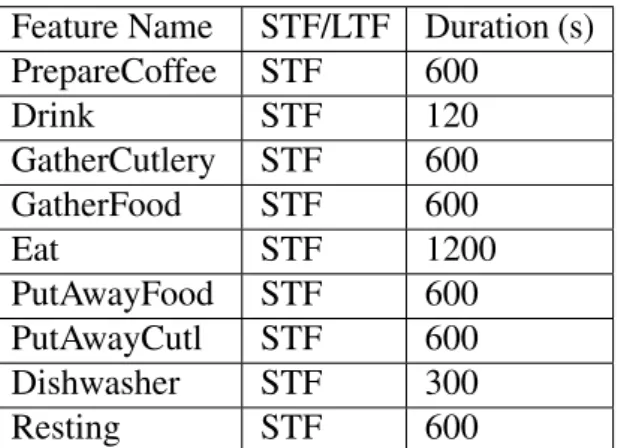
2.5 A resume of previous works of dynamic streaming sensor data segmentation 33 3.1 List of considered features. STF: Short Term Feature, LTF: Long Term feature 47 3.2 Average recognition results over three routines for the three subjects obtained by AGACY Monitoring (with DS) and the system proposed in [92] for n=180s. . . 48
3.3 Average recognition results for activities instances detection over three rou-tines for subjects S10, S11, and S12. . . 50
4.1 Examples of CAR . . . 67
4.2 Rules set in the MLN KB . . . 69
4.3 PSP Grounded from CAR . . . 70
4.4 Performance for CAR extraction into FAERS dataset . . . 77
5.1 Statistics of six weeks over Aruba dataset . . . 87
Acronyms
ADL Activity of Daily Life.
AGACY Activity AGgregation under unCertaintY.
AI Artificial Intelligence.
ANN Artificial Neural Networks.
AR Association Rule.
CAR Causal Association Rule.
CARMA Causal Association Rule Mining Algorithm.
CBN Causal Bayesian Network.
DgMLN Dynamic ground Markov Logic Network.
DS Dempster-Shafer Theory.
DT Decision Tree.
FCD Fuzzy Context Data.
FSCEP Fuzzy Semantic Complex Event Processing.
HMM Hidden Markov Model.
IoT Internet of Things.
KB Knowledge Base.
22 Acronyms
LTF Long Term Feature.
MLN Markov Logic Network.
NB Naive Bayes.
NN Neural Network.
OWL Web Ontology Language.
PDP Probabilistic Dynamic Predicate.
PHP Probabilistic Hidden Predicate.
PSP Probabilistic Static Predicate.
RF Random Forest.
RFID Radio Frequency Identification.
STF Short Term Feature.
SVM Support Vector Machine.
Chapter 1
Introduction
1.1
Research Context
These last years, the trend of computing is moving toward pervasive computing, also called ubiquitous computing, which aims to provide services according to the user needs. This can be ensured by means of integration, cooperation and communication of multiple devices and software agents that are connected with the user and the environment in which they operate. These pervasive environments are generally perceived with the help of sensors of heterogeneous sources, the collected data is interpreted and a high level context is derived. This context information is then used by context-aware applications to adapt their behaviour to accommodate user desires and activities. In this setting, smart environments are particularly interested by context-awareness and proactivity to make smart decisions depending on user information and the surroundings. Indeed, smart environments are conceived as an overlay digital infrastructure that proactively, but sensibly, support people in their every daily lives. The deployed sensors are outstretched on any objects or human bodies. They gather data including user’s location, motion, bio-medical information, environment temperature, humidity, or ambient noise level to extract useful information. This process follows a life cycle to convert raw data to meaningful information. The most important stages are (1) the collection which consists of obtaining data from available sources and verifying the quality and the accuracy of the gathered data. Actually, a bad quality of data heavily impacts the data analysis by producing highly misleading results; (2) the data processing which includes diverse means and methods associated with the preparation of the collected data; (3) the data analysis which is in charge of exploring and interpreting processed data to provide meaningful information that will help future decisions-making. One of the tasks of data processing is data segmentation i.e. divide the data stream into intervals or windows in order to be analyzed to extract knowledge. Depending on the target application, this knowledge
2 Introduction
can be used to either recognize human Activities of Daily Living (ADL) (e.g. “watching TV”), actions (e.g. “take cup” or “open door”) and motion gestures or to detect anomalies. Both activity recognition and anomaly detection issues received a great attention these last years by numerous research projects among which we can cite:
• Dem@Care (Dementia Ambient Care) project: it is funded by the European Union, that aims to develop a proper installation of multiple sensors in the home, on the monitored person in an unobtrusive manner (wearable, portable devices), in tandem with recording of utilities usage for activities monitoring and analysis.
• E-Monitorage1 (Nursing home systems applications and resident supervision data analysis) project: it is funded by the French Interministerial Fund (FUI) where the objective being to improve the comfort and safety of the residents in helping staff to be more efficient.
• SECURE2(Intelligent System for Early Diagnosis and Follow-up at Home) project. it is funded by a grant of Lombardy Region and Italian Ministry of Education, which proposes an activity recognition system integrated with a novel method to detect abnormal activity routines of elderly people living at home.
• Heart project: it is an European Union’s Horizon 2020 (H2020) project. Heart is aiming to release a health integrated activity recognition platform able to detect activities from heterogeneous data, using scalable algorithms, while safeguarding the privacy of the persons. A priority for the non Academic beneficiary’s competitiveness is to deliver wearable technology for health monitoring, primary dedicated to healthy people (of +40 age) to penetrate the Chinese market.
• TENSOR project: it is an European Union’s Horizon 2020 (H2020) project. TENSOR is aiming to provide a powerful terrorism intelligence platform offering LEAs fast and reliable planning and prevention functionalities for the early detection of terrorist organised activities, radicalisation and recruitment. The platform integrates a set of automated and semi-automated tools for efficient and effective searching, crawling, monitoring and gathering online terrorist-generated content from the Surface and the Dark Web.
• datACRON project: it is an European Union’s Horizon 2020 (H2020) project. dat-ACRON is introducing novel methods for threat and abnormal activity detection in
1https://www.pole-scs.org/en/projects/e-monitorage/
1.1 Research Context 3
very large fleets of moving entities spread across large geographical areas. Specifically, datACRON aims to develop novel methods for real-time detection and prediction of trajectories and important events related to moving entities, together with advanced vi-sual analytic methods, over multiple heterogeneous, voluminous, fluctuating, and noisy data streams from moving entities, correlating them with archived data expressing, among others, entities’ characteristics, geographical information, mobility patterns, regulations and intentional data (e.g. planned routes), in a timely manner.
A new projected named CoCAPS has been started since May 2016. This project finances my thesis. CoCAPS is funded by the French Public Investment Bank (BPI France) and coordinated by Legrand. Legrand is a French industrial group historically located in Limoges, Limousin and one of the world leaders in products and systems for electrical installations and information networks. CoCAPS is aiming at designing low cost sensors to provide enriched information on the behaviour(s) of person(s) inside a building, in the service of energy efficiency and autonomy. Through the collaboration with different industrial(Legrand, id3, and EMKA) and academic (UTC3, Prisme4, Vallorem5,and Samovar6) partners. COCAPS will allow an energy saving in the smart environment by keeping user satisfaction considering her/his activity. Another aim of COCAPS is to provide autonomy to elderly. By knowing his/her activity, COCAPS may recommend actions to prevent anomalies or also to help the elderly in realizing his/her activities. CoCAPS differs from the previous projects in different aspects. Firstly, CoCAPS goes forward just realizing a prototype to provide a real industrial product: set of sensors. Moreover, unlike most of previous projects different use cases are handled by CoCAPS (e.g. enegrgy management, anomaly detections, etc.)
The final product of CoCAPS will be, then, different sensors that ensure the mentioned functionalities according to the target use case. In order to reach this objective, the tasks are distributed to the different partners of the project. Prisme, the laboratory of Orleans university, starting by acquiring the deployed sensor data in the smart environment, is in charge of fusion these data. It allows, for example, to interpret the data of PIR sensors to a probability distribution of localization in the different areas of the environment. The laboratory Vallorem of the university Orleans-Tours participates in the project for the task of user’s gesture recognition. It allows for example to recognize whether the user is sitting or stand up. On the other side, UTC, the university of technology of Compiègne, is in charge of the voice recognition inside a room in the environment with the goal of distinguishing the different persons in the room. At the bottom of these different process, Samovar the
3University of Technology of Compiègne https://www.utc.fr/
4Prisme laboratory of Orléans university http://www.univ-orleans.fr/en/group/234/home
5Vallorem laboratory of university of Tours https://vallorem.fr/
4 Introduction
laboratory of Télecom SudParis, participates in COCAPS through this thesis. Based on the different given information from the different partners, the role of this thesis in COCAPS is to recognize user daily activity and then to make decisions for the service of energy efficacy and autonomy. For recognizing user activities, labelled data are supposed to be provided which help to build a model for supervised learning. Moreover, real data can be easily obtained through realizing different scenarios in the smart environments related to CoCAPS as for instance the GIS MADONAH. It is a smart apartment equipped with different types of sensors (e.g. PIR, CO2, COV, Temperature, and luminosity sensors) and used as a nursing home for elderly. The real data acquired from this smart environment serve to prove to viability of this thesis proposals in real scenarios.
Hence, as we mentioned above, this thesis is carried out as a part of the COCAPS project and focuses mainly on the data processing and analysis phases by addressing in particular the following issues: activity recognition, anomaly detection, and data segmentation. These issues are difficult in different aspects. Firstly, for intrusiveness concerns, the use of camera is not allowed. This constraint makes these issues even more complex. Secondly, these issues must be processed online because of the constantly incoming sensor streams. Thirdly, incoming sensor data are often imperfect (like missing values, noise or imbalanced distribu-tion), due in general to hardware failures, energy depletion, etc. This problem will increase difficulties to process and analyze the data.
For a clearer understand, in the next section, we show an illustrative scenario about the tackled problems and their requirements.
1.2
An illustrative scenario
Mary is an elderly women living alone in her smart home. This smart home contains various sensors: movement sensors, beacons, RFID tags, window and door open sensors, Mary’s smart phone, connected devices (stove, TV, fridge, etc.), thermometers, gas detectors, air quality sensors, switches, and microphones. It also possesses various actuators: lights, smart devices (TV, fridge, heaters, etc.), motorized doors, alarms (i.e. speakers), motorized windows and shutters, and user’s smart phone. Neither cameras nor intrusive sensors are used. Mary wants a more secure and comfortable life. She suffers from low remembering ability. She often forgets the stove open after cooking or the window open while she is sleeping. She feels now afraid about the problems that may occur: A fire may broke out if the stove is still open for a long time or she may be sick if it was cold and the bedroom’s window remained open while she was sleeping. Therefore, she wants to be alerted before the
1.2 An illustrative scenario 5
occurrence of such anomalies related to her daily activity’s surrounding context. Yet, she refuses to be monitored for a long period of time.
Mary has different daily routines. Hence, her activity may change according to her life’s routine. For example, when she has an appointment she can have a quick lunch in ten minutes otherwise she can take it during half an hour.
This scenario outlines the problems that should be tackled and serves to highlight the require-ments to satisfy at different stages in the process as follows:
Activity recognition
• R1: Online recognition. The ADL recognition should be done online.
• R2: Precise recognition. Sensor data may be uncertain. In order to provide precise results, this uncertainty should be considered for recognizing the user ADL.
• R3: Multiple life routines. The user can have different routines for his/her daily activities. This criterion should be considered for the recognition of ADL: One ADL may have different duration.
• R4: Small data processing. Experiments involving real people have in general small data to avoid their monitoring for a long time period. This is a limiting issue for statistical learning algorithms.
Anomaly detection
• R5: Context anomaly. The detected anomaly should be related to the context surround-ing the activity to detect whether the activity is realized in abnormal conditions.
• R6: Anomaly forecasting. The anomaly should be detected in the early stages. A successful method for anomaly detection usually requires solutions for predictions in order to be able to warn of future emergency or abnormal conditions.
• R7: Online anomaly prediction. The early detection should be done online.
• R8: Precise anomaly prediction. Sensor data may be uncertain. In order to provide precise results, this uncertainty should be considered for predicting the anomalies.
• R9: Insufficiency of data. Only a small amount of data about the user daily life routine could be provided for predicting the anomalies.
6 Introduction
• R10: Flexible segmentation. In order to online recognize ADL and then detect anoma-lies, data should be before segmented into a set of time window. Afterwards, each window is analyzed separately. Usually, data segmentation is achieved with a fixed window size. For a higher precision, the window size has to be adjusted dynamically. Moreover, for the seek of generality, the segmentation method should be adapted to several processing purposes.
• R11: Online segmentation. The segmentation should be realized online based on the received streaming sensor data.
1.3
Challenges
Throughout this subsection, we aim to define the different challenges related to each of the aforementioned problems. In the following, we review them by giving key insights.
Activity Recognition
The activity recognition task aims to infer from the given segment of sensor data the user’s ADL. This process is still challenging despite the multitude of works proposed for this aim [47, 46, 52, 30, 62]. Previous methods are either using learning methods which require a large amount of data to setup the model or based on knowledge techniques (i.e ontology, logic) which claim regular experts intervention for the definition of the model. Both types of methods are able to handle sensor data uncertainty to provide precise results. However, on the one hand, regarding the requirement R4, with small amount of data, learning techniques may not provide satisfying results. On the other hand, knowledge techniques require effort and time from the experts to define and update the model which is a laborious task depending on the experts availability. To overcome these issues, hybrid methods, that combine both techniques, have shown recently an increasing interest. Thanks to the high level knowledge provided by the knowledge technique, a hybrid method is independent of the data amount. Moreover, an important part of knowledge is learned which facilitates the expert task and reduces his/her intervention. In order to satisfy the requirement R2, sensor data uncertainty should be considered in the whole recognition process. However, hybrid models are complex since several components from heterogeneous fields collaborate to provide the adequate recognition. In addition, two more constraints must be considered: the recognition process should be performed online and the user life routines diversity has to be integrated (requirements R1 and R3). However, as mentioned previously an hybrid method holds two extremely different techniques. For an online recognition, a seamless communication between these two techniques should be ensured to handle streaming sensor data. Fulfilling these requirements leads to the following new challenges:
1.3 Challenges 7
Ch1: How to hybridize learning and knowledge based techniques while dealing with data uncertainty and its propagation during the activity recognition process?
Ch2: How to achieve online activity recognition through an hybrid method and considering multiple user routines?
Anomaly detection
Anomaly detection is the problem of finding deviation regarding the normal behaviour. In this thesis, based on the requirements R5, R6, and R7, we focus on online anomaly prediction. The anomalies that we target are occurred when the activities are realized in a particular context. Hence, the normal behaviour is the normal conditions where an activity should be performed. Generally, in the literature [58, 39, 39], the anomaly targets only the activity, a group of activities or the activity under some context. Smart environments are dynamic, the user context is changing over time. Therefore, we think that considering the context for detecting the anomalies and extracting their causes is an important topic. Most previous works in this field, do not analyze the context in order the extract the anomaly causes. Moreover, small data is not compatible with the application of statistical learning and may involve uncertainty and missing data (requirements R8 and R9). The problem becomes more complex and leads to the following challenges:
Ch3: How to early detect anomalies and extract their causes in the activity’s context using only a small amount of data?
Ch4: How to manage data uncertainty in the anomaly prediction process?
Sensor data segmentation
Before the online analysis of sensor data to recognize user activities and early detect the anomaly occurrence, these data should be segmented. The segmentation aims to divide the data into a set of fragments. It is not possible for any online analysis process (e.g. activity recognition, anomaly detection) to handle the data by a one-pass. The segmentation can be realized either statically or dynamically. Static segmentation means that the segments (or windows) keep always the same size which can be measured in terms of time or sensor data number. This is the simplest way to segment the data that does need neither effort nor investigation. It requires only an empirical evaluation of the target process with different window sizes. The size providing better results is chosen. However, this entails testing each method with all possible sizes. Hence, finding the suitable size is not guaranteed. Moreover, when the size is badly chosen the method’s precision can be decreased. The data analysis can be confused when the segment contains too much data (i.e the size is too large) or rather
8 Introduction
the opposite, has insufficient information to be precise (i.e. the size is too short). Therefore, dynamic segmentation is needed in order to overcome this issue by adapting the segment size according to the target analysis. However, the dynamic segmentation is already not trivial problem since it requires enough flexibility and precision to correctly choose the best size. According to the requirements R10 and R11, the segmentation should be also adapted for both activity recognition and anomaly detection issues and done online. Thus, the dynamic segmentation with these requirements becomes more difficult. The first challenge is then stated as follows:
Ch5: How to define an online method able to dynamically segment the streaming sensor data and having the ability to be adapted for different analysis goals?
1.4
Contributions
With current research advancement, numerous challenges are still remaining unsolved, as we can deduce from the previous subsection. In this computer science thesis, we proposed multiple contributions to cope with those challenges and to provide solutions for data processing and analysis in smart environments. Through these contributions, we explored the usage of various techniques and combinations, including learning and knowledge techniques.
1.4.1
AGACY Monitoring for activity recognition and uncertainty
han-dling
The online activity recognition handles the received segment of data and decides which activity the user is currently doing. As stated previously, handling uncertainty in hybrid methods for activity recognition is a challenging task ( challenge Ch1). In order to tackle this problem, we proposed a novel hybrid method, named AGACY Monitoring, to recognize user activities into smart environment considering sensor data uncertainty belonging to the given segment. The method combines ontology modelling, possibilitic logic reasoning, and supervised learning. The modelling and reasoning part allows to infer knowledge about the realised user events. These events are inferred together with their uncertainty values computed based on those of the received sensor data. The learning part exploits this knowledge in order to learn the user activities and compute their uncertainty values considering those of the given events. AGACY Monitoring recognizes online the user ADL and is able through its hybrid model to consider different user routines (challenge Ch2).
1.4 Contributions 9
1.4.2
Caredas for early anomaly Detection
In order to tackle the challenges Ch 3 and 4, we proposed, Caredas, a hybrid model com-bining Markov Logic Network (MLN) [69] and causal association rules mining (CAR) [51] for the early detection of anomalous situations. The CAR serves to extract, offline, logic rules about anomaly causes regarding the context surrounding the user activities. Afterwards, these rules model the logic part of MLN. CAREDAS receives as input, online, a segment of sensor data containing user activity and his/her current context data that we call a situation. Using MLN, it decides if this situation risks to be anomalous or not, if it is the case it recognizes the anomaly. During the whole process, the sensor data uncertainty is considered and integrated in the risk computation of the anomalies by modifying the MLN rules weight calculus. Through this hybridization, the method is able to precisely predict the anomalies even with small amount data.
1.4.3
DataSeg: Dynamic streaming sensor data segmentation
As a first step befor the online analysis, the streaming data must be divided into segments. However, as stated previously, dynamically segmenting the sensor data independently of the target use is still problematic. In order to tackle the challenge Ch5, we proposed DataSeg, a hybrid method combining clustering and ontology to a dynamic segmentation of streaming sensor data. The method is conceived to be adapted for different target applications. To achieve this aim, as input, it receives a set of features and annotated training dataset that are related to the target use. The clustering groups the dataset into a set of clusters according to the given features. The ontology is automatically updated to semantically represent the provided clusters. The proposed method, using the knowledge provided by the ontology, handles online the incoming streaming data in order to decide which better size for the current segment. Once the size is decided, it becomes possible to send the segment to the target process.
1.4.4
Conflict Detection and Resolution
In this thesis, as stated above, we are mainly interested in the hybridization of artificial intelligence models, that is to say, statistical and symbolic learning. In such models and more precisely in the reasoning part, the definition of logic rules is mandatory. However conflicts can occur among these rules. Several experts can collaborate for the definition of the rules. For instance, when one expert updates a rule and forgets to delete the previous one conflicts can occur. Particularly in smart environment applications, the contrariness
10 Introduction
conflict may often occur when two rules have the same conclusion but different antecedents. This type of conflict is neglected in the related works, instead they focus on inconsistency conflict of rules. In order to overcome this issue, we proposed, through a collaboration with other members of the team, a method able to detect and resolve conflicts (contrariness and inconsistency) among logic rules. The novel method is based on a new adjustment of the argumentation theory to be able to detect and resolve the conflicts among logic rules.
1.4.5
Overall view about this thesis contributions
For a clearer understanding, Figure 1.1 shows an overview of this thesis contributions.
Figure 1.1 Overview of the thesis contributions
To tackle the whole sensor data life cycle, the acquisition of the data is required as a first step, as depicted in the Figure. During this thesis, the sensor data acquisition is achieved by a the FSCEP [5] system that is developed in our team. Afterwards, DATASEG receives a streaming of acquired sensor data, divides this stream into segments with different sizes. Each segment is sent to AGACY MONITORING which provides the knowledge about the user current ADL. This activity is provided to DATASEGwhich adds it into a segment combined with the current sensor data about the environment context. The final segment is sent to the
1.5 Thesis organization 11
will be exploited afterwards by the decision-making process to generate an action. AGACY
MONITORINGand CAREDASare hybrid methods which employ (among others) logic rules
for reasoning. Thus, they ask the CONFLICTSHANDLINGmethod that have been proposed
in collaboration with other team members. This method detects and resolves the conflict if it occurs among the received rules.
1.5
Thesis organization
This manuscript describes the work conducted during my thesis and is divided into six chap-ters. The next chapter reviews the state of the art about data life cycle in smart environment and identifies the current and open problems. I then address our contributions that start by recognizing user activities in Chapter 3, and early detecting the anomalies in Chapter 4, to finally dynamically segment streaming sensor data in Chapter 5. Chapter 6 concludes the thesis in which the main contributions are summarized and the future perspectives are announced. In the Appendix A, the contribution about conflicts handling, that have been proposed through a collaboration, is presented.
Chapter 2
State of the art
2.1
Introduction
Decision making in smart environments is an important topic that emerged with a wide range of applications to provide energy saving, security and autonomy of the elderly and disabled people. Each of these applications carries a tremendous amount of challenges and topics at different levels of the process starting from the acquisition of sensor data to decision including the processing and the analysis. Despite the plethora of decision making applications, the employed techniques for the processing and the analysis of sensor data are mainly classified as data-driven or knowledge based depending on the underlying algorithms and formalisms.
This chapter presents a review of the literature and evaluate the current state of the research related to the processing and the analysis of sensor data in smart environments. Moreover, we aim to identify the limitations to tackle in order to achieve our objectives.
As the domain is vast and various, we first introduce smart environments and sensor data life cycle in smart environments. We review, then, the different techniques used in the literature for sensor data processing and analysis. Sensor data processing and analysis fields are very large including several problems and challenges. On the one hand, the analysis aims to extract knowledge from sensor data data. This knowledge, depending on the application, can be the user ADL, his/her daily events, her/his motion gestures, and even an anomaly. In particular, ADL and anomaly recognition problems have gained a lot of attention in smart environment applications due to their important impact on improving the user life quality and sometimes saving her/him life. On the other hand, for online recognition sensor data need to be segmented. Data segmentation is one of data processing. For these reasons, in this thesis, we mainly focus on the problems of activity and anomaly recognition for the analysis of data and on the segmentation problem regarding data processing. Thus, in this chapter, we
14 State of the art
identify the types of problems encountered by the previous work about activity recognition, anomaly detection, and sensor data segmentation.
This chapter is organized as follows: in the next section, we define the notion of smart environments and their most important issues. Afterwards, in Section 2.3, we review the techniques that could be applied for the data processing and analysis. In the following Sections 2.4, 2.5, and 2.6 we review respectively previous work about the activity recognition, the anomaly detection, and the sensor data segmentation fields. This chapter ends with a conclusion summarizing our analysis of the literature.
2.2
Smart Environments
Smart environments that are aware of the current user’s situation and can react to provide proactive decisions are expected to become a part of our everyday life. Furthermore, it is widely believed that computing in smart environments will move from desktop computers to a multiplicity of embedded computers present in the smart devices around us. A smart environment is a small world where different types of smart devices are continuously working to make inhabitants’ lives more comfortable. Formally it is defined as follows [25]:
Definition 1 Smart Environments are varied physical worlds typically used in human daily life; those are seamlessly embedded with tiny devices capable of pervasive sensing, actuating and computing. These physically embedded tiny devices are all connected through a con-tinuous network for data collection, in order to enable various pervasive applications and services. The Smart Environments include Smart Home, Smart Building, Smart Office, Smart Farm, Smart Hospital, and Smart Meeting Room etc.
Sensors are embedded in the smart environment for sensing spatial-temporal states of physical or environmental situations. Table 2.1 shows a list of the common types of sensors that are used in various applications. Each sensor is used for measuring one of the physical properties like Temperature, Resistance, Capacitance, Conduction, Heat Transfer, IR presence, etc.
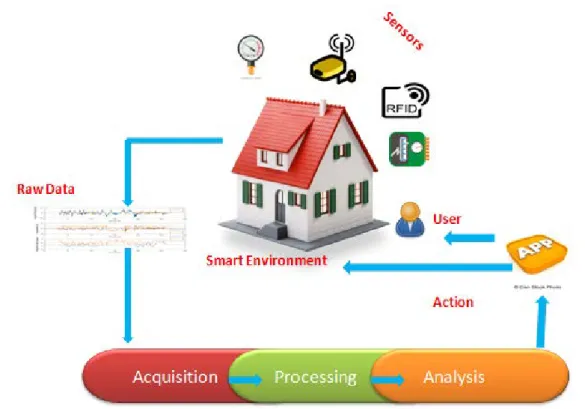
Raw data provided by the sensors has a life cycle, as shown in Figure 2.1, starting from the acquisition, then being processed and analyzed to leverage knowledge models handled by the application to provide proactive decisions. The latter aims to provide actions that can be related directly to the user and also the smart environment. In smart environments the most common issues to tackle for the sensor data are as follows:
• Data are uncertain. Sensor devices have hardware restrictions making provided data always subjected to some level of imperfection. Moreover, the quality of sensor data is
2.2 Smart Environments 15
Sensor usefulness
Temperature Sensor measures the amount of heat energy or even coldness that is generated by an object or system Accelerometer sensor
measures acceleration, which is the rate of change of the velocity of an object. It measures in meters per second squared (m/s2) or in G-forces (g) Infrared (IR) Sensor almost always used for remote control detection by emitting IR pulses
Pressure Sensor
measures the pressure, typically of gases or liquids. It generates a signal related to the pressure imposed.
Light Sensor measures illuminance, which can be used to measure more than the brightness of a light source Ultrasonic Sensor
measures distance. It is a cheap sensor that can measure 2cm to 400cm
of non-contact measurement functionality with a ranging accuracy that can reach up to 3mm. Smoke and Alcohol Sensor
is useful module for detecting alcohol or smoke concentration.
It measures the alcohol concentration precisely. It can also measure smoke and alcohol with low sensitivity. Touch Sensor
enables touch detection by measuring capacitance, exhibiting a change in capacitance in response to a change in surrounding materials. Color Sensor
detects the color of the surface, usually in the RGB scale.
Color is the result of interaction between a light source, an object and an observer.
Humidity Sensor
measures and reports both moisture and air temperature.
The ratio of moisture in the air to the highest amount of moisture at a particular air temperature is called relative humidity.
Table 2.1 List of the most common sensors types
Figure 2.1 Smart environments architecture for decision making applications
often decreased by sensor failures or malfunctions. Thus, when deficiencies on sensor are tackled, it allows to reduce information misunderstandings [13].
• Data are heterogeneous. Normally, each type of sensors (see Table 2.1) is used to provide one kind of data (i.e temperature, humidity, etc.). Usually, a variety of sensors are generated in a smart environment where each one is used for a particular aim (i.e
16 State of the art
providing user location, getting status of an object, etc.). Hence, these multitude of sensors provide heterogeneous data.
• Data streaming. Sensor data are generally provided as time series, that is to say a streaming sensor data. Hence, this stream can be either stored on computer to be treated afterwards offline or treated immediately by an online process. In this thesis we are interested by the online handling of sensor data. We believe that results can loose their effect if they come too late.
In the next subsections we provide an overview of each step of the sensor data life cycle.
2.2.1
Acquisition
Data acquisition allows mainly the transformation of sensor data into information that could be treated in computers. This task includes the collection and the fusion of the sensor data from the smart environments. Moreover, the acquisition step is responsible of data cleansing from noisy data and computing their uncertainty values which vary between 0 and 1. Uncertain data have almost 0 as uncertainty value. This value increases with the data quality. Nowadays, sensor data acquisition field is a quite popular topic. The corresponding literature around it is rich and there are several works for various applications. The Fuzzy Semantic Complex Event Processing (FSCEP) [5, 4] system, that is developed in our team, is able to acquire data from several sensors and compute their uncertainty values. One advantage of this system is the ability to consider the different types of uncertainty, compute their values, and merge them into one value for each data. Several other systems have been proposed in the literature for the same aim such as CEP2U [38] and SCADA1. The CEP2U is a model for dealing with uncertainty in complex events. The SCADA framework is a more evolved system. One of its main functionality is the ability to monitor, gather, and process real-time data and to record events in log file. The main difference between these systems and the FSCEP is, on the one hand, the lack of dealing with fuzzy data for these systems and, on the other hand, they do not handle different uncertainty dimensions.
The acquisition field is mature enough in the state-of-the-art. Several efficient methods have been proposed allowing to achieve this step. In this thesis we have chosen to use the FSCEP system for data acquisition. Firstly, because it is available easily. Secondly, the FCSEP provides more advantages regarding the other systems. Therefore, we focus on the processing and the analysis of sensor data as main contributions of this thesis.
2.2 Smart Environments 17
2.2.2
Processing
After collecting the sensor data, cleansing it, and computing its uncertainty, we obtain a model of information that can be handled by computers. Hence, it becomes possible to process this information to prepare it for the analysis. Data segmentation is considered as one of the important fields of data processing. In fact, any process cannot handle the acquired data in one-pass. Therefore, data needs to be segmented. The segmentation process divides the data into a set of segments, called also windows. Afterwards, each segment can be analyzed separately. The sensor data segmentation is still an open research question due to its important effect on the analysis process and also on the application output. Thus, the segment size must be properly chosen. Otherwise, the segment may contain either too much or insufficient data which decreases the application accuracy. In the literature, there are two strategies of segmentation: (1) Static or (2) Dynamic [78, 12]. On the one hand, static segmentation means that the segment size is fixed and cannot be changed. The application will be evaluated using different segment sizes. Then, the size providing best results is chosen. On the other hand, the dynamic segmentation allows to divide the data into a set of segments with different size. Each size is chosen dynamically during the application process.
Data segmentation is a challenging task that has a great effect as well as for analysis and also for the application. Therefore, in this thesis we have studied this problem.
2.2.3
Analysis
After processing the sensor data and receiving a segment of data, the analysis aims at ex-tracting knowledge from the sensor data belonging to the given segment. As examples of knowledge we can cite user daily activities [61, 77, 56] which are considered as a high level knowledge, the user generated events [19], his/her motion gestures in the smart en-vironment [88], or the occurrence of anomalies [58]. Particularly, activity and anomaly recognition fields are well researched problems and have known a great attention this last decade due the importance of the provided knowledge for a wide range of applications across a variety of domains, such as healthcare, social networks, safety, environmental monitoring, and transportation. On the one hand, recognizing the user activity allows the application to provide a personalized outcome according to the user’s activity needs. On the other hand, detecting anomalies is a crucial topic particularly for health-care applications. The anomalies are considered as the deviations from the the normal behaviour. Ideally, these anomalies can be used to better assess the individual’s current state in smart home, rate of change, and the potential need for assistance, and ultimately a reduction in the costs of care and medical emergencies [89].
18 State of the art
Accordingly, due to the importance of these fields, in this thesis we focus on the problems of activity recognition and anomaly detection for the analysis of sensor data.
2.2.4
Applications
A wide range of applications have been proposed in the literature for decision making in smart environments using the knowledge given by the analysis. For a mobile context-aware recommender application, the authors in [29] design a method that suggests to the user the suitable information depending on her/his situation and interests. Indeed, the application is dynamically adapted according to the evolution of the user’s interest. Nowadays, energy management applications based on user’s activity have gained a great attention in smart environments [79]. Such application allows to propose the best strategy for energy consumption without reducing the user’s comfort according to his/her activity. A related medication remainder is another example of known applications for user health monitoring in smart homes [90, 96]. It aims, principally, to remind an elderly person to take his/her medicine. For such applications, forgetting taking medicine is considered as anomaly. It serves then to provide action, a recall, that consists of reminding the user about the forgotten medicine.
Applications in smart environments are considered as the end of sensor data life cycle. We let this avenue for future researches. Mainly, in this thesis we are interested about the sensor data processing and analysis in order to prepare the decision making module associated to an application. The point that comes before studying works into these topics, is to review the different techniques that could be applied for the sensor data analysis and processing. This study is the goal of the next section.
2.3
Techniques for data analysis and processing
Throughout this section we present the techniques that could be applied for data analysis and processing, in general, for smart environments. These techniques can be classified into three categories: data driven, knowledge based, and hybrid techniques. On the one hand, data driven techniques, that is to say machine learning, include supervised, unsupervised methods and reinforcement learning. On the other hand, knowledge based techniques mostly concern ontology and logic reasoning. Finally, hybrid techniques combine between methods from both categories. In the next subsections we review each category, identify its benefits and limitations. .
2.3 Techniques for data analysis and processing 19
2.3.1
Data driven techniques
As the name suggests, data driven techniques are based on analyzing the data of a system, in particular finding connections between the system state variables (input, internal and output variables) without explicit knowledge of the physical behaviour [28]. A data driven algorithm is used, then, to determine the relationship between a system’s inputs and outputs using a training dataset that is representative of all the behaviour found in the system. Once the model is trained, it can be tested using an independent dataset to determine how well it can generalize to unseen data.
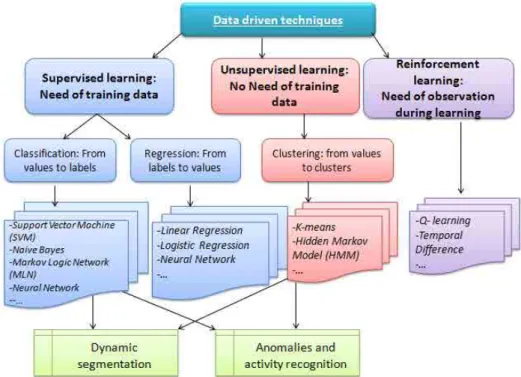
Data driven methods can be classified into supervised, unsupervised, or reinforcement learning as illustrated in Figure 2.2.
Figure 2.2 Data driven techniques overview
• The supervised learning algorithms build a model based on a labelled training dataset according to a given set of features. This model allows to represent relationships and dependencies between the target prediction output and the input features. It is possible then to predict the output values for new data based on those relationships which are learned from the previous datasets. Formally, the training data is a finite sequence S = (x1, y1), . . . , (xn, yn) of pairs where each xi is some measurement or set of
measurements of a single example data point, and yiis the label for that data point. The