HAL Id: hal-00765040
https://hal.archives-ouvertes.fr/hal-00765040
Submitted on 14 Dec 2012
HAL is a multi-disciplinary open access
archive for the deposit and dissemination of
sci-entific research documents, whether they are
pub-lished or not. The documents may come from
teaching and research institutions in France or
abroad, or from public or private research centers.
L’archive ouverte pluridisciplinaire HAL, est
destinée au dépôt et à la diffusion de documents
scientifiques de niveau recherche, publiés ou non,
émanant des établissements d’enseignement et de
recherche français ou étrangers, des laboratoires
publics ou privés.
Comparing QoS of DSDV and AODV routing protocols
in vehicular network
Aref Hassan Poor, Hooman Hoodeh, Amirhossein Zarrinnegar, Arsalan
Emami, Rafidah Md Noor
To cite this version:
Aref Hassan Poor, Hooman Hoodeh, Amirhossein Zarrinnegar, Arsalan Emami, Rafidah Md Noor.
Comparing QoS of DSDV and AODV routing protocols in vehicular network. 2012. �hal-00765040�
Abstract- With the advance of Vehicular ad-hoc network, routing protocol has become one of the most important issues in transmitting data among Vehicles. The two routing protocol are DSDV and AODV which DSDV is known as a novel approach in proactive system; however, AODV has good performance in reactive system. In this paper, we compare the efficiency between DSDV & AODV in terms of packet-loss, end-to-end delay and throughput based on given scenarios. The comparison has implemented in various speeds for acquiring result with higher performance. The speeds consist of 5, 20 and 40km/s. then we analyze the explicit results according to X-Graph in NS2. Our comparison and evaluation indicate that AODV demonstrate more satisfactory result than DSDV in case of usage in highway. Keywords- Ad hoc Network, Quality of Service, Routing Protocol, Simulation
I. INTRODUCTION
In recent years, there are many vehicles on the roads and highways are already full. Vehicular Ad Hoc Networks (VANETs) have increased exponentially to support the communication between vehicle in highway or road. Vehicles can notify other vehicles of traffic congestion, sudden stops or dangerous road condition. In addition, VANET assist to rapid development of Intelligent Transportation System (ITS)[1]. Majority of people used several wireless devices inside vehicle such as laptop, mobile phones and personal digital assistance (PDAs), therefore the cars need to have internet connection. [1]. VANET is one type of mobile ad hoc network (MANETs). Where MANET is utilized without any support of roadside infrastructure and the mobile nodes are in a position to self-configure. In fact, VANET has some unique characteristic like MANET. Namely, high dynamic topology, frequent disconnected network, mobility modelling and prediction, communication environment [2]. VANET has many advantages for intelligent transportation system (ITS) and assists to collect information about the current location of vehicle and vehicle information. The collection of data caused to increase the quality of driving by car assistance and drive safety. In fact, Car assistance and drive safety are two
important of VANET advantages. Car assistance and drive safety can be consisting of break warning sent from another vehicle, information and data about the road condition, traffic jam and caution to an accident. VANET also can useful by enabling the passengers by internet access, chatting interactive games between cars close to each other.[2].
The rest of the paper is organized as follow. Section 2 presents an overview of vehicle ad hoc network. In section 3 a scenario for highway is introduced and then three parameters of QOS (end-to-end delay, packet loss, and throughput) are compared between AODV and DSDV. Finally in section 4 concludes all of the processes of this paper.
I. RELATED WORKS
Mobile ad hoc Network (MANET) is an infrastructure less wireless network composed of a set of mobile nodes that communicate with each other through wireless links. Each node in MANET is easily to move independently in any direction [3][4][5]. Vehicular ad hoc Network (VANET) is considered as a special type of MANETs and the vehicles are the mobile nodes, which are equipped with wireless transceivers so that they can exchange information with other vehicles such as safety messages or traffic information. Vehicles can also communicate with roadside units, which are called infrastructures (V2I). V2I protocol enables vehicles to have Internet connection and use traditional applications in addition to dedicated applications for ITS (Intelligent Transport System) [6]. There are many different routing protocols developed for MANET but due to characteristics of VANET such as very high mobility, different speeds and limited degree of freedom (because of roads) ,it is essential to improve technologies in MANET to make it adaptable to VANET needs [5]. The two very common routing protocols in VANET are proactive routing and reactive routing. Proactive routing protocols are table driven, it means that they keep information on routing among all vehicles at all time and update the route information regularly even if the path is currently not used [7][8]. However, reactive routing or on-demand routing protocol establishes a route only when it is needed for a node to communicate with another node and it maintains the route as long as it is in use. Reactive routing has
Comparing QoS of DSDV and AODV routing
protocols in vehicular network
Aref Hassan Poor, Hooman Hoodeh, Amirhossein Zarrinnegar, Arsalan Emami, Dr.Rafidah Md Noor
A.Hassan Poor, Faculty of Computer science ,University Malaya (e-mail: [email protected]).
H.Hoodeh, Faculty of Computer science ,University Malaya, (e-mail: [email protected]).
A.Zarrinnegar, Faculty of Computer science ,University Malaya (e-mail: [email protected]).
A.Emami, Faculty of Computer science ,University Malaya (e-mail: [email protected]).
Dr. Rafidah Md Noor, Head of Department of Network, Faculty of Computer Science, University Malaya (Email: [email protected])
much less overhead in the network than proactive protocol [7][8]. Changes in dynamic environments using proactive routing protocols are propagated slower than reactive protocols [9].
DSDV is a proactive routing protocol. It uses bellman-ford algorithm to find the best route. It uses a routing table to update with other routers when it sends the update messages. Time of sending update messages is depended either on topology changes or not. Without any topology changes this protocol sends the update messages to its neighbors every 15 seconds. Upon topology changes, it sends the message update regardless of time period. The update message in DSDV is classified based on its content. There are two types of update to aware nodes of the network that topology was changed. The first type is sent if topology is changed with few nodes, in this type the incremental update will be sent to the neighbors that includes the change of the routing table. The second type is full-table update which shows significant change in topology was occurred [10].
Ad-Hoc On demand Distance Vector (AODV) is one of the renowned reactive routing protocols in wireless ad-hoc networks; it is used as a reference when a new protocol is being tested [11]. In AODV [12] [13], before a sender send a packet to destination, the source sends a RREQ packet to its neighbors and they maintained the sender address and broadcast the RREQ till it reaches either to destination or an intermediate node that has a valid route to destination, then a RREP packet is unicasted to the source through the routing table that has been stored route back to the originator. The nodes add the next hop address to their routing table for destination during transferring the RREP. In AODV, when a link breakage occurs, a broken node would send a RERR packet - that includes all the nodes which are not accessible anymore to the sender and all intermediate nodes therefore they would be informed about the broken link and sender will generate a new RREQ to find a new route.
III SIMULATION AND RESULT A. Scenario
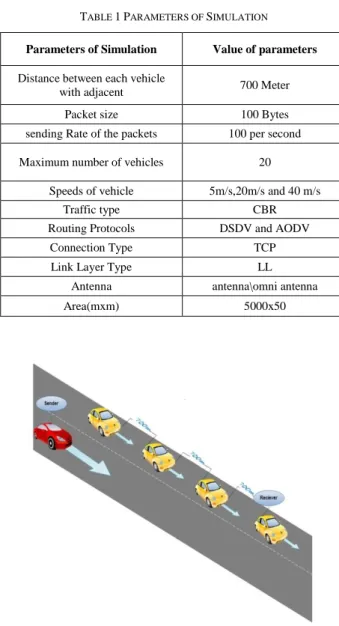
This section discusses a simple experiment as depicted in Figure 1.In this scenario all nodes move in a same direction. The first node has more speed that the other nodes. In compare, the other nodes have a constant speed (5 m/s) with a constant distance with adjacent nodes, i.e. the first node sends packets with size of 100 bytes to the last node in every 0.01 seconds. The most important parameter that is effective to the results is difference of speed between first nodes with other nodes. This scenario has been examined by difference speeds of 5 m/s, 20 m/s and 40 m/s. Therefore the speed of first node is defined for 3 speeds (10 m/s, 25 m/s and 45 m/s). For each speed of the first node, we measured the throughput, delay and packet loss.
Figure1 shows an example of this scenario for 5 nodes. This scenario also has been tested for 3 nodes, 5 nodes, 10 nodes and 20 nodes.
TABLE 1PARAMETERS OF SIMULATION
Parameters of Simulation Value of parameters
Distance between each vehicle
with adjacent 700 Meter
Packet size 100 Bytes
sending Rate of the packets 100 per second Maximum number of vehicles 20
Speeds of vehicle 5m/s,20m/s and 40 m/s
Traffic type CBR
Routing Protocols DSDV and AODV
Connection Type TCP
Link Layer Type LL
Antenna antenna\omni antenna
Area(mxm) 5000x50
Figure 1 Sample of Scenario
B. Analysing of results
The main parameters of Quality of Service which are considered in this paper are end-to-end delay, packet loss, and throughput. Each result is discussed in the next section.
1) End-to-end delay
The end-to-end delay is the amount of time that is taken to transmit a packet from source to destination. In figure 2 AODV demonstrates almost same average of delay in various speeds. In contrast, DSDV exhibits gradually raising amount of delay by increasing the speed. In this scenario (e.g. highway), the sender with a higher speed reaches to destination in a shorter time that is a reason to reduce the end-to-end delay; however, topology changes faster in this circumstance that is a reason for link broken in DSDV routing protocol. Consequently, routing tables of DSDV must be updated frequently which leads to increasing delay in the
network. As a result, by increasing the vehicle speeds, end to end delay in DSDV becomes longer. In contrast AODV which is an on-demand protocol, due to increasing the speed of sender (e.g. vehicle), it closes to destination faster. Therefore, higher speed shows less delay in AODV which is depicted in table 2. To sum up, for various speeds, AODV functions less end-to-end delay in compare of DSDV.
Figure 2 Average result of end to end delay for different scenario
TABLE 2END-TO-END DELAY COMPARISON
Comparision of Delay between AODV and DSDV(S)
Speed 5 20 40
AODV 0.009989 0.009957 0.00991275 DSDV 0.020706 0.046893 0.083044
1. 2) Packet Loss
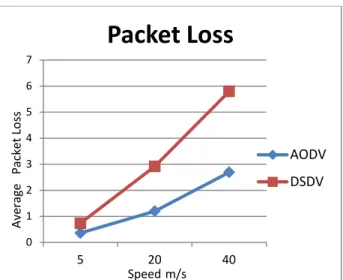
Packet loss is number of packets which have been sent by source and on the other side didn’t receive by destination. In our scenario by increasing the speed of source node, the amount of packet loss increased too. For AODV, a number of packet losses increased moderately in compare to DSDV. In both protocols, packets are buffered in a queue when a link broken happens; in addition establishing a new route is faster in AODV so fewer packets will be dropped from queue and the value of packet loss will not grow dramatically. Figure 3 and Table 3 show the results.
Figure 3 Average result of packet loss for different scenario
TABLE 3PACKET LOSS COMPARISON
Comparison of Packet loss between AODV and DSDV
Speed 5 20 40
AODV 0.36068 1.200533 2.69418 DSDV 0.732871 2.917975 5.798889
2. 3) Throughput
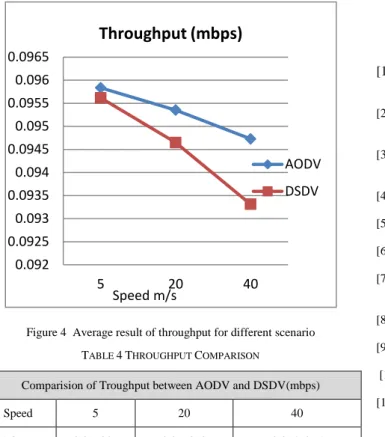
Throughput is rate of transfer data from a source to a destination during specific time. Figure 4 has shown that by increasing the vehicle speed, the throughput in both AODV and DSDV will be decreased with because sender and receiver become close to each other faster in higher speed. Table 4 shows the results specifically. Base on the results of end-to-end delay and packet loss, when the speed is intensified, both amount of delay and packet loss will be decreased. As a result, decreasing of other two parameters is a reason for reducing amount of throughput in DSDV. On the other hand, AODV demonstrates almost same amount of delay in different speeds, however it shows less amount of packet loss in this case. Consequently, in higher speed scenario, outcome of AODV for this parameter will decrease. However, this amount is better than DSDV due to it has less delay in compare of DSDV. 0 0.02 0.04 0.06 0.08 0.1 5 20 40
Delay (S)
AODV DSDV Speed m/s A ve rag e End -to -E nd D el ay ( S) 0 1 2 3 4 5 6 7 5 20 40Packet Loss
AODV DSDV Speedm/s A ve rag e Pa cke t Lo ssFigure 4 Average result of throughput for different scenario
TABLE 4THROUGHPUT COMPARISON
Comparision of Troughput between AODV and DSDV(mbps)
Speed 5 20 40
AODV 0.095835 0.095353 0.0947275 DSDV 0.095615 0.094648 0.0933145
IV. CONCLUSION
In this paper, we have presented the comparison performance between AODV and DSDV routing protocol in highway scenario. Based on the analysis of simulated scenario it has been proved that the AODV routing protocol could be used for performance enhancement instead of DSDV due to three parameters of QoS: end-to-end delay, packet loss, and throughput. Firstly, AODV has less end-to-end delay in the different speeds. By increasing the speed difference of this amount between DSDV and AODV will become more. Secondly, in terms of the packet-loss, fewer packets will be dropped in AODV but in low speed these protocol function almost same. Lastly, in throughput, regarding the less amount of delay and packet loss, AODV will have better throughput in compare of AODV.
REFERENCES:
[1] S.yousefi,M.mousavi, M.fathy, “Vehicular ad hoc network(vanet) :challenges and perspectives, 2006,international conference on ITS telecommunication proceeding
[2] C.ta li, m.Hwang, y.chu, “ a secure and eeicient communication schme with authenticated key establishment and privacy preserving for vehicular ad hoc networks”, 2007
[3] Cuyu Chang, Yong Xiang, and Meilin Shi, ”Development and status of vehicular ad hoc network ,” Journal on Communication, vol. 28, 2007, pp. 116-126
[4] Perkins, C E: Ad hoc Networking. Addison Wesley Longman, Boston, 2001
[5] Baozhu Li, Y. L. a. G. C., “Optimized AODV Routing Protocol for Vehicular Ad hoc Networks”, 2010, IEEE.
[6] Anna Maria Vegni, Tiziano Inzerilli and Roberto Cusani,”seamless Connectivity Techniques in Vehicular Ad-hoc Networks
[7] Sherali Zeadally, Ray Hunt, Yuh-Shyan Chen,Angela Irwin,Aamir Hassan, ”Vehicular ad hoc networks (VANETS):status, results, and challenges” ,springer ,2010
[8] Kevin C. Lee, Uichin Lee, Mario Gerla,”Survey of Routing Protocols in Vehicular Ad hoc Networks”
[9] Elizabeth M. Royer, Chai-Keong Toh,” A Review of Current Routing Protocols for Ad Hoc Mobile Wireless Networks” , 1999
[10] P. B. Charles E.Perkins, "Highly Dynamic Destination-Sequenced Distance-Vector Routing (DSDV) for Mobile Computers," 1994. [11] Md. Monzur Morshed, Md. Habibur Rahman, Md. Rezaur Rahman
Mazumder, K.A.M. Lutfullah, "Simulation and Analysis of Ad-hoc OndemandDistance Vector Routing Protocol," ICIS 2009, ol. II, pp. 610-614, November 2009.
[12] C.E. Perkins and E.M. Royer , “Ad-hoc on-demand distance vector (AODV) routing,” Proc. of 2nd IEEE Workshop on Mobile Computing Systems and Applications, 1999
[13] C.E. Perkins, E.M. Royer and S.R. Das , “Ad hoc on-demand distance vector (AODV) routing,”, RFC 3561, July 2003
0.092 0.0925 0.093 0.0935 0.094 0.0945 0.095 0.0955 0.096 0.0965 5 20 40