HAL Id: hal-00010020
https://hal.archives-ouvertes.fr/hal-00010020
Preprint submitted on 7 Oct 2005
HAL is a multi-disciplinary open access
archive for the deposit and dissemination of
sci-entific research documents, whether they are
pub-lished or not. The documents may come from
teaching and research institutions in France or
abroad, or from public or private research centers.
L’archive ouverte pluridisciplinaire HAL, est
destinée au dépôt et à la diffusion de documents
scientifiques de niveau recherche, publiés ou non,
émanant des établissements d’enseignement et de
recherche français ou étrangers, des laboratoires
publics ou privés.
UML Protocols State Machines Incremental
Construction: a conformance-based Refinament
Approach.
Olivier Gout, Thomas Lambolais
To cite this version:
Olivier Gout, Thomas Lambolais.
UML Protocols State Machines Incremental Construction: a
conformance-based Refinament Approach.. 2005. �hal-00010020�
UML Protocol State Machines Incremental Construction: a Conformance-based
Refinement Approach
Olivier Gout
Thomas Lambolais
LGI2P ´
Ecole des mines d’Al`es Nˆımes 30 035 France
{Olivier.Gout, Thomas.Lambolais}@ema.fr
Submitted to SEFM05, LGI2P Research Report RR05/027
Abstract
This article introduces formal relations between UML Protocol State Machines in order to support their incre-mental construction. This is based on the use of confor-mance relations. Protocol State Machines (ProSMs) intro-duced in UML2.0 are means to model external behaviors of objects and/or components in a service oriented way. These machines are specializations of generic UML State Machines without actions nor activities. In previous works, we adapted Labeled Transition System conformance rela-tions to UML usual State Machines. Going further, ProSMs allow us to be more formal thanks to the presence of log-ical propositions such as state invariants, pre and post-conditions. Hence, we define a conformance relation as a specialization of the informal notion of Protocol Confor-mance of UML2.0 and we illustrate it on an example.
1. Introduction
Our works deal with the construction processes in the early stages of software intensive system development. Such steps are: requirements engineering, analysis (abstract system specification and environment modeling) and ab-stract design. By the latter, we mean architectural steps but not detailed design and programming aspects.
Current software engineering practices usually imply the use of the UML notation de facto standard [8]. For our purposes we are concerned with dynamic models and es-pecially UML state machines [8]. Hence, we address the problem of “UML state machines development”, and in par-ticular what we shall call “abstract UML state machines”, i.e. first and simplified UML behavioral models. Basically, in a top-down process, steps go from abstract to concrete and precise state machines. On the opposite, in a
bottom-up approach, development steps go from detailed to general state machines. Since we want our approach to be a prag-matic one, and we want to take into account current prac-tices in software engineering, the development framework we are going to settle up should be able to describe both kinds of approaches: bottom-up, top-down, and even hy-brid approaches.
In the category of “theoretical” top-down approaches, we may classify pure refinement approaches like the “B method” [1] in the case of the B language. This kind of approach is theoretically appealing, but we find it too con-straining: the first steps must be very abstract and global, for them to implicitly include forthcoming details. Our goal is not to convert the B method for the UML language. Nev-ertheless, we are inspired by the refinement relation: we like the idea of a process “adding details, but preserving previ-ous properties”.
In the category of “pragmatic” approaches, we may find classical “extension” approaches in which a new version is a specialization of a former version, with new capabilities and responsibilities, such as new methods in specialized classes. Such incremental construction processes are also appealing, but a risk appears: are new versions compatible with previ-ous ones? In other words, are new capabilities (extension points) preserving former ones?
Conformance between development steps tackles both aspects of reduction (i.e. refinement and property preserva-tion) and extension: It combines both advantages of theory and practice. It has been initially proposed in the context of service and telecommunication protocols [4], to define the notion of ‘conformance tests’. Afterwards, formal rela-tions namedconf, ioconf and ioco have been proposed for formal languages like process algebras based on Labeled Transition Systems [11].
Our point of view is to use such relations in the context of incremental development processes. In previous works,
we have defined conformance relations for sequential UML state machines. In this paper, the address the case of UML protocol state machines. The paper is structured as follows. The Section 2 introduces UML Protocol States Machines and shows an example. In Section 3, we informally recall previous conformance definitions over LTS and UML State Machines. They are the background for new conformance relation definitions given in Section 4. This relation is illus-trated on an example in Section 5.
2. Protocol State Machines
In UML, State Machines are used to model the global behavior of objects. These models capture both internal and observable behaviors and do not necessarily make a dis-tinction between the various orthogonal services offered by the object. This distinction can be done thanks to Protocol State Machines (ProSMs in the sequel) a new formalism proposed in UML2.0. An object can have several ProSMs for the different services it provides. These ProSMs can be associated to interfaces or to ports to specify how others objects (or components) have to proceed to use a service. In other words, a ProSM defines at any time which opera-tion (or method) is enable and which is not, for a specified service.
2.1. Differences between
ProSMsand SMs
According to the UML2.0 specification [9], ProSMs are specializations of State Machines. Consequently, ProSMs are similar to State Machines and can have the same char-acteristics: concurrency, hierarchy, event policy, etc. Nev-ertheless, ProSMs impose some restrictions on states and transitions.
States. Changes in states from State Machines to ProSMs are threefold:
1. A state in a ProSM cannot have actions nor activities, so entry, exitanddofeatures no longer exist in ProSMs.
2. Restriction on deep history and shallow history pseudo states: their use is no longer possible in ProSMs.
3. A state invariant typedConstraintwhich specifies a condition that is always true when the state is active.
Notation:
State 1
[invariant expr]
Transitions. Transitions are slightly different. As in states, actions have been suppressed and replaced by a post-condition that must be verified once the transition is trig-gered.
Notation:
State1 −−−−−−−−−−−−−−−−−−−−−−→ State[precondition]event/[postcondition] 2 Thepreconditionexpression has the same seman-tics as theguardsin generic states machines. Consider-ing the purpose of ProSMs, events in transitions are, most of the time,CallEventscorresponding to method-calls on the object. Other event types such asTimeEventor
ChangeEventare also possible.
2.2. Example: Lift Control Service
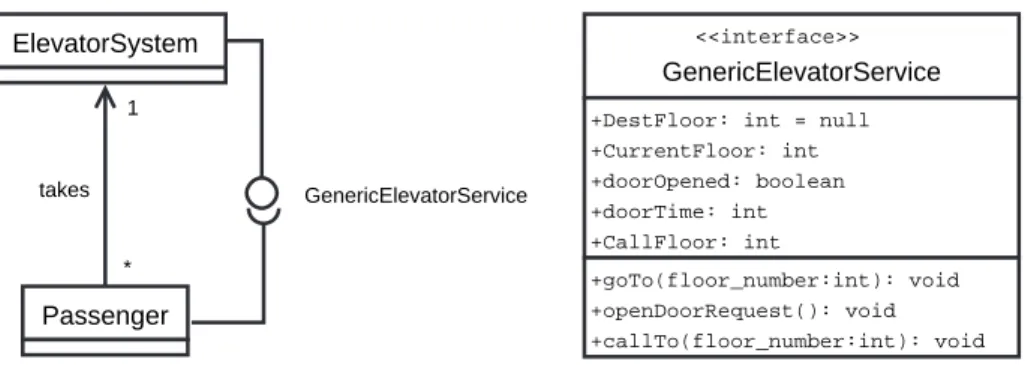
An example of how ProSMs can be used to model differ-ent uses or scenario of an elevator control system is shown on figure 1.
The main classes (cf. figure 1) areElevatorSystem
that captures actions and features of the lift cabin and the Passenger class. These two classes communicate through theGenericElevatorServiceinterface. The
Passengerclass uses this interface and this connection is represented by a circle and a half-circle in the diagram.
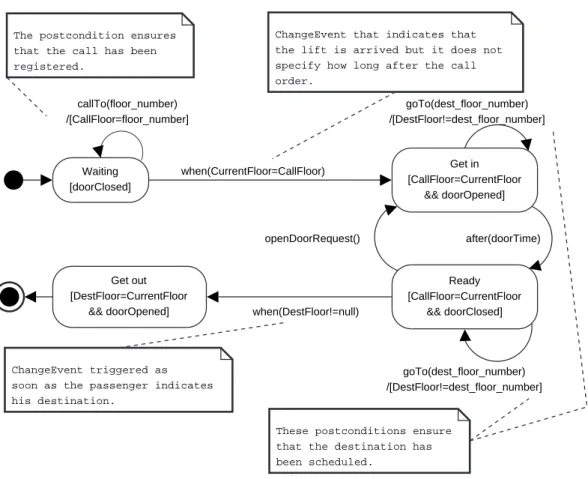
A Protocol State Machine is associated to this interface. The service offered is quite simple and a typical usage cor-responds to the following sequence sketch:
Calling→ Waiting → Getting in ↓
Getting out← Choosing a destination
This simple ProSM is represented in figure 2. ProSM is rather simple, It must not be considered as an advanced specification of the elevator service. Note that UML2.0 ProSM standard definition [9] does not give any example of ProSM at the moment, as well as the current literature which is still very poor on the subject [7].
As specified in the class diagram, the passenger can only interact with theElevatorSystemthrough three meth-ods:
• callTo(floor number: int) models the way to call for the lift.
• goTo(floor number: int) models the way to indicate, once inside the lift, which floor to go. • openDoorRequest()models the way to open the
door.
All these methods are called through CallEvents
Passenger
1
*
<<interface>>
GenericElevatorService
+DestFloor: int = null +CurrentFloor: int +doorOpened: boolean +doorTime: int +CallFloor: int +goTo(floor_number:int): void +openDoorRequest(): void +callTo(floor_number:int): void ElevatorSystem GenericElevatorService takes 1
Figure 1. Elevator class diagram
or TimeEvent whose syntax are, respectively,
when(hconditioni) and after(htime
expressioni). All the pre/post-conditions and invariants must be expressed using the attribute vari-ables defined in the interface. The first state is the waiting state, the elevator door is closed. Once the
Passenger activates the CallTo transition the el-evator is informed of his call. This is ensured by the postcondition of the transition. Then, when the lift is at the desired floor (CurrentFloor=CallFloor) the
Passenger is able to get in (doorOpened). Dur-ing this state, the Passenger can activate the goTo
transition to indicate his destination. After some du-ration (doorTime), the elevator closes the door and is ready to move. If the Passenger has not set his destination at this point, he can do a call to goTo()
or request the door opening (openDoorRequest()). If the destination was already set or once he has set it (DestFloor!=null), the lift takes him to his destina-tion and opens the door ([DestFloor=CurrentFloor && doorOpened]). We refer to figure 2 for more details.
3. Conformance background
Evaluation and correction means at each development step are the base of a rigorous approach. In the case of generic UML state machines (abbreviated SM in the se-quel), evaluation means may be: simulation or animation, internal and external consistency checking (by external, we mean with other UML diagrams), property verification, code generation. . .
Unfortunately, current UML tools do not offer many state machine evaluation mechanisms. Even basic simula-tion mechanisms are very rarely proposed.
The simple SM construction process we advocate is based on a simple ‘good sense’ cycle: design, evaluation, correction,. . . For our purpose, the evaluation means we study is the conformance evaluation between development steps. Informally, such kind of relation checks that a
‘refine-ment’ must accept all what the abstract step must accept.
3.1. Conformance relations for Labeled Transition
Systems
Conformance relations used in test generation derive from the following idea:
A realization I is a conform implementation of a spec-ification S if all entries that S must accept must also be accepted by I. Equivally (since the negation of ‘S must ac-cept a’ is ‘S may refuse a’) “all entries that I may refuse, after a trace of S, may also be refused by S”.
This definition, using refusal sets of actions, is the one proposed by Tretmans and Brinksma in 1992 [10, 11] to formalize the ISO definition of conformance testing. Un-fortunately, in practice, if I is a black-box implementation of S, it may be impossible to test the refusal of actions. Hence, other more practical conformance relations have be defined, such as input-output conformance (‘ioco’). These relations have been defined on IOTS (Input Output Transi-tion Systems). Basically, an implementaTransi-tion I is a conform realization of S if the output set of I after a trace s of inputs defined in I is included in the output set of S after s.
These relations have been successfully used in test gen-eration tools. For our purpose, we have been studying an adaptation of such relations for UML State Machines.
3.2. Conformance Relation for
genericState
Ma-chines
In previous works [2, 6], we proposed two conformance relations intended to be used in an incremental develop-ment of generic states machines. These relations are named ‘eco’ and ‘aco’ for Event Conformance and Action
Confor-mance. Their adaptation to UML states machines has led us to consider non-concurrent state machines and to introduce nondeterminism capability and a notion of observability for events and actions.
Waiting [doorClosed] Get in [CallFloor=CurrentFloor && doorOpened] Ready [CallFloor=CurrentFloor && doorClosed] callTo(floor_number) /[CallFloor=floor_number] goTo(dest_floor_number) /[DestFloor!=dest_floor_number] after(doorTime) openDoorRequest() when(DestFloor!=null) Get out [DestFloor=CurrentFloor && doorOpened] goTo(dest_floor_number) /[DestFloor!=dest_floor_number] when(CurrentFloor=CallFloor)
The postcondition ensures that the call has been registered.
These postconditions ensure that the destination has been scheduled.
ChangeEvent that indicates that the lift is arrived but it does not specify how long after the call order.
ChangeEvent triggered as soon as the passenger indicates his destination.
Figure 2. GenericElevatorService Protocol State Machine
Non determinism We considered non deterministic State Machines. Harel’s Statecharts can be nondeterministic [3], but usually, UML State Machines are treated like opera-tional and deterministic behavioral models. At the end of the construction process, we aim at obtaining deterministic models; but for the first abstract steps, non determinism is a very expressive mechanism.
Observability In UML State Machines, actions, events and activities are not explicitly said to be observable nor internal. Conformance relations, like simulation relations, compare two models from an external point of view: what are the external/visible interactions offered by a machine? What are the visible results of internal treatments? As an answer, we consider change events, time events and com-pletion events like internal events. Call events and signal events have to be tagged as either internal or observable by the specifier.
Event conformance The event conformance relation is close to the initial “conf” relation defined by Tretmans [10]. In State Machines, transition triggers are events and not ac-tions, so that we adapted initial definition in the following
way. Informally, a realization R is event-conform with a specification S, written Reco S, if all the observable events that S must accept after se, sebeing any trace of events of S (i.e. partial sequence of observable events), must also be
accepted by R after se.
We refer to [2] for a more formal definition.
Action conformance Action conformance is inspired from input-output conformance “ioco” also defined by Tret-mans [12]. A realization R is action-conform with a spec-ification S, written R aco S, if after any trace of events se, the set of observable actions that R may perform is
in-cluded into the set of observable actions that S may perform after se. This relation is not fully formal because it uses the
notion of action inclusion that is not yet defined in UML.
4. Conformance Relation for ProSMs
UML meta-model context. A relation of conformance between two ProSMs is already presented in the UML2.0 notation. Unfortunately, this relation remains infor-mal because of its very general definition. The
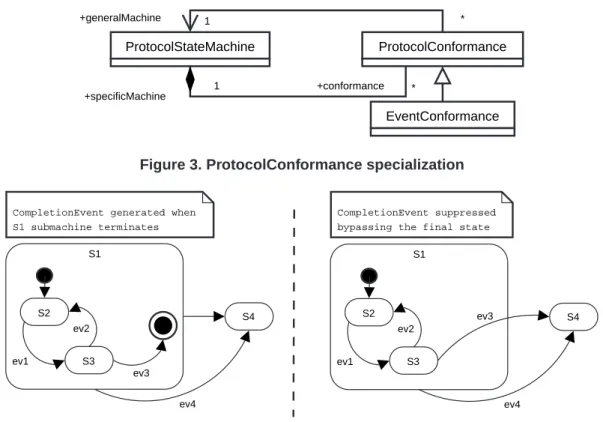
explic-ProtocolStateMachine ProtocolConformance EventConformance +generalMachine +specificMachine 1 +conformance * * 1
Figure 3. ProtocolConformance specialization
CompletionEvent generated when S1 submachine terminates S1 ev2 ev1 ev3 S2 S3 ev4 S4 S1 ev2 ev1 ev3 S2 S3 ev4 S4 CompletionEvent suppressed bypassing the final state
Figure 4.CompletionEventautomatic generation example and transformation to observable model.
itly declared by the ProSM that want to conforms with a more abstract ProSM. The semantics of the
ProtocolConformance is based on the conservation of the rules (pre/post-conditions, invariants) of the gen-eral ProSM in the specific one but the way to maintain these properties is not addressed. Nevertheless, this tion is a good starting point to define a more refined rela-tion. So, our relation is defined as a specialization of the
ProtocolConformanceand according to the UML no-tation, can be implemented in the UML meta model as de-scribed in figure 3.
As introduced in Section 2, ProSMs specify the ways of using a service offered by an object but not the ways of how the object realize this service. Considering this we must clarify some properties of ProSMs before defining precisely a conformance relation.
4.1. Properties of
ProSMsObservability. The observability notion is interpreted dif-ferently in ProSMs than in usual SMs. ProSMs describe explicitly observable behaviors where state represent “an exposed stable situation” [9]. Contrary to SMs which con-tains internal behaviors that model how services are real-ized, ProSMs do not contain internal behaviors. However, there is one kind of events that cannot be observed: the
CompletionEvent. ACompletionEvent is gener-ated each time an activity is completed. Even when there is no activity in ProSMs, completion rules apply to subma-chine with final state. Thus a transition without event spec-ified can be fired when arriving in a final state (see example in figure 4).
This kind of transition (without event) is not acceptable for our study. A simple way to avoid this is to transform such ProSMs. Without lost of expressivity, we can bypass the final state by redirecting the transitions to final state to the state reached by the completion transition (see figure 4). All other event kinds are considered as observable (even
ChangeEvent).
Nondeterminism. As for generic states machines, ProSMs have to be deterministic models. For identical reasons as exposed in Section 3.2 we consider that ProSMs may be non deterministic. Non determinism is the fact that with same initial conditions, two identical executions (an execution starts from an initial state) lead to different results. Since we assume that all events in ProSMs are ob-servable, the only kind of nondeterminism is the observable nondeterminism (for example: a state with two outgoing transitions with the same label).
Concurrency and Composite States. Concurrency in ProSMs is authorized and modeled using orthogonal com-posite states, but some semantic flaws remain. At first, for sake of simplicity, we shall consider non concurrent ProSMs.
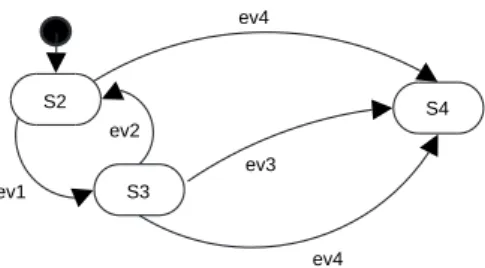
Hence, without concurrent regions and history pseudo-states, composite states are just a useful syntactic sugar. They are a means to factorize transitions and keep diagrams human readable but do not provide additional expressivity. Consequently, we do not treat composite states, considering that they can be automatically transformed in flat state ma-chines distributing transitions to nested states (see figure 5). In the same manner, the invariant of the composite state is distributed to the internal states in conjunction with their proper invariant. ev2 ev1 ev3 S2 S3 ev4 S4 ev4
Figure 5. A flat state machine semantically equivalent to the one in Fig.4
This consideration will help us to express ProSMs in a simpler formalism.
Running context. An important statement is that we con-sider running ProSMs 1. This means that we are able to determine the active states of the ProSM under study. We do not address here a semantics of execution of states ma-chines. Thus, we assume the run-to-completion step [9] se-mantics for event processing. This means that we are able to determine the active state after a trace once the last tran-sition have been trigerred and before a new event have been dispatched. In our definitions of flat ProSMs, a running state machine have exactly one active state.
4.2. Definitions
Having considered all the previous properties, we can now introduce a protocol State Machines semantic interpre-tation on transitions systems as follow.
Definition 4.2.1 (Protocol state machine interpretation) A ProSM P is interpreted as a tuple hS, Sis, L ,−→, sAi
where:
1In UML this concept is meaningless because ProSMs are associated tointerfacesthat can not be instantiated.
• Sisis the set of initial states; • S is a set of states defined hereafter; • L is a set of labels defined hereafter;
• −→⊆ S × L × S is the set of transitions. If
(P, α, Q) ∈−→, we write P −→ Q;α • sAis the active state in the running context.
Definition 4.2.2 (States, labels)
The set S is a set of state labels, S = (Names × Invariant) ∪ Names, where
• Names is the set of states names available in P ; • Invariant is the set of state invariant expressions of
P . Jointly we defineInv : S → Invariant the function
that for a state s associates its invariant.
The set L is a set of labels, L = (Pre × Ev × Post) ∪ (Pre × Ev ) ∪ (Ev × Post) ∪ Ev , where
• Pre is the set of preconditions of transitions in P ; • Post is the set of postconditions of transitions in P ; • Ev is the set of events of P . This set cannot be empty.
The notion of classical observable transition of LTS can be extended to the state machines as follows:
Definition 4.2.3 (Transition) Let α∈ L be a label and P
be a ProSM such that P = hS, Sis, L ,−→, sAi. The
rela-tion=⇒ is defined on ProSMs, writing P =⇒ if sα A α −→. Precisely, if P = hS, Sis, L ,−→, sAi and P α =⇒ P′ then sA−→ sα ′Aand P′ = hS, Sis, L ,−→, s′Ai.
This notation is extended to path transitions
σ= α1; . . . ; αn, writing P =⇒ Pσ ′if there exist P1, . . . , Pn
such that P =⇒ Pα1 1 α2 =⇒ · · ·αn−1 =⇒ Pn−1 αn =⇒ P′.
We define event trace sets as follows:
Definition 4.2.4 (Events traces, Refusal) Let P be a Proto-col State Machine and σ∈ EvTraces(P ) be an event trace. EvTraces(P ) is the event traces set and ref(P, σ) is the
re-fusal set defined as follows:
• EvTraces(P ) =def {σ ∈ Ev∗| P σ =⇒} • ref(P, σ) =def{ev ∈ Ev | ∀P′, P
σ
=⇒ P′6=⇒}ev
The concept of refusal in a state corresponds to the events for which the evolution of the system is not explicitly spec-ified. In fact the events do not make absolutely evolve the system at this time. In a strict sense, in State Machines, there is no refusal: just like the IOTS, in any state, the re-sponses of the system are specified for any event. But when this answer corresponds to be unaware of a given event, we call it here a refusal.
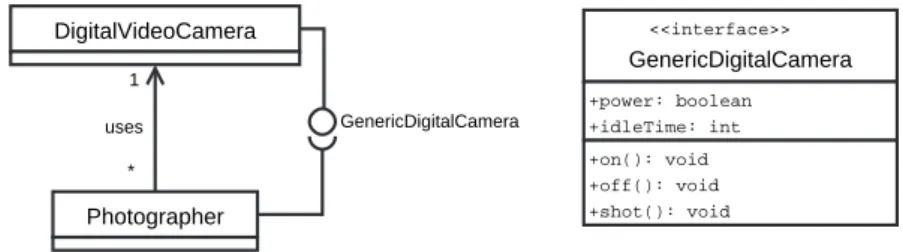
<<interface>> GenericDigitalCamera +power: boolean +idleTime: int +on(): void +off(): void +shot(): void DigitalVideoCamera Photographer GenericDigitalCamera 1 * uses
Figure 6. Digital Camera and Photographer system class diagram
Definition 4.2.5 (PreCond, PostCond, Invar) Let P be a Protocol State Machine and σ ∈ EvTraces(P ) be an
event trace. PreCond(P, σ) is the set of the last
pre-conditions that must have been verified to complete σ;
PostCond(P, σ) (resp. Invar(P, σ)) is the set of
postcondi-tions (resp. invariants) that must be verified after the trace
σ and defined as follows:
PreCond(P, σ) =def {p ∈ Pre | P
σ′;[p]ev
=====⇒, with σ= σ′; ev}
PostCond(P, σ) =def {p ∈ Post | P
σ′;ev/[p]
=====⇒, with σ= σ′; ev}
Invar(P, σ) =def Inv(s′A) with P σ
=⇒ P′and
P′= hS, Sis, L ,−→, s′Ai
4.2.1 Conformance relation
These traces, action and refusal sets, guide us to define a conformance relation, in a similar way to that already de-fined for LTS and IOTS.
Definition 4.2.6 (Event conformance) Let P and P′be two
protocol state machines
P′eco P if, for each σ∈ EvTraces(P ),
ref(P′, σ) ⊆ ref(P, σ)
and PreCond(P, σ) ² PreCond(P′, σ)
and ¡PostCond(P, σ)
∪ Invar(P, σ)¢ ²
PostCond(P′, σ) ∧ Invar(P′, σ)
Thus we ensure that when preconditions are strength-ened, the resulting postconditions and invariants are also strengthened.
It defines a relation that captures a kind of behavioral substitutability between ProSMs. This conformance rela-tion takes into account both events sequences and logical properties (constraints). Verifying this relation is a means to deal with ProSMs refinement and thus to support incre-mental design of ProSMs.
5. Example
To illustrate the usage of theeco relation in an incremen-tal design process, we propose incremenincremen-tal design process, we propose to study a simple case of incremental st to study a simple case of incremental step. We consider a basic dig-ital camera interface offered by a digdig-ital video camera and used by a photographer. A first class diagram is given in figure 6. We consider two attributes:
• poweris a boolean which indicates the power status of the camera.
• idleTimeis an integer representing the duration (in seconds for example) of inactivity before automati-cally entering in idle mode.
5.1
First step
At this stage, thePhotographercan only call three methods. This first step is very abstract and just models the basic usage/service of a digital camera, typically:
Switching on→ Shooting → Shooting → . . . → Switching off
A ProSM of this service is proposed in figure 7, with invariants and a timed transition in addition. We call this ProSM PCam. on() off() Idle [power=false] Operate [power=true] after(idleTime) shot()
Figure 7. First ProSM for generic video
cam-era: PCam
5.2
Second step
In this second stage, we precise the definition of the ser-vice with new methods and attributes. the resulting class
on() off() Idle [power=false] after(idleTime) ViewMode [display=true && power=true] BlindMode [display=false && power=true]] Setup [power=true] disp() disp() menu() menu() shot() shot() off() off()
Figure 8. FlatPCam′. on() off() Idle [power=false] Operate [power=true] after(idleTime) ViewMode [display=true] BlindMode [display=false] Setup disp() disp() menu() menu() shot() shot()
Figure 9. Second RefinedProSMfor generic video camera.
diagram of the interface is slightly different (see figure 10). We add:
• The attributedisplay, a boolean used to differenti-ate view mode and blind mode;
• The method disp(), to access and exit the setup mode of the camera;
• The method menu(), used to activate or deactivate display.
The ProSM PCam′ associated is exposed in figure 9. The newmenu()anddisp()methods are used to refine the service when the digital camera is operating. The refine-ment is done by adding nested states and transitions in the
Operatestate.
5.3
Conformance evaluation
First we have to transform PCam′into a flat ProSM. The
flat ProSM equivalent to PCam′is given in figure 8.
After that, we have to compute refusal sets of PCam and PCam′ on the event traces of PCam. To do this we have
to determine the traces set of PCam. This set is given as a grammar-like expression :
EvTraces(PCam) = Prefix((on(); shot()∗; off())∗)
wherePrefix(σ)), σ ∈ Ev is the set of the prefixes of σ
trace. Now we can examine refusal sets:
ref(PCam′,{on()}) = {on(), after(idleTime)} ref(PCam, {on()}) = {on()}
so ref(PCam′,{on()}) 6⊆ ref(P Cam, {on()}) and P Cam′eco P Cam
As a result, PCam′ is not event conform with PCam.
The reason is that from step1 to step2, the timed transi-tion labeled after(idleTime) has been moved from the composite state Operate to one of its nested states
BlindMode. The aim of this move is to model the fact that the auto power-off mode can only be activated when the dis-play is off. Consequently, aPhotographerdesigned to use a “step1” GenericDigitalCameramay be dead-locked in theViewModebecause he cannot know how to transit toBlindMode. In a finalized product, this kind of modeling error would cause a battery discharge. Generally, when refining, changing the source state of a transition to a nested state of the original source is a wrong refinement. This kind of error is detected with our relation.
6. Conclusion and future work
ProSMs differ sensibly from UML usual State Machines in the sense that they are more abstract (actions and
activi-<<interface>> GenericDigitalCamera +power: boolean +idleTime: int +display: boolean +on(): void +off(): void +shot(): void +menu(): void +disp(): void
Figure 10.GenericDigitalCameraservice: new class diagram.
ties are not detailed any more) but also that all the described behaviors are observable. Internal transition triggers cannot be used any more, since ProSMs describe the offered ser-vices and not a way it could be implemented. In order to define a conformance relation over ProSMs, abstraction is a real advantage, but the absence of internal transitions led us to adopt another point of view of the refinement notion.
For the first stages, we consider fully observable abstract non deterministic ProSMs: the refinement steps concern the reduction of nondeterminism. Indeed, for such stages, non-determinism is a very convenient means to formally specify a behavior which is not entirely known. Hence, like pre-vious conformance relations, the relation we defined over ProSMs reduces nondeterminism.
There is also a practical advantage of dealing with ProSMs rather than directly with State Machines. The ProSM language is very close to FTS (Fair Transition Sys-tems). FTS are defined with state invariants and logical con-ditions to trigger transitions. Since several studies and tools have been proposed for FTS [5], we can reasonnabily hope to realize a bridge between UML ProSMs and FTS at short time.
The main differences between ProSMs and FTS consist in the internal transition which can be directly used in FTS, and in the fact that FTS cannot be externally nondeterminis-tic. But refinement relations defined over FTS make a spe-cial use of the internal transition. It appears that a first way to translate ProSMs nondeterminism could be to use FTS internal transition.
References
[1] J.-R. Abrial. The B-Book: Assigning Programs to Meanings. Cambridge University Press, 1996.
[2] O. Gout and T. Lambolais. Construction incrmentale
de modles comportementaux UML. In J. Julliand,
edi-tor, AFADL’04, Approches Formelles dans l’Assistance au Dveloppement des Logiciels, pages 29–42, Besanon, June 2004. Translated as a Research Report ref.[RR05/001].
[3] D. Harel and M. Politi. Modeling Reactive Systems with Statecharts. The Statemate Approach. Computing McGraw-Hill, 1998. ISBN 0-07-026205-5.
[4] ISO/IEC-JTC1/SC21. Conformance Testing Methodology
and Framework, April 1989. DIS 9646.
[5] O. Kouchnarenko and A. Lanoix. Refinement and Verifi-cation of Synchronized Component-based Systems — Ex-tended version of the FM’03 article. Research Report, IN-RIA, June 2003.
[6] T. Lambolais and O. Gout. Using Conformance Relations to Help the Development of State-Machines. In IEEE, editor, ISSRE’04, International Symposium on Software Reliability Engineering, Saint-Malo, November 2004.
[7] V. Mencl. Specifying Component Behavior with Port State Machines. In F. de Boer and M. Bonsangue, editors, Pro-ceedings of the Workshop on the Compositional Verification of UML Models (CVUML, Oct 21, 2003, part of UML 2003), volume 101C, pages 129–153. Electronic Notes in Theoret-ical Computer Science, Nov 2004.
[8] OMG. OMG Unified Modeling Language Specification.
OMG formal/03-03-01, March 2003.
[9] OMG. OMG Unified Modeling Language Specification.
OMG Adopted Specification ptc/03-08-02, August 2003. [10] J. Tretmans. A Formal Approach to Conformance Testing.
PhD thesis, University of Twente, Enschede, The Nether-land, 1992.
[11] J. Tretmans. Repetitive Quiescence in Implementation and Testing (Extended Abstract). In A. Wolisz, I. Schiefer-decker, and A. Rennoch, editors, Formale Beschreibung-stechniken f¨ur verteilte Systeme, number Nr. 315 in GMD-Studien, pages 23–37, St. Augu, 1997. GI/ITG-Fachgespr¨ach, GMD.
[12] J. Tretmans and A. Belinfante. Automatic testing with for-mal methods. In EuroSTAR’99:7thEuropean Int. Confer-ence on Software Testing, Analysis & Review, Barcelona, Spain, November 8–12, 1999. EuroStar Conferences, Gal-way, Irelan.