HAL Id: inria-00371199
https://hal.inria.fr/inria-00371199
Submitted on 30 Mar 2009
HAL is a multi-disciplinary open access
archive for the deposit and dissemination of
sci-entific research documents, whether they are
pub-lished or not. The documents may come from
teaching and research institutions in France or
abroad, or from public or private research centers.
L’archive ouverte pluridisciplinaire HAL, est
destinée au dépôt et à la diffusion de documents
scientifiques de niveau recherche, publiés ou non,
émanant des établissements d’enseignement et de
recherche français ou étrangers, des laboratoires
publics ou privés.
Testing Peers’ Volatility
Eduardo de Almeida, Gerson Sunye, Yves Le Traon, Patrick Valduriez
To cite this version:
Eduardo de Almeida, Gerson Sunye, Yves Le Traon, Patrick Valduriez. Testing Peers’ Volatility.
23rd IEEE/ACM International Conference on Automated Software Engineering (ASE 2008), 2008,
L’Aquila, Italy, Italy. �inria-00371199�
Testing Peers’ Volatility
Eduardo Cunha de Almeida
∗, Gerson Suny´e
∗, Yves Le Traon
†and Patrick Valduriez
‡∗LINA - Universit´e de Nantes
Email:{eduardo.almeida, gerson.sunye}@univ-nantes.fr
†IT-TELECOM Bretagne,
Email: [email protected]
‡INRIA & LINA - Nantes,
Email: [email protected]
Abstract—Peer-to-peer (P2P) is becoming a key technology
for software development, but still lacks integrated solutions to build trust in the final software, in terms of correctness and security. Testing such systems is difficult because of the high numbers of nodes which can be volatile. In this paper, we present a framework for testing volatility of P2P systems. The framework is based on the individual control of peers, allowing test cases to precisely control the volatility of peers during execution. We validated our framework through implementation and experimentation on two open-source P2P systems. Through experimentation, we analyze the behavior of both systems on different conditions of volatility and show how the framework is able to detect implementation problems.
I. INTRODUCTION
A P2P system is composed of a volatile set of nodes, also called peers. Each peer can be a client and a server, as well as a router, since it can route incoming requests to other peers. Peers are autonomous, they can join and leave the system at any time, during the system lifetime. Such dynamic behavior distinguishes P2P systems from classical distributed systems. A P2P system must be able to work properly even though peers are highly volatile.
From the development point of view, a peer is an instance of a P2P application, which executes on a distinct logical node. Programming a peer is a difficult and error-prone task since it is part of a distributed system, with the classical synchro-nization issues, and it is programmed with various languages and platforms. P2P applications have two different interfaces, remote and local. The remote interface is used by other peers to request services through the network. The local interface is used by local applications to access the functionalities from the whole system. Samples of local applications are graphical user interfaces or applications that use the peer application as a middleware component.
A Distributed Hash Table (DHT) [1], [2] is an example of a P2P application, where each peer is responsible for the storage of values corresponding to a range of keys. It has a simple local interface that only provides three operations: value insertion, value retrieval and key lookup. The remote in-terface is more complex, providing operations for data transfer and maintenance of the routing table, i.e., the correspondence
Research partially supported by the Programme Alβan, the European Union Programme of High Level Scholarships for Latin America, scholarship no. E05D057478BR.
table between keys and peers, used to determine which peer is responsible for a given key. Testing these interfaces in a stable system is rather simple. However, testing that the routing table is correctly updated and that requests are correctly routed when peers leave and join the system requires a mechanism to simulate volatility and ensure that this simulation does not interfere with the test, i.e., that unanswered requests are not interpreted as faults. To our knowledge, no such mechanism exists to test system’s functionality together with its robustness to nodes volatility.
Some approaches for P2P testing propose to randomly stop the execution of peers [3], [4], or to insert faults in the network [5]. While these approaches are useful to observe the behavior of the whole system, they are not totally adapted for testing a P2P application. Since they focus on the tolerance to network perturbations, they fail in detecting software faults, especially those which occurs due to peers volatility. For instance, if one wants to test if a peer is able to rebuild its routing table when all peers it knows leave the system, then the random departure of peers is not precise enough. Increasing significantly the percentage of volatile peers is not desirable either since the high number of messages necessary to rebuild the routing tables from the remaining peers may interfere with the test.
In this paper, we present a framework for testing P2P systems that can combine the execution of functional tests to the simulation of volatility. The capabilities of this framework are (1) to automate the execution of each local-to-a-peer test case, (2) to build automatically the global verdict, (3) to allow the explicit control of each peer volatility. This framework does not address the issue of test cases generation but is a first element towards an automated P2P testing process. It can be considered analogous to the JUnit[6] testing framework for Java unit tests. The framework is composed of two actors, the coordinator and the testers. Testers are applications that execute in the same logical node as peers and control their execution and their volatility, making peers leave and join the system at any time, according to the needs of a test. Thus, the volatility of peers can be controlled at a very precise level. The coordinator is an independent application that dispatches test case actions to testers and stores the state of each peer, avoiding the interference of unavailable peers with the execution of test cases.
II. TESTINGP2P SYSTEMS
The classical architecture for testing a distributed system consists of a centralized tester which sends the test inputs, con-trols the synchronization of the distributed system and receives the outputs (or local verdicts) of each node of the system under test (SUT). In many cases, the distributed SUT is perceived as a single application and it is tested using its external functionalities, without considering its components (i.e., black-box testing). The tester in that case must interpret results which include non-determinism since several input/outputs orderings can be considered as correct.
Analyzing the specific features of P2P system, we remark that they are distributed systems, but the existing testing techniques for distributed systems do not address the issue of synchronization when a large number of nodes are involved. However, the typical centralized tester architecture can be reused for building a testing framework for P2P systems. Another issue that is not addressed by distributed system testing is the problem of node volatility. P2P systems must be robust and work even if peers are volatile (under limits which have to be determined). Volatility thus interferes with the system functionality and may cause failures to occur.
III. A FRAMEWORK FORTESTINGPEERVOLATILITY
In this section, we present a framework for testing P2P systems. First, we define the basic concepts. Then, we describe the components of the framework. Finally, we explain how the framework executes test cases.
A. Basic Concepts
As described in the previous section, one particularity of a P2P system is that its interface is spread over a network. Thus, even if all peers have exactly the same interface, testing the interface of a single peer is not sufficient to test the whole system. For instance, consider a simple test case for a DHT, where the string ”one” is inserted at key 1. Then, some data is retrieved at key 1. Finally, the retrieved value is compared with the string ”one” to assign a verdict to the test case. Clearly, this test case does not ensure that all peers will be able to retrieve the data stored in key 1. This is why we introduce the notion of distributed test cases, i.e., test cases that apply to the whole system and whose actions may be executed by different peers.
Let us denote by P the set of peers representing the SUT,
i.e., the P2P system. We denote by T , where |T | = |P | the
set of testers that controls the SUT, byDT S the suite of tests
that verifiesP , and by A the set of actions executed by DT S
on P .
Definition 1 (Distributed test case): A distributed test case
noted τ is a tuple τ = (Aτ , Tτ , Lτ , Sτ , Vτ ) where Aτ ⊆ A
is an ordered set of actions {aτ 0, . . . , a τ m}, T τ ⊆ T a set of testers,Lτ
is a set of local verdicts,Sτ
is a schedule and Vτ is a set of variables.
The Schedule is a map between actions and sets of testers, where each action corresponds to the set of testers that execute it.
Definition 2 (Schedule): A schedule is a mapS = A 7→ Π,
whereΠ is a collection of tester sets Π = {T0, . . . , Tn}, and
∀Ti∈ Π : Ti⊆ T
In P2P systems, the autonomy and the heterogeneity of peers interfere directly in the execution of service requests. While close peers may answer quickly, distant or overloaded peers may need a considerable delay to answer. Consequently, clients do not expect to receive a complete result, but the available results that can be retrieved during a given time. Thus, test case actions must not wait indefinitely for results, but specify a maximum delay for an execution.
Definition 3 (Action): A test case action is a tuple aτ
i =
(Ψ, ι, T′) where Ψ is a set of instructions, ι is the interval of time in which Ψ should be executed and T′ ⊆ T is a set of testers that executes the action.
The instructions are typically calls to the peer application interface as well as any statement in the test case programming language.
Definition 4 (Local verdict): . A local verdict is given by
comparing the expected result, notedE, with the result itself,
noted R. E and R may be a single value or a set of values
from any comparable type. The local verdict v of τ on ι is
defined as follows: lτ ι = pass if R = E f ail if R 6= E inconclusive if R = ∅
B. Test Case Example
Let us illustrate these definitions with a simple distributed test case. The aim of this test case is to detect errors on a DHT implementation. More precisely, it verifies that new peers are able to retrieve data that was inserted before their arrival.
Example 1 (Simple test case):
Action Testers Instructions (a1) 0,1,2 join() (a2) 2 put(14, ”fourteen”); (a3) 3,4 join(); (a4) 3,4 data := retrieve(14); (a5) 3,4 assert(data = ”fourteen”); (a6) * leave();
This test case involves five testers Tτ
= {t0. . . t4} that control five peers P = {p0. . . p4} and six actions A
τ
= {aτ
1, ..., a τ
6}. If the data retrieved in a4 is the same as the one inserted ina2, then the verdict ispass. If the data is not
the same, the verdict isf ail. If t3ort4are not able to retrieve any data, then the verdict is inconclusive.
C. Framework Components
The framework has two main components, the tester and the coordinator. The role of the tester is to execute test case actions and control the volatility of a single peer. The role of the coordinator is to dispatch the actions of a test case (Aτ
) through the testers (Tτ
) and maintain a list of unavailable peers. The UML diagram presented in Figure 1 illustrates the deployment of the framework: one coordinator controls several
Peer Application Tester
Coordinator
1 *
Fig. 1. Deployment Diagram
testers and each tester runs on a different logical node (the same as the peer it controls).
The tester component provides two interfaces, for action execution and volatility control:
1) execute(): executes a given action
2) leave(), fail(), join(): makes a set of peers leave the system, abnormally quit or join the system.
The coordinator component provides three different inter-faces, for action execution, volatility and test case variables:
1) register(), ok(), fail(), error(): action registration (per-formed before all tests) and response for action execu-tion, called by testers once the execution of an action is finished.
2) set(), get(): accessors for test case variables.
3) leave(), fail(), join(): makes a set of peers leave the system, abnormally quit or join the system.
D. Test Case Execution Algorithm
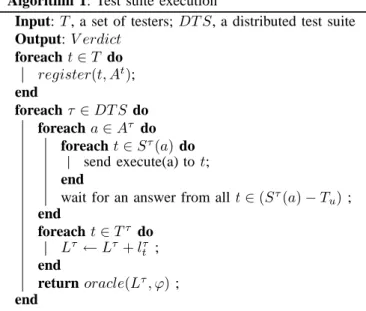
The algorithm has three steps: registration, action execution and verdict construction. Before the execution of a τ , each t ∈ T register its actions with the coordinator. For instance,
tester t2 may register the actionsA′ = {a1, a2, a6}. Once the registration is finished, the coordinator builds the schedule, mapping the actions with their related subset of testers. In our example, action a3is mapped to {t3, t4}.
OnceS is built, the coordinator traverses all test cases τ ∈ DT S and then the actions of each τ . For each action aτ
i, it uses S(aτ
i) to find the set of testers that are related to it and then sends the asynchronous message execute(ai)∀t ∈
Sτ
(aτ
i). Then, the coordinator waits for the available testers to inform the end of their execution. The set of available testers corresponds toSτ
(a) − Tu, whereTuis the set of unavailable testers. In our example, oncea1is finished, testers{t0, t1, t2} inform the coordinator of the end of the execution. Thus, the
coordinator knows that a1 is completed and the next action can start.
When a testert ∈ Tτ
receives the messageexecute(aτ n), it executes the suitable action. If the execution succeeds, then a messageok is sent to the coordinator. Otherwise, if the action
timeout is reached, then a message error is sent. Once the
execution of τ finishes, the coordinator asks all testers for
a local verdict. In the example, if t3 gets the correct string ”fourteen” in a5, then its local verdict is pass. Otherwise, it
is f ail. After receiving all local verdicts, the coordinator is
Algorithm 1: Test suite execution
Input:T , a set of testers; DT S, a distributed test suite
Output:V erdict foreacht ∈ T do register(t, At ); end foreachτ ∈ DT S do foreacha ∈ Aτ do foreacht ∈ Sτ (a) do send execute(a) to t; end
wait for an answer from allt ∈ (Sτ
(a) − Tu) ; end foreacht ∈ Tτ do Lτ ← Lτ + lτ t ; end returnoracle(Lτ , ϕ) ; end
able to assign a verdictLτ
. If any local verdict isf ail, then Lτ
is alsof ail, otherwise the coordinator continues grouping
each lτ t into L
τ
. When Lτ
is completed, it is analyzed to decide between verdictspass and inconclusive as described
in Algorithm 2. This algorithm has two inputs, a set of local verdicts (L) and an index of relaxation (ϕ), representing the
level of acceptableinconclusive verdicts. If the ratio between
the number ofpass and the number of local verdicts is greater
than ϕ, then the verdict is pass. Otherwise, the verdict is inconclusive.
Algorithm 2: Oracle
Input:L, a set of local verdicts; ϕ an index of relaxation
if∃l ∈ L, l = f ail then
returnf ail
else if|{l ∈ L : l = pass}|/|L|) ≥ ϕ then
returnpass
else
returninconclusive
end
IV. EXPERIMENTALVALIDATION
In this section, we present an experimental validation of our framework. This is based on an experiment that verify the routing table structure of two popular open-source DHTs: (i) FreePastry1: an implementation of Pastry [7], from Rice University; and (ii) OpenChord2: an implementation of Chord [2], from Bamberg University.
The routing table is a common structure, used in most implementation of structured P2P systems. It stores the neigh-borhood of a peer, i.e., the peers it must know to maintain the system underlying structure and (indirectly) access the rest of the system. Chord and Pastry have different approaches to
1FreePastry: http://freepastry.rice.edu/FreePastry/ 2OpenChord: http://open-chord.sourceforge.net/
update their routing table. While Chord uses an active process called stabilization, which periodically maintains the routing table, Pastry uses a lazy approach: the routing table is updated only when a peer communicates with its neighbors. In Chord, the components of a routing table are called successors.
For instance, in a Chord system with peers p0, p1, p3, and p6, the routing table of p1 stores the addresses of its successors,p3 andp6. If a new peerp4 joins the system, then
p1 will update its routing table with the address of p4. The update of the routing table happens every time a peer joins or leaves the system.
For our experiment, we implemented our framework in Java (version 1.5), and we use a cluster of 64 nodes3 running GNU/Linux. Each node has 2 Intel Xeon 2.33GHz dual-core processors with 4GB of memory. Since we can have full con-trol over this cluster during experimentation, our experiments are reproducible. The implementation and tests, produced for this paper and other P2P applications, can be found in our web page.4Yet, we allocate the peers equally through the nodes in the cluster. In the experiment reported in this paper, each peer is configured to run in its own Java VM.
A. Recovery from Peer Isolation
In this experiment, we test the ability of a peer to update its routing table. This test consists in the departure of all peers that are present in the routing table of a given peer p and in
the verification that this routing table is updated within a time limit. The test shows the ability of the framework to simulate and control the volatility of peers at a very precise level.
The test case has four actions. In the first one, the P2P system is created and a set of peers P joins the system. In
the second action, a peer p ∈ P (randomly chosen) stores the
contents of its routing table in the test case variableRT . In the
third action, the peers whose IDs are inRT leave the system.
In the fourth action, the routing table of p is periodically
analyzed within a delay. At the end of this action, the routing table ofp is analyzed a last time to assign a verdict. The values
of RT are compared with the updated routing table of p. If
the intersection of these two sets is empty, the verdict ispass.
We created a system of 64 peers. Indeed, creating a system with less than 64 peers can lead the test to aninconclusive
result because p may know all the peers which are removed
in the third action. In a larger system, the results would be similar since the update of the routing table is performed periodically. The test cases showed that both systems were able to update their routing table. While OpenChord updated its routing table in 4.32 sec., FreePastry needed 29.9 sec. A delay of 4 seconds was necessary to OpenChord to get a
pass verdict. This delay represents a unique execution of the
stabilization process (whose periodicity is set to 6 seconds). In the case of FreePastry, two calls of a ping method are needed to force the update of the routing table and get apass verdict.
3The clusters are part of the Grid5000 project: http://www.grid5000.fr/ 4Peerunit project, http://peerunit.gforge.inria.fr
V. CONCLUSION
In this paper, we proposed a framework for testing volatility of P2P systems. The framework is based on the individual control of peers, allowing test cases to precisely control the volatility of peers during tests. The execution of test cases is controlled by a coordinator, which ensures the correct synchronization of test case actions and avoid that volatility interferes with the execution of actions. The coordinator is also responsible for analyzing the results of test cases and for assigning their verdicts. We introduced the concept of distributed test cases, i.e., test cases that apply to several peers at the same time.
During the experiments, we focused on volatility testing and did not test these systems on more extreme situations such as performing massive inserts and retrieves or using very large data. Testing different aspects (concurrency, data transfer, etc.) would increase significantly the confidence on these systems. However, these tests are out of the scope of this paper. They could be performed through the interface of a single peer and would not need the framework presented in this paper.
Finally, the experiments exposed the need for a precise methodology for P2P testing, where the simplicity of interfaces contrasts with the complexity of the factors that can affect the test: volatility, number of peers, data size, amount of data, number of concurrent requests, etc. Thus, the difficulty of testing is not only in choosing the relevant input data, but also in choosing the factors that should vary, their values and their association.
REFERENCES
[1] S. Ratnasamy, P. Francis, M. Handley, R. Karp, and S. Shenkern, “A scalable content-addressable network,” ACM SIGCOMM, 2001. [2] I. Stoica, R. Morris, D. Karger, M. F. Kaashoek, and H. Balakrishnan,
“Chord: A scalable peer-to-peer lookup service for internet applications,”
ACM, 2001.
[3] G. Antoniu, L. Boug´e, M. Jan, and S. Monnett, “Large-scale deployment in P2P experiments using the JXTA distributed framework,” JXTA -jdf.jxta.org, Tech. Rep., 2004.
[4] L. Yunhao, L. Xiaomei, X. Li, N. Lionel, and Z. Xiaodong, “Location-aware topology matching in P2P systems,” IEEE INFOCOM, 2004. [5] W. Hoarau, S. Tixeuil, and F. Vauchelles, “Fault injection in distributed
java applications,” in 20th International Parallel and Distributed
Process-ing Symposium (IPDPS 2006), ProceedProcess-ings, 25-29 April 2006, Rhodes Island, Greece, 2006.
[6] Junit, “http://www.junit.org,” 2006.
[7] A. Rowstron and P. Druschel, “Pastry: Scalable, decentralized object location and routing for large-scale peer-to-peer systems,” in IFIP/ACM
International Conference on Distributed Systems Platforms (Middleware),