AVIS
Ce document a été numérisé par la Division de la gestion des documents et des archives de l’Université de Montréal.
L’auteur a autorisé l’Université de Montréal à reproduire et diffuser, en totalité ou en partie, par quelque moyen que ce soit et sur quelque support que ce soit, et exclusivement à des fins non lucratives d’enseignement et de recherche, des copies de ce mémoire ou de cette thèse.
L’auteur et les coauteurs le cas échéant conservent la propriété du droit d’auteur et des droits moraux qui protègent ce document. Ni la thèse ou le mémoire, ni des extraits substantiels de ce document, ne doivent être imprimés ou autrement reproduits sans l’autorisation de l’auteur.
Afin de se conformer à la Loi canadienne sur la protection des renseignements personnels, quelques formulaires secondaires, coordonnées ou signatures intégrées au texte ont pu être enlevés de ce document. Bien que cela ait pu affecter la pagination, il n’y a aucun contenu manquant.
NOTICE
This document was digitized by the Records Management & Archives Division of Université de Montréal.
The author of this thesis or dissertation has granted a nonexclusive license allowing Université de Montréal to reproduce and publish the document, in part or in whole, and in any format, solely for noncommercial educational and research purposes.
The author and co-authors if applicable retain copyright ownership and moral rights in this document. Neither the whole thesis or dissertation, nor substantial extracts from it, may be printed or otherwise reproduced without the author’s permission.
In compliance with the Canadian Privacy Act some supporting forms, contact information or signatures may have been removed from the document. While this may affect the document page count, it does not represent any loss of content from the document.
1,4-Diazepin-2-one Synthesis
Par
Hassan
Iden
Département de Chimie Faculté des Arts et Sciences
Mémoire présenté à la Faculté des Études Supérieures en vue de l'obtention du grade de
Maître ès Sciences (M.Sc.) En Chimie
Juillet, 2007 © Hassan Iden, 2007
Faculté des Études Supérieures
Ce mémoire intitulé:
1,4-Diazepin-2-one Synthesis
Présenté par:
Hassan Iden
A été évalué par un jury composé des personnes suivantes:
Président -rapporteur Membre du jury Directeur de recherche
Mémoire accepté le :
Professeur Keillor. Jeffrey W. Professeur Charrette. André B.
1 wish to express my sincere gratitude to my supervisor, Prof. William D. Lubell for
giving me the opportunity to be a member of his group. Thanks also for his help,
guidance and enthusiastic support during this work.
1 would to express my sincere gratitude to my old co-workers Simon Suprenant and
Dr Ramesh Kaul for pleasant times in the lab, helpful discussions and comments
concerning chemistry. To aIl present and former members of Lubell group, Wajih
Ben Tahar, Rui Wattanabe, Aurélie Dorr, Zhoreh Sajjadi, Nicolas Genest, Benoit
Jolicoeur, Yann BrouieIlte, Fabrice Galaude, Philipe Deaudelin, Tanya Godina,
Caroline Proulx, Carine Bourguet, Dr Suzan Seeaman, Dr Teresa Lama, Dr Gill
Fridkin, Dr Ramana Rao, Dr Mandar Boudas, Dr Karl Hansford, Dr Andrew
J amieson, Dr Nicolas Boutard, Dr David Sabatino, and Dr Tarek Kassem, for a
friendly and pleasant atmosphere.
1 wish to express my sincere gratitude to Mildred Bien Aimé for help with technical
issues, for enjoyable and interesting discussions concerning life and especially for
her human spirit.
1 would like to acknowledge the assistance of Françine Bélanger-Gariépy with
X-ray diffraction, Dalbir Sekhon for HPLC analysis, Dr Alexandra Furtos and Mrs
Karine Venne for mass spectral analysis, as weIl as the Natural Sciences and
Engineering Research Council of Canada (NSERC) and Fonds Québécois de la
Recherche sur la Nature et les Technologies (FQRNT), for tinancial support.
Last but not least 1 am grateful to my parents, for their love, support and
encouragement.
Résumé
Une stratégie efficace a été développée pour la synthèse de tours-y inverses, particulièrement pour la synthèse de 1,4-diazépin-2-ones et de 1,4-pyrrolodiazépin-2-ones. Ces tours-y ont été formés par couplage d'acides N-Boc-a-aminés et d'esters homo-~
aminés comme précurseurs chiraux facilement accessibles, comme décrit au Chapitre 2. Les cétones y,ù-insaturées, intermédiaires clés, ont été préparées par l'addition en cascade de bromure de vinylmagnésium sur les N-Boc-a-aminoacyl ~-aminoesters correspondants. Par la suite, les 1,4-diazépin-2-ones ont été obtenues par clivage des groupes protecteurs Boc, neutralisation des fonctions ammes résultantes et amination réductrice intramoléculaire. Ces intermédiaires clés cétones y,ù-insaturés ont été aussi employées dans des réactions d'oxydation d'alcènes, comme le procédé Tsuji-Wacker ou des réactions d' ozonolyse pour produire respectivement les 1,4-diones et 4-cétoaldéhydes correspondantes. Ces composés ont conduit aux 1,4-pyrrolodiazépin-2-ones correspondantes après clivage du Boc, neutralisation de l'amine et cyclisation de type Paal-Knorr. L'accès aux 1,4-diazépin-2-ones possédant un N-substitutant supplémentaire en position 1 est décrit dans le Chapitre 3. Les dérivée~ N-alkyl ~-propionate de méthyle ont été synthétisées par amination réductrice de quatre différents aldéhydes avec le ~-alaninate
de méthyle. Les réactions de couplage menées entre ces dérivés alkylés et la phénylalanine ainsi que la lysine, toutes deux protégées sur leurs fonctions amines par des groupements Boc ont conduit à un certain nombre de dipeptides. Les composés cétoniques ont ensuite été obtenus comme précédemment par addition en cascade de bromure de vinylmagnésium sur ces N-alkyl a-aminoacyl ~-aminoesters. Les 1,4-diazépin-2-ones 1,3,5-trisubstitutées possédant un N-substitutant en postion 1 ont alors été préparés de la même manière selon une séquence impliquant le clivage du groupement Boc, la neutralisation de l'amine et amination réductrice cyclisante. La présence de N-substituants provoque une accélération sensible de l'étape d'amination réductrice pour fournir les diazépin-2-ones 1,3,5-trisubstituées. Certains résultats préliminaires ont démontré que des 1,4-diazépin-2-one
disubstituées peuvent être obtenues à partir des dérivés trisubstitutés comportant un substituant acide labile avec de bons rendements.
Enfin, l'adaptation de cette méthodologie en phase solide a été menée en étudiant deux stratégies impliquant l'ancrage des substrats par une fonction amide, comme décrit dans le Chapitre 4. Les tentatives employant un linker de type mercaptoéthyle sur une résine polystyrène ont été infructueuses. Alternativement, une 1,4-diazépin-2one a pu être synthétisée en employant une résine aldéhyde de Wang suivant six étapes similaires à celles décrites au Chapitre 3. Le clivage final est effectué par traitement acide, tel que par le TFA, pour fournir un produit brut de haute pureté. Les conformations des tours occasionnées par ces 1,4-diazépin-2-ones ont été déterminées par diffraction de rayons X.
En résumé, ces travaux ont permis d'aboutir à de nouvelles méthodologies en solution et sur support solide permettant l'accès à des dérivés de type diazépin-2-one. Ces méthodologies peuvent de plus potentiellement conduire à des composés de plus grande diversité moléculaire en vue d'éventuelles applications thérapeutiques.
Mots clés: Tours-y, peptidomimétiques, cétone, résine amide, double addition de réactifs de Grignard vinyliques, antibiotiques.
Abstract
An efficient strategy has been developed for the synthesis of inverse y-tum mlmlCS, particularly 1,4-diazepin-2-one and 1,4-pyrrolodiazepin-2-one heterocyc1es. The tum mimics were assembled from the coupling of N-Boc-a-amino acids and homo-~-amino
esters as inexpensive chiral building blocks, as described in Chapter 2. The key intermediate y,ô-unsatured ketone was prepared by the cascade addition of vinyl Grignard reagent to the corresponding N-Boc-a-aminoacyl ~-aminoester. Subsequently, Boc group deprotection, amine neutralization and intramolecular reductive amination yielded the 1,4-diazepin-2-one skeleton. The key intermediate y,ô-unsatured ketone could also be employed in alkene oxidations by the Tsuji-Wacker process and by ozonolysis to respectively yield 1,4-diones and 4-ketoaldehydes, which upon Boc group removal, amine neutralisation and Paal-Knorr cyc1isation yielded 1,4-pyrrolodiazepin-2-ones.
Access to the 1,4-diazepin-2-one possessing an additional N-substituent at the I-position was achieved as described in Chapter 3. Methyl N-alkyl ~-aminopropionate derivatives were synthesized by reductive amination of the imine generated from methyl ~-alaninate
and four different aldehydes. Dipeptide formation followed by addition of vinyl Grignard reagent to the N-alkylated a-aminoacyl ~-aminoester yielded y-ô-unsatured ketone. Trisubstituted-l,4-diazepin-2-ones possessing a I-postion N-substituent were the~ prepared by an analogous Boc deprotection / amine neutralisation / reductive amination sequence. The additional N-alkyl substituent caused a noticeable acceleration in the reductive amination step to provide the 1,3,5-trisubstituted diazepin-2-ones. Preliminary results demonstrated that disubstituted 1,4-diazepin-2-one can be made from the trisubstituted analog bearing acid labile N-substituent in good yield.
Finally, the adaptation of our solution-phase methodology to solid phase was pursued studying two different backbone amide linker strategies, as discussed in Chapter 4. Attempts were unsuccessful in employing a mercaptoethyl linker on polystyrene resin. Altematively, 1,4-diazepin-2-one was synthesized on Wang aldehyde resin by a 6-step process similar to that described in Chapter 3 featuring c1eavage from the resin by treatment
with acid, such as TFA, to provide the crude product ofhigh purity. The tum conformations of 1,4-diazepin-2-ones were determined by x-ray structures analysis.
In summary, this thesis has provided new methodologies for making diazepin-2-one derivatives using solution and sol id-phase chemistry and offers potential for synthesizing such y-tum mimics for future studies in peptide science and medicinal chemistry.
Key Words: y-tum, peptidomimetics, y-ô-unsaturated ketone, 1,4-diazepin-2-one, backbone amide linker, cascade addition of vinyl Grignard reagent, antibiotics.
Table of contents
Acknow ledgments ... .i
Résumé ... '" ... .ii
Summary ... iv
Table of Contents ... vi
List of Figures ... " ... .ix
List of Tables ... x
List of Schemes ... xi
List of Equations ... xiii
List of Abbreviations ... xiv
Chapter 1: Introduction 1.1 Peptides as Drugs ... 2 1.2 Peptidomimetics ... 4 1.2.1 Side-Chain Modifications ... 5 1.2.2 Backbone Modification ... 5 1.2.3 Restriction by Cyclization ... 6
1.2.4 Secondary Structure Mimetics ... 7
1.3 y-tum ... '" ... 7
1.4 l,4-Diazepinones and Pyrrolodiazepinones ... 9
1.5 Diazepinone Synthesis ... 12
1.5.1 Diazepinones Synthesis by Lactam Formation ... " ... 13
1.5.2 Diazepinones S ynthesis by Mitsunobou Cyclisation ... 15
1.5.3 Diazepinone Synthesis byParrallel approaches ... 15
1.5.4 Diazepinone Library ... 17
1.5.5 1,4-Diazepinones Synthesis By Ring Expansion ... 18
1.5.6 Pyrrolodiazepinones Synthesis ... 21
1.5.7 Solid-Phase Syntheis of Diazepinones ... 21
1.7 References ... 26
Chapter 2: 1,4-Diazepinone and Pyrrolo-Diazepinone Syntheses via Homoallylic Ketones from Cascade Addition of Vinyl Grignard Reagent to a-Aminoacyl-p-amino Esters 2.1 Abstract ... 31
2.2 Introduction ... 31
2.3 Results and Discussion ... 34
2.4 Conclusions ... 41
2.5 Acknowledgment. ... 41
2.6 Supporting Information Available ... .41
2.7 Experimental Section ... 42
2.8 References ... 61
Chapter 3: 1,3,5-Trisubstituted 1,4-Diazepin-2-ones 3.1 Abstract ... 65
3.2 Introduction ... 65
3.3 Results and Discussion ... 69
3.4 Conclusions ... 72
3.5 Acknowledgments ... 72
3.6 Experimental Section ... 73
3.7 References ... 89
Chapter 4: Concluding Statements and Future Work 4.1. Introduction ... 93
4.2. Attempted Solid-phase Synthesis of 1,Diazepin-2-one using Thioethyl and 4-Alkoxybenzyllinker. ... 97
4.3 Conclusion and Perspectives ... 104
4.5 References ... 109
Chapter 5: Conclusion
5.1 Conclusion ... 112 5.2 Reference ... 113
Appendix 1
List of Figures
Chapter 1
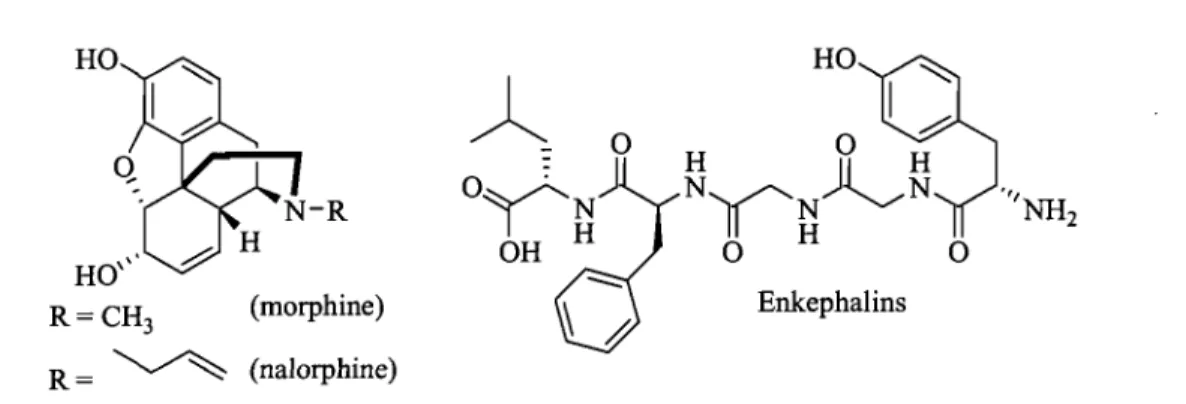
Figure 1.1 Morphine (opiate agoni st) 1 and nalorphine (opiate antagonist) 1 compared with enkephalins 2.
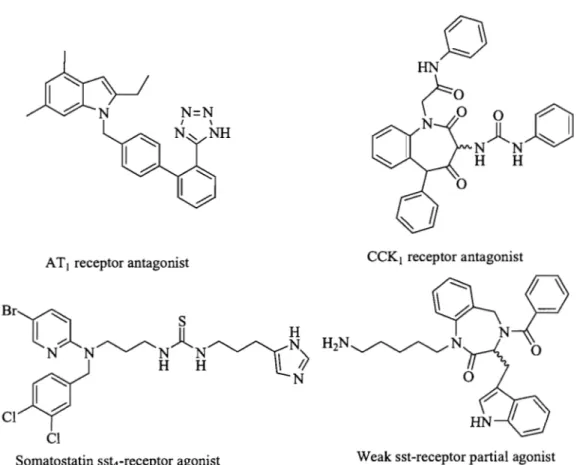
Figure 1.2 Examples of non-peptide agonists and antagonists
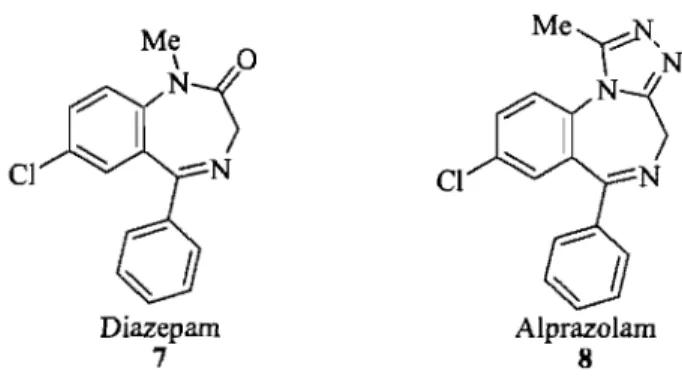
Figure 1.3 Classic and inverse y-tums with their corresponding angles Figure 1.4 Examples of heterocyc1ic and peptide y-tum mimetics Figure 1.5 Structure of diazepam and alprozalam
3
4
8 8 10
Figure 1.6 Structural relationship between pyrrolodiazepinone, 1,4-diazepin-2-one and
benzodiazepine Il
Figure 1.7 Examples of l,4-diazepinones and 1,4 pyrrolodiazepinones 12
Chapter 2
Figure 2.1 Representative 1,4-diazepin-2-one and pyrrolo-diazepinone systems and related
biologically active structures
33
Figure 2.2 X-ray diffraction structures of compounds 95c (upper) and 95d 36
Chapter 3
Figure 2.3 Dîmer 100 40
List of Tables
Chapter 1Table 1.1 The most frequent modifications of the peptide backbone
Chapter 2
Table 2.1 Yields of isolated product in the synthesis of 95
Table 2.2 Yields ofisolated product in the synthesis of98 and 99
Chapter 3
Table 3.1 Product Yields
6
35 38
List of Schemes
Chapter 1
Scheme 1.1 Diazepinone synthesis by lactam formation
Scheme 1.2 1,4-Diazepin-2-one synthesis by Mitsnubou cyclization Scheme 1.3 Synthesis of N,N-dimethyll,4-diazepin-2-one 33 Scheme 1.4 Synthe sis of l-substitued 1,4-diazepin-2-one 37
Scheme 1.5 General synthesis oflibrary of 1,4-diazepin-2-one 1.43
Scheme 1.6 Synthesis of 1,4-diazepin-5-ones 47 by azido-Schmidt reaction
Scheme1.8 Synthesis of 1,4-diazepin-5-ones by ring expansion and intramolecular
14 15 16 17 18 19 transamidation 20
Scheme 1.8 Pyrrolodiazepinones synthesis 21
Scheme 1.9 1,4-diazepin-3-one synthesis on solid support 22 Scheme 1.10 Solid phase syntheis of diazepinones by ring expansion 22 Scheme 1.11 Diazepin-2-one library generation by solid-phase synthesis 23 Scheme 1.12 General Methodolgy for making diazepinone and pyrrolodiazepinone 24 Scheme 1.13 General methodology for making diazepinone and pyrrolodiazepinone using
Chapter 2
Scheme 2.1 Synthesis of Diazepinones 95 35
Scheme 2.2 Synthesis ofPyrrolodiazepinones 98 and 99 38
Chapter 3
Scheme 3.1 1,3,5-Trisubstituted diazepin-2-one synthesis 69
Chapter 4
Scheme 4.1 Synthesis of l,4-benzodiazepine derivatives using germanium-linker 94
Scheme 4.2 Synthesis oftetrahydro-l,4-benzodiazepin-2-one by intramolecular 7-exo-trig
cyclization 95
Scheme 4.3 1,4-benzodiazepin-2,5-dione synthesis using 2,4,6-trialkoxy benzyllinker 96
Scheme 4.4 Proposed approach for the solid-phase synthesis of 1,4-diazepin-2-one
employing thioethyllinkers 98
List of Equations
Chapter 3
Equation 3.1 4-Benzyloxybenzylamide c1eavage under acidic conditions 71
Chapter 4
[a]D
Ac anhyd A aq Arg Ar Bn or BzI Boe Bop Bu t-butyl bp br Bz Cbz CNS m-CPBA Cys d dd DAbbreviations
optical rotation acetyl anhydrous alanine aqueous arginine aryl benzyl tert-butoxycarbon yI(l-benzotriazolyl)oxy tris(dimethylamino) phosphonium [PF6]
but yI t-butyl boiling point broad (spectral) benzoyl benzyloxycarbonyl central nervous system meta-chloroperbenzoic acid cysteine
doublet
doublet of doublet aspartic acid
DBU DEAD DCC DIC orDIPC DIPEA DMF DMPU DPPA EADC ee Fmoc G Glu h HATU HOBt HRMS IBCF IR J LDA LHMDS 1 ,8-diazabicyclo[ 5.4.0]undec-4-ene diethyl azodicarboxylate dicyclohexyl carbodiimide 1,3-diisopropylcarbodiimide diisopropyleth ylamine N,N-dimethylformamide N,N-dimethylpyrrolidinone diphenyl phosphoryl azide
ethyl aluminium dichloride enantiomeric excess 9-fluorenylmethyloxycarbonyl guanine glutamic acid hours O-(7-azabenzotriazole-l-yl)-1,1,3,3-tetramethyluronium hexafluorophosphate I-hydroxy IH-benzotriazole high-resolution mass spectrometry isobutyl chloroformate
infrared
coupling constant
lithium diisopropylamide lithium hexamethyldisilazane
LHMDS lithium hexamethyldisilazane lit. literature Il micro m multiplet (spectral) M molar Me methyl mg milligram mm minutes MHz megahertz mL millilitre mmol millimole mp melting point MS mass spectrometry MW molecular weight N asparagine
NMR nucIear magnetic resonance
NMM N-methylmorpholine
PCC pyridinium chlorochromate
Ph phenyl
ppm part per milliom
Rf retention factor (in chromatography)
s singlet
t triplet
Tf OH THF
TLC
Trt orTr Ts triflie aeid tetrah ydrofuranthin layer chromatography trityl
CHAPTERI
1.1 Peptides as Drugs
Endogenous peptides and proteins such as the enkephalins, angiotensin II, bradykinin, cholecystokinin and insulin were shown to control many of the chemical and physiological processes in the human body. Most exert their biological function at specifie receptors, in particular seven transmembrane G-protein coupled receptors (GPCRS).1,2
Discovery of biologically active peptides and proteins with relevance in disease processes has led to the discovery of novel therapeutic targets, as weIl as probes for the development of new drugs.3 A significant increase over the last decade in the use of peptides as agonists and antagonists for the development of drugs has been observed. However, in most cases the use of native peptides as therapeutic agents has been limited due to poor pharmacokinetics, such as difficulty in crossing the blood-brain barrier, low uptake, poor oral administration, rapid metabolism and facile excretion. Furthermore, the flexibility of the peptide may also reduce receptor specifity.4,5,6,7 Significant efforts have been committed to the design and synthesis of non-peptidic molecules which display pharmacologie al activity like the native peptides at their receptors to avoid the above problems. These non-peptidic compounds are referred to peptidomimètics.
HO
HO'" R = CH
3 (morphine)
R= ~ (nalorphine)
Figure 1.1 Morphine (opiate agoni st) 1 and nalorphine (opiate antagonist) 1 compared with
enkephalins 2.
An example of peptide mimicry is that of morphine, which acts as a non-peptide agoni st producing a similar agonist effects and binds to the same receptor family compared to the corresponding endogenous peptide enkephalins (Fig 1.1). The possible structural relationship between the morphine skeleton and enkephalins remains unknown.8 Morphine and related opioids remained the only examples of non-peptide agonists at peptide receptors for an extended period of time. It is only in the past few years that other examples of non-peptide agonists or antagonists at non-peptide receptors have been reported (Fig. 1.2).9
AT 1 receptor antagonist Br~ S
~._A
)l
H N/. N~N N~N"Jj
H Hli;
~ N Ih-Cl ClSomatostatin sst4-receptor agoni st
CCK1 receptor antagonist
~-P~
lr1
-H2N~N
N 0Weak sst-receptor partial agonist
Figure 1.2 Examples of non-peptide agonists and antagonists.1O
1.2. Peptidomimetics
Peptidomimetics are valuable research tools for the study of molecular recognition by structure-activity relationship (SAR) investigations.8,1I Constrained structures that mimic
the bioactive conformation of a peptide may be more resistant to enzymatic cleavage and exhibit enhanced selectivity compared to the linear flexible peptide.8,12
Peptidomimetics can be c1assified into three types:
Type 1: Mimetics which match the peptide backbone. These are peptides which are modified by an amide bond isosteres.
Type II: Small nonpeptidic molecules that bind to a peptide receptor or enzyme.
Type III: Nonpeptidic molecules unrelated to the original peptides which may be considered as ideal mimetics containing the functional groups necessary to serve as topographical mimetics.13 Several approaches have been described for the development of peptidomimetics, sorne ofthem are listed below.
1.2.1. Side-Chain Modifications
The incorporation of amino acids with side chains that do not occur naturally in peptides and pro teins may introduce special functional groups, restrict peptide flexibility and increase metabolic stability.14 Such single residue modifications inc1ude enantiopure N-alkyl and Ca-diN-alkyl amino acids. For example [l-deamino, D-arg8] vasopressin (DDAVP)
is a modified peptide used as a selective antiduretic agent suitable for the treatment of diabetes insipidus.6
1.2.2. Backbone Modification
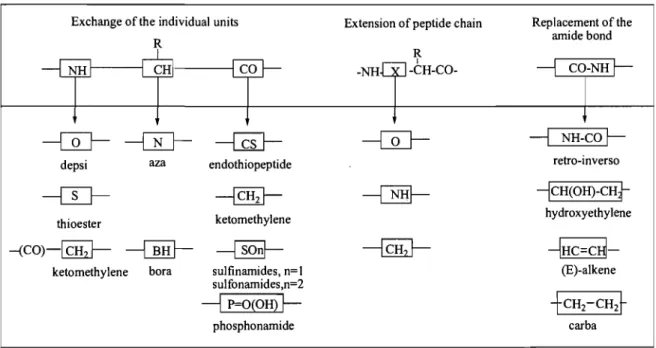
In addition to the backbone modifications caused by single residue substitutions, the replacement of peptide bonds by non-peptide analogs has also been utilised to modify the backbone of peptides. Such isosteric replacements inc1ude substitution of the amide by hydroxyethylene, vinyl ester and amine moieties, as well as the replacement of the
u-carbon by nitrogen in azapeptides or by a BR group in borapeptides. The most general modifications are listed in Table 1.1.
Exchange of the individual units Extension of peptide chain Replacement of the
R amide bond
R
1
---1
CO-NHr-NH ~ ~O -NH
-CH-CO---ŒJ-
---{il----{ru-
--ŒJ-
---1
NH-COr-depsi aza endothiopeptide retro-inverso
----ITJ----
~---Œffi----
-lCH(OH)-CH}thioester ketomethylene hydroxyethylene
-(CO)-[lliJ- ----G!!}- ~
----{Qhl-
~HC=CH-ketomethylene bora sulfinamides, n=1 (E)-alkene sulfonamides,n=2
---1
P=O(OH) ~ +CH2-CH2t
phosphonamide carba
Table 1.1 The most frequent modifications of the peptide backbone.' ,
1.2.3. Restriction by Cyc1ization
Global restrictions in the conformation of a peptide may be achieved by backbone cyc1ization. Cyc1ic peptides may possess relatively rigid conformations, decreased molecular volume, increased metabolic stability, superior bioavailability and higher cell-permeability.'4
1.2.4. Secondary Structure Mimetics
The secondary structure of a protein refers to the folding of local regions into energy-minimum conformations that are stabilized by non-covalent bonds such as hydrogen bonds and hydrophobic interactions. Hydrogen bonds are formed between the NH group (hydrogen bond donor) and the carbonyl oxygen atom (hydrogen bond acceptor) of peptide amide bonds. Common secondary structural motifs inc1ude the: a-helix, ~-sheet, and tum conformations. Incorporation of such a moiety will provide additional information about the condition of receptor binding and activation. Secondary structures such as tums are often essential components for peptide and prote in biology because they are often located on the prote in surface and act as molecular recognition sites. 10,14,15
1.3.
y-
Turn
The y-tum is a secondary structure that contains three amino acid residues connected by amide bonds. In the y-tum a hydrogen bond may exist between the backbone carbonyl of the first residue (i) and the amide NH of the third residue (i+2), to form a seven-membered ring (Fig 1.3). The y-tum has been c1assified into two families, contingent on the dihedral angles (~and\lf), of the central amino acid residue (Fig 1.3).16-21
Classic ~i+ 1 700 to 850 'JI i+ 1 -600 to -850 Inverse _700 to -850 700 to 850
Figure 1.3 Classic and inverse y-tums with their corresponding angles.
The inverse y-tum is found more frequently than the classic y-tum. The inverse y-tum does not give rise to chain reversaI in proteins, inverseIy to the classic tums. y-Tums are rare in proteins, however, they are often found in sm aIl cyclic peptides (Fig 1.4).16,18
:~:NHTrt
}-O~
o
3 H MeMe'(}o
Ph~H
N CONH2 Mpa-Tyr-N ~ H 0T~~
HN 0 H2NCO'-.\\\.yc s-Pro-D-Arg-Gly-NH2o
Me 5 6y-Tums have been shown to play important roles in the control of local peptide conformations and also in biological recognition.22 For example, the y-tum present in the RGD (Arg-Gly-Asp) sequence of vitronectin was found to contribute to the specific recognition of integrin receptor av~3.25 Several linear and cyclic peptides that exhibit biological activity such as bradykinin, cyclosporin, vasopressin and the cyclic somatostatin analogues have been shown to adopt y_tumS.24,26
Sorne of these molecular scaffolds have been incorporated into biologically active peptides to study the relationship between conformation and activity. For example, the incorporation of an inverse y-tum in place of residues 3-5 in the peptide hormone oxytocin produced an analog that did not induce contractions of the uterine tissue nor did it act as an inhibitor of oxytocin-induced contractions.27 However, the incorporation of 2-oxo piperidines as y-tum mimetics into the bradykinin sequence produced an analog with an activity similar to bradykinin and so this supported the presence of a reverse y-tum in the bioactive conformation of this peptide.24
1.4. 1,4-Diazepinones and Pyrrolodiazepinones
The benzodiazepines (BZDs), which include the diazepam better known as Valium® 7 and alprozalam 8 (Fig 1.5) are an important class of drugS.28 Benzodiazepines exhibit different therapeutic applications such as antitumor antibiotic, muscle relaxant, HIV Tat antagonist, hypnotic and anxiolytic activities, due to their potential to mimic peptide secondary structures such as y- and ~- tums.29 Benzodiazepines are known to exert their broad
pharmacological effects through specific binding to a subunit on the y-aminobutyric acid which acts on the y-aminobutyric acid-A chloride ion channel (GABAA) receptor.30
Furthermore, it has been suggested that benzodiazepines, such as diazepam, may be peptidomimetics of endogenous peptide endozepines which are single-chain polypeptides of 86 residuesY The seven-membered ring in a benzodiazepine can be formed as acyclic dipeptide.32 Cl Diazepam 7 Alprazolam 8
Figure 1.5 Structure of diazepam and alprozalam.
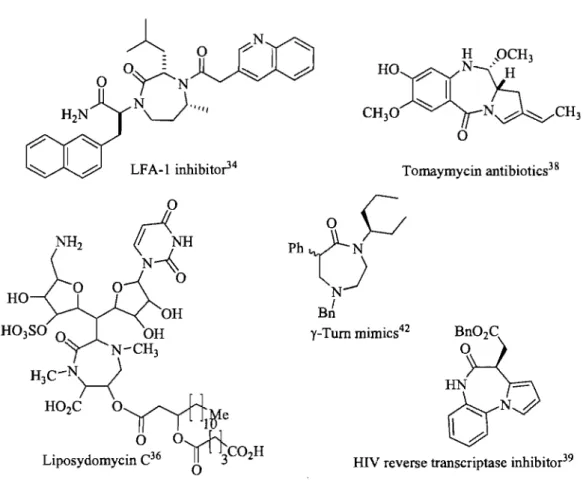
1,4-Benzodiazepine heterocycle fused diazepine derivatives such as 1,4-diazepinone and pyrrolobenzodiazepinone derivatives (Fig 1.6) have exhibited widespread biological activities.33 Examples have been reported for 1,4-diazepinones that act as inhibitors of the lymphocyte function-associated antigen-l (LF A -1 )34 and as anticonvulsant agents.35 The
diazepinone system is also present in the liposidomycin nucleoside antibiotics which inhibit bacterial peptidoglycan synthesis.36 Furthermore, 1,4-diazepinone derivatives have been incorporated into peptides as constrained dipeptide mimetics.37
Ph
cC}
/ 0Pyrrolodiazepinone 1,4-Diazepin-2-one Benzodiazepine
Figure 1.6 Structure relationship between pyrrolodiazepinone, 1,4-diazepin-2-one and benzodiazepine.
The pyrrolobenzodiazepines (PBDs) are a group ofnaturally occurring antibiotics produced by diverse Streptomyces species, which include the anthramycin family, that contain a pyrrolobenzodiazepine structure.38 Synthetic pyrrolobenzodiazepines analogs have inhibited non-nucleoside reverse transcriptase.39 Activity was also demonstrated against various leukemia celllines40 and as CNS antidepressants41 (Fig 1.7). The seven-membered 1,4-diazepinone ring adopts a y-tum conformation,42,43 as supported by X-ray diffraction.44
LFA-l inhibito?4 Tomaymycin antibiotics3&
o
r,NH
N~
o
HOHIV reverse transcriptase inhibitor39
Figure 1.7 Examples of 1,4-diazepinones and 1,4 pyrrolodiazepinones.
1.5. Diazepinone Synthesis
The synthesis of diazepinone ring systems has attracted considerable interest in developing probes for studying structure-activity relationship of biologically relevant receptors. There are a variety of approaches for the synthesis of diazepinone ring systems. 1,4-Diazepinones have been synthesized through head-to-tail cyclization of the terminal amine and carboxylic acid moieties of a linear dipeptide consisting of an a-amino and p-amino acid, using an activating agent.
1.5.1 Diazepinones Synthesis by Lactam Formation
Trisubstituted 1,4-diazepin-3-one was synthesized for use as a novel constrained dipeptide scaffold (Scheme 1.1, synthe sis 1). The synthesis began from readily available N-protected homo serine lactone 10. Ring opening of lactone 10 by aminolysis generated the primary alcohol 11 which was oxidized to the corresponding aldehyde 12 using pyridinium chi oro chromate (PCC) in the presence of silica gel. The reductive amination of aldehyde 12 with t-butyl-(S)-phenylalaninate using sodium cyanoborohydride in methanol afforded the secondary amine 13. Acylation of the secondary amine 13, followed by Boc removal and lactam formation yielded 1,4-diazepinone 15. This acylation of the secondary amine 13 resulted in a mixture of isomers, generated by the GÏs-trans isomerisation around the acetylated tertiary amide bond. A closely related synthesis of diazepinone 15, was accompli shed from N-protected aspartic acid 16, using similar protocols featuring a reductive aminationllactam cyclization sequence (Scheme 1.1, synthesis 2). The yield obtained for diazepinone 21 was low and several side products were obtained in the last step of the synthesis.37 1,4-Diazepin-2-one has been prepared in enantiomerically enriched form as a constrained peptide mimic from chiral BocGlu(Obzl)OH 22. Methylation, debenzylation and modified Curtius reaction yielded diamino acid 23. Boc removal, N-tosylation and N-alkylation followed by t-butyl removal and lactam formation gave 1,4-diazepin-2-one 25 in moderate yieid (Scheme 1.1, synthesis 3).45
Synthesis 1 Htl'O H,
1'0
HC1.H2N~ -O 76% (t-Bu-OCOhO, Et3N DMFt-Bu-OCOH2N~
o 10 MezNH EtOH-THF 70% 9 PCC/silica gel [ DCM •1
NM~]
HCI t-Butyl (S)-Phenylalaninet-BU-OCOH2~/~
_N_a_C_NB_H_3_, A_c_O_H_-_M_e_O_H _ _ _o
12 54% for two step
O\~n~./H
1 \ 1) TFA in DCM
AC20, i-Pr2NEt, DMAP
chloroform t-BuO ACN~ H, NMe2 _ _ _ _ 2) (PhOhP(0)N3' NaHC03 D_Mf _ _ _ _ _
t-Bu-OCOH2N 79% 14 0 80% Synthesls 2 OH 1) t-Bu-OCOCI, Et3N
~
C02H THFH, , O-t-Bu ..;;2;.:.).:.N;:;;aB:;;,H=4 • ..:,H::.;.20.::::-_ _ H, ,,) O-t-Bu
BnOCOHN~
PCC/silica gel DCM BnOCOHNo 67% o
16
0p<H
17
HCI t-Butyl (S)-Phenylalanine
NaCNBH3, AcOH-MeOH H" O-t-Bu
BnO HN~ HC02-NH/, 10 % PdlC MeOH-AcOH-H20 BnOCOHN 19 0 97% 67% H Bn 0
1--f
HN NH~,
.. t..
-O-t-Bu 21 H"Tr
HATU, I-Pr2NEt, DMF 40% Synthesis 3 BocGlu(OBzl)OH 22 o1) IBCF, Et3N, MeOH 2) H2' Pd(OH)2' EtOH 3) DPPA, Et3N. PhCH20H 50%overal1 W (NH3+Sr" DMF MeO~ 0
TSN~OH
24 50% o )l /"... ,NHZ MeO'l "-/
NHBoc 23 o MeOÂ(\NH Ts" .... N~ 2S 0 l)TFA 2)TsCl 3) BrCH2C02tBu, CHlCN 18-C-6, K2C03 4) AcOH. TFA 78% overall1.5.2 Diazepinones Synthesis by Mitsunobu Cyclisation
Racemic 1,4Mdiazepin-2-one has been prepared as a constrained peptide mimic starting
from N-Boc-allylamine 26. Dipolar cycloaddition afforded isoxazolidine 27. Ring opening N-acylation yielded the linear precursor 29. Intramolecular cyc1ization of 29 was then accomplished under Mitsunobu conditions for the alkylation of sulfonamide 29 to afford 1,4-diazepin-2-one 30. The cyclization of a tertiary amide was essential for ring formation.
BocHN~ 26 30-82% RI = H, CH2Ph, CH) 78-94% BocHNy.-o, ~N-Rl 27 RI R2
BOCHN~~0NHTS
OH 0 29 R2 = CH), CH2Ph CH20CH2Ph, CH2CH(CH3h 79-99% 1) PPh), DEAD 2)TFA,DCM 0-97% H BOCHN~N'RI OH 28Scheme 1.2 1,4-Diazepin-2-one synthesis by Mitsnubou cyc1ization.45
1.5.3 Diazepinone Synthesis by Parallel Approaches
The liposidomycins are a family of nuc1eoside antibiotics with complex structures composed of three portions: a diazepinone moiety, an aminopentose moiety and a lipid portion. There have been different procedures describing the synthesis of the diazepinone moiety with the aim of developing liposydomycins analogs as new antibacterial drugs that inhibit the enzymes responsible for the biosynthesis of bacterial peptidoglycan.
Formation of the N,N-dialkyl diazepinone 33 core was accomplished by a one-pot synthesis featuring heating a mixture of N,N-dimethylpropane-1,3-diamine 31 and the sodium bisulfite adduct of glyoxal 32 at reflux in toluene (Scheme 1.3). This approach was later abandoned because of the harsh conditions employed that led to epimerization and e1imination in the case of more substituted diazepinone.
NaHC03aq, toluene, reflux
40%
32 33
Scheme 1.3 Synthesis of N,N-dimethy11,4-diazepin-2-one 33.
The 7-substitued 1,4-diazepin-2-one 37 was later prepared by a synthetic route featuring annulation by reductive amination (Scheme 1.4). N-Boc-sarcosine ethyl ester 34 was converted to its lithium enolate, alkylated with ally1 iodide, N-deprotected then acylated with N-(Cbz)-sarcosine to afford dipeptide 36. Oxidative cleavage of the olefin gave aldehyde 37, which was hydrogenated to remove the Cbz group allowing intramolecular iminium ion formation and reductive amination to yield diazepinone 38.
o CH3
)~N,
EtO CO2-t-Bu 1) LDA, THF, -78 oC 2) Allyl idodide, -20 oC 34 84% overall)O~~~3
EtO COrtBu 1 35 1) TFA/DCM 2) N-Cbz-sarcosine DIPC, HOBt, DCM 76% overall o CH3 _ _ _ _ _ _ _ .. Et°5-)=N CH o 3 EtOH)NYNO_CH H2' Pd-C, MeOHl~
~
67% from36 36 1 3 H3C o C02Bn 37 38Scheme 1.4 Synthesis of l-substitued 1,4-diazepin-2-one 37 .46
1.5.4 Diazepinone Library
A library of ninety 1,4-diazepin-2-ones was synthesized starting from a-amino amide 39 (Scheme 1.5). Michael addition onto the methyl vinyl ketone gave secondary amine 40; which was acylated with an N-Boc amino acid and N-deprotected to yield dipeptide 41. Intramolecular reductive amination yielded diazepinone 42, which was acylated to afford diazepinone 43 with overall yield of 5- 10%.
o 0 H
)l . NH2 HCI Methyl vinyl ketone, dioxane ) l . 1) Boe amino aeid, DIPC, NMM, DMF, rt
2) TFA neat, then 3N HCI/ diethyl ether
H2N
Y
.
DIPEA H2NY
N~( RI ---~ 1 RI 0 ---~ 39 NaBH3CN, dioxane-H20 pH 5.4 40 oR)lOH
DIPEA, EADC, DCM, rt 5-10% overallRI = (S)·Me, (R)-Me, (R)-Benzyl, (S)-Benzyl, (S)-2-Naphtalenylmethyl, (S)-2-indomethyl R2 = (R)-Me, (S)-iBu, (R)-iBu, (R)-Cyelohexylmethyl, (R)-2-Phenylmethyl
R3 = 2-Naphtalenylmethyl, I-Naphtalenylmethyl, N-Benzyl 5-indolylmethyl
1.5.5 1,4-Diazepinones Synthesis By Ring Expansion
The 1,4-diazepin-5-ones were synthesized by a route featuring ring expansion by an azido-Schmidt reaction (Scheme 1.6). Piperidones 45 reacted in the presence of an acid and with 2-hydroxyalkyl azides 44 to yield a hemiketal intermediate that underwent the azido-Schmidt reaction to fumish cyclic iminium ether 46. Subsequent hydrolysis produced the desired 1,4-diazepin-5-ones 47. Enolization and alkylation of 1,4-diazepin-5-one 47 yielded a mixture of diastereoisomers 48.
6
_B_F_3_0_E_t2_/T_fD_H~
/::)N O>"'R KOHINaHC03lN
52-89% overall 44 45 X1) NaH, BnBr, DMF
2) LiHMDS-HMPA, BnBr, THF 45 % overall for R = CHMe2
X 46
x = Bn, Cbz, Fmoc, GlyCbz
R = CHMe2, CH2CHMe2, CH2C6H40Bn, (CH2hNHCbz, (CH2hSMe, C02Bn,
Scheme 1.6 Synthesis of 1,4-diazepin-5-ones 47 by azido-Schmidt reaction.42
Intramolecular ring expansion has proven to be a versatile method for the synthesis of diazepinones. For example, intramolecular transamidation has been used to prepare 1,4-diazepin-5-ones (Scheme1.7).43 Heating iminoketimines 51 in toluene at reflux, provided a mixture 1:1 of cis and trans azeto[I,2-a]imidazoles 54 and 55. Purification of the crude mixture by chromatography on a silica gel column yielded trans-diazepinones 52 and azeto[I,2-a]imidazoles 53. The azeto[I,2-a]imidazoles 53 could be converted to
cis-diazepinones 56 with catalytic HCI in THF/H20. In an aternative strategy four
N-aminoethyl-p-Iactams, 57 and 58 were prepared by intramolecular 2+2 cycloadditions; however only the Gis isomer reacted to provide diazepinone 52 by intramolecular transamidation.
NH2 ( Ar-CHO, MgS04, Et20, rt N3 Ar Nd ( PPh3, Et20, reflux N3 49 Ar Nd ( Ph(CH3)C=C=O
~
N=PPh3 50 Ar Nd ( ;-CH3 N=C=C "Ph 51 1) Toluene, reflux 2) Silica gel colurnnH H N 1 Ar
C
'",CH3 N Ph +~1H'Ar
r-J+A<
( ,
"Œ,\ _ HCI cat, THFIH20 rt N Ph
N-- , , 'Ph ---'---=--.... H
°
H
°
CH3trans-52 1; 1 Ratio cis-53
17-24 % overall 20-26% overall
1
Sili", 001 ,olumn1
Ar H N d/"~
(Toluene reflux ~ \ _ N "'Ar +
51 ;-CH3 N-- "'CH3 N=C=C Ph "Ph trans-54 1) Ph(CH3)C=C=O, DCM, rt, 2) PPh3 , THF, reflux 3) H20, THF, rt Ar = 4-CI-C6H4, 4-Br-C6H4, 3,5-(CH30)z-C6H3 , 4-02N-C6H4 H
<-~~'''Ar
N~--+"Ph CH3 cis-55 Hk~~"'Ar
2n
"'CH3°
CH3 trans-58 32-43 % overall + H"A"'Ar
NH 2 "'Ph°
CH3 55 cis-57 14-20 % overall Toluene reflux Toluene refluxIl
cis-56 16-22% ove rail + Hr-A"'Ar
"'Ph H2N°
CH 3 cis-57 42-59% overall~1H'Ar
C
'",CH3 N Ph H°
trans-52 34-40% overall~1H'Ar
C
'",CH3 N Ph H°
cis-56Scheme1.7 Synthesis of 1,4-diazepin-5-ones by ring expansion and intrarnolecular transarnidation.43
1.5.6 Pyrrolodiazepinones Synthe sis
Although pyrrolodiazepinones fused to a third aromatic or heteroaromatic ring have been reported, to the best of our knowledge only one synthesishas been described which affords the parent pyrrolodiazepinone (Scheme 1.8). paal-Kno) condensation of phtalimidoalkane-1,4-diones 59 and glycine ethyl ester gave (phtalimidoalkyl)pyrrole 60. Hydrazinolysis removed the phtalimide and intramolecular acylation yielded pyrrolodiazepinones 62.
~
o
/'--..1 /'--...
RI N "'"'1
l(
+ ~ R 0 o 59 RrQ
HNy
RI o 62 60First example R = H and RI = CH3 yield 27% Second example R = C6Hs and RI = C6Hs yield 37%
Scheme 1.8 Pyrrolodiazepinones synthesis.47
1.5.7 Solid-Phase Synthe sis of Diazepinones
The synthesis of diazepinones on solid-phase has attracted attention in order to prepare libraries of these heterocycles. For example, diazepinones were made from a linear precursor 65 generated by N-alkylation of the tert-butyl phenylalaninate with resin-bound co-bromo-a-aminobutanoamide 64 and selective removal of the Fmoc and tert-butyl groups. Lactam formation and resin cleavage yielded diazepinone 68 (Scheme 1.9).
H,
1'0
Fmoc.HN~
o HBr/ AcOHB~r
1)H-pMBHA-~
H, OH DCCII HOBt IN DMFFmocHN _2)::...,A_c..::,20 _ _ _ _ _ FmocHN
~
CO-pMBHA ~'-'
o
63 ~l :::".. 64 65 O-tBu 1) 20 % piperidine in DMF 2) 40 % TFA / anisole (95:5) in DCM H, ~ FmocHN CO-pMBHA ~r'i
:::".. OH 1) BOP/ DIPEA in DMF H, ~ H 2N CO-pMBHA ~ 66 H--l-NH
2&:~
67pMBHA
-0
= p-methylbenzhydrylamine resinScheme 1.9 1,4-Diazepin-3-one synthesis on solid support.48
Ring expansion of piperidone 69 attached to Merrifield resin was accompli shed using 3-azidopropanol in a solide-phase azido-Schmidt reaction (Scheme 1.10). Esterification with N-Boc phenylalanine and resin cleavage gave diazepinone 71.
N3~OH 1) BF3.OEt2' DCM 2) H30+ 3) n-Boc-Phe-OH, DCC, DMAP 71 33% overall yield
Finallya library of 1,4-diazepin-2-ones were prepared using a-amino acids linked to Rink-amide MBHA resin. Michael addition to methyl vinyl ketone, acylation with a second amino acid and reductive amination gave diazepinone 75. Acylation of the resulting heterocycle 75 yielded an expanded set of diazepin-2-ones 76 (Scheme Il).
o
Jl
1) 20 % piperidinelDMF ~ N'Y
NHFmoc 2) Methyl vinyl ketone, DMt' Fmoc-amino acid, HOBt,@NH 2 DIPEA RinkMBHA J3.2 / ' . . HOlC NHFmoc DICD,DMF 1) HOlCR), DICD, DMF 2)TFAlDCM H RI J3.2 72 o .
o
~NHFmoc~NÂyN~
1) 20 % piperidinelDMF H RIÔ
2) NaBH)CN, DMF 74 R2 0O~
)l.RJ o 1 N X=NH2,OHXÂyNJ''''~6
RIRI = (S)-Me, (R)-Me, (R)-Benzyl, (S)-Benzyl, (S)-2-Naphtalenylmethyl, (S)-2-indomethyl R2 (R)-Me, (S)-iBu, (R)-iBu, (R)-Cyclohexylmethyl, (R)-2-Phenylmethyl
R3 = 2-Naphtalenylmethyl, I-Naphtalenylmethyl, N-BenzyIS-indolylmethyl
Scheme 11 Diazepin-2-one library generated by solid-phase synthesis.34
1.6 Aims of the Project
This study is part of an ongoing research project with the overall goal of developing new methodologies for the synthesis of diazepinone heterocycles using solid-phase and solution reactions. The solution 'chemistry utilizes a-amino acids 77 and ~-amino esters 78 as inexpensive, commercially available starting materials to provide a-aminoacyl ~-amino
cascade addition of a vinyl Grignard to esters 79. This methodology developed by Lubell and co-workers, provided pyrroles in two steps from the homoallylic ketones by olefin oxidation of a 1,4-dicarbonyl compound and Paal-Knorr condensation with vanous primary amines.49 Homoallylic ketone 80 was then used as a precursor for making diazepinone 81 and pyrrolodiazepinone 83 heterocycles.
o
R3 0Peptide coupling •
Rlyl~~lo/
BocHN
j
79Homoallylic ketone synthesis
Reductive amination
..
Paal-Knorr condensation R,=
CH3 , Bn, CH20H R2=
H, CH3 R3=
H, Bno
R3 0Rlyl~~~
BocHN 80j
Wacker or OzonolysisScheme 12 General methodology for making diazepinone and pyrrolodiazepinone.
The 1,4-diazepin-2-one was generated on ammo ethylated polystyrene resm (AEPS). Coupling of the resin to para-mercaptobenzoic acid derivatives gave polymer supported resin 84. Acetal deprotection, followed by reductive amination with ~-amino esters gave the secondary amine supported resin 85. The secondary amine 85 was acylated using
activated Boc ammo acids. Cascade addition of vinyl Grignard to the resulting tertiary amide 86 yielded homoallylic ketone supported resm 87. Sulfone oxidation, Boc deprotection, intramolecular reductive amination and p-elimination produced diazepinone 88. Pyrrolodiazepinone 90 was obtained by oxidation, Boc removal, and intramolecular Paal-Knorr cyclization and p-elimination. The general pathway is presented below in Scheme 13.
c::.
Peptide coupling V-NH2 • MeO ('"l;\ H J L J = Lf
OMe WN~S o Acetal de protection ('"l;\NH J L J = L S JH 'W~ 83 ~c02Me Reductive amination.@-~JlQ-S~NH
Peptide coupling •85
q,/
~c 1) Sulfone oxidation
~ 2) Boe de protection
('"l;\ H J L Q - - ° ~N 3) Cyclization Cascade addition WN ~ /; s )=0 4) ~-elimination
•
Rl--\
87 NHBoc Oxidation R 2q,J-\
~c 0 H~~~N~N~S
>=0 89Rl--\
NHBoc 1) Sulfone oxidation 2) Boe de protection 3) Cyclization 4) B-elimination 86 R1=
CH3 , Bn, CH20H R2=
H, CH3 R3 = H, Bn 84Scheme 13 General methodology for making diazepinone and pyrrolodiazepinone using a traceless linker.
1.7 References
1. Burbach, J. P.; Meijer, O. C. Eur. J. Pharmacol., Mol Pharmacol. 1992,227, 1-18. 2. Strosberg, A. D. Eur. J. Biochem. 1991, 196, 1-10.
3. Ahn, J. M.; Boyle, N. A.; Macdonalds, M. T.; Janda, K. D. Mini Rev. Med. Chem. 2002,2,463-473.
4. Veber, D. F.; Freidinger, R M .. Trends Neurosci. 1985,8,392-396. 5. Giannis, A.; Rubsam, F. Adv. Drug. Res. 1997,29, 1-78.
6. Hedenstrom, M.; Yuan, Z.; Brickmann, K.; Carlson, J.; Ekholm, K.; Johansson, B.; Kreutz, E.; Kreutz, E.; Nilsson, A.; Sethson, I.; Kihlberg, J. J. Med. Chem. 2002,45, 2501-2511.
7. Marx, V. Chem. Eng. News. 2005, March, 17-24.
8. Giannis, A.; Kollter, T. Angew. Chem. Int. Ed. 1993,32, 1244-1267. 9. Sugg, E. E. Annu. Rep. Med. Chem. 1997,32,277-283.
10. Beely, N. RA. Drug Discoverg Today. 2000, 5, 354-363. 11. Gante, J. Angew. Chem. Int. Ed. 1994, 106, 1780-1802
12. Fairlie, D. P.; West, M. L. Curr. Med. Chem. 1998,5,29-62.
13. Ripka, A. S.; Rich, D. H. Curr. Opin. Chem. Biol. 1998,2,441-5452.
14. Sewald, N.; Jakubke, H.-D.; Peptides: Chemistry and Biology; Wiley. 2002, 345-353.
15. Aquino, C. J.; Armour, D. R; Berman, J. M.; Birkemo, L. S.; Carr, R A. E.; Croom, D. K.; Dezube, M.; Dougherty, R W.; Jr.; Ervin, G. N.; et al. J. Med. Chem. 1996,39,562-569.
16. Rose, G. D.; Gierasch, L. M.; Smith, J. D. Adv. Protein Chem. 1985,37, 1-109. 17. Kessler, H. Angew. Chem. [nt. Ed. 1982,21,512-523.
18. Milner-White, E. J. J. Mol. Biol. 1990,216,386-397.
19. Vass, E.; Ho1l6si, M.; Besson, F.; Buchet, R Chem. Rev. 2003,103,1917-1945. 20. Stachel, S. J.; Que N, H. H. ; Shaka, A. J. ; Van Vranken, D. L. Bioorg. Med. Chem.
1998,6, 1439-1446.
21. Belvisi, L.; Bernardi, A.; Manzoni, L.; Potenza, D.; Scolastico, C. Eur. J. Org. Chem. 2000, 2563-2569.
22. Milner-White, E. J.; Ismail, R; Belhadji-Mosteffa, K.; Poet, R. J. Mol. Biol. 1998, 204, 777-782.
23. Ferguson, M. D.; Meara, J. P.; Nakaishi, H.; Lee, M. S.; Kahn, M. Tetrahedron Lett.
1997, 38, 4685-4698.
24. Alkorta, 1.; Suarez, M. 1.; Herranz, R; Gonzalez-Muniz, R.; Garcia-L6pez, T. J.
Mol. Model. 1996,2, 16-25.
25. Yang, D.; Li, W.; Qu, J.; Luo, S.-W. ; Wu, Y-Do J. Am. Chem. Soc. 2003, 125, 13018-13019.
26. Brickmann, K.; Yuan, Z.; Sethson, 1.; Somfai, P.; Kihlberg, J. Chem. Eur. J. 1999,
5,2241-2253.
27. Yuan, Z.; Blomberg, D.; Sethson, 1.; Brichman, K.; Ekholm, K.; Johansson, B.;
Nilsson, A.; Kihlberg, J. J. Med. Chem. 2002, 45, 2512-2519.
28. Cabrera Gallardo, C.; Goldberg de Waisbaum, R.; Nudelman, S. N. J. Phys. Chem.
29. Cabedo, N.; Pannecoucke, X.; Quirion,
J-c.
Eur. J. Org. Chem. 2005, 1590-1596. 30. Shafer, A. Cril. Care Med. 1998,26,947.31. Marquardt, R; Todaro, G.1.; Shoyab, M. J. Biol. Chem. 1986,261,9727-9731.
32. Roos, W. In The Alkaloids: Chemistry and Biology; Brossi, A., Ed.; Academic press: San Diego, 1990; 39,63-97.
33. Correra, A.; Herrero, M. T.; Tellitu, I.; Dominguez, E. ; Moreno, 1. ; SanMartin, R. Tetrahedron. 2003, 59, 7103-7110.
34. Wattanasin, S.; Albert, R.; Ehrhardt,
c.;
Roche, D.; Sabio, M.; Hommel,u.;
Welzenbach, K.; Weitz-Schmidt, G. Bioorg. Med. Chem. Lett. 2003, 13,499-502. 35. Kesheva Murthy, K. S.; Knaus, E. E. Drug Dev. Res. 1999,46, 155-162.36. Isono, K. J. Antibiot.1988, 41,1711-1739.
37. Weitz, I, S.; Pellegrini, M.; Mierke, D. F.; Chorev, M. J. Org. Chem. 1997, 62, 2527-2534.
38. Puwada, M. S.; Hartley, J. A.; Jenkins, T.
c.;
Thurston, D. E. Nuc/eic Acids Res.1993,16,3671-3675.
39. De Lucca, G. V.; Otto, M. J. Bioorg. Med. Chem. Lett. 1992,2, 1639-1644.
40. Lisowski, V.; Fabis, F.; Pierre, A.; Caignard, D.-H.; Renard, P.; Rault, S. J. Enzyme Inhib. Med. Chem. 2002, 17,403-407.
41. Massa, S.; Artico, M.; Mai, A.; Corelli, F.; Botta, M.; Tafi, A.; Pantaleomi, G. C.; Giorgi, R.; Coppolino, M. F.; Cagnotto, A.; Skorupska, M. J. Med. Chem. 1992,24,
42. Rarnanathan, S. K.; Keeler, J.; Lee, H.-L.; Reddy, D. S.; Lushington, G.; Aubé, J.
Org. LeU. 2005, 7, 1059-1062
43. Alajarin, M.; Vidal, A.; Tovar, F. Tetrahedron. 2005, 61,1531-1537. 44. Iden, H., Lubell, W. D. Org. LeU. 2006,8,3425-3428
45. Nouvet, A.; Larnat y, F.; Lazaro, R. Tetrahedron LeU. 1998,39,2099-2102.
46. Knapp, S. ; Moriello, G. J.; Nandan, S, R. ; Ernge, T. J.; Doss, G. A. ; Mosley, R. T. ; Chen, L. J Org. Chem. 2001, 66, 5822-5831.
47. Sttetter, H.; Lappe, P. Liebigs Ann. Chem. 1980, 703-714
48. Weitz, l, S.; Pellegrini, M.; Royo, M.; Mierke, D. F.; Chorey, M. LeU. Pep. Sei. 1998, 5, 83-86.
CHAPTER2
Article: 1,4-Diazepinolle and Pyrrolo-Diazepinone Syntheses
via Homoallylic Ketones from Cascade Addition of Vinyl
Grignard Reagent to
a
Aminoacyl-(3-amino Esters
Iden, H; Lubell, W. D.
2.1 Abstract
95°
R 2°
RI0~~
BocHN 94 2 steps 1 3 steps a b c d RI Me Bn Me Bn R2 H H Bn Bn0X)jH
R 2RI
N ~ ::::-... R 98: R=H 99: R=CH3l,4-Diazepinone 95 and pyrrolodiazepinones 98 and 99 were synthesized from common homoallylic ketone precursors 94 prepared by copper-catalyzed cascade addition of vinyl Grignard reagent to a-aminoacyl p-amino-esters 93. Nitrogen deprotection~ and intramolecular reductive amination yielded 1~4-diazepinones 95. Olefin oxidation, Boc removal and intramolecular Paal-Knorr condensation gave pyrrolodiazepinones 98 and 99. X-ray structures of diazepinones 95c and 95d depicted dihedral angles about the a-amino acid moiety similar to the central residue in an ideal reverse y-tum.
2.2
Introduction
Among the small molecules employed in drug discovery, molecular scaffolds that mimic peptide secondary structures are particularly useful for lead identification and the development of therapeutic agents. In this respect, l,4-benzodiazepines display a wide range of pharmacological activities likely due to their potential to mimic peptide turn conformations. 1-3 1~4-Diazepinones have exhibited activity as high-affinity antagonists of
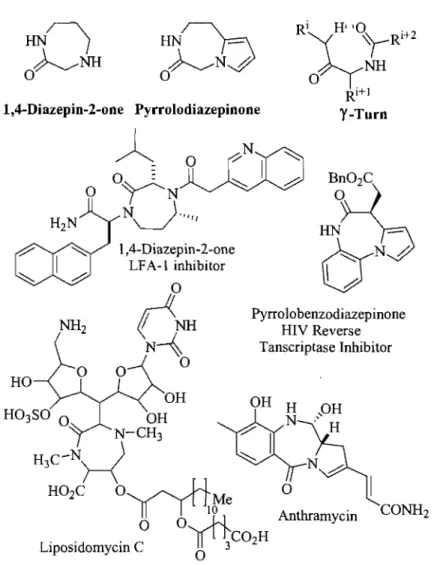
the lymphocyte function-associated antigen-l / immunoglobulin superfamily ICAM-l interaction.4 They have shown anticonvulsant activity.5 The diazepinone system is also present in the liposidomycin nucleoside antibiotics that inhibit bacterial peptidoglycan
synthesis (Figure 1).6 The pyrrolobenzodiazepine structure is contained in the natural anthramycin family of antitumor antibiotics.7 Synthetic pyrrolobenzodiazepines have acted as non-nucleoside reverse transcriptase inhibitors8 and CNS agents;9 they have also exhibited antiproliferativelO and antidepressantll activity (Figure 1). The synthesis of diazepinone ring systems has attracted considerable interest. Annulation of the diazepinone
\
ring has been accomplished from linear precursors by reductive amination, 12, 13 and lactam
formation. 14 Ring expansion of N-protected-4-piperidones by azido-Schmidt reactions with 2-hyroxyalkyl azides has given N-substituted diazepinones.3 1,4-Diazepin-5-ones have been recently made by acid-catalyzed hydrolysis of azeto[I,2-a]imidazoles.15 In addition, a combinatorial library of 1,4-diazepinone derivatives was synthesized by a solid-phase approach.16
HN)
~NH
o
o
w
R;;:;tR
;+2 1,4-Diazepin-2-one Pyrrolodiazepinone Ri+l Y-Turn HONH
2 1,4-Diazepin-2-one LFA-l inhibitoro
r,NH
N~
o
Liposidomycin C Bn02C&
l )
Pyrrolobenzodiazepinone HIVReverse Tanscriptase InhibitorFigure 2.1 Representative 1,4-diazepin-2-one and pyrrolo-diazepinone systems and related biologically active structures.
Syntheses of the pyrrolobenzadiazepine structures were reviewed in a recent Note on pyrroloaryldiazepine construction by modification of the four-component Ugi condensation.l7 To the best of our knowledge, only one synthesis of the parent pyrrolodiazepinone has been described featuring a Paal-Knorr condensation 1 lactam cyc1ization sequence to forrn sequentially the pyrrole and diazepinone rings. lB
Their remarkable biological activity has inspired development of new synthetic methodology for making diazepinone and fused aryl and hetero-aryldiazepinone structures.
Present methods employ expensive starting materials, often give low to moderate yields, and provide compounds of limited diversity. Employing inexpensive amino acids as chiral educts, efficient synthetic approaches for making diazepinone and pyrrolodiazepinone heterocyc1es were conceived that use a common homoallylic ketone 94. Four diazepinones
95 and eight pyrrolodiazepinones 98 and 99 (Schemes and Tables 2.1 and 2.2) were synthesized starting from combinations of Ala, Phe, ~-Ala and ~-homophenylalanine to provide a-aminoacyl ~-amino esters 93. Homoallylic ketones 94 were then made by Cu-catalyzed cascade addition ofvinyl Grignard reagent to esters 93.19
2.3 ResuUs and Discussion
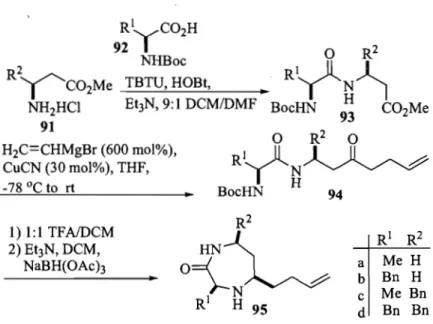
a-Aminoacyl ~-amino esters 93 were synthesized by coupling ~-amino esters 91 to the respective N-Boc-a-amino acids 92 using TBTU and HOBt in DCM (Scheme 2.1).20 Dipeptides 93 were isolated by chromatography on silica gel in 85-92% yields. Homoallylic ketones 94 were synthesized by treating a-aminoacyl-~-amino esters 93 with an excess of freshly prepared vinyl magne sium bromide (600 mol %) in the presence of copper cyanide (30-40 mol%) in THF at -78
Oc
to rt.19 After quenching the Grignard reaction at 0 oC, work up and solvent removal un der vacuum, homoallylic ketones 94a-c were isolated by chromatography on silica gel in yields of 60-75% (Table 2.1). Isolation of ketone 94d was best accompli shed by chromatography over silica gel impregnated with silver nitrate, in 45% yield.21H2C=CHMgBr (600 mol%), CuCN (30 mol%), THF, 1) 1:1 TFAlDCM 2) Et3N, DCM, NaBH(OAch
..
R2o{L
1 N R H 95 RI R2 a Me H b Bn H c Me Bn d Bn BnScheme 2.1 Synthesis ofDiazepinones 95.
entry RI R2 93 (%) 94 (%) 95 (%)
a CH3 H
85
75
45
b CH2Ph H
90
60
40
C CH3 CH2Ph
90
65
50
d CH2Ph CH2Ph
92
45
50
0[211
<"eclm
Diazepinones 95 were synthesized from homoallylic ketones 94 by a route featuring
nitrogen deprotection with TF AlDCM (1: 1), treatment of the trifluoroacetate salt with
triethyl amine at 0
Oc
and reduction of the imine intermediate with sodiumtriacetoxyborohydride in di lute DCM?2 The progress of the imine reduction was followed by LCMS analysis, which showed only one diastereoisomer in the crude product as
confirmed by lH NMR spectroscopy. After work up, diazepinone 95a was isolated after
this sequence from 94a in 45% yield by preparative HPLC. Diazepinones 95b-d were
purified by precipitation as hydrochoride salts and isolated in 40-50% overall yields from
ketones 94b-d (Scheme 1, Table 1).
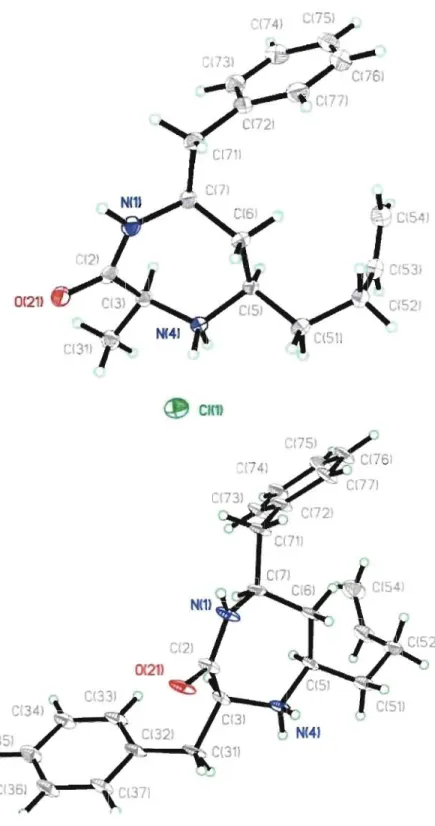
The hydrochloride salts of diazepinone 95c and 95d were recrystallized from methanol in
ethyl acetate to fumish crystals for X-ray analysis. The newly formed stereocentie at the
5-position of diazepinones 95 was found to have a cis relationship with respect to the
3-position substituent as expected based on the literature precedent in which reduction of the cyclic iminium intermediate occurred with hydride attack on the face opposite the ring substituents,16,23 A survey of the Cambridge structural database indicated that the X-ray
structures of 95c and 95d represent the first 1,4-diazepin-2-one examples. Upon
comparison of the dihedral angle geometry of the a-amino acid portion of diazepinones 95c
(0/ 70, ~ -80) and 95d (0/
=
67, ~ = -83) with ideal values of tum conformations, wenoted the close resemblance to the dihedral angle geometry of the central residue in a
reverse y-tum conformation (0/ = 60-70, ~ = -70-85; Figure 2.2). 24
Pyrrolodiazepinones 98 and 99 were made next from the common homoallylic ketone
oxidation of olefin 94 using either ozonolysis or periodate/osmium tetraoxide, and by Tsuji-Wacker oxidation, respectively (Scheme 2.2).
o
R2 0RI0~~
Boc~ 94 0 3, DCM, Me2S, NaHC03, -78 oC to rto
R2 0 O2, PdC12, CuCl 7:1 DMFIH20o
R2 0RI0~AJ~CHO
Boc~ 96Rlyl~~
Boc~ 97 0j
1) 1:1 TFNDCM 2) Et3N, DCM 3) TsOH,DCMR2~
~Y-\RI
o
98 RI R2 a Me H b Bn H c Me Bn d Bn Bnj
1) 1:1 TFNDCM 2) Et3N, DCM 3) TsOH,DCMR2~
~Y-\RI
o
99Scheme 2.2 Synthesis of Pyrrolodiazepinones 98 and 99.
entry RI R2 96 (%) 97 (%) 98 (%) 99 (%)
a CH3 H
85
85
30
65
b CH2Ph H
85
80
40
45
C CH3 CH2Ph
80
80
55
50
d CH2Ph CH2Ph
85
80
60
50
4-Keto aldehydes 96 were isolated in 80-85% yields by chromatographie purification after ozonolysis of homoallylic ketones 94 in CHzClz lMeOH (1: 1) at -78 oC, and treatment with
excess dimethylsulfide in the presence of NaHC03
?5
Altematively, oxidative c1eavage ofthe double bond of homoallylic ketones 94 was performed with sodium periodiate in the presence of catalytic amounts of OSOl6 to afford aldehydes 96 in 65-85% yield after chromatography. Comparing the two methods for making aldehyde 96, the ozonolysis was found to be more advantageous, because crude product was obtained in suitable purity for the subsequent Paal-Knorr reaction.
l,4-Diketones 97 were produced by Tsuji-Wacker oxidationZ7 employing PdClz (0.2
equiv.) and CuCI (2 equiv.), in DMF:HzO (9:1) at room temperature under an atmosphere of oxygen. After work up and chromatography on silica gel, 1,4-diketones 97 were isolated in 80-85% yields (Scheme 2, Table 2). Yields were improved for olefins 94c and 94d by using more PdClz (40 mol%) and 2 eq of CuCI in THFlHzO (4:1) at room temperature under oxygen atmosphere and agitation in a sonicator.
Diazepinones 95 and pyrrolodiazepinones 98 and 99 were respectively prepared from 4-ketoaldehydes 96 and l,4-diketones 97 by a generally effective albeit moderate yielding
route featuring nitrogen deprotection and Paal-Knorr condensation.Z8 Acid induced Boe
group removal was accomplished using either HCI gas or TFA in CHzClz, with better success on ketoaldehyde 96 using TF A instead of the HCI conditions. Paal-Knorr cyc1ization occurred on treatment with triethyl amine and a catalytic amount of toluene sulfonic acid in di lute DCM at 0 oC. After quenching with saturated NaHC03 solution, pyrrolodiazepinones 99 were isolated by chromatography on silica gel in 45-65% overall
yield from 97. An improved Paal-Knorr condensation was then developed using basic Amberlyste A-21 ion exchange resin for generating the free amine after Boc deprotection with TF A in DCM.29
Oy~~
t-N).·'"
"lN~
~N
0 H Figure 2.3 Dimer 100.The use of higher concentrations of ketoaldehydes 96 and diketones 97 in the Paal-Knorr annulation to form pyrrolodiazepinone 98 and 99 provided mixtures of monomer and dîmer as observed by LCMS analyses. Dimer 100 was isolated by preparative HPLC and identified by its doubling in mass, yet relatively simple IH and l3C NMR spectra due to C2
2.4 Conclusions
Practical, diversity-oriented methodology for the synthesis of diazepinone structures has been developed that features treatment of a-aminoacyl ~-amino-esters 93 with excess vinyl Grignard reagent to yield a common homoallylic ketone intermediate.
Diazepinones 95a-d, pyrrolo- and methylpyrrolodiazepinones 98a-d and 99a-d, all were made in 4 to 6 steps and 16 to 31 % overall yields from inexpensive amino acid building blocks 91 and 92. Considering the tolerance of the Cu-catalyzed cascade additions of vinyl
19
Grignard reagent to a variety of N-(acyl)amino esters possessing different side-chains, a wealth of peptide-based diazepinone and pyrrolo-diazepinone structures may now be obtained by this practical approach.
2.5 Acknowledgment
The authors would like to acknowledge the assistance of Françine Bélanger-Gariépy with X-ray diffraction, Dalbir Sekhon for HPLC analysis, Ramesh Kaul, Simon Suprenant and Susan Seeman, for their helpful assistance as weIl as the Natural Sciences and Engineering Research Council of Canada (NSERC) and Fonds Québécois de la Recherche sur la Nature et les Technologies (FQRNT), for tinancial support.
2.6 Supporting Information Available
Experimental details, spectroscopic caracterization for aIl compounds, and X-ray crystallographic data Of Sc and Sd. This material is available free of charge via the Internet at http://pubs.acs.org
2.7 Experimental Section
For reactions performed under anhydrous conditions, glassware was either oyen or flame-dried and the reaction was performed under a positive pressure of argon. Column chromatography was performed on silica gel (Silicycle; 230-400 mesh) and thin layer chromatography (TLC) was performed on aluminum plates coated with (O.2mm) silica gel F254 from EMD Inc or Silicyle Inc, using the solvent system indicated for TLC. Amino acids were obtained from Sigma Aldrich Inc or A vocado Research Chemicals Inc, and were N-protected using standard procedures.30 ~-Phenylalanine was prepared according to the literature protocol31 and esterified using methanol and acetyl chloride to afford the methyl ester.32
Semi-preparative reverse-phase high performance liquid chromatography (RP-HPLC) was carried out on RP-18 column 5J.lm (250 x 20 mm; TARGA column), at a flow rate of 10 mL/min. The solvent system used in RP-HPLC included the following: solvent A, 0.1 % (v/v) TFA in CH3CN; solvent B, 0.1% (v/v) TFA in H20, detector was monitored at 214 nm. Spectral data were collected on Bruker A V300 (300 MHz) and AV 400 (400 MHz) instruments. Chemicals shifts (OH) were reported in parts per million (ppm) and are referenced to the residual solvent peak CDCh (7.26 ppm), unless noted otherwise. \3C were reported in ppm and were referenced to the residual solvent peak, CDCh (77 ppm) unless