
HAL Id: hal-02264343
https://hal.archives-ouvertes.fr/hal-02264343
Submitted on 6 Aug 2019
HAL is a multi-disciplinary open access
archive for the deposit and dissemination of
sci-entific research documents, whether they are
pub-lished or not. The documents may come from
teaching and research institutions in France or
abroad, or from public or private research centers.
L’archive ouverte pluridisciplinaire HAL, est
destinée au dépôt et à la diffusion de documents
scientifiques de niveau recherche, publiés ou non,
émanant des établissements d’enseignement et de
recherche français ou étrangers, des laboratoires
publics ou privés.
Multicomponent Metal–Organic Frameworks as
Defect-Tolerant Materials
Seok Lee, Celine Doussot, Anthony Baux, Lujia Liu, Geoffrey B Jameson,
Christopher Richardson, Joshua Pak, Fabien Trousselet, François-Xavier
Coudert, Shane Telfer
To cite this version:
Seok Lee, Celine Doussot, Anthony Baux, Lujia Liu, Geoffrey B Jameson, et al.. Multicomponent
Metal–Organic Frameworks as Defect-Tolerant Materials. Chemistry of Materials, American Chemical
Society, 2016, 28 (1), pp.368-375. �10.1021/acs.chemmater.5b04306�. �hal-02264343�
Multicomponent Metal-Organic Frameworks as Defect-Tolerant
Ma-terials
Seok J. Lee,
[a]Celine Doussot,
[a]Anthony Baux,
[a]Lujia Liu,
[a]Geoffrey B. Jameson,
[a]Christopher
Richardson,
[b]Joshua J. Pak,
[c]Fabien Trousselet,
[d]Francois-Xavier Coudert,
[d]and Shane G. Telfer*
[a][a] MacDiarmid Institute for Advanced Materials and Nanotechnology, Institute of Fundamental Sciences, Massey University, Palmerston North, New Zealand. [b] School of Chemistry, University of Wollongong, Wollongong, Australia.[c] Department of Chemistry, Idaho State University, Pocatello, Idaho, USA. [d] PSL Research University, Chimie ParisTech – CNRS, Insti-tut de Recherche de Chimie Paris, 75005 Paris, France.
ABSTRACT: Multicomponent metal-organic frameworks (MOFs) comprise multiple, structurally-diverse linkers fixed into an ordered
lattice by metal ions or clusters as secondary building units (SBUs). Here, we show how multicomponent MOFs are ideal platforms for engineering materials with high levels of vacancy defects. First, a new type of quaternary MOF that is built up from two neutral, linear ditopic linkers, a threefold-symmetric carboxylate ligand, and a dinuclear paddlewheel SBU was synthesized. This MOF, named MUF-32 (MUF = Massey University Framework), is constructed from dabco, 4,4'-bipyridyl (bipy), 4,4',4''-nitrilotrisbenzoate (ntb) and zinc(II), and it adopts an ith-d topology. The zinc(III) ions and ntb ligand define an underlying [Zn2(ntb)4/3] sublattice (with pto topology) that is ‘load bearing' and maintains the structural integrity of the framework. On the other hand, the dabco and bipy ligands are ‘decorative’ and high levels of vacancy defects can be introduced by their omission. These defects can be generated by direct synthesis or by postsynthetic modi-fication. The framework structure, crystallinity and porosity are maintained even when vacancy levels of 80% are reached. Defect healing is possible by introducing free ligands in a solvent-assisted process to restore pristine MUF-32. Computational analysis reveals that the mechanical instability of the [Zn2(ntb)4/3] sublattice sets an upper limit on defect levels in this material.
Introduction
Building metal-organic frameworks (MOFs) from multiple or-ganic linkers has emerged as a fruitful strategy for obtaining materials with remarkable properties.[1-2] There are two categories of such MOFs: (1) multivariate MOFs in which the linkers have identical backbones, and (2) multicomponent MOFs in which the linkers are structurally distinct. While exceptional functional behavior has been observed for some MOFs in category 1,[3-4] the linkers are imperfectly ordered, which leads to pore heterogeneity. We[5-6] and others[2,7-15] have focused on frameworks in the second category. Since the ligands are distinct they can be discriminated during crystallization of the MOF and occupy specific positions in the lattice. For example, UMCM-1 comprises btb (benzene-1,3,5-tribenzoate) and bdc (benzene-1,4-dicarboxylate) linkers riveted in place by Zn4O secondary building units (SBUs).[16] The MUF-7 and MUF-77 families are quaternary MOFs constructed from Zn4O clusters, bdc, and bpdc (biphenyl-4,4'-dicarboxylate) and threefold symmetric carboxylate ligands.[5-6] Here, the distinct lengths of the bdc and bpdc linkers allow them to be differentiated during framework assembly and located in specific lattice posi-tions. Owing to their structural regularity, insights into the rela-tionship between ligand structure, pore topography, and guest uptake can be drawn from these multicomponent MOFs.
A number of MOFs with defects have emerged in the recent literature, and beneficial impacts of defects on framework proper-ties have been established.[17] Notable examples include the report from Li et al. on the creation of ordered vacancies in a cubic MOF based on Zn(II) and pyrazole-carboxylic acid by removing a quarter of the metal ions and half of the linkers.[18] This provides
access to a host of materials with intricate, ordered structures that cannot be synthesized directly. Partial replacement of the tereph-thalate linkers by capping trifluoroacetate ligands introduces large pores and open metal sites in UiO-66, which render this MOF catalytically-active for Meerwein reduction reactions.[19] Advanc-es in the characterization of defective frameworks have also pro-pelled our understanding of the distribution and properties of defects in MOF crystals.[20-21]
We propose that multicomponent MOFs can serve as platforms for generating materials with high levels of vacancy defects. This concept has parallels with architectural principles where buildings are designed with both ‘load-bearing’ and ‘decorative’ walls. Our strategy, as detailed herein, involves the design of multicompo-nent MOFs in which certain compomulticompo-nents are essential for main-taining structural integrity (load-bearing), while other components are nonessential (decorative). Since absence of these decorative components can be tolerated by the framework, vacancy defects are easily generated.
MOFs with an ith-d topology well-suited to this strategy. Such frameworks can be deconstructed into two subcomponents: an underlying pto sublattice (Fig. 1a) and linear struts (Fig. 1b).[22-23] These struts link adjacent square planar four-connected nodes of the pto net to produce the ith-d net.[24] Translating this to feasible chemical building blocks, [M2(L)4/3] nets with the pto topology are readily generated by combining triangular tris(carboxylate) ligands paddlewheel metal nodes into lattices.[25-31] For the linear struts there are several requirements: (i) they must coordinate via one donor atom to the axial sites of the paddlewheel nodes, (ii) they must be neutral so that charge balance is maintained in their
absence, (iii) they must be of a suitable length to bridge the gap between adjacent nodes.
On the basis of the foregoing considerations we identified dab-co and bipy (4,4'-bipyridine) as potentially useful linear struts. With respect to point (iii) above, the two ligands have an average length of 9.0 Å (Table 1). When combined with ntb, the length ratios given by the equation [twofold linker length]/[threefold linker length] is 1.11. This is close to the ratio of 1.18 found in [Zn2(btb)4/3(bipy)],[22-23] which implies that a linker set of ntb, bipy and dabco is geometrically comptible for coassembly into a quaternary MOF. The utility of linker length ratios in formulat-ing viable multicomponent MOF ligand sets is highlighted in Table 1 by the examples of [Zn4O(btb)4/3(ndc)][14,32] (ndc = naph-thalene-2,6-dicarboxylate) and MUF-7. Since their linker length ratios are very similar (1.33 and 1.30, respectively), in conjunc-tion with Zn4O nodes both btb/ndc and btb/bpdc/bdc linker sets readily assembly into MOFs with the same ith-d topology.
We herein report the successful demonstration that multicom-ponent MOFs are excellent platforms for creating materials with vacancy defects. We showing how Zn(II) paddlewheel nodes and ntb linkers combine to generate a load-bearing pto sublattice, which can be cross-linked into an ith-d net by bipy and dabco ligands. Since these latter linkers are not required for structural integrity, high levels of vacancy defects can be tolerated (Fig. 1c).
Figure 1. (a) A load-bearing sublattice with a pto topology is readily constructed from triangular tris(carboxylate) ligands and metal paddlewheel SBUs. (b) Adding two different linear struts to the pto lattice generates a quaternary MOF with an ith-d topolo-gy. (c) Since the linear struts are not essential to the structural integrity of the MOF vacancy defects can be sustained.
Table 1. Ligand length ratios, given by the formula [twofold
linker length]/[threefold linker length], for ligand sets of known and putative ternary and quaternary metal-organic frameworks. The length ratios of known frameworks with an ith-d topology are bolded. ditopic linkers O O Zn Zn N N Zn Zn O O Zn Zn O O Zn Zn O O Zn Zn O O Zn Zn linker length linker length tritopic linkers tritopic ditopic ntb btb length[a] 8.1 9.6 dabco 6.7 0.83 [c] 0.70 bipy 11.3 1.40 [c] 1.18 [e] dabco/bipy 9.0 [b] 1.11 [c] 0.94 bdc 10.1 1.25 [d] 1.05 [f] ndc 12.8 1.58 1.33 [g] bpdc 14.9 1.84 1.55 bdc/bpdc 12.5 [b] 1.54 1.30 [h]
[a] In Å. [b] Average length of bdc and bpdc. [c] This work. [d] UMCM-4.[9] [e] FJI-1/DUT-23.[22-23] [f] UMCM-1.[16] [g] MOF-205/DUT-6.[14,32] [h] MUF-7.[5] ntb = 4,4',4''-nitrilotrisbenzoate.
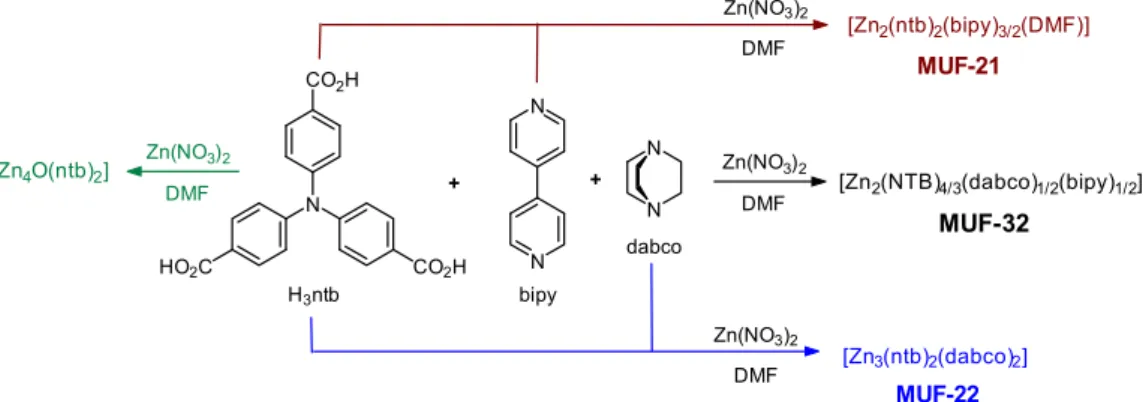
N HO2C CO2H CO2H N N N N dabco bipy H3ntb + + DMF MUF-32 Zn(NO3)2 DMF Zn(NO3)2 MUF-21 Zn(NO3)2 DMF MUF-22 [Zn2(NTB)4/3(dabco)1/2(bipy)1/2] [Zn2(ntb)2(bipy)3/2(DMF)] [Zn3(ntb)2(dabco)2] Zn(NO3)2 DMF [Zn4O(ntb)2]
Figure 2. The quaternary metal-organic framework MUF-32 is formed from a three-membered ligand set (ntb, bipy and dabco) in
combi-nation with zinc(II) ions. Two ternary MOFs, MUF-21 and MUF-22, are also reported here. [Zn4O(ntb)2] is a known compound.[33]
Results and discussion
Synthesis of MUF-32
We were delighted to find that the reaction of H3ntb, bipy and dabco (Fig. 2) with Zn(NO3)2 in DMF produces a framework with the formula [Zn2(ntb)4/3(bipy)1/2(dabco)1/2], henceforth referred to as MUF-32 (MUF = Massey University Framework). This MOF can be produced in the form of both a microcrystalline powder (MUF-32mc), and, if benzoic acid is added as a modulator to the reaction mixture, as high-quality single crystals (MUF-32sc). X-ray crystallography on MUF-32sc reveals that all three organic components are incorporated into unique positions in the lattice to produce a well-ordered MOF. Each ntb ligand coordinates to three dinuclear zinc(II) paddlewheels via its carboxyl groups to generate the underlying pto sublattice (Fig. 1a and purple net in Fig. 3b). The paddlewheels additionally coordinate to the nitro-gen donor atoms of one bipy and one dabco ligand in their axial sites (Fig. 3a). These linear ligands link the metal clusters to generate a network with ith-d topology. Three different cavities exist in MUF-32: two dodecahedral cavities with interatomic diameters of 25.8 Å and 24.3 Å (Figs. 3c-d), and a smaller tetra-hedral cavity (Fig. 3e). MUF-32 joins a small group of known quaternary frameworks and is the first to feature neutral N-donor ligands.
Figure 3. (a) The six-connected dinuclear zinc(II) SBU of
MUF-32, highlighting the coordination of three different ligands, (b) the network structure of MUF-32 with the pto sublattice shown in purple, (c) the larger dodecahedral cavities of MUF-32 that are
bounded by the bipy ligands, (d) the smaller dodecahedral cavi-ties of MUF-32 that are bounded by the dabco ligands, (e) the tetrahedral cavities of MUF-32.
Due to the large number of components in the reaction mixture, a number of phases that are derived from just one or two ligands can compete with MUF-32 during synthesis (Fig. 2). Known compounds built up from Zn(NO3)2, ntb, dabco and/or bipy in-clude [Zn4O(ntb)2] (MOF-150),[33] [Zn(bipy)](NO3)2,[34] and a variety of discrete Zn(II)-dabco complexes.[35] In spite of the existence of these competing phases, we were able to prepare phase-pure MUF-32 by optimization of the synthesis conditions. Yields were maximized by maintaining a high ratio of glass surface area to solvent volume in the reaction vessel. Bulk phase purity was established by 1H NMR spectroscopy on dissolved samples (Fig. S1), which confirms that the ligands are present in the expected ratios, and a match between the PXRD pattern of a bulk sample with the pattern calculated from the single-crystal structure (Fig. S8). PXRD patterns recorded after exposure of MUF-32 to the atmosphere indicate that it has good stability under these conditions (Fig. S8).
Following activation by solvent exchange with CH2Cl2, the permanent porosity of MUF-32 was established by gas adsorp-tion. Its N2 adsorption isotherm measured at 77K displays a steep rise in the low pressure region followed by a plateau beyond P/Po ~0.08 (Figs. S9, S11). This is consistent with the microporosity expected on the basis of its single-crystal structure. An apparent BET surface area of 2810 m2/g can be calculated from the iso-therm for MUF-32mc, and 3260 m2/g for MUF-32sc. The capaci-ty of both forms of MUF-32 to adsorb CO2, CH4, and N2 at 273 and 298 K was also assessed (Figs. S10, S12). Linear isotherms are observed in all cases. Relative uptake capacities follow the expected trend CO2 > CH4 > N2, and are higher for MUF-32sc as compared to MUF-32mc owing to the higher accessible pore volume of the former (as evidenced by the N2 uptake at 77 K)..
Synthesis of MUF-21 and MUF-22
We subsequently sought to deliberately synthesize ternary MOFs from combinations of (i) ntb and bipy, and (ii) ntb and dabco. This expands this family of multicomponent MOFs and enables confirmation (by PXRD) that these phases do not con-taminate MUF-32.
Using synthetic conditions similar to those employed for MUF-32, the combination of zinc(II), H3ntb and bipy produces the ternary framework [Zn3(ntb)2(bipy)3/2(DMF)] (MUF-21). Using a linker set comprising H3ntb and dabco, we observed formation
of the ternary framework [Zn3(ntb)2(dabco)] (MUF-22). MUF-21 and MUF-22 were characterized by single-crystal X-ray diffrac-tion, thermogravimetric analysis (TGA) and gas adsorption iso-therms. In MUF-21, three crystallographically-independent zinc(II) SBUs – a paddlewheel and two mononuclear nodes – link the ntb and bipy linkers into a 3D network (Fig. S5). This net-work comprises 2D sheets that are formed by the fusion of tubes that run along the crystallographic b direction. Adjacent sheets are interpenetrated. MUF-22 features an uncommon[36-37] type of eight-connected trinuclear zinc(II) SBU that links the ntb and dabco ligands into a 3D network (Fig. S6). Channels with a cross-section of ~22 × 27 Å (interatomic distances) propagate along the
c axis.[38]
N2 adsorption isotherms measured at 77K established the poros-ity of MUF-21 and MUF-22 following activation (Figs. S13-14). For MUF-21, a steep rise in N2 uptake up to P/Po ~0.01 is fol-lowed by a near-plateau region between P/Po ~0.01 - 0.1. This is consistent with the microporosity anticipated from the X-ray crystal structure. An upward inflection of the isotherm beyond P/Po = 0.02 and hysteresis in the desorption curve in this region are consistent with a gradual gate-opening process. From a struc-tural viewpoint, this is likely to be associated with movement of the interpenetrated sublattices relative to one another.[39-40] The Type I profile of the isotherm recorded for MUF-22, with a slight inflection at P/Po ~0.05, is in keeping with the mesoporous nature of this framework. Its apparent BET surface area is 1810 m2/g.
Defect engineering in MUF-32
Several observations during the synthesis and handling of MUF-32 indicated that it was indeed amenable to high levels of bipy and dabco vacancy defects: (i) when adjusting the feed ratio of the three linkers to optimize the synthetic route to MUF-32 we noticed that frameworks with substoichiometric quantities of bipy were frequently produced; (ii) when pristine MUF-32 was washed with DMF some of the bipy dissociated from the frame-work into solution; (iii) TGA traces exhibited gradual weight loss at moderate temperatures, which could be traced to the expulsion of dabco from the framework (Fig. S4).
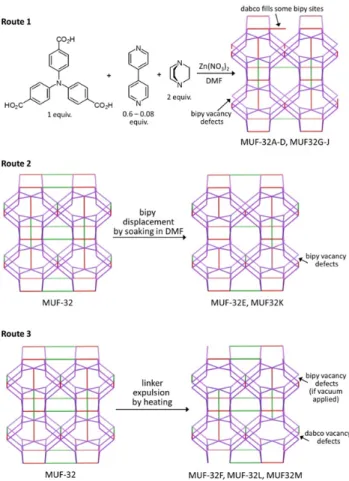
We conducted a systematic investigation on the deliberate en-gineering of defects in MUF-32. Both vacancy defects, specifical-ly the absence of bipy or dabco ligands, and substitution defects, bipy or dabco being partially replaced by another ligand, are possible. As summarized in Table 2, defects were introduced to MUF-32 by three different routes. The deliganded frameworks are formulated as [Zn2(ntb)4/3(bipy)x(dabco)y], where x and y deviate from the value of ½ observed in pristine MUF-32. De-fects were quantified by 1H NMR spectroscopy on digested frameworks on the assumption that, for reasons of charge bal-ance, the ntb ligand sites are always fully occupied and only the bipy and dabco ligands assume substoichiometric ratios.
Table 2. Summary of MUF-32 materials with vacancy defects,
which are formulated as [Zn2(ntb)4/3(bipy)x(dabco)y]. Form [a] Route [b] x [c] y
Defect creation MUF-32mc MC pristine 0.50 0.50 MUF-32A MC 1 0.40 0.50 MUF-32B MC 1 0.33 0.54 MUF-32C MC 1 0.20 0.62 MUF-32D MC 1 0.10 0.68 MUF-32E3 MC 2 0.40 0.50 MUF-32E10 MC 2 0.39 0.50 MUF-32E30 MC 2 0.39 0.50 MUF-32F MC 3 [d] 0.47 0.26 MUF-32sc SC pristine 0.50 0.50 MUF-32G SC 1 0.35 0.62 MUF-32H SC 1 0.27 0.70 MUF-32I SC 1 0.20 0.76 MUF-32J SC 1 0.14 0.78 MUF-32K10 SC 2 0.48 0.50 MUF-32K30 SC 2 0.47 0.50 MUF-32K180 SC 2 0.44 0.50 MUF-32K1440 SC 2 0.40 0.50 MUF-32L SC 3 [d] 0.49 0.42 MUF-32M SC 3 [e] 0.37 0.32 Defect healing MUF-32Bh MC 4 0.44 0.53 MUF-32Dh MC 4 0.21 0.68 MUF-32E3h MC 4 0.51 0.51 MUF-32Gh SC 4 0.42 0.56 MUF-32Ih SC 4 0.23 0.74 MUF-32K1440h [f] SC 4 0.50 0.50
[a] MC = microcrystalline powder, SC = large single crystals. [b] Route 1 = direct synthesis; Route 2 = washing with DMF, the superscripts on the sample codes indicate the lengths of time, in minutes, the sample was exposed to DMF; Route 3 = direct heating of solid sample; Route 4 = defect healing by soaking in a solution of bipy in CH2Cl2. [c] The stoichiometry of bipy and dabco was determined by 1H NMR spectros-copy using the ntb peak integrals as a reference. [d] Heated to 150 °C in a TGA instru-ment. [e] Heated to 150 °C in a vacuum oven for three hours. [f] By X-ray diffraction on a single crystal, x = 0.474(6).
Figure 4. Three routes that were developed to create defects in
MUF-32. The network structures of the MOFs are presented. Purple = ntb; green = bipy, red = dabco.
Route 1: Introduction of defects by de novo synthesis.
MUF-32A-D (microcrystalline) and MUF-32G-J (single crystalline) with substoichiometric levels of bipy were directly synthesized by systematically reducing the amount of bipy in the synthesis mixture. Although SCXRD on MUF-32G-J was not possible due to the presence of multiple crystal domains (Fig. S19), PXRD indicated that the overall architecture of MUF-32 was retained in all cases (Figs. S18, S23). The amount of bipy ligand incorpo-rated into these materials was determined by 1H NMR spectros-copy on digested samples. The creation of bipy absence defects correlates with an uptick in the amount of incorporated dabco linker, particularly for the single-crystalline materials (Table 2). In all cases, the total quantity of bipy and dabco per paddlewheel (x + y) does not exceed unity, which suggests that the dabco occupies some of the bipy sites in the lattice. Since major varia-tions are not seen in the PXRD patterns of these materials, it is unlikely that the dabco ligand bridges two paddlewheels, since this would necessitate a significant structural reorganization, but rather that it coordinates to the framework by just one of its nitro-gen donors (Fig. S7). It is likely that solvent molecules, e.g. H2O, DMF, fill the remaining coordination site on the paddlewheel cluster vacated by the bipy ligand.
Route 2: Postsynthetic introduction of defects by soaking in DMF. Bipy is expelled from MUF-32mc and MUF-32sc simply
by soaking in fresh DMF. When this method was employed for preparative purposes, the numerical superscript at the end of the sample code indicates the soaking period in minutes (Table 2). The release of bipy was confirmed by 1H NMR spectroscopy of DMF-d7 solvent in contact with solid samples of these materials
(Figs. S17, S24, S25). Replacing DMF by CH3NO2 or CH2Cl2 in
the soaking experiments led to no loss of the bipy ligand, which suggests that the ability of DMF to coordinate to the coordination site made vacant on the zinc SBU is important. The exchange of MOF ligands by solvent molecules has precedence in the litera-ture.[41-42] Interestingly, many known examples involve the dis-placement of dabco linkers, rather than bipy as seen here. We posit that in this case bipy is expelled in preference to dabco owing to its weaker basicity. Steric effects may play a role, as well as entropic effects since bipy gains torsional degrees of freedom that dabco does no upon release into solvent.
Due to its smaller particle size, defect creation is much more rapid in MUF-32mc than in MUF-32sc, however in both cases the amount of bipy ligands released from the lattice, as quantified by 1H NMR spectroscopy on digested samples, plateaus at ~20% (Figs. S16, S22). The overall network of MUF-32 is sustained upon displacement of the bipy linkers, as evidenced by PXRD patterns (Figs. S18, S23).
Route 3: Postsynthetic introduction of defects by heating.
The third route to generating defects in MUF-32 is by heating to moderate temperatures. Deliganded 32 frameworks, MUF-32F from MUF-32mc and MUF-32L from MUF-32sc, which are deficient in dabco are produced by this method (Table 2). The loss of dabco by heating is consistent with it being the most vola-tile of the framework components. Chun et al. have previously reported on the thermal expulsion of dabco from a MOF.[43]
The release of the dabco ligands could be monitored by TGA experiments where samples were heated to 150 °C and held at that temperature for three hours (Fig. S20). Since TGA cannot be used as a quantitative tool due to the unavoidable presence of volatile guest molecules that also contribute to the observed weight loss, we employed 1H NMR spectroscopy on digested samples to assess the extent of dabco vacancy formation (Figs. S15, S21). Owing to its larger particle size, MUF-32sc releases dabco much less readily than MUF-32mc: only 16% of the dabco ligands are absent from MUF-32L, whereas ~50% of the dabco linkers are expelled in producing MUF-32F. If the sample is placed in a vacuum chamber during heating, the reduced pressure results in significant loss of both the dabco and bipy ligands (MUF-32M). In all cases, PXRD clearly indicates that the overall structure of the parent MUF-32 framework is maintained follow-ing thermal defect generation (Figs. S18, S23).
Gas adsorption properties of defect MUF-32 materials
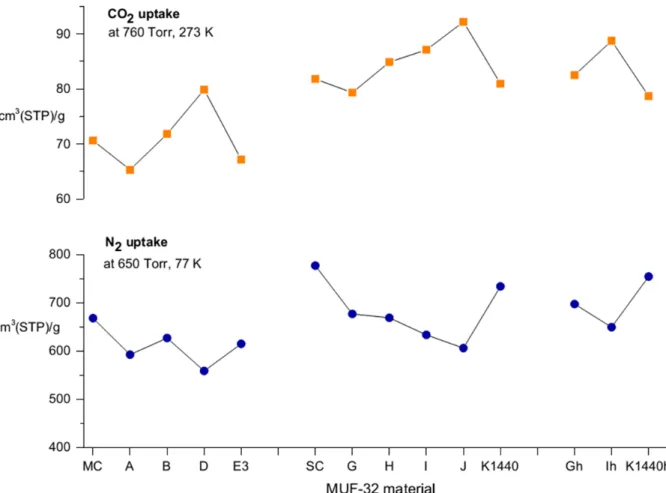
To assess the textural characteristics of deliganded MUF-32 materials, gas adsorption isotherms were measured. Crucially, MUF-32 maintains high levels of porosity – and thus its structural integrity - even when significant defects are introduced (Fig. 5). This can be ascribed to its multicomponent nature: the underlying [Zn2(ntb)4/3] sublattice provides a sound structural foundation that resists collapse when a significant fraction of the bipy and dabco ligands are absent.
CO2 adsorption isotherms measured on the microcrystalline materials at 273 K reveal several interesting trends (Fig. 5). MUF-32A and MUF-32E3, in which ~20% of the bipy sites are vacant, adsorb fractionally less CO2 than pristine MUF-32mc. On the other hand, despite taking up less N2 at 77 K, MUF-32B and MUF-32D take up more CO2. A greater number of bipy linkers are absent from these frameworks and some of these sites are occupied by dabco. Since in this situation the dabco coordinates in a monotopic fashion, this leaves one of its nitrogen atoms free to interact with guest molecules (Fig. S7). Favorable electrostatic interactions between CO2 molecules and the dabco nitrogen thus underlie the affinity of MUF-32B and MUF-32D for this gas.[44] The CO2 capacity of MUF-32mc is increased by 15% in going to its deliganded analogue MUF-32D.
Figure 5. Plot showing N2 (650 Torr, 77 K) and CO2 (760 Torr, 273 K) capacities of MUF-32mc, MUF-32sc and related defect and healed materials.
At 273 K, the CO2 uptake capacities of the deliganded single-crystalline materials ranges from 79 to 92 cm3(STP)/g (Fig. 5). CO2 uptake increases for the directly-synthesized defect frame-works as progressively more of the bipy ligands are replaced by monotopic dabco ligands (MUF-32G-J). As outlined above, this can be ascribed to interactions between the CO2 and the free dabco nitrogen atom. MUF-32H-J outperform MUF-32sc in terms of CO2 adsorption despite having lower N2uptake at 77 K. The postsynthetic removal of bipy ligands from MUF-32sc to give MUF-32K1440 has little impact on the CO
2 uptake capacity.
Defect healing
MUF-32E3 and MUF-32K1440 can be healed by soaking in a so-lution of bipy to regenerate pristine MUF-32 (Table 2). The suc-cess of the healing prosuc-cess was judged by 1H NMR spectroscopy. For MUF-32K1440, defect healing significantly improves its struc-tural order, as evidenced by single-crystal X-ray diffraction pat-terns. Upon soaking MUF-32 single crystals in DMF for various periods to produce the MUF-32Kx materials, the diffraction quali-ty is reduced. The diffraction spots become more diffuse and often split into multiple spots (Fig. S28). This indicates that the long-range order in the lattice of MUF-32K is reduced with re-spect to MUF-32sc and that multiple domains develop upon defect formation. Upon healing the bipy vacancies in MUF-32K1440 to generate MUF-32K1440h, sharp and single spots are restored to the diffraction pattern (Fig. S28). Optical microscopy shows that the external form and transparency of the MUF-32 crystals are maintained through the defect production and healing
steps. Gas adsorption measurements conducted on the healed single-crystalline materials 32Gh, 32Ih and MUF-32K1440h indicate that high levels of porosity are maintained during the healing process (Fig. 5).
For MUF-32Bh, MUF-32Dh, MUF-32Gh and MUF-32Ih, heal-ing of the defect frameworks produces materials other than pris-tine MUF-32. For example, MUF-32G has the formula [Zn2(ntb)4/3(bipy)0.35(dabco)0.62], indicating that dabco occupies some of the bipy sites. Soaking MUF-32G in a solution of bipy in CH2Cl2 produces MUF-32Gh, [Zn2(ntb)4/3(bipy)0.42(dabco)0.56]. The reduction in the dabco content vis-a-vis MUF-32G indicates some of the dabco ligands residing in the bipy sites are displaced by incoming bipy ligands. However, the extent to which these ‘imposter’ dabco ligands can be displaced has an upper limit, even after extensive exposure to a solution of bipy (Table 2). It is noteworthy that the sum of the bipy and dabco stoichiometries nears the maximum value of unity, implying that almost all bipy sites are occupied by either a bipy or a dabco linker.
Computational analysis
To further understand the ability of MUF-32 to tolerate defects we performed a quantum-chemistry calculations at the Density Functional Theory (DFT) level for eight crystalline structures of formula [Zn2(ntb)4/3(bipy)x(dabco)y], with 0 ≤ x, y ≤ ½. We
fo-cused on the relative energies of these materials and their mechan-ical stability. Ordered models with various compositions were
generated from the MUF-32 crystallographic structure by removal of bipy or dabco ligands (Table S3). Energy minimization was then performed for each model, giving both a relaxed structure and its energy. The structures calculated in this way are in good agreement with the crystallographic coordinates (Fig. S47). On the basis of the relaxed structures, second-order elastic constants were calculated and the elastic properties analyzed following a procedure established in earlier literature.[45-46]
The computational results underscore the utility of multicompo-nent MOFs creating materials with high levels of defects:
(i) The calculated unit cell volume and cell parameters of the defective frameworks were found to vary only slightly (±1.7%) from MUF-32 (Table 3), which shows that the creation of defect does not involve a substantial structural reorganization. This is consistent with the experimental PXRD patterns. One geometric parameter that does change between calculated structures of MUF-32 and [Zn2(ntb)4/3] is the distance between the paddle-wheels. In the latter it adopts a uniform value and does not alter-nate between short (dabco sites) and long (bipy sites) values as it does in MUF-32. The insertion of both bipy and dabco linkers to link the axial sites of the paddlewheel SBUs therefore does in-volve a local deformation, however it results in minimal strain on the [Zn2(ntb)4/3] sublattice.
(ii) Although not experimentally observed, [Zn2(ntb)4/3] was found to be energetically feasible since it corresponds to a local energy minimum. The same holds for the structures with (x, y) = (1/2, 0) and (0, 1/2). Rather than compare absolute energies, which is fraught with difficulty for these kinds of materials, we calculated the binding energies of the bipy and dabco ligands to these structures. The binding energies to the [Zn2(ntb)4/3] sublat-tice are 238 kJ/mol (bipy) and 329 kJ/mol (dabco) per ligand. The stronger binding of dabco is in agreement with experimental observations that this ligand is more difficult to remove from MUF-32 when generating vacancy defects.
We found that these binding energies do not depend strongly on the composition of the rest of the framework. For bipy, where compositions of x = 0, 1/6, 2/6 and 1/2 were tested, we observe that the binding energy has only a slight (and almost linear) de-pendency on the number of vacancies, varying between 233 and 242 kJ/mol. Likewise, the binding energy of dabco to [Zn2(ntb)4/3(bipy)1/2] is only marginally smaller (303 kJ/mol) than that to [Zn2(ntb)4/3] (329 kJ/mol). Thus, from an energetic per-spective, there is no barrier to creating [Zn2(ntb)4/3(bipy)x(dabco)y]
materials with any values of x and y between 0 and ½.
(iii) Geometric pore space analysis was performed on the re-laxed structures. Porosity (φ) decreases monotonously with both x and y, ranging from φ = 0.45 (MUF-32) to φ = 0.55 ([Zn2(ntb)4/3]). The surface area S (in cm2/g) is found to increase slightly upon ligand removal owing to the decrease in mass. It is interesting to note that the variation of S observed upon varying x is smaller than the variations in BET surfaces as extracted from N2 adsorption experiments. There are thus additional aspects than pure geometric considerations that drive the adsorption in the deliganded MUF-32, such as presence of guest molecules inside the pores or flexibility of the framework. Additional theoretical work on adsorption properties will be needed to settle this ques-tion.
(iv) Bulk modulus, which quantifies the volumetric response to isotropic compression) is almost unaffected by ligand removal (Table S4), meaning that the global stiffness of all MUF-32 mate-rials is mostly determined by the underlying [Zn2(ntb)4/3] sublat-tice. However, large changes are seen in the Young’s and shear moduli, i.e. responses to uniaxial compression and shearing. In particular, the spatially-averaged shear modulus, equal to 1.84 GPa in pristine MUF-32, is decreased to 0.99 GPa upon total removal of dabco [to Zn2(ntb)4/3(bipy)1/2], and further to 0.54 GPa in [Zn2(ntb)4/3]. The Young’s moduli follow the same trend: the lower connectivity of the metal clusters in deliganded MOFs renders the substoichiometric lattices more susceptible to both shear forces and compression along the directions of missing linkers.
The small value of shear modulus in [Zn2(ntb)4/3] reveals why compounds with high proportions of both bipy and dabco vacan-cies, including [Zn2(ntb)4/3] itself, are not observed. Although energetically feasible, it is the mechanical properties of MUF-32 that set an upper limit on the extent to which it can sustain vacan-cy defects. This situation is similar to that of hypothetical ZIF frameworks which, although of relatively low formation enthal-py,[47] are not mechanically stable enough to be able to be synthe-sized.[48] This theoretical study is a first to demonstrate the rela-tionship between ligand vacancies and mechanical properties in MOFs, and parallels some recent work by Cliffe et al. showing the dependence of thermal properties on the concentration of defects in UiO-66(Hf).[49]
Table 3. Structural and mechanical properties of eight
frame-works with formulae [Zn2(ntb)4/3(bipy)x(dabco)y] as calculated
by Density Functional Theory.
(x, y) MOF ∆V (%) φ S E G (1/2, 1/2) MUF-32 0 0.45 3920 5.24 1.84 (1/3, 1/2) defect –0.47 0.46 3980 (1/6, 1/2) defect –1.21 0.48 4040 (0, 1/2) defect –1.74 0.50 4120 2.89 0.99 (1/2, 0) defect –0.24 0.47 4460 (1/3, 0) defect 0.13 0.50 4520 (1/6, 0) defect 0.66 0.52 4590 (0, 0) [Zn2(ntb)4/3] 1.68 0.55 4670 1.60 0.54
Quantities listed: volume variation, (V)with respect to MUF-32 (in percent), porosity φ, accessible surface area S (in cm2/g), spatially-averaged Young's (E) and shear (G) moduli, both in GPa.
Conclusion and outlook
We have established a new strategy for deliberately introducing vacancy defects in MOFs. This strategy relies on coassembling both load-bearing and decorative components into the same framework. An underlying three-dimensional sublattice is main-tained by the metal cluster and one of the linkers. Since the two other linkers are neutral and not essential for the structural integri-ty of the network, the network can be sustained when they are present at substoichiometric levels. Defects can be introduced in multiple ways, involving both de novo synthesis and postsynthetic modification, and defect levels can be used to tune the adsorption properties. In addition, we have shown how defect healing can restore the pristine parent MOF or produce a range of new materi-als. More broadly, our strategy can be viewed as an example of the recently introduced principle of ‘using weakness as a synthetic tool,’[50] and contributes a new angle to the current surge of inter-est in MOFs with defects.[17] Taking advantage of multicompo-nent ligand sets to rationally engineer ‘defectogenic’ frameworks promises to be a widely-applicable methodology for fabricating materials with novel structural features and properties.
ASSOCIATED CONTENT
Supporting InformationExperimental and computational details, additional characteriza-tion data, and crystallographic informacharacteriza-tion (CIF) files.
AUTHOR INFORMATION
Corresponding AuthorEmail: [email protected]
Notes
The authors declare no competing financial interests.
ACKNOWLEDGMENT
We thank Dr. Hui Yang for valuable experimental assistance and advice. SGT is grateful to the RSNZ Marsden Fund for supporting this research, and FT and FXC acknowledge access to HPC re-sources provided by GENCI (grant i2015087069).
REFERENCES
1. 'Mixed-Component Metal-Organic Frameworks (Mc-Mofs):
Enhancing Functionality through Solid Solution Formation and Surface Modifications,' A. D. Burrows, CrystEngComm 2011, 13,
3623-3642.
2. 'Mixed Linker Strategies for Organic Framework
Functionalization,' D. N. Bunck and W. R. Dichtel, Chem. Eur. J.
2013, 19, 818–827.
3. 'Multiple Functional Groups of Varying Ratios in
Metal-Organic Frameworks,' H. Deng, C. J. Doonan, H. Furukawa, R.
B. Ferreira, J. Towne, C. B. Knobler, B. Wang and O. M. Yaghi,
Science 2010, 327, 846-850.
4. 'Nonlinear Properties in Coordination Copolymers Derived
from Randomly Mixed Ligands,' T.-H. Park, K. Koh, A. G.
Wong-Foy and A. J. Matzger, Cryst. Growth Des. 2011, 11, 2059–2063.
5. 'Programmed Pore Architectures in Modular Quaternary
Metal–Organic Frameworks,' L. Liu, K. Konstas, M. R. Hill and
S. G. Telfer, J. Am. Chem. Soc. 2013, 135, 17731-17734.
6. 'Systematic Ligand Modulation Enhances the Moisture Stability
and Gas Sorption Characteristics of Quaternary Metal-Organic Frameworks,' L. Liu and S. G. Telfer, J. Am. Chem. Soc. 2015, 137, 3901-3909.
7. 'Coordination Copolymerization of Three Carboxylate Linkers
into a Pillared Layer Framework,' A. Dutta, A. G. Wong-Foy and
A. J. Matzger, Chem. Sci. 2014, 5, 3729-3734.
8. 'Exceptional Surface Area from Coordination Copolymers
Derived from Two Linear Linkers of Differing Lengths,' K. Koh,
J. D. V. Oosterhout, S. Roy, A. G. Wong-Foy and A. J. Matzger, Chem. Sci. 2012, 3, 2429–2432.
9. 'Coordination Copolymerization Mediated by Zn4o(Co2r)6
Metal Clusters: A Balancing Act between Statistics and Geometry,' K. Koh, A. G. Wong-Foy and A. J. Matzger, J. Am. Chem. Soc. 2010, 132, 15005-15010.
10. 'A New Metal-Organic Framework with Ultra-High Surface
Area,' R. Grunker, V. Bon, P. Muller, U. Stoeck, S. Krause, U.
Mueller, I. Senkovska and S. Kaskel, Chem. Commun. 2014, 50, 3450-3452.
11. 'Copolymerisation at Work: The First Example of a Highly
Porous Mof Comprising a Triarylborane-Based Linker,' S.
Helten, B. Sahoo, V. Bon, I. Senkovska, S. Kaskel and F. Glorius,
CrystEngComm 2015, 17, 307-312.
12. 'Route to a Family of Robust, Non-Interpenetrated Metal–
Organic Frameworks with Pto-Like Topology,' N. Klein, I.
Senkovska, I. A. Baburin, R. Grünker, U. Stoeck, M. Schlichtenmayer, B. Streppel, U. Mueller, S. Leoni, M. Hirscher and S. Kaskel, Chem. Eur. J. 2011, 17, 13007-13016.
13. 'Postsynthetic Paddle-Wheel Cross-Linking and
Functionalization of 1,3-Phenylenebis(Azanetriyl)Tetrabenzoate-Based Mofs,' P. Müller, F. M. Wisser, V. Bon, R. Grünker, I.
Senkovska and S. Kaskel, Chem. Mater. 2015, 27, 2460−2467.
14. 'Ultrahigh Porosity in Metal-Organic Frameworks,' H.
Furukawa, N. Ko, Y. B. Go, N. Aratani, S. B. Choi, E. Choi, A. Ö. Yazaydin, R. Q. Snurr, M. O’Keeffe, J. Kim and O. M. Yaghi,
Science 2010, 329, 424-428.
15. 'A Non-Regular Layer Arrangement of a Pillared-Layer
Breaking at Nodes,' A. Dutta, J. Ma, A. G. Wong-Foy and A. J.
Matzger, Chem. Commun. 2015, 51, 13611-13614.
16. 'A Crystalline Mesoporous Coordination Copolymer with
High Microporosity,' K. Koh, A. G. Wong-Foy and A. J. Matzger, Angew. Chem., Int. Ed. 2008, 47, 677-680.
17. 'Defect-Engineered Metal–Organic Frameworks,' Z. Fang, B.
Bueken, D. E. De Vos and R. A. Fischer, Angew. Chem., Int. Ed.
2015, 54, 7234-7254.
18. 'Ordered Vacancies and Their Chemistry in Metal-Organic
Frameworks,' B. Tu, Q. Pang, D. Wu, Y. Song, L. Weng and Q.
Li, J. Am. Chem. Soc. 2014, 136, 14465-14471.
19. 'Synthesis Modulation as a Tool to Increase the Catalytic
Activity of Metal-Organic Frameworks: The Unique Case of Uio-66(Zr),' F. Vermoortele, B. Bueken, G. Le Bars, B. Van de
Voorde, M. Vandichel, K. Houthoofd, A. Vimont, M. Daturi, M. Waroquier, V. Van Speybroeck, C. Kirschhock and D. E. De Vos,
J. Am. Chem. Soc. 2013, 135, 11465-11468.
20. 'Correlated Defect Nanoregions in a Metal-Organic
Framework,' M. J. Cliffe, W. Wan, X. Zou, P. A. Chater, A. K.
Kleppe, M. G. Tucker, H. Wilhelm, N. P. Funnell, F. X. Coudert and A. L. Goodwin, Nat Commun 2014, 5, 4176.
21. 'Assessing Chemical Heterogeneity at the Nanoscale in
Mixed-Ligand Metal-Organic Frameworks with the Ptir Technique,' A. M. Katzenmeyer, J. Canivet, G. Holland, D.
Farrusseng and A. Centrone, Angew. Chem. Int. Ed. 2014, 53, 2852-2856.
22. 'A Non-Interpenetrated Porous Metal-Organic Framework
with High Gas-Uptake Capacity,' D. Han, F.-L. Jiang, M.-Y. Wu,
L. Chen, Q.-H. Chen and M.-C. Hong, Chem. Commun. 2011, 47, 9861-9863.
23. 'Route to a Family of Robust, Non-Interpenetrated Metal–
Organic Frameworks with Pto-Like Topology,' N. Klein, I.
Senkovska, I. A. Baburin, R. Grünker, U. Stoeck, M. Schlichtenmayer, B. Streppel, U. Mueller, S. Leoni, M. Hirscher and S. Kaskel, Chem. Eur. J. 2011, 17, 13007-13016.
24. 'Connection of Zinc Paddle-Wheels in a Pto-Type
Metal-Organic Framework with 2-Methylimidazolate and Subsequent Incorporation of Charged Organic Guests,' N. Ko, K. Noh, S.
Sung, H. J. Park, S. Y. Park and J. Kim, Chem. Commun. 2014,
50, 6785-6788.
25. 'The Reticular Chemistry Structure Resource (Rcsr) Database
of, and Symbols for, Crystal Nets,' M. O'Keeffe, M. A. Peskov, S.
J. Ramsden and O. M. Yaghi, Acc. Chem. Res. 2008, 41, 1782-1789.
26. 'Topological Analysis of Metal–Organic Frameworks with
Polytopic Linkers and/or Multiple Building Units and the Minimal Transitivity Principle,' M. Li, D. Li, M. O’Keeffe and O.
M. Yaghi, Chem. Rev. 2013, 114, 1343-1370.
27. 'Metastable Interwoven Mesoporous Metal–Organic
Frameworks,' Y. He, Z. Guo, S. Xiang, Z. Zhang, W. Zhou, F. R.
Fronczek, S. Parkin, S. T. Hyde, M. O’Keeffe and B. Chen, Inorg.
Chem. 2013, 52, 11580-11584.
28. 'Isoreticular Expansion of Metal–Organic Frameworks with
Triangular and Square Building Units and the Lowest Calculated Density for Porous Crystals,' H. Furukawa, Y. B. Go, N. Ko, Y.
K. Park, F. J. Uribe-Romo, J. Kim, M. O’Keeffe and O. M. Yaghi, Inorg. Chem. 2011, 50, 9147-9152.
29. 'Polymorphism of Metal-Organic Frameworks: Direct
Comparison of Structures and Theoretical N2-Uptake of
Topological Pto- and Tbo-Isomers,' N. Zhu, M. J. Lennox, T.
Duren and W. Schmitt, Chem. Commun. 2014, 50, 4207-4210.
30. 'Direct X-Ray Observation of Trapped Co2 in a Predesigned
Porphyrinic Metal–Organic Framework,' J. A. Johnson, S. Chen,
T. C. Reeson, Y.-S. Chen, X. C. Zeng and J. Zhang, Chem. Eur. J.
2014, 20, 7632-7637.
31. 'Assembly of Two 3d Porous Metal–Organic Frameworks
Based on 1,2,3-Triazole-4,5-Dicarboxylate Exhibiting Novel Coordination Modes,' T. Zhao, X. Jing, J. Wang, D. Wang, G. Li,
Q. Huo and Y. Liu, Cryst. Growth Des. 2012, 12, 5456-5461.
32. 'A Mesoporous Metal–Organic Framework,' N. Klein, I.
Senkovska, K. Gedrich, U. Stoeck, A. Henschel, U. Mueller and S. Kaskel, Angew. Chem., Int. Ed. 2009, 48, 9954-9957.
33. 'Design of Frameworks with Mixed Triangular and
Octahedral Building Blocks Exemplified by the Structure of [Zn4o(Tca)2] Having the Pyrite Topology,' H. K. Chae, J. Kim,
O. D. Friedrichs, M. O’Keeffe and O. M. Yaghi, Angew. Chem.,
Int. Ed. 2003, 42, 3907-3909.
34. 'Preparation and Characterization of Divalent Cobalt, Nickel,
Zinc, Cadmium and Monovalent Silver Nitrate Complexes with 4.4′-Bipyridine,' I. S. Ahuja, R. Singh and C. P. Rai, J. Inorg. Nucl. Chem. 1978, 40, 924-926.
35. 'Direct Synthesis of Zinc and Nickel(Ii) Complexes with
1,4-Diazabicyclo[2.2.2]Octane,' S. R. Petrusenko, J. Sieler and V. N.
Kokozay, Z. Naturforsch., B: Chem. Sci. 1997, 52, 331-336.
36. 'Secondary Building Units, Nets and Bonding in the Chemistry
of Metal-Organic Frameworks,' D. J. Tranchemontagne, J. L.
Mendoza-Cortes, M. O’Keeffe and O. M. Yaghi, Chem. Soc. Rev.
2009, 38, 1257-1283.
37. 'Enantiopure Vs. Racemic Metalloligands: Impact on Metal–
Organic Framework Structure and Synthesis,' S. J. Garibay, J. R.
Stork, Z. Wang, S. M. Cohen and S. G. Telfer, Chem. Commun.
2007, 4881-4883.
38. While this work was in progress the structure of MUF-21 was
reported elsewhere: Zhao, M.; Su, J.; Zhang, J.; Wu, J.-Y.; Tian, Y.-P., Acta Cryst. C 2015, 71, 799-803.
39. 'Control over Flexibility of Entangled Porous Coordination
Frameworks by Molecular and Mesoscopic Chemistries,' S.
Furukawa, Y. Sakata and S. Kitagawa, Chem. Lett. 2013, 42, 570-576.
40. 'Soft Porous Crystals,' S. Horike, S. Shimomura and S.
Kitagawa, Nat Chem 2009, 1, 695-704.
41. 'Stability and Hydrolyzation of Metal Organic Frameworks
with Paddle-Wheel Sbus Upon Hydration,' K. Tan, N. Nijem, P.
Canepa, Q. Gong, J. Li, T. Thonhauser and Y. J. Chabal, Chem.
Mater. 2012, 24, 3153-3167.
42. 'Reversible Two-Dimensional−Three Dimensional
Framework Transformation within a Prototype Metal−Organic Framework,' Z. Chen, S. Xiang, D. Zhao and B. Chen, Cryst. Growth Des. 2009, 9, 5293-5296.
43. 'A Simple and Rational Approach for Binodal Metal–Organic
Frameworks with Tetrahedral Nodes and Unexpected Multimodal Porosities from Nonstoichiometric Defects,' H. Chun, W. Bak, K.
Hong and D. Moon, Cryst. Growth Des. 2014, 14, 1998-2002.
44. 'Carbon Dioxide Capture in Metal–Organic Frameworks,' K.
Sumida, D. L. Rogow, J. A. Mason, T. M. McDonald, E. D. Bloch, Z. R. Herm, T.-H. Bae and J. R. Long, Chem. Rev. 2012,
112, 724-781.
45. 'Anisotropic Elastic Properties of Flexible Metal-Organic
Frameworks: How Soft Are Soft Porous Crystals?,' A. U. Ortiz,
A. Boutin, A. H. Fuchs and F.-X. Coudert, Phys. Rev. Lett. 2012,
109, 195502-195505.
46. 'Metal–Organic Frameworks with Wine-Rack Motif: What
Determines Their Flexibility and Elastic Properties?,' A. U. Ortiz,
A. Boutin, A. H. Fuchs and F.-X. Coudert, J. Chem. Phys. 2013,
138, 174703-174708.
47. 'Zeolitic Imidazole Frameworks: Structural and Energetics
Trends Compared with Their Zeolite Analogues,' D. W. Lewis, A.
R. Ruiz-Salvador, A. Gomez, L. M. Rodriguez-Albelo, F.-X. Coudert, B. Slater, A. K. Cheetham and C. Mellot-Draznieks,
CrystEngComm 2009, 11, 2272-2276.
48. 'Thermal and Mechanical Stability of Zeolitic Imidazolate
Frameworks Polymorphs,' L. Bouëssel du Bourg, A. U. Ortiz, A.
Boutin and F.-X. Coudert, APL Materials 2014, 2, 124110-124119.
49. 'Defect-Dependent Colossal Negative Thermal Expansion in
Uio-66(Hf) Metal-Organic Framework ' M. J. Cliffe, J. A. Hill, C.
A. Murray, F.-X. Coudert and A. L. Goodwin, Phys. Chem.
Chem. Phys. 2015, 17, 11586-11592.
50. 'Exploiting Chemically Selective Weakness in Solids as a
Route to New Porous Materials,' R. E. Morris and J. Cejka, Nat Chem 2015, 7, 381-388.
![Table 1. Ligand length ratios, given by the formula [twofold linker length]/[threefold linker length], for ligand sets of known and putative ternary and quaternary metal-organic frameworks](https://thumb-eu.123doks.com/thumbv2/123doknet/7762608.255376/3.892.439.821.205.559/ligand-formula-twofold-threefold-putative-ternary-quaternary-frameworks.webp)
![Table 2. Summary of MUF-32 materials with vacancy defects, which are formulated as [Zn 2 (ntb) 4/3 (bipy) x (dabco) y ]](https://thumb-eu.123doks.com/thumbv2/123doknet/7762608.255376/5.892.450.820.153.759/table-summary-muf-materials-vacancy-defects-formulated-dabco.webp)
![Table 3. Structural and mechanical properties of eight frame- frame-works with formulae [Zn 2 (ntb) 4/3 (bipy) x (dabco) y ] as calculated by Density Functional Theory](https://thumb-eu.123doks.com/thumbv2/123doknet/7762608.255376/8.892.456.815.159.376/structural-mechanical-properties-formulae-calculated-density-functional-theory.webp)
