HAL Id: hal-01096531
https://hal.archives-ouvertes.fr/hal-01096531
Submitted on 17 Dec 2014
HAL is a multi-disciplinary open access
archive for the deposit and dissemination of
sci-entific research documents, whether they are
pub-lished or not. The documents may come from
teaching and research institutions in France or
abroad, or from public or private research centers.
L’archive ouverte pluridisciplinaire HAL, est
destinée au dépôt et à la diffusion de documents
scientifiques de niveau recherche, publiés ou non,
émanant des établissements d’enseignement et de
recherche français ou étrangers, des laboratoires
publics ou privés.
Mathematical symbol hypothesis recognition with
rejection option
Frank Julca-Aguilar, Nina Hirata, Christian Viard-Gaudin, Harold Mouchère,
Sofiane Medjkoune
To cite this version:
Frank Julca-Aguilar, Nina Hirata, Christian Viard-Gaudin, Harold Mouchère, Sofiane
Medjk-oune.
Mathematical symbol hypothesis recognition with rejection option.
14th International
Conference on Frontiers in Handwriting Recognition, Sep 2014, Crete, Greece.
pp.500 – 504,
�10.1109/ICFHR.2014.90�. �hal-01096531�
Mathematical symbol hypothesis recognition with rejection option
Frank Julca–Aguilar, Nina S. T. Hirata Department of Computer Science Institute of Mathematics and Statistics,
University of S˜ao Paulo S˜ao Paulo, Brazil. {faguilar,nina}@ime.usp.br
Christian Viard–Gaudin, Harold Mouch`ere, Sofiane Medjkoune LUNAM LUNAM Universit´e, Universit´e de Nantes
IRCCyN UMR CNRS 6597 Polytechnique Nantes rue Christian Pauc – BP 50609 – 44306, Nantes, France {christian.viard-gaudin, harold.mouchere, sofiane.medjkoune}
@univ-nantes.fr
Abstract—In the context of handwritten mathematical
ex-pressions recognition, a first step consist on grouping strokes (segmentation) to form symbol hypotheses: groups of strokes that might represent a symbol. Then, the symbol recognition step needs to cope with the identification of wrong segmented symbols (false hypotheses). However, previous works on symbol recognition consider only correctly segmented symbols. In this work, we focus on the problem of mathematical symbol recog-nition where false hypotheses need to be identified. We extract symbol hypotheses from complete handwritten mathematical expressions and train artificial neural networks to perform both symbol classification of true hypotheses and rejection of false hypotheses. We propose a new shape context-based symbol descriptor: fuzzy shape context. Evaluation is performed on a
publicly available dataset that contains101 symbol classes. Re-sults show that the fuzzy shape context version outperforms the original shape context. Best recognition and false acceptance rates were obtained using a combination of shape contexts and online features: 86% and 17.5% respectively. As false rejection rate, we obtained 8.6% using only online features.
Keywords-Mathematical symbol classification and rejection;
symbol segmentation; shape context.
I. INTRODUCTION
Recognition of handwritten mathematical expressions im-plies solving three tasks: (1) symbol segmentation, (2) sym-bol recognition and (3) structural analysis. In the first task, strokes that belong to a same symbol must be grouped. In the second task, a label must be assigned to each symbol; and in the structural analysis task, relations between symbols must be identified, for example superscript or subscript relations. As it is difficult to find a correct segmentation, several symbol hypotheses are generated and classifiers must give a recognition confidence to each hypothesis. Most symbol classifiers are trained on the recognition of isolated symbols (only true hypothesis) [1], [2], [3], and it is assumed that confidence values of miss-segmented symbols (false hypotheses) will be lower than those for the correctly segmented symbols.
A different approach uses both true and false hypotheses to explicitly train the classifier to identify or reject mis-segmented symbols [4]. Previous results suggest that training classifiers with this approach can improve the performance
of a mathematical expression recognition system [4]. How-ever, to the best of our knowledge, there are no previous works that focus on the development of these classifiers with rejection option.
In this work, we focus on the problem of handwritten mathematical symbol hypothesis recognition with rejection option. We extract symbol hypotheses from complete hand-written mathematical expressions and train artificial neural networks to perform symbol classification of true hypotheses and rejection of false hypotheses (Section II). In addition, we propose a new version of the well-known shape context descriptor (SC) [5], called: fuzzy shape context (F-SC) (Section III). To provide comparable results (Section IV), we evaluate the proposed methods on the publicly available Competition on Recognition of On-line Mathematical Ex-pressions (CROHME 2013) dataset [6].
II. MATHEMATICAL SYMBOL HYPOTHESIS RECOGNITION AND REJECTION
An online handwritten mathematical expression can be represented as a sequence of strokes:
E = (s1, s2, s3, . . . , st) (1) wheresi is thei-th written stroke, considering time order.
For an expression composed oft strokes, the total number of symbol hypotheses that can be generated is O(2t). To limit the number of symbol hypotheses, several heuristics have been applied: limiting the number of strokes (between 4 or 5) that form a symbol [4], [1], considering only groups of consecutive (in time order) strokes [7], [8], and considering groups of only intersected strokes [9].
Despite the fact that the proposed heuristics reduce the number of symbol hypotheses, the number of false hypothe-ses is generally bigger than the true ones.
Handwritten variability makes difficult to differentiate true hypotheses from the false ones. According to the CROHME 2013 competition [6], the best recall and precision of segmentation obtained by the best University system were 84.97% and 87.08%, respectively.
Recognition of a large number of mathematical symbol classes is by itself another difficult problem. In addition to 2014 14th International Conference on Frontiers in Handwriting Recognition
the intrinsic similarity between some symbols (such as C, c, P, p) the handwritten nature introduces more ambiguity be-tween symbols. Results in the CROHME 2013 competition suggest that there are still a considerable room for further improvements in terms of symbol classification.
As we do not consider that symbols are already seg-mented, the scope of our problem includes, at some extent, both symbol segmentation and recognition. The symbol segmentation is given by the rejection of false hypotheses, and the symbol classification is given by the classification of the correctly accepted symbol hypotheses.
To generate symbol hypotheses from mathematical ex-pressions, we use a symbol hypothesis generator tool pro-vided in the Fourth International Competition on Hand-written Mathematical Expression Recognition (CROHME-IV)1. Given an expression, this tool allows us to extract the
whole set of true symbol hypotheses and also false symbol hypotheses. The false hypotheses are generated by grouping consecutive (in time order) strokes that not represent true symbols in the expression.
III. FEATURE SET
We extract offline and online features from symbol hy-potheses. As offline features, we use the previously defined shape context [5] and propose a new shape context version:
fuzzy shape context. As online features, we use a set of raw
online data.
A. Shape Context
Shape context was proposed as a shape descriptor in [5] and has been applied in several symbol recognition problems with outstanding results. Applications include recognition of handwritten digits and 3D objects [5], handwritten Tamil scripts with 156 symbol classes [10] and leaf image classi-fication (220 leaf classes) [11].
Given a set of points P = {p1, p2, . . . , pn}, the shape
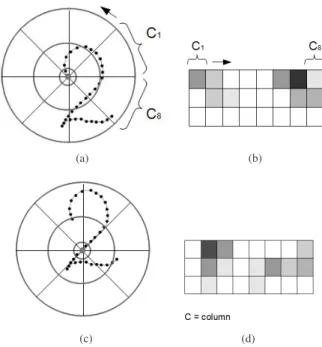
context of a point pi in P is a log polar histogram that expresses the distribution of the remaining points relative to pi [5]. Figure 1 illustrates shape context calculation for two points of a symbol. In that example, the symbol area is divided into 8 angular regions and 3 radial regions, for a total of 24 bins. Each bin contains the quantity of points spatially placed in that bin.
Given that a shape context histogram is defined over a log polar space, the shape context relative to a pointpiis more sensitive to positions of nearby sample points (local features) than those of points farther away (global features) [5].
B. Fuzzy shape context
The shape context descriptor was originally defined over crisp bins. Considering this definition, each point belongs only to one bin of an histogram.
1http://www.isical.ac.in/∼crohme/
(a) (b)
(c) (d)
Figure 1. Shape context of two points of a symbol “2”: (a) and (c) show the sampled points and log polar histogram bins used to calculate shape context. (b) and (d) show the shape context histogram relative to (a) and (c) respectively. Dark cells mean higher values.
During the sampling process or due to handwritten vari-ability, small changes in sampled points may be generated. These changes may affect specially points falling near to the limits of bins: small displacements near to the end of a bin may change the total of number of points in that bin.
We extend the shape context definition by considering bins as fuzzy sets, as shown in figure 2.
(a)
(b)
Figure 2. Fuzzy bins in the (a) radial and (b) angular coordinates. The arrows in the angular coordinates indicate the continuation given by the circular nature of shape context.
Given a shape context histogramH = {Binij}, where i indexes the bins relative to radial coordinate and j indexes bins in the angular coordinate. For a pointP = (Pl, Pθ), that lies in a bin Binij, the membership value of point P
is given by:
Mij(P ) = αi∗ βj (2)
where αi and βj are between 0 and 1 and indicate the confidence value of P lying inBinij relative to the radial and angular coordinates, respectively. When P lies in an intercepting region, the values αi and βj are calculated according to its position relative to the corresponding co-ordinate, otherwise they take the value 1. For example, for the point in P in figure 2, the confidence values will be:
αi= PBl− Al
l− Al (3)
βj= PBθ− Aθ
θ− Aθ (4)
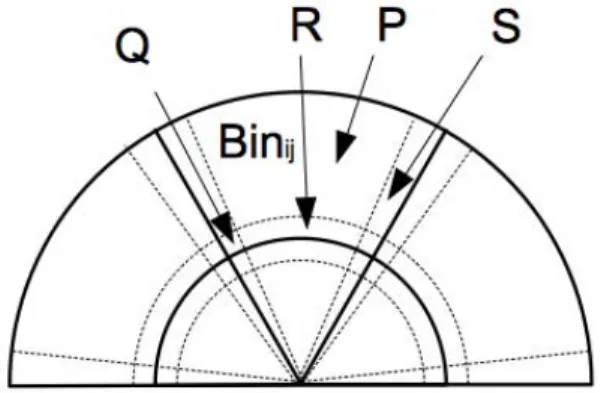
Note that with these new definitions, depending on its position, a point may belong up to four bins. Figure 3 shows four different positions for calculating the membership val-ues:
• P position, only binBijreceives a non-zero value (=1), • R position, binBij and a radial-connected bin receive
non-zero values,
• S position, bin Bij and an angular-connected bin re-ceive non-zero values,
• Q position, bin Bij and three connected bins receive non-zero values
Figure 3. Four different positions in a binBinij. Regions between dotted lines indicate transition areas between bins
C. Shape contexts as input features for Neural Networks Shape contexts has generally been applied using a shape matching approach: given two sets of points P = {p1, . . . , pn} and Q = {q1, . . . , qn}, to calculate a similarity betweenP and Q, shape context is calculated at each point and a best matching between between points of P and Q is calculated, using the χ2 metric [5].
However, in a previous work, we showed that using shape contexts as input features for neural networks, results are
comparable to the matching based approach, but with a considerable efficiency improvement [12].
When using shape contexts within neural networks, we can reduce number of features without decreasing perfor-mance. As shape contexts of near points tend to be similar, we do not need to calculate shape contexts at each sampled point. In contrast, we can keep the rate of sampled points (for instance, 30 points per symbol), but extract shape contexts of only a subset of points. For example, when using online data, shape contexts of some consecutive (in time) points could be avoided.
In our shape context implementation, we used 3 radial regions and 8 angular regions, for a total of 24 bins. We extracted 30 points per symbol but only calculated shape contexts of eight equally distributed (in time order) points. These values were determined in a previous work [12]. Accordingly, the size of a SC and F-SC feature vector is 8 x 24 = 192.
D. Online Features
As mentioned above, we also extracted raw online data. For each sampled point, 7 features are extracted: (2) nor-malized coordinates, sin and cousin of the direction and curvature (4) and a binary value (0 or 1) that indicates the state of the stylus in the point [13]. As in this case we also extract 30 points per symbol, the dimension of the feature vector is 30 x 7 = 210.
IV. EXPERIMENTATION
A. Experimental setup
To evaluate the proposed methods, we used the CROHME 2013 dataset 2 [6]. This dataset includes expressions
col-lected from several laboratories around different countries through several kinds of input devices, as digital pen tech-nologies, white-boards and tablets with sensible screens. Given this variety of devices, symbols were sampled in different scales and resolutions.
The dataset is divided into a training part with 8, 835 mathematical expressions and 85,803 symbols and a test part with 671 expressions and 5,889 symbols. The number symbol classes is 101.
Using the CROHME-IV symbol generator tool, we gen-erated 74,285 false symbol hypothesis from the training expressions and 5,276 from the test expressions. Thus, in our evaluation, the ratio between true and false hypothesis is near 1.
It is important to note that symbols which are considered here come from entire mathematical expressions. Hence, a symbol might be influenced by its context. For example, symbols written before and after a symbol X may influence the way people write X. This may have introduced more variability on symbol classes.
2The CROHME 2013 dataset is publicly available at: http://www.
For training neural networks, we split the training data and perform a cross-validation scheme. In this scheme, we selected a Multi Layer Perceptron neural network with one hidden layer containing 150 units when the two sets of features are used separately. When both feature sets are used jointly, we also selected one hidden layer but, in this case, it is composed of 200 units.
We evaluate our methods using symbol recognition rate (SRR), false acceptance rate (FAR) and false rejection rate (FRR). Considering Table I, FAR and FRR are calculated as:
F AR = #{{Accepted junk} ∪ {Rejected junk}}#{Accepted junk} (5) F RR = #{{Accepted symbol} ∪ {Rejected symbol}}#{Rejected symbol}
(6)
Table I
SYMBOL HYPOTHESES CLASSIFIER OUTCOMES FORFARANDFRR Output Actual class
Symbol Junk Accepted Accepted symbol Accepted junk Rejected Rejected symbol Rejected junk
From the{Accepted symbol} set, we determine the sym-bols that have been correctly classified (between the 101 classes): {Correct classification}. Thus, we calculate SRR as:
SRR = #{Correct classification}#{Accepted symbol} (7) In the context of a mathematical recognition system, low FAR values allow us to reduce the search space for the correct segmentation and classification search. On the other hand, low FRR values allow us to keep more true hypotheses for a posterior final recognition, for example using the complete expression structure.
B. Results and discussion
Results relative to the Top-1, Top-2 and Top-3 recognition rates for the test set are presented in table II. Regarding to the features used separately, we can see that the F-SC features are the best, with 84.38% Top-1 recognition rate. Considering all features set, the best results were obtained combining SC and F-SC with online features: around86% Top-1 recognition rate in both cases.
It is important to note that some symbols can not be recognized by considering only the symbol information. For example, symbols x, X and × (“\times” latex code) may be handwritten with an identical shape. To solve those ambiguities, context from the mathematical expressions must be used. In these cases, a set of best classifications or top classifications can be used: best possible classifications can
be kept and in the structural analysis step the best class can be selected, considering relations with other symbols. Top-3 recognition rates show that combining both features we can get high confidence of including the true symbol between the possible classes.
Table II
TOP-1, TOP-2ANDTOP-3RECOGNITION RATES. Feature set SRR (%)
Top-1 Top-2 Top-3 SC 83.59 90.00 94.07 F-SC 84.38 89.87 94.45 Online features 82.55 90.15 94.20 Online + SC 86.02 92.47 96.07 Online + F-SC 85.99 92.29 96.13
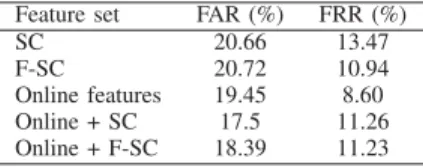
Table III shows results relative to FAR and FRR. In this case, best FAR was obtained by the Online + SC features (17.5%) and best FRR by the online features (8.60%). We can see also that the F-SC version outperforms SC: while the F-SC gets almost the same FAR as the SC, the first has 3% less FRR than the second one.
Note that the FAR and FRR are independent of the ratio symbol/junk in the test set. Although the ratio in the train set (about 1) influence these rates via the training of the classifier, we can see that the obtained FRR and FAR values are far from 50%. This means that our classifier performs much better than a simple random decision with prior probability knowledge.
Table III
FALSE ACCEPTANCE RATE(FAR)ANDFALSE REJECTION RATES(FRR). Feature set FAR (%) FRR (%)
SC 20.66 13.47 F-SC 20.72 10.94 Online features 19.45 8.60 Online + SC 17.5 11.26 Online + F-SC 18.39 11.23
V. CONCLUSIONS ANDFURTHER WORK
In this work, we propose a mathematical symbol hypoth-esis classifier with rejection option. As part of the features set, we propose a new shape context-based feature: Fuzzy Shape Context. In contrast to the common matching based approach, we used shape contexts as input features for neural networks. In this architecture, the F-SC outperforms the SC in terms of recognition rate and FRR. Best recognition rates and FAR were obtained combining both features and best FRR was obtained using only online features.
The good performance of shape context and its combi-nation with online data suggests further research in this area. At this regard, an important issue that can be studied is the way we extract shape context. As described above, in the current approach, we extract shape contexts at eight
equally distributed (in time order) points. As a result, shape contexts is also influenced by the online information: the order in which strokes are introduced or writing direction may change the order in which shape contexts are input to the neural networks. To obtain totally offline features, we could extract shape contexts at some key points, for example, the center bounding box of a symbol.
The proposed classifier and future improvements will be integrated and evaluated into a handwritten mathematical expression recognition system.
REFERENCES
[1] N. E. Matsakis, “Recognition of handwritten mathematical expressions,” Master’s thesis, Massachusetts Institute of Tech-nology, Cambridge, 1999.
[2] S. MacLean and G. Labahn, “A new approach for recogniz-ing handwritten mathematics usrecogniz-ing relational grammars and fuzzy sets,” International Journal on Document Analysis and
Recognition (IJDAR), vol. 16, no. 2, pp. 139–163, 2013.
[3] F. ´Alvaro, J.-A. S´anchez, and J.-M. Bened´ı, “Recognition of on-line handwritten mathematical expressions using 2d stochastic context-free grammars and hidden markov models,”
Pattern Recognition Letters, no. 0, pp. 58 – 67, 2012.
[4] A.-M. Awal, H. Mouch´ere, and C. Viard-Gaudin, “A global learning approach for an online handwritten mathematical expression recognition system,” Pattern Recognition Letters, vol. 35, no. 0, pp. 68 – 77, 2012.
[5] S. Belongie, J. Malik, and J. Puzicha, “Shape matching and object recognition using shape contexts,” IEEE Trans. Pattern
Anal. Mach. Intell., vol. 24, pp. 509–522, April 2002.
[6] H. Mouchere, C. Viard-Gaudin, U. Garain, D. H. Kim, K. J. H., and Z. R. (2013, April) Icdar 2013 crohme: Competition on recognition of online handwritten mathematical expres-sions.
[7] B. Huang and M.-T. Kechadi, “A structural analysis approach for online handwritten mathematical expressions,” in
Interna-tional Journal of Computer Science and Network Security,,
2007.
[8] S. Lehmberg, H.-J. Winkler, and M. Lang, “A soft-decision approach for symbol segmentation within handwritten math-ematical expressions,” in International Conference on
Acous-tics, Speech, and Signal Processing, 1996. ICASSP-96. Con-ference Proceedings, 1996 IEEE, vol. 6, May 1996, pp. 3434–
3437 vol. 6.
[9] E. Tapia, “Understanding mathematics: A system for the recognition of on-line handwritten mathematical expression,” Ph.D. dissertation, Freie Universitt Berlin, 2004.
[10] L. Prasanth, V. Babu, R. Sharma, G. V. Rao, and D. M., “Elastic Matching of Online Handwritten Tamil and Telugu Scripts Using Local Features,” in Proceedings of the Ninth
International Conference on Document Analysis and Recog-nition - Volume 02, 2007, pp. 1028–1032.
[11] Z. Wang, B. Lu, Z. Chi, and D. Feng, “Leaf image classi-fication with shape context and sift descriptors,” in Digital
Image Computing Techniques and Applications (DICTA), 2011 International Conference on, 2011, pp. 650–654.
[12] F. Julca-Aguilar, C. Viard-Gaudin, H. Mouch`ere, S. Medjk-oune, and N. Hirata, “Integration of shape context et neural networks for symbol recognition,” in Semaine du Document
Num´erique et de la Recherche d’Information 2014 (SDNRI),
2014.
[13] A.-M. Awal, “Reconnaissance de structures bidimensionnelles : Application aux expressions mathmatiques manuscrites en-ligne,” Ph.D. dissertation, Image and VideoCommunication, research group, IRCCyN, 2010.