Titre:
Title
:
Gas sensing with SU-8 whispering gallery mode resonators
Auteurs:
Authors
:
Cédric Lemieux-Leduc, Régis Guertin, Marc-Antoine Bianki et
Yves-Alain Peter
Date: 2018
Type:
Communication de conférence / Conference or workshop itemRéférence:
Citation
:
Lemieux-Leduc, C., Guertin, R., Bianki, M.-A. & Peter, Y.-A. (2018, juillet). Gas
sensing with SU-8 whispering gallery mode resonators. Communication écrite
présentée à International Conference on Optical MEMS and Nanophotonics (OMN 2018), Lausanne, Suisse (2 pages). doi:10.1109/omn.2018.8454653
Document en libre accès dans PolyPublie
Open Access document in PolyPublieURL de PolyPublie:
PolyPublie URL: https://publications.polymtl.ca/6275/
Version: Version finale avant publication / Accepted version Révisé par les pairs / Refereed Conditions d’utilisation:
Terms of Use: Tous droits réservés / All rights reserved
Document publié chez l’éditeur officiel
Document issued by the official publisherNom de la conférence:
Conference Name:
International Conference on Optical MEMS and Nanophotonics (OMN 2018)
Date et lieu:
Date and Location: Lausanne, Suisse, 2018-07-29 - 2018-08-02 Maison d’édition:
Publisher: IEEE URL officiel:
Official URL: https://doi.org/10.1109/omn.2018.8454653 Mention légale:
Legal notice:
© 2018 IEEE. Personal use of this material is permitted. Permission from IEEE must be obtained for all other uses, in any current or future media, including
reprinting/republishing this material for advertising or promotional purposes, creating new collective works, for resale or redistribution to servers or lists, or reuse of any copyrighted component of this work in other works.
Ce fichier a été téléchargé à partir de PolyPublie, le dépôt institutionnel de Polytechnique Montréal
This file has been downloaded from PolyPublie, the institutional repository of Polytechnique Montréal
Gas sensing with SU-8 whispering gallery mode
resonators
Cédric Lemieux-Leduc, Régis Guertin, Marc-Antoine Bianki, and Yves-Alain Peter Department of Engineering Physics, Polytechnique Montréal
Montréal, Canada
E-mail: [email protected]; [email protected]
Abstract—We present an optical gas sensor using SU-8 microdisk whispering gallery mode resonators. Sensitivities were measured for different vapor phases: water, toluene, limonene and valeric acid. The highest reported sensitivity is 18.98 pm/ppm.
Keywords—gas sensor, whispering gallery mode, SU-8 I. INTRODUCTION
The detection of volatile organic compounds (VOC) motivates the development of devices based on several sensing mechanisms. Most detection methods have flaws and limitations like energy consumption that prevent them from being used in harsh environments. Optical gas sensors are a suitable solution for monitoring in such media like explosive environments or in high electromagnetic fields since electronics are not required to be connected to the device. We previously reported an interferometric sensor based on a silicon Fabry-Pérot microcavity functionalized with polymers [1]. The polymer inserted in the cavity absorbs gases, thus modifying the optical length of the cavity, and inducing a spectral shift of the resonance modes. Selected polymers exhibit unequal absorption for different gases [2]. Selective measurement of gases is then possible by monitoring cavities with different polymers at the same time. Whispering Gallery Mode (WGM) resonators are attractive optical sensors thanks to their high-quality factor. In these circular-shaped cavities, light undergoes total internal reflection and resonance occurs for wavelengths matching the constructive interference conditions.
Typical WGM chemical sensors are silica microtoroids or microspheres functionalized with a thin polymer coating and able to detect a spectral shift [3]. The spectral shift ∆ caused by the polymer’s absorption of an analyte can be expressed by the following equation:
∆
= ∆ +∆ (1)
where is the wavelength where the spectral shift is probed, the radius of the cavity with its change due to swelling ∆ and the refractive index of the cavity with the change ∆ coming from the mix of analyte and the polymer. The spectral shifts achieved by this method are limited by the capacity of the coating to absorb a specific analyte and its swelling.
We propose an all-polymer WGM microcavity standing on a silicon pedestal which increases the absorption capacity and the
swelling effect. The polymer used to fabricate the WGM cavities is SU-8, which is a negative photoresist with excellent mechanical and thermal properties broadly used to fabricate optical waveguides with high-transparency in the visible and telecommunication wavelengths. It has been previously used in the fabrication of an integrated humidity sensor [4], but the swelling of the cavity is restricted since the WGM cavity is attached to the substrate.
II. FABRICATION AND METHODOLOGY
The fabrication of the WGM resonators first requires the patterning of SU-8 photoresist spin-coated directly on silicon. Then a dry chemical etch of silicon with SF6 is performed to
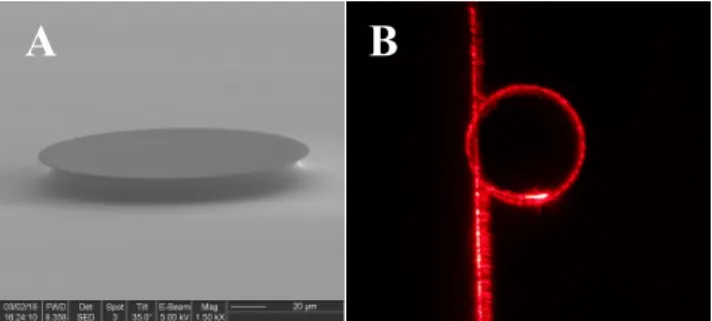
shape the silicon pedestal. The silicon pedestal, which has a higher refractive index than the disk, acts as a sink for the higher-order radial modes of the cavity. The number of remaining radial modes is inversely proportional with the size of the pedestal. Cavities with a 60-µm radius and a thickness of 700 nm were tested for this study and the radius of the pedestal is approximately 50 µm. The measured quality factor at 1549 nm is 2×10⁴ and the free spectral range (FSR) of this resonance peak is approximately 4 nm. Figure 1 shows pictures of the resonator.
Fig. 1. (A) SEM image of an SU-8 microcavity ( = 60 µm) with a silicon pedestal. (B) Photograph of a tapered fiber coupling into the microcavity with a red laser.
A schematic of the experimental setup is shown in Figure 2. Light is coupled to the microcavity using a 1-µm tapered SMF28 fiber to probe the transmission of the WGM. An infrared tunable laser source is used for the optical characterization of the microcavities. A custom fibered tunable laser source ranging from 1500 nm to 1620 nm is used for fast acquisition of the spectra with an optical power meter. Solvents are placed in a bubbler and injected with nitrogen to reach their saturated concentration. The analyte is then mixed with a background
nitrogen flow and brought to the cavity in a sealed environment. Spectra were sampled at different concentrations of analyte to observe the related spectral shift.
Fig. 2. Configuration of the experimental setup.
III. RESULTS AND DISCUSSION
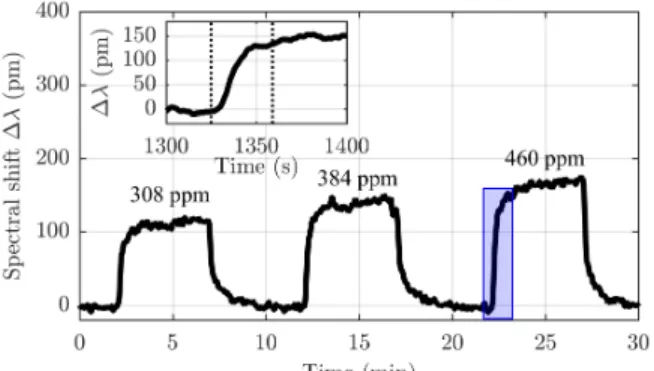
Figure 3 shows the measured spectral shift of a resonance peak at 1549 nm over time as the cavity is exposed to different concentrations of toluene. Inset in Figure 3 shows a zoom of the transient region for the third gas exposition for which the response time (time to reach 90 % of the maximal shift) is roughly 34 s. The response time is mainly limited by the diffusion of the gas through the setup. Figure 4 shows spectral shifts of the cavity in function of different concentrations of toluene. The sensitivity values for humidity, valeric acid, toluene and limonene were calculated by applying a linear regression on the spectral shifts. The limit of detection (LOD) is then calculated by taking three times the standard deviation of the signal divided by the sensitivity.
Fig. 3. Response of the device for different concentrations of toluene.
Table I reports the calculated sensitivity and limit of detection of the WGM microcavity for each gas tested in comparison to previously reported data from the Fabry-Pérot cavity functionalized with SU-8 [2]. The resonator shows a high sensitivity to valeric acid with 18.98 pm/ppm and a LOD of
2 ppm. Humidity and toluene have lower sensitivities than valeric acid by two orders of magnitude (0.18 and 0.36 pm/ppm respectively) while sensitivity to limonene is lower than valeric acid by one order of magnitude (5.12 pm/ppm). The same pattern can be seen with the Fabry-Pérot cavity. For the same gases, the sensitivity with the WGM cavity is higher than the Fabry-Pérot cavity by one order of magnitude. The sensitivity of the device depends on many parameters such as the radius and the thickness of the resonator as well as the size of the silicon pedestal. Upcoming work includes a study of the effect of these parameters on the sensitivity and tests with other gases.
Fig. 4. Spectral shifts in function of concentration for toluene.
IV. CONCLUSION
Selectivity of an SU-8 microdisk was measured for different gases and the device was found to be more sensitive to valeric acid than humidity, toluene and limonene. Furthermore, this cavity has a higher sensitivity than the functionalized Fabry-Pérot [2] by about one order of magnitude for the same gases tested.
ACKNOWLEDGMENT
Fabrication was performed at the GCM clean room at Polytechnique Montréal with financial support from CMC Microsystems. Financial support was provided by the Natural Sciences and Engineering Research Council of Canada.
REFERENCES
[1] R. St-Gelais et al., “Gas sensing using polymer-functionalized deformable Fabry-Pérot interferometers,” Sensors & Actuators B: Chemical, vol. 182, pp. 45-52, 2013.
[2] P. Jubinville et al., “Selective in-plane Fabry-Pérot gas sensor functionalized with polymer,” in IEEE/Photonics International Conference on Optical MEMS and Nanophotonics, pp. 117-118, 2017. [3] M. Foreman et al., “Whispering gallery mode sensors,” Advances in
Optics and Photonics, vol. 7(2), pp. 168-240, 2015
[4] M. Eryürek et al., “Integrated humidity sensor based on SU-8 polymer microdisk microresonator,” Sensors & Actuators B: Chemical, vol. 242, pp. 1115-1120, 2017.
TABLE I. CALCULATED SENSITIVITIES AND LIMITS OF DETECTION
This work Fabry-Pérot functionalized with SU-8
Analyte Sensitivity (pm/ppm) LOD (ppm) Sensitivity (pm/ppm) LOD (ppm)
Humidity 0.18 190 0.02 - Valeric acid 18.98 2 1.39 - Toluene 0.36 57 0.06 201 Limonene 5.12 6 0.35 99