THIS IS NOT THE LAST VERSION
1
Updating Frasnian miospore zonation from the Boulonnais (Northern France) and comparison with
2
new data from the Upper Palaeozoic cover on the Brabant Massif (Western Belgium)
3
M. Streel (1)*, F. Boulvain (2), M. Dusar (3), S. Loboziak (4), P. Steemans (1), 4
(1) EDDy Lab/Palaeopalynology, Bât B-18, University of Liège, B-4000 Liège, Belgium. 5
(2) Sedimentary Petrology, Bât B-20, University of Liège, B-4000 Liège, Belgium. 6
(3) Royal Belgian Institute of Natural Sciences-Geological Survey of Belgium, B-1000 Brussels, Belgium 7
(4) Deceased 8
* Corresponding author: [email protected] 9
Abstract: Accurate palyno-analysis by S. Loboziak (from 1980 to 1983) of 28 samples from the
10
Upper Givetian to the Middle Frasnian Blacourt, Beaulieu and Ferques Formations and of 44 samples 11
of the Upper Frasnian to the Lower Famennian Hydrequent Formation are reevaluated. Chelinospora 12
concinna, Verrucosisporites bulliferus, Cirratriradites jekhowskyi, Lophozonotriletes media first
13
occurrences are major criteria for Lower and Middle Frasnian, well calibrated by conodonts. 14
Cymbosporites acanthaceus, Rugospora bricei, Grandispora gracilis, Diducites plicabilis, Corbulispora
15
vimineus first occurrences allow to subdivide the Upper Frasnian where conodonts are poorly
16
present. Samarisporites triangulatus versus Auroraspora pseudocrista taxonomy and stratigraphic 17
significance are discussed. 18
The reconnaissance borehole Nieuwkerke-De Seule (95W152), near the limit of the Upper Palaeozoic 19
subcrop on the Brabant Massif (West Flanders, Belgium, 75 km east of the Boulonnais), which has 20
intersected conodont-dated Givetian/Frasnian boundary at the transition between the Bois de 21
Bordeaux and Bovesse Formations, contained poorly preserved miospores attributed to the 22
triangulatus-concinna (TCo) Oppel Zones. In the nearby Nieuwkerke-Noordhoek borehole (95W153),
23
strata also assigned to the Bovesse Formation yielded better preserved miospores which 24
demonstrate a close succession of triangularis-concinna (TCo) and bulliferus-jekhowskyi (BJ) Oppel 25
Zones at the transition Lower –Middle Frasnian, also known in the Beaulieu Formation in the 26
Boulonnais. 27
Samples from the Heuvelland piezometric well (95W175), 10 km north of Nieuwkerke, contain the 28
bricei-acanthaceus (BA) Oppel Zone suggesting a late Frasnian age, also known in the Hydrequent
29
Formation in the Boulonnais area and in the Booischot Formation in the Booischot borehole (59E146) 30
from the Campine Basin (Belgium). 31
International correlation using Frasnian miospore zonation is attempted between the Pripyat 32
Depression in Belarus, the Timan-Pechora province in Russia and North-West China. 33
Keywords: biostratigraphy, Oppel Zones, Boulonnais, Flanders, Russia, China.
34
Introduction
35
History: Frasnian miospores from the Boulonnais (Northern France) were first described and
36
illustrated from one sample collected in the Beaulieu Formation believed to belong to the Lower 37
Frasnian (Taugourdeau-Lantz, 1960). Most taxa were tentatively identified by comparison with the 38
rich Upper Devonian miospore drawings from the Russian Platform (Naumova 1953). Several species 39
were updated and re-illustrated in further papers (Taugourdeau-Lantz, 1967a, b), a first palyno-40
stratigraphic chart covering the whole Frasnian being given in Taugourdeau-Lantz (1967a). The 41
stratigraphic chart, illustration and description of miospores were again updated (Taugourdeau-42
Lantz, 1971). 43
A new section showing in succession the Blacourt Formation and the Beaulieu Formation was then 44
made available in the railway track Caffiers-Ferques allowing, among other fossils, ten conodont 45
faunas to be identified (Brice et al., 1979). These new detailed stratigraphic data have encouraged us 46
to restudy the miospores produced in three papers concerning respectively the Givetian-Lower 47
Frasnian (Loboziak & Streel, 1980) and the Middle-Upper Frasnian to Lower Famennian (Loboziak & 48
Streel, 1981, Loboziak et al., 1983). All taxa received an identification number (from 1 to 79, see table 49
1, in front of fig.1) reused in a next paper (Loboziak & Streel, 1988) establishing a succession of four 50
formal Oppel Zones: Samarisporites tiangulatus-Rhabdosporites langi (TLa) renamed (Streel et al., 51
1987) S.triangulatus-Ancyrospora ancyrea ancyrea (TA), S.triangulatus-Chelinospora concinna (TCo), 52
Verrucosisporites bulliferus-Cirratriradites jekhowskyi (BJ), V. bulliferus- Lophozonotriletes media
53
(BM) and two informal Zones (IV and V), that were not defined in that paper. These two unformal 54
zones were characterized and subdivided by Streel (2009) as Rugospora bricei-Cymbosporites acanthaceus 55
(BA) and Knoxisporites dedaleus- Diducites versabilis (DV) Oppel Zones. 56
The former TLa Zone, now renamed TA Zone, is typified by the composition of sample G-02 at the 57
base of the Blacourt Formation in the Griset quarry; the TCo Zone is typified by the composition of 58
sample H26 in the upper part of the same formation in the Ferques railroad trench; the BJ Zone is 59
typified by the composition of sample sequence Q52 to Q56 in the Beaulieu Formation in the Ferques 60
railroad trench; the BM Zone is typified by the composition of samples VW5 and VW8 in the Ferques 61
Formation in the Bois quarry (Loboziak & Streel, 1981). The BA Zone, mainly studied in the 23 m of 62
shales above the dolomitic bed (Loboziak et al., 1983, fig. 1) in the Hydrequent Formation in the 63
“Briqueterie de Beaulieu” quarry, is more complex, requiring probably several characteristic samples 64
to typify the subdivisions A to E (fig. 1). The base of the DV Zone in the same quarry, could be typified 65
by sample 109 (this paper). 66
Correalation with other microfossils: The base of TA Zone probably occurs in or below the conodont 67
Middle varcus Zone (FIV on fig. 1), the base of the TCo Zone ranging from the conodont (FV) Upper 68
varcus to the Lower asymmetricus Zone (Bultynck in Streel et al., 1987). BJ and BM Zones range from
69
the conodont Lower asymmetricus Zone to as far as the conodont Ancyrognathus triangularis Zone 70
(Brice et al., 1981). 71
We had attempted to provide a stratigraphic control of the Frasnian/Famennian Boundary 72
(conodonts being poorly present in the Upper Frasnian of the Boulonnais), using acritarchs “dated” 73
by conodonts in the type region from the Ardenne (Vanguestaine, 1986, Martin, 1993, Streel et al., 74
2000a). The conclusion was that the higher part of the BA Oppel Zone (BA plic Subzone, starting with 75
the first occurrence of Diducites plicabilis in Streel, 2009) ranges from the conodont upper 76
Palmatolepis gigas Zone to the upper Palmatolepis triangularis Zone and contains therefore the base
77
of the Famennian Stage (Ziegler & Sandberg, 1990). 78
The acritarch Visbysphaera (?) fecunda (Vf) Zone occurs in samples 217-216 of the Upper Frasnian 79
Hydrequent Formation (Loboziak et al., 1983). The Famennian acritarch Villocapsula globosa (Vg) 80
Zone is not recorded in that section. If one accepts the synonymy (Vanguestaine et al., 1983) of 81
Herkomorphytae sp. A and V.? occultata, as a good marker for the earliest Famennian in Belgium
82
(Martin, 1993), then sample 213 of the Hydrequent Formation might be Famennian. A 83
Frasnian/Famennian Boundary drawn between samples 216 and 213 would match the top of several 84
miospore species recorded in the Upper Frasnian Hydrequent Formation, i.e. Cymbosporites sp. C 85
(75), Aneurospora sp. A (77), A. sp. B (78) and Samarisporites sp. D (79), illustrated and briefly
86
described by Loboziak et al. (1983). 87
Comments on the first occurrence (FOB) of main taxa: Most of these papers show the range of each 88
taxon by a line joining the first and last occurrences. This failed in not showing the quantity of data 89
these ranges were built upon and did not enable us to evaluate the likelihood of the “presence” 90
criterion. Fig. 1 shows (according to data still available and unmodified), the presence of the selected 91
taxa in each sample (28 samples of the Upper Givetian to the Middle Frasnian Blacourt, Beaulieu and 92
Ferques Formations and 44 samples of the Upper Frasnian to the Lower Famennian Hydrequent 93
Formation, all slides scanned by Stanislas Loboziak at Lille. The corresponding slides have not been 94
revised for the present paper). One can observe then that C. concinna (38), V. bulliferus(45), C. 95
jekhowskyi(39), L. media(50) first occurrences are major criteria for the Lower and Middle Frasnian,
96
and that C. acanthaceus (57), R. bricei(58), G. gracilis(69), D.plicabilis(64) first occurrences allow the 97
subdivision of the Upper Frasnian. 98
It might seem surprising that Samarisporites triangulatus Allen 1965 (syn.: S. euglyphus 99
Taugourdeau-Lantz, 1967b, Cristatisporites triangulatus (Allen) McGregor & Camfield, 1982), the
100
eponymspecies of TA and TCo Oppel Zones, is not retained among the taxa listed here above. 101
Its first occurrence is indeed controversial (Richardson & McGregor, 1986, fig.6; Streel 2009, fig. 3). It 102
might be, in part, the result of differences of palynologist acceptation of the degree of the equatorial 103
flange reaching its maximum width radially even if it is hardly perceptible in the inter-radial regions 104
(Allen 1965, p. 706). Compare, for instance, Allen (1965) plate 99, Richardson & McGregor (1986) 105
plate 15, Loboziak et al. (1991) plate 2. 106
It might also be that Geminospora lemurata(40) was not recognized in the few samples studied in the 107
Blacourt Formation (Loboziak & Streel, 1980, fig. 1) or maybe confused with Aneurospora 108
greggsii(24) (See Streel & Loboziak , 1987 p. 100) showing why Geminospora lemurata is recorded as 109
being older than Samarisporites triangulatus in the Eifel (Loboziak et al., 1991) as in Canada and 110
European Russia according to Richardson & McGregor (1986). 111
The stratigraphic range of S. triangulatus is also questionable. According to Richardson & McGregor 112
(1986), it occurs in their optivus-triangulatus and ovalis-bulliferus assemblage Zones corresponding 113
to the TA, TCo, BJ, BM and the lower part of BA Oppel Zones. Allen (1982, figs 2 and 3) has recorded 114
many occurrences of this species and possible synonyms in the Northern hemisphere and suggests 115
they range from Upper Givetian to Middle Frasnian. 116
However, in the Boulonnais, we had noted S. triangulatus as high as the top of the Frasnian. 117
Allen (1982) explains that its stratigraphic value is enhanced by the fact that the characteristic zona 118
with a maximum width radially, can usually be identified even in poorly preserved specimens. It 119
should be noted that such poorly preserved specimens might as well correspond to Auroraspora 120
pseudocrista Ahmed 1980 ranging from the uppermost Frasnian into the Famennian and which often 121
demonstrates one or more maximum width radially. 122
123
The reconnaissance boreholes De Seule (95W152, renamed 110W7) and
Nieuwkerke-124
Noordhoek (95W153)
125
These partly cored boreholes were drilled near the limit of the Upper Palaeozoic subcrop on the 126
Brabant Massif (West Flanders, Belgium, 75 km east of the Boulonnais) (Figs. 2 and 3). They are north 127
of the Brabant Parautochthon, and within the Upper Paleozoic cover of the Brabant Massif 128
unaffected by the Variscan orogeny (Belanger et al., 2012). All facies indications and correlations with 129
the Tournai, Vieux-Leuze and Annapes boreholes suggest a correlation to the lower part of the 130
Bovesse Formation (or Beaulieu Formation in the Boulonnais) of the Frasnian strata in the 131
Nieuwkerke boreholes (Coen-Aubert et al., 1980, Legrand, 1981, Dusar & Loy, 1986). 132
Nieuwkerke (95W152) which has penetrated conodont-dated Givetian/Frasnian boundary at the 133
transition between the Mazy Member and the Bovesse Formation (Fig. 4), contained poorly 134
preserved miospores attributed to the Samarisporites triangulatus-Chelinospora concinna (TCo) 135
Oppel Zone (Tourneur et al., 1989). They are listed on Table 2. 136
Nieuwkerke-Noordhoek (95W153) provided 3 samples from the Bovesse Formation with rather well 137
preserved miospores listed also on Table 2, suggesting proximity to the Lower/Middle Frasnian 138
boundary. 139
The youngest sample (219m) contains Cirratriradites jekhowskyi (39) with Chelinospora concinna 140
(38), both taxa coexisting in the lower part of the Verrucosisporites bulliferus-Cirratriradites
141
jekhowskyi (BJ) Oppel Zone.
142
In the sample at 221,5m, Retusotriletes rugulatus(30) and Verrucosisporites bulliferus(45) suggests a 143
close proximity to the top of the Samarisporites triangulatus-Chelinospora concinna (TCo) Oppel 144
Zone and the base of the Verrucosisporites bulliferus-Cirratriradites jekhowskyi (BJ) Oppel Zone. 145
In the sample 223,7m, Grandispora velata(22) and Corystisporites multifurcatus(42) belong to the 146
Samarisporites triangulatus-Chelinospora concinna (TCo) Oppel Zone.
147
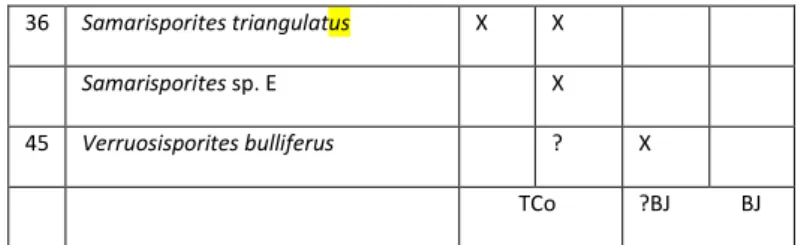
Table 2: Main taxa recorded in the boreholes Nieuwkerke-De Seule (95W152) and Nieuwkerke-Noordhoek (95W153). 148
A: Identification numbers of taxa, B: List of taxa. C: Taxa recorded in Nieuwkerke (95W152) after Tourneur et al., 1989. 149
D,E,F : Taxa recorded in the present paper in Nieuwkerke-Noordhoek (95W153): D=223,7m, E=221,5m, F=219m, this paper. 150
FOB key species presences are underlined. 151
A B C D E F
31 Ancyrospora langii X
37 Ancyrospora angulata X X
13 Ancyrospora ancyrea ancyrea X
24 Aneurospora greggsii X X X
Auroraspora aff. pseudocrista X
38 Chelinospora concinna X 39 Cirratriradites jekhowskyi X 42 Corystisporites multispinosus X X 6 Dibolisporites cf. gibberosus X 28 Dibolisporites echinaceus X 29 Emphanisporites spp X 40 Geminospora lemurata X X X X 22 Grandispora velata X 21 Grandispora inculta X 33 Hystricosporites spp. X X X 34 Perotrilites ergatus X 30 Scylaspora rugulata X Retusotriletes confossus X 35 Rhabdosporites parvulus X
36 Samarisporites triangulatus X X Samarisporites sp. E X 45 Verruosisporites bulliferus ? X TCo ?BJ BJ 152 153 154
. The Heuvelland piezometric well (95W175), in Westouter, 10 km north of Nieuwkerke.
155
This well has also traversed Frasnian shales covering the Brabant Massif, albeit in a north dipping 156
position resulting in the subcrop of younger strata. One cuttings sample from the interval 260,00m – 157
262,00m, assigned to the Franc-Waret Formation, contains the taxa recorded on table 3. 158
Diducites plicabilis (64) and Grandispora gracilis (69) belong to the upper part (BA plic) of the Oppel
159
Zone BA. 160
Samarisporites sp. E and Pavonisporites costulatus (Taugourdeau-Lantz) Taugourdeau-Lantz, 1971 161
are known in the Mid-Late Frasnian from the Booischot borehole from the Brabant Massif (Streel & 162
Loboziak, 1987). Pavonisporites costulatus (Taugourdeau-Lantz) Taugourdeau-Lantz, 1971 was 163
originaly recorded as Lagenoisporites costulatus by Taugourdeau-Lantz (1960) in the Middle Frasnian 164
in the Boulonnais Region. 165
Auroraspora pseudocrista Ahmed 1980, Teichertospora torquata (Higgs) McGregor & Playford 1990 166
and Lophozonotriletes lebedianensis Naumova 1953 belong to the torquata-gracilis assemblage 167
Zone of Richardson & McGregor 1986, ranging from the uppermost Frasnian up to the Famennian. 168
In conclusion the sample contains the bricei-acanthaceus (BA) Oppel Zone suggesting an Upper 169
Frasnian age, also known in the Hydrequent Formation in the Boulonnais (France) and in the 170
Booischot Formation in the Booischot borehole (59E146) from the Campine Basin (Belgium). 171
172
Table 3: miospores recorded in the Heuvelland piezometer (95W175) 173
(14) Ancyrospora ancyrea var. brevispinosa Richardson 1962 174
(31) cf. Ancyrospora langii (Taugourdeau-Lantz) Allen 1965
175
(24) Aneurospora greggsii (McGregor) Streel 1974 176
aff. Archaeoperisaccus sp. 177
Auroraspora pseudocrista Ahmed 1980
178
(42) Corystisporites multispinosus Richardson 1965 179
(64) Diducites plicabilis Van Veen 1981 180
(29) Emphanisporites spp. 181
(69) Grandispora gracilis (Kedo) Streel 1974 182
(33) Hystricosporites spp. 183
Pavonisporites costulatus (Taugourdeau-Lantz) Taugourdeau-Lantz 1971
184
cf. Lophozonotriletes lebedianensis Naumova 1953 185
cf. Retusotriletes crassus Clayton et al. 1980 186
(36) Samarisporites triangulatus Allen 1965 187
Samarisporites sp. cf. Acanthotriletes hirtus Naumova 1953
(79) Samarisporites sp. D in Loboziak, Streel & Vanguestaine 1983 189
cf. Teichertospora torquata (Higgs) McGregor & Playford 1990. 190 191 192 193 194 195
The Booischot borehole (59E146) from the Campine Basin (Belgium) (Figs. 2 and 4).
196
The Booischot geological reconnaissance borehole (59E146), drilled in the Campine Basin, north of 197
the Brabant Massif, encountered at the base of Upper Palaeozoic a thick sequence of red and green 198
conglomerates, assigned to the Booischot Formation (Lagrou & Coen-Aubert, 2017). The upper part 199
of the Booischot Formation had been investigated by Streel (1965) and Streel & Loboziak (1987). 200
Between 1002 and 994.5 m, the Verrucosisporites bulliferus- Lophozonotriletes media (BM) Oppel 201
Zone recognized by Streel & Loboziak (1987) is correlated in the Boulonnais, with the conodont zones 202
occurring between the Middle Polygnathus asymmetricus and Ancyrognathus triangularis Zones. 203
Higher in the borehole, Streel & Loboziak (1987) identified between 940 m and 900.5 m the miospore 204
interval Zones IV A, C and E present in the upper part of the Hydrequent Formation from the 205
Boulonnais. Their miospore zonation as well as the distribution of characteristic miospores and 206
acritarchs have been reviewed by Streel (2000a), p. 131, fig. 13). In this paper, the authors correlated 207
the miospore Zones IV B, C and partly D with the Upper Palmatolepis rhenana conodont Zone (See 208
Coen-Aubert 2014, Lagrou & Coen-Aubert 2017). Streel (2009) had renamed the IV Regional Zone as the 209
Rugospora bricei-Cymbosporites acanthaceus (BA) Oppel Zone and the V Regional Zone as the Knoxisporites
210
dedaleus –Diducites versabilis (DV) Oppel Zone.
211 212
Nomenclatural notice.
213
Several species of Samarisporites first occurring in the BA Zone were illustrated but left in open nomenclature by 214
Loboziak & Streel 1981, Loboziak et al. 1983 and Streel & Loboziak (1987). The opportunity is now taken to 215
regularize their status. 216
Samarisporites sp. A (54) in Loboziak & Streel, 1981, plate II: 7, 8.
217
1965. “Gen. nov.” in Streel 1965, plate 1: 4-6. 218
1974. Samarisporites sp. cf. Hymenozonotriletes acanthyrugosus Chibrikova 1959 in Becker et al. 1974, pl. 18: 8. 219
1987. Samarisporites sp. A in Streel & Loboziak 1987, plate 1: 7. 220
Thick, often dark, spherical central body and thin narrow equatorial wing, sometimes slightly expanding in front of 221
the trilete rays. Ornaments are mainly composed, on the distal and equatorial surfaces, of narrow spines, 2-3 µm 222
high. Comparable with Samarisporites sp. 2 in Breuer & Steemans 2013, which differs in being significantly bigger. 223
?Samarisporites sp. B (73) in Loboziak, Streel & Vanguestaine 1983, plate 1:11.
224
Rounded central body and a reticulate ornamentation with a broad mesh (fields are 10µm in 225
diameter) and high (2-5µm high) diaphanous muri which might be confused with the equatorial thin 226
membrane and the high lips of the trilete mark. The generic identification remains doubtful. 227
Samarisporites sp. C (76) in Loboziak, Streel & Vanguestaine 1983, plate 2: 4-6.
228
1989. Cf. also Samarisporites triangulatus in Loboziak & Streel 1989, plate IV: 6-8. 229
Rounded central body and equatorial wing reaching up to one third of the spore radius, expanding in front of the 230
trilete rays. Ornaments are mainly composed, on the distal and equatorial surfaces, of coni reaching sometimes 2 231
-3µm high and 2µm wide. This taxon might well be part of a S. triangulatus sensu lato morphon yet to be defined 232
(See also Allen 1982). 233
Samarisporites sp. D (79) in Loboziak, Streel & Vanguestaine 1983, plate 2: 2-3.
234
1988. Samarisporites sp. D, in Loboziak & Streel 1988, plate 3: 14. 235
Equatorial margin subtriangular. Ornament of coni (up to 2µm high and wide) borne on irregular 236
crests that are more or less fused in an imperfect reticulum (mesh 3-6µm). Ornamentation denser on 237
polar area than on the zona which reaches sometimes to one half of the spore radius. 238
Samarisporites sp. E in Streel & Loboziak 1987, plate 1: 10.
239
1965. Calyptosporites microspinosus Richardson 1962 in Streel 1965, plate II: 10. 240
1974. Samarisporites sp. aff. S. inusitatus Allen 1965 in Becker et al. 1974, plate 18: 7. 241
1981. Samarisporites triangulatus Allen 1965 in Loboziak & Streel 1981, plate II: 3. 242
1989. Samarisporites sp. E in Loboziak & Streel 1989, plate IV: 9. 243
Non Samarisporites triangulatus Allen 1965 in Loboziak & Streel 1981, plate II: 4-5. 244
Rounded central body and equatorial margin subtriangular. Ornament of small verrucae and sometimes 245
coni (up to 2µm high and wide) borne on irregular crests to form a more or less fused imperfect 246
reticulum (smaller mesh than in Samarisporites sp. D.). Compare with Samarisporites inusitatus Allen 1965 247
(See Breuer & Steemans 2013, fig. 40: B-C) which has an equatorial margin that is less triangular in shape and with 248
rare spines on the verrucae. 249
Samarisporites triangulatus Allen 1965 in Loboziak & Streel 1981, plate II: 4-5. = Cristatisporites deliquescens 250
(Naumova) Arkhangelskaya in Obukhovskaya et al. 2000, plate 1:1, plate 4:2. 251
1981. Samarisporites cf triangulatus Allen 1965 in Loboziak & Streel 1981, plate II: 6. 252
1987 Samarisporites sp. F in Streel & Loboziak 1987, plate1: 5?-6.
253
1991. Samarisporites sp. F in Loboziak et al. 1991, 2: 1-3. 254
Rounded central body with thin smooth equatorial zona showing small typical radial expansions. 255
This taxon might as well (see also S. sp. C) be part of a S. triangulatus sensu lato morphon yet to be defined (See 256
also Allen, 1982). 257
Better definition of some taxa formerly attributed to Samarisporites triangulatus Allen 1965 (21) 258
suggest that the range of this species in the BM and BA Zone should be revised. Two taxa (without 259
identification number in fig. 1) should obviously be added to the BM Zone: Samarisporites sp. E in 260
Streel & Loboziak 1987 and Cristatisporites deliquescens (Naumova) Arkhangelskaya, both occurring in the 261
Ferques Formation from the Boulonnais. 262
263
International correlations using Frasnian miospore zonations. (See also Streel et al., 2000b)
264
International correlations using Upper Devonian miospore zonations have been attempted between 265
far-away basins. For instance, comparison of the Boulonnais miospores with the Amazon Basin (Melo 266
& Loboziak 2003), allowed, for the first time, to correlate, using microfossils, SW Gondwanaland and 267
Laurussia. 268
At a smaller scale, Frasnian and Lower Famennian deposits, containing miospores, are widespread 269
on the territory of the Pripyat Depression in SE Belarus and the Timan – Pechora Province in Russia 270
(See map, fig. 5). Biostratigraphy of these deposits is based also on conodonts in the Timan-Pechora. 271
A paleophytogeographic reconstruction (Fig. 6) after Streel et al. (1990) shows, during Frasnian time, 272
Eastern Europe centered on the equatorial belt and Western Europe in the tropical belt. It explains, 273
to some extent, why different miospore zonations can be found in these regions (Streel, 2000a). 274
Correlation charts between Western Europe and Eastern Europe have been tentatively published by 275
Loboziak & Streel (1981, 1988) but the most documented chart was published by Avkhimovitch et al. 276
(1993) for the Middle and Upper Devonian and Obukhovskaya et al. (2000) for the Upper Frasnian 277
and Famennian boundary deposits. 278
Correlations from the Late Givetian until the Mid Frasnian are shown on these charts to be obvious 279
from the varcus to punctata conodont Zones (Obukhovskaya, 2000, Streel et al., 2000a, Telnova, 280
2008, Telnova et al., 2019) but less obvious from Middle Frasnian to the Lower Famennian within the 281
Archaeoperisaccus ovalis – Verucosisporites grumosus (OG), Cristatisporites deliquescens-
282
Verrucosisporites evlanensis (DE) and Corbulispora vimineus-Geminospora vasjamica (VV)
283
Assemblage-Acme Zones of Eastern Europe. 284
Subzone SB, in the lower part of the OG Zone, contains Cristatisporites deliquescens and is associated 285
with the conodont Upper Polygnathus asymmetricus and Ancyrognathus triangularis Zones i.e. more 286
or less the hassi –jamieae level of the “standard” conodont zonation (Ziegler & Sandberg, 1990). 287
Subzone CVe, in the middle part of the OG Zone, contains Grandispora gracilis (69) and is associated 288
to the conodont Lower gigas Zone or early rhenana level. Subzone MR in the upper part of the OG 289
Zone, contains Diducites mucronatus (74) associated to the conodont gigas Zone. 290
Subzone AS, in the lower part of the DE Zone, contains Cymbosporites acanthaceus (57) and is 291
associated to the conodont gigas Zone. Subzone GS, in the upper part of the DE Zone is referred to 292
the conodont Uppemost gigas Zone or linguiformis level. 293
VV Zone shows the appearance of the first index species Corbulispora vimineus (61) and is correlated 294
with conodonts of the Palmatolepis triangularis Zone. 295
296
Tab. 4: Correlation between late Frasnian miospore assemblages in Western and Eastern Europe. 297
Miospore zonation after Avkhimovitch et al. (1993). Conodont after the “standard” zonation of Ziegler & Sandberg (1990). Substage limits 298
based on SDS members votes (SDS Subcommission Devonian Stratigraphy Newsletter 22, 2007). 299
Miospore zonations Conodont (Fig 7) Ages FOB key species?
300
Western Europe Eastern Europe
301
DV VV triangularis Famennian 302
BA plic-E VV triangularis Famennian Corbulispora vimineus 61) 303
BA grac DE GS linguiformis Upper Frasnian 304
BA pregrac DE AS rhenana Upper Frasnian Cymbosp. acanthaceus (57) 305
BM/BA ? OG MR rhenana Upper Frasnian Diducites mucronatus (74) 306
BM/BA ? OG CVe Early rhenana Upper Frasnian Grandispora gracilis (69) 307
BM OG SB hassi Middle Frasnian Cristatisporites deliquescens 308
309
Consequently it is proposed here (Tab. 4) that a correlation exists between part of the 310
Verrucosisporites bulliferus- Lophozonotriletes media (BM) Oppel Zone, all of the Rugospora
bricei-311
Cymbosporites acanthaceus (BA) Oppel Zone and part of the Knoxisporites dedaleus –Diducites versabilis (DV )
Oppel Zone in Western Europe with the Archaeoperisaccus ovalis – Verucosisporites grumosus (OG), 313
Cristatisporites deliquescens- Verrucosisporites evlanensis (DE) and part of the Corbulispora
vimineus-314
Geminospora vasjamica (VV) Assemblage-Acme Zones of Eastern Europe, covering the range from
315
the conodont hassi Zone to the triangularis Zone. 316
The transition from the Rugospora bricei-Cymbosporites acanthaceus (BA) Oppel Zone and the Knoxisporites 317
dedaleus –Diducites versabilis (DV ) Oppel Zone of Western Europe crossing the Frasnian-Famennian Boundary is
318
tentatively recognized in the lowermost part of the Honggelelung Fm in the Bulongguoer section of the Junggar 319
Basin in NW China (Stachacz et al. in press). The Frasnian/Famennian Boundary is dated by Zircon-U-Pb (371, 5 ± 320
0,9 Ma) immediately below the Honggelelung Fm, in the Zhulumute Fm in the same region (Zheng et al. 2020). 321
Conclusions
322
The correlation proposed on Table 4 at the transition BM/BA dated Upper Frasnian by the rhenana 323
conodont Zone in Eastern Europe points to the inability in the Ferques and Hydrequent Formation 324
succession between the La Parisienne Member (or Gris Member ?) and the Dolomitic Beds (Brice et 325
al., 1981) to trace the exact base of the Upper Frasnian in the Boulonnais. An initial examination at 326
the many recorded ranges of taxa (fig. 1) suggests, first of all, a sampling gap between these 327
formations. Obviously, it suggests also a significant change in the vegetation cover occurring at that 328
level which introduces the basal Famennian miospores characteristics of the DV Zone. Such a deep 329
change in the vegetation cover might well have a climate origin (Streel et al., 2000a,Huang et al. 330
2018) corresponding more or less to the Lower Kellwasser Event (LKW) starting at the base of the 331
Upper rhenana conodont Zone (Becker et al., 2016). 332
333
Acknowledgements
334
We would like to thank Alexandre Lambion (Department of Geology, Uliège) for technical assistance
335
in preparing the samples from the Nieuwkerke-Noordhoek borehole. Marleen De Ceukelaire,
Geo-336
collections manager of the Royal Belgian Institute of Natural Sciences is thanked for making the core
337
available. We are grateful to the two reviewers, Prof. J. Marshall (Southampton) and Dr. M.
Coen-338
Aubert (Brussels) for their suggestions which greatly improved the manuscript. P.S. is a NFSR Senior
339 Research Associate. 340 341
References
342Allen, K.C., 1965. Lower to Middle Devonian spores of North and Central Vestspitsbergen.
343
Palaeontology, 8/4, 687-748.
344
Allen, K.C., 1982. Samarisporites triangulatus Allen 1965, an important Devonian miospore,
345
and its synonymous species. Pollen et Spores, 24/1, 157-166.
346
Avkhimovitch, V.I., Tchibrikova, E.V., Obukhovskaya, T.G., Nazarenko, A.M., Umnova,
347
V.T., Raskatova, L.G., Mantsurova, V.N., Loboziak, S. & Streel, M., 1993. Middle and
348
Upper Devonian miospore zonation of Eastern Europe. Bulletin des Centres de
349
Recherches Exploration-Production Elf Aquitaine, 17, 79-147.
350
Becker, G., Bless, M.J.M., Streel, M. & Thorez, J., 1974. Palynology and ostracode
351
distribution in the Upper Devonian and basal Dinantian of Belgium and their
352
dependence on sedimentary facies. Mededelinen Rijks Geologische Dienst, 25, 9-99.
353
Becker, R.T., Königshof, P. & Brett, C.E., 2016. Devonian climate, sea level and evolutionary
354
events: an introduction, in: Becker, R.T., Königshof, P.& Brett, C.E. (Eds), Devonian
climate, sea level and evolutionary events, Geological Society, London, Special
356
Publications, 1-10.
https://doi.org/10.1144/SP423.15
357
Belanger, I., Delaby, S., Delcambre, B., Ghysel, P., Hennebert, M., Laloux, M., Marion, J.M.,
358
Mottequin, B. & Pingot, J.L., 2012. Redéfinition des unités structurales du front
359
varisque utilisées dans le cadre de la nouvelle Carte géologique de Wallonie (Belgique).
360
Geologica Belgica, 15/3, 169-175.
361
Boulvain, F., Bultynck, P., Coen, M., Coen-Aubert, M., Lacroix, D., Laloux, M., Casier, J.G.,
362
Dejognhe, L., Dumoulin, V., Ghysel, P., Godefoid, J., Helsen, S., Mouravieff, N.,
363
Sartenaer, P. Tourneur, F. & Vanguestaine, M., 1999. Les formations du Frasnien de la
364
Belgique. Memoirs of the Geological Survey of Belgium, 44, 1-125.
365
Breuer, P. & Steemans, P., 2013. Devonian spore assemblages from northwestern Gondwana:
366
taxonomy and biostratigraphy. Special Paper in Palaeontology, 89, 1-163.
367
Brice, D., Bultynck, P., Deunff, J., Loboziak, S. & Streel, M., 1979. Données
368
biostratigraphiques nouvelles sur le Givétien et le Frasnien de Ferques (Boulonnais,
369
France). Annales de la Société Géologique du Nord, XCVIII, 325-344.
370
Brice, D., Coen, M., Loboziak, S. & Streel, M., 1981. Précisions biostratigraphiques relatives
371
au Dévonien supérieur de Ferques (Boulonnais). Annales de la Société Géologique du
372
Nord, 100, 159-166.
373
Bultynck, P., Coen-Aubert, M., Dejonghe, L., Godefroid, J., Hance, L., Lacroix, D., Préat, A.,
374
Stainier, P., Steemans, P., Streel, M. & Tourneur, F., 1991. Les formations du Dévonien
375
moyen de la Belgique. Mémoires pour servir à l’explication des cartes géologiques et
376
minières de la Belgique, 30, 1-106.
377
Coen-Aubert, M., 2014. Révision of the Frasnian marine deposits from the Booischot
378
borehole (Campine Basin, Belgium). Geologica Belgica, 17/3, 333-337.
379
Coen-Aubert, M., Groessens, E. & Legrand, R., 1980. Les formations paléozoïques des
380
sondages de Tournai et de Leuze. Bulletin Société Belge de Géologie, 89/4, 271-275.
381
Dusar, M. & Loy, W., 1986. The geology of the Upper Paleozoic aquifer in West-Flanders.
382
Aardkundige Mededelingen, 3, 59-74.
383
Heckel, P.H. & Witzke, B.J., 1979. Devonian world palaeogeography determined from
384
distribution of carbonates and related lithic palaeoclimatic indicators. In House M.R.,
385
Scrutton C.T. & Bassett, M.G. (Eds), The Devonian System. Special Paper in
386
Palaeontology, 23, 99-123.
387
Huang, C., Joachimski, M. M. & Gong, Y., 2018. Did climate changes trigger the Late
388
Devonian Kellwasser Crisis? Evidence from a high-resolution conodont δ
18O
PO4record
389
from South China. Earth and Planetary Science Letters, 495, 174-184.
390
https://doi.org/10.1016/j.epsl.2018.05.016
391
Klapper, G., & Ziegler, W. (1979). Special Papers in Palaeontology. Devonian conodont
392
biostratigraphy, 23, 199-224.
393
Lagrou, D. & Coen-Aubert, M., 2017. Update of the Devonian lithostratigraphic subdivision
394
in the subsurface of the Campine Basin (northern Belgium). Geologica Belgica, 20/1-2,
395
1-13.
https://doi.org/10.20341/gb.2016.017
396
Legrand, R., 1964. Coupe résumée du forage de Booischot (Province d’Anvers). Bulletin de
397
la Société belge de Géologie, 72, 407-409.
398
Legrand, R., 1981. Les "logs" des sondages de Tournai et de Vieux-Leuze. Service
399
géologique de Belgique, Professional Paper, Bruxelles, 1981/1, N. 180.
400
Loboziak, S. & Streel, M., 1980. Miospores in Givetian to lower Frasnian sediments dated by
401
conodonts from the Boulonnais, France. Review of Palaeobotany and Palynology, 29,
402
285-299.
https://doi.org/10.1016/0034-6667(80)90065-2
Loboziak, S. & Streel, M., 1981. Miospores in middle-upper Frasnian to Famennian
404
sediments partly dated by conodonts (Boulonnais, France). Review of Palaeobotany and
405
Palynology, 34/1, 49-66.
https://doi.org/10.1016/0034-6667(81)90065-8
406
Loboziak, S. & Streel, M., 1988. Synthèse palynostratigraphique de l'intervalle
Givetien-407
Famennien du Boulonnais (France), in: Brice, D. (Ed.), Le Dévonien de Ferques,
Bas-408
Boulonnais (N. France)-Biostratigraphie du Paléozoique, 71-77.
409
Loboziak, S.& Streel, M., 1989. Middle-Upper Devonian miospores from the Ghadamis Basin
410
(Tunisia-Libya): Systematics and stratigraphy. Review of Palaeobotany and Palynology,
411
58, 173-196.
https://doi.org/10.1016/0034-6667(89)90084-5
412
Loboziak, S., Streel, M., Caputo, M.V. & Melo, J.H.G., 1991. Evidence of west European
413
defined miospore zones in the uppermost Devonian and Lower Carboniferous of the
414
Amazonas Basin (Brazil). Geobios, 24, 5-11.
https://doi.org/10.1016/0016-415
6995(91)80031-T
416
Loboziak, S., Streel, M. & Vanguestaine, M., 1983. Miospores et acritarches de la formation
417
d'Hydrequent (Frasnien supérieur à Famennien inférieur, Boulonnais, France). Annales
418
de la Société Géologique de Belgique, 106, 173-183.
419
Mansy, J. L., Guennoc, P., Robaszynski, F., Amédro, F., Auffret, J. P., Vidier, J. P.,
420
Lamarche, J., Lefèvre, D., Sommé, J., Brice, D., Mistiaen, B., Prud’homme, A., Rohart,
421
J.C. & Vachard, D., 2007. Notice explicative, carte géologique de la France (1/50 000),
422
feuille Marquise. BRGM édition, 208 p.
423
Martin, F., 1993. Acritarchs: a review. Biological Review, 68, 475-538.
424
https://doi.org/10.1111/j.1469-185X.1993.tb01241.x
425
Melo, J.H.G. & Loboziak, S., 2003. Devonian-Early Carboniferous miospore biostratigraphy
426
of the Amazon Basin, northern Brazil. Review of Palaeobotany and Palynology, 124,
427
131-202.
https://doi.org/10.1016/S0034-6667(02)00184-7
428
Naumova, S., 1953. Spore-pollen assemblages of the Upper Devonian of the Russian Platform
429
and their stratigraphic significance. Transactions of the Institute of Geological Sciences,
430
Academy of Science, SSSR, 143/60, 200 p.
431
Obukhovskaya, T., 2000. Miospores of the Givetian-Frasnian boundary deposits in Belarus.
432
Acta Palaeobotanica, 40/1, 17-23.
433
Obukhovskaya, T.G., Avkhimovitch, V.I., Streel, M. & Loboziak, S., 2000. Miospores from
434
the Frasnian-Famennian Boundary deposits in Eastern Europe (the Pripyat Depression,
435
Belarus and the Timan-Pechora Province, Russia) and comparison with Western Europe
436
(Northern France). Review of Palaeobotany and Palynology, 112/4, 229-246.
437
https://doi.org/10.1016/S0034-6667(00)00045-2
438
Richardson, J.B. & McGregor, D.C., 1986. Silurian and Devonian spore zones of the Old Red
439
Sandstone continent and adjacent regions. Geological Survey of Canada, Bulletin, 364,
440
1-79.
https://doi.org/10.4095/120614
441
Stachacz, M., Kondas, M., Filipiak, P. & Ma, X. 2020. Environment and Age of the Upper
442
Devonian-Carboniferous Zhulumute and Hongguleleng Formations (Junggar Basin, NW
443
China): Ichnological and Palynological Aspects. Acta Geologica Sinica - English
444
Edition.
https://doi.org/10.1111/1755-6724.14408
445
Streel, M., 1965. Etude palynologique du Dévonien du sondage de Booischot (Belgique).
446
Bulletin de la Société belge de Géologie, 73/2, 172-185.
447
Streel, M., 2009. Upper Devonian miospore and conodont zone correlation in western Europe,
448
in: Königshof, P. (Ed.), Devonian change: case studies in palaeogeography and
449
palaeoecology The Geological Society, London, Special publications, 314/1, 163-176.
450
https://doi.org/10.1144/SP314.9
451
Streel, M., Caputo, M.V., Loboziak, S. & Melo, J.H.G., 2000a. Late Frasnian-Famennian
452
climates based on palynomorph analyses and the question of the Late Devonian
glaciations. Earth-Science Reviews, 52/1, 121-173.
https://doi.org/10.1016/S0012-454
8252(00)00026-X
455
Streel, M., Fairon-Demaret, M. & Loboziak, S., 1990. Givetian-Frasnian phytogeography of
456
Euramerica and western Gondwana based on miospore distribution, in: McKerrow,
457
W.S., Scotese, C.R. (Eds.), Palaeozoic Palaeogeography and Biogeography Geological
458
Society, 12/1, 291-296.
https://doi.org/10.1144/GSL.MEM.1990.012.01.28
459
Streel, M., Higgs, K.T., Loboziak, S., Riegel, W. & Steemans, P., 1987. Spore stratigraphy
460
and correlation with faunas and floras in the type marine Devonian of the
Ardenno-461
Rhenish regions. Review of Palaeobotany and Palynology, 50, 211-229.
462
https://doi.org/10.1016/0034-6667(87)90001-7
463
Streel, M. & Loboziak, S., 1987. Nouvelle datation par miospores du Givétien-Frasnien des
464
sédiments non marins du sondage de Booischot (Bassin de Campine, Belgique).
465
Bulletin de la Société belge de Géologie, 96, 99-106.
466
Streel, M., Loboziak, S., Steemans, P. & Bultynck, P., 2000b. Devonian miospore
467
stratigraphy and correlation with the global stratotype sections and points. In: Bultynck,
468
P. (Ed.), Subcommission on Devonian Stratigraphy. Fossil groups important for
469
boundary definition. Frankfurt: Courier Forschungsinstitut Senckenberg, 220, 9-23.
470
Taugourdeau-Lantz, J., 1960. Sur la Microflore du Frasnien supérieur de Beaulieu
471
(Boulonnais). Revue de Micropaléontologie, 3/3, 144-154.
472
Taugourdeau-Lantz, J., 1967a. Les spores du Frasnien du Bas-Boulonnais (France). Review
473
of Palaeobotany and Palynology, 1/1-4, 131-139.
474
https://doi.org/10.1016/0034-6667(67)90115-7
475
Taugourdeau-Lantz, J., 1967b. Spores nouvelles du Frasnian du Bas-Boulonnais (France).
476
Revue de Micropaléontologie, 10/1, 48-60.
477
https://doi.org/10.1016/0034-6667(67)90115-7
478
Taugourdeau-Lantz, J., 1971. Les spores du Frasnien d'une région privilégiée, le Boulonnais.
479
Société géologique de France, 114, 1-86.
480
Tel'nova, O.P., 2008. Palynological characterization of Givetian-Frasnian deposits in the
481
reference Borehole section 1-Balneologicheskaya (Southern Timan). Stratigraphy and
482
Geological Correlation, 16/2, 143-161.
483
https://doi.org/10.1134/S0869593808020044
484
Tel'nova, O., Soboleva, M. & Sobolev, D., 2019. Upper Devonian Cristatisporites
485
deliquescens Palynozone and its correlation (Timan-North Urals Region). Filodiritto
486
Editore -Proceedings, 253-261.
487
Tourneur, F., Babin, C., Bigey, F.P., Boulvain, F., Brice, D., Coen-Aubert, M., Dreesen, R.,
488
Dusar, M., Loboziak, S., Loy, W. & Streel, M., 1989. Le Dévonien du sondage de
489
Nieuwkerke (Flandre Occidentale, Belgique - extrémité occidentale du Synclinorium de
490
Namur. Annales de la Société Géologique du Nord, 108, 85-112.
491
Vanguestaine, M., 1986. Late Devonian and Carboniferous acritarch stratigraphy and
492
paleogeography. Annales de la Société Géologique de Belgique, 109/1, 93-102.
493
Vanguestaine, M., Declairfayt, T., Rouhart, A. & Smeesters, A., 1983. Zonation par
494
Acritarches du Frasnien supérieur- Famennien inférieur dans les Bassins de Dinant,
495
Namur, Herve et Campine (Dévonien supérieur de Belgique). Annales de la Société
496
Géologique de Belgique, 106, 121-171.
497
Zheng, D., Chang, S.-C., Algeo, T., Zhang, H., Wang, B., Wang, H., Wang, J., Feng, C. &
498
Xu, H., 2020. Age constraint for an earliest Famennian forest and its implications for
499
Frasnian-Famennian boundary in West Junggar, Northwest China. Palaeogeography,
500
Palaeoclimatology, Palaeoecology, 552, 109749.
501
https://doi.org/10.1016/j.palaeo.2020.109749
Ziegler, W. & Sandberg, C.A., 1990. The Late Devonian Standard Conodont Zonation.
503
Courier Forschungsinstitut Senckenberg, 121, 1-115
504
Addendum
505
Identification numbers of taxa recorded on figure 1, sorted by taxa name 506
Acinosporites lindlarensis Riegel 1968 (Richardson et al. 1993) =1 507
Aneurospora cf. heterodonta (Naumova) Streel 1972 = Acinosporites lindlarensis Riegel 1968 (Richardson et al. 1993) =1 508
Ancyrospora ancyrea var. brevispinosa Richardson 1962 =14 509
Acanthotriletes cf. horridus Hacquebard 1957 sensu Richardson 1965 =10 510
Ancyrospora ancyrea var. ancyrea Richardson 1962 =13 511
Ancyrospora angulata Tiwari & Schaarschmidt 1975 =37 512
Ancyrospora langii (Taugourdeau-Lantz) Allen 1965 =31 513
Ancyrospora loganii McGregor 1973 =15 514
Ancyrospora lysii (Taugourdeau-Lantz) Loboziak & Streel 1981=52 515
Ancyrospora simplex Guennel 1963=46 516
Aneurospora goensis Streel 1964 = Geminospora expansa (Naumova) Gao in Obukhovskaya 2000=11 517
Aneurospora greggsii (McGregor) Streel 1974 =24 518
Aneurospora sp. A in Loboziak, Streel & Vanguestaine 1983 =77 519
Aneurospora sp. B in Loboziak, Streel & Vanguestaine 1983 =78 520
Archaeozonotriletes variabilis (Naumova) Allen 1965=2 521
Auroraspora hyalina (Naumova) Streel 1974 =62 522
Auroraspora macra Sullivan 1968 =63 523
Auroraspora macromanifesta (Hacquebard) Richardson 1960 =16 524
Auroraspora micromanifesta (Hacquebard) Richardson 1960 =17 525
Auroraspora solisorta Hoffmeister, Staplin & Malloy 1955 =70 526
Auroraspora sp. A in Loboziak & Streel 1981 =66 527
Biornatispora reticulata Lele & Streel 1969 =25 528
Brochotriletes sp. =3 529
Bullatisporites aff. bullatus Allen 1965 =18 530
Chelinospora concinna Allen 1965 =38 531
Cirratriradites dissutus Allen 1965 =19 532
Cirratriradites jekhowskyi Taugourdeau-Lantz 1967b=39 533
Contagisporites optivus var. vorobjevensis (Chibrikova) Owens 1971 =12 534
Convolutispora cf. subtilis Owens 1971 =43 535
Convolutispora disparilis Allen 1965=4 536
Convolutispora paraverracuta McGregor 1964=5 537
Convolutispora tegula Allen 1965=48 538
Corbulispora sp. in Loboziak & Streel 1981 = C. viminea (Nekriata) Obukhovskaya & Nekriata in Obukhovskaya et al. 2000= 61 539
Corbulispora viminea (Nekriata) Obukhovskaya & Nekriata in Obukhovskaya et al. 2000= 61 540
Corystisporites multispinosus Richardson 1965 =42 541
Cymbosporites acanthaceus (Kedo) Obukhovskaya in Obukhovskaya et al. 2000 =57 542
Cymbosporites cf. cyathus Allen 1965 =20 543
Cymbosporites sp. A in Loboziak & Streel 1981 =68 544
Cymbosporites sp. B Loboziak & Streel 1981 = C. acanthaceus (Kedo) Obukhovskaya in Obukhovskaya et al. 2000 =57 545
Cymbosporites sp. C in Loboziak, Streel & Vanguestaine 1983 =75 546
Densosporites ssp. Loboziak & Streel 1981 No records =71 547
Dibolisporites cf. gibberosus (Naumova) Richardson 1965 =6 548
Dibolisporites echinaceus (Eisenack) Richardson 1965 =28 549
Dibolisporites sp. cf. Lophotriletes atratus (Naumova) sensu Streel 1974 =41 550
Diducites mucronatus (Kedo) Van Veen 1981 =74 551
Diducites plicabilis Van Veen 1981 =64 552
Diducites poljessicus (Kedo) Van Veen 1981 =55 553
Diducites versabilis (Kedo) Van Veen 1981 =65 554
Emphanisporites spp. =29 555
Geminospora lemurata Balme 1962 =40 556
Geminospora expansa (Naumova) Gao in Obukhovskaya 2000=11 557
Grandispora cf. tenuispinosa (Hacquebard) Playford 1971 in Streel 1974 =53 558
Grandispora douglastownense McGregor 1973 =7 559
Grandispora gracilis (Kedo) Streel 1974 =69 560
Grandispora inculta Allen 1965 =21 561
Grandispora sp.A . Loboziak & Streel 1981 No records =56 562
Grandispora tomentosa Taugourdeau-Lantz 1967b =32 563
Grandispora velata (Eisenack) McGregor 1973 =22 564
Hystricosporites multifurcatus (Winslow) Mortimer & Chaloner 1967 =47 565
Hystricosporites spp. =33 566
Knoxisporites cf. hederatus (Ishenko) Playford 1963 =60 567
Knoxisporites dedaleus (Naumova) Streel 1977 =59 568
Lophozonotriletes media Taugourdeau-Lantz 1967b =50 569
Perotrilites ergatus Allen 1965 =34 570
Planisporites scaber Taugourdeau-Lantz 1967b =49 571
Pustulatisporites rugulatus (Taugourdeau-Lantz) Loboziak &Streel 1981 =51 572
Retusotriletes planus Dolby & Neves 1970 =67 573
Retusotriletes rugulatus Riegel 1973 = Scylaspora rugulata (Riegel) Breuer et al. 2007 =30 574
Rhabdosporites langi (Eisenack) Richardson 1960 =8 575
Rhabdosporites parvulus Richardson 1965 =35 576
Rugospora bricei Loboziak & Streel 1989 =58 577
Rugospora cf. flexuosa (Juschko) Streel 1974= R. bricei Loboziak & Streel 1989 =58 578
Samarisporites inaequus (McGregor) Owens 1971 =23 579
Samarisporites sp. A in Loboziak & Streel 1981 =54 580
?Samarisporites sp. B in Loboziak, Streel & Vanguestaine 1983 =73 581
Samarisporites sp. C in Loboziak, Streel & Vanguestaine 1983 =76 582
Samarisporites sp. D in Loboziak, Streel & Vanguestaine 1983 =79 583
Samarisporites triangulatus Allen 1965 =36 584
Scylaspora rugulata (Riegel) Breuer et al. 2007 =30 585
Verruciretusispora pallida (McGregor) Owens 1971 =9 586
Verruciretusispora sp. A in Loboziak, Streel & Vanguestaine 1983 =72 587
Verrucosisporites bulliferus Richardson & McGregor 1986 =45 588
Verrucosisporites cf. grandis McGregor 1960 =44 589
Verrucosisporites cf. uncatus (Naumova) Richardson 1965 =27 590
Verrucosisporites premnus Richardson 1965 =26 591 592 593 594 595 596 597 598
Table 1: Identification numbers of taxa recorded on figure 1, sorted by number. (Taxa are sorted by names in appendix)
599
1=Aneurospora cf. heterodonta (Naumova) Streel 1972. = Acinosporites lindlarensis Riegel 1968 (Richardson et al. 1993) 600
2=Archaeozonotriletes variabilis (Naumova) Allen 1965 601
3=Brochotriletes sp. 602
4=Convolutispora disparilis Allen 1965 603
5=Convolutispora paraverracuta McGregor 1964 604
6=Dibolisporites cf gibberosus (Naumova) Richardson 1965 605
7=Grandispora douglastownense McGregor 1973 606
8=Rhabdosporites langi (Eisenack) Richardson 1960 607
9=Verruciretusispora pallida (McGregor) Owens 1971 608
10=Acanthotriletes cf. horridus Hacquebard 1957 sensu Richardson 1965 609
11=Aneurospora goensis Streel 1964 = Geminospora expansa (Naumova) Gao in Obukhovskaya 2000 610
12=Contagisporites optivus var vorobjevensis (Chibrikova) Owens 1971 611
13=Ancyrospora ancyrea var ancyrea Richardson 1962 612
14= Ancyrospora ancyrea var brevispinosa Richardson 1962 613
15=Ancyrospora loganii McGregor 1973 614
16=Auroraspora macromanifesta (Hacquebard) Richardson 1960 615
17=Auroraspora micromanifesta (Hacquebard) Richardson 1960 616
18=Bullatisporites aff. bullatus Allen 1965 617
19=Cirratriradites dissutus Allen 1965 618
20=Cymbosporites cf. cyathus Allen 1965 619
21=Grandispora inculta Allen 1965 620
22=Grandispora velata (Eisenack) McGregor 1973 621
23=Samarisporites inaequus (McGregor) Owens 1971 622
24=Aneurospora greggsii (McGregor) Streel 1974 623
25=Biornatispora reticulata Lele & Streel 1969 624
26=Verrucosisporites premnus Richardson 1965 625
27=Verrucosisporites cf uncatus (Naumova) Richardson 1965 626
28=Dibolisporites echinaceus (Eisenack) Richardson 1965 627
29=Emphanisporites spp. 628
30=Retusotriletes rugulatus Riegel 1973 = Scylaspora rugulata (Riegel) Breuer et al. 2007 629
31=Ancyrospora langii (Taugourdeau-Lantz) Allen 1965 630
32=Grandispora tomentosa Taugourdeau-Lantz 1967b 631
33=Hystricosporites spp. 632
34=Perotrilites ergatus Allen 1965 633
35=Rhabdosporites parvulus Richardson 1965 634
36=Samarisporites triangulatus Allen 1965 635
37=Ancyrospora angulata Tiwari & Schaarschmidt 1975 636
38=Chelinospora concinna Allen 1965 637
39=Cirratriradites jekhowskyi Taugourdeau-Lantz 1967b 638
40=Geminospora lemurata Balme 1962 639
41=Dibolisporites sp. cf.Lophotriletes atratus (Naumova) sensu Streel 1974 640
42=Corystisporites multispinosus Richardson 1965 641
43=Convolutispora cf. subtilis Owens 1971 642
44=Verrucosisporites cf. grandis McGregor 1960 643
45=Verrucosisporites bulliferus Richardson & McGregor 1986 644
46=Ancyrospora simplex Guennel 1963 645
47=Hystricosporites multifurcatus (Winslow) Mortimer & Chaloner 1967 646
48=Convolutispora tegula Allen 1965 647
49=Planisporites scaber Taugourdeau-Lantz 1967b 648
50=Lophozonotriletes media Taugourdeau-Lantz 1967b 649
51= Pustulatisporites rugulatus (Taugourdeau-Lantz) Loboziak &Streel 1981 650
52=Ancyrospora lysii (Taugourdeau-Lantz) Loboziak & Streel 1981 651
53=Grandispora cf tenuispinosa (Hacquebard) Playford 1971 in Streel 1974 652
54=Samarisporites sp. A in Loboziak & Streel 1981 653
55=Diducites poljessicus (Kedo) Van Veen 1981 654
56=Grandispora sp.A . Loboziak & Streel 1981 No records 655
57=Cymbosporites sp. B Loboziak & Streel 1981 = C. acanthaceus (Kedo) Obukhovskaya in Obukhovskaya et al. 2000 656
58=Rugospora cf. flexuosa (Juschko) Streel 1974= R. bricei Loboziak & Streel 1989 657
59=Knoxisporites dedaleus (Naumova) Streel 1977 658
60=Knoxisporites cf. hederatus (Ishenko) Playford 1963 659
61=Corbulispora sp. in Loboziak & Streel 1981 = Corbulispora viminea (Nekriata) Obukhovskaya & Nekriata in Obukhovskaya et al. 2000 660
62=Auroraspora hyalina (Naumova) Streel 1974 661
63=Auroraspora macra Sullivan 1968 662
64=Diducites plicabilis Van Veen 1981 663
65=Diducites versabilis (Kedo) Van Veen 1981 664
66=Auroraspora sp. A in Loboziak & Streel 1981 665
67=Retusotriletes planus Dolby & Neves 1970 666
68=Cymbosporites sp.A in Loboziak & Streel 1981 667
69=Grandispora gracilis (Kedo) Streel 1974 668
70=Auroraspora solisorta Hoffmeister, Staplin & Malloy 1955 669
71=Densosporites ssp. . Loboziak & Streel 1981 No records 670
72= Verruciretusispora sp. A in Loboziak, Streel & Vanguestaine 1983 671
73=?Samarisporites sp. B in Loboziak, Streel & Vanguestaine 1983 672
74=Diducites mucronatus (Kedo) Van Veen 1981 673
75=Cymbosporites sp. C in Loboziak, Streel & Vanguestaine 1983 674
76=Samarisporites sp. C in Loboziak, Streel & Vanguestaine 1983 675
77=Aneurospora sp.A in Loboziak, Streel & Vanguestaine 1983 676
78=Aneurospora sp.B in Loboziak, Streel & Vanguestaine 1983 677
79=Samarisporites sp.D in Loboziak, Streel & Vanguestaine 1983 678
679 680
Legend of plates 1a and 1b: the thick black line represent 10 mµ.
681
1, 2: Ancyrospora angulata (37) 1:223, 7, H50-3-4, 2:219,0, G45-2. 682
3: Aneurospora greggsii (24) 221, 5 L36-0. 683
4: Auroraspora aff. pseudocrista Ahmed 1980: 223,7, R40-1-4. 684 5: Chelinospora concinna (38) 219,0, N43-4 685 6,7 : Cirratriradites jekhowskyi (39) 219,0, 6:M42-3. 7:T52-4 686 8: Corystisporites multispinosus (42) 223, 7, F55-4. 687 9: Dibolisporites echinaceus (28) 219,0, R43-0. 688 10: Emphanisporites spp (29) 219,0, W41-4. 689 11,12 : Geminospora lemurata (40) 11:221,5, M4-,0. 12:223,7, H53-1-2 690 13: Grandispora inculta (21) 223,7. J38-3 691 14: Grandispora velata (22) 223,7, G57-0. 692 15,16 : Hystricosporites spp (33) 15 :219,0, L44-3, 16 :223,7, H39-3. 693
17: Retusotriletes confossus (Rich.) Streel 1967, 223,7, F51-0. 694
18: Scylaspora rugulata (Riegel) Breuer et al. 2007 (30) 221,5, G33-0. 695 19,20 : Samarisporites triangulatus (36) 223,7, 19:L37-12,20:J35-4. 696 21,22 : Samarisporites sp. E, 223,7, 21:U37-0, 22:L38-50. 697 23,24 : Verrucosisporites bulliferus (45) 221,5, 23:G48-3, 24:T46-3. 698 699
Legend of plates2a and 2b: all figures are at a magnification of x500 unless otherwise stated
700
1: aff. Archaeoperisaccus sp. H31-2 701
2, 3 ,4: Auroraspora pseudocrista Ahmed 1980 2,3: H41-2 4:048-3 702
5,6,7: Samarisporites sp. D (79) in Loboziak, Streel & Vanguestaine 1983, 5:M33-1, 6:O46-3, 7:E44-2 703
8: cf. Teichertospora torquata (Higgs) McGregor & Playford 1990., 8:O46-2. 704
9: Aneurospora greggsii (McGregor) Streel 1974 (24),W46-1
705
10,11:Samarisporites triangulatus Allen 1965 (36), 10:U48-4, 11:G44-4. 706
12: Diducites plicabilis (64), E47-3. 707
13,14: Pavonisporites costulatus (Taugourdeau-Lantz) Taugourdeau-Lantz 1971, 12:N46-2, 13:V30. 708
15: Grandispora gracilis (69), O46-4 709
710
Figure 1.
1
: chronostratigraphy;
2, 3
: conodont faunas (Brice et al., 1979);
4, 5, 6
:
712
lithostratigraphy (Note that there is no scale for the thickness of the formations)
; 7
: samples
713
with miospores
; 8:
related publications;
9:
miospore zones.
714
Taxa 56 and 71 are not displayed.
715 716
Figure 2. Location of studied boreholes and sections on a tectono-stratigraphic map showing
717
their position in the Devonian cover sequence on the Lower Paleozoic Brabant Massif
718
(reprinted from Belanger et al., 2012, with permission of Geologica Belgica). A: Ferques
719
section in the Paleozic core of the Boulonnais ; B: Nieuwkerke boreholes on the margin of the
720
Brabant Parautochthon south of the Brabant Massif ; C: Booischot borehole in Devonian
half-721
graben on the margin of the Variscan Campine basin north of the Brabant Massif.
722 723
Figure 3. Schematic N-S profile between Brabant Massif and the Variscan Front (reprinted
724
from Belanger et al., 2012, with permission of Geologica Belgica). Ferques section (A on Fig.
725
2) corresponds to the deformed zone 2; the Nieuwkerke boreholes (B on Fig. 2) are located in
726
the nearly undeformed northern margin of the Brabant Parautochthon at number 1; Booischot
727
borehole (C on Fig. 2) is located north of the Brabant Massif outside this scheme but in an
728
approximately symmetrical position to the undeformed zone 1 of the Brabant Parautochthon.
729 730
Figure 4: Formation names and lithology after Boulvain et al. 1999, Bultynck et al. 1991,
731
Lagrou & Coen-Aubert, 2017, Mansy et al. 2007. Miospore Zones extensions in the
732
Boulonnais between samples (x) located on figure 1; in W Brabant, depth in boreholes (this
733
paper); in Campine Basin, depth in Booischot Borehole, miospores after Streel 1965, Streel &
734
Loboziak, 1987; acritarch data for Falisolle Fm. after Vanguestaine et al. 1983. Green arrows
735
locate after Legrand, 1964 abundant fronds of Archaeopteris fimbriata versus A. macilenta.
736
Figure 5: Western to Eastern Europe from Boulonnais to Timan-Pechora near the Ural
737
Mountains.
738
Figure 6: Global paleogeography during Middle Devonian time after Heckel and Witzke
739
(1979). The map shows (black thick line) the tropical to equatorial transect of Western to
740
Eastern Europe suggested on fig. 5.
741
Black X correspond to the locality studied in North-West China by Stachacz et al., 2020.
742
Figure 7: Conodont zonations after Klapper & Ziegler (1979), Ziegler and Sandberg 1990.
743
Redrawn from Avkhimovitch et al. 1993, fig. 4.
744
745
746 747