DIGITAL ECOSYSTEM AND CONSUMER ENGAGEMENT: A SOCIO-TECHNICAL PERSPECTIVE
Author preprint, as accepted in the JOURNAL OF BUSINESS RESEARCH (2020)
Morgan Thomas, A., Dessart, L., Veloutsou, C.
ABSTRACT
This paper develops a technology-centric perspective on consumer engagement in the digital ecosystem. Focusing on engagement with brands on social media-based brand communities, the study argues that consumer engagement is a socio-technical phenomenon that emerges from consumer action with digital technology, where the action and the technology are co-contistutive of engagement practice and subject to continuous and mutually recursive change. The empirical findings explore how consumers engage in the digital ecosystem through actions with physical devices, digital haptics, and platforms. The findings highlight how the digital materiality of the engagement ecosystem generates new kinds of engagement practices including uncovering, appropriating, and cultivating. The study advances current thinking on engagement by offering a holistic view of engagement practice that encompasses multiple technologies whilst rejecting technological mediation. This paper offers original theoretical insights into the status of digital technologies in consumer engagement, setting new directions for the future research on engagement.
Keywords: consumer engagement, digital ecosystem, socio-technical, practice, sociomateriality, social media, brand communities
DIGITAL ECOSYSTEM AND CONSUMER ENGAGEMENT: A SOCIO-TECHNICAL PERSPECTIVE
1. INTRODUCTION
In an era when digital technologies increasingly permeate modern lives, the task of fostering interactive consumer engagement across digital platforms is a managerial imperative (Brodie et al., 2019; Ferreira et al., 2020; Harmeling et al., 2017; Li et al., 2017). Contemporary consumer management emphasizes the enduring, experimental, and reciprocal nature of relationships amongst consumers and brands, and extends engagement beyond transactions to include a continuum of pre-, during, and post-purchase stages (Harmeling et al., 2017;
Verleye et al., 2014; Vivek et al., 2012). Though engaged consumers inhabit physical and virtual environments (Breidbach et al., 2014; Schau et al., 2009; Wirtz et al., 2013), the social interaction, communication, and sharing that underpin clustering around brands increasingly tie engagement with the digital realm (Baldus et al., 2015; Brodie et al., 2013; Hollebeek et al., 2017). The technologies of engagement include an ever-increasing array of social media, apps, games, and websites (Chahal et al., 2020; Frow et al., 2014; Petit et al., 2019).
Reflecting current realities, recent academic scholarship has emphasized the ambient, continuous, and persistent qualities of consumer engagement (Wirtz et al., 2013) and the evolving mesh of digital technologies, which brings about seemingly endless possibilities for engagement (Akaka and Vargo, 2015; Breidbach and Brodie, 2017; Hollebeek et al., 2019; Veloutsou and Ruiz-Mafé, 2020; Venkatesan, 2017).
Digital technologies play an important role in engagement research (Breidbach and Brodie, 2017; Dessart et al., 2015; 2016; Hollebeek et al., 2017; Hollebeek et al., 2019). The
emergence and ongoing development of engagement platforms, such as apps and social media sites, is continuing to generate new possibilities for consumer action and interaction
managerial agendas, which necessitate firms to embrace these developments and effectively manage consumer engagement within the changing digital environment (Venkatesan, 2017; Verleye et al., 2014). Some have argued that technological developments are the very reason for much of the scholarly interest in engagement (Vivek et al., 2012; Venkatesan, 2017).
Past studies have attempted to examine digital technology in consumer engagement from a number of perspectives. Considering engagement in the context of different technologies, extant research has explored consumer participation and involvement in online brand communities (Baldus et al., 2015; Chahal et al., 2020; Desssart et al., 2015; Gong, 2018; Hollebeek et al., 2017), mobile applications (Marino and Lo Pesti, 2018; Vishvanatan et al., 2017) and social media (Hollebeek et al., 2014; Pongpaew et al., 2017). Taking a more holistic perspective on technology, recent studies in ecosystem scholarship have argued that engagement may form in various digital contexts in which individuals and technologies actively contribute to the workings of a broader ecosystem (Brodie et al., 2019; Breidbach et al., 2014;). According to this perspective, engagement involves volitional yet bounded activity (Hollebeek et al., 2017), which centers on the production of value across constellations of actors: consumers, brands, firms, and other entities within engagement networks (Alexander et al., 2017; Brodie et al., 2019). Digital technologies bind the system of engagement by fostering action and interaction (Breidbach and Brodie, 2017; Li et al., 2017).
Despite significant progress in the understanding of engagement, the role of digital technology in digital ecosystems remains only partially understood. Though studies
acknowledge digital technologies in engagement (Wirtz et al., 2013), empirical accounts that capture technology’s mattering for engagement remain rare (see, e.g., Hollebeek et al., 2014; Li et al., 2017; Vivek et al., 2014). When making an appearance, technologies seem passive engagement tools (Hollebeek et al., 2019) and elements of context, or backdrops, to human
activity (Chahal et al., 2020). The metaphor of technological mediation prevails (Breidbach and Maglio, 2016).
This human-centric approach appears to be increasingly at odds with actualities of engagement where technological innovations give rise to an increasing array of novel practices of engagement (Chahal et al., 2020; Wirtz et al., 2019); where
technology-technology interaction shapes human behaviors (Hoffman and Novak, 2017; Larivière et al., 2017); and where technologies such as software algorithms actively determine how, when, and why human actors may act and interact (Lugosi and Quinton, 2018). For example, an icon of a flame (“Snapstreak)” represents the strength of a friendship symbolizing unbroken
streams of interactions between two friends on Snapchat. This functionality impacts the way teens interact and the amount of effort they put into maintaining the streaks, affecting their behaviors. Some go as far as leaving their device with someone else to take care of the streak when they are unable to (BBC, 2019).
Recent developments in ecosystems research (Alexander et al., 2017; Hollebeek et al., 2018; Wajid et al., 2019) potentially further undermine the development of technology-centric scholarship. In elaborating a service dominance (S-D) perspective of engagement ecosystems, the existing studies elevate actors (consumers, firms, and other participants of the ecosystem) and push technologies into the conceptual background, nesting them alongside other elements of the institutional context (see Brodie et al., 2018, Wajid et al., 2019). This nesting makes it difficult to isolate the technological component and trace its interaction and effects on other actors. This paper therefore suggests that the conceptual toolbox of the S-D perspective may not be best suited to studying digital technologies and that a search for alternative
This paper attempts to reenergize the interest in technologies of engagement by advancing a socio-technical perspective on consumer engagement in the digital ecosystem. Parting with the dominant S-D logic, the paper adopts a socio-technical view (Orlikowski and Scott, 2015a, b; Scott and Orlikowski, 2014a, 2014b). The paper aims to explore consumer action with technology and map out the elements of the engagement ecosystem to uncover
contemporary engagement practices from the micro-perspective of a consumer as reported from Storbacka et al. (2016). Using mixed-method qualitative data on consumer engagement with social media-based brand communities, the study argues that consumer engagement is a socio-technical phenomenon that centers on the confluence of consumer action with digital technology. Viewed from a micro-perspective, the technologies of engagement include physical elements (tablets, laptops, and mobile phones) and non-physical software
components (haptics and digital platforms). The physical and non-physical instantiations of technology are material to engagement because technologies tie with consumer actions to generate engagement practices.
The socio-technical view advanced, here, offers several contributions to engagement research. The focus on socio-technical practice provides a novel direction for engagement research that promises to deliver a view of engagement that better reflects the mattering of technology for engagement. In advancing this perspective, the study responds to recent calls to extend the theoretical repertoire of engagement research (Brodie et al., 2019). The holistic treatment of the digital ecosystem and its components enhances past conceptualizations of ecosystems, elevates the status of technology, and permits theoretical exploration of its generative and integral role in engagement practice. The conception of engagement as a socio-technical phenomenon advances research on engagement by providing an original theorization of engagement as a set of socio-technical practices.
2. FOUNDATIONS OF ENGAGEMENT ECOSYSTEMS
The concept of consumer engagement captures the interactive and experiential nature of the contemporary relationships with entities, such as brands, firms, products, and brand
communities (Dessart et al., 2016; Hollebeek et al., 2014; Mollen and Wilson, 2010; Wirtz et al., 2013). Although the conceptual domain of engagement is still contested (Alexander et al., 2017; Baldus et al., 2015; Brodie et al., 2019; Chahal et al., 2020; Dessart et al., 2015; 2016), the extant scholarship recognizes that engagement encompasses cognitive, emotional, and behavioral aspects (Baldus et al., 2015; Dessart et al., 2016) that occur in specific situational contexts (Hollebeek et al., 2016, 2017; Roy et al., 2018) and in relation to different objects of engagement (Dessart et al., 2016). As such, consumer engagement is distinct from other marketing concepts. For example, CE is different from consumer experience because engagement presumes a motivational state (Hollebeek et al., 2019) whereas experiences can occur in the absence of interest or connection with a brand or a product (Brakus et al., 2009). CE is also different from motivational concepts, such as involvement, because the latter is a cognitive phenomenon that reflects consumer needs, values, and interests and, thus, lacks the interactive and behavioral dimensions (Brodie et al., 2011). Finally, engagement is broader than participation (Beukeboom et al., 2015) because the latter only captures the behavioral aspect of engagement.
Some early conceptualizations have emphasized engagement’s psychological nature, and defined it as a psychological state emerging from interactive consumer experiences with a focal object such as a firm or brand (Brodie et al., 2011). An alternative subset of scholarship has framed engagement as behavior (Gong, 2018; Jaakola and Alexander, 2014; Marino and Presti, 2018; Verleye et al., 2013), building on the pioneering work of van Doorn et al., (2010). Yet another strand of research has questioned the activity focus in engagement and
al., 2015; Dessart et al., 2015, 2016; Vivek et al., 2014). Most recently, the mainstream scholarship on engagement draws on service-dominant logic (Alexander, et al., 2018; Brodie et al., 2019; Li et al., 2017; Hollebeek et al., 2019), and defines engagement as a bounded volitional behavior which involves investment of cognitive, emotional and social resources into brand interactions (Hollebeek et al., 2017). With its roots in structuration theory (Akaka and Vargo, 2015), this perspective stresses the embeddedness of an engagement actor within broader institutional structures (Wajid et al., 2019), which influences behavior and shapes engagement.
Considering the context of engagement, a growing number of engagement studies examine engagement in online, digital, and virtual settings (Baldus et al., 2015; Dessart et al., 2015, 2016; Gong, 2018). Some studies have adopted a singular technological focus on specific digital tools, such as apps (Marino and Presti, 2018) or social media (Pongpaew et al., 2017). Other recent studies evidence a growing interest in the ecosystems of engagement (Breidbach et al. 2014; Maslowska et al., 2016; Storbacka et al., 2016) thus acknowledging consumer reliance on multiple technological tools.
The ecosystem view attempts to embrace the wider landscape of digital technologies
(Breidbach et al., 2014; Li et al., 2017; Storbacka et al., 2016). A key tenet of the ecosystem perspective is the notion of a system of interconnected actors and objects that work in tandem to generate value (Akaka and Vargo, 2015; Vargo and Lusch, 2016). Accordingly,
contemporary engagement involves interactions across multiple technological platforms and the key empirical challenge is to conceptualize and capture engagement across technological contexts (Breidbach and Brodie, 2017; Li et al., 2017). For example, Breidbach et al. (2014) have argued that the ecosystem perspective accommodates both the totality and the dynamics of technology-enabled interaction, attempting to account for all the touchpoints that facilitate interactions with firms, brands, and other consumers. Although the engagement ecosystem
involves technological components alongside other elements such as artifacts, processes, and people (Storbacka et al., 2016), digital technologies of engagement serve as essential
connectors which facilitate interactions and the actors’ exchange of resources, co-creation, and co-capture of value (Breidbach et al., 2014; Larivière et al., 2017).
Contrasted with the volume of conceptual papers on consumer engagement ecosystems (Alexander et al., 2017; Breidbach and Brodie, 2017; Breidbach et al., 2014; Brodie et al., 2019; Hollebeek et al., 2018; Maslowska et al., 2016; Storbacka et al., 2016; Wajid et al., 2019), empirical studies have been slow to emerge (see Li. et al., 2017 for a valuable
exception). Moreover, the thrust of the scholarly efforts appears to have shifted away from the initial interest in technologies (Breidbach et al., 2014, Breidbach and Brodie, 2017) to the focus on actors of engagement (see Alexander et al., 2017; Brodie et al., 2019; Chahal et al., 2020; Wajid et al., 2019). Moreover, recent theoretical refinements of the ecosystem
perspective increasingly align it with structuration theory (see e.g. Hollebeek et al., 2018; Wajid et al., 2019). Although these extend the conception of engagement beyond the consumer-firm dyad and account for engagement at different levels of analysis (Frow et al., 2015; Storbacka et al, 2016), they also undermine the central position of technologies in engagement. Structuration makes it more difficult to examine technological components because it does not explicitly address technologies and their materiality (Wajid et al., Brodie at al., 2019). To research technologies, it seems necessary to look for an alternative theory. For these reasons the socio-technical view of practice, presented below, may provide a useful alternative.
(Orlikowski and Scott, 2015a, b; Scott and Orlikowski, 2014a, 2014b). This perspective explores the implications of information technologies for practices and offers a distinct conception of what digital technology is and how it affects practice (Leonardi, 2013). It assumes that any form of social activity can be deconstructed into actions – doings and sayings – and that bundles of actions generate practices: recognizable and organized patterns of activity (Feldman and Orlikowski, 2011; Orlikowski and Scott, 2008, 2015b). Unlike behaviors, which may be idiosyncratic, irregular, and individual, practices assume
persistence, regularity, and repetition of activity over time and across groups of individuals (Schatzki, 1996, 2002; Schau et al., 2009). Ontologically, practices are organized bundles of activity that embody shared understandings, rules, norms, beliefs and emotions (Schatzki, 2002). They reflect skills, abilities, principles, and instructions as well as implicit assumptions about acceptability and desirability of action (Schatzki, 1996). A key tenet of the practice perspective is that practices are the fundamental units that build social realities in different contexts (Jaakkola and Alexander, 2014; Hollebeek et al., 2017; Schatzki 2002).
Emphasizing the role of technology in practice, the socio-technical view examines how digital technologies tie with activities to generate new practices in multiple domains (Barrett et al., 2016; Leonardi, 2011; Orlikowski and Scott, 2014a; 2014b; Scott and Orlikowski, 2014b). Technologies are viewed as material arrangements that co-constitute practices because “activity is inherently entwined with objects and it precedes amid entities that mold it and to which it is constitutionally bound” (Schatzki 2002, p. 124). Technologies matter for practices because they allow individuals to do things: they afford action and interaction (Leonardi, 2013; Orlikowski and Scott, 2008). For example, social media technologies facilitate
interaction and communication enabling the creation of content, replying, linking, posting, or editing text, video, and images. Concurrently, technologies may constrain action by
way of illustration, Twitter allows communication but, previously, constrained messages to 140 characters; Snapchat deletes a photo or video once it has been viewed; and YouTube permits saving a video only after creating an account.
Importantly, technologies do not simply mediate or channel activity. Rather, by affording action, technologies generate practices: they give rise to new practices and drive the demise of other practices (Orlikowski and Scott, 2015b). Technologies are powerful actors (see
Hoffman and Novak, 2017; Storbacka et al., 2017) and not simply passive entities that consumers invest with meaning (Belk, 2013). Technologies increasingly have an existence in their own right, an existence that in part relies on human interaction and in part on
interactions with other technologies. For instance, software and proprietary algorithms that underlie social media platforms shape what information becomes available to consumers and how their behavior may unfold (Hallinan and Striphas, 2016; Lugosi and Quinton, 2016). The use of bots and other intelligent technologies in interactions with consumers generates a new range of non-human actors fostering consumer activity (Ferrara et al., 2016; Petit et al., 2019). The capacity to affect and be affected by other actors suggests that technologies are becoming “emerging entities akin to life forms” (Zwick and Dholakia 2006, 57).
The socio-technical view of practice departs from the S-D logic in important ways. Although both stress the relevance of action and imply that activity is volitional yet bounded by context, important differences pertain to the nature of “context” and the actors within it. In S-D logic, actors are typically humans or collections of humans such as organizations (Brodie et al., 2019; Lusch and Vargo 2014). Human actors are embedded in the contexts of institutions, i.e., rules, norms, and beliefs (Vargo et al., 2015; Vargo and Lusch, 2016). Institutional
arrangements create conditions for engagement and drive actors’ cognition, behaviors, and emotions (Akaka et al., 2013; Frow et al., 2014; Vargo and Akaka, 2012; Vargo and Lusch,
lens of S-D logics places an equal emphasis on actor activity, on the one hand, and on its context, on the other. By contrast, the socio-technical view elevates the importance of activity and downplays the role of context because it assumes that practices already embody rules, norms, beliefs, emotions, and cognitive structures (see Schatzki, 2002). In addition, the perspective parts with a human-centric view of practice and assigns an equal role to human and non-human actors (e.g., technologies) in their generation of practice. Accordingly, technologies are active participants (actors) within practice and not passive mediators (contexts) of activity. The main argument advanced in this article is that the socio-technical perspective may provide a novel theoretical template for the exploration of engagement in digital ecosystems.
4. METHODOLOGY
In line with past research (Barrett et al., 2016; Kozinets et al., 2017; Orlikowski and Scott, 2015a; Scott and Orlikowski, 2014a: Schau et al., 2009), this study adopts an exploratory design and uses qualitative data from interviews, netnography, and participant observation. Given the complexity of the phenomenon, the use of multiple methods is not uncommon, especially when the behavior of people in consumption-related groups is investigated (i.e., Schau et al., 2009; Cova and White, 2010; Goulding et al., 2013). The empirical data concern consumer engagement in a digital ecosystem as captured by activities directed at brands, other consumers, and brand communities, a context that has increasingly attracted academic
research interest over the last ten years (Veloutsou and Ruiz-Mafé, 2020).
Interviews. To canvass rich data on technology-action encounters, the study uses a theoretical sample of individuals who exhibit above-average levels of engagement activity and thus provide deep and broad accounts of practice (Paine and Chaves, 2010). Purposely, the sample
represents a diverse group of participants to explore the complexity of engagement. The sampling followed replication logic: the recruitment of participants sought reiterations, contrasts, or extensions to the emerging theory and proceeded until no new insights were generated. Each interview began with background questions and then focused on the
participant’s use of digital technologies and online activities that reflected engagement with brands on social media. The interviews lasted between 35 and 140 minutes and generated almost 20 hours of conversations. The interview sample includes 23 individuals selected from a range of cultural and ethnic backgrounds and varying in terms of gender, age, profession, and employment status (see Appendix 1). Consistent with the demographic profile of a typical social media user, the sample is skewed towards the younger and more educated participant.
Netnography. Netnographic evidence supplements the interview data and focuses on brand communities embedded in social media where the interviewees participate. Netnography encompasses texts, conversations, and other content, such as video and pictures from multiple brand communities (Cova and White, 2010; Schau et al., 2009) that evidence participants’ practices and supplement interview data (Kozinets, 2002). Specifically, the evidence concerns 23 brand communities, which the respondents indicated as their favorite, and which capture a diverse spectrum of brands and brand categories (de Vries et al., 2012). The sampled brand communities include Starbucks, The Body Shop, Nutella, Coldplay, KLM, and the Rotary Club (see Appendix 1 for details). The volume of online content poses a significant challenge for data analysis. Guided by other practice studies (Barrett et al., 2016; Scott and Orlikowski, 2014a), the study design involved sampling of online data. The evidence included information concerning the community technical settings and data reflecting activities, texts, and other digital artefacts generated by the participants over a period of 12 months. To maintain
familiarity with the context, and to inform the interpretation of the data, the practices of brand communities were reviewed.
Participant observation. Past studies concerning activity with technology have relied on participant observation (Leonardi, 2011). To understand actions with technology in the context of engagement ecosystems, this study employed naturalistic participant observation, i.e., observation of actual interactions with digital technology (Bettany and Kerrane, 2011), and the data include descriptions of more than 76 hours of observations capturing five young adults, who agreed to be observed, from the pool of interviewees, and their interactions with brands on social media.
Data analysis. Data analysis followed an iterative cycle of movement between existing theory and insight from the data (Kozinets et al., 2017; Hoffman and Novak, 2017) and relied on descriptions generated from observations as well as participants’ accounts of their
engagement activities. The initial coding scheme built on existing conceptualizations (Breidbach et al., 2014; Faulkner and Runde, 2009; Storbacka et al., 2016), and two co-authors coded the dataset to identify new categories that were persistent and theoretically relevant. The analysis progressively integrated and adapted the initial open categories to form a broader theory.
5. FINDINGS
5.1. Layers of the Engagement Ecosystem
Devices. To map out the components of engagement ecosystems, the analysis began with digital technologies of engagement. The observations of individuals’ activities with
technology and the insights from interviews provide a rich depiction of actions constituting engagement. From a consumer perspective, contemporary engagement seems to involve activities with devices such as touching, tilting, holding, pressing, turning, or clicking on
objects such as mobile phones, computer mice or screens. The behavior is habitual and associated with strong affect:
‘If I tweet (to the brand) for instance, (…) it seems like there is a person there, on the other end of the computer, rather than with quite a lot of other brands’ (Claire- F-
28).
Devices invite actions because they are physical carriers for syntactic entities – computer codes – which translate touch into doings and sayings (Faulkner and Runde, 2009; Frow et al., 2014). Activity with devices is directed at pieces of code hosted within it, e.g., through the touchscreens, participants activate links on social media sites to express their support or, conversely, to voice dislike or disapproval. The physical device enables the user to do things (post, reply, like, dislike) and thus engage with the non-physical realm of, for instance, a brand community:
I like, I comment, I share, I ask questions [. . .] for instance if I see a design that I like, I ask questions about it and they [the brand] always reply. They have a website as well, but I like using Facebook to get frequent updates and see their designs in more detail [. . .] I really like this store! (Mary, F -25)
The observations reveal that individuals seem to rely on multiple devices and use them
interchangeably to make the most of the functionalities in specific contexts, as Olivia and Ray illustrate:
‘Yes, I have my phone when I am at work, because Facebook and Twitter are banned, but I know how to bypass this: I have my iPhone, and my iPad if I need to do a little bit more – because the iPhone Facebook application works quite well, but for certain things you need the iPad. With Twitter, for instance, it is hard to read its content
properly on my iPhone, it’s a bit too small. And so, I do what I have to do over my lunch break’. (Olivia, F-27)
‘I use Instagram and Foursquare, but in my mind, these are rather linked to my
smartphone. I rather use them when I am on the move, to take pictures or check-in, but I would never use them on my computer’. (Ray, M-28)
From the observations it seems clear that engagement centers on activities with a device and the device is the physical and most tangible element of the engagement ecosystem. Whether a phone, laptop, tablet, or desktop computer, the device facilitates causation by making things happen and linking action and effect (Schatzki, 2002).
Digital haptics. Persistence and continuity of activity rest on the understanding that action will have an effect, and user activity comes about from chains of actions and reactions produced by the software embedded in the devices. Unlike touchpoints, which may include physical as well non-physical opportunities for encounters in the ecosystem (Breidbach et al., 2014), digital haptics are non-physical, syntactic entities (Sreelakshmi and Subash, 2017). They are the most elusive and intangible elements of the ecosystem: pieces of code interacting with electronics to produce the device’s reaction to human touch or motion (Alur et al., 2014). Digital haptics are not “real” in that they are computer-generated entities: strings of computer codes including sensors, processors and actuators that reside within the computer hardware (Alur et al., 2014; Sagaya, 2020). These representations entice us to touch and manipulate imaginary objects in a way that evokes a compelling sense of tactile "realness”
(Sreelakshmi and Subash, 2017): human (hand) exerts force that stimulates contact with a virtual object and facilitates (a level of) control over it. Digital haptics appear as banners, buttons, and graphics such as “share”, “reply”, “comment”, “tweet”, “like”, or “update status” reflecting “calls for action” that are specifically designed for participants to do things. The
interviews uncovered that users understand the meaning and purpose of digital haptics and know that doing something (e.g., clicking on a button) will trigger an effect (e.g., liking) with consistent and widely understood social meaning. The following illustrate how this
understanding affects practices:
‘I would probably still comment on people’s posts in the community, but I won’t post anything. That’s because I know that if I do, comments get started, you have to respond, you get involved, and I don’t have time for this’. (Sam, M-29)
‘I like things very easily, such as people statuses or photos, yes, I do that … but I also know it does not have much impact’. (Olivia, F-27)
Digital haptics evolve and user activities change as a result. The changes, at times, may be met with hostility but, at other times, the change may be welcome, as explained by Lisa:
‘The introduction of the timeline (on Facebook) was one of the happiest days of my life (…) with the timeline, it was as if all my life was already on Facebook and they were giving me a tool to organize it better, so I was like “Oh, this is wonderful!”’ (Lisa,
F-28)
By pressing screens, users interact with digital haptics, and the software converts touch into programs and procedures; for example, pressing the send button transfers the content from an individual device onto the social media platform to be seen by all. As Daniel, one of the expert informants explains, haptics push users to engage and are crucial for initiating, fostering, and maintaining engagement.
Digital platforms. Digital haptics do not exist in a vacuum. Netnography of brand
communities reveals how, together with other elements of computer code, digital haptics form engagement platforms: online sites where engagement activities can occur (Brodie et al.,
2013). Consumer engagement often spans a multitude of platforms, and engagement activities may vary from one platform to another, as illustrated by Denis:
‘I use Facebook the most. Twitter to read; I post less for personal use. I don't engage on YouTube; I just watch. Google+ feels like a ghost town. I tried to get into it, but couldn't. LinkedIn a bit — more and more these days, Weibo, then a whole bunch of mobile social media: Foursquare, Instagram … what else … Weixin. It’s like Skype + Whatsapp + Instagram. (…) It's funny how the way the system is set up affects how people interact’. (Denis, M-33)
Participant observations show that individuals are selective, and that their interactions with haptics vary depending on the platform. For example, some participants post frequently on Twitter but are less proactive on Facebook. The basic functionalities of engagement platforms seem to be partly responsible for the differences: individuals may choose Twitter for short but frequent interactions or Facebook for richer content. The analysis also reveals that some actions seem to be more or less convenient, easy, sensible, or desirable on particular platforms:
‘I feel much more comfortable posting things on Twitter, and I would more easily complain to a brand, or use humor on Twitter. With Facebook you see how many people have commented or interacted really clearly, with Twitter, it's not as clear or obvious, I feel. On Facebook, I don't want to be one of 3,000 people who commented on a post in the community, and who might not be read’. (Maxim, M-25)
Interestingly, some evidence reflects users’ shaping of the digital ecosystem going beyond selectivity in actions across engagement platforms. Some participants have voiced rejection or boycott of changes in digital haptics, e.g., when Instagram started showing sponsored posts.
Interviews also seem to expose how users shape ecosystems through adaptations,
modifications, and the use of software that enable customization of devices and platforms:
‘It is extremely important for me to find the same environment on each of my machines. There are five of them: my computer at home, the one at work, which is more powerful, my laptop, iPad, and my smartphone. Google Chrome helps me find the same
applications in the same environment on each machine’. (Anthony, M-46)
The observations also illustrate physical interaction with the devices. Most social-media platforms require heavy and almost addictive scrolling (e.g., Instagram, Facebook). This compulsion is echoed in Lisa's interview where she mentions that she just cannot stop scrolling and does it for hours. The vertical layout of the (web or mobile) app is designed to facilitate this action. Other platforms, e.g., WeeChat, tend to be used for sending voice messages, as observed in the behavior of the Chinese interviewee Denis. This use generates different interaction with a device – a common activity among WeeChat users of holding the phone horizontally in front of one’s mouth to speak into the microphone. Devices, haptics, and platforms generate unique activities. When these activities are socially understood, replicated over time and bearing meanings, they become practices.
5.2. Engagement as Practice
Thus far, the analysis has focused on individuals and their actions with technology given that activity represents the most observable aspect of engagement (Storbacka et al., 2016). The individual focus necessarily downplays the common, typical, and shared nature of
engagement activity. Yet, observations of participants’ engagement with brand communities over time uncover recurring patterns of actions when individuals repeatedly perform similar
activities. In addition, the netnographic findings reveal activities that are routine and commonplace across different community members. Answering messages, commenting, reviewing, supporting, or posting pictures are not isolated and individual acts but, rather, repetitive, habitual and commonplace patterns of behavior, as suggested by Flora and Sabrina:
‘The first thing I do in the morning is to check my phone actually: I check my WhatsApp, then my e-mail, then I check Facebook, and Twitter’. (Flora-F-23)
‘Every night I go on Facebook, and it is the same as for the e-mails, I go either on my laptop or on my iPhone with the application’. (Sabrina, F-27)
The notion of engagement practices is not in itself new: past studies have traced recurrent behaviors in engagement (Hollebeek et al., 2017; Jaakola, E. and Alexander, 2014). This paper expands these understandings by adopting a more robust definition of practice
(Schatzki, 1996; Schau et al. 2009). Accordingly, practices occur when activity appears to be accompanied by shared understanding of what could, ought, and should be done, as well as a sense of purpose and orientation towards ends (Schau et al., 2009). All these features denote the presence of practice: a regular, persistent, and recurrent pattern of activity prevailing over time within a group of individuals who share a sense of purpose, tasks, and ends (Schatzki, 1996). The analysis of the empirical material makes it possible to discern patterns of individual actions with digital technology that mark three distinct sets of engagement practices: uncovering, appropriating, and cultivating.
Uncovering. At the most basic level, online consumer engagement on social media involves multiple interactions with digital content. All engagement platforms, including apps and social media, share the ability to display content, and individuals use the devices to access information about significant others through content that appears on multiple engagement platforms. The practice of uncovering generally refers to technology affording users to
discover something through information, whether intentionally or not, and actively or not. Uncovering may involve passive absorption of content as conveyed by actions such as browsing, reading, viewing, and monitoring. Uncovering occurs on multiple engagement platforms, and involves static software content such text files, images, and videos, as explained by Liam and Flora, who are somewhat passive in their uncovering practices:
‘As for brands, when I like their page on Facebook or other social media, I will usually have a quick read on my feedback stream rather than really look for information on the profile of the brand; it is a rather passive process’. (Liam, M-25)
‘I think I’m a really passive follower; I don’t really contact the brand a lot, or ask things. I just read their feed, their news, but I don’t comment, unless I have a problem, or a question. That’s when I usually interact. But I am not the kind of user that puts something ... I read their feed and if it is interesting I will read further, but usually I just look at it, I’m not really active in that style’. (Flora, F-25)
The practice of uncovering may also take a more active form to include proactive searching, evaluation, selection, and assimilation of brand-related content. These activities frequently address personal goals such as ‘education’ or ‘self-growth’. The data reveal that participants feel enriched by the content they find and curate on social media, that they are developing themselves:
‘When I go on Facebook I essentially read the newsfeed, but I really read every single thing, even if it takes me hours. It’s really stupid and every time I get mad at myself because I am wasting time and I don’t really see the point, but always end up finding something interesting so I tell myself that I do get something out of the two hours I just spent on it, either because I found a nice article, or learned something’. (Lisa, F-28)
Digital haptics, such as newsfeeds, facilitate more active absorption. Several respondents describe an extensive use of their newsfeed, whether on Facebook or Twitter, and value it as a highly personalised and real-time information source – ‘I go check what happens on Twitter more and more so, even before checking news websites’, says Liam.
‘When something happens, when there is a hot piece of news, you see it straight away on Twitter. And you do not only see official information, but also everybody else’s reaction to it, whether they think like you or not, and debates can arise. So I use Twitter a bit like a newspaper, more and more so in fact.’ (Ray, M-28)
Platform functionalities support the practice of uncovering in that they prompt recall or enable storing the information for future use. When asked why she follows certain brand pages (movies), Laura explains:
‘Yes, and I do it only to show people that it’s a good movie, but also for me to keep track; because I often forget about what movies I saw and whether I liked them or not, so when I like them, I have them on my page and I know it was a good movie, so if someone asks me “Can you recommend a movie?”, I go: “Oh yeah, look there, it’s all the good movies”’. (Laura, F-25)
Appropriating. As engagement platforms, social media are inherently interactive, enabling users to use platforms to serve their own purposes. Appropriating is a practice of
customization, in many ways. Appropriating captures the self-focused aspect of interactivity that permits users, for instance, to extend themselves by making connections and associations with other customers, brand communities, and brands (Belk, 2013). Digital haptics, such as ‘comment’ or ‘reply’ buttons on Facebook and Twitter pages, make connecting possible. As Mary suggests:
‘We often have a discussion with other customers on the Facebook page, like ‘Oh, you
have this as well, it is so nice!’ And it’s people that I didn’t know before! Like, when they ask opinion on designs, somebody might say ‘Try this one’, and I’ll go: ‘Yes, this one is nice, I agree with you’. (Mary, F-25)
By identifying things as “their own”, or having their preference, users create connections. Social media users collect, assemble, and display content that reflects their identity (Belk, 2014). Social media are vectors of identity negotiation, and online participants, consciously or not, associate or disassociate themselves with or from other individuals or brands. In other words, they appropriate content and gather evidence that expresses affiliation, creates a desirable impression, and delineates boundaries between the self and others (Wallace et al., 2014). The practice of appropriating is also about creating a unique and distinct ‘self’ via actions such as selecting pictures, backgrounds, or sounds:
‘I like things that are like me (…) I really like this page because it represents me and it represents what I like. And so, that is why it is very important when I am fan of a brand, that it reflects my personality’. (Sabrina, F-27)
‘I almost see Twitter and Facebook as ways to build a brand for yourself (…) you should use maybe the same picture, have the same tone, or talk about yourself in the same way, and think about what you want other people to think about you’. (Claire,
F-28)
Appropriating can also serve to create distance and differentiation by opposing or
disconnecting a user from content or a site that symbolizes a brand, for instance. It is also a dynamic process of making disassociations by using digital haptics, such as unfollow, unfriend, or unsubscribe from, as captured by Lisa:
‘I stop following accounts that do not represent me anymore. If a page becomes offensive or it is not related to me anymore, I am just going to not like the page anymore. I’m never going to click “don’t show in my newsfeed anymore”. I’m gonna directly unlike the page, because I do not want to be associated with it’. (Lisa, F-28)
Cultivating. In addition to the inwardly focused practices of uncovering and appropriating, some activities on social media directly have other individuals in mind and cultivating describes activities that explicitly benefit others. Digital haptics, such as “share” and
“retweet” facilitate cultivating and, as the following quotes indicate, cultivating may involve altruistic motives or the need for reciprocity.
‘Yes, I don’t really like or comment on things but I like to share information, especially when I think that it is a win-win situation. I’m quite attached to Starbucks emotionally, so when I think that they have a good deal, why not let people know?’ (Nigel, M-29)
In addition to spreading the content, users may try to manipulate the tone, valence, or strength of the original communication. By using digital touchpoints, such as comment, reply, or link, they may try to calibrate the content to increase or decrease the depth or strength of a point. When approving or contesting content produced by others, individuals assert, authenticate, reinforce, or challenge its validity, and add weight or visibility to the issues raised:
‘I would give my views, my very hard views even. When I don’t like something I say it, I don’t mind, I have to raise my voice sometimes, which is something that people don’t often do’. (Sam, M-29)
‘It really depends on the content. I would say that stuff that I like more and stuff that I interact most with or share most are not necessarily the same’. (Lisa, F-28)
The data suggest that the practice of cultivating may involve the creation of new content. Consequently, cultivating is also about contributing original material, and the evidence from netnography reveals that individuals often post their own ideas, whether about private or community-related matters. The new content may involve writing reviews or reporting personal experience, as Ray and Claire illustrate:
‘When I went to New York with Brussels Airlines, I tweeted “Amazing Flight with Brussels Airlines to New York”, because I knew that they just opened this connection and that they were advertising it a lot on social media’. (Ray, M-28)
‘Well, I wanted an eye cream for a while ... so I tweeted [the brand] and asked for recommendations ... and I was surprised that a couple of people that I talk to already on Twitter came back and said: “I think you should try their eye cream, there is one that is a gel, it’s really good”, and then there are people who obviously saw that I had tweeted them and so they intercepted and said, “Oh yes, I used it, you should try it’”.
(Claire, F-28)
6. DISCUSSION
6.1. Socio-Technical View of Consumer Engagement
The findings from interviews, netnography, and observations paint the ecosystem of
consumer engagement as a mesh of human actions with devices. Engagement is about activity and the observations reveal how, over time, participants repeatedly use devices to interact with other users and brands on their favorite platforms. Observations and interviews also provide insight into how users shape the ecosystem by selecting devices and customizing
platforms to optimize their engagement with the best combinations of device, platform, and digital haptic.
From the perspective of participants’ actions that make up engagement, the findings reveal three distinct layers of the digital ecosystem: (1) the digital haptics in the form of software programs and procedures that convert actions into effects; (2) engagement platforms such as social media sites that host digital haptics, making them accessible, intelligible, and
understandable to users; and (3) physical devices that enable causation by linking haptics, platforms, and actions. All three layers – device, platform and haptics – are material to action because they enable individuals to do things in a specific manner and with a specific meaning and associated affect (Faraj and Azad, 2012; Leonardi, 2013). Taken together, they form the digital materiality of the ecosystem (Morgan-Thomas, 2016). Importantly, materiality need not be physical: digital haptics are largely independent from devices because the same haptic (e.g., the like button) can be interchangeably accessed from multiple devices. The
non-physical haptic translates activity with the object (device) into a meaningful outcome (engagement with a brand, user or brand community).
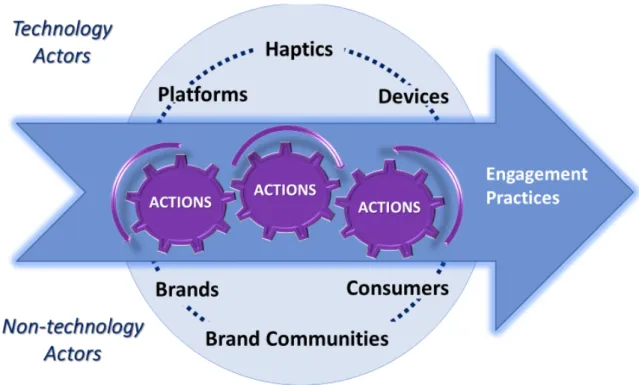
Taken together, the findings concerning the elements of the ecosystems and engagement practices provide a unique micro-perspective on consumer engagement in the digital
ecosystem (see Figure 1). The socio-technical view advanced here assumes that the consumer engagement ecosystem consists of technology and non-technology actors that interactively facilitate and stimulate individuals in their actions. Non-technology actors include consumers but also brands and brand communities; the technology actors, encompass a continuum that includes physical materiality (devices) and non-physical materiality (digital haptics and platforms). Individuals’ actions with technology bind together technology and
non-technology actors and the repetitive, routine, and shared patterns of actions across groups of individuals and over time coalesce into distinct patterns of engagement practices.
Insert Figure 1
The micro-perspective advanced, here, offers three distinct conceptual insights. First, the technology implications for engagement stem from the combined and concurrent effect of physical devices, computer software, and human action. Both software and hardware tie with individual actions into complex, interchangeable, but not entirely predictable ways. Both physicality and virtuality matter: there is no virtuality (platforms & haptics) without
physicality of sorts (devices). The key insight concerning digital materiality is that physical (devices) or non-physical entities (such as software codes) have implications for action and contribute to the emergence and persistence of engagement practices. Contemporary engagement is a socio-technical phenomenon in which technology forms a necessary foundation for action.
Second, this article argues that within the consumer engagement ecosystem, the implications of digital technology for engagement are generative in that technology generates new actions and offers new possibilities for action. The socio-technical view advanced here strongly rejects the notion of mediation because to mediate means to link pre-existing entities. This work argues that technology does not mediate but is generative (Scott and Orlikowski, 2014): it gives rise to novel types of activities and practices. As illustrated by the interviewees, technologies generate new engagement activities with objects such as haptics or platforms and, in turn, enable new engagement practices such as uncovering, augmenting, and cultivating. By opening possibilities for actions, that were previously impossible,
unimaginable or too difficult - like sharing a digital object, manipulating its properties or communicating with a large audience in real time- technologies create engagement of a different kind.
Third, whilst setting possibilities for actions, digital technologies do not determine what users may do. Though technologies may facilitate some actions by making them easier, more sensible or desirable (Hollebeek et al., 2019), users ultimately decide whether to choose, make use of, reject, or ignore particular courses of actions. In addition, as illustrated by the interviews, participants take steps to shape the digital ecosystem through their choices of devices, use or rejection of digital touchpoints, as well as customizations affecting the digital ecosystem. The link between technology and practice, therefore, is not deterministic but involves ongoing negotiation between technological possibilities and user preferences, knowledge, and attitudes. Importantly, the interaction is recursive: a user’s actions (or their absence) are driving an ongoing evolution of technology and users are not passive recipients but active shapers of the technology landscape. The recursive system is ever-evolving and dynamic. The next section provides a theoretical discussion of the key insights.
6.2. Contribution to Theory
This article set out to offer a micro-perspective on the digital ecosystem of consumer engagement. Building on a socio-technical perspective (Leonardi, 2011, 2013; Orlikowski and Scott, 2008; 2015b; Scott and Orlikowski, 2014b) and focusing on engagement with brands on social media, the study has argued that consumer engagement is a socio-technical phenomenon centering on the confluence of consumer action with digital technology. Using mixed-qualitative data, the empirical findings illustrate how the technologies can be broken into three layers of digital materiality: physical devices, digital haptics, and digital platforms. The study rejects technological mediation and calls for a generative view of technologies in engagement, one that stresses the possibility of emergence of new practices and assumes a recursive, non-determinist link between the human and technical dimension of the ecosystem.
The findings have important implications for the future study of engagement and the ecosystem perspective on engagement.
The first contribution concerns a novel micro-theoretical view of consumer engagement. The mainstream theorizations conceive engagement as a psychological concept that encompasses affective, cognitive, and behavioral dimensions (Dessart et al., 2016), and a rich stream of studies have attempted to operationalize engagement from this perspective (Brodie et al., 2011; Van Doorn et al., 2010). Recent conceptual papers have challenged this approach and called for an alternative view that goes ‘beyond the psychological and emotional state of humans to cover increasingly autonomous technologies’ (Storbacka et al., 2016, p. 3013). Responding to this call, the conceptualization advanced, here, explores activity as a locus of engagement and integrates activities with technologies in a theoretically coherent manner. Framing engagement as a socio-technical phenomenon, this study suggests that engagement is practice that comes about from the confluence of activity with technology. Technology
neither determines nor mediates practice but, rather, is co-constitutive: technology is practice because the digital layers of haptics and platforms are necessary for the contemporary
engagement activity to occur. Importantly, this practice-based approach does not undermine the earlier behavioral (Gong, 2018; Hollebeek et al.,2019; Jaakola and Alexander, 2014) or psychological (Dessart et al., 2015) perspectives. Rather, the current approach offers an alternative that may better accommodate the technological dimension of the engagement ecosystem. In focusing on activity with technology, this study sets a new, exciting, direction for engagement research.
By adopting a micro-perspective, the study departs from the current theorizing of engagement in ecosystems in three substantive ways. First, the micro-perspective advanced, here, offers contrasts with the strategic conception and the macro- and firm-focused analytical equivalent
emerges. The issue of genesis is of paramount importance because it helps to explain the fast-changing dynamics of the engagement ecosystem (Chahal et al., 2020) . It also helps the scholars and practitioners to cope with the ever-evolving technology landscape enabling us to handle the evolution of technology. Second, this article argues that the micro-theoretical perspective on engagement is not an empirical issue concerning a lower level of analysis (see Storbacka et al., 2016) but, rather, a theoretical question that has critical implications for the conceptualization of engagement and its empirical calibration. How engagement has
important implications on what one sees (Alexander et al., 2017; Brodie et al., 2019). Third, the view of the digital ecosystem presented, here, offers an integrative view that takes into account multiple instantiations of technology in which virtual, digital, online, offline, and physical are concurrent and parallel dimensions of the ecosystem and where technologies and action are inseparable and interdependent (Orlikowski and Scott, 2014a, 2015a). Contrasted with previous research (Dessart et al., 2014; Gong, 2018), the study design shows that technologies can take center-stage. The design offers new exciting directions for the study of engagement and the ecosystem.
The micro-perspective advanced, here, makes it possible to capture the seamless and
pervasive nature of consumer engagement in a digital ecosystem. Past studies have tended to overlook the holistic nature of engagement because the empirical designs have reflected narrow choices of engagement settings, such as a specific brand (e.g., Wallace et al., 2014) or a singular online brand community (e.g., Gummerus et al., 2012). By adopting a
socio-technical approach, this study reveals engagement that involves different engagement actors (consumers, brand communities, and brands) and occurs across multiple engagement
platforms accessed from multiple devices and embracing multiple technological contexts (Storbacka et al., 2016). Given the increasingly ambient, persistent, and seamless nature of consumer engagement (Chahal et al., 2020; Hollebeek et al., 2019), this research calls for
future studies to adopt a holistic perspective and emphasize pervasiveness, omnipresence, and continuity.
In tracing engagement back to activity, the study advances the empirical operationalization of an ecosystem. Past studies have painted ecosystems as complex and limitless entities (see Storbacka et al., 2016) that may contain artefacts, interfaces, processes, and people (see Breidbach and Brodie, 2017) and even nations (Vargo and Lusch, 2014). Although intuitively appealing, such seemingly all-encompassing definitions do not seem well suited for empirical analysis or managerial decision making. Zooming into the digital ecosystem (Alexander et al., 2017) and deconstructing technologies into three layers of digital materiality (digital haptics, platforms, and devices) potentially enhances conceptual clarity. The model advanced, here, provides a systematic and integrative conception of the ecosystem components and offers an original alternative to prior conceptualizations (see Ramaswamy, 2009; Storbacka et al., 2016).
In offering a socio-technical view of engagement, the paper revises the human-centric notion of practice. Several past studies have explored engagement from a practice perspective; Jaakkola and Alexander (2014), for instance, develop a service system perspective on consumer engagement and classify behaviors into four broad categories: augmenting, co-developing, influencing, and mobilizing. Although the authors do not explicitly refer to practice, their emphasis on behavior that is underpinned by skills, knowledge, goals and preferences aligns with the practice view. More explicitly, Hollebeek et al., (2017) offer a practice perspective on consumer engagement in virtual brand communities and develop a typology of eight practices (“greeting”, “regulating”, “assisting”, “celebrating”,
“appreciating”, “empathizing”, “mingling”, and “ranking”) comprising engagement. Though valuable, both studies develop a human-centric approach to practice which prioritizes human
Novak, 2017; Lugosi and Quinton, 2017). Attention to technological materiality of
engagement in both its physical (device) and non-physical guises (haptics or platforms) opens the possibility for future research on engagement from a technology-centric perspective that permits technologies to play a more agential role (Zwick and Dholakia, 2006; Petit et al., 2019; Wirtz et al., 2019; Larivière et al., 2017).
When considering the implications for engagement, the conceptualization of digital
ecosystems advanced, here, potentially resolves confusion over the material status of digital technology, challenging the divide between the virtual/digital/online and
physical/material/offline found in ecosystem research (Breidbach et al., 2014) and beyond (Belk, 2014). Following socio-technical principles, this study argues that physical and non-physical dimensions are not mutually exclusive but complementary and integral facets of the digital ecosystem. There is no digitality without physicality because engagement platforms, interfaces, apps, or social media are syntactic entities that need to reside in the physical
devices humans interact with. Complementing recent work on the technologies of engagement (Fritze et al., 2020, Larivière et al., 2017; Wirtz et al., 2020) and the omni-channel nature of customer experiences (Lemon and Verhoef, 2016), this study calls for a replacement of the dichotomies (digital/non-digital, online/offline, material/dematerialized) with a more explicit focus on the materiality of digital technologies: the ways and means by which technologies are significant to action (Leonardi, 2013).
Admittedly, the micro-approach advanced, here, is not free from limitations. The study has only begun to explore engagement practices: the interview data, netnography, and
observations provide only partial insights into the broader structures of practice, namely, rules, general understandings, or tele-affective structures (Schatzki, 2002). Future in-depth research into foundations of practices is urgently needed. In addition, by adopting a micro-focus, the current design necessarily downplays the macro-perspective of the engagement
ecosystem and the strategic dimension of ecosystems (Breidbach et al., 2014). In doing so, the study misses actors such as firms, competitors, or nations (Vargo and Lusch, 2014). Future studies should provide a more strategic perspective and follow the seminal work in that area (see Breidbach et al., 2014; Storbacka et al., 2016).
6.3. Managerial Implications
This study provides several managerial insights into engagement and technology-enabled customer interactions. To begin with, the findings call for a more explicit focus on
engagement as action to complement the current preoccupation with attitudes and perceptions, on the one hand (Dessart et al., 2015), and click-stream data, on the other (Larivière et al., 2017). If engagement comprises a set of practices which, in turn, consist of actions that managers may monitor, analyze, and influence, then a key task in managing engagement is to seek deeper and broader understanding of what customers actually do. To arrive at such an understanding, managers should follow a holistic approach accounting for the totality of consumer actions and including actions across platforms, devices, and digital touchpoints. The management of engagement should focus on the physical and non-physical components of the digital ecosystem (Breidbach et al., 2014) because actions in digital ecosystems span boundaries of platforms and consumer engagement increasingly involves seamless blending of physical and digital environments in omni-channel experiences (Lemon and Verhoef, 2016). The ecosystem perspective implies a change of managerial focus away from individual engagement platforms towards an integrative view. Extant research on selected social media (de Vries et al., 2012) or online communities (Healy and McDonagh, 2013; Gummerus et al., 2012) invariably draws attention to the singularized instantiations of technology. One way of coping with the complexity and unpredictability of the digital ecosystem is to step back and
take a broader and more integrated approach, moving away from channel management
towards a more holistic, strategic approach considering all elements of the ecosystem, as users already do. Brand managers would be wise to take the broad view of the digital domain and move their attention beyond the isolated instances of technology towards a holistic and continuing view of the evolving ecosystem of devices, platforms, and their digital haptics.
The model of the digital ecosystem advanced, here, may assist with the task of managing engagement is several ways. A key managerial insight is that engagement is bound with physical devices and that digitality and physicality are co-dependent: innovation in physical devices affects possibilities for action and engagement opportunities and, conversely, the evidence of consumer actions constituting engagement leads to changes in technology. The findings concerning density and variability of devices show that consumer interactions with the digital ecosystem are becoming increasingly synchronized, continuous, and ambient and that engagement activity occurs across the boundaries of devices, time, and space.
Management of engagement has to involve monitoring changes in engagement platforms but also innovation in devices, the emergence of new device types, shifts in patterns of
ownership, or connectivity. These are needed because the ongoing unfolding of technological innovation has ongoing implications for the possibilities of action and interaction in the digital ecosystem.
Moreover, the focus on practice and on what users do with technology, rather than what possibilities the technology offers, provides a reality check for managers. Managers face significant challenges in making sense of an ever-changing landscape of the digital
ecosystem, and separating hype from realities of digital innovation is a formidable task. From a managerial perspective, the emphasis on “technology in use” that stresses localized and limited appropriation of possibilities and places discount on expectations may be reassuring. Viewing engagement as a socio-technical phenomenon assumes that only some technological
innovations will be adopted, that the adoption will never be complete, that it will follow unintended patterns, and that technologies may be adopted in the wrong way (see the case of SMS messaging). The focus on practice, rather than on consumer attitudes and perceptions, may provide some reassurance to brand managers in the difficult task of keeping abreast of technological developments.
REFERENCES
Akaka, M.A. & Vargo, S.L. (2015). Extending the context of service: from encounters to ecosystems. Journal of Services Marketing, 29(6/7), 453-462.
Akaka, M.A., Vargo, S.L. & Lusch, R.F. (2013). The complexity of context: a service
ecosystems approach for international marketing. Journal of Marketing Research, 21(4), 1-20
Alexander, M.J., Jaakkola, E. & Hollebeek, L.D. (2017). Zooming out: actor engagement beyond the dyadic. Journal of Service Management, 29(3), 333-351.
Alur, A., Shrivastav, P. & Jumde, A. (2014). Haptic Technology: a Comprehensive Review of its Applications and Future Prospects. International Journal of Computer Science and
Information Technologies, 5(5), 6039-6043.
Baldus, B., Voorhees, C. & Calantone, R. (2015). Online brand community engagement: Scale development and validation. Journal of Business Research, 68, 978–985.
Brakus, J.J., Schmitt, B.H. & Zarantonello, L. (2009). Brand experience: what is it? How is it measured? Does it affect loyalty?. Journal of Marketing, 73(3), 52-68.
Barrett, M., Oborn, E., & Orlikowski, W. (2016). Creating value in online communities: The sociomaterial configuring of strategy, platform, and stakeholder engagement. Information
Belk, R. (2014). You are what you can access: Sharing and collaborative consumption online. Journal of Business Research, 67(8), 1595–1600.
Belk, R. (2013). Extended Self in a Digital World. Journal of Consumer Research, 40(3), 477-500
Bettany, S. & Kerrane, B. (2011). The (post-human) consumer, the (post-avian) chicken and the (post-object) Eglu: Towards a material-semiotics of anti-consumption. European
Journal of Marketing, 45(11/12), 1746-1756.
Beukeboom, C., Kerkhof, P. & de Vries, M. (2015). Does a virtual like cause actual liking? How following a brand's Facebook updates enhances brand evaluations and purchase intention. Journal of Interactive Marketing, 32, 26–36.
Breidbach, C. & Brodie, R. (2017). Engagement platforms in the sharing economy:
Conceptual foundations and research directions. Journal of Service Theory and Practice, 27(4), 761-777
Breidbach, C.F. & Maglio, P.P. (2016). Technology-enabled value co-creation: an empirical analysis of actors, resources, and practices. Industrial Marketing Management, 56, 73-85. Breidbach, C., Brodie, R. & Hollebeek, L. (2014). Beyond virtuality: From engagement
platforms to engagement ecosystems. Managing Service Quality, 24(6), 592–611. Brodie, R., Hollebeek, L., Juric, B., & Ilic, A. (2011). Customer engagement: Conceptual
domain, fundamental propositions, and implications for research. Journal of Service
Research, 14(3), 252–271.
Brodie, R., Ilic, A., Juric, B. & Hollebeek, L. (2013). Consumer engagement in a virtual brand community: An exploratory analysis. Journal of Business Research, 66(1), 105–114. Brodie, R., Fehrer, H., Jaakkola, E. & Conduit, J. (2019). Actor Engagement in Networks:
Chahal, H., Wirtz, J. & Anu, V. (2020). Social Media Brand Engagement: Dimensions, Drivers and Consequences. Journal of Consumer Marketing, forthcoming
Cova, B. & White, T. (2010). Counter-brand and alter-brand communities: The impact of web 2.0 on tribal marketing approaches. Journal of Marketing Management, 26(3–4), 256–270. de Vries, L., Gensler, S. & Leeflang, P. S. (2012). Popularity of brand posts on brand fan
pages: An investigation of the effects of social media marketing. Journal of Interactive
Marketing, 26(2), 83–91.
Dessart, L., Veloutsou, C. & Morgan-Thomas, A. (2015). Consumer engagement in online brand communities: A social media perspective. Journal of Product & Brand
Management, 24(1), 28–42.
Dessart, L., Veloutsou, C. & Morgan-Thomas, A. (2016). Capturing consumer engagement: Duality, dimensionality and measurement. Journal of Marketing Management, 32(5–6), 399–426.
Ekbia, H. R. (2009). Digital artifacts as quasi-objects: Qualification, mediation, and materiality. Journal of the American Society for Information Science and Technology,
60(12), 2554–2566.
Faraj, S. & Azad, B. (2012). The materiality of technology: An affordance perspective. In P. M. Leonardi, B. A. Nardi & J. Kallinikos (Eds.), Materiality and organizing: Social
interaction in a technological world (pp. 25–48). Oxford, UK: Oxford University Press.
Faulkner, P. & Runde, J. (2009). On the identity of technological objects and user innovations in function. Academy of Management Review, 34(3), 442–462.
Feldman, M. S. & Orlikowski, W. J. (2011). Theorizing practice and practicing theory.
Organization Science, 22(5), 1240–1253.
Ferrara, E., Varol, O., Davis, C., Menczer, F. & Flammini, A. (2016). The rise of social bots.
Ferreira, M., Zambaldi, F. & Guerra, D. (2020). Consumer engagement in social media: scale comparison analysis. Journal of Product & Brand Management. ahead-of-print.
https://doi.org/10.1108/JPBM-10-2018-2095
Fritze, M. P., Marchand, A., Eisingerich, A., & Benkenstein, M. (2020). Access-Based Services as Substitutes for Material Possessions: The Role of Psychological Ownership.
Journal of Service Research, forthcoming.
Frow, P., McColl-Kennedy, J., Hilton. T., Davidson, A, Payne, A. & Brozovic, D. (2014). Value propositions: A service ecosystems perspective. Marketing Theory, 14(3), 327-351. Gong, T. (2018). Customer brand engagement behavior in online brand communities. Journal
of Services Marketing, 32(3), 286–299.
Goulding, C., Shankar, A. & Canniford, R. (2013), "Learning to be tribal: facilitating the formation of consumer tribes", European Journal of Marketing, Vol. 47 No. 5/6, pp. 813-832.
Gummerus, J., Liljander, V., Weman, E. & Pihlström, M. (2012). Customer engagement in a Facebook brand community. Management Research Review, 35(9), 857-877.
Hallinan, B. & Striphas, T. (2016). Recommended for you: The Netflix Prize and the production of algorithmic culture. New Media & Society, 18(1), 117-137.
Harmeling, C. M., Moffett, J. W., Arnold, M. J. & Carlson, B. D. (2017). Toward a theory of customer engagement marketing. Journal of the Academy of Marketing Science, 45(3), 312-335.
Healy, J. C. & McDonagh, P. (2013). Consumer roles in brand culture and value co-creation in virtual communities. Journal of Business Research, 66(9), 1528–1540
Hoffman, D.L. & Novak, T.P. (2017). Consumer and Object Experience in the Internet of Things: An Assemblage Theory Approach. Journal of Consumer Research, 44(6), 1178– 1204.