Identification and Characterization of Clostridium perfringens Isolated
from necrotic Enteritis in Broiler Chickens in Tiaret, Western Algeria
Rachid MERATI
1,2 Soraya TEMIM
2Ali Alaa Abdel-Fattah MOHAMED
31 Laboratoire d’Hygiène et Pathologie Animale, Université Ibn Khaldoun, 14000, Tiaret, ALGERIE
2 Laboratoire de Recherche « Santé et Production Animales », Ecole Nationale Supérieure Vétérinaire, 16000, Alger, ALGERIE
3 Veterinary Serum and Vaccine Research Institute, 11765, Abassia, Cairo, EGYPT
Article Code: KVFD-2017-17431 Received: 14.01.2017 Accepted: 19.04.2017 Published Online: 19.04.2017 Citation of This Article
Merati R, Temim S, Mohamed AAA: Identification and characterization of Clostridium perfringens isolated from necrotic enteritis in broiler chickens
in Tiaret, Western Algeria. Kafkas Univ Vet Fak Derg, 23 (4): 595-601, 2017. DOI: 10.9775/kvfd.2017.17431
Abstract
The present study was carried out to investigate the presence of Clostridium perfringens (C. perfringens) in broiler chickens from various locations in Tiaret province, western Algeria, and to characterize the bacterium isolates for the presence of cpa, cpb, etx, iA and netB gene. A total of 180 samples representing intestinal contents of broiler chickens showing enteric disorder symptoms and lesions suspected to be Necrotic Enteritis (NE) were analyzed by conventional methods and polymerase chain reaction (PCR). C. perfringens was isolated at the rate of 34.44% (62/180), and its presence was confirmed by cultural and biochemical characterization. 83.87% (52/62) C. perfringens isolates were toxigenic and 16.13% (10/62) were non-toxigenic. Multiplex PCR was performed to toxinotype the 52 toxigenic isolates, and the results showed that all isolates were positive for the gene cpa and negative for cpb, etx and iA. This indicates that all the toxigenic isolates were C.
perfringens type A (52/52). Uniplex PCR for detection of NetB toxin gene was carried out on 22 type A isolates, and these results showed
none of the isolates as positive for the gene netB. This result indicates that the C. perfringens type A was the most predominant etiology of NE without carrying the netB gene.
Keywords: Clostridium perfringens, Necrotic enteritis, Broiler, Toxinotyping, NetB
Batı Cezayir’in Tiaret Bölgesinde nekrotik Enteritli Broiler Tavuklardan İzole
Edilen Clostridium perfringens’in İdentifikasyonu ve Karakterizasyonu
ÖzetBu çalışma Batı Cezayir’in Tiaret Bölgesinin değişik alanlarındaki broiler tavuklarda Clostridium perfringens (C. perfringens) mikroorganizmalarının varlığını araştırmak ve cpa, cpb, etx, iA ve netB genlerinin mevcudiyeti açısından bakteri izolatlarını karakterize etmek amacıyla yürütülmüştür. Enterik bozukluk semptomları ve lezyonları göstererek Nekrotik Enterit (NE) şüpheli olduğu düşünülen toplam 180 broiler tavuğa ait bağırsak içeriği örneği klasik metot ve polimeraz zincir reaksiyonu (PCR) ile incelendi. C. perfringens %34.44 (62/180) oranında izole edildi ve mikroorganizmanın kültürel ve biyokimyasal karakterizasyonu teyit edildi. C. perfringens’in %83.87 (52/62) izolatı toksijenik ve %16.13’ü (10/62) non-toksijenik olarak belirlendi. 52 toksijenik izolata toksinotiplendirme amacıyla Multipleks PCR uygulandı ve elde edilen bulgular tüm izolatlarda cpa geni için pozitif cpb, etx ve iA genleri için negatif olduğunu gösterdi. Bu durum tüm toksijenik izolatların C. perfringens tip A (52/52) olduğuna işaret etti. 22 tip A izolata NetB toksin genini belirlemek amacıyla unipleks PCR uygulandı ve sonuçlar izolatların hiç birinin netB geni için pozitif olmadığını gösterdi. Bu sonuçlar netB geni taşımaksızın C. perfringens tip A’nın Nekrotik Enteritin predominant etiyolojik etkeni olduğunu göstermiştir.
Anahtar sözcükler: Clostridium perfringens, Nekrotik enteritis, Broiler, Toksinotiplendirme, NetB
InTRODUCTIOn
Clostridium perfringnens is a Gram positive
spore-forming anaerobic bacterium that plays an important
role in the etiology of NE disease, which is the cause of the greatest economic losses in the poultry production industry [1.2]. It has been estimated that NE costs the poultry
industry 2 billion dollars per year as result of reduction
İletişim (Correspondence)
+213 67 0284000performance, disease treatment and preventive measures [3,4]. C. perfringens is responsible for synthesis and secretion
of more than 17 different extracellular toxins, and it has been classified into 5 toxinotypes (A, B, C, D and E) on the basis of their ability to produce the major lethal toxins alpha (α), beta (β), epsilon (Ԑ) and iota (ὶ) [5-7]. NE disease is
caused mainly by type A strains, which produce the alpha toxin, and to a lesser extent, type C strains, which produce both alpha and beta toxin[8,9]. The alpha toxin was long
considered the main cause responsible of the induction of the disease, while, a novel pore-forming toxin NetB has been demonstrated in type A strains [2,10,11].
NE can present as an acute clinical disease characterized by severe intestinal necrosis, leading to a sudden 50% increase in flock mortality rates [12,13]. NE can also arise as
a sub-clinical infection, associated with chronic damage of the intestinal mucosa, causing problems such as lower performance and reduced weight gain [14,15]. In the past,
NE has been controlled in poultry flocks with antimicrobial growth promoters in commercial poultry feed [16,17]. However,
since the ban of these supplementations due to policy changes, NE has reemerged as a costly disease in poultry industry [2,16].
In Algeria, poultry meat is the primary source of protein, especially for Tiaret province population where broiler breeding was developing through the last decade. The detection and the characterization of C. perfringens, which is known as causative agent of NE in the poultry industry, and one of the most frequently isolated bacterial pathogens in foodborne disease outbreaks in humans [18],
remains unknown in this region.
In this study, we aimed to investigate the presence of C.
perfringens, at various locations in Tiaret province (western
Algeria) and to characterize the bacterium isolates for the presence of cpa, cpb, etx, iA and NetB gene by PCR technology.
MATERIAL and METHODS
Sampling
A total of 180 samples were collected aseptically from freshly sacrificed broiler chickens (2-8 weeks old) reared in 70 poultry farms (average of 2500 broiler chickens by farm) at different locations in Tiaret province, western Algeria, from August 2015 to July 2016. The samples were collected after postmortem examination and the sections of intestine displaying gross lesions suspected to be NE were collected. Samples were taken to the laboratory in an ice box as soon as possible.
Isolation and Identification of Clostridium perfringens
The intestinal content of the collected samples were inoculated into tubes of freshly prepared cooked meat
medium (Oxoid,UK) for enrichment and incubated in an anaerobic jar (Oxoid,UK) for 24 h at 37°C in anaerobic atmosphere provided by AnaeroGen atmosphere generation system. 0.1 mL of inoculated fluid media was streaked onto perfringens agar base containing 400 µg/mL of cycloserine (TSC) without egg emulsion (Oxoid, UK) and incubated anaerobically[19]. After 24-48 h incubation at
37°C, typical black colonies presumed to be C. perfringens were taken out with the help of the loop, re-streaked onto two plates of 5% defibrinated sheep blood agar and egg yolk agar, and incubated anaerobically for 24 h at 37°C [20]. C. perfringens isolates were identified via morphological and
biochemical characterization as previously recommended by Koneman et al.[21]and Macfaddin [22].
Determination of Toxigenic Clostridium perfringens Isolates
- Mouse Bioassays (Lethality Test)
After an anaerobic incubation for 24 h at 37°C, the cultures of isolated C. perfringens strains in cooked meat medium were centrifuged at 3.000 rpm for 15 min, and the cell-free culture supernatants were recovered. 0.3 mL from the clear supernatant fluid was I/V inoculated in the tail vein of each Swiss mouse (25-40 g), and injected mice were observed over a period of three days for nervous symptoms or death [23].One mouse was injected with broth
culture without bacteria as a control.
- Nagler’s Reaction (Toxin - Antitoxin Half Plate)
This test was carried out according to the method of Smith and Holdeman [24]. It was performed by spreading C. perfringens type A antitoxin serum (National Institute
for Biological and Standard Control, UK) on half of the egg yolk agar plate and allowed to dry in the incubator for half an hour. The cultures were then streaked across the plate, beginning at the non-antitoxin coated portion and ending to the side containing the antitoxin. The cultures were incubated anaerobically for 24 h at 37°C.
All isolated toxigenic strains were stored in thyoglycolate medium (Oxoid, UK) with 30% glycerol at -20°C for sub-sequent toxin genotyping.
The experiment on animals was carried out according to the National Regulations on Animal Welfare.
Genotyping of the Toxigenic Clostridium perfringens Isolates
- DNA extraction and PCR
The DNA was extracted from toxigenic C. perfringens isolates using QIAamp DNA Mini Kit (QIAGEN, USA), as indicated per the manufacturer’s instructions. Specific oligonucleotide primers sequences corresponding to alpha, beta, epsilon and iota toxin genes of C. perfringens and NetB toxin gene, as reported by Yoo et al.[25] and
Keyburn et al.[10], respectively were procured from Midland
Certified Reagent Company, (Oligos, USA ).The details of primers are given in (Table 1).
The PCR reaction mix for alpha, beta, epsilon and iota toxins was prepared as follows: 8 µL of extracted DNA template from bacterial cultures, 25 µl EmeraldAmp GT PCR master mix (TAKARA, USA), 1 µL of each alpha, beta, epsilon and iota forward and reverse primers (20 pmol µL-1),
and 9 µl of PCR-grade water, to a total volume of 50 µL. For NetB toxin, the reaction mixture was prepared as follows: 6 µl of extracted DNA template from bacterial cultures, 12.5 µL EmeraldAmp GT PCR master mix (TAKARA, USA), 1 µL NetB forward and reverse primers (20 pmol µL-1), 4.5 µL
of PCR grade-water, to a total volume of 25 µL.
The PCR amplification for detection the toxins (α, β, ε and ι) was programmed in TRIO thermal cycler (Biometric, Germany) as follows: initial denaturation step at 94°C for 5 min, followed by 35 cycles of amplification. Each cycle comprised denaturation at 94°C
for 30 sec, annealing at 55°C for 45 sec, and extension at 72°C for 45 sec. There was then a final extension for 10 min at 72°C. For detection of netB gene PCR, an initial denaturation step at 94°C for 5 min was followed by 35 cycles. Each cycle comprised denaturation at 94°C for 30 sec, annealing 58°C for 45 sec, and extension at 72°C for 45 sec. There was a final extension for 10 min at 72°C. Finally, 30 µL of the amplified product for alpha, beta, epsilon and iota toxin genes and 20 µL of the amplified products for NetB toxin gene were electrophoresed in 1.5% agarose gel and stained with ethidium bromide. Standard DNA fragments (Gel Pilot100-bp DNA molecular weight marker;
QIAGEN, USA) were used as molecular weight markers to indicate the sizes of the amplification products. Amplified bands were visualized and photographed by a gel documentation system (Alpha Innotech, Germany), and the data was analyzed through computer software (Automatic Image Capture Software, ProteinSimple formerly Cell Biosciences, USA).
The positive DNA samples for alpha, beta, epsilon, iota and NetB toxins were obtained from reference laboratory for veterinary quality control on poultry production. (Animal Health Research Institute of Cairo, Egypt). Distilled water was used as negative control.
RESULTS
Necropsy Findings
At necropsy, all the 180 broiler chickens, from which the intestinal contents were collected, showed gross lesions suspected to be NE. Lesions were seen in the middle of the small intestine that had friable wall and distended with gases. Intestinal mucosa was covered by a tan to yellow necrotic membrane with or without hemorrhagic foci (Fig. 1).
Bacteriological and Biochemical Examination
Out of the 180 intestinal samples examined, 62 C.
perfringens isolates (34.44%) were detected. The isolates
produced 1 to 2 mm typical black colonies on TSC agar medium, as shown in Fig. 2. Also produced were smooth, round, glistening colonies surrounded by double zone of haemolysis on sheep blood agar medium, as shown in Fig. 3. Biochemical characterization revealed that all
the isolates were positive for lecithinase activity on egg yolk agar medium, sugar fermentation, milk digestion, while indole production, catalase and oxidase tests were negative.
Table 1. Details of oligonucleotide primers sequences used in this study
Gene Primer Sequence Size (bp)Product
cpa (α toxin) F GTTGATAGCGCAGGACATGTTAAG 402 R CATGTAGTCATCTGTTCCAGCATC cpb (β toxin) F ACTATACAGACAGATCATTCAACC 236 R TTAGGAGCAGTTAGAACTACAGAC etx (ε toxin) F ACTGCAACTACTACTCATACTGTG 541 R CTGGTGCCTTAATAGAAAGACTCC iA (ι toxin) F GCGATGAAAAGCCTACACCACTAC 317 R GGTATATCCTCCACGCATATAGTC NetB (NetB toxin) F GCTGGTGCTGGAATAAATGC 560 R TCGCCATTGAGTAGTTTCCC
Toxigenic Activities of Clostridium perfringens Isolates
52 isolates out of 62 C. perfringens isolates (83.87%) were toxigenic, as indicated by the death of the inoculated mice in mouse bioassays, and positive reaction on Nagler’s tests expressed by zone of opacity surrounding the toxigenic C. perfringens colonies on the half of the plate without antitoxin while no change was observed on the
other half containing the antitoxin (Fig. 4). The remaining
10 C. perfringens isolates (16.13%) were non-toxigenic.
Multiplex PCR for the Genotyping of Toxigenic C. perfringens Isolates
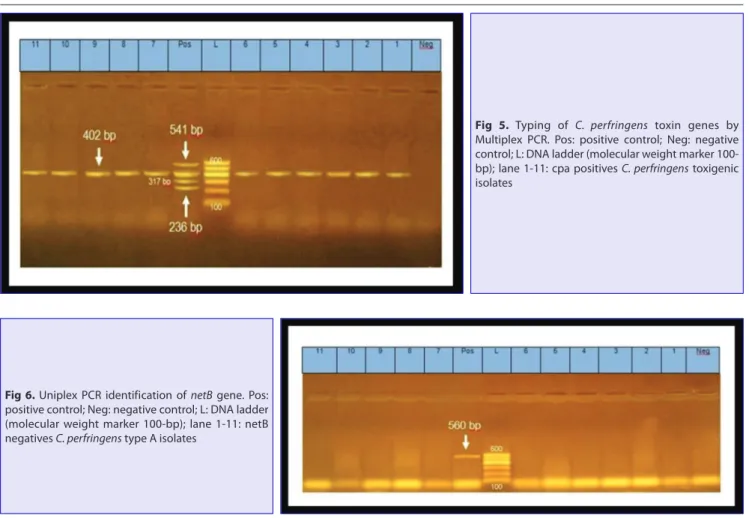
The genotyping of the 52 toxigenic isolates revealed that all the isolates carried the gene cpa (402 bp), coding for the alpha toxin as illustrated in Fig. 5, and none of
the isolates carried the genes cpb (236 bp), etx (541 bp) and iA (317 bp) coding for beta, epsilon and iota toxins, respectively. This indicates that all the toxigenic isolates were C. perfringens type A 100% (52/52).
Uniplex PCR for the Detection of netB Gene
A selection of 22 toxigenic isolates were confirmed to be C. perfringens type A and analyzed by uniplex PCR to detect the presence of the netB (560 bp) gene. None of the isolates were found positive for this gene that expresses for the NetB toxin, as illustrated in Fig. 6.
DISCUSSIOn
C. perfringens has been demonstrated in several regions
in the world. It is one of the most common causes of severe gastro-intestinal infection and necrotic enteritis in poultry [1,13,26]. However, no studies on the detection and
molecular characterization of C. perfringens inducing NE in broiler chickens were carried out in Algeria.
The presence of C. perfringens was investigated in different broiler chicken flocks located at Tiaret province.
C. perfringens was isolated in 62 from 180 samples analyzed
Fig 2. Typical black colonies presumed to be C. perfringens on TSC agar
medium
Fig 3. C. perfringens colonies surrounded by double zone of haemolysis
on sheep blood agar medium
at the rate of 34.44%, this finding indicates that not all the intestinal lesions observed in the field were due to C.
perfringens infection. Other pathogens may be incriminated
in the etiology of these lesions. It is also believed that the sampling was carried out on farms receiving curative antibiotics which lead to the destruction of the intestinal microbial population, thus explaining the low isolation rate of C. perfringens observed in our study. Several studies have reported different isolation rates; Svobodova et
al.[27] isolated C. perfringens at the rate of 18.39%, and
Schocken-Iturrino et al.[28] analyzed 560 intestinal contents
and reported that C. perfringens was found in 94 samples at the rate of 16.78%. Manfreda et al.[29] have detected C. perfringens in 87 from 149 samples analyzed (58.40%),
while the lowest frequency of isolated C. perfringens was reported by Kalender and Ertas [30], who found that only
5% of intestinal contents were positive for C. perfringens. This variation may be due to the different methodologies used for the isolation, selection of samples (number and nature of samples, from healthy and/or diseased birds) and poultry farm management (the use or not of antibiotics as growth promoters in feed).
C. perfringens is considered a commensal organism
of normal chicken intestinal flora [31], for this reason, we
should differentiate between toxigenic and non-toxigenic isolates. Our results revealed that, out of the 62 isolates that were previously identified morphologically and
bio-chemically as C. perfringens, 52 isolates (83.87%) were toxigenic. The high rate of toxigenic C. perfringens isolates recorded in our study confirm the role of this bacterium in the occurrence of the NE disease due to the high production of toxin that is responsible of the destruction of intestinal mucosa.
Multiplex PCR is a rapid and effective method for typing of C. perfringens toxins. The typing of 52 toxigenic isolates revealed that all the isolates were C. perfringens type A, in agreement with previous investigations carried out by Keyburn et al.[32], Crespo et al.[33], Svobodova et al.[27],
Drigo et al.[34] and Trinh et al.[35]. However, there were no C.perfringens type C and D that were isolated from broiler
chickens which demonstrated NE, disagreeing with the results of Shane et al.[36]and Heier et al.[37], who isolated C.perfringens type D and type C from broiler chickens
suffering from NE.
Several studies have reported the role of other toxins in the induction of NE. The most important of these is Necrotic Enteritis toxin B (NetB), a pore forming toxin capable of causing lesions typical of NE [10]. Since the
discovery of this new virulence factor, the presence of netB gene in C. perfringens isolates was investigated in different regions of the world. According to our study none of the selected toxigenic C. perfringens type A isolates were positive for NetB toxin. These results agree with Datta et Fig 6. Uniplex PCR identification of netB gene. Pos:
positive control; Neg: negative control; L: DNA ladder (molecular weight marker 100-bp); lane 1-11: netB negatives C. perfringens type A isolates
Fig 5. Typing of C. perfringens toxin genes by
Multiplex PCR. Pos: positive control; Neg: negative control; L: DNA ladder (molecular weight marker 100-bp); lane 1-11: cpa positives C. perfringens toxigenic isolates
al.[38], who investigated the presence of NetB toxin in 26
isolates of C. perfringens type A and reported that none of the isolates were positive for this toxin. Similar results were reported by Thomas et al.[39], who recorded tested isolates
for the presence of netB gene were negative. In contrast to our finding, several studies demonstrated the existence of netB gene in C. perfringens isolates. Johansson et al.[40]
investigated the prevalence of this toxin and reported that more than 90% of all isolates from cases of NE carried
netB gene. In addition, the presence of this gene was
examined in 36 isolates of C. perfringens and was detected in 19 isolates at the rate of 52.8% from diseased flocks by Talooe et al.[41]. The lack of netB gene in our study may be
explained by the insufficient number of samples analysed or the inexistence of this gene in our region.
Our study indicated the presence of C. perfringens in broiler chicken flocks in Tiaret province, and type A was the most predominant etiology in the occurrence of NE, an important bacterial disease of poultry. Hence, considerable attention should be paid in the prevention of this disease as C. perfringens type A is considered one of the most important causes of foodborne disease in human. All the selected toxigenic C. perfringens type A isolates were negatives for the netB gene. This finding represents the first report on the detection of netB gene in Algerian field isolates of C. perfringens. We suggest further study to find other toxins that are the cause of NE, as in the case of NetB negative isolates. Future investigations should be carried out on an important number of C. perfringens isolates and on other regions in Algeria.
REFEREnCES
1. Van Immerseel FJD, Buck F, Pasmans G, Huyghebaert F, Haesebrouck G, Ducatell R: Clostridium perfringens in poultry: An emerging threat
for animal and public health. Avian Pathol, 33, 537-549, 2004. DOI: 10.1080/03079450400013162
2. Cooper KK, Songer JG: Necrotic enteritis in chickens: A paradigm
of enteric infection by Clostridium perfringens type A. Anaerobe, 15, 55-60,2009. DOI: 10.1016/j.anaerobe.2009.01.006
3. Vander Sluis W: Clostridial enteritis is often an under estimated
problem. World Poult, 16, 42-43, 2000.
4. McReynolds JL, Byrd JA, Anderson RC, Moore RW, Edrington TS, Genovese KJ, Poole TL, Kubena LF, nisbet DJ: Evaluation of
immunosuppressants and dietary mechanisms in an experimental disease model for necrotic enteritis. Poult Sci, 83, 1948-1952, 2004. DOI: 10.1093/ps/83.12.1948
5. Songer JG: Clostridial enteric diseases of domestic animals. Clin
Microbiol Rev, 9 (2), 216-234, 1996.
6. Van Immerseel F, Rood JI, Moore RJ, Titball RW: Rethinking our
understanding of the pathogenesis of necrotic enteritis in chickens.
Trends Microbiol, 17, 32-36, 2009. DOI: 10.1016/j.tim.2008.09.005
7. Uzal FA, Freedman JC, Shrestha A, Theoret JR, Garcia J, Awad MM Adam SV, Moore RJ, Rood JI, McClane B: Towards an understanding of
the role of Clostridium perfringens toxins in human and animal disease.
Future Microbiol, 9, 361-377, 2014. DOI:10.2217/fmb.13.168
8. Songer JG, Meer RR: Genotyping of Clostridium perfringens by
polymerase chain reaction is a useful adjunct to diagnosis of clostridial enteric disease in animals. Anaerobe, 2, 197-203, 1996. DOI: 10.1006/
anae.1996.0027
9. Enstrom BE, Fermer C, Lindberg A, Saarinen E, Baverud A, Gunnarsson A: Molecular typing of isolates of Clostridium perfringens
from healthy and diseased poultry. Vet Microbiol, 94, 225-235, 2003. DOI: 10.1016/S0378-1135(03)00106-8
10. Keyburn AL, Boyce JD, Vaz P, Bannam TL, Ford ME, Parker D, Di Rubbo A, Rood JI, Moore RJ: NetB a new toxin that is associated with
avian necrotic enteritis caused by Clostridium perfringens. PLOS Pathog, 4 (2): e26-e26, 2008. DOI: 10.1371/ journal. ppat.0040026
11. Keyburn AL, Yan XX, Bannam TL, Van Immerseel F, Rood JI, Moore RJ: Association between avian necrotic enteritis and Clostridium
perfringens strains expressing NetB toxin. Vet Res, 41, 21-21, 2010. DOI:
10.1051/vetres/2009069
12. Kaldhusdal M, Lovland A: The economical impact of Clostridium perfringens is greater than anticipated. World Poultry, 16, 50-51, 2000.
13. McDevitt RM, Brooker JD, Acamovic T, Sparks nHC: Necrotic
enteritis: a continuing challenge for the poultry industry. World Poultry
Sci J, 62, 221-247, 2006. DOI: 10.1079/WPS200593
14. Kaldhusdal M, Schneitz C, Hofshagen M, Skjerve E: Reduced
Incidence of Clostridium perfringens-associated lesions and improved performance in broiler chickens treated with normal intestinal bacteria from adult fowl. Avian Dis, 45, 149-156, 2001. DOI: 10.2307/1593022
15. Skinner JT, Bauer S, Young V, Pauling G, Wilson J: An economic
analysis of the impact of subclinical (mild) necrotic enteritis in broiler chickens. Avian Dis, 54 (4), 1237-1240, 2010. DOI: 10.1637/9399-052110-Reg.1
16. Williams RB: Intercurrent coccidiosis and necrotic enteritis of chickens:
Rational, integrated disease management by maintenance of gut integrity.
Avian Pathol, 34, 159-180, 2005. DOI: 10.1080/03079450500112195
17. Lee KW, Lillehoj HS, Park MS, S. I. Jang GD, Ritter YH, Hong W, Jeong HY, Jeoung DJ, Lillehoj EP: Clostridium perfringens alpha-toxin
and netB toxin antibodies and their possible role in protection against necrotic enteritis and gangrenous dermatitis in broiler chickens. Avian
Dis, 56, 230-233, 2012. DOI: 10.1637/9847-070711-ResNote.1
18. Fisher DJ, Miyamoto K, Harrison B, Akimoto S, Sarker MR, McClane BA: Association of beta 2 toxin production with Clostridium perfringens
type A human gastro - intestinal disease isolates carrying a plasmid enterotoxin gene. Vet Microbiol, 56, 747-762, 2005. DOI: 10.1111/j.1365-2958.2005.04573.x
19. Harmon S: Clostridium perfringens: enumeration and identification. In, FDA Bacteriological Analytical Manual. Association of Official Analytical
Chemists. 1701-1710, Arlington, VA, 1984.
20. Cruickshank R, Duguid JP, Marimo BR, Swain RH: Medical
Microbiology, 12th edn. Vol. II, Churchill Livingstone, Edinburgh, London
and New York; 1975.
21. Koneman EW, Allen SD, Janda WM, Schreckenberger PC, Winn WC: Color atlas and textbook of diagnostic microbiology. 4th edn., J.B.
Lippincott Company, Philadelphia, Pa, 1992.
22. Macfaddin JF: Biochemical test for identification of medical bacteria
3rd edn., LippinCott Willians & wilkins, Philadelphia, Pa, 2000.
23. Mariano EF, Derek JF, Rachael P, Sameera S, Vicki A, Julian IR, Bruce AM, Francisco AU: Both epsilon-toxin and beta-toxin are important for
the lethal properties of Clostridium perfringens Type B isolates in the mouse intravenous injection model. Infect Immun. 75, 1443-1452, 2007. DOI: 10.1128/IAI.01672-06
24. Smith LD, Holdeman LV: The Pathogenic Anaerobic Bacteria.1st edn.,
20l-205, Charles C-Thomas Publisher, USA, 1968.
25. Yoo HS, Lee SU, Park KY, Park YH: Molecular typing and
epidemiological survey of prevalence of Clostridium perfringens types by multiplex PCR. J Med Microbiol, 35 (1), 228-232, 1996.
26. Timbermont L, Haesebrouck F, Ducatelle R, Van Immerseel F:
Necrotic enteritis in broilers: An updated review on the pathogenesis.
Avian Pathol, 40, 341-347, 2011. DOI: 10.1080/03079457.2011.590967
27. Svobodova I, Steinhauserova I, nebola M: Incidence of Clostridium
perfringens in broiler chickens in the Czech Republic. Acta Vet Brno,
28. Schocken-Iturrino RP, Vittori J, Massoli MCB, Meirelles Gama LFSA: Presence of Clostridium perfringens in broiler from chicken
farms in Ribeirão Preto-sp. ARS Vet, 29, 037-041, 2013. DOI: 10.15361/ 2175-0106.2013v29n1p37-41
29. Manfreda G, bondioli V, De Cesare A, Franchini A: Quantitative
evaluation of Clostridium perfringens in Italian broilers. Poult Sci, 62 (Suppl.): 91-92, 2006.
30. Kalender H, Ertas HB: Isolation of Clostridium perfringens from
chickens and detection of the alpha toxin gene by polymerase chain reaction (PCR). Turk J Vet Anim Sci, 29, 847-851, 2005.
31. Petit L, Gilbert M, Popoff MR: Clostridium perfringens: Toxinotype
and genotype. Trends Microbiol, 7, 104-110, 1997. DOI: 10.1016/S0966-842X(98)01430-9
32. Keyburn AL, Sheedy SA, Ford ME, Williamson MM, Awad MM, Rood JI, Moore RJ: Alpha-toxin of Clostridium perfringens is not an
essential virulence factor in necrotic enteritis in chickens. Infect Immun, 74, 6496-6500, 2006. DOI: 10.1128/IAI.00806-06
33. Crespo R, Fisher DJ, Shivaprasad HL, Fernandez - Miyakawa ME, Uzal FA: Toxinotypes of Clostridium perfringens isolated from sick
and healthy avian species. J Vet Diagn Invest, 19, 329-333, 2007. DOI: 10.1177/104063870701900321
34. Drigo I, Agnoletti F, Bacchin C, Bettini F, Cocchi M, Ferro T, Marcon B, Bano L: Toxin genotyping of Clostridium perfringens field strains
isolated from healthy and diseased chickens. Ital J Anim Sci, 7, 397-400, 2008. DOI: 10.4081/ijas.2008.397
35. Trinh HT, Mallozzi M, Vedantam G, Songer JG: Clostridium perfringens
alpha toxin is produced in the intestines of broiler chicks inoculated with an alpha toxin mutant. Anaerobe, 16, 614-617, 2010. DOI: 10.1016/j. anaerobe.2010.09.006
36. Shane SM, Gyimah JE, Harrington KS, Snider TG: Etiology and
pathogenesis of necrotic enteritis. Vet Res Commun, 9 (4): 269-287, 1985. DOI: 10.1007/BF02215151
37. Heier BT, Lovland A, Soleim KB, Kaldhusdal M, Jarp J: A field study
of naturally occurring specific antibodies against Clostridium perfringens Alpha toxin in Norwegian broiler flocks. Avian Dis, 45, 724-732, 2001. DOI: 10.2307/1592919
38. Datta S, Rakha nK, narang G, Arora D, Mahajan nK: Prevalence of
α, ß and Netb toxin producing strains of Clostridium perfringens in broiler chickens in Haryana. Haryana Vet, 53 (1): 39-42, 2014.
39. Thomas P, Arun TR, Arthik KK, Berin PV, Kumar MA, Usharani MP, Gupta SK, Dhama K, Viswas Kn: Molecular characterization and
toxinotyping of a Clostridium perfringens isolate from a case of necrotic enteritis in Indian kadaknath fowl. Asian J Anim Vet Adv, 9, 385-394. DOI: 10.3923/ajava.2014.385.394
40. Johansson A, Aspan A, Kaldhusdal M, Engstrom BE: Genetic
diversity and prevalence of netB in Clostridium perfringens isolated from a broiler flock affected by mild necrotic enteritis. Vet Microbiol, 144, 87- 92, 2009. DOI: 10.1016/j.vetmic.2009.12.017
41. Tolooe A, Shojadoost B, Peighambar SM, Tamaddon Y: Prevalence
of netB gene among Clostridium perfringens isolates obtained from healthy and diseased chicks. J Anim Vet Adv, 10, 106-110, 2011. DOI: 10.3923/javaa.2011.106.110