Bruxelles 11 et 12 Octobre 2012
Synthesis of highly porous matrices by CO
2-in-water emulsion polymerization
stabilized with new glycosurfactants
C. Boyère1, A. Favrelle1, B. Grignard1, M. Paquot2, F. Boury3, C. Jérôme1, A. Debuigne1* 1 Center for Education and Research on Macromolecules, University of Liège, Chemistry Department, Sart-Tilman (B6a) 4000 Liège, Belgium.
2 Laboratory of Industrial Biological Chemistry, University of Liège, Gembloux Agro-Bio Tech (GxABT), Gembloux, Belgium.
3
LUNAM Université, UMR S-1066, Micro-Nanomédecines Biomimétiques, IBS Institut de Biologie en Santé, Angers, France.
Porous polymer structures can be prepared by high internal phase emulsion (HIPE) polymerization. Typically, the internal droplets phase of the emulsion exceeds 74% of the total volume and the monomer is located in the continuous phase. After polymerization, the removal of the internal phase creates cavities in the polymer matrix (scheme 1). The resulting materials, called polyHIPEs, exhibit highly interconnected voids and sustain a variety of applications such as scaffolds for tissue engineering, support for catalyst, immobilization of proteins, etc.1 Interestingly, Cooper et al. reported the possible use of supercritical carbon dioxide (scCO2) as an alternative to the traditional organic solvents for the synthesis of polyHIPE.2 In addition to be an inexpensive, non-toxic, non-flammable and environmentally friendlier medium, CO2 is readily removed at the end of the process since it reverts to gaseous phase upon depressurization.
(CH2)2 (CF2)n CF3 O HO HO OH OH O O S O O n = 5, 7, 9 H2O/AM/MBAM/K2S2O8 scCO2 Templated-polym. (+ CO2venting) Hydrophilic head CO2-philic tail polyHIPE
Scheme 1. Synthesis of polyHIPE by scCO2-in-water emulsion polymerization.
In this work, we designed novel non-ionic fluorinated carbohydrates by enzymatic modification of mannose3, 4 and we used it as surfactants for the synthesis of polyHIPEs in scCO2 (scheme 1). The hydrophilic head of the surfactant consists in a sugar moiety whereas the
Bruxelles 11 et 12 Octobre 2012
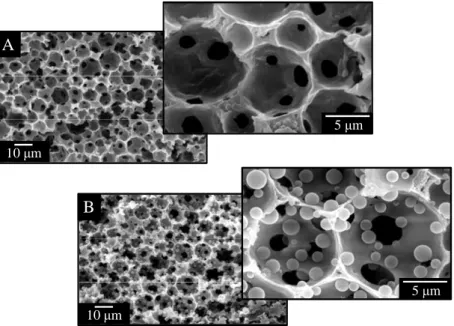
fluorinated tail has a strong affinity for the scCO2 phase. The stabilization of the scCO2-water interface by these glycosurfactants was demonstrated by tensiometry measurements5 and the resulting acrylamide polyHIPEs were characterized by scanning electron microscopy (Figure 1A), pycnometry and porosimetry.6 The effect of the nature and the concentration of the surfactant on the porous polymer structure will be discussed. Finally, the properties of the resulting polymer scaffolds were tuned by performing dispersion polymerizations within their cavities filled with supercritical CO2 leading to microsphere-loaded porous polymers6 (Figure 1B).
B A 5 µm 5 µm 10 µm 10 µm
Figure 1. Scanning electron microscopy images of a polyacrylamide polyHIPE before (A) and after (B) methyl methacrylate dispersion polymerization within the cavities.
References
1. Kimmins S. D., Cameron N. R. Adv. Funct. Mater., 2011, 21, 211-225. 2. Butler R., Davies C. M., Cooper A. I., Adv. Mater., 2001, 13, 1459-1463.
3. Favrelle A., Boyère C., Laurent P., Broze G., Blecker C., Paquot M., Jérôme C., Debuigne A., Carbohydr. Res., 2011, 346, 1161-1164.
4. Boyère C., Favrelle A., Broze G., Laurent P., Nott K., Paquot M., Blecker C., Jérôme C., Debuigne A., Carbohydr. Res., 2011, 346, 2121-2125.
5. Favrelle A., Boyère C., Tran M. K., Clavignac B, Paquot M., Boury F., Jérôme C., Debuigne A. J. Colloid Int. Sci., 2012, submitted.
6. Boyère C., Léonard A. F., Grignard B., Favrelle A., Pirard J.-P., Paquot M., Jérôme C., Debuigne A., Chem. Commun. 2012, 48, 8356-8358.
This work was supported by the French Community of Belgium under the scientific “Concerted Research Actions – ARC” program, “Superzym project”. The CERM thanks the “Belgian Science Policy” for financial support in the frame of the “Interuniversity Attraction Poles Program (PAI VI/27) – Functional Supramolecular Systems”. A. Debuigne is also grateful to the “Fonds National de la Recherche Scientifique” (FRS-FNRS) for the financial support.