This content has been downloaded from IOPscience. Please scroll down to see the full text.
Download details:
IP Address: 95.182.238.245
This content was downloaded on 21/03/2016 at 17:01
Please note that terms and conditions apply.
The virtual atomic and molecular data centre (VAMDC) consortium
View the table of contents for this issue, or go to the journal homepage for more 2016 J. Phys. B: At. Mol. Opt. Phys. 49 074003
The virtual atomic and molecular data centre
(VAMDC) consortium
*
M L Dubernet
1, B K Antony
2, Y A Ba
1, Yu L Babikov
3,4, K Bartschat
5,
V Boudon
6, B J Braams
7, H-K Chung
7, F Daniel
8, F Delahaye
1,
G Del Zanna
9, J de Urquijo
10, M S Dimitrijevi
ć
1,11, A Domaracka
12,
M Doronin
1, B J Drouin
13, C P Endres
14, A Z Fazliev
3, S V Gagarin
15,
I E Gordon
16, P Gratier
17,18, U Heiter
19, C Hill
20, D Jevremovi
ć
11, C Joblin
21,
A Kasprzak
22, E Krishnakumar
23, G Leto
24, P A Loboda
15,25, T Louge
21,
S Maclot
12,26, B P Marinkovi
ć
27, A Markwick
28, T Marquart
19, H E Mason
9,
N J Mason
29, C Mendoza
30, A A Mihajlov
27, T J Millar
31, N Moreau
1,
G Mulas
21,32, Yu Pakhomov
33, P Palmeri
34, S Pancheshnyi
35,
V I Perevalov
3, N Piskunov
19, J Postler
36, P Quinet
34,37,
E Quintas-Sánchez
1, Yu Ralchenko
38, Y-J Rhee
39, G Rixon
40,
L S Rothman
16, E Roueff
1, T Ryabchikova
33, S Sahal-Bréchot
1, P Scheier
36,
S Schlemmer
41, B Schmitt
8, E Stempels
19, S Tashkun
3, J Tennyson
20,
Vl G Tyuterev
42, V Vuj
cˇić
11,43, V Wakelam
17,18, N A Walton
40, O Zatsarinny
5,
C J Zeippen
1and C M Zwölf
11
LERMA, Observatoire de Paris, PSL Research University, CNRS, Sorbonne University, UPMC Univ Paris 06, 5 Place Janssen, F-92190 Meudon, France
2
Department of Applied Physics, Indian School of Mines, Dhanbad 826 004, India 3Institute of Atmospheric Optics, Zuev Sq. 1, Tomsk 634021, Russia
4
Tomsk State University, Tomsk 634050, Russia 5
Department of Physics and Astronomy, Drake University, Des Moines, IA 50311, USA 6
Laboratoire Interdisciplinaire Carnot de Bourgogne, UMR 6303 CNRS-University Bourgogne Franche-Comté 9 Avenue Alain Savary, BP 47 870, F-21078 DIJON Cedex, France
7
Nuclear Data Section, Division of Physical and Chemical Sciences, International Atomic Energy Agency (IAEA), Vienna International Centre, A-1400 Vienna, Austria
8
University Grenoble Alpes/ CNRS, IPAG, F-38000 Grenoble, France 9
DAMTP, Centre for Mathematical Sciences, Wilberforce Road, Cambridge CB3 0WA, UK 10
Instituto de Ciencias Físicas, Universidad Nacional Autónoma de México, PO Box 48-3, 62251 Cuernavaca, Mor., Mexico
11
Astronomical Observatory, Volgina 7, 11060 Belgrade, Serbia 12
CIMAP, UMR 6252(CEA/CNRS/ENSICAEN/UCN), Bd. Henri Becquerel, BP 5133, F-14070 Caen Cedex 5, France
13
California Institute of Technology,Jet Propulsion Laboratory, 4800 Oak Grove Dr. Pasadena, CA 91109, USA
14Max-Planck-Institut für extraterrestrische Physik, Giessenbachstrasse, D-85748 Garching, Germany 15
Russian Federal Nuclear Centre All-Russian Institute of Technical Physics(RFNC VNIITF), Snezhinsk, Russia
16
Harvard-Smithsonian Center for Astrophysics, Atomic and Molecular Physics Division, MS50, 60 Garden St, Cambridge, MA 02138-1516 USA
17
University Bordeaux, LAB, UMR 5804, F-33270, Floirac, France 18
CNRS, LAB, UMR 5804, F-33270, Floirac, France 19
Department of Physics and Astronomy, Uppsala University, Box 516, SE-751 20 Uppsala, Sweden 20
Department of Physics and Astronomy, University College London, London WC1E 6BT, UK 21
Institut de Recherche en Astrophysique et Planétologie, Université de Toulouse UPS-OMP, CNRS, 9 Av. du Colonel Roche, F-31028 Toulouse Cedex 4, France
22
SRCV, Observatoire de Paris, 61 Av. Denfert Rochereau, 75014 Paris, France
J. Phys. B: At. Mol. Opt. Phys. 49(2016) 074003 (18pp) doi:10.1088/0953-4075/49/7/074003
23Tata Institute of Fundamental Research, Department of Nuclear and Atomic Physics, Homi Bhabha Road, Colaba, Mumbai 400005, India
24
INAF—Osservatorio Astrofisico di Catania, Via S. Sofia 78, I-95123 Catania, Italy 25
National Research Nuclear University Moscow Engineering Physics Institute(MEPhI), Moscow, Russia 26
Université de Caen Normandie, Esplanade de la Paix, CS 14032, F-14032 Caen Cedex 5, France 27
Institute of Physics Belgrade, University of Belgrade, PO Box 57, 11001 Belgrade, Serbia 28
Jodrell Bank Centre for Astrophysics, School of Physics and Astronomy, University of Manchester, Oxford Road, Manchester M13 9PL, UK
29
Department of Physical Sciences, The Open University, Walton Hall, Milton Keynes MK7 6AA, UK 30Centro de Física, Instituto Venezolano de Investigaciones Científicas (IVIC), PO Box 20632, Caracas 1020A, Venezuela
31
School of Mathematics and Physics, Queen’s University Belfast, University Road, Belfast BT7 1NN, UK 32Istituto Nazionale di AstroFisica—Osservatorio Astronomico di Cagliari, via della Scienza 5, I-09047 Selargius(CA), Italy
33
Institute of Astronomy RAS, Pyatnitskaya 48, 119017 Moscow, Russia 34
Physique Atomique et Astrophysique, Université de Mons, B-7000 Mons, Belgium 35ABB Corporate Research, Segelhofstrasse 1K, 5405 Baden-Dättwil, Switzerland
36Institute for Ion Physics and Applied Physics, University of Innsbruck, Technikerstr. 25/3, A-6020 Innsbruck, Austria
37
IPNAS, Université de Liège, B-4000 Liège, Belgium 38
Atomic Spectroscopy Group, National Institute of Standards and Technology, Gaithersburg, MD 20899, USA
39
Nuclear Data Center, Korea Atomic Energy Research Institute, Daejeon, 305-353, Korea 40
Institute of Astronomy, University of Cambridge, Madingley Road, Cambridge, CB3 0HA, UK 41
I. Physikalisches Institut, Universität zu Köln, Zülpicher Str. 77, D-50937 Kln, Germany 42
GSMA, UMR CNRS 7331, Université de Reims, France
43Faculty of Organizational Sciences, University of Belgrade, Jove Ilića 33, 11000 Belgrade, Serbia E-mail:[email protected]
Received 15 November 2015, revised 31 December 2015 Accepted for publication 7 January 2016
Published 17 March 2016 Abstract
The Virtual Atomic and Molecular Data Centre(VAMDC) Consortium is a worldwide consortium which federates atomic and molecular databases through an e-science infrastructure and an organisation to support this activity. About 90% of the inter-connected databases handle data that are used for the interpretation of astronomical spectra and for modelling in manyfields of astrophysics. Recently the VAMDC Consortium has connected databases from the radiation damage and the plasma communities, as well as promoting the publication of data from Indian institutes. This paper describes how the VAMDC Consortium is organised for the optimal distribution of atomic and molecular data for scientific research. It is noted that the VAMDC Consortium strongly advocates that authors of research papers using data cite the original experimental and theoretical papers as well as the relevant databases.
Keywords: databases, atoms, molecules, spectroscopy, kinetic data, astrophysics (Some figures may appear in colour only in the online journal)
1. Introduction
The Virtual Atomic and Molecular Data Centre (VAMDC) Consortium originates from two European funded projects: the VAMDC (http://www.vamdc-project.vamdc. eu/) Dubernet et al 2010 and the SUP@VAMDC (http://
www.sup-vamdc.vamdc.org/) (Zwölf et al 2014) projects.
The main scientific outcomes of these projects are:
(1) An e-science infrastructure that interconnects about 30 databases(http://www.vamdc.eu/activities/research);
(2) An overarching organisation: ‘the VAMDC Consor-tium’ that was launched 1 November 2014 and currently involves 35 groups, 19 of them having signed a memorandum of understanding(http://www.vamdc. org/structure/how-to-join-us/).
Original content from this work may be used under the terms of the Creative Commons Attribution 3.0 licence. Any further distribution of this work must maintain attribution to the author(s) and the title of the work, journal citation and DOI.
VAMDC Consortium activities cover four domains: research, which is the most developed domain, education and industry that are currently in their early development stage, and outreach activities.
To facilitate its implementation VAMDC has developed protocols, data structures and query languages to allow dis-parate but complementary databases to be both interrogated simultaneously and to be utilised in a synchronised manner. This article describes the current status of the VAMDC including a description of the databases participating in this project. The data centre provides particularly comprehensive coverage of laboratory atomic and molecular physics data required for astrophysics studies. VAMDC therefore provides a unique access point for astronomers seeking the best atomic and molecular data for their studies.
2. Research services
VAMDC offers a common entry point to all incorporated databases through the VAMDC portal(http://portal.vamdc. eu).This portal is flexibly designed offering the possibility of
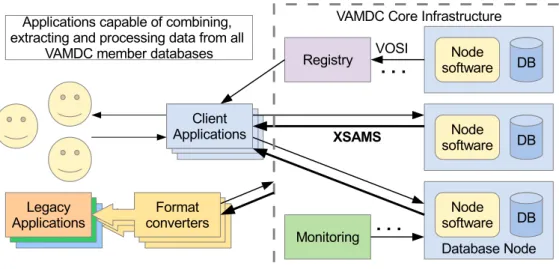
including new data and new databases within the VAMDC e-infrastructure, as well as providing software libraries and modules that can be included in the user’s own programs, and providing stand-alone user-oriented software that retrieves and handles atomic and molecular data. Figure1depicts the structure of the VAMDC e-infrastructure.
2.1. Standards
The VAMDC e-infrastructure has evolved over the years through successive releases (Rixon et al 2011, Doronin et al 2012, Dubernet et al 2015). The current version of
standards and software is release version v12.07. The VAMDC Standards include the definition of data models for atomic and molecular data, the definition of ‘keywords’, the definition of query protocols and data access, the definition of registries, of units, of versioning processes, and the estab-lishment of a uniform protocol for web application to process
XML schema for atoms, molecules and solids (XSAMSs) files. All Standards Documents can be found on http:// standards.vamdc.eu/. Below we provide here a brief expla-nation of some of the key features of these standards.
2.1.1. Data model and XSAMS files. The exchange of heterogeneous atomic and molecular data requires that the relevant parts of physics and chemistry be translated into a computing framework. XSAMS is an XML implementation of the VAMDC data model which is used to build the computer framework. The processes being represented by XSAMS are essentially quantum-mechanical in nature.
XSAMS provides a standard approach to the description of atomic and molecular (A+M) physics in terms of physical processes connecting different quantum-states of atoms and molecules. The identification of the states is standardised by XSAMS to promote matching of corresp-onding states between databases. Several levels of detail are supported by XSAMS for the description of states and a range of coupling schemes may be specified. States of molecules are identified by tuples of the most-relevant quantum numbers, different tuples being specified in XSAMS for different classes of molecules. XSAMS describes both radiative and collisional transitions between states. The description of collisions may include chemical changes and interactions with elementary particles. The environment in which the transitions occur may be specified, with the main emphasis being on events in the gas phase, but improved support is planned for solid and liquid environments. Cross-sections, both differential and total, for the reactions may be included, and these may be expressed in either tabular or para-metric form.
Finally, since the origin and history of the data are necessary for data assessment, XSAMS imposes strict requirements on the traceability of the data, with mandatory inclusion of information on data sources and the methods used to generate specific sets of data. Similarly XSAMS also enforces the rigorous use of standardised units systems and facilitates the provision of uncertainties with the data Figure 1.Layout of the VAMDC e-infrastructure.
provided. XSAMS was initially developed (Ralchenko et al2009) through the joint efforts of researchers from the
International Atomic Energy Agency (IAEA), National Institute of Standards and Technology (USA), Oak Ridge National Laboratory(USA), Université Pierre et Marie Curie and Observatoire Paris-Meudon(France), with contributions from the All-Russian Institute of Technical Physics(Russia). The VAMDC Consortium has further developed XSAMS, which then became VAMDC-XSAMS and implemented its logic in all the software used within the VAMDC e-infrastructure. An agreement between the VAMDC Consortium and the IAEA makes the IAEA curator of the stable developed versions of VAMDC-XSAMS (Braams et al2016), currently VAMDC-XSAMS version 1.0 released
in July 2012(http://standards.vamdc.org/#data-model).
Figure 2 provides an example of the use of XSAMS (Endres et al2014) provided by the CDMS database (Mueller
et al2005).
2.1.2. Registry of services. The VAMDC registry is a database of metadata describing VAMDC nodes and web applications. It allows an application tofind the address of a given node, to select nodes by the kinds of data they offer and to find out which query terms are supported at a node. Members of the VAMDC Consortium have a password allowing them to register a new database or a web application, once they have followed the quality procedures concerning their new resource.
3. VAMDC connected databases
Each database included in VAMDC may be interrogated individually by software via its own web-service, but these services conform strictly to the VAMDC standards and all use the same query protocol and language; thus, it is easy to send the same query to multiple databases. The query protocol is called VAMDC-TAP44, derived from the table Access Pro-tocol of the International Virtual Observatory Alliance, and the query language is VAMDC SQL Sub-set 2 (VSS2)45, a limited form of structured query language tailored to suit the VAMDC data-model inherent in XSAMS. The combination of a service and a database is called a ‘VAMDC data-node’ and is achieved by building a small program, specific to the database and running inside a web server, to represent the database and to convert between internal and external repre-sentations of the data. Such a program is called ‘node soft-ware’ and almost all the code for it is provided by VAMDC as a standard library; only minor customisation is needed for each database. Support is provided by VAMDC for building new data-nodes.
The VAMDC nodes are distributed such that they are located at themembers’ and partners’ sites. At present most of
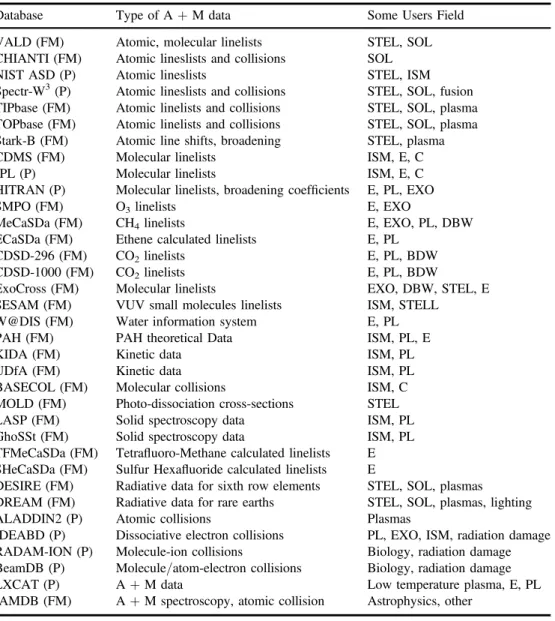
the databases included in the VAMDC e-infrastructure are key databases used in astrophysics. Table1 provides a sum-mary of the databases currently accessible via VAMDC which are each discussed in turn below.
3.1. Database of species
Many queries select by atomic and molecular species, and the names for species vary between scientific communities. VAMDC maintains a database of names, called the‘species database’ from which community-specific terms may be refined into standard identifiers understood by all VAMDC nodes. VAMDC identifiers are based on InChIkeys (Heller et al2015). In most cases, the VAMDC identifier is just the
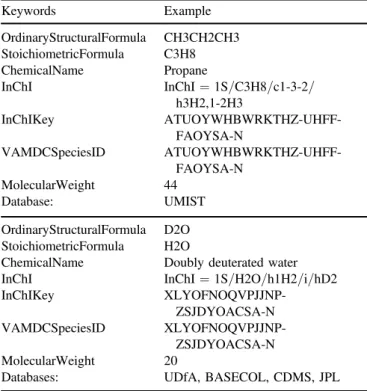
standard InChIkey, but in special cases a suffix is added to distinguish molecular conformers. One copy of the species database is encapsulated in the web portal. Another copy is available for query by applications as a VAMDC data-node. We have designed software which updates the species data-base when a new species is introduced in any of the VAMDC-connected databases. Copies of the Species Database are distributed to user client software to allow the same query capability as the portal. Table2gives two sample entries from the species database. This species database is a key comp-onent of the interoperability within the VAMDC e-infrastructure.
3.2. VALD
VALD (Piskunov et al 1995) is a collection of critically
evaluated laboratory parameters for individual atomic transi-tions, complemented by theoretical calculations. VALD is actively used by astronomers for stellar spectroscopic studies —model atmosphere calculations, atmospheric parameter determinations, abundance analysis etc. The twofirst VALD releases (Piskunov et al 1995, Kupka et al1999) contained
parameters for atomic transitions only. In a major upgrade, VALD3, publically available from the spring of 2014, the atomic data was extended to cover elements from hydrogen to uranium, and also complemented with parameters for mole-cular transitions (Ryabchikova et al 2015). An evaluation
procedure which involves a comparison with a selection of high-precision stellar spectra is described by (Ryabchikova et al 1999) and (Ryabchikova et al 2008). At present the
Moscow VALD-VAMDC node serves high-quality atomic data only (about 2 million transitions). The Uppsala node contains all collected transitions (about 177 million) and is, therefore, suitable for applications such as opacity calcula-tions. The Moscow node is limited to transitions between the experimentally measured energy levels (hence precise wave-lengths) and is more tuned for high-resolution spectroscopic analysis. From 2016 Moscow and Uppsala nodes will also run the mirrors of each other for enhanced reliability.
3.3. CHIANTI
CHIANTI (www.chiantidatabase.org), first released in 1996
(Dere et al 1997), is a well-established atomic database for
ions of astrophysical importance. Combined with
44
See http://www.vamdc.org/documents/standards/dataAccessProtocol/ index.html.
45 See http://www.vamdc.org/documents/standards/queryLanguage/ index.html.
spectroscopic diagnostic programs, it is used in the analysis of optically thin collisionally ionised plasmas. The CHIANTI database contains atomic structure data (experimental and calculated wavelengths and radiative data), and rates for electron and proton collisions, as well as for ionisation and recombination. The data are mostly obtained from published literature, and are regularly assessed and updated. The latest version 8 of CHIANTI (Del Zanna et al 2015), contains a
large number of new atomic data for several isoelectronic sequences, calculated within the UK atomic processes in
astrophysical plasmas(APAP) network (www.apap-network. org). APAP/CHIANTI data are used world-wide by almost
all atomic databases and modelling codes for astrophysical plasmas. For example, by the modelling codes for photo-ionised plasmas such as Cloudy (Ferland et al 2013) and
MOCASSIN (Ercolano et al2008); by modelling codes for
the x-rays such as PINTofALE (Kashyap and Drake 2000)
and ISIS (Houck and Denicola 2000); hydrodynamic codes such as HYDRAD(Bradshaw and Mason2003) and RADYN
(Allred et al2015); spectral modelling of supernovae such as
Figure 2.An example of use of XSAMS: data for the CO molecule due to(Winnewisser et al1997) provided by the CDMS database
TARDIS (Kerzendorf and Sim2014); and atomic databases
such as XSTAR(Bautista and Kallman2001), Stout (Lykins
et al 2015), ATOMDB (Smith et al 2001). The CHIANTI
basic data is available via VAMDC, and version 8 is being added.
3.4. NIST atomic spectra database(NIST ASD)
The NIST ASD athttp://www.nist.gov/pml/data/asd.cfm
contains critically evaluated standard reference data on energy levels, spectral lines, and radiative transitions in atoms and ions of 110 elements from H to Ds. As of November 2015, ASD offers detailed information on more than 109 000 levels and 250 000 spectral lines, in particular, level identifications (configurations, terms, total angular momentum, etc) and radiative decay rates for almost 100 000 transitions. All data in ASD are carefully analysed and evaluated and proper uncertainties for numerical values are derived. ASD also
offers several graphical data manipulation tools, e.g., dynamic Grotrian diagrams and Saha-local thermodynamic equilibrium spectra, as well as spectroscopic diagnostic information for ions of several astrophysically abundant elements.
3.5. Spectr-W3
The Spectr-W3project is the collaboration between the Rus-sian Federal Nuclear Centre All-RusRus-sian Institute of Techni-cal Physics (RFNC VNIITF) and the Joint Institute for High Temperatures of the Russian Academy of Sciences (JIHT RAS). The information accumulated in the Spectr-W3 (Fae-nov et al 2002) atomic database contains over 450 000
records and includes experimental and theoretical data on ionisation potentials, energy levels, wavelengths, radiation transition probabilities, oscillator strengths, and (optionally) parameters providing analytical approximations for electron-collisional cross-sections and rates for atoms and ions. These Table 1.Table of VAMDC connected databases linked to astrophysics. Userfields are labelled as follows for applications in astrophysics and planetary science : stellar physics(STEL), solar physics (SOL), interstellar medium (ISM), Earth (E), planets (PL), exoplanets (EXO), brown dwarfs(BDW), comets (C). Partnerships are indicated as Full Members (FM) according to the VAMDC Consortium MoU and partners following the VAMDC technical quality chart(P) only. References for the databases are found in the appendix.
Database Type of A+ M data Some Users Field
VALD(FM) Atomic, molecular linelists STEL, SOL CHIANTI(FM) Atomic lineslists and collisions SOL
NIST ASD(P) Atomic lineslists STEL, ISM
Spectr-W3(P) Atomic lineslists and collisions STEL, SOL, fusion TIPbase(FM) Atomic linelists and collisions STEL, SOL, plasma TOPbase(FM) Atomic linelists and collisions STEL, SOL, plasma Stark-B(FM) Atomic line shifts, broadening STEL, plasma
CDMS(FM) Molecular linelists ISM, E, C
JPL(P) Molecular linelists ISM, E, C
HITRAN(P) Molecular linelists, broadening coefficients E, PL, EXO
SMPO(FM) O3linelists E, EXO
MeCaSDa(FM) CH4linelists E, EXO, PL, DBW
ECaSDa(FM) Ethene calculated linelists E, PL
CDSD-296(FM) CO2linelists E, PL, BDW
CDSD-1000(FM) CO2linelists E, PL, BDW
ExoCross(FM) Molecular linelists EXO, DBW, STEL, E
SESAM(FM) VUV small molecules linelists ISM, STELL
W@DIS(FM) Water information system E, PL
PAH(FM) PAH theoretical Data ISM, PL, E
KIDA(FM) Kinetic data ISM, PL
UDfA(FM) Kinetic data ISM, PL
BASECOL(FM) Molecular collisions ISM, C
MOLD(FM) Photo-dissociation cross-sections STEL
LASP(FM) Solid spectroscopy data ISM, PL
GhoSSt(FM) Solid spectroscopy data ISM, PL
TFMeCaSDa(FM) Tetrafluoro-Methane calculated linelists E SHeCaSDa(FM) Sulfur Hexafluoride calculated linelists E
DESIRE(FM) Radiative data for sixth row elements STEL, SOL, plasmas DREAM(FM) Radiative data for rare earths STEL, SOL, plasmas, lighting
ALADDIN2(P) Atomic collisions Plasmas
IDEABD(P) Dissociative electron collisions PL, EXO, ISM, radiation damage RADAM-ION(P) Molecule-ion collisions Biology, radiation damage BeamDB(P) Molecule/atom-electron collisions Biology, radiation damage
LXCAT(P) A+M data Low temperature plasma, E, PL
data were extracted from the scientific literature or provided directly by authors. The information is supplied with refer-ences to the original sources and comments, elucidating the details of experimental measurements or calculations, where necessary and available. At the present time, Spectr-W3is the largest available database providing information on the spectral properties of multicharged ions. A new development of the Spectr-W3atomic database started in 2014 will create a new section containing information on x-ray emission spec-trograms recorded at various plasma sources. Software for this section is currently being created and tested. The spec-trograms, mostly obtained in the laser-produced-plasma experiments are also in preparation. Spectr-W3 is hosted at
http://spectr-w3.snz.ru/.
3.6. TIPbase-TOPbase
Atomic data calculated within the framework of the interna-tional opacity project(OP) and iron project (IP) are available in TOPbase (the OP database for radiative processes) (Sea-ton1987, Cunto and Mendoza1992, Cunto et al 1993) and
TIPbase (the IP database, for collisional and radiative pro-cesses) (Hummer et al 1993). Included are energy levels/
terms, radiative transitions probabilities, photoionisation cross sections and collision strengths for a large selection of ions in the range H to Ni. These theoretical data have been calculated using state-of-the-art computer programs such as various versions of the R-matrix suite of codes(Berrington et al1995, Berrington and Ballance 2002), superstructure (Eissner
et al 1974) and autostructure (Badnell 2011) or CIV3
(Hibbert 1975, Hibbert et al 1991). Within their range of
validity, the OP and IP data remain a widely used reference
set for both producers and users of atomic data. They are relevant for experiment analysis, theoretical comparisons and for various atrophysical or laboratory experiment applica-tions. The OP radiative data are used to calculate mono-chromatic and mean opacities (Badnell et al 2005) required
notably in stellar codes or for the analysis of experiments. TOPbase and TIPbase are hosted athttp://cdsweb.u-strasbg. fr/OP.htx.
3.7. Stark-B
The Stark-B (Sahal-Bréchot et al 2015) database is a
colla-borative project between the Laboratoire d’Etude du Rayon-nement et de la matire en Astrophysique and the Astronomical Observatory of Belgrade. The database contains calculated widths and shifts of isolated lines of atoms and ions due to electron and ion collisions (Stark broadening parameters), calculated in a series of papers by Dimitrijevi’c, Sahal-Br’echot and their co-workers, using the semiclassical-perturbation approach developed by Sahal-Bréchot (1969a, 1969b, 1974)
supplemented by Fleurier et al (1977), and updated by
Dimitrijević and Sahal-Bréchot (1984) and in subsequent
papers(see Dimitrijević and Sahal-Bréchot2014).
The database’s principal purpose is to provide the Stark broadening data needed for the modelling and spectroscopic diagnostics of stellar atmospheres and envelopes but it is also useful for laboratory plasmas, as well as for laser produced, fusion and technological plasmas. Various astrophysical and other applications of data in STARK-B are discussed by Dimitrijević and Sahal-Bréchot (2014). Data are provided
for a wide range of temperatures and electron or ion densities. Hence the range of temperatures and densities covered by the tables is wide and depends on the ionisation degree of the considered ion. Stark-B is hosted at http:// stark-b.obspm.fr/.
3.8. Cologne database for molecular spectroscopy(CDMS)
The CDMS (Mueller et al 2005) provides transition
fre-quencies of atoms and molecules mostly for radio astro-nomical observations. The included species have been or may be observed in the interstellar medium (ISM), in the cir-cumstellar envelopes (CSEs) of very young and very old stars, or in planetary atmospheres. As of October 2015, 789 species are available which refer not only to the main isotopic species and the ground vibrational state, but also to minor isotopic species and excited vibrational states as far as these may be of interest for radio astronomers. The catalogue is similar to that of the Jet Propulsion Laboratory (Pickett et al 1998 and while duplication is avoided, nevertheless, some overlap exists. CDMS welcomes outside contributions after critical evaluation. As a partner of the VAMDC, the CDMS is accessible from the general VAMDC portal, from the SPECTCOL tool(Dubernet et al2012), from CDMS new
interface (http://cdms.ph1.uni-koeln.de/cdms/portal/) and
from its traditional user interfacehttp://www.astro.uni-koeln. de/cdms. CDMS is hosted athttp://www.cdms.de.
Table 2.The species database showing keywords with values given for two entries.
Keywords Example OrdinaryStructuralFormula CH3CH2CH3 StoichiometricFormula C3H8 ChemicalName Propane InChI InChI=1S/C3H8/c1-3-2/ h3H2,1-2H3 InChIKey ATUOYWHBWRKTHZ-UHFF-FAOYSA-N VAMDCSpeciesID ATUOYWHBWRKTHZ-UHFF-FAOYSA-N MolecularWeight 44 Database: UMIST OrdinaryStructuralFormula D2O StoichiometricFormula H2O
ChemicalName Doubly deuterated water
InChI InChI=1S/H2O/h1H2/i/hD2 InChIKey XLYOFNOQVPJJNP-ZSJDYOACSA-N VAMDCSpeciesID XLYOFNOQVPJJNP-ZSJDYOACSA-N MolecularWeight 20
3.9. JPL
The submillimetre, millimetre, and microwave spectral line catalogue(Pickett et al 1998) has provided the astrophysics
community with atomic and molecular absorption/emission spectral data for over 35 years. The catalogue listings include line-by-line tabulations for each spectral feature, as well as source documentation. As for CDMS, entries are prepared with the quantum mechanical software SPFIT/SPCAT (Pickett 1991), which provides a well-founded and
thor-oughly tested common basis for the molecular physical data.
3.10. HITRAN
The HITRAN database (Rothman et al 2013) is a
long-standing compilation of molecular spectroscopic parameters that are required for radiative-transfer codes. This latest edi-tion of HITRAN has a tradiedi-tional line-by-line high resoluedi-tion section that contains essential spectral parameters for 47 molecules along with their significant isotopologues appro-priate for the terrestrial atmospheric and diverse room temp-erature applications. There is a section that contains high-resolution experimental cross-sections for so-called heavy molecules, including, for example, the chlorofluorocarbons and halocarbons, that are not amenable to full quantum-mechanical description as in the traditional part of HITRAN. There is also a section of the compilation that provides col-lision-induced absorption cross-sections. Recently the tradi-tional line-by-line part of HITRAN has been restructured(Hill et al2013) in order to expand the capabilities to address the
issues of planetary atmospheres as well as more sophisticated line shapes. The HITRAN database contains explicit and convenient citations to all source data, and in fact in many cases has raised the impact factor of contributors (Gordon et al2016).
3.11. Spectroscopy and molecular properties of ozone(SMPO)
SMPO is an information system(Babikov et al2014) devoted
to the high resolution spectroscopy of the ozone molecule, related properties and data sources. SMPO contains infor-mation on original spectroscopic data recovered from com-prehensive analyses and modelling of experimental spectra as well as associated software for data representation written in PHP Java Script, C++ and FORTRAN. The line-by-line list of vibration–rotation transitions, energy levels, transition moments and other related information can be requested from SMPO via the VAMDC portal. Considerable new spectro-scopic information has been included using extended analysis of ozone in the infrared(Barbe et al2007,2013, De Backer-Barilly et al 2006). SMPO also contains supplementary
information to that of HITRAN (Rothman et al 2013) and
GEISA (Jacquinet-Husson et al 2011): spectroscopic
para-meters, theoretical predictions for high-energy states of var-ious isotopologues from potential energy surfaces (Holka et al2010, Tyuterev et al2013) as well as assigned data near
the dissociation threshold (Campargue et al 2008, Barbe et al 2011, Tyuterev et al 2014) that could be useful for
scientists exploring the dynamics of ozone. Applications for
the SMPO may include: education/training in molecular physics, radiative processes, laser physics; spectroscopic applications (analysis, Fourier transform spectroscopy, atmospheric optics, spectroscopic atlases); applications to environmental studies and atmospheric physics (remote sensing) and photochemistry (laser excitation, multiphoton processes). SMPO can be accessed via Reims (http://smpo. univ-reims.fr) and Tomsk (http://smpo.iao.ru) sites providing
supplementary functionalities of relational database under control of MySQL database tools including graphical inter-face for theoretical spectra simulation and comparisons with experimental records.
3.12. MeCaSDa, ECaSDa, TFMeCaSDa, SHeCaSDa
The MeCaSDa, ECaSDa, TFMeCaSDa and SHeCaSDa databases (Ba et al 2013) provide calculated spectroscopic
data for the CH4, C2H4, CF4and SF6molecules, respectively,
including isotopologues. These databases not only provide spectroscopic line lists (line positions, intensities and line broadening coefficients) for infrared absorption and Raman scattering spectra, but also a full description of molecular eigenstates with all quantum numbers. The data result from the most recent fits of experimental data, see for example (Nikitin et al2013, Amyay et al2015) for CH4,(Ballandras
et al2013) for C2H4,(Faye et al2014) for SF6and(Boudon
et al 2011,2013) for CF4. All analysis calculations are
per-formed using the XTDS software package (Wenger et al 2008). These databases are complementary to other
databases, such as HITRAN (Rothman et al 2013), which
mostly rely on experimental data. The calculated data may be less accurate in some spectral regions, but the calculated data sets are more complete since all information is calculated in a given spectral region. The databases are hosted at http:// vamdc.icb.cnrs.fr/PHP/methane.php, http: //vamdc.univ-reims.fr/PHP/ethylene.php, http://vamdc.icb.cnrs.fr/PHP/ CF4.phpand http://vamdc.icb.cnrs.fr/PHP/SF6.php.
3.13. Carbon dioxide spectroscopic databank(CDSD)-296 and CDSD-1000
The CDSD for atmospheric applications contains spectral line parameters of the seven atmospherically most-abundant iso-topologues of the carbon dioxide molecule: 16O12C16O,
16
O13C16O, 16O12C18O, 16O12C17O, 16O13C18O, 16O13C17O,
18O12C18O. The line parameters(line position, line intensity,
energy of lower state, air-broadening coefficient, self pres-sure-induced broadening coefficient and exponent of temp-erature dependence of air broadening coefficients) have calculated values. The CDSD-296 databank covers the 5.9–12784.1 cm−1 spectral range and contains more than 419600 lines. This line list was generated using an intensity cutoff of 10−30 cm/molecule at a reference temperature of 296 K. Recently the CDSD-296 databank (Tashkun et al2015) has been extended to include all 12 stable carbon
dioxide isotopologues, and the full database will be available through the VAMDC portal in 2016. The CDSD-1000 data-bank (Tashkun et al 2003) covers the spectral range
257–9648 cm−1and contains more than 3950 500 lines. The line list has been generated using an intensity cutoff of 10−27cm/molecule at a reference temperature of 1000 K. The databanks are hosted in Tomsk at ftp://ftp.iao.ru/pub/ CDSD-296andftp://ftp.iao.ru/pub/CDSD-1000.
3.14. ExoCross
The ExoMol project (Tennyson and Yurchenko 2012)
pro-vides computed line lists for molecules likely to be of importance in hot atmospheres such as those of extrasolar planets and cold stars. Because of the elevated temperatures in these environments, a very large number of transitions must be included in spectral simulations: up to 1011lines in some cases. To ease the computational burden involved in the calculation of opacities(which in many practical cases are not required at high resolution), ExoMol provides pre-calculated absorption cross sections (Hill et al 2013) at a range of
temperatures through a service on the project website(http:// www.exomol.com/xsecs/). The ExoMol database has just
undergone a comprehensive upgrade to its data structures (Tennyson et al2016). ExoCross is a VAMDC database node
which provides access to these cross sections through the VSS2 query language. Data is returned in the XSAMS format for interoperability with other data returned by VAMDC services. ExoCross is hosted at www.exomol.comwhere a considerable amount of other spectroscopic data can be found for the molecules concerned.
3.15. Spectroscopy of atoms and molecule(SESAM)
SESAMs is devoted to the spectroscopic analysis of UV electronic spectra of diatomic molecules. Data for H2, HD, D2
and CO are presently available as a whole dataset or can be searched within a defined wavelength window. Other selec-tion criteria are available such as the energy of the lower (upper) level of the transition and the oscillator strength value. The data are obtained from theoretical calculations which include rotational and radial perturbations between electronic potential curves(Abgrall et al 1993,1994). They have been
tested carefully against experimental values when available (Abgrall et al1994, Liu et al2007, Gabriel et al2009). They
are useful in various contexts, ranging from plasma labora-tories (Gabriel et al 2009) to planetary (Barthélemy
et al 2014), interstellar (France et al 2011, 2012, 2014) or
extragalactic environments(Salumbides et al2015). SESAM
is hosted athttp://sesam.obspm.fr/.
3.16. W@DIS
The W@DIS information system (Polovtseva et al 2012, Tennyson et al2013,2014) is designed to provide access to
data, information, and ontologies relating to quantitative spectroscopy required for solving fundamental and applied problems pertaining to a number of subject domains: atmo-spheric optics, astronomy, etc. The information system under discussion is a prototype of the next generation information system on molecular spectroscopy based on Semantic Web technologies(Berners-Lee et al2001, Fazliev et al2013). The
system focuses on spectral data representation for the end user with the possibility of employing information characterised by different levels of details both for the structure of the data and for the knowledge(semantic annotations) associated with these data. It is the end user who makes the decision about the level of detail required. W@DIS divides molecular spectro-scopic data into three parts: parameters for energy levels, transitions, and line profiles. Most of the molecular data are accessible via VAMDC portal. W@DIS is hosted at http:// wadis.saga.iao.ru.
3.17. Polycyclic aromatic hydrocarbon(PAH)
The Cagliari-Toulouse PAH theoretical spectral database (Malloci et al2007) is a joint effort by the groups of Mulas
(INAF-OAC) and Joblin (Univ. Toulouse III/CNRS-IRAP), aimed at providing all the‘ingredients’ needed for modelling of the photophysics of individual PAHs in space, mainly in photon-dominated interstellar and circumstellar environ-ments. It includes basic structural properties of PAHs in four charge states (−1, 0, +1, and +2), ionisation potentials and electron affinities, harmonic vibrational analyses, vertical photoabsorption electronic spectra. Recent examples of the use of the data in this database are e.g. Berné et al (2015),
Zhen et al (2015), Zonca et al (2015). All these data were
obtained in the framework of the density functional theory, (see Jones2015for a recent review), and some on-going work (van Mourik 2014), in its time-independent formulation for
ground electronic state properties and in its time-dependent formulation for photoabsorption spectra. Data were obtained using the Gaussian (Frisch et al 2004), NWChem (Valiev
et al 2010), and Octopus (Andrade et al 2015) computer
codes.
3.18. Kinetic database for astrochemistry(KIDA)
The KIDA (Wakelam et al2012), is a compilation of kinetic
data(chemical reactions and associated rate coefficients) used to model the chemistry in astrophysical environments (the interstellar medium, protoplanetary disks, planetary atmo-spheres etc). In addition, to detailed information of each reaction(temperature range of validity of the rate coefficients, reference, uncertainty etc), particular attention is given to the quality of the data which is evaluated by a group of experts in the field. The 2014 update has just been released (Wakelam et al2015). KIDA is hosted athttp://kida.obs.u-bordeaux1.fr.
3.19. UDfA
The UMIST database for astrochemistry(McElroy et al2013)
contains reaction rate coefficients and related material for the study of chemical kinetic modelling of astronomical sources, including molecular clouds, CSEs and shocked gas. The main part of the database Rate12, which is thefifth public release of the data, is a set of 6173 gas-phase reactions and temperature-dependent rate coefficients among 467 species and involving 13 elements (McElroy et al 2013). In this release particular
emphasis has been placed on identifying the source of the data; DOI codes and web links to the original papers are
provided where possible. In parallel, a comprehensive, searchable web site has been developed which includes other relevant data including deuterium exchange reactions and state-selective ortho–para reactions among hydrogen and deuterium, both of which are essential for calculations of deuterium fractionation in interstellar clouds, a set of binding energies for atoms and molecules on interstellar ices and a set of three-body reactions and rate coefficients that are important at very high densities. The web site also provides fully commented codes and documentation for calculations of abundances in molecular clouds and CSEs together with related perl scripts and instructions for generating the ODEs and plotting routines. Software that turn the abundance out-puts into line intensities and profiles is being developed. UDfA is hosted atwww.udfa.net.
3.20. BASECOL
The BASECOL2012 database (Dubernet et al 2013) is a
repository of collisional data. It contains rate coefficients for the collisional excitation of rotational, ro-vibrational, vibra-tional, fine, and hyperfine levels of molecules by atoms, molecules, and electrons, as well asfine-structure excitation of some atoms, that are relevant to interstellar and circum-stellar astrophysical applications. In addition, BASE-COL2012 provides spectroscopic data queried dynamically from various spectroscopic databases using the VAMDC technology. These spectroscopic data are conveniently mat-ched to the in-house collisional excitation rate coefficients using the SPECTCOL software package (Dubernet et al2012), and the combined sets of data can be downloaded
from the BASECOL2012 website. As a partner of the VAMDC, BASECOL2012 is accessible both from the general VAMDC portal and from user tools such as SPECTCOL. Submissions of newly published collisional rate coefficients sets are critically evaluated before inclusion in the database which is hosted at http://basecol.obspm.fr. The BASECOL database contains explicit citations to all source data; the authors’ publications can be easily retrieved from the BASECOL website and from both the SPECTCOL tool and the VAMDC portal through the ‘bibtex’ visualisation software.
3.21. MOLD
MOLD(Vujčić et al2015) contains photo-dissociation
cross-sections for the individual ro-vibrational states of the diatomic molecular ions and rate coefficients for the atom–Rydberg atom chemi-ionisation and inverse electron–ion–atom chemi-recombination processes. At the moment MOLD contains data for photodissociation cross-sections of the hydrogen H2+
(Mihajlov et al2007) and helium He2+(Mihajlov et al2009)
molecular ions and the corresponding averaged thermal photodissociation cross-sections. MOLD is hosted at the Belgrade Astronomical Observatory,http://servo.aob.rs.
3.22. Laboratorio di Astrosica Sperimentale(LASP)
The database is maintained by the‘Laboratorio di Astrofisica Sperimentale’ (Catania-LASp for short), Catania, Italy. LASp spectra are taken by using in situ techniques and equipment especially developed to analyse the effects of irradiation(ion and/or UV photons) and thermal cycling (down to 10 K) by infrared, Raman and UV-VIS-NIR spectroscopy. Analysed materials include frozen gases, solids samples and meteorites. The main application field up until now has been in astro-physics, and over the years many hundreds of ice mixtures of various compositions and of solids have been studied(Baratta et al 1991, Strazzulla et al 1991, Baratta et al 1994, Leto et al1996, Scollo et al2013, Sabri et al2015). Through the
VAMDC portal, transmission and optical depth data for water-ice experiments are available for the temperature range from 12.5 to 150 K (Baratta et al 2003, Leto and Bar-atta2003). The public database also includes optical constants
of solid state CO, CO2(Baratta and Palumbo1998, Palumbo
et al2006), and CH4(Brunetto and Roush2008) deposited at
various temperatures. LASP is hosted at http://vamdclasp. oact.inaf.it/GUI/indexand additional information can be found at http://web.ct.astro.it/weblab/.
3.23. Grenoble astrophysics and planetology solid spectroscopy and thermodynamics(GhoSST)
The GhoSST database provides experimental data and pro-ducts on:(1) transmission spectra of ices, sulfur compounds, minerals, organic and meteoritic material in the wavelength range from the visible to the far-IR;(2) absorption coefficients and optical constants of ices;(3) bidirectional diffuse reflec-tion spectra of granular surfaces (hydrated minerals, adsorp-tion on minerals, ices, natural and synthetic organic materials, meteorites, ...) from Visible to near-IR; (4) bidirectional reflection spectra of granular surfaces simulated with a radiative transfer model(Spectrimag) using laboratory optical constant data; (5) infrared micro-spectroscopy of minerals, natural organics, and meteorites;(6) Raman and fluorescence micro-spectroscopy of cosmomaterials (meteorites, IDPs, Stardust, ...) and planetary analogs; (6) lists of vibration bands of molecular solids and molecules adsorbed on solids, from Visible to far-IR. Only the linelists are currently accessible from the VAMDC The GhoSSt database is hosted athttp:// ghosst.osug.fr/.
3.24. Desire-dream
The main purpose of DESIRE (database on sixth row ele-ments) is to provide the scientific community with updated spectroscopic information concerning the sixth row elements (Z = 72–86) of the periodic table in their lowest ionisation stages. In the tables, the spectra are classified by elements, and for a given element, by degree of ionisation. For each spectrum, the tables show the wavelengths (in Å) derived from the experimental levels, the lower and upper levels (in cm−1) of the transitions, the calculated weighted oscillator strengths(log gf) and transition probabilities (gA in s−1), and the cancellation factors. The radiative rates listed in this
database have been obtained by the Atomic Physics and Astrophysics group of Mons University, Belgium, by means of a systematic and extensive use of the pseudo-relativistic Hartree–Fock (HFR) method (Cowan 1981) modified for
taking core-polarisation effects into account(HFR+CPOL) (Quinet et al 1999, 2002). Most of these theoretical results
have been validated by the good agreement obtained when comparing computed radiative lifetimes and accurate experimental values measured by the time-resolved laser-induced fluorescence technique. The DESIRE database is hosted at http://hosting.umons.ac.be/html/agif/databases/ desire.html.
DREAM(Database on Rare-Earths At Mons University) contains information concerning the wavelengths, the oscil-lator strengths and the transition probabilities for spectral lines of neutral and lowly ionised lanthanides (Z=57–71). The format of the tables as well as the methods used for obtaining the listed values are the same as for DESIRE. DREAM is hosted athttp://hosting.umons.ac.be/html/agif/ databases/dream.html.
3.25. ALADDIN2
The International Atomic Energy Agency(IAEA) ALADDIN (originally ‘a labelled atomic data interface’) database con-tains numerical data on atomic and molecular collision pro-cesses that are relevant to fusion energy and other plasma applications as well as data on plasma–material interaction processes. The name goes back to a data exchange format developed in the fusion atomic and molecular data commu-nity in the 1980s (Hulse 1990), but the present database at
IAEA is based on SQL and XSAMS is used for data exchange. ALADDIN2 is a subset of ALADDIN accessible through the VAMDC interface and containing at this time only the gas-phase collisional differential and integrated cross sections and rate coefficients. Data in ALADDIN and ALADDIN2 have largely been produced in coordinated research projects or other activities sponsored by the IAEA or they have been evaluated under auspices of the IAEA. The ALADDIN database is hosted at http://www-amdis.iaea. org/ALADDIN.
3.26. RADAM databases
Some databases aimed at the radiation damage community have lately adopted the VAMDC standards and are therefore currently accessible in VAMDC: RADAM-ION, IDEABD and BeamDB. Those databases are part of a collaboration that has a created the RADAM portal at http://radamdb. mbnresearch.com/.
3.26.1. IDEABD. The innsbruck dissociative electron attachment (DEA) database node holds relative cross sections for dissociative electron attachment processes of the form: AB + e− A−+ B, where AB is a molecule. It supports querying by various identifiers for molecules and atoms, such as chemical names, stoichiometric formulae, InChI(-keys) and CAS registry numbers. These identifiers are
searched both in products and reactants of the processes. It then returns XSAMS files describing the processes found including numeric values for the relative cross sections of the processes. DEA processes have several areas of importance, among which are technical applications, biological effects in radiation damage and extra-terrestrial ion chemistry, which makes this node interesting for the astrophysical and astrochemical community. The node is hosted at the University of Innsbruck, Austria and maintained by the group of Paul Scheier. New datasets will be added in the future and contributions are highly welcome. IDEABD is hosted at http://ideadb.uibk.ac.at/.
3.26.2. RADAM-ION. The RADAM-ION database concerns ion interactions with biomolecular system. Currently the RADAM-ION database compiles data on cross sections for elastic and inelastic collisions, for ionisation and charge transfer characterising the interaction of singly and multiply charged ions with biomolecules and biomolecular complexes. These data correspond to total and differential cross sections as well as fragmentation mass spectra(including tables of ion yield) of the biomolecular system in interaction with ions. Additional information on secondary particle production (electrons, radicals) will be included in a second step. It is hosted at http://radam.unicaen.fr/.
3.26.3. BeamDB. BeamDB(Marinković et al2015) contains
measured collisional data for electron interactions with atoms and molecules in the form of differential and integrated cross sections as well as energy loss of the spectra. The BeamDB is hosted at the Belgrade Astronomical Observatory, http:// servo.aob.rs.
3.27. LXCAT
LXCAT (Pancheshnyi et al2012) is an open-access website
for collecting, displaying, and downloading electron and ion scattering cross sections, swarm parameters(mobility, diffu-sion coefficient, etc), reaction rates, energy distribution functions and other data required for modelling low temper-ature plasmas. The available data bases have been contributed by members of the community and are indicated by the contributor’s chosen title. The LXCAT website is hosted at
http://www.lxcat.net/.The following contributors to LXCAT have chosen to open their data within the VAMDC e-infrastructure and LXCAT maintains this VAMDC access.
3.27.1. Quantemol data. gives access to a variety of electron–molecule collision cross section data calculated using the Quantemol expert system (Tennyson et al 2007)
which runs R-matrix codes(Tennyson2010, Carr et al2012).
The data set considers electron collisions with BF3
(Radmilovic-Radjenovic et al 2008), C2 (Halmová et al
2006), C22H2 (Varambhia et al 2008), C2H2+, C2OH6, C3,
C3H4 (Varambhia et al 2008), C3N (Harrison and
Tennyson 2011), CaF, CaF+, CF (Rozum and Tennysonn
2004), CF2 (Rozum and Tennyson 2004), CF4, CH, CH+,
CONH3, COS, CS(Varambhia et al2010), F2O, H2, H2+, H2O
(Faure et al 2004), H2S , H4C, HBr, HCHO, HCN
(Varambhia and Tennyson2007), HCP, Kr, N2, N2O, NH3,
NO2, O2, O3, PH3, SiF2, SiH4, SiO (Varambhia et al 2009)
and SO2where the citations are to the publications on which
the calculations were based. Calculations without a citation are unpublished but details of the calculations are available on the LXCAT website.
3.27.2. Zatsarinny and Bartschat data. Zatsarinny and Bartschat made their data, currently stored in LXCat, also available via VAMDC These are generally angle-integrated elastic, momentum-transfer, excitation, and ionisation cross sections from the ground state of the noble-gas atoms, for low and intermediate energies from threshold to about 100 eV. Some angle-differential data, as well as angle-integrated results for transitions between and ionisation from excited states are available from the authors upon request. The calculations were performed with a parallelised version of the B-spline R-matrix code described by (Zatsarinny 2006).
Details of the method and references to many recent calculations can be found in a recent Topical Review (Zatsarinny and Bartschat2013).
3.27.3. UNAM database. The UNAM database (de Urquijo et al2011,2013,2014) contains measured swarm data for the
interactions of low energy electrons and ions with rare gases (He, Ne, Ar, Xe), atmospheric gases (O2, N2, H2O, N2O,
CO2), hydrocarbons (CH4), fluorocarbons (CF4, C2F6, CHF3,
C2F6, CF3I and C2H2F4), and SF6. The data are in the form of
swarm coefficients (electron drift velocities, ionisation, attachment, electron detachment and diffusion coefficients, ion–molecule reaction rates, all as a function of the density-normalised electric field intensity, E/N). Overall, the interaction energy range is 0.025–100 eV. An update with binary mixtures of H2O and other gases is in preparation.
3.27.4. ETHZ database. The ETHZ database contains the effective ionisation rate and the electron drift velocity in various gases, such as N2, CO2, Ar and several fluorocarbon
gases. These data are obtained experimentally using the pulsed Townsend method (Dahl et al 2012) in the high
voltage laboratory from ETH Zurich.
3.28. Indian atomic and molecular database(IAMDB)
The Indian atomic and molecular research community has been actively involved in atomic and molecular research for decades, especially in the areas of collision physics, spectroscopy, astrochemistry and chemical kinetics. There is a wide spectrum of activity in both theory and experiment covering collisions of electrons, ions and photons and atomic and molecular spectroscopy (Nandi et al 2005, Ram et al2009, Vinodkumar et al2011, Gupta and Antony2014, Kaur et al2015). Thus there is an enormous amount of high
quality experimental (Krishnakumar et al1997, Prabhudesai et al 2008, Rawat et al 2008) and theoretical data
(Vinod-kumar et al 2012, Barot et al 2013, Goswami et al 2013,
Nagma and Antony2014) on atomic and molecular processes
being produced by the Indian research community.
Krishnakumar and his collaborators have initiated a programme aimed at the creation of the IAMDB. The aim was two fold:(1) create ‘IAMDB’ as a repository for the A+M data in India; (2) link it to the VAMDC portal for wider visibility. IAMDB (www.iamdb.co.in) is currently being
developed to incorporate data from all the Indian atomic and molecular research groups. Each node in the database is developed independently and the collision node will be ready soon. Later all the nodes will be assembled together to form the complete IAMDB database which will consist of: (1) a collisional data node;(2) an atomic spectroscopy data node; (3) a molecular spectroscopy data node.
3.28.1. The collisional data node. The atomic and molecular physics group at Indian School of Mines, Dhanbad in collaboration with Tata Institute of Fundamental Research and Sardar Patel University is setting up a database on collision cross section for atoms and molecules(iamdb.co.in). This is a general version of the previous database (electron collision cross section, e-atmol.in) with data from ion collisions, photon collisions and spectroscopy. The iamdb. co.in contains data on electron scattering cross section for many atoms and molecules in their gaseous form, published in peer-reviewed papers (Goswami et al 2013, Gupta and Antony 2014, Nagma and Antony 2014, Kaur et al 2015).
Preparations are under way for the inclusion of ion and photon collision data. It should be noted that unpublished data may also be included later after due evaluation by experts in the field. This first node of the IAMDB will be ready to go online by the end of 2015, and within VAMDC by 2016.
4. Other data services
4.1. Web portal
The portal(http://portal.vamdc.eu) is the main single entry
point to all VAMDC connected databases. It provides immediate visibility for the available data in the VAMDC connected databases, and in many cases can be thefirst step towards discovering data since those databases will respond if they contain the requested data. The portal contains several sections: the‘VAMDC Databases’ section provides a general description of the VAMDC connected databases and allows display of the species that are available in each database; the ‘Guided Query’ section is new and provides a query interface for beginners where users are guided step-by-step; the ‘Advanced Query’ section allows more flexibility in inter-rogating the databases; The‘info’ section provides a link to tutorials which provide a full understanding of the portal’s capabilities. Once a query is performed, the user is invited to choose one of the possible tools to visualise the data. These tools are homogeneous between the databases and the description of the retrieved data, in particular of quantum numbers, is also the same across all databases. Such uni-formity means that the portal cannot offer the same services
as a traditional graphical user interface of the individual databases. This is the price paid for accessing a wide range of data stored in a heterogeneous fashion. Nevertheless, where possible, specific visualisation software is associate with each database. Currently this visualisation software is accessible from‘—Choose display—’ of the result page (see figure3),
the tools labelled with stars being those that are recom-mended. The result page is under continuous development in order to meet evolving user needs.
It should be emphasised that the portal has been tuned towards astrophysical users for spectroscopic applications. Indeed the two visualisation tools called ‘molecular spectroscopy XSAMS to HTML’ and ‘Atomicxsams2HTML’ that display, for molecular and atomic spectroscopic data respectively, an HTML page where columns and lines can be selected, allow to export selected data into a VOTable format which is a virtual observatory (VO) standard(http://www. ivoa.net)used to exchange data among VO Tools. The
VOTable can be sent to any VO Tool launched on the user’s desktop using the‘send via SAMP’ functionality of the pro-cessor. SAMP is another VO Standard (http://www.ivoa. net/documents/SAMP/)that allows several applications to
exchange data directly, without the need to save and load a file locally. As a typical example, a selected data file can be sent to an application called TOPCAT(http://www.star.bris. ac.uk/~mbt/topcat/) which is dedicated to the visualisation
of tabular data. All functionalities of TOPCAT can be used on the selected VAMDC data.
4.2. Services to include new databases
The current VAMDC e-infrastructure includes databases related to atomic and molecular spectroscopy and to heavy particle collisional processes, and is appropriate to the type of currently accessible data. Any producer of data can join the VAMDC infrastructure through one of the following meth-ods: (1) they can include their data in existing atomic and molecular databases that are partners of VAMDC; (2) they can create a new database hosted by a partner of VAMDC;(3) they can create a new node in the VAMDC e-infrastructure. VAMDC aims to provide atomic and molecular data provi-ders and compilers with a large dissemination platform for their data. Currently all products related to VAMDC, portal and tools, explicitly encourage users to cite both the original papers where the data have been published and the relevant databases.
4.3. Libraries and software
The libraries, software modules and software can be found on the VAMDC website46. The integration of the libraries are documented, supported via tutorials and illustrated by scien-tific case studies (Dubernet et al 2014). Up till now case
studies have concentrated on astrophysical applications since the traditional VAMDC collaborators come from the astro-physics communities.
Figure 3.Result page of the VAMDC portal(http://www.portal.vamdc.eu).
46
As an example of this, the SPECTCOL tool(Dubernet et al2012) matches spectroscopic data from CMDS (Mueller
et al2005) and JPL (Pickett et al1998) with collisional data
from BASECOL(Dubernet et al2013) for interstellar
appli-cations. The client tool interrogates the registry to find spectroscopic and collisional information about a molecule. It retrieves different possible sets of data from different data-bases. The user can associate sets of their own choice to create a customised combination of spectroscopic and colli-sional data. This automatically resolves the common difficulty met by researchers wishing to combine collisional data from a database such as BASECOL with spectroscopic data coming from other native databases such as CDMS, JPL or any other spectroscopic databases. Combining data involves matching molecular states that are very often described differently in JPL, CDMS and BASECOL. This problem is now resolved easily using XSAMS. A recent example of application of the SPECTCOL tool has been to the study of protoplanetary disks (Öberg et al2015).
Another example is access of VAMDC connected data-bases through the BASS2000 web portal(http://bass2000. obspm.fr)that provides access to a wide range of the solar
spectra, from 67 to 5400 nm. This overall spectrum is obtained from (Curdt et al 2001) for the UV part using
SOHO/SUMER data; from (Delbouille et al 1972) for the
visible part, using Kitt Peak National Observatory observa-tions; from(Delbouille et al 1981) for the infrared part, also
based on Kitt Peak observations. The visible part of the spectrum is very much used both for preparing and processing observations. Spectro-polarimeters take full advantage of the detailed knowledge of atomic data concerning the observed lines in order to be able to calculate local magnetic field. Therefore, the solar spectral data has been connected to VAMDC in order to provide directly useful information to the user. This helps in data processing, but also in order to pre-pare observations, for instance tagging atmospheric molecular lines, such as water, that may serve for wavelength calibration.
Two astrophysical software packages have implemented access to the VAMDC e-infrastructure, to provide the cap-ability of analysing interstellar medium spectra. One package is the standalone software called CASSIS(http://cassis.irap. omp.eu),the other is a toolbox (http://www.astro.uni-koeln. de/projects/schilke/myXCLASSInterface)for the common
astronomy software applications package that includes the MyXClass program(Moeller et al2015).
Finally SPECVIEW (http://www.stsci.edu/institute/ software_hardware/specview/) is a tool for 1D spectral
visualisation and analysis of astronomical spectrograms from STScI that can overplot spectral line identifications taken from a variety of line lists, including user-supplied lists. SPECVIEW has been modified to include the VAMDC query module, called QueryBuilder47, thus providing the full cap-ability to query the VAMDC databases. As an example SPECVIEW is launched automatically to visualise synthetic spectral librairies for the GAIA missionhttp://gaia.esa.int/
spectralib/)and now the user can make detailed selections of
observed species and properties of linelists in order to over-plot spectral line identifications.
Users might want to create new libraries and software; VAMDC provides support for those activities. The VAMDC Consortium can provide the following services to users: (1) services and tools can be adapted to meet specific user requirements; (2) VAMDC capabilities and facilities can be imported into tools developed by institutes external to the consortium; (3) innovative tools for easily handling and processing results can be provided.
5. The communication services
The VAMDC Consortium has a large communication plat-form that is made available to producers and users of data. The ‘VAMDC Consortium’ communication activities occur through its main website that is the entry point for all cus-tomers from research, education, business, outreach, through the News, the Events, the Blogs sections. VAMDC is present in the social networks (Facebook, Twitter, ResearchGate, LinkedIn), uses the natural channel of dissemination in con-ferences and workshops, organises tutorials for different categories of users either through self-organisation or through joining other tutorials linked to atomic and molecular data or to e-infrastructure or to the application fields. We offer a Forum platform that can be used by any groups of data users and data producers. The above communication channels and tools are available for general use.
6. The education services
Education activities cover different target groups and different methodologies. The main target groups are students in sec-ondary school education, higher education and continuous education. The methodologies include the use of VAMDC in face-to-face education sessions or via on-line teaching. The Education activities are linked to national curriculae and must be displayed in the national language at least for all levels below university degrees. Nevertheless the coupling of edu-cational activities in science and the use of English is often seen as attractive.
Our objectives for education are the following: to give easy access to atomic and molecular data and information related to these data; to provide innovative pedagogical resources in agreement with national curriculae in order to illustrate lectures at all levels of education; to re-inforce the link between research and education; to create national net-works, and to interconnect them at the international level; to be partners of public institutions; to support teachers and lecturers, and bring them our knowledge on our scientific expertise linked to e-science; to offer training on the devel-oped education tools.
47
7. Future developments
The VAMDC Consortium is currently involved into two updates of its current standards: the serialisation of the data model underlying the XSAMS schema and issues concerning data citation. Indeed the data model underlying XSAMS, being based on physics and chemistry, can be serialised in other languages and technologies should the XML technology become obsolete. In particular, the serialised form of XML is very verbose and probably needs to be reconsidered for extracting, transporting and analysing large sets of data such as linelists containing many billions of lines(Yurchenko and Tennyson2014, Sousa-Silva et al 2015).
Since the VAMDC e-infrastructure is designed for sci-entific usage, we pay special attention to problems linked to data citation and reproducibility of the data-extraction pro-cess: in this context we are in collaboration with the research data alliance (RDA) and its data citation working group48. The aim of this working group is to create an identification mechanism that allows VAMDC services to identify and to cite selected views of data, ranging from a single record to an entire database, the identification includes a timestamp. The VAMDC has fully implemented the RDA recommenda-tions49: we are refining our standards (mainly the XSAMS format) and databases in order to support both data version-ing, so that an earlier state of data can be retrieved at later time, and timestamping, so that modification and addition of data are marked with a timestamp. These evolutions are necessary for the scientific usage of atomic and molecular data retrieved through the e-infrastructure as it will ensure the traceability of data in user applications codes.
8. Conclusion
The VAMDC is not a database; rather is a facility which allows data to be federated from many different databases with overlapping but different remits. Implementation of the VAMDC portal has required the development of a novel data language, XSAMS, to allow the participating databases to be automatically queried, and implementation of common molecule and quantum number identification schemes, allowing data from heterogeneous databases to be both compared and merged. Software products, such as SPECT-COL, are being developed which exploit the functionality offered by combining data from several sources. It is antici-pated that as the scope and use of VAMDC increases, a number of similar products will emerge.
The VAMDC Consortium is open to new members and to the inclusion of new types of data. In particular, the scope of VAMDC Consortium can be extended if:(1) a new com-munity of data providers is interested in benefiting from our experience and from parts of our software,(2) one of our user communities needs different types of data to be combined
with the sets of data already available via the VAMDC e-infrastructure. The inclusion of new types of data could impact some of the VAMDC Consortium activities so the method of integration within the ‘VAMDC e-infrastructure’ needs careful discussion.
Overall the VAMDC offers access to disparate data sources within the atomic and molecular physics area. The interoperability developed offers a roadmap for other com-munities wishing to confederate their data sources in a similar fashion.
Acknowledgments
Support for VAMDC has been provided through the VAMDC and the SUP@VAMDC projects funded under the ‘Combination of Collaborative Projects and Coordination and Support Actions’ Funding Scheme of The Seventh Frame-work Program. Call topic: 2008-1.2.2 and INFRA-2012 Scientific Data Infrastructure. Grant Agreement num-bers: 239108 and 313284. In addition we acknowledge sup-port from Paris Astronomical Data Center. The UK nodes acknowledge support from the UK Science and Technology Facilities Council(STFC) under grants ST/M007731/1, ST/ M007774/1 and ST/M007766/1. Portions of the research described in this paper were performed at the Jet Propulsion Laboratory, California Institute of Technology, under contract with the National Aeronautics and Space Administration. The NIST ASD development is supported in part by NASA. GDZ and HEM work on CHIANTI has been supported by the UK STFC and SOLID (First European SOLar Irradiance Data Exploitation), a collaborative SPACE Project under the Seventh Framework Programme (FP7/2007–2013) of the European Commission under Grant Agreement N 313188. The Spectr-W3 project activities are currently supported in part by the Russian Foundation for Basic Research, RFBR grant Nr. 14-07-00863. LSR and IEG wish to thank the support from NASA Planetary Atmospheres Grant NNX13AI59G. ExoMol is supported by ERC Advanced Investigator Project 267219. ZB and KB acknowledge sup-port from the United States National Science Foundation under grants PHY-1403245 and PHY-1520970, and by the XSEDE supercomputer allocation PHY-090031. AD and SM thank P Rousseau and B A Huber for fruitful discussions, Quentin Marie for the preparing of the RADAM-ION data-base website structure and Université de Caen Normandie for hosting the website. BA is supported by the Dept. of Science and Technology(DST), Govt. of India. Part of this research was supported by the Austrian Science Fund(FWF): P26635. Support from Nano-IBCT COST Action MP1002 (Nano-scale Insights into Ion Beam Cancer Therapy) is also acknowledged. YLB and VGT acknowledge support from LIA SAMIA and from Tomsk State University D Mendeleev funding program. Belgrade node activities and the corresp-onding research are supported by projects III44002, 176002 and 171020 of the Ministry of Education, Science and Technological Development of Republic of Serbia.
48
https://rd-alliance.org/groups/data-citation-wg.html.
49 https: //rd-alliance.org/system/files/documents/RDA-DC-Recommendations_150924.pdf.