
Performing accurate joint kinematics from 3-d in vivo image sequences through consensus-driven simultaneous registration.
Texte intégral
Figure
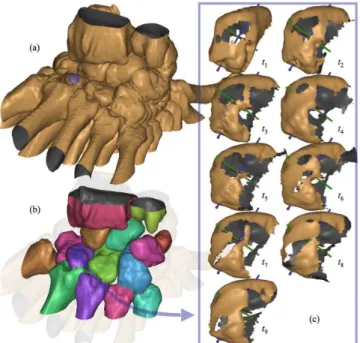
![Fig. 1. Data examples obtained in vivo: MRI (0.5x0.5x1.5mm) of the tarsus [1] (a) and CT (0.3x0.3x1mm) of the carpus (b)](https://thumb-eu.123doks.com/thumbv2/123doknet/12400594.332006/2.918.503.818.385.937/fig-data-examples-obtained-vivo-mri-tarsus-carpus.webp)
Documents relatifs
L’inconvénient de ces mesures axées sur les performances est de laisser au second plan une évaluation plus globale et intégrée du développement de l’enfant qui pourrait bien
Some results of our proposed spatial and temporal tracking algorithm is illustrated with two different applications, one for mechanical purposes with a sequence containing fibers,
Das liegt zum einen da- ran, dass die Regularien früher Stabilität gewährleistet haben und sich die Unternehmen an stabile Verhältnisse gewöhnt haben, so dass sie auf eine
Travaillant pour plus de 11 ans dans l'administration tunisienne et ayant une double formation en sciences de l'information et de la communication (licence
Technical Note (National Research Council of Canada. Division of Building Research), 1965-03-01?. READ THESE TERMS AND CONDITIONS CAREFULLY BEFORE USING
Incurables, la maladie, les douleurs omniprésentes, dans leur constance, semblent tenir en quelque sorte, lieu d’existence : « C’est très dur de devoir demander de l’aide pour
Nagesha SH, Casey GJ, Rieckmann KH, Fryauff DJ, Laksana BS, Reeder JC, Maguire JD, Baird JK: New haplotypes of the Plasmodium falciparum chloroquine resistance transporter (pfcrt)
In conclusion, in rat diaphragm, diabetes type I induced complex mechanical and energetic changes, associated with improved resistances to fatigue and hypoxic condition that may
