DOCTORAT DE L'UNIVERSITÉ DE TOULOUSE
Délivré par :
Institut National Polytechnique de Toulouse (INP Toulouse)
Discipline ou spécialité :
Science et Génie des Matériaux
Présentée et soutenue par :
Mme SHEYLA HERMINIA CAMPEROS GUEVARA
le mercredi 20 janvier 2016
Titre :
Unité de recherche :
Ecole doctorale :
STATISTICAL LIFETIME MODELING OF FeNiCr ALLOYS FOR
HIGH-TEMPERATURE CORROSION IN WASTE TO ENERGY PLANTS AND
METAL DUSTING IN SYNGAS PRODUCTION PLANTS
Sciences de la Matière (SDM)
Centre Interuniversitaire de Recherche et d'Ingénierie des Matériaux (C.I.R.I.M.A.T.)
Directeur(s) de Thèse :
M. DANIEL MONCEAU M. JEAN-MICHEL BROSSARDRapporteurs :
M. MICHAEL SPIEGEL, SALZGITTER MANNESMANN FORSCHUNG M. NIGEL SIMMS, CRANFIELD UNIVERSITY BEDFORD
Membre(s) du jury :
1 M. MICHEL VILASI, UNIVERSITE DE LORRAINE, Président
2 M. DANIEL MONCEAU, INP TOULOUSE, Membre
Acknowledgements
The culmination of three years’ work, 20 January, 2016 will go down as one of the most important days in my life. It is almost impossible to get to this point by oneself and therefore at this point I would like to take some time to thank the people who were there for me when thinks got tough.
My directors and advisors Dr. Daniel MONCEAU and Dr. Jean Michel BROSSARD who have been an absolute fount of knowledge and patience during the last three years. Thank you for helping me acclimatize, especially in the beginning, to a way to work that was not similar to that of mine. Thank you for your patience with my far-from-perfect French during all these years. The critical thought and detailed oriented mindedness encouraged by them I am sure will help me to succeed in my professional path. The members of my jury: Dr. Michael Spiegle, Dr. Nigel Simms, Dr. Michel Vilasi, Dr. Mehdi Salem, Dr. François Ropital, Dr. Christel Augustin, Dr. Sébastien Doublet and Dr Aurélie ROUAIX for accepting to be a part of my jury and taking the time to go over this dissertation. I really appreciate their patience in reviewing a dissertation written in a foreign language and foreign English. Their critique of this study has been most informative and I expect a good number of their suggestions to be implemented in the future. Dr. Pascal Floquet for having me oriented with his technical knowledge about statistics. My workteam Fares MAAD, Emmanuel Schaal, Aurelien Fabas for being cool to me and always be disposed to share. Remi CHAVROT for his help and availability to discuss new and interesting scientific approaches. A special thanks to my dear friends Aneesha Varguesse and Koenraad.Theuwissen for being there, helping to adapt to a new culture and language. My sincere thanks to my dear friend Pauline Audigie, for her invaluable support, kindness, open-mindedness and friendship. Without them I would not have been able to understand a lot of french jokes and expressions. I learned a lot from this atmosphere while their cheerfulness and their encouragement have bolstered me numerous times over the last three years. They have come to mean a lot to me and I consider them my family away from home.
My oxidation team Charlotte Dupressoire, Aurelien Fabas, Franck Nozahic, my friends and colleagues at CIRIMAT, whom I passed many excellent and fun-filled moments, both at the lab and outside.
My husband for his infinite patience and good energy and for his unconditional support and love, always encouraging me to meet my goals. My brother and sister who have always got my back. My parents who are physically so far away from me but always close to me in spirit, their support and encouragement have been unfailing and I hope I have done them proud.
Abstract
Over the last decades, the corrosion control of alloys exposed to severe and complex conditions in industrial applications has been a great challenge. Currently, corrosion costs are increasing and preventive strategies have become an important industrial demand. The SCAPAC project funded by the French National Research Agency has proposed to study the corrosion for two separate processes: Steam Methane Reforming (SMR) and Waste to Energy (WtE). Although the operating conditions of both processes are different, the modeling approaches can be similar. Metallic components in the SMR process are subjected to metal dusting corrosion, which is a catastrophic form of damage that affects alloys exposed to highly carburising gases (aC>1) at high temperatures (400–800 °C).[1]. Likewise, metallic components in the Waste to Energy (WtE) process are subjected to high temperature corrosion under deposit that takes place in equipment exposed to atmospheres with high content of corrosive products of combustion.
Metal dusting corrosion is considered as a critical phenomenon that has led to worldwide material loss for 50 years. A basic understanding of the degradation mechanisms is available. However, the effect of some process parameters is still not well understood in current literature and requires further study. Otherwise for high temperature corrosion, a considerable amount of literature has been published over the last few decades and the mechanisms are well documented. Also many materials and coatings have been developed. However, the material performance in different environments has not been sufficiently well understood to define suitable criteria for lifetime prediction models regarding operating conditions, due to the high complexity of the corrosion phenomena involved. Literature research in both fields revealed modeling approaches in different kinds of complex conditions and applications. Nevertheless, there are no lifetime models currently available in the open literature for commercial materials that consider a wide range of conditions and the relative weight of the variables involved in the corrosion processes.
This dissertation presents a methodology to develop lifetime prediction models to evaluate materials performance under metal dusting and high-temperature corrosion conditions. Two databases were created to integrate experimental results from the SCAPAC project, as well as results from literature to enable sufficient amount of data for modeling. The databases allowed analyzing approximately 4000 corrosion rates by different statistical methods over different scenarios. The Principal Component Analysis (PCA) methodology was performed to identify the key parameters to create lifetime prediction models using Multiple Linear Regressions (MLR).
For metal dusting corrosion, two models were obtained to explain the incubation times (IT) and the kinetic of Pit Depth Growth (PDGr). IT showed high dependency on the alloy composition while the PDGr showed high correlations with the atmosphere composition and total pressure. For high-temperature corrosion, three models were obtained in the thermal gradient scenario for three families of alloys: low alloyed steels, Fe/Ni-based high temperature alloys and Ni-based alloys, showing agreeable results. TFlue gas and TMetal were confirmed as 1st order parameters on fireside corrosion. It was also shown that the relative weight of the variables varies with the family of alloys. The statistical models in both cases were compared with experimental and theoretical results showing good agreement with experimental findings, which allows performing a first lifetime assessment of materials under defined conditions.
Contents
INTRODUCTION ... 1
I CHAPTER 1. LITERATURE REVIEW ... 4
I.2 METAL DUSTING ... 4
I.2.1 Metal dusting of iron and low alloy steels ... 6
I.2.2 Metal dusting of iron - nickel alloys ... 7
I.2.3 Metal dusting of nickel and Ni-based alloys ... 7
I.2.4 Effect of the alloying elements on metal dusting ... 8
I.2.5 Effect of the environment ... 9
I.2.6 Kinetics modeling of metal dusting ... 15
I.3 HIGH-TEMPERATURE CORROSION ... 19
I.3.1 Effect of the environment ... 21
I.3.2 Effect of the alloys composition ... 30
I.3.3 Kinetics modeling of high-temperature corrosion ... 35
I.4 LIFE ASSESSMENT MODELING ... 40
I.5 SUMMARY ... 43
II CHAPTER 2. EXPERIMENTAL SET-UP, STATISTICAL METHODS... 45
II.1 METAL DUSTING ... 45
II.1.1 Experimental set-up ... 45
II.1.2 Database construction: Metal Dusting ... 47
II.2 HIGH-TEMPERATURE CORROSION ... 51
II.2.1 Experimental set-up ... 51
II.2.2 Database construction ... 54
II.3 STATISTICAL METHODS ... 57
II.3.1 Descriptive Statistics ... 58
II.3.2 Multiple Linear Regression (MLR) ... 61
II.3.3 Principal Component Analysis ... 66
II.4 SUMMARY ... 69
III CHAPTER 3. MODELING OF METAL DUSTING CORROSION RATE ... 71
III.1 EXPERIMENTAL RESULTS ... 71
III.2 RAW DATABASE ... 76
III.3 STATISTICAL MODELING... 77
III.3.1 Data filtering and variables selection ... 78
III.3.2 Modeling: Multiple Linear Regression ... 97
III.4 CONCLUSIONS ... 116
IV CHAPTER 4. MODELING OF HIGH-TEMPERATURE CORROSION RATE ...119
IV.1 EXPERIMENTAL RESULTS ... 119
IV.2 RAW DATABASE ... 122
IV.3.1 Data filtering and variables selection ... 124
IV.3.1.1 Maximum thickness loss rate (MTLr) ... 124
IV.3.1.1.1 Principal Component Analysis and Correlation Tests ... 125
IV.3.1.1.2 Alloy classification and correlation tests ... 133
IV.3.2 Modeling: Multiple Linear Regression ... 138
IV.4 CONCLUSIONS ... 160
V CHAPTER 5. MODELING AND LIFETIME ASSESSMENT ...163
V.1 METAL DUSTING ... 163
V.2 HIGH-TEMPERATURE CORROSION ... 168
V.3 CONCLUSIONS ... 175 GENERAL CONCLUSION ...177 FUTURE WORK ...181 RÉSUMÉ EN FRANÇAIS ...183 BIBLIOGRAPHY ...184 APPENDIX I ...195 APPENDIX II ...205 APPENDIX III ...207 APPENDIX IV ...209 APPENDIX V ...221 APPENDIX VI ...225
1
INTRODUCTION
The economic growth of any region depends on its natural resources and productive activities, but also on the infrastructure that accounts for goods processing. Industrial installations are affected by deterioration and degradation mechanisms. Corrosion is a worldwide issue that strongly affects natural and industrial environments.1 It is a pernicious problem that impairs the efficiency of the industrial processes and the
lifetime of the infrastructure assets.
Over the years, the corrosion control of alloys exposed to severe and complex conditions has been a great challenge for industrial facilities. Currently, corrosion costs are increasing and preventive strategies have become the main industrial demand. The SCAPAC project funded by French National Research Agency is proposed for two separate processes: Steam Methane Reforming (SMR) and Waste to Energy (WtE). Metallic components in the Steam Methane Reforming process are subjected to metal dusting corrosion, which is a catastrophic form of damage that affects alloys exposed to highly carburizing gases (carbon activity aC > 1) at intermediate temperatures (400–800 °C). Metal dusting corrosion is considered a critical
phenomenon that has led to worldwide material loss for 50 years. A basic understanding of the degradation mechanisms is available. However, the effect of some process parameters is still not well understood in current literature and requires further study.
Likewise, metallic components in the Waste to Energy (WtE) process are subjected to high-temperature corrosion that takes place in equipment exposed to atmospheres with high content of corrosive products of combustion. A considerable amount of literature has been published on this subject, and the mechanisms are well documented. Also, many materials and coatings have been developed to resist the damage. However, the material performance in different environments has not been sufficiently well understood to define suitable criteria for lifetime prediction models regarding operating conditions.
Literature research in both fields revealed modeling approaches in different kinds of complex conditions and applications. Nevertheless, there are no lifetime models currently available in literature for commercial materials that consider a wide range of conditions, and the relative weight of the variables involved in the corrosion processes. Although the operational conditions of both processes are different, the application of preventive strategies through predictive modeling approaches can be similar.
A predictive model is based on a number of predictors, which are variable factors that are likely to influence future behavior or results. In predictive modeling, data are collected for the relevant predictors, a statistical model is formulated, and the model makes predictions that are validated with additional data available. Predictive modeling is used widely in information technology (IT), customer relationship management (CRM), planning, management, engineering, change management, material’s selection, lifetime assessment, maintenance scheduling.
This dissertation presents a methodology to develop lifetime predictive models to evaluate materials performance under metal dusting corrosion and high-temperature corrosion. Two databases were created to integrate experimental results from the project, as well as results from literature to enable sufficient amount of data for modeling. The databases allowed analyzing over 4000 corrosion rates by different statistical methods over different scenarios. The Principal Component Analysis (PCA) methodology was
2
performed to identify the key parameters for modeling the corrosion mechanisms. Statistical outcomes were explained by experimental and theoretical results in order to build a lifetime prediction model by Multiple Linear Regression (MLR) that corresponds with experimental findings, in a defined scenario. Now, coming to the definition of the objective of this study; it may be broadly classified under two divisions, one concerning a way to determine the parameters that play the most significant role in metal dusting corrosion and high-temperature corrosion under deposits and the other, to create lifetime prediction models for materials subject to both mechanisms under different scenarios.
Chapter 1 will commence with a description of Steam Methane Reforming (SMR) and Waste to Energy (WtE) processes. This will be followed by a discussion of the mechanisms proposed for metal dusting corrosion and high-temperature corrosion under deposits in the literature review. The goal here was to summarize the effect of the different parameters on the corrosion mechanisms, according to experimental findings by the authors.
Chapter 2 will describe the experimental set-up, database construction procedure and statistical tools used to analyze all the information contained in the databases. Two statistical tools will be exploited in this study:
Principal component analysis (PCA) - This was utilized to aid in the analysis of the mainly used parameters in experimental studies to determine the parameters that were the most crucial for the corrosion mechanisms.
Multiple Linear Regression (MLR) - This was employed for modeling the corrosion kinetics to determine, quantitatively, the relative weight of the different parameters on corrosion rates.
Chapter 3 will discuss the results obtained from the statistical analysis to determine the key parameters for modeling the kinetics of metal dusting corrosion. This will be followed by the classification of scenarios considered according to output parameters and family of materials. Finally, six models will be proposed for each possible scenario. The results of modeling will be discussed regarding various data available in literature and experimental data from the SCAPAC project.
Chapter 4 will discuss the results obtained from the statistical analysis to determine the most significant parameters for modeling the kinetics of high-temperature corrosion under deposits. This will be followed by the classification of scenarios considered according to atmosphere conditions and family of materials. Lastly, six models will be suggested for each possible scenario. The results of modeling will be compared with experimental data available in literature and experimental data from this project.
Chapter 5 will consist in the application of the models in lifetime prediction of materials subjected to metal dusting corrosion and to high-temperature corrosion under deposits. This will be followed by plotting the variation of the corrosion rates as a function of the main parameters resulted from modeling procedures. For both mechanisms, the first set of analyses will be performed by scheming the estimate lifetime of materials under defined conditions. The second set of analyses will be performed by plotting corrosion maps as it allowed for a better interpretation of the variation of the corrosion rates with the main affecting parameters.
3
Chapter 1. Literature Review
Contents
I CHAPTER 1. LITERATURE REVIEW ... 4
I.2 METAL DUSTING ... 4
I.2.1 Metal dusting of iron and low alloy steels ... 6
I.2.2 Metal dusting of iron - nickel alloys ... 7
I.2.3 Metal dusting of nickel and Ni-based alloys ... 7
I.2.4 Effect of the alloying elements on metal dusting ... 8
I.2.4.1 Effect of chromium ... 8
I.2.4.2 Effect of aluminum and silicon ... 9
I.2.4.3 Effect of copper ... 9
I.2.5 Effect of the environment ... 9
I.2.5.1 Effect of temperature ... 9
I.2.5.2 Effect of gas composition ... 12
I.2.5.3 Effect of pressure ... 14
I.2.5.4 Effect of mechanical stress ... 14
I.2.5.5 Effect of gas velocity ... 14
I.2.6 Kinetics modeling of metal dusting ... 15
I.3 HIGH-TEMPERATURE CORROSION ... 19
I.3.1 Effect of the environment ... 21
I.3.1.1 Effect of the temperature ... 21
I.3.1.2 Effect of the flue-gas composition ... 23
I.3.1.3 Effect of the composition of deposits ... 25
I.3.1.3.1 Deposit - induced corrosion ... 25
I.3.1.3.2 Corrosion by molten ash-salts mixtures ... 28
I.3.2 Effect of the alloys composition ... 30
I.3.2.1 Oxidation of metals ... 30
I.3.2.1.1 Iron ... 31 I.3.2.1.2 Nickel ... 31 I.3.2.1.3 Chromium ... 31 I.3.2.1.4 Aluminum ... 32 I.3.2.1.5 Silicon... 32 I.3.2.1.6 Molybdenum ... 32
I.3.2.2 High-temperature resistant alloys ... 33
I.3.3 Kinetics modeling of high-temperature corrosion ... 35
I.4 LIFE ASSESSMENT MODELING ... 40
4
I
Chapter 1. Literature Review
Corrosion of metals can be defined as the destructive attack of a metal through interaction with its
environment. All metals and alloys can be subject to corrosion even the nobles metals, such as gold, are subject to corrosive attack in some environments. The corrosion is a natural process. Most metals are not thermodynamically stable in the metallic form; they corrode to return to the more stable forms that are normally found in ores, such as oxides. 2 Like other natural hazards, corrosion can cause dangerous and
expensive damage to everything from vehicles, home appliances, to pipelines, and industrials assets. However, there are time-proven methods to prevent and control corrosion that can reduce or eliminate its impact on human safety, the economy, and the environment.
The science of corrosion prevention and control is highly complex, by the fact that corrosion takes different forms and is affected by numerous outside factors. Corrosion professionals must understand the effects of environmental conditions, required lifetime of the structure or component, appropriate mitigation methods; and other considerations before determining the specific corrosion problem and specifying an effective solution. 3
Uniform corrosion is characterized by corrosive attack over the entire surface area, or a large fraction of
the total area. The breakdown of protective layers or microstructural degradation below coating systems on structures often lead to this form of corrosion. General thinning and microstructural evolution of the substrate take place until failure. In the context of the present study high-temperature corrosion mechanism can be included in this category. 4
Localized corrosion is defined as the selective removal of metal by corrosion at zones on a metal surface
in contact with corrosive environment. It usually takes place when small local sites are attacked at a much higher rate than the rest of the surface. Localized corrosion can cause more damage than any other form of corrosion. Pitting corrosion is a localized form of corrosion by which cavities or "holes" are produced in the material, it is considered to be more dangerous than uniform corrosion damage. Pits can create stress raisers zones and it is more difficult to detect, predict and design against. A small, narrow pit with minimal overall metal loss can lead to the failure of an entire engineering system. However, pitting corrosion can be even more dangerous when it becomes generalized as the case of metal dusting, extensive areas with large metal wastage in the form of pits leads to catastrophic failure. 4,5
The first step in effective control and prevention of high-temperature corrosion and metal dusting corrosion, in certain industrial units is to understand the mechanisms involved, how to detect them, how and why they occur and the factors that govern the processes and add complexity to the equation.
I.2
Metal Dusting
Metal dusting is a catastrophic form of corrosion in environments of carburizing gases, high carbon activities (aC > 1), and very low oxygen partial pressures at elevated temperatures 400-800°C. 6–8 The
deposition of carbon from the carbon supersaturated atmosphere disintegrates the metal surface producing powdery carbon, metal particles, carbides and oxides. Corrosion can be in the form of pitting and general metal wastage. This form of corrosion affects iron, low and high alloy steels, Ni-based and Co-based alloys used in structural components in the heat treating industry when oil residue mixes with gases used during heat treating to form gases that are kinetically favorable for metal dusting attack. Oil refineries experience metal dusting attack in hydro-dealkylation and catalyst re-generation processes. Also in the
5
steel i ndustry i n bl ast furnaces a nd nuc lear pl ants that em ploy ca rbon d ioxide (CO2) fo r c ooling, t he
recycle-gas l oop equ ipment o f coal g asification un its, f ired heaters handling hy drocarbons at high-temperatures and metallic interconnects used in solid oxide fuel cells. 9
Equipment in processes t hat use sy nthesis gas containing v arying cont ents of hy drogen (H2), c arbon
monoxide (CO), steam - methane (CH4) and water vapor (H2O) is susceptible to metal dusting. 9 Figure I.1
shows a diagram of the steam-methane r eforming pr ocess use d t o pr oduce hydrogen. Me tal dus ting i s found in the inside tubes containing syngas downstream the reforming furnace in the heat recovery zone where t emperatures st art t o dec rease pr oducing t emperature gradients i n carburizing a tmospheres favorable for metal dusting.
Figure I.1. Schematic representation of the Steam-methane reforming process1
Thermogravimetric experiments performed by Grabke et al. 7 at 650°C i n a CO-H
2-H2O at mosphere at
different carbon activities for iron and low alloys steels showed that at aC 1.1 m etal dusting did not
occur but at values aC > 1.3 hi gher carbon content is reached and t he mass gain accelerates indicating
metal dust ing. Whe n t he thermodynamic activity exc eeds unity, conc urrent r eactions at t he gas-metal
interface can cause the formation of coke and carbon deposition. Metal dusting corrosion in CO or CH4
containing env ironments can l ead t o t he transfer of ca rbon t o t he metal su rface thru t he following reactions (1,2,3). 8,10 𝑪𝑶 + 𝑯𝟐 ↔ 𝑪 + 𝑯𝟐𝑶 Reaction 1 𝟐𝑪𝑶 ↔ 𝑪 + 𝑪𝑶𝟐 Reaction 2 𝑪𝑯𝟒↔ 𝑪 + 𝟐𝑯𝟐 Reaction 3 𝑯𝟐𝑶 ↔ 𝑯𝟐+ 𝟏/𝟐𝑶𝟐 Reaction 4
6
In most of the studies reviewed, CO has been used as the main carbon provider since reaction 1 has the fastest kinetics. Grabke et al.11 have determined that the carburization in CH
4-H2 is much slower than in
CO-H2. As the carbon activity is the driving force for metal dusting, for syngas mixtures CO-H2-H2O
obtained from methane conversion, it can be calculated from reaction 1 and equation (1). Syngas also contains CO2 and other authors have calculated the carbon activity from the Boudouard reaction 2 through
equation (2).7 However the steady state carbon activity established in non-equilibrium atmospheres on the
metal surface is determined by the faster kinetics which is reaction 1.8,12 And the oxygen partial pressure
for the CO-H2-H2O mixture results from the reaction 4 and it can be calculated through equation (4).13
𝒂𝑪= 𝑲𝟏 𝒑𝑪𝑶 × 𝒑𝑯𝟐 𝒑𝑯𝟐𝑶 Equation 1 𝒂𝑪= 𝑲𝟐 (𝒑𝑪𝑶)𝟐 𝒑𝑪𝑶𝟐 Equation 2 𝒂𝑪= 𝑲𝟑 𝒑𝑪𝑯𝟒 𝒑𝑯𝟐 Equation 3 𝒑𝑶𝟐= 𝑲𝟒 ( 𝒑𝑯𝟐𝑶 𝒑𝑯𝟐) 𝟐 Equation 4
Additionally metal dusting has been observed under conditions where carbon activity calculated from reaction 2 is aC < 1 and according to reaction 1 is aC > 1 making activity calculation with reaction 1 more
reliable. In such cases where metal dusting is observed in processes that involve hydrocarbons and H2,
carbon activity may be calculated from reaction 3 through equation (3). However methane is rather inert at intermediate temperature but may cause metal dusting at about 1000°C.12
Young et al 6 have proposed that metal dusting mechanisms can be classified into two types: one for iron
and ferritic alloys, where iron carbide forms at the surface and the other for nickel and their alloys where no carbide is formed. Both mechanisms produce coke which consists of carbon filaments and graphite particle containing metal-rich particles inside.
I.2.1 Metal dusting of iron and low alloy steels
Metal dusting for iron and ferritic alloys starts with the transfer of C within the metal surface from the gas atmosphere (aC > 1 in the gas atmosphere) which leads to carburization. No formation of protective scale
is expected because iron or low alloy steels do not oxidize under metal dusting conditions. But formation of cementite Fe3C at the metal surface could act as a barrier for further carbon ingress. After formation of
Fe3C, the carbon oversaturated atmosphere generates the deposition of graphite decreasing the carbon
activity on the cementite to aC = 1. This causes Fe3C dissociation according to reaction 5.
𝑭𝒆𝟑𝑪 ↔ 𝟑𝑭𝒆 + 𝑪 Reaction 5
Figure I.2 shows schematically that the carbon atoms are attached to the basal planes of graphite which grow into the cementite which is known to be a carbon diffuser.6 Iron atoms from cementite intercalate
into graphite and diffuse through the interspace between graphite planes and agglomerate to small particles, whose act as catalysts for further carbon deposition and coke formation. This mechanism is in agreement with the proposals of Grabke, 7,12 Chun 10 and Pippel. 14
7
Figure I.2. Schematic representation of metal dusting mechanism of iron at the atomic level 10
I.2.2 Metal dusting of iron - nickel alloys
Grabke and coworkers 7 have studied metal dusting in Fe-Ni alloys. These alloys are not oxidized in metal
dusting atmospheres, because low oxygen pressures do not favor the formation of Fe-oxides and Ni-oxides, hence carburization and metal dusting are possible. Their analysis showed that carbon deposition decreases with increasing Ni content in binary Fe-Ni alloys as well as the metal content in the corrosion product from Fe-30%Ni. These results are in agreement with Zhang and Young 15 findings, where
thermogravimetric analysis showed that increasing the nickel content in the alloy decreased the initial rate of carbon uptake. This decrease was approximately linear with nickel concentration up to about 60–70%. Only slight decreases were achieved by further nickel additions. The carbon uptake rate of pure nickel was very small, only about 1% that of pure iron. A uniform Fe3C scale is formed on pure iron. On ferritic Fe–
5%Ni a layer with mixed structures of Fe3C and -Fe is developed. Small amounts of Fe3C was developed
at the surface of an austenite layer grown on two-phase ( + ) Fe–10%Ni and no carbide appeared at nickel content above 10%. 6,15
I.2.3 Metal dusting of nickel and Ni-based alloys
For nickel, Ni-base alloys and steels with Ni/Fe > 2/3 another mechanism applies that does not involve the intermediate formation of Fe3C. After carbon oversaturation of the metal phase, follows graphite growth
into the metal phase. Disintegration of the metal results from the growth of graphite oriented perpendicular to the surface, whereas graphite with basal planes parallel to the metal surface seems harmless which indicates that metal dusting attack on Ni is strongly dependent on the surface orientation and the way of epitaxial deposition of graphite. 10,12 Ni-atoms migrate through the graphite layer by
intercalation and diffusion and agglomerate into particles in the outer reaction zone (coke layer). In comparison to iron in the case of nickel; the metal particles are much bigger and are not covered by a graphitic envelope which means that Ni particles are less active catalysts for the carbon deposition. 14,16
8
I.2.4 Effect of the alloying elements on metal dusting I.2.4.1 Effect of chromiumMetal oxides induce protection by limiting carbon diffusion into the base metal. Thus alloy resistance to metal dusting is maximized by formation of a dense, well adherent oxide layer which avoid access of carbonaceous gases to the meal substrate.12 For the temperature range of metal dusting (400°C-800°C), a
chromia - layer is the protective scale generally used even when literature studies also deal with alumina layers. Increasing temperature promotes the oxidation of chromia forming steels and Ni-base alloys so metal dusting rates are suppressed by oxide formation at temperatures T > 650°C but also because of carbon activity decreasing at temperatures beyond 700°C. However in the heat recovery process in Syngas plants the temperature will decrease what makes high alloys steels most susceptible to metal dusting in the temperature range 500- 650°C, where generally no protective Cr-rich scale is formed. Also the oxide layer should be thermodynamically and physically stable under the prevailing environmental conditions and during the process. The causes of oxide instability usually are defects in the oxide layer or the oxide carbides that are chemically reduced by gas. 12
Grabke et al 12 has proposed a mechanism in presence of chromia protective scale, which starts with the
local attack at defects of the scale, allowing carbon transfer from the carburizing atmosphere to the metal substrate that allows the dissolution of carbon within the metal. The dissolved carbon diffuses inward and causes precipitation of stable carbides, mainly M23C6. After the precipitation of the carbides, depending on
the composition of the matrix, the disintegration of the material starts, either by formation of instable cementite for low alloy steels or by inward internal growth of graphite for high alloy steels and Ni-base alloys. The metal particles that come from disintegration, depending on the composition of the matrix, act as catalyst for carbon deposition and coke arises from the growing pit. The surface around a growing pit is covered by a protective oxide layer, but that cannot stop the pit growth since the scale is already undermined.
Under metal dusting conditions the alloys are exposed to a competition between the process of formation of a chromia layer and the diffusion process of carbon into the metal. If the first process comes earlier, the alloy will be protected for longer time by the Cr-rich scale but if the second process prevails, an unstable scale is formed and metal dusting starts and spreads rapidly. 12
The formation of stable Cr-oxide layer need to be favored by high Cr-content in the alloy, because at temperatures < 700°C, even steels with enough Cr-content (> 12% for ferritics and > 17% for austenitics) do not form chromia layers. 12 Also if the scale is damaged either by spalling due to thermal cycling or by
marring the surface when scratching the coke from the surface, self-healing of the chromia layer is essential to prevent carbon attack.17 The self-healing process is promoted by high chromium
concentration, high diffusivity of chromium in the metal towards the surface and surface modification by cold working to increase the diffusion of chromium. Klower et al.17 experiments at 650°C showed that
Fe-Ni-Cr alloys suffered high metal dusting rates after short periods of time whereas Ni-base alloys were generally less susceptible to metal dusting but their effect was dependent on their Cr-content. Alloy 600H with Cr-content of 16% suffered metal loss rates similar to those of iron base alloys and Ni-base alloys with Cr-contents > 25% showed no significant evidence of metal dusting after 1000 hours of exposure, these findings reveals the presence of a dense chromia scale that protect the alloy substrate from the penetration of carbon.
9
Later Grabke et al. tested several 9-20%Cr alloys in the temperature range 500-600°C that showed the
important effect of the presence of easy-diffusion paths for fast formation or healing of protective Cr-rich oxide scale against metal dusting. Such easy diffusion paths are provided by a fine-grain microstructure which is capable of rapidly supplying chromium to the surface. The surface cold working (polishing, grinding, machining, sand blasting) increases dislocation density, and hence diffusion through dislocations pipes of Cr to the surface. Therefore more resistance to metal dusting is promoted.
I.2.4.2 Effect of aluminum and silicon
Al and Si form stable oxides Al2O3 and SiO2 at the low oxygen potentials of typical dusting atmospheres.
It was shown that solubility of carbon in Al2O3 at 1000°C is negligible.6 However the decline in
temperature to the metal dusting range compromises this stability.19
Al and Si are added to form continuous protective layers. However, when concentrations are too low at metal dusting temperature range, they will form internal oxides which are detrimental for corrosion resistance, therefore a less stable oxide eventually will not be enough to protect against metal dusting. 19
I.2.4.3 Effect of copper
Copper is shown to be noncatalytic to carbon deposition from gas atmospheres, and owing to its extremely low solubility for carbon, it is inert to the metal dusting. 20 Several authors have studied its effect on the
metal dusting behavior. Zhang 20 investigated the weight changes of Ni-Cu alloys after carburization and it
was concluded that increasing the alloy Cu content decreased the rate of carbon deposition. Similar results
were reported by Nishiyama 21 who studied binary alloys from 1-70%Cu-Ni and concluded that almost
20% of Cu is needed to avoid carbon deposition. He also performed metal dusting tests using transition metals which suggest that noble metals such as Cu, Ag, and Pt have good resistance against metal dusting. There is neither coke formation nor change mass in Cu-specimen after exposure in a simulated synthetic gas at 650°C. As Cu does not protect by formation of an oxide scale, the element has a “Surfactant-Mediated Suppression” role against metal dusting which is explained in terms of atomistic interaction of CO with transition-metal surfaces by electronic structure analyses.
Later Zhang and Young 22 evaluated the effect of copper on alloys 304SS, 310S and 800H. Cu content of
up to 10% in 304SS show no effect in metal wastage rates but at 20%Cu the alloy dusted even faster. Cu contents of up to 10% in 310SS suppressed dusting but at 20% it shows even higher wastage rates. In the alloy 800H the variants of Cu content shows the same rates which are slightly lower than the original alloy. It is concluded that copper additions at appropriate levels can provide significant protection against carbon deposition and consequently dusting problems if the alloy is fully austenitic and large amounts of Cu-rich phases are avoided. Its positive effect for ferritic alloys is not evident.
I.2.5 Effect of the environment I.2.5.1 Effect of temperature
Young et al.6 expose that temperature affects both sides of the dusting process: the driving force for
reactions is the gas phase supersaturation with carbon. The kinetics of degradation is controlled by the rates of internal oxidation and diffusion of carbon. Since dusting can occur only when carbon activities aC
> 1, it is interesting to study how equilibrium constants for reactions 1, 2 and 3 vary with temperature as shown in Figure I.3. The synthesis gas (reaction1) and Boudouard reaction (reaction 2) are exothermic and
10
produce increasing carbon activities as the temperature is lowered and the hydrocarbon cracking reaction (reaction 3) is endothermic and leads to aC> 1 at high-temperature. Nevertheless the reaction 1 has the
fastest kinetics and therefore deposition of carbon will be higher in the interval (400°C - 600°C°) at high aC. However there is confusion in literature related to the effect of temperature on metal dusting because
of the way in which aC varies with temperature and gas composition in CO/H2/H2O mixtures.
Figure I.3. Equilibrium constants for gas phase carbon producing reactions.6
Muller Lorenz 23 and Grabke 12 showed in Figure I.4 that metal dusting rates of several alloys increase
with temperature up to 600°C, in spite aC decreases when temperature increases, according to kinetics
reactions in controlled atmospheres of CO/H2/H2O where the activities can be quantified. This is due to
the fact that diffusion and reaction kinetics involved in metal dusting are thermally activated. Therefore, the correlations between dusting rates and temperature and aC are not directly proportional.
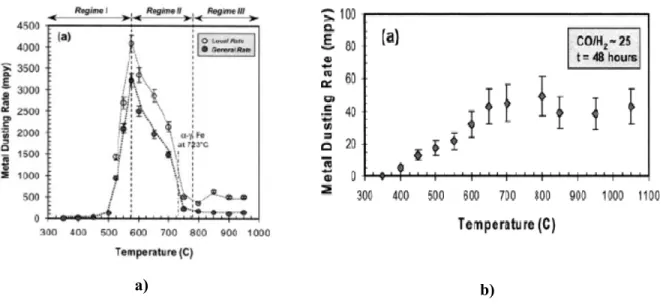
Chun et al. 24 showed the temperature dependence of the corrosion rate of iron in a 50CO:50H 2 gas
mixture in Figure I.5 and gave a microstructural explanation. In the case of iron (Figure I.5a), three regimes can be distinguished, corrosion rate increases up to a maximum observed around 575°C, above this temperature corrosion rate decreases until 723 °C where it becomes independent of temperature. In the first regime, the competition between the growth of Fe3C and its dissociation determines the overall
metal dusting rate. In the second regime, the decrease in the corrosion rate can be explained considering that nucleation of metal particles by cementite decomposition is related to the chemical potential difference of carbon between cementite and graphite (µC - µC*), this difference decreases with increase in
temperature. Therefore it could explain the decrease of corrosion rate when temperature rises. In the third regime above 723°C, iron undergoes from BCC structure to the FCC structure. The latter has considerably higher solubility for carbon therefore the dissolution and diffusion of carbon in the austenite phase prevent surface carbide formation.10 On the other hand, from the point of view of the gas atmosphere conditions,
even when activities of carbon cannot be controlled because of the absence of H2O, in the first regime the
dusting rates increase with temperature but qualitatively it is known that simultaneously aC decreases, in
the second regime the contrary happens up to 723°C and in the third regime aC goes down with rates. This
means that in such atmospheres neither the correlation between dusting rates and aC values is directly
11
In the case of nickel, corrosion rate increases up to a maximum around 600°C, above this temperature corrosion rate becomes independent of temperature in the 600-1050°C range. Nickel does not form carbides, metal dusting corrosion of nickel depends on the composition of the gas. Figure I.5b shows a slight increase in corrosion rate with temperature up to 600 °C, beyond this temperature it becomes independent. In this study, Chun et al. 10 exposes that in the absence of surface carbide, dusting rates do
not show temperature dependence because the activation energy for the rate-limiting step (growth of Fe3C)
is negligible. The most likely rate-limiting step is the diffusion of Fe or Ni through graphite.
a) b)
Figure I.4. Arrhenius diagram of metal wastage rates by metal dusting in H2/CO/H2O atmospheres 23 a) Different steels b) Two low alloys and Ni-base 600.
12
a) b)
Figure I.5. b) Temperature dependence of iron in CO/H2 ≈ 1 mixture b) Temperature dependence of nickel in CO/H2 ≈ 25 mixture. 10
I.2.5.2 Effect of gas composition
The dependence of coking and dusting rates on the composition of CO/H2/H2O has been studied by
several authors. Grabke et al. 25 curves for the mass gain vs. time at different pCO, pH
2, and pH2O show
clear dependence on the partial pressures: its rate is proportional to pCO and pH2 and inversely
proportional to pH2O. Thus, the equation (5) is valid for reaction 1 where µ is the coking rate.
𝝁 ∝ 𝒑𝑪𝑶 ×𝒑𝑯𝟐
𝒑𝑯𝟐𝑶 Equation 5
Muller Lorenz et al.23 measured coking rates at 650°C varying partial pressures shown in Figure I.6a, it
indicates that coking rates increase with partial pressure of CO. However, Yin et al. 26shows a significant
increase of carbon uptake for both steel and pure iron, increasing 0.25 to 0.5 atm of pCO, some smaller increase was observed between 0.5 and 0.68 and finally rates decreased with further increase of pCO up to 0.9 atm, reaching the steady-state carbon uptake at a maximum value of 0.68atm.
Muller Lorenz 23 also measured the metal wastage at the same conditions and showed that the process is
dependent on the partial pressures of CO an H2 and independent on H2O. The maximum rate was observed
at about CO/H2 ≈ 1 which indicates that the rate of metal wastage in the high-temperature range is
proportional to the product pCO x pH2. These results are consistent with Chun 24 experiments shown in
Figure I.6b which indicates that the general corrosion rate is more or less independent of the gas composition in region A and go through a maximum in region B, at the CO/H2 ≈ 1 composition. The
13
a)b)
c)
Figure I.6. a) Dependence of metal wastage rate and coking rate on Fe and 2 ¼ Cr-1Mosteel in various H2/CO/H2O mixtures at 650°C. 23 b) Metal dusting corrosion rate of iron as a function of H2
content in CO at 550°C for 7 h. 24c) Coking rate of iron at a
14
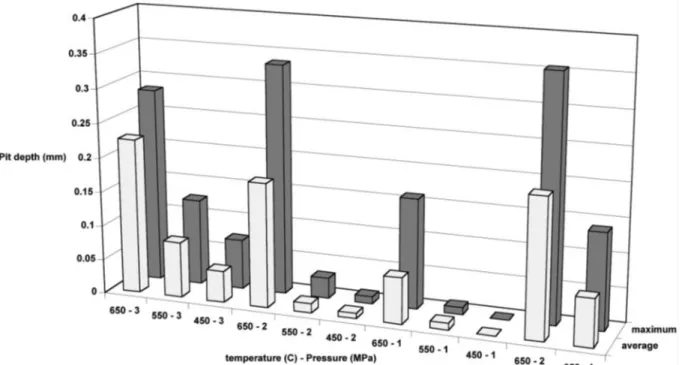
I.2.5.3 Effect of pressureLevi et al. 27studied the effect of pressure on the "metal dusting" on stainless steel TP 316. They found that
for a given pressure the pit depth increases with temperature and for a given temperature the pit depth increases with pressure (Figure I.7). In this study the effect of the temperature is consistent with previous studies. 10,23 However f urther exp eriments at h igh pr essures ar e necessary t o el ucidate the effect o f
pressure on the carbon activity that causes the increase of the attack by "metal dusting". I.2.5.4 Effect of mechanical stress
Usually in industrial installations certain components such as reactors and tubes are submitted to different levels o f pressure. This c ondition creates a state of biaxial stress i n the materials w hich is c ertainly harmful for equipment in service. In the case of metal dusting, the pits might act as stress risers leading to cracks and hence failures. 4 Also these stresses can degrade the oxide protective layers on the surface of
the materials, accelerating the attack. No systematic studies deal with this specific subject. Most of metal dusting expe riments und ergo no m echanical s tress, h owever t his i s a l imitation t o r eproduce i ndustrial conditions in laboratory, and therefore further studies involving considering mechanical stress would be useful.
I.2.5.5 Effect of gas velocity
More data is required to discuss the effect of gas rates on metal dusting. Most laboratory experiments are performed under low gas rates, smaller than those observed in industrial conditions.
Figure I.7. Graphical representation of the average and maximum pit depths between 1 and 3 Mpa at 450° to 650°C.27
15
I.2.6 Kinetics modeling of metal dustingIn t he last decades several models have been proposed by different authors using different approaches. Young et al. 6 studied the kinetics of metal dusting in iron and some ferritic steels where iron carbides like
cementite ( Fe3C) fo rm at the sur face and is sur mounted by coke. Measurements of the average sc ale
thickness as a function of time at 680°C in a gas of CO-26%H2-6%H2O and aC = 2.9 is shown in Figure
I.8. It clearly shows that the ce mentite s cale c ontinues to thicken t hroughout the reaction. For t his to happen, aC must be higher than the value required to stabilize Fe3C. For temperatures lower than 764°C
this value i s higher than 1, t his means that carbon supersaturated gas penetrates the porous coke. As a consequence the scale thickness increases with r eaction t ime as a result o f sol id st ate diffusion and simultaneously the cementite i s consumed at t he surface as material i s removed as dust. Y oung et al .6
proposed a model represented by equation (6) that describes the growth kinetics of the cementite layer mentioned above. In the equation (6) the constant kp is the parabolic rate constant for scaling evaluated
from Wagner’s theory (7) with DC the carbon diffusion coefficient in cementite and 𝑎𝑐′, 𝑎𝑐′′ the boundary
values at the metal-scale and scale-gas interfaces and kd is the linear rate constant for cementite scale loss.
At constant rate, the solution of the equation (6) is a final constant thickness 𝑋 =𝑘𝑝 𝑘𝑑 when
𝑑𝑥 𝑑𝑡 = 0.
The m easurement o f kp under d efined ca rbon activity condi tions leads to t he calculation o f DC which
corresponds with estimates made by other authors cited by Young in his article 6 validating that the rate of
cementite sc ale growth is controlled by sol id st ate diffusion. In t his model t he kinetics estimations are limited t o t he evaluation of the cementite l ayer un der one single t emperature and g as com position. However the metal dusting goes further with temperature gradients and more complex alloy systems.
𝒅𝑿 𝒅𝒕 = 𝒌𝒑 𝑿 − 𝒌𝒅 Equation 6 𝒌𝒑= ∫ 𝑫𝒄 𝒂𝒄′′ 𝒂𝒄′ 𝒅 𝒍𝒏 𝒂𝒄 Equation 7
Figure I.8. Measurements of cementite scale thickness represented in the model (equation (6))
Yin 26 evaluated the reaction of 2¼Cr-1Mo and pure iron at 650°C in CO-H
2-H2O gas, varying pCO and
nominal aC which is calculated assuming equilibrium of the synthesis gas reaction. After an incubation
period a cementite scale grew, covered by a graphite deposit con taining ce mentite particles. I t w as concluded that both iron and steel were initially protected against dusting by a marginally stable surface oxide scale, once disappeared the oxide layer, carbon uptake followed linear kinetics at rates which varied
16
with gas composition but did not correlate with the carbon activity. Based on these experimental results Yin et al.26 presented a simple kinetics model abandoning the application of the equilibrium
approximation and considering reactions 1, 2 and the carbon gasification process by reaction 6. The same approach was offered by Young et al. 8 previously. All contribute to carbon production (1, 2) and removal
(6). Assuming their reverse reactions negligible the model is described by equation (8).
𝑪 + 𝟐𝑯𝟐↔ 𝑪𝑯𝟒 Reaction 6
𝒓 = 𝐤𝟏 𝐩𝐂𝐎𝐩𝑯𝟐+ 𝐤𝟐 𝐩𝟐𝐂𝐎 − 𝐤𝟐𝐩𝟐𝑯𝟐 Equation 8
Where, r represents carbon deposition rate and k1, k2, k3 represent the reaction rate constants for reactions
1, 2 and 6 from left to right. The values of r were calculated from the straight line portions of the carbon uptake kinetics plots and individual rate constants ki deduced from the experimental results. The
experimental data and the rates calculated from equation (7) are compared for both iron and steel with reasonable agreement. Comparison of the corresponding rate constant values for pure iron, steel and nickel from the study, 8 shows that all three reactions are fastest on steel, intermediate for iron and slowest
on nickel. These results indicate that the relative contribution of the carbon gasification reaction changes with the substrate. This model may be appropriate to assess the influence of the gas composition on the kinetics of carbon uptake during metal dusting. However, it does not allow predicting the material lifetime, as it considers neither the mass loss caused by metal dusting nor the material chemical composition. Even for evaluating the effect of the gas composition, it takes into account only the linear zone without considering the incubation time that is usually longer for high performance alloys.
Albertsen 28 evaluated the mechanisms of pitting corrosion in the Ni-based alloys 602 and 693, submitted
to 4 years’ plant-exposed to syngas at 540°C and 35 bar total pressure. In this study, it is concluded that pitting corrosion attack starts when carbon diffuses into the bulk of the alloys after the breakdown of the protective Cr2O3-Al2O3 oxide layer which provides an effective barrier against carbon diffusion during the
incubation time. The corrosion pits then grow by process of internal carburization and oxidation in which carbides, oxides and graphite form separately within an approximately 30 µm thick belt shown in Figure I.9a. The oxidation of internal Cr3C2 carbides is associated with large volume changes which result in the
buildup of high mechanical stresses in the white zone and eventually, to the complete disintegration of the original alloy into a layered pit microstructure consisting of Ni + Fe and Cr2O3 + Al2O3 + graphite.
All these microstructural changes have been rationalized through a detailed model represented by equation (9) that describes by the physical reactions involved.
𝑺𝑺𝑪𝑹 = 𝒅𝒙𝟏 𝒅𝒕 = 𝒌𝟏 𝒙𝑪𝒁= 𝜶 𝜷 𝑫𝒄 𝑪𝑪𝒓𝟎 𝑪𝑪𝒊 𝒁𝑪𝒓 𝟏 𝑿𝑪𝒁 Equation 9
Where SSCR is the steady state corrosion rate indicated in Figure I.9b, and β are the stoichiometric coefficients of CrCβ specie, DC is the coefficient of diffusion of carbon in the alloy, 𝐶𝐶𝑖 is the molar
concentration of carbon at the interface between the carburized region and the substrate of the alloy, 𝐶𝐶𝑟0 is
the molar concentration of chromium in the alloy, 𝑍𝐶𝑟 is the mole fraction of chromium associated with
17
Figure I.9. Model by Albertsen for high-temperature pitting corrosion in Ni-based alloys proposed. a) Pit formation and associated carbide precipitation within the white zone after the breakdown of protective layer. b) Corrosion kinetics as observed during and after incubation period when carbon
starts to penetrate into bulk of materials.28
The model allows predicting corrosion rates in different materials and operational conditions. However, the influence of the different operational parameters such as gas composition and its variation during the exposition period cannot be elucidated. The approach is essentially metallurgical, it is required to characterize the final pit resulting from the exposition period to calculate the corrosion rate without considering the incubation time, the calculated corrosion rate corresponds to the regime after incubation time, additionally the model does not show if the growth kinetics of the pit is associated with a known kinetics law.
Baker et al.29,30 evaluated different commercial alloys at 621 °C in CO-H
2-H2O gas, this study showed that
the kinetics of mass loss and pit depth growth can be fitted with a linear combination of the alloy element concentrations. Baker established linear models for the mass loss rate (MLr) (10) and the pit depth growth rate (PDGr) (11) as a function of the chemical composition of the different commercial alloys, using different approaches that show good agreement. The pit depth (local attack) is greater than the average thickness loss calculated from the mass loss (general attack). Therefore, the measurement of the pit depth is more conservative for estimating material lifetime. This model can be useful for materials selection nevertheless the estimations can only be made under the specific validity domain shown in the study.
18
𝒍𝒐𝒈 𝑴𝑳𝒓 = (𝑵𝒊 + 𝑪𝒐) + 𝟕𝟐. 𝟒 𝑺𝒊 + 𝟒𝟑. 𝟒 𝑨𝒍 + 𝟒𝟏. 𝟑 𝑻𝒊 + 𝟏𝟎. 𝟐 𝑪𝒓 + 𝟔. 𝟐 (𝑴𝒐 + 𝑾) − 𝟏. 𝟑 𝑭𝒆 Equation 10 𝒍𝒐𝒈 𝑷𝑫𝑮𝒓 = (𝑵𝒊 + 𝑪𝒐) + 𝟐𝟑. 𝟕𝑺𝒊 + 𝟑𝟎𝑨𝒍 + 𝟑𝟎. 𝟗𝑻𝒊 + 𝟑𝑪𝒓 + 𝟒. 𝟖(𝑴𝒐 + 𝑾) − 𝟏. 𝟗𝑭𝒆 Equation 11 In the equations (10) and (11) the elements are expressed in weigth percentage (wt.%). These models are consistent with a positive effect of Ni and Co in the matrix and a negative effect of Fe. They also show the positive effect of protective oxide forming elements (Al, Cr, Si) and carbide forming elements (Ti, Mo, W).
Table I.1 shows the summary of the models found in literature focused in the kinetics of metal dustings. The authors have proposed different modeling approaches for a variety of validity domains with advantages as well as limitations for their further application.
Table I.1. Summary of kinetics models for metal dusting corrosion
Author Material Magnitude Equation Validity domain
Young 6 Pure Iron
2 ¼ Cr – 1Mo Fe3C thickness 5 and 6
T= 680°C
pInternal= 1 atm
68%CO–26%H2–6%H2O aC = 3
Yin 26 Pure Iron Pure Nickel
2 ¼ Cr – 1Mo
Mass gain (carbon
uptake) 7
T= 650°C
pInternal= 1 atm %CO = 25- 90
aC = 2,35 - 16
Albertsen 28 602, 693 Pit depth growth 8 Operational conditions
Syngas plant Baker 29,30 754, TD, 600, 758, 400, 693, 602CA, 625, 625, 601, 690, C-276, 671, 617, 263, 825, DS, 330, 803, 864, 800, 800HT, 956 Mass loss
Pit depth growth 9 and 10
T= 621°C
pInternal= 1 atm
70%CO-25%H2-0.8%H2 O-4%CO2
aC = 58
According to experimental results reported in literature (Table I.1), the main parameters that affect metal dusting kinetics are the temperature, the total pressure and the gas phase composition. Regarding the alloy composition, higher ratios of Fe/Ni (wt.%) seem to be detrimental to the alloy resistance and the alloying elements such as Cr, Al, Si and Cu contribute to metal dusting resistance. Other factors like gas rates, grain orientation, grain size, surface finish and cold working are reported to have certain influence on metal dusting. However further studies are needed regards to these parameters.
Metal dusting degradation has been measured using several parameters such as: Fe3C thickness, the
carbon uptake by mass gain and the material loss by mass loss and pit depth. Unlike the incubation periods which are reported by very few authors.
19
I.3
High-temperature corrosion
The process, which involves solid waste for the production of energy, is named waste to energy (WtE). WtE is a process, which recovers energy contains in high-temperature flue-gas resulting from the waste materials combustion.31 Figure I.10 illustrates how the process works.31 Solid waste is unloaded from
collection trucks and placed in a waste storage bunker (1). An overhead crane is used to lift waste fuel into a combustion chamber to be burned (2). Calories from combustion flue-gas flow are transfer to heat exchangers tube to convert water to steam in boiler tubes (3). The remaining bottom ash is collected and taken to a landfill (4). The steam is then transported from the boilers to a turbine generator to produce electricity (5) and the remaining fly ash particles are captured by a filtering system where more than 99% of particles matter is removed to avoid pollution. 31
The tubular water boilers are generally used for steam and hot water generation from the energy potential of hot flue-gases that come from combustion of waste. The steam or hot water is generally produced in tube bundles or platen located in the flue-gas path (6). Special attention is required in boiler design and steam parameters of WtE facilities because, while the selection of high-temperatures and pressures increases boiler efficiency, these conditions favor corrosion problems, especially at the superheater surfaces and the evaporator.32,33 Also, the high proportion of ash in flue-gas causes high fouling of the heat
transfer surfaces, leading to a decline in heat transfer and severe corrosion 34 As the ash and the flue-gas
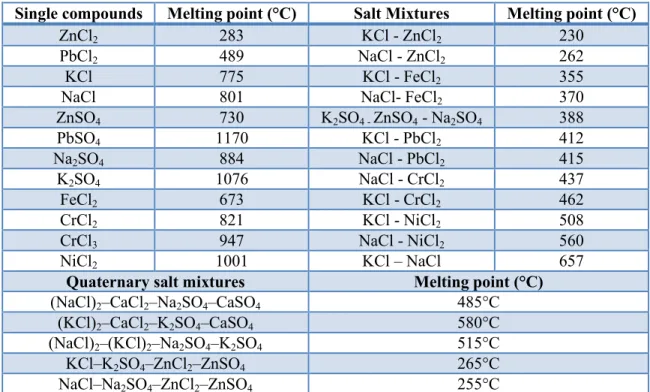
contain high concentrations of alkaline metals (Na, K, etc) heavy metals (Pb, Zn, etc) chlorides and sulfates which adhere on the material surface exposed to combustion gas, severe corrosion is caused by ash deposits melting at 300-500°C. 35,36
The combustion chamber, the waterwalls of the first blank passes, and the superheater are the boiler components most susceptible of corrosion (Figure I.11). Corrosion of boiler tubes is caused by the chemical attack of flue-gas and ash particles from the furnace. The superheater tube corrosion is either due to gaseous chloride attack and deposits containing chloride salts (active oxidation) or a combination of molten chlorides and molten sulfates.,37,38 Table I.2 shows typical temperatures conditions in corrosion
sensitive areas in WtE boilers.
Ash particles present in flue-gas and sootblowers cleaning system can cause erosion, which is the abrasion of surface material. Erosion appears mostly in the area of high flue gas velocity or gas redirection. Tube wear is caused by a combination of corrosion and erosion. 39 As the corrosion products form a layer on the
pipe surface (oxide layer), they act as a protective layer and slow down corrosion but if this protective layer wears out through cracks, spalling or erosion, the metallic surface reappears and the entire process starts anew.
20
Figure I.10. Waste to energy process diagram. European mass burning power plant 31
Figure I.11. Corrosion sensitive areas in a WtE Unit 37
Table I.2. Boiler parts and temperature levels 40
Boiler part Steam System TMetal (°C) TGas (°C)
Waterwall Evaporator ( ̴ 265°C) ̴ 200 – 300°C ̴ 1000 – 800°C Screen Tubes Evaporator ( ̴ 265°C) ̴ 200 – 300°C ̴ 800 – 700°C
21
Corrosion rates in WtE boilers is reported to be higher than in boilers combusting fossil fuels that operate at higher temperatures, 41 due to the heterogeneous nature of the municipal waste which makes difficult to
maintain the uniform combustion conditions required in the steam boilers but also to its variable chlorine, alkali and heavy metals contents. High-temperature corrosion in WtE boilers could causes 70% of shutdowns approximately and corrosion maintenance costs can reach to a third of the annual maintenance budget and might be as high as 10% of the annual turnover.37
The characteristics of the fuel also can cause incomplete combustion, increasing CO levels and occasional heat flux peak on the waterwall produced by flame impingement, 37 High-temperatures of metal surface,
either due to high radiation fluxes to the wall or inadequate transfer of heat to the water/steam result in the melting point of deposits and acceleration of the corrosion rate. Furthermore, the temperature gradient between gas temperature and the metal surface determines the condensation of vapor species, rate of deposition and the composition of deposits. 42–44
Coherent consideration of the corrosion process is difficult, as several parameters interact simultaneously: physical, chemical, operating conditions, metallurgical and crystallographic. Corrosion is often the summative or increased effect of specific parameters which are not critical when taken individually. 45
Therefore the influence of each parameter must be analyzed separately and their relative contribution in the global corrosion processes must be elucidated considering their possible variations caused by the interaction with others parameters involved in the process.
I.3.1 Effect of the environment I.3.1.1 Effect of the temperature
Both metal and flue gas temperatures are important parameters affecting corrosion in waste-fired boilers. Flue gas temperatures at heat exchanger location determine the types of volatile species that can be transported in the gas, as well as the maximum temperature of any deposits. Tube metal temperatures determine the minimum temperature of such deposits, and thus have a decisive influence on corrosion mechanisms and corrosion rate. 38
The metal temperature generates the high-temperature reactions and activates melting of deposits to enhance the corrosive process, as shown in Figure I.12. Numerous studies have been performed under isothermal conditions and demonstrated that wastage rate increase with metal temperature. Nevertheless these tests do not consider the effect of flue gas temperature.
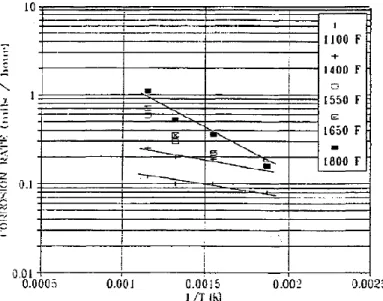
The gas temperature determines the composition of the deposits and influences the deposition rate. The temperature gradient at the corrosion interface is the driving force for condensing and diffusion of gas constituents such as alkali and heavy metal chlorides. Figure I.13 shows that corrosion rates increase with metal temperature (1/T) for a given flue gas temperature and with flue gas temperature for a given metal temperature. 38
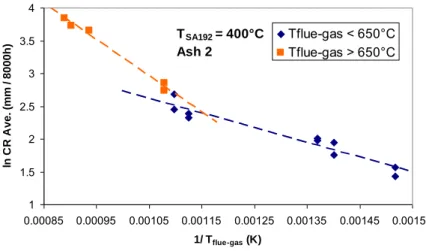
Brossard et al.46 also showed that corrosion rate increases with flue-gas temperature for a given metal
temperature, as shown in Figure I.14. It is observed that the mechanism and kinetics are different for temperatures lower than 650°C and temperatures higher than 650°C for a given deposit composition. At Tflue gas < 650°C no molten salts were observed and corrosion mechanism was assumed to be mainly
22
controlled by gas phase attack while at Tflue gas > 650°C, fused phases were detected which confirms
molten salts corrosion mechanism.
This is consistent with real conditions in WtE facilities, where significant differences can be observed between corrosion rates in heat exchangers for a given steam temperature at different flue gas temperature and corrosion rates for a given flue gas temperature at different steam temperature. 47
Figure I.12. High-temperature corrosion of superheater steels by KCl and K2CO3 under dry and wet conditions. 38
Figure I.13. Corrosion rates of carbon steel in municipal solid waste combustors as a function of metal temperature at different gas temperatures.38
23
Figure I.14. Arrhenius plots of corrosion rates as a function of flue gas temperature for a given metal temperature at 46
Waldman et al.48 also quantified the effect of flue gas and metal temperature on corrosion rates in WtE
boilers measured by cooled probe as shown in Figure I.15. Some authors also claim that a large temperature gradient increases the concentration of chlorides within an area in which the eutectics melt, accelerating corrosion.49 However, this indicator must be considered carefully because significant
differences can be observed for a given temperature gradient, at low and high flue gas temperature areas.
Figure I.15. 3D plot: Corrosion rate as a function of flue gas temperature and metal temperature. 48
I.3.1.2 Effect of the flue-gas composition
Combustion of waste produces flue-gas and ash particles (aerosols and solid particles). 50 The gas
composition depends on the composition of waste and combustion conditions (O2, temperature) which
change with time and depends on the country. The flue-gas composition is not constant throughout the facility; it depends on local injections of air and the gas temperature which vary according to the location.
51,52 Table I.3 shows an example of gas phase composition at the combustion chamber. 1 1.5 2 2.5 3 3.5 4 0.00085 0.00095 0.00105 0.00115 0.00125 0.00135 0.00145 0.00155 1/ Tflue-gas (K) ln C R A v e . (m m / 8 0 0 0 h ) Tflue-gas < 650°C Tflue-gas > 650°C TSA192 = 400°C Ash 2
24
Table I.3. Gas composition in the different parts of an incinerator. 52
Zone O2 a H2O a CO2 a HCl b SO2 b HF b CO b Lower (TFlue-Gas>1000°C) 6 40-1650 90-200 10-40 >1000 Higher (combustion chamber- superheaters) (700°C < TFlue-Gas < 900°C) 8-10 15 9-12 600-1200 90-130 <20 20-40 a (vol%), b (ppm)
Carbon dioxide (CO2), sulfur dioxide (SO2) and water vapor (H2O) present in the flue-gas come from the
combustion of organic matter and moisture waste. Hydrogen chloride (HCl) comes from chlorine release in different type of biomass residues 34 or plastics (PVC) 53. HCl and SO
2 are considered corrosive agents
from average levels of 500 ppm and 50 ppm, respectively. 51
In general, oxidizing conditions by excess of oxygen O2 tend to limit corrosion.54,55 The positive effect of
oxygen in delaying corrosion has been demonstrated in simulated incineration atmospheres 56,57 as shown
in Figure I.16. Water vapor (H2O) content in the combustion atmosphere can cause a similar
corrosion-suppressing effect. 56,58 Nakagawa et al.59 studied the behavior of carbon steel and type 347H below
deposits (NaCl-KCl) under oxidizing and reducing conditions and found a severe corrosion attack in the reducing gas with HCl and H2O as H2O acts as an oxidant in molten chlorides, while in the oxidizing
atmosphere with H2O and the highest level of HCl the corrosion rate decreased for all the temperature
tested. However the results from two laboratory tests appear to negate that reducing conditions are more damaging than oxidizing conditions. 60,61 This inconsistency can be explained by the fact that reducing
conditions raise the vapor pressure of alkali chlorides and thus enhance their formation and deposition but, that once formed; these deposits are more corrosive under oxidizing conditions. This suggests that alternating oxidizing/reducing atmospheres from unstable combustion conditions may promote especially rapid attack.53 Besides Ruh and Spiegel 55 also showed recently that water vapor seems to reduce the
corrosion rate in oxidizing conditions. It can be concluded that both oxidizing and reducing atmospheres are damaging depending on the composition of the gas and characteristics of the deposits but the effect of water vapor can vary according to the type of atmosphere.