Direction des bibliothèques
AVIS
Ce document a été numérisé par la Division de la gestion des documents et des archives de l’Université de Montréal.
L’auteur a autorisé l’Université de Montréal à reproduire et diffuser, en totalité ou en partie, par quelque moyen que ce soit et sur quelque support que ce soit, et exclusivement à des fins non lucratives d’enseignement et de recherche, des copies de ce mémoire ou de cette thèse.
L’auteur et les coauteurs le cas échéant conservent la propriété du droit d’auteur et des droits moraux qui protègent ce document. Ni la thèse ou le mémoire, ni des extraits substantiels de ce document, ne doivent être imprimés ou autrement reproduits sans l’autorisation de l’auteur.
Afin de se conformer à la Loi canadienne sur la protection des renseignements personnels, quelques formulaires secondaires, coordonnées ou signatures intégrées au texte ont pu être enlevés de ce document. Bien que cela ait pu affecter la pagination, il n’y a aucun contenu manquant.
NOTICE
This document was digitized by the Records Management & Archives Division of Université de Montréal.
The author of this thesis or dissertation has granted a nonexclusive license allowing Université de Montréal to reproduce and publish the document, in part or in whole, and in any format, solely for noncommercial educational and research purposes.
The author and co-authors if applicable retain copyright ownership and moral rights in this document. Neither the whole thesis or dissertation, nor substantial extracts from it, may be printed or otherwise reproduced without the author’s permission.
In compliance with the Canadian Privacy Act some supporting forms, contact information or signatures may have been removed from the document. While this may affect the document page count, it does not represent any loss of content from the document.
Université de Montréal
Quantum nonlocality, cryptography and complexity
par
Anne Lise Broadbent
Département d'informatique et de recherche opérationnelle Faculté des arts et des sciences
Thèse présentée à la faculté des études supérieures et postdoctorales en vue de l'obtention du grade de Philosophiœ Doctor (Ph. D.)
en informatique
mars 2008
Université de Montréal
Faculté des études supérieures et post doctorales
Cette thèse intitulée:
Quantum nonlocality, cryptography and complexity
présentée par:
Anne Lise Broadbent
a été évaluée par un jury composé des personnes suivantes:
Pierre McKenzie président-rapporteur Alain Tapp directeur de recherche Gilles Brassard codirecteur Richard MacKenzie membre du jury Andrew C.-c. Yao examinateur externe Lael Parrott
Résumé
L'informatique quantique est l'étude de ce que nous pouvons et ne pouvons pas faire grâce à l'ordinateur quantique: un ordinateur dont les calculs sont basés sur les lois de la mécanique quantique. Cette thèse est une collection de sept articles, traitant de trois aspects de l'informatique quantique: la non-localité, la cryptographie et la complexité.
Non-localité
La non-localité quantiq~e est l'observation de corrélations produites par deux partici-pants physiquement séparés qui utilisent une ressource quantique appelée intrication.
Ces corrélations ne peuvent être produites sans intrication. Ceci mène aux jeux non-locaux, qui sont des jeux coopératifs à plusieurs joueurs, pour lesquels des
joueursquan-tiques (qui ont accès à l'intrication) ont un avantage sur les joueurs classiques (qui partagent seulement de l'information classique). Un jeu de pseudo-télépathie est un jeu
non-local pour lequel les joueurs quantiques ont une stratégie gagnante parfaite.
Le premier article de cette thèse, On the power of non-local boxes, est l'étude des
corrélations quantiques (qui sont non-communicantes, c.-à-d. elles ne permettent pas de
communiquer plus vite que la vitesse de la lumière), ainsi que des corrélations super-quantiques (qui sont aussi non-communicantes, mais «plus fortes» que celles prédites
par la mécanique quantique). Nous considérons la simulation de stratégies gagnantes pour des jeux de pseudo-télépathie avec l'emploi de la boîte non-locale (qui est
con-sidérée comme la corrélation super-quantique de base), révélant que la non-localité et l'intrication sont des ressources différences. Avant notre travail, il était commun d'égaler ces deux notions.
Le deuxième article, Classical, quantum and non-signalling resources in bipartite games, montre que le problème de décider si un jeu a une stratégie parfaite classique
est NP-complet, tandis que décider si une stratégie parfaite existe avec des corrélations super-quàntiques est dans P. Nous établissons aussi des liens avec le théorème de Be11-Kochen-Specker, les graphes d'orthogonalité et les preuves interactives.
La non-localité quantique est un phénomène que nous pouvons, en théorie, observer en laboratoire. Plusieurs expériences ont été accomplies, mais aucune jusqu'à présent n'a simultanément fermé toute échappatoire expérimentale. Il y a présentement un effort scientifique soutenu pour atteindre l'expérience parfaite. Mais toutes les expériences ne sont pas égales: le troisième et quatrième article de cette thèse, Entanglement swapping, light cones and elements of reality et On the logical structure of Bell theorems, montrent
RÉSUMÉ ii
dans notre compréhension du monde quantique. Notre travail indique que ces lignes de recherche ne méritent pas d'être approfondies.
Cryptographie classique et quantique
Le travail révolutionnaire de Peter Shor en 1995 a établi que l'ordinateur quantique peut factoriser de grands nombres entiers de façon efficace, de ce fait brisant la plupart des cryptosytèmes modernes. Mais ce que l'ordinateur quantique brise, il peut aussi ré-parer: Bennett et Brassard avaient déjà donné en 1984 un protocole pour la distribution de clef dont la sécurité se fonde uniquement sur les lois de la mécanique quantique.
Dans un monde avec des ordinateurs quantiques, il semble que la seule façon de s'assurer d'une sécurité parfaite est de se passer d'hypothèses calculatoires (telle la présumée difficulté de factoriser) : ceci est le monde de la sécurité basée sur la théorie de l'information. Dans la cinquième contribution de cette thèse, Information-theoretic security without an honest majority, nous donnons des protocoles pour accomplir une série de six tâches privées distribuées (en particulier, vote et .transmission de message anonyme), tout en assurant une sécurité basée sur la théorie de l'information. Puis, dans
Anonymous quantum communication, nous donnons un protocole qui, dans un groupe, permet à un expéditeur d'acheminer un message quantique à un destinataire de son choix. Le protocole assure l'anonymat pour l'expéditeur et le destinataire, ainsi que la confidentialité du message, le tout avec une sécurité basée sur la théorie de l'information.
Complexité dans le modèle fondé sur la mesure
Enfin, dans Parallelizing quantum circuits, nous étudions la profondeur de circuits quan-tiques et donnons une technique automatique pour la parallélisation de ces· circuits. La progression de circuits quantiques parallèles (de petite profondeur) semble presque es-sentielle si nous voulons implanter des algorithmes quantiques dans le futur proche avec la technologie disponible. L'information quantique est habituellement instable, ce qui fait que nous pouvons la manipuler que pour de courtes périodes de temps. Les circuits quantiques parallèles maximisent l'emploi de cette information fragile. Notre méthode est basée sur le paradigme récent pour le calcul quantique appelé calcul quantique fondé
sur la mesure.
Mots-clés: informatique quantique, pseudo-télépathie, boîtes non-locales, théorème de Bell, calcul multi-parties, sécurité basée sur la théorie de l'infor-mation, anonymat, profondeur des circuits quantiques, calcul quantique fondé sur la mesure, calcul de la mesure.
III
Abstract
Quantum computing is the study of what we can and cannot do with quantum com-puters: computers operating based on the laws of quantum mechanics. This thesis is a collection of seven papers, dealing with three aspects of quantum computing: non-locality, cryptography and complexity.
N onlocality
Quantum nonlocality refers to the fact that, using a resouree called quantum entangle-ment, two participants who are physically separated and unable to communicate can exhibit correlations that cannot be produeed without entanglement. This gives rise to
non local games, which are multi-player cooperative games for which quantum players (who share entanglement) have an advantage over classical players (who share only classical information). A pseudo-telepathy ganie is a special case of a nonlocal game for which quantum players have a perfect winning strategy. The first paper in this thesis,
On the power of non-local boxes, is a study of quantum correlations (which are non-signalling, i.e. they do not allow faster-than-light communication), as weIl as superquan-tum correlations (which are also non-signalling, but "stronger" than those predicted by quantum mechanics). We consider the simulation of pseudo-telepathy winning strategies with the nonlocal box.(which can be se en as the most basic superquantum correlation), revealing that nonlocality and entanglement are different resourees. Before our work, it was common to equate these two notions. The second paper, Classical, quantum and non-signalling resources in bipartite games, shows that the problem of deciding if a fixed game has a perfect classical winning strategy is NP-complete, while deciding if a perfect strategy exists with superquantum correlations is in P. We also establish links with the Bell-Kochen-Specker theorem, orthogonality graphs and two-prover interactive proofs.
Quantum nonlocality is a phenomenon that we can, in theory, witness in the labo-ratory. Many experiments have been performed, but none so far have simultaneously closed aIl experimental loopholes. There is currently a substantial scientific effort to achieve the perfect laboratory experiment. Yet not aIl experimental setups are created equally: the third and fourth paper of this thesis, Entanglement swapping, light cones and elements of reality and On the logical structure of Bell theorems, show that reeent proposaIs have classical explanations, and thus do nothing to aid in our comprehension of the quantum wodd. This work is scientifically valuable, sinee it tells us that we should not invest in the proposed lines of research.
ABSTRACT IV
Classical and quantum cryptography
The groundbreaking work of Peter Shor in 1995 established that quantum computers can efficiently factor large integers, thus rendering most modern cryptographic systems insecure. But what quantum computers break, they also fix: Bennett and Brassard had already given in 1984 a protocol for key distribution whose security is based only on the laws of quantum mechanics.
In a world with quantum computers, it seems like the only way to ensure perfect se-curity in cryptographic tasks is to do away with computational assumptions (such as the apparent difficulty of factoring): this is the realm of information-theoretic security. In the fifth paper of this thesis, Injormation-theoretic security without an honest majority
we give protocols to accomplish a series of six private distributed tasks (in particular,
vote and anonymous message transmission), while ensuring information-theoretic secu-rity. Then, in Anonymous quantum communication, we give a proto col which, within a group, allows a sen der to transfer a quantum message to a receiver of his choosing. The protocol ensures information-theoretic anonymity for the sender and the receiver as weIl as information-theoretic privacy for the message.
Complexity in the measurement-based model
Finally, in Parallelizing quantum circuits, we study the depth complexity of quantum circuits, giving an automated technique for the parallelization of quantum circuits. The development of parallel (low-depth) quantum circuits seems almost essential if we wish to implement quantum algorithms in the near future with available technology. Quan-tum information is usually unstable, hence we can only operate on it for a very short period of time. Parallel circuits maximize the use of this fragile quantum informa-tion. Our method is based on the recent paradigm for quantum computing called the
measurement-based model.
Key words: quantum information processing, pseudo-telepathy, nonlocal boxes, Bell's theorem, multi-party computation, information-theoreiic secu-rit y, anonymity, quantum depth complexity, measurement-based quantum computing, measurement calculus.
v
Contents
Résumé 1
Abstract iii
Contents v
Acknow ledgements viii
1 Introduction
1
1 Quantum Information Processing 1
2 Outline of Thesis 1
II
N onlocality
9
On the power of non-local boxes 10
Anne Broadbent and André Allan Méthot
Theoretical Computer Science 358:3-14 (2006)
Classical, quantum and non-signalling resources in bipartite games 30 Gilles Brassard, Aime Broadbent, Esther Hiinggi, André Allan Méthot and
Stefan Wolf
To appear in Natural Computing. Initial version in Proceedings of the Second International Conference on Quantum, Nano, and Micro Technologies (ICQNM 2008)
Entanglement swapping, light cones and elements of reality Anne Broadbent and André Allan Méthot
Physics Letters A 364:357-361 (2006) On the logical structure of Bell theorems
Anne Broadbent, Hilary A. Carteret, André Allan Méthot and Jonathan Walgate New Journal of Physics 8:302 (2006)
54
CONTENTS vi
III
Classical and Quantum Cryptography
75
Information-theoretic security without an honest majority 76 Anne Broadbent and Alain Tapp
Proceedings of ASIACRYPT'07 pp. 410-426 (2007)
Anonymous quantum communication 97
Gilles Brassard, Anne Broadbent, Joseph Fitzsimons, Sébastien Gambs and Alain Tapp
Proceedings of ASIACRYPT'07 pp. 460-473 (2007)
IV
Complexity in the measurement-based model
Parallelizing quantum circuits Anne Broadbent and Elham Kashefi
submitted to Theo'fetical Computer Science (2007)
V
Conclusion
References
for parts 1 and V Curriculum Vitae114
115161
163 ixto Didier and
to my parents
Vlll
Acknowledgements
For their unconditional support, l am deeply indebted to my supervisors Gilles Brassard and Alain Tapp: over the past few years you have been my guide, introducing me to more and more aspects of the fascinating world of theoretical computer science and beyond; l am grateful for the liberty and trust that you granted me.
As a collection of papers, the credit for this thesis is to be shared with my wonder-fuI co-authors (except for any mistakes or omissions, for which l assume full respon-sibility): Gilles Brassard, Hilary A. Carteret, Joseph Fitzsimons, Sébastien Gambs, Esther Hanggi, Elham Kashefi, André Allan Méthot, Alain Tapp, Jonathan Walgate, and Stefan Wolf.
Many thanks to the following students, former students and post-do cs at the lab-oratoire d'informatique théorique et quantique at Université de Montréal, all of which
J
have enhanced my academic and social experience in their own way: Som Bandyopad-hyay, Hugue Blier, Félix Bussières, Hilary A. Carteret, Paul Chouha, Julien Degorre, Frédéric Dupuis, Sébastien Gambs, José M. Fernandez, Charles Hélou, Elham Kashefi, André Allan Méthot, Olivier Landon-Cardinal, Éric Oliver Paquette, Flavien Serge Mani Onana, Sébastien Paquet, Simon Pilette, Valérie Poulin, David Pouliot, and Jürg Wullschleger.
Thanks to Niel de Beaudrap for exchanging ideas on the measurement-based model for quantum computing and thanks to Sébastien Gambs for the mousses au chocolat.
This work would not have been possible without the encouragement of my friends and family. Special thanks to Didier for his st.eadfast support.
Finally, l am grateful to the Canadian Federation of University Women (CFUW),
the Fonds québécois de la recherche sur la nature et les technologies (FQRNT) and to the Natural Sciences and Engineering Research Council of Canada (NSERC) for having funded this work.
1
Part 1
Introduction
This thesis is a collection of seven papers, grouped under three themes: nonlocality, cryptography and complexity. Part l is the present introduction, which motivates and presents the results of this thesis. Part II contains four papers on nonlocality, part III contains two papers on classical and quantum multi-party cryptography, while part IV contains one paper on circuit complexity in the measurement-based model. All papers are re-printed with the kind permission of the respective editors, as well as that of my co-authors; the papers are re-formatted to corn ply with University standards, but are otherwise unchanged. Each paper contains its own list of references. Part V is the conclusion, followed by references (pertaining to the introduction and conclusion only) and a short curriculum vitae.
A note on my personal contributions: . by principle, all authors names appear alpha-betically in aU of my publications. This is common practice in the theoretical computer science community. For all papers, my coUaborative participation has been significant.
1
Quantum Information Processing
Quantum information ·processing is concerned with what we can and cannot do with comput ers that operate based on the laws of quantum mechanics. The first univers al quantum computer was described by David Deutsch [28] in 1985, but historically, work related to quantum computing had already appeared under many forms: conjugate coding (by Stephen Wiesner [50]), Holevo's bound (by Alexander Holevo [35]), the idea of using quantum computers to simulate quantum systems (Richard Feynman [30]), and quantum cryptography (Charles Bennett and Gilles Brassard [7]).
Quantum information is fundamentally different from its classical counterpart: it ex-ploits distinctive quantum mechanical phenomena such as superposition, entanglement
and interference. Contrary to its classical counterpart, quantum information cannot, in general, be copied [51]. For an introduction to quantum computing, see [43,40,37].
2
Outline of Thesis
We now present the three major themes of the thesis, giving sorne background and outlining the scientific contributions made by each paper.
INTRODUCTION 2
2.1
Nonlocality
Quantum mechanics defies our intuition in a very profound way. Here, we address one of its peculiarities: nonlocality. In short, this is the ability of quantum mechanics to enable distant parties to share correlations that are stronger than what would be possible with only local classical information. The fundamental underlying resource that enables this is called entanglement.
Nonlocality has a tumultuous history. In 1935, Albert Einstein, Boris Podolsky and Nathan Rosen wrote a famous paper to criticise the then-new quantum theory [29]. According to them, quantum mechanics had to be incomplete, in the sense that the theOl'y would be missing an underlying vector of information: what they called ele-ments of reality, which later became known as local hidden variables. These variables, although partially hidden to the outside observer, would hold the absolute truth about any system: performing a measurement would sim ply reveal their state. Accordingto Einstein, Podolsky and Rosen, a possible way to "fix" quantum mechanics would be to introduce elements of reality into the theory.
This question of whether or not it was necessary or even possible to introduce local hidden variables in quantum mechanics remained unsolved until John Bell's 1964 dis-covery [5]: the predictions of quantum mechanics cannot be explained by a local realistic theory! This means that quantum mechanics cannot simultaneously obey the no-faster-than-light-communication princip le and be determined entirely by local variables. This revealed the unique character of entanglement and the impossibility of locally pre-programming measurement outcomes, thus starting the study of what is now known as
nonlocality.
From an information processing point of view, nonlocality is studied in the are a of communication corn pl exit y (a model first considered by Harold Abelson [1] and given in its current form by Andrew Yao [52]), or more precisely in the area of quantum
communication complexity (pioneering work in this area was also done by Yao [54]; see [8] for a sùrvey), where we ask: can shared entanglement reduce the amount of exchanged communication necessary for participants to compute a distributed function?
(This specific model was designed by Richard Cleve and Harry Burhman [25].)
This scenario can also be viewed in the context of nonlocal games [26]. These games consist of questions given by a referee to distant players who are unable to communicate and who must return answers to the referee such that a certain relation between the questions and answers is satisfied. Agame is nonlocal if quantum players (who share entanglement) have an advantage (in terms of suc cess probability) over classical players (who share only common classical information). A pseudo-telepathy game is a special
INTRODUCTION 3
case of a nonlocal game for which quantum players have a perfect winning strategy [12].
Part II contains four contributions on the theme of nonlocality, which we now de-scribe.
2.1.1 On the power of non-local boxes
Anne Broadbent and André Allan Méthot
Theoretical Computer Science 358:3-14 (2006)
A nonlocal box is an asynchTOnous virtual device that has the following property: given
that Alice inputs a bit at her end of the device and that Bob does likewise, it pro duces two bits, one at Alice's end and one at Bob's end, which are locally uniformly random, but such that the XOR of the outputs is equal to the AND of the inputs.
This box, inspired from the Clauser-Horne-Shimony-Holt inequality [26], was first proposed by Sandu Popescu and Daniel Rohrlich [46] to examine the question: given that a maximally entangled pair of qubits is nonlocal, why is it not maximally nonlocal? Understanding the power of this box yields insight into the nonlocality of quantum mechanics.
Contributions. It was shown in 2004 by Nicolas Cerf, Nicolas Gisin, Serge Massar and Sandu Popescu [23] that the nonlocal box is able to simulate correlations from any measurement on a singlet state. Here, we show that the nonlocal box can in fact do much more: through the simulation of the magic square pseudo-telepathy game and the Mermin-GHZ pseudo-telepathy game, we show that the nonlocal box can simu-late quantum correlations that no entangled pair of qubits can, in a bipartite scenario and even in a multi-party scenario. Finally we show that a single nonlocal box can-not simulate aIl quantum correlations and propose a generalization for a multi-party nonlocal box. In particular, we show quantum correlations whose simulation requires an exponential amount of nonlocal boxes, in the number of maximally entangled qubit pairs. We conclude that nonlocality and entanglement are different and incomparable resources.
2.1.2 Classical, quantum and non-signalling resources in bipartite games
Gilles Brassard, Anne Broadbent, Esther Hanggi, André Allan Méthot and Stefan Wolf To appear in Natural Computing. Initial version in FTOceedings of the Second In-ternational Conference on Quantum, Nan 0, and Micro Technologies (ICQNM 2008)
INTRODUCTION 4
In this work, we study two types of nonlocal games: pseudo-telepathy and Bell theor'ems without inequalities [36]. By representing the games as bipartite graphs, we are able to show various results.
Contributions. Our main results are alternate proofs that deciding whether a no-communication classical winning strategy exists for certain games (called forbidden-edge and covering games) is NP-complete, while the problem of deciding if these games admit a non-signalling winning strategy is in P. We discuss relations between quantum winning strategies and orthogonality graphs. We also show that every pseudo-telepathy game yields both a proof of the Bell-Kochen-Specker theorem and
an
instance of a two-proyer interactive proof system that is classically sound, but that becomes unsound when proyers use shared entanglement.2.1.3 Entanglement swapping, light cones and elements of reality
Anne Broadbent and André Allan Méthot
Physics LetteTs A 364:357-361 (2006)
At the beginning of section 2.1, we discussed the theoretical importance of Bell's theorem. Equally important is the experimental demonstration of these predictions. Efforts in this area were performed starting in 1972 [33], followed by a series of exp er-iments led by Alain Aspect [4, 5, 3]. But laboratory experer-iments are imperfect and it is generally agreed that we have yet to witness the ideal experiment, where all experi-mental errors are taken into account, and all statistical evidence is irrefutable (such an experiment is said to close aIl loopholes). This motivates the quest for new theoretical and experimental proposaIs to demonstrate the nonlocality of the world in which we live.
Contributions. Recently, new scenarios thatcan be cast into the framework of two-player pseudo-telepathy games have been proposed as candidates for loophole-free non-locality experiments [34, 35, 21, 22]. The authors claim that they present new proofs against local realism. Although the equations that they present are mathematically correct, it is not possible to interpret them in such a way as to rule out alllocal hidden variable models for the proposed experiments. Our work aims to clar if y this situation. Here, we give local realistic explanations for these experiments. More precisely, we examine the scenario where a participant swaps his entanglement with two other participants and then is removed from the experiment; we also examine the scenario where two particles are in the same light cone, i.e. belong to a single participant. Our conclusion is that, in both cases, the proposed exp eriments , if implemented, would not be convincing proofs against local realism.
INTRODUCTION
2.1.4 On the logical structure of Bell theorems
Anne Broadbent, Hilary A. Carteret, André Allan Méthot and Jonathan Walgate
New Journal of Physics 8:302 (8 pages) (2006)
5
Contributions. As an extension ofthe work presented in section 2.1.3, here we present an in-depth analysis of the logical structure of the proof presented in Cabello's proposaI for a loophole-free Bell experiment [21, 22]. Though our analysis is general, we focus on this one example for clarity, because it is perhaps the most convincing of its class, and has been clearly presented on a number of occasions. We show these novel designs fail in the most basic way, by not ruling out local hidden variable models, and we provide an explicit classical model to demonstrate this. They share a common fiaw, which reveals a basic misunderstanding of how nonlocality proofs work. Given the time and resources now being devoted to such experiments, theoretical clarity is essential. Our explanation is presented in terms of simple logic and should serve to correct misconceptions and avoid future mistakes.
2.2
Classical and quantum cryptography
In its broadest sense, cryptography is the art and science of designing proto cols that accomplish tasks in the presence of an adversary. The basics of cryptography have to do with exchanging private messages: the famous Rivest-Shamir-Adleman (RSA) pro-tocol [49] enables two parties to communicate secretly, even though they have perhaps never met. The security of the RSA proto col relies on computational assumptions: hav-ing a me ans to efficiently factor large integers would provide a way to completely break the RSA cryptosystem. When Peter Shor showed in 1995 [50] that quantum computers can be used to efficiently factor large integers, the impact was tremendous. According to many, it would just be a matter of time until large-sc ale quantum comput ers are built and the RSA cryptosystem becomes obsolete. Luckily, what quantum comput ers break, they also fix: Bennett and Brassard had already given a quantum proto col for the unconditional secure transmission of classical messages [8]. Proto cols (such as Bennett and Brassard's) whose security is not based on computational assumptions (such as the presumed difficulty of factoring) are said to provide information-theoretic security.
In the following two papers, we are interested in information-theoretic security for cryptographic protocols. The motivation for this level of security is due in part to Shor's algorithm and its impact on the RSA cryptosystem. We study general cryptographic tasks, known as multi-party computation [55]. Formally, in multi-party computation, a group of participants interact in order to accomplish a distributed task: each participant
INTRODUCTION 6
has a private input and at the end of the protocol, each participant should know sorne fixed function of the private inputs, but nothing else. We also require that such a proto col be secure against saboteurs (either by being robust against saboteurs or by detecting them).
Assuming that private random keys are shared between each pair of participants, every function can be computed with information-theoretic security as long as less than a third of the participants are cheaters (cheaters can deviate from the proto col and collude); this fundamental result is due to David Chaum, Claude Crépeau and Ivan Damgard [24] and Michael Ben-Or, Shafi Goldwasser and A vi Wigderson [7]. When a broadcast channel is available, the results of Tai Rabin and Michael Ben-Or [47] teU us that an honest majority suffices.
In our work, we make no assumption on the number of cheating parties. The first paper presents proto cols to accomplish novel classical tasks in this model. The sec-ond paper builds on the previous one and presents a proto col for anonymous quantum
comm unication.
2.2.1 Information-theoretic security without an honest majority Anne Broadbent and Alain Tapp
Proceedings of the 13th International Conference on the Theory and Application of Cryptology fj Information Security (ASIACRYPT 2007) pp. 410-426 (2007)
Contributions. We present six multiparty protcicols with information-theoretic secu-rit y that tolerate an arbitrary number of cheating participants. AU proto cols assume pairwise authentic private channels and a broadcast channel (in a single case, we re-quire a simultaneous broadcast channel). We give proto cols for veto, vote, anonymous
bit transmission, collision detection, notification and anonymous message transmission.
Not assuming an honest majority, in most cases, a single corrupt participant can make the protocol abort. AU protocols achieve functionalities never obtained before without the use of either computational assumptions or an honest majority. l
2.2.2 Anonymous quantum communication
Gilles Brassard, Anne Broadbent, Joseph Fitzsimons, Sébastien Gambs and Alain Tapp
Proceedings of the 13th International Conference on the Theory and Application of Cryptology fj Information Security (ASIACRYPT 2007) pp. 460-473 (2007)
INTRODUCTION 7
Anonymous quantum message transmission a11ows, within a group of participants,
an anonymous sender to target a receiver of his choosing and send him a private quantum message, such that the identity of the receiver is unknown to a11 but the sender and receiver (the identity of the sender is known only to himself). Matthias Christandl and Stephanie Wehner were first to define the concept of anonymous quantum message transmission and to give an explicit protocol for solving this task [51, 25], but under
the assumption that the participants share ahead of time a specific entangled state. Under this assumption, their proto col is information-theoretica11y secure in terms of anonymity, but malicious participants can alter the transmitted state in a way that will not be detected by the honest participants. Our contribution improves on these previous results.
Contributions. We present the first proto col for the anonymous transmission of
a quantum state that is information-theoretica11y secure against an active adversary, without any assumption on the number of cheating participants. The anonymity of the sen der and receiver, as we11 as the privacy of the quantum state, are perfectly protected except with exponentia11y sma11 probability. Even though a single cheating participant can cause the proto col to abort, the quantum state can only be destroyed with exponentia11y sma11 probability: ifthe protocol succeeds, the state is transferred to the receiver and otherwise it remains in the hands of the sender (provided the receiver is honest).
2.3
Complexity in the measurement-based model
In this section, we study the depth complexity and para11elization of quantum circuits. The development of para11el (low-depth) quantum circuits seems almost essential if we wish to implement quantum algorithms in the near future with available technology. Due to decoherence, qubits have a tendency to spontaneously change their state, hence we can only operate on them for a very short period of time. Para11el circuits could maximize the use of these fragile qubits.
As for theoretical motivation, the study of para11el quantum algorithms could le ad to new results in complexity theory. For instance, one interesting open question is
w hether the class of decision .problems solvable in polynomial time, P, is equal to the class of decision problems solvable in polylogarithmic depth and polynomial size, NC.
Let QNC be the classofdecision problems solvable in polylogarithmic depth with a quantum computer,"one càn ask similarly whether BQP is equal to QNC. Fina11y, Richard Jozsa conjectured that any polynomial-time quantum algorithm can be
imple-INTRODUCTION 8
mented with only 0 (log n) quantum layers interspersed with polynomial- time classical computations [38].
We present a construction for the parallelization of quantum circuits. Our method gives a formula that computes the exact decrease in depth that the construction can achieve. This yields precious insight for the construction of lower-depth quantum cir-cuits. Our results are obtained using the recently proposed formalism of the measurement-based model for quantum computation (MBQC) [48,38,44,20], an approach to quan-tum computing that uses measurement as its main ingredient. A computation in MBQC
is usually referred to as a pattern and consists of a round of global operations (two-qubit
gates) to create the required initial multi-qubit entanglement, followed by a sequence of classically controlled local operators (single-qubit measurements and unitaries). We work in particular within an algebraic framework for MBQC called the measurement
calculus
[29].
2.3.1 Parallelizing quantum circuits
Anne Broadbent and Elham Kashefi
submitted to Theoretical Computer Science (34 pages) (2007)
Contributions. We present a novel automated technique for parallelizing quantum circuits via the forward and backward translation to measurement-based quantum com-puting patterns, and analyze the trade-off in terms of depth and space complexity. As a result, we distinguish a class of polynomial depth circuits that can be parallelized to logarithmic depth while ad ding only a polynomial number of auxiliary qubits. In particular, we provide for the first time a full characterization of patterns with fiow of arbitrary depth, based on the notion of infiuencing walks and a simple rewriting system on the angles of the measurement. Our method leads to insightful knowledge for con-structing parallel circuits. As applications, we demonstrate several classes of circuits that can be parallelized to constant or logarithmic depth. Furthermore, we prove a con-stant versus logarithmic separation in terms of quantum depth between the quantum circuit model and the measurement-based mode!.
9
Part
II
Originally published in Theoretical Computer Science 358:3~ 14 (2006)
On the power of non-local boxes
Anne Broadbent
André Allan Méthot
Département d'informatique et de recherche opérationnelle Université de Montréal, c.P. 6128, Suce. Centre- Ville
Montréal (QC), H3C 3J7 CANADA
Abstract
A non-local box is a virtual device that has the following property: given that Alice inputs a bit at her end of the device and that Bob does likewise, it pro duces two bits, one at Alice's end and one at Bob's end, such that the XOR of the outputs is equal to the AND of the inputs. This box, inspired from the CHSH inequality, was first proposed by Popescu and Rohrlich to examine the question: given that a maximally entangled pair of qubits is non-local; why is it not maximally non-local? We believe that understanding the power of this box will yield insight into the non-Iocality of quantum mechanics. It was shown recently by Cerf, Gisin, Massar and Popescu, that this imaginary device is able to simulate correlations from any measurement on a singlet state. Here, we show that the non-local box can in fact do much more: through the simulation of the magic square pseudo-telepathy game and the Mermin-GHZ pseudo-telepathy game, we show that the non-local box can simulate quantum correlations that no entangled pair of qubits can, in a bipartite scenario and even in a multi-party scenario. Finally we show that a single non-local box cannot simulate aU quantum correlations and propose a generalization for a multi-party non-local box. In particular, we show quantum correlations whose simulation requires an exponential amount of non-local boxes, in the number of maximally entangled qubit pairs.
On the power of non-local boxes
Anne Broadbent and André Allan Méthot 11
1
Introd uctio'n
In a 1964 influential paper, Bell showed that there exist correlations that can be obtained from bipartite measurements of a quantum state that no local realistic theory can reproduce [:1.]. From this, if one believes that quantum mechanics is a correct description of the world, one is forced to conclude that Nature is fundamentally non-local. This astounding discovery has le ad to a rich and still developing literature. One of the best known papers in the field is the 1969 experimental proposition of Clauser, Horne, Shimony and HoIt [2]. The authors put forth an inequality which aIl local hidden variable (LHV) models must satisfy:
(1)
where Al and A2 are local spin measurements of a spin-half particle on Alice's subsystem
and BI and B2 are measurements on Bob's subsystem. While any LHV model has to
abide by this rule, quantum mechanics can violate Inequality 1 by an apptopriate choice of measurements on a maximally entangled state, such as 11f-) = (1
+ -) -
1 -+) ) /
V2:(2)
This result may also be interpreted in a more intuitive fashion [3J: if Alice and Bob want to play agame, called the CHSH game, where they are each given as input a bit, x(A) and x(B) respectively, and they want to produce output bits y(A) and y(B) respectively such that
(3)
then there is no classical (LHV) strategy that can help them win this game with a probabilitygreater than 3/4, but if they share the quantum state 11f-) = (101)
-110))/V2, then they can succeed with probability cos2(7r/8) ~ 0,85 [2].
Many years later, Popescu and Rohrlich [4] asked a natural question: why not more? Given that quantum mechanics is non-local, why is it not maximally non-local? Many authors have studied this question [5, 6, 7, 8, 9] and we will discuss their results in Section 4. Besides this intriguing question, Popescu and Rohrlich suggested something el se of interest, a gedanken product: the non-local box (NLB). A NLB is a virtual device that has two ends and the following property: if Alice inputs a bit into her end of the NLB and Bob do es likewise, then they will both receive a bit from the NLB such that the condition of Equation 3 is always respected, and such that aIl solutions are
On the power of non-local boxes
Anne Broadbent and André Allan Méthot 12
equally likely. Tt is important to note that this device does not allow faster than light communication [4].
Recently, Cerf, Gisin, Massar and Popescu built on the work of Toner and Bacon [10] and used a NLB to simulate the correlations obtained from any bipartite measurement of a maximally entangled pair of qubits, I~-), without any communication [l1J. This result shows that signaling information on the inputs is not necessary for a perfect simulation of quantum correlations. The long term aim of this work is to characterize the NLB in order to yield insights into the non-locality of Nature.
In this paper, we want to push this research further. The NLB was inspired from the CHSH inequality, which is often thought as the generic inequality for non-locality, and it can also simulate the correlations of a maximally entangled pair of qubits. From this, it is tempting to draw an anal ogy between the NLB and the maximally entangled pair of qubits. We will show however that a single NLB can be used to accomplish a distributed task that cannot be accomplished with only a maximally entangled pair of qubits. In particular, we will study pseudo-telepathy and show simulations of sorne pseudo-telepathy games with one NLB where the quantum strategy requires more than a maximally entangled pair of qubits to succeed. We will also give limitations on what a single NLB can achieve and propose a generalization of the NLB to the multi-party setting.
Definition 1. A bipartite game G (X, Y, R) is set of inputs X
=
X(A) X X(B), a setof outputs Y = y(A) X y(B) and a relation
R
ç
X(A) X XCB) x' y(A) X y(B).Definition 2. A winning strategy for a bipartite game G = (X, Y, R) is a strategy according to which for eve~y x CA ) E X(A) and xCB) E XCB), Alice and Bob output y(A) E y(A) and y(B) E y(B) respectively such that (x(A) l X(B), y(A), y(B)) E R.
Definition 3. We say that a bipartite game G exhibits pseudo-telepathy if bipartite measuremerits of an entangled quantum state can yield a winning strategy, whereas no classical strategy that does not in'JJolve communication is a winning strategy.
The generalization to multi-party pseudo-telepathy to be taken is the natural one. For a complete survey on pseudo-telepathy, please see [12].
Definition 4. A non-local protocol is a purely classical protocol where the participants are not allowed communication but are allowed the use of NLBs.
Definition 5. A protocol simulates the correlations of a pseudo-telepathy game if, in addition to yielding a winning strategy, the probabilities Pr(y(A), y(B) IX(A), X(B)) are identical to those of a quantum winning strategy.
On the power of non-local boxes
Anne Broadbent and André Allan Méthot 13
2
Magic square game
We saw in Section 1 that one use of a NLB can give the correlations of any bipartite measurement on
11/'-)
without any communication. A natural question would be to ask whether it can give us more. In particular, are there correlations that can only be obtained by bipartite. measurements of an entangled state of more than a pair of quhits,' but that can be simulated with one use of a NLB? In this Section, we answer affirmatively by showing a pseudo-telepathy game, the magic square game [13], that requîres more than an entangled state of two qubits in the quantum winning strategy, yet only one use of a NLB suffices to yield a non-local winning strategy. We also give a non-local strategy that makes use of a single NLB and that simulates the magic square correlations.Definition 6. In the magic square game, Alice and Bob are given x(A) E {1, 2, 3}
and X(B) E {1, 2, 3}, respectively. They produce 3 bits each, (ylA) , y~A), y~A») and (y (B) y(B) y(B») such that. l , 2 ' 3 ) .
y~A)
=
yi A) ED y~A) y~B) = yiB) ED y~B) ED 1(A) _ (B) Yx(B) - Yx(A)'
(4)
Here, and in aIl future definitions of bipartite games, it is understood that
(x(A), x(B), y(A), y(B») E R if and only if the given equations are satisfied.
It is known that the magic square game is a pseudo-telepathy game: the best classical players can do is succeed on 8/9 of the possible inputs, whereas players with the shared entangled state
11/')
= ~1001l) ~101l0)411001)
+
~11l00) (two maximally entangled pairs of qubits), where Alice has the first two qubits and Bob the last two qubits, have a quantum winning strategy [12].It is useful here to mention that a magic square is a 3 x 3 matrix with binary entries such that the sum of each row is even and the sum of each column is odd. It is obvious that such a magic square does not exist, yet Alice and Bob's output bits (as defined in Equation 4) fit perfectly into a magic square: we place Alice's three output bits in the x(A)th row and Bob's three output bits in the x(B)th column. Using this sa~e construction, we can represent a player's strategy as a 3 x 3 binary matrix.
Lemma 1. No quantum strategy can win the magic square game with probability one if the participants share only an entangled pair of qubits,
11/')
= aIOO)+
,BIll).On the power of non-local boxes
Anne Broadbent and André Allan Méthot 14
Proof. The proof is straightforward from Brassard, Méthot and Tapp [14], where the authors show that there cannot exist a proto col that exhibits pseudo-telepathy where the quantum strategy makes use of a pair of entangled qubits.
o
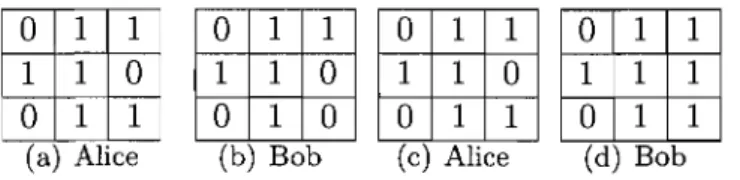
Theorem 1. The magic square game can be won classically with probability one if the participants are allowed one bit of communication.0 1 1 0 1 1 0 1 1 0 1 1 1 1 0 1 1 0 1 1 0 1 1 1 0 1 1 0 1 0 0 1 1 0 1 1
(a) Allee (b) Bob (e) Allee (d) Bob
Figure 1: Two strategies: strategy 0 ((a) and (b)) and strategy 1 ((c) and (d)).
Proof. Alice and Bob agree ahead of time on a two strategies, say 0 and 1. Strategy 0 yields a correct answer for aIl inputs except when x(A)
=
x(B)=
3, and strategy 1 yieldsa correct answer when x(A)
=
x(B)=
3. Furthermore, strategies 0 and 1 can be chosensuch that Alice's out cornes are identical for both strategies. We give an example of such strategies in Figure 1. Alice and Bob's final strategy is for Alice to send a single bit to Bob" indicating whether or not x(A) = 3. If x(A) =f:. 3, Bob acts according to strategy 0,
otherwise he uses strategy 1. It is easy to check that with this strategy, Alice and Bob
always win. 0
Theorem 2. Classical players that are allowed one bit of communication can simulate the magic square correlations.
Proof. Since, in the quantum strategy, Alice's and Bob's density matrices are totaIly mixed, the local outputs of their von Neumann measurements are uniformly distributed among aIl possible outputs respecting the conditions of Definition 6.
Now in the classical protocol, Alice and Bob agree on strategies 0 and 1 as in the proof of Theorem 1, but they use shared randomness to choose the strategies uniformly at random among aIl strategies that fit the construction. With this strategy, Alice and Bob's outcomes are distributed uniformly at random among aIl possible winning
outcomes.
o
Theorem 3. There exists a non-local winning strategy for the magic square game that makes use of a single NLB.
Proof. Alice and Bob each have two strategies, say AO and Al for Alice and BQ and
On the power of non-local boxes
Anne Broadbent and André Allan Méthot 15
Bob's y~B)
=
yfB) EB y~B)EB 1. Both pairs of strategies (AO, BO) and (Al, BI) yield a correct answer, y~1~)=
y~fl), for aIl inputs except when x(A)=
x(B)=
3. Additionally, strategies AO and BI, as weIl as Al and BO, are coordinated such that if Alice answers according to strategy Ai (i E 0, 1) and Bob according to strategy B j (j= i
EB 1), then on inputs x(A)=
x(B)=
3, we have that y~A)=
y~B). Such strategies (AO, Al, BO andBI) are easy to find.
Alice and Bob use a NLB to determine which strategy each player uses: they both input in the NLB whether x(A)
=
3 or whether x(B)=
3. They then independently use the output of the NLB, z(A) and z(B) to determine the strategy to use (Az(A) for Alice,Bz(B) for Bob).
Note that by virtue of the NLB, Alice and Bob will have z(A) = z(B) as long as
XA
i-
3 or XBi-
3. Strategies (AO, BO) and (Al, BI) will yield correct answers in this case. If, however, both x(A) =3 and x(B) = 3, then Alice and Bob will answer according to strategies (AO, BI) or (Al, BO). But these strategies are coordinated sothat y~A)
=
y~B), so their answer is correct. 0Theorem 4. There exists a non-local protocol that simulates the magic square correla-tions with a single use of a NLB.
Proof. The proof is similar to the proof of Theorem 2: aIl that Alice and Bob must do in order to simulate the magic square correlations is apply the strategy given in the proof of Theorem 3, but with strategies AO, Al, BO and BI chosen among aIl possible such strategies according to the uniform distribution. Then Alice and Bob's outcomes are distributed uniformly at random and Definition 6 is satisfied. 0
From Lemma 1 and Theorem 4, we get the following Corollary:
Corollary 1. A NLB can simulate bipartite correlations that no entangled pair of qubits, 1'ljJ)
=
aIOO)+
,8111), cano3
Mermin-GHZ game
In this Section, we add to the demonstration of the power of a NLB by showing that it can also simulate correlations found in a tripartite state.
Definition 7. In the Mermin-GHZ game
flS},
Alice, Bob and Charlie are each given a bit su ch that x(A)+
x(B)+
x(C)==
0 (mod 2) and they must produce a bit of outputOn the power of non-local boxes
Anne Broadbent and André Allan Méthot 16
each, y(A), y(B) and y(C), su ch that:
(A) (B) CC) x(A)
+
X(B)+
x(C)y ffiy ffiy = 2
It is weIl known that this is a pseudo-telepathy game. In the quantum winning strategy, Alice, Bob and Charlie share a GHZ-state: ~IOOO)
+
1111).Lemma 2. No quantumstrategy can win the Mermin-GHZ game with probability one if any two participants share only an entangled pair of qubits, 1'Ij!) = aIOO)
+
,8111).Proof. As in the proof of Lemma 1, the result follows from [14].
o
Theorem 5. The Mermin-GHZ game can be won classically with probability one if theparticipants are allowed one bit of communication.
Proof. The classical strategy that' uses a bit of communication is the following: Bob and Charlie output y(B) b, y(C) = c respectively where band c are arbitrary bits known to aIl participants. Bob sends x CB ) to Alice, who computes y = X(A) V x CB ) and outputs yCA) b c y. It is easy to check that this strategy works. .:::J Theorem 6. The Mermin-GHZ correlations can be simulated by classical participants
using a single bit of communication.
Proof. First, note that the quantum winning strategy (as given in [12], for instance) is such that the outcomes of the players are uniformly distributed among aH out cornes satisfying Definition 7. Now, Alice and Bob can used shared randomness to select uniformly at random among aIl strategies that succeed in the proof of Theorem 5. This
gives a simulation of the Mermin-GHZ correlations. 0
Theorem 7. The Mermin-GHZ game can be won with probability one if the participants
are allowed one use of a NLB.
Proof. Once again, we will use the NLB in our construction to replace the communica-tion in the proto col of Theorem 5. First, we note the relacommunica-tionship between the logical
OR and the logical AND:
The strategy is then simple. Alice and Bob fiip their inputs and feed them into a shared . NLB which returns y(A) and y(B) such that
On the power of non-local boxes
Anne Broadbent and André Allan Méthot 17
Since xCA)
+
x CB )+
x(C)a
(mod 2),EBl.
If Charlie outputs y(C) 1, the proto col satisfies Definition 7.
o
Theorem 8. There is a non-local protocol that simulates the lvlermin-GHZ correlationswith a single use of a NLB.
Praof. As in the proof of Theorem 6, we can randomize the proof of Theorem 7 so that the outcomes of Alice, Bob and Charlie are uniformly distributed among aIl outcomes that satisfy Definition 7. AIl we need to add is a random bit shared between the participants telling whether or not Bob and Charlie should both flip their outputs or
~.
0
From Lemma 2 and Theorem 8, we get the following Corollary:
Corollary 2. A NLB can simulate tripartite correlations that no entangled pair of qubits, 1'ljI)
=
alaa)
+
/3111),
cano4
Non-local box pseudo-telepathy
We have seen in Sections 2 and 3 that a single use of a NLB can simulate quantum correlations that are st ronger than those obtained by bipartite measurements of a max-imaIly entangled pair of qubits. Can a NLB do more? In this Section, we discuss the known result that a NLB can indeed yield correlations that cannot be reproduced by quantum mechanics by showing a NLB pseudo-telepathy game that can be won with probability one with a single use of a NLB while no quantum protocol cano
Definition 8. We say that a bipartite game exhibits non-local box pseudo-telepathy if
there exists a non-local winning strategy, while no winning strategy based on the laws of quantum mechanics exists.
Lemma 3. A single NLB is sufficient to yield a proto col for a NLB pseudo-telepathy game.
The game in which we are interested is what the NLB is defined to do. It is clear from the definition of the NLB that, using a such a device, Alice and Bob can produce outputs such that the X 0 R of their outputs is equal to the AND of their inputs. When
On the power of non-local boxes
Anne Broadbent and André Allan Méthot 18
Popescu and Rohrlich proposed the NLB, it was already known, although not expressed in these terms, that it could yield NLB pseudo-telepathy.
In fa ct , in 1980, Tsirelson [5] showed that quantum mechanics could not yield a value greater than 2V2 in Equation 2 while, by definition, the NLB has the algebraic maximum value of 4. Cleve, H0yer, Toner and Watrous [6] generalized Tsirelson's result to show that there cannot be a bipartite game with binary outputs that cannot be won classically with probability one while a quantum proto col could. Sin ce the CHSH game cannot be won classically with probability greater than 3/4, then no quantum strategy can win with probability 1. More recently, van Dam [7, 8] and others [9], also showed that no quantum strategy can win the CHSH game with probability equal to unit y by taking an altogether different approach. They showed how we can use NLBs [7, 8], or even faulty NLBs [9], to reduce all of communication complexity for decision problems to a single bit. Since we know thatquantum communication complexity is not trivial [16], no quantum simulation of the NLB can exist.
5
Limits on the power of the non-local box
In previous Sections, we have shown the amazing power of a single NLB. We have demonstrated quantum correlations that cannot be generated by an entangled pair
- .
of qubits but still can be simulated with only one NLB. Do all quantum correlations collapse to a single use of a NLB? The answer is no. In [17], it is shown that one use of a NLB is not sufficient to simulate non-maximally entangled states of two qubits. Here, we will also prove that there exist pseudo-telepathic correlations (whose simulation cannot require more resources than the simulation of general measurements on the quantum state used in the quantum winning strategy) that cannot be simulated with a single NLB. We will first show that in a multi-party setting, there exist pseudo-telepathic correlation that require more than one use of a NLB to simulate. We then use the distributed Deutsch-Jozsa game to show that sorne bipartite pseudo-telepathic correlations also require more than one use of a NLB to simulate. As a consequence, we will prove that maximally entangled bipartite states and NLBs are truly different resources.
Definition 9. The multi-party Mermin-GHZ game (18] 19; is defined as follows. Each player i E {I, ... , n} (n
2::
3) is given a bit x(i) such thatL:i
x(i)=
0 (mod 2). EachOn the power of non-local boxes
Anne Broadbent and André Allan Méthot 19
player must produce a bit y(i) of output such that:
Theorem 9. (;) E O(n2
) NLBs are sufficient for the simulation of the multi-party
Mermin-GHZ correlations.
Proof. Each player shares a NLB with every other player (there are therefore (;) NLBs). Upon receiving his input X(i), player i feeds X(i) into each of his shared NLBs. Let y(i,j)
be the output of the NLB shared with player j. Player i then computes the parity of aIl such y(i,j): let y(i) = 2:#i y(i,j) (mod 2). This is player i's output.
To show that this strategy works, note that
Ly(i) = L Ly(i,j) (mod 2),
i #i
and furthermore, \fi, j where i =1= j
(mod 2)
==
{
a,
1, X(i) 1\ x(j)=
°
X(i) 1\ x(j) = 1Therefore, if
2..:i
X(i)=
4k for sorne non-negative integer k, (and soe:\x(i»)
==
°
(mod 2)), then2..:i
y(i)==
(~k)==
°
(mod 2). And if2..:i
X(i)=
4k+
2 for sorne non-negative integer k, (and therefore,e:\x(i»)
==
1 (mod 2)), then 2..:iy(i)= (
4ki
2)==
1(mod 2). 0
Theorem 10. Any simulation of the multi-party Mermin-GHZ correlations for n ~ 4
players requires more than a single use of a NLB.
Proof. Consider the case where n = 4. Without loss of generality, suppose that players 1 and 2 share a NLB. Let us assume furthermore that players 1 and 2 are allowed unlimited communication with each other. We will show that even under this stronger assumption, there is no winning strategy for the multi-party Mermin-GHZ game .. It follows that the four players cannot simulate the multi-party Mermin-GHZ correlations with a single NLB.
Let us consider a subset of the possible inputs: l
=
{(0,0,0,0),(0,0,1,1),(0,1,0,1), (0, 1, 1, O)}. If we consider players 1 and 2 as a single entity, we get, af-ter relabelling, a new set of inputs: {(a, 0, 0), (0,1,1), (1,0,1), (1, 1, O)}. This is the
On the power of non-local boxes
Anne Broadbent and André Allan Méthot 20
Mermin-GHZ game (Definition 7). Since a winriing strategy for the set l of inputs leads to a dassical winning strategy for the Mermin-GHZ game, which is impossible, this contradiction proves our daim.
The result extends easily to the case of n
>
4: even if we aUow communication between the first n - 2 players, we can find a subset of inputs (as above) where the players need to be able to win the Mermin-GHZ game in order to win this game. DTheorem 11. O(n) NLBs are necessary in a non-local winning strategy for the
multi-party Mermin-GHZ game.
Proof. As we saw in the proof of Theorem 10, there cannot be two players, or more, that are not linked with at least one other player through a NLB. So in order for at least n - 1 players to be linked with another player, we need
ln/2 -
1J+
1 E O(n)NLBs. D
We now turn to a bipartite scenario and show that there exist bipartite quantum correlations that require more than one use of a NLB to simulate.
Definition 10. In the distributed Deutsch-Jozsa game (20)) Alice and Bob are given 2n-bit strings x(A) and x(B) respectively such that
(5)
where .6.(x(A) , x(B») is the Hamming distance between two strings (Equation 5 states that either the two strings are the same or they differ in exactly half the bit positions).
Then the players must output n-bit strings of y(A) and y(B») respectively such that:
(6)
We know that for aU n 2: 4, the above game is a pseudo-telepathy game [21], and the quantum state used for the quantum winning strategy is ~ L~:~l Ij) 1)) [20]. Furthermore, we have the foUowing lemma from [20]:
Lemma 4. A dassical winning strategy for the distributed Deutsch-Jozsa game requires
0(2n
) bits of communication.
Theorem 12. No classical winning strategy for the distributed Deutsch-Jozsa game
with less than 0(2n
) uses of a NLB exists.
Proof. Suppose we had a winning strategy for the distributed Deutsch-Jozsa game with less than 0(271 ) NLBs. Sinee we can simulate a NLB with one bit of communication
On the power of non-local boxes
Anne Broadbent and André Allan Méthot 21
[22], we could use communication to transform the winning strategy that uses NLBs into a winning strategy with less than
n(2
n) bits of communication (and no NLBs). Such a strategy would contradict Lemma 4.
When considered as a resource, entanglement is usually quantified by the number of maximally entangled bipartite states of two qubits, (100)
+
111))/v'2.
In [17L Brunner, Gisin and Scarani showed that there exist bipartite entangled states of two qubits thatcannot be simulated with a single use of a NLB. Since a single use of a NLB can simulate a maximally entangled bipartite state of two qubits [11], the authors conclude that "entanglement and non-Iocality are different resources". vVe concur that according to their measure there is an anomaly which also occurs in many other measures of non-locality [17]. However, when concerned with how many resources we need to perform a certain computational task, we quantify resources in an asymptotic fashion. The result of [17] is not asymptotic: it does not rule out a world in which en NLBs, for sorne constant c, are sufficient to simulate n bipartite entangled states. In such a world, NLBs would still be considered strictly stronger than entanglement, for when speaking of computational resources., multiplicative constants do not matter. Our results have the advantage of proving an asymptotic gap between the two resources: we have shown that there exist correlations whose simulation requires an exponential amount of NLB uses (in the number of maximally entangled two qubit bipartite states). Furthermore, the existence of NLB pseudo-telepathy games confirms that non-Iocality and entanglement are different and incomparable resources.
Our result shows that the simulation of n pairs of maximally entangled qubits re-quires n(2n) NLB uses. At first sight, this may seem to contradict the fact that a
single NLB use is sufficient for the simulation of a single pair of maximally entangled qubits. This apparent contradiction is explained by the fact that, thanks to entangle-ment, the simulation of n bipartite maximally entangled qubit pairs cannot, in general, be expressed as n independent simulations of separate systems of two qubits.
We finish this section by showing that the lower bound of Theorem 12 is tight.
Theorem 13. There is a non-local winning strategy for the distributed Deutsch-Jozsa game with O(2n
) NLB uses.
Before turning to the pro of, first note that if the task were for the players to outputs
any string y(A) and yCB) respectively, such that [yCA)