Science Arts & Métiers (SAM)
is an open access repository that collects the work of Arts et Métiers Institute of Technology researchers and makes it freely available over the web where possible.
This is an author-deposited version published in: https://sam.ensam.eu Handle ID: .http://hdl.handle.net/10985/10223
To cite this version :
Jayesh S. PILLAI, Uday A. ATHAVANKAR, Colin SCHMIDT, Simon RICHIR - Presence in Visual Mental Imagery In: International Visual Informatics Conference (IVIC), Malaisie, 201311 -Advances in Visual Informatics - 2013
Any correspondence concerning this service should be sent to the repository Administrator : [email protected]
Presence in Visual Mental Imagery
Jayesh S. Pillai1, Uday A. Athavankar2, Colin T. A. Schmidt1,3, Simon Richir1
1 LAMPA, Arts et Metiers ParisTech, Angers, France {jayesh.pillai, colin.schmidt, simon.richir}@ensam.eu 2 IDC, Indian Institute of Technology Bombay, India
3 Le Mans University, Le Mans, France
Abstract. ‘Presence’, the sense of being inside a virtual environment evoked with the help of computer mediation, has come to be a subject well explored in the field of virtual reality. Studies on mental imagery confirm that we can intuitively evoke objects and spaces in our minds and interact with them temporally. We believe that a sense of presence could be experienced in such self-evoked reality as well. This paper explores the experience of presence in visual mental imagery. We studied verbal expressions, physical movements and gestures, exhibited during mental imagery experiences in two scenarios - a guiding task and a mental walk exercise. A ‘protocol analysis’ was performed followed by analysis of time taken and mapping of physical movements. The results evidently point to this spatio-temporal phenomenon of experiencing presence. Furthermore, we present a comparative review on the sense of presence experienced during mental imagery and virtual reality.
Keywords: Presence, Mental Imagery, Mental Walk, Spatial Attention, Protocol Analysis, Virtual Reality
1 Introduction
Research on how we experience a sense of presence in computer generated immersive virtual environments, has been going on for years. In fact the ultimate aim of virtual reality would be to be able to evoke a strong sense of presence almost similar to our presence in the real world [1-4]. But as the research on presence progressed it became clear that presence could be evoked not only by computer mediated virtual spaces, but also be evoked endogenously in immersive mental imagery spaces. According to Sanchez-Vives & Slater [5], presence research should be opened up, beyond the domain of computer science and other technologically oriented disciplines, as the concept of presence is sufficiently similar to consciousness and it may help to transform research within domains outside virtual reality. Pillai et al. [6] suggested that the sense of presence is not confined to such media-evoked reality but could be experienced in self-evoked reality as well. Biocca [7] rightly pointed out that research on presence in virtual reality often failed to adequately incorporate the roles of mental imagery and spatial attention.
Findings of Shepard & Metzler [8] and Kosslyn [9] in the area of mental imagery provided empirical evidence of our wonderful ability to evoke images or imagine stimuli without actually perceiving them. In addition, Kosslyn’s [10, 11] work demonstrated that there are considerable similarities between the neural mappings for imagined stimuli and perceived stimuli. Recent experiments conducted by Athavankar et al. [12] on blindfolded architects to study how they efficiently used movements and hand gestures to interact with objects and spaces around in mental imagery, clearly indicate a sense of presence similar to the physical world. Being immersed in the mental imagery space (whether visually faint or highly vivid), they reacted as if they were in a real-world space that was continuously being shaped. Thus we decided to investigate directly into this sense of presence evoked by mental imagery with the help of mental walk exercises.
Lately, the term ‘presence’ has come to have multiple meanings [13], as a result of being observed from different fields of communication media. So, it should be noted that we will use the term ‘sense of presence’ for what we experience in the virtual world (whether media-evoked or self-evoked) as opposed to presence we experience in the real (physical) world. The term ‘presence’ would mean presence in general.
2 Background
2.1 The Sense of Presence
Virtual reality researchers have attempted to define presence in many ways. Presence, as Steuer [4] describes, is the key to defining virtual reality in terms of human experience rather than technological hardware. He adds that presence refers not to one’s surroundings as they exist in the physical world, but to the perception of those surroundings as mediated by both automatic and controlled mental processes. Witmer & Singer [14] defined presence as the subjective experience of being in one environment (there) when physically in another environment (here). Presence induced by computer applications or interactive simulations was believed to be what gave people the sensation of, as Sheridan called it, ‘being there’. Although beginning with what was called ‘telepresence’ [2], the idea evolved over time with the slow realization that the sense of presence is beyond just the ‘being there’ quality. Lombard & Ditton [1] described presence as an ‘illusion of non-mediation’ that occurs when a person fails to perceive or acknowledge the existence of a medium in his/her communication environment and responds as he/she would if the medium were not there. They explained how the concept of presence is derived from multiple fields like communication, computer science, engineering, science, psychology, philosophy, and the arts. As we can see clearly, almost all the definitions above correspond to the sense of presence induced by mediation (from the perspective of virtual reality and computer mediated environments). Presently this sense of presence that we experience (different from physical reality) is being studied from various disciplines associated with cognitive science (for instance, film theory and art, television and media [15], literature theory [16], teleoperation [3, 17], communication media [1], video games and serious games [18, 19], virtual reality [5, 13, 20].
2.2 Mental Imagery
Although the best way to examine mental imagery is through ‘introspection’, research on mental imagery required objective methods of analysis to support its evidence. It indeed took many years for researchers to come up with a method, which Kosslyn called ‘the quantification of introspection’. This method attempted to externalize mental events and tried to detect and measure the behavioural consequences, often in terms of performance time of internal processing. One of the best examples in this direction was Shepard and Metzler’s [8] experiment on the mental rotation of geometric shapes. Presently mental imagery is studied extensively, through various methods of externalization of mental activities. One such method is protocol analysis with the help of thinking aloud process where the externalization is through real time verbal expressions and associated physical gestures and movements. We attempt to study the sense of presence in mental imagery. To begin with, Athavankar et al. [12, 21] had earlier found the indication of a sense of presence in mental imagery in the experiments conducted with blindfolded architects, although the objectives of those experiments were to explore design possibilities. It was observed that, even though the architects used different strategies as part of their design process, they remained immersed in the (simultaneously being designed) mentally evoked spaces. They acted in the mental space with certain similarities corresponding to the physical world. This led us to conduct an experiment to study how people experienced mental imagery, with their sense of presence as our primary focus.
2.3 Analyzing Presence
Analysing and measuring the sense of presence is still an ongoing debate, in the fields of communication media [22]. Different questionnaires and methods have been proposed in order to break down this subjective experience into objective parameters. In the area of mental imagery, experiments were devised to objectively study the properties of mental processes through behaviour analysis [23] or the process of thinking aloud [24]. In our experiment we chose a verbal descriptive task, thus ensuring availability of protocols and thus used ‘protocol analysis’. Its effectiveness has been seen in previous experiments conducted on designers and architects [25]. Study of gestures and movements along with verbal transcriptions took protocol analysis method one step further, helping in the efficient mapping of various elements of mentally evoked spaces [12, 26]. Studies show that although mental transformations could involve the visual system, the operations may perhaps be guided by inputs from the motor system as well (certainly in some situations, according to Zacks [27]), and thus it may not be difficult to convert them into corresponding physical movements [11, 28].
Research Questions. The two main questions that we try to address in this paper are:
1. Does one experience a ‘sense of presence’ in mental imagery?
2. Can this sense of presence be objectively identified by analysing verbal expressions, gestures and movements?
3 Experimental Procedure
3.1 Mental TasksTo objectively study presence, we chose to have two scenarios for the experiment - an indirect and a direct task. The tasks concentrated particularly on imagery spaces evoked from memory. As we were interested in presence in particular, we chose tasks that would not necessarily require design thinking or creativity. We decided on ‘way finding’ as the means of indirectly studying presence, as it did not impose additional mental load on the participants and they could rely principally on their long term memory. The tasks were defined as follows:
Scenario-1 - Guiding Task: The participants were asked to guide a friend verbally on mobile phone, from point A to B, while they were themselves at point B. The given locations (namely IDC and Nescafe Stall) were well known to the participants.
Scenario-2 - Mental Walk: The participants were asked to imagine that they were at point A and were going to point B. They were asked to think aloud while doing so.
In both cases, the subjects were blindfolded and were in a sound proof experiment hall in order to completely depend on their mental imagery and have minimum interference from external perception during the mental tasks. They had enough space to physically move around. In addition, the order of the tasks was alternatively changed with each subsequent participant.
3.2 Experimental Setup
For both the scenarios, there were mainly 3 stages in the experiment process.
Stage 1: The task was given to the participant in writing. They were asked to recall the task once, just before the experiment started.
Stage 2: In the hall, they were given the freedom to choose where to stand and to orient themselves however they preferred to, before starting the experiment. As soon as they did so, they were blindfolded.
Stage 3: They were cued to begin the task. From beginning to the end of the task, Stage 3 session was recorded on video for transcription of verbal expressions and study of gestures and movements.
In case the participants preferred to move around during the experiment (Scenario-2), the floor was marked with grids of 50cm by 50cm size, to map their physical movements. After Stage 3, post-experiment discussions also took place, which in fact helped us clarify certain aspects of their mental imagery experiences. Although such clarifications are introspective and subjective, they were used only to compare the remarks with what we could objectively deduct from the transcripts and the videos.
Subjects.For each task, there were eight subjects (five male and three female). All the participants had a fair knowledge of the locations mentioned in the tasks and had often been using the given route. They had no knowledge of the primary objectives of our study, and only knew that the experiments were regarding mental imagery.
Methodology. The contents of the protocols (from the externalised think aloud data)
helped us decode the various elements they encountered during the imagery experience. From the recorded videos, data was later transcribed and logged in data sheets for analysis. The information was organized in a tabular form under - Timestamp, Transcripts (Verbal Data), Gestures and Movements (Physical Data). Verbal data provided direct information on various aspects such as self-positioning and elements of the evoked imagery space, while physical movements and gestures helped us in comparing and analyzing those. In Scenario-2, the floor-grids helped us plot outlines of the physical movements made by them with respect to their mental movements. In Scenario-1, as there were no (or inconsiderable) physical changes in positions we had to rely on verbal data and gestures (with orientation) for the analysis.
4 Analysis
4.1 Scenario-1: Guiding Task
Protocol Analysis. Based on the analysis method the protocols were classified into
two main information categories - ‘Verbal Expressions’ and ‘Physical Expressions’. Both were transcribed from the videos so as to analyze them with their simultaneity in time. Verbal Expressions were divided into the sub categories - Body and External Space, while Physical Expressions into - Orientation and Gestures. The sub categories
Table 1. Information categories, sub categories and codes from the protocols for Scenario-1.
Information Categories (Scenario-1) Analysis
Method Sub Category Codes (Elements of Sense of Presence in Mental Imagery, based on the protocols)
Verbal
Expressions Body Position Action Direction Orientation External Space Distance
Specific Location / Space / Building Elements / Things
Relative position of elements with respect to other elements
Properties Visual Sense Physical
Expressions Orientation Rotation / Orientation with respect to cognitive map Gestures Self Position
Relative position of elements with respect to self position
Shapes and forms of elements Direction
were further broken down into different codes, denoting various elements of mental imagery that pointed towards the sense of presence (Table 1). In Scenario-1, verbal data analysis was difficult, as the sense of presence was to be detected indirectly. Although certain aspects of verbal data provided direct references to the locations and movements in the imagery, as we studied the corresponding gestures, the way they positioned themselves in the imagery space became clearer. Mainly two strategies were observed in guiding techniques: (1) the participant guided the friend in real time, through every point between starting and the ending locations, or (2) the participant guided the friend such that after his guidance, the friend would take that route.
Time and Distance. We analysed the time taken by the participants for different
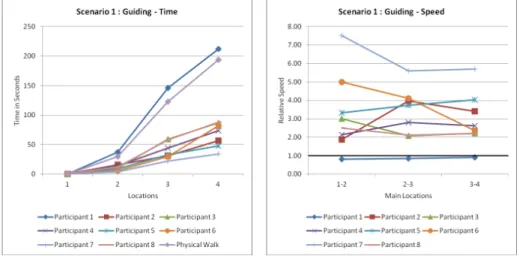
segments of the mental task. It was then compared to the average time that one would take to walk (at constant speed) from the locations A to B in a real-world scenario. Two intermediate landmark points were identified from the protocols, depending on the locations that every participant had encountered. It was interesting to find (as we can see in Fig. 1) that the time taken by them to mentally go through each part of the route correlated with the average real-world walking time. To confirm this, we compared their speed of mental movement at each interval. The graph in Fig. 2 shows their speed, with the value of speed in the real-world as 1. This showed a positive correlation between the time and the distance taken mentally to reach from one point to another (Pearson correlation coefficient between average time taken during Physical Walk (real-world scenario) and Mental Guiding Task r = 0.999, p = 0.010).
Fig. 1: Time taken to reach the locations mentally (Scenario-1), compared to the avg. walking time in real-world scenario.
Fig. 2: Relative speed at the intervals (Scenario-1) compared to the avg. walking speed in real-world scenario (taken as 1).
Orientation Strategies. When the verbal expressions and the physical movements
were correlated, two strategies seemed to emerge. The participant performed mental movement either (1) with physical orientation, or (2) without physical orientation. At times the participants naturally oriented themselves while imagining turns or pointing
to landmarks on their sides, while other times they did not move at all. They constantly shifted between the two strategies. In both cases, the hand gestures, or subtle upper body and head movements were very helpful in unravelling where they were present in the mental space during that time.
4.2 Scenario-2: Mental Walk
Protocol Analysis. In this case, the main analysis methods remained same, while
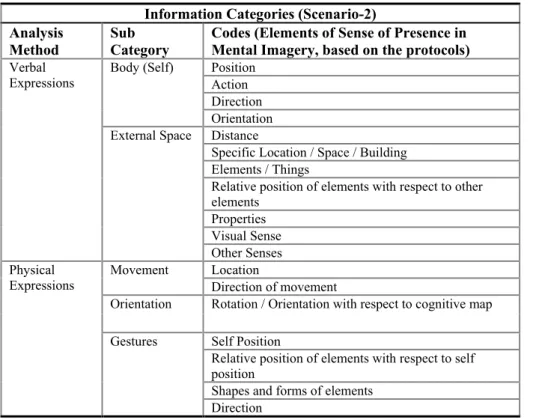
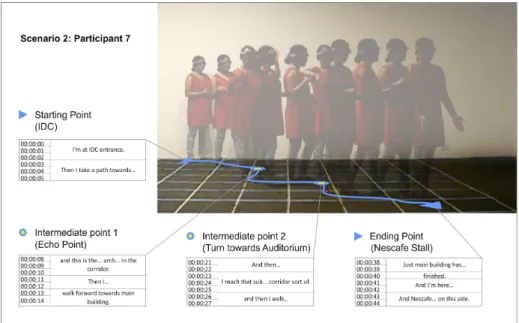
some subcategories differed. Verbal Expressions were categorised into - Body (Self) and External Space, while Physical Expressions into - Movement, Orientation and Gestures. The sub categories were again broken down into different codes representing the elements of sense of presence in mental imagery (Table. 2). In this case, the participants naturally evoked the mental space to be experienced from their own perspective. We found that while the participants moved in the mental space, their corresponding physical movements occurred naturally. We believe that physical movements may have in fact helped them to navigate in the mental space better and with ease of orientation. An example of how these physical movements corresponding to the mental walk were mapped with the help of transcripts can be seen in Fig. 3 below (the starting, intermediate and ending points are marked on the route map).
Table 2. Information categories, sub categories and codes from the protocols for Scenario-2.
Information Categories (Scenario-2) Analysis
Method Sub Category Codes (Elements of Sense of Presence in Mental Imagery, based on the protocols)
Verbal
Expressions Body (Self) Position Action Direction Orientation External Space Distance
Specific Location / Space / Building Elements / Things
Relative position of elements with respect to other elements
Properties Visual Sense Other Senses Physical
Expressions Movement Location Direction of movement
Orientation Rotation / Orientation with respect to cognitive map Gestures Self Position
Relative position of elements with respect to self position
Shapes and forms of elements Direction
Fig. 3: Example showing how the physical movements of a participant (in Scenario-2) were mapped with the help of transcripts and the floor grid.
Fig. 4: Time taken to reach the locations mentally (Scenario-2), compared to the avg. walking time in real-world scenario.
Fig. 5: Relative speed at the intervals (Scenario-2) compared to the avg. walking speed in real-world scenario (taken as 1).
Time and Distance. On exploring the mental walk time, this case also showed
considerable correlations with time that one would take in a real situation. As we can see in Fig. 4, all the participants performed the task faster than the average time to
walk in the real-world scenario. Although the time taken was shorter, it shows considerable correlations (Pearson correlation coefficient between average time taken during Physical Walk (real-world scenario) and Mental Walk r = 0.997, p = 0.045), which can also be observed from their relative speeds at different intervals (Fig. 5). In order to maintain the speed of the mental movements they at times omitted verbal details (even a simple right or a left turn). However, several of those details were often noticeably reflected in the associated physical movements (particularly in Scenario-2).
Movement and Orientation Strategies. During the task, almost all the participants
moved physically, corresponding to their mental walk. Although a few did not intend to, they ended up taking few steps at times as there was enough space to move. There was also a participant who did not move at all, but his upper body and head movements often indicated directions and properties of his mental space.
So, in this scenario, three strategies seemed to evolve. The participant performed mental movement (1) with corresponding physical movement and orientation, or (2) with partial physical movement or orientation, or (3) without any physical movement or orientation (although with faint upper body responses). While one participant adopted the third strategy consistently, the rest of the participants seemed to adopt mainly the first strategy (although shifting at times to the second strategy).
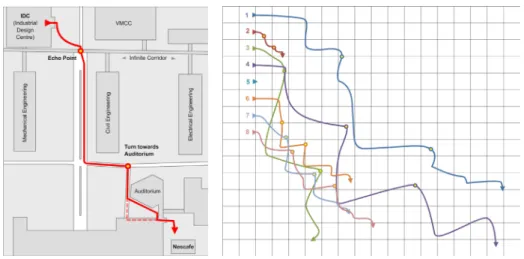
Fig. 6: Map showing the original path, from point A (IDC) to point B (Nescafe stall) and the two main landmark points.
Fig. 7: Physical movements of the participants in relation to their mental walk (arranged according to the initial orientation) and their respective positions of the two intermediate landmark points.
To study the physical movements corresponding to the mental task, we plotted them on a graph. Fig. 6 shows the actual path that one would take from point A (IDC) to point B (Nescafe) in a real-world scenario. In Fig. 7 we can see the physical movements of each participant with respect to their mental walk (note that the plotted movements on the grid were in fact extremely disordered, however in the figure they are arranged according to their initial orientations facing the same direction, to make
it comprehensible). The intermediate points were also plotted with reference to the protocols. We can clearly see spatial correlations in the movements of participants. Although the scales of their movements differ notably, we can’t deny their remarkable similarity with the actual path. As the experiment was related to way finding, this plotting of movements turned out to be an excellent approach to efficiently mapping and thus confirming the mental path they took during the task.
5 Inference and Discussion
5.1 Indication of Presence in Mental Imagery
In Scenario-1, on carefully analyzing the gestures and upper body movements with respect to verbal data, we found that the (guiding) participants naturally put themselves in the (guided) friend’s perspective. Although they did not physically move, it was noticed that whenever they reached a point where a turn was required, their hand gestures or head movements indicated the direction. And after they took the turn their point of view intuitively took that direction in such a way that the same direction which was few seconds ago to their left or right, became straight ahead. It shows that the spatial imagery was constantly updating in order to give the illusion of movement. While they did not take steps to physically move, the imagery moved (towards them) and rotated accordingly (similar to a first-person video game view, or a virtual reality CAVE system with changing surroundings). In Scenario-2, before the experiment started, almost all the participants wanted to orient themselves in certain directions. Many additional interesting elements were also noticed which did not turn up in the first scenario. For instance two of the participants imagined sounds in addition to visual imagery. On evaluation we could see that auditory imagery was a result of certain experiences that the participants previously had, which were well embedded in the memory. Thus the auditory elements too contributed to their sense of presence in mental imagery, although very specific to the individual participants. In both the scenarios, the time intervals were longer when more verbal details were reported. It may imply that the time intervals were also affected by the ability of the participants to put those details into suitable words.
If we find similarities in an experience of an Evoked Reality [6] (in virtual reality or mental imagery) with the real world experiences, we are certainly experiencing a sense of presence. The concept of self, being in a place, is the first step towards the signs of evidence of presence (the subsequent steps being the vividness of experience, levels of presence, spatial attention characteristics, multisensory experiences etc). The illusion of perceiving a spatio-temporal reality validates presence. Every participant expressed a sense of moving in a mentally evoked space for a certain amount of time. Similar to the phenomenon of visual selective attention in a real-world scenario [29], the elements of mental imagery spaces were selective as well and this played a major role in their subjective experiences. The mental load was balanced by evoking only the relevant details required for the task. However, sometimes extremely non task-related elements were also evoked, if they were well set in their memory of the path.
5.2 Similarities with Presence in Virtual Reality (or Media-Evoked Reality)
The evoked sense of presence in mental imagery clearly shows much resemblance with the experience of presence in virtual reality and associated media. Here we provide a comprehensible account of the comparisons between presence in mental imagery and media experiences.
After the experiments it was intriguing to note that the participants referred to the mental imagery space as a place they just visited and the mental events as something that happened a few minutes before, which also strongly implied their experience of presence. It is similar to the case of post-virtual reality experience of the sense of ‘being there’ [15, 30]. There was also the element of ‘suspension of disbelief’, that normally occurs among the users of media, by which they believe that they are in a world other than where their real bodies are located [1, 31]. This helped the participants move and interact well with the mental imagery environment, although they knew on a sub-conscious plane that they were in the experiment hall. Our ability to project our point of view into another person at another location was observed especially in the first experiment scenario. Buckner & Carroll [32] identified four related forms of self-projection and suggested that they may share a common functional anatomy. They illustrated how the phenomenon of self-projection relies on a personal mental simulation of another time, place or perspective. This attribute is comparable to one of the primary characteristics of a virtual reality illusion that gives us the feeling of ‘telepresence’ [3, 17] or a sense of ‘transportation’ to a virtual world [16] or what Rheingold [20] called ‘a form of out-of-body experience’.
And most of all, mental imagery elements are evoked internally without the requirement of any external perception. Although this illusion of reality evoked in the mind is entirely endogenous, due to the presence thus evoked, we interact with the imagery environment as if it may have been real. This phenomenon is comparable to the sense of presence due to external mediation, which is often referred to as 'perceptual illusion of non-mediation’ [1] or ‘mediated presence’ [33]. Although we found evidence of presence, its properties have to be further explored. The experience of presence is often referred to as a psychological state or a subjective perception [34]. So, various aspects of mental imagery like the imagery itself (for instance, its vividness compared to physical reality) may be still indefinable. We expect that further research on mental imagery would help us probe into this sense of presence and consequently contributing to our knowledge on internal perception and cognition.
6 Conclusion
We had two main research questions, and we were able to coherently answer both. 1. Yes, one surely experiences a sense of presence in mental imagery, similar to being in a virtual reality environment. In the case of virtual reality, presence is evoked since our external perception is mediated, leading to an illusion of reality similar to our physical world. In mental imagery the spaces are evoked endogenously by our mind without the help of any external perception, bringing about an experience of presence. Because in the case of a media evoked reality (like virtual reality), the
illusion of a different reality is created by forcing our external sense organs to perceive the computer generated world in an intuitive manner, our perception is very much similar to how it would be in the real-world situation. In the case of self evoked reality like mental imagery, even though the perceptual elements are evoked internally by our mind, there are remarkable similarities to the real-world scenarios.
2. Yes, this sense of presence can be detected by analysing verbal expressions, gestures and movements. In fact the verbal and physical expressions complemented each other and helped us putting together the externalization of the mental experience. It became clear how the participants experienced the imagery from their perspectives by evoking the task related mental space around them. The experiments were rather successful in providing evidence of presence in mental imagery. Thus, we strongly believe that presence study should be opened up further, and not be confined to virtual reality or mediated virtual environments.
Acknowledgments. This study was made possible through a collaboration between
the laboratories of Arts et Métiers ParisTech and Indian Institute of Technology Bombay as part of the IIT-ParisTech mobility programme.
References
1. Lombard, M., Ditton, T.: At the Heart of It All: The Concept of Presence http://jcmc.indiana.edu/vol3/issue2/lombard.html
2. Minsky, M.: Telepresence. Omni 2, 45-52 (1980)
3. Sheridan, T.B.: Musings on telepresence and virtual presence. Presence: Teleoperators and Virtual Environments 1, 120-126 (1992)
4. Steuer, J.: Defining virtual reality: Dimensions determining telepresence. Journal of communication 42, 73-93 (1992)
5. Sanchez-Vives, M.V., Slater, M.: From presence to consciousness through virtual reality. Nature Reviews Neuroscience 6, 332-339 (2005)
6. Pillai, J.S., Schmidt, C.T.A., Richir, S.: Achieving Presence through Evoked Reality. Frontiers in Psychology (Frontiers in Consciousness Research) 4, (2013)
7. Biocca, F.: Can we resolve the book, the physical reality, and the dream state problems? From the two-pole to a three-pole model of shifts in presence. In: EU Future and Emerging Technologies, Presence Initiative Meeting. (2003)
8. Shepard, R.N., Metzler, J.: Mental rotation of three-dimensional objects. Science 171, 701-703 (1971)
9. Kosslyn, S.M.: Image and Mind. Harvard University Press, Cambridge, MA (1980) 10. Kosslyn, S.M.: Mental images and the brain. Cognitive Neuropsychology 22, 333-347
(2005)
11. Kosslyn, S.M.: Image and Brain: The Resolution of the Imagery Debate. MIT Press, Cambridge, MA (1994)
12. Athavankar, U.A., Bokil, P., Guruprasad, K., Patsute, R., Sharma, S.: Reaching Out in the Mind's Space. Design Computing and Cognition'08 321-340 (2008)
13. Slater, M.: Place Illusion and Plausibility Illusion can lead to realistic behaviour in immersive virtual environments. Philosophical Transactions of the Royal Society B: Biological Sciences 364, 3549-3557 (2009)
14. Witmer, B.G., Singer, M.F.: Measuring presence in virtual environments. In: ARI Technical Report, pp. 783-784. Army Research Inst For The, Behavioral Social Sciences., (1994)
15. Reeves, B.: Being there: Television as symbolic versus natural experience. Unpublished manuscript, Institute for Communication Research, Stanford University, Stanford, CA (1991)
16. Gerrig, R.J.: Experiencing narrative worlds: On the psychological activities of reading. Yale University Press (1993)
17. Schloerb, D.W.: A quantitative measure of telepresence. Presence: Teleoperators and Virtual Environments 4, 64-80 (1995)
18. Geslin, E., Bouchard, S., Richir, S.: Gamers' versus non-gamers' emotional response in virtual reality. Journal of CyberTherapy & Rehabilitation 4, 489-493 (2011)
19. Ravaja, N., Saari, T., Turpeinen, M., Laarni, J., Salminen, M., Kivikangas, M.: Spatial presence and emotions during video game playing: does it matter with whom you play? Presence: Teleoperators and Virtual Environments 15, 381-392 (2006)
20. Rheingold, H.: Virtual reality. Summit Books, New York (1991)
21. Athavankar, U.A., Mukherjee, A.: Blindfolded classroom getting design students to use mental imagery. Human behaviour in design, Springer 111-120 (2003)
22. Slater, M.: A note on presence terminology, http://publicationslist.org/data/melslater/ref-201/a%20note%20on%20presence%20terminology.pdf
23. Austin, J., Delaney, P.F.: Protocol analysis as a tool for behavior analysis. The Analysis of verbal behavior 15, 41 (1998)
24. Ericsson, K.A., Simon, H.A.: Verbal reports on thinking. Introspection in second langauge research 24-53 (1987)
25. Suwa, M., Tversky, B.: What do architects and students perceive in their design sketches? A protocol analysis. Design studies 18, 385-403 (1997)
26. Athavankar, U.A.: Gestures, Imagery and Spatial Reasoning. In: Garo JS, T.B. (ed.) Visual and Spatial Reasoning, Preprints of the International Conference on visual and spatial Reasoning, pp. 103-128. MIT, Cambridge (1999)
27. Zacks, J.M.: Neuroimaging studies of mental rotation: A meta-analysis and review. Journal of Cognitive Neuroscience 20, 1-19 (2008)
28. Reisberg, D., Logie, R.: The ins and outs of working memory: Overcoming the limits on learning from imagery. Advances in psychology : Imagery Creativity and Discovery 98, 39-76 (1993)
29. Duncan, J.: Selective attention and the organization of visual information. Journal of Experimental Psychology: General 113, 501 (1984)
30. Slater, M., Steed, A.: A Virtual Presence Counter. Presence: Teleoperators and Virtual Environments 9, 413-434 (2000)
31. Slater, M., Usoh, M.: Representations systems, perceptual position, and presence in immersive virtual environments. Presence: Teleoperators and virtual environments 2, 221-233 (1993)
32. Buckner, R.L., Carroll, D.C.: Self-projection and the brain. Trends in Cognitive Sciences 11, 49-57 (2007)
33. Biocca, F., Burgoon, J., Harms, C., Stoner, M.: Criteria and scope conditions for a theory and measure of social presence. Presence: Teleoperators and virtual environments (2001) 34. ISPR - International Society for Presence Research: The Concept of Presence: Explication
Statement, http://ispr.info/about-presence-2/about-presence/