
An experimental analysis of fluid structure interaction on a flexible hydrofoil in various flow regimes including cavitating flow
Texte intégral
Figure

Documents relatifs
Les travaux r´ecents sur la simulation des grandes ´echelles (mod`eles LES) devraient permettre `a terme d’avoir `a disposition des mod`eles plus fins (pour un temps de calcul qui
Influence of the approaching turbulent boundary layer on the structure excitations A comparison of the velocity spectra between the approaching turbulent boundary layer measured at
The air-inflated flexible hemisphere exposed to a turbulent boundary layer is a challenging FSI case from both points of view, the experimental investigation and the
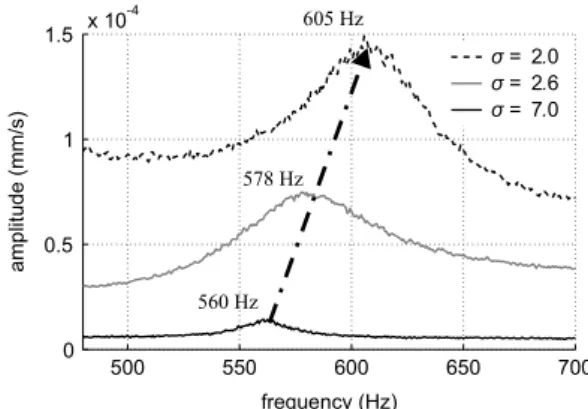
Finally, in cavitating flow the fluid density rate of change at the fluid–structure interface induces an added damping operator. It has been found that the coefficients of the
Comparison of numerical and experimental results of average friction factor using Nitrogen as working fluid, yields that intermittency based transitional turbulence model can
This paper presents the experimental tools used in this study, namely the 2D-orifice set-up, and the devices dedicated to the characterisation and texturation of the wall surface in
The difference between both velocities is bigger when the flow is choked: Vapor cavities reach the channel outlet and structure velocity decreases (Figure 9b). In Figure 9b, U y
An increase in velocity fluctuations is observed at the channel outlet for a critical normalized length of vapor cavities equals to 40-50 %. A parametric study on channel
