www.cmefe.ch
The hepia Moto2 Aerodynamic Program -
From CFD to the Track
SWISS UNIVERSITIES OF APPLIED SCIENCES
AND ARTS
• 7 Universities • + 2 private • 80 000 Studentshepia
(Geneva)
MOTORSPORTS AT HEPIA
! Egli Motorradtechnik (1985) Bachelor thesis! Motos ROC Annemasse (1992) Bachelor Thesis
! ASM Formula 3 (2006)
! Eco-marathon Shell : Consomini (2003-05), Biomobile.ch (2005 - actual)
! Motostudent PoliTo Turin (2011-12)
! Moto2 NCS Rapid Inside Modena (2011)
! Audit of the Formula 1 teams (2010 – 2013)
! MotoGP Akira (2014 - actual)
! Moto2 Tech3 (2014)
MOTORSPORTS AT HEPIA
Moto2 Tech3 Guy Coulomb
THE TRADITIONAL WORKING METHOD
! Experimental analysis of the moto2 Ri211 from Rapid Inside NCS (Modena)
in 2011
! Development of the air inlet and air box
Subsonic wind tunnel hepia-cmefe in Geneva
! Based on experience and feeling, production of parts in rapid
prototyping
! Use of a rigid support and a 6 component balance
! Rotation of the front wheel using a rolling belt
Production of parts in rapid prototyping CAD of the motorcycle
FORMULA 1 TEAMS WORKING METHOD
! From 2010 to 2013 hepia worked as partner of theFormula One Teams Association (FOTA)
! Roberto Putzu and Patrick Haas are team auditors in
charge of the « Aerodynamic testing and CFD simulation
Regulation »
Formula One Teams Association
Some Formula 1 wind tunnels
FORMULA 1 WIND TUNNELS
! Regulation adopted to reduce costs!
! 60% max. model scale
! 50 m/s max air speed
! Rolling belt
! Boundary layer succion
! Tests for several angles (pitch, yaw)
! More than 500 complete tests a month (all angles) in addition
to CFD
A test every 30 minutes !
FORMULA 1 CFD METHOD
! The number of operations in a
period of 2 months is limited
! Up to 18 h CPU time on a server
of hunderth of cores per simulation
! Up to 1’500 CFD simulation per
month
Up to 50 simulations full car per day !
« Aerodynamic CFD Restrictions (FOTA 2013) »
FORMULA 1 CFD METHOD
CFD CAPABILITIES OF THE FORMULA 1 TEAMS
! Commercially available codes (Fluent, Star CCM+)! Finite volume approach
! Highly parallelized computer of 64 bits processors
! Servers with up to 6’000 cores
! Up to 18’000 Gb RAM
! Infiniband DDR 48 Gbit/s interconnections or better
! Approx. 100 kW electrical suply
! Approx. 150 kW cooling tower (condenser)
WHAT CAN BE LEARNED FROM THE
FORMULA 1 TEAM WORK?
Mercedes AMG F1 WA06, 2015
Ferrari SF15T, 2015 1. CFD intensive computations:
! CFD shows all quantities everywhere without perturbing the flow at the time scale
you want!
Complete and detailed flow understanding New ideas!
2. Wind tunnel tests:
! Instrumented models (balances, PSI, motorized wheels,
suspensions, ecc.)
! Rapid prototyping parts on a steel body
! Exceptional methodology and work organization
3. Tests on track:
! Aspect ratio and size effects
! Hypothesis validation
WHAT CAN BE LEARNED FROM THE
FORMULA 1 TEAM WORK?
THE HEPIA MOTO2 AERODYNAMIC
PROGRAM
1. Wind tunnel tests with 50% scale models
! Difficulties having the bike for a long time in the wind tunnel (no second bike allowed in moto2 regulation)
! Aspect ratio (front area / test section)
! Costs
2. Wind tunnel tests at full scale
! Pilot training and position, seat definition ! Validation of CFD results
! Continuity with the past (known results and effects)
3. Simulation CFD
! Flow understanding
! New ideas, aerodynamic program definition ! Motor cooling and thermal analysis
THE HEPIA MOTO2 AERODYNAMIC
PROGRAM
4. On track aerodynamic drag evaluation
! Full scale
! Complete motorcycle (the true one!)
! Made by torque measurement on gearbox shaft
! Job done using a motoGP to investigate the effect of the aspect ratio
5. Race results analysis
! ECU logger data analysis
The objective is a real increase of performances during the races, i.e. on track !
www.cmefe.ch
P. Haas, Prof. HES ANSYS Forum Zurich 2015
WIND TUNNEL TESTS WITH 50%
SCALE MODELS
Model development
Scan 3D, CAD, ecc.
Motor Honda 600 cm3
Model production and instrumentation
Model assembly
WIND TUNNEL TESTS WITH 50%
SCALE MODELS
Motorized wheel Fairing
CFD SIMULATIONS
Objectives
! External and internal aerodynamics
! Drag optimisation
! Thermal exchange
! Radiator as an anysotropic
porous media
! Rotating wheels with mesh
CFD SIMULATIONS
Modeler
! Catia V5
! ANSYS SCDM (Space Claim Design
Modeler)
Mesher
! ANSYS ICEM
! Workstation 16 cores, 126 Gb RAM
CFD SIMULATIONS
Scan of the pilot
!
Hand scanned (fast)
!
Dominique Aegerter
!
Correct positions
!
All suit and helmet details!
CFD SIMULATIONS
Solver
! ANSYS CFD Fluent
! Server 224 cores, 3 GHz
! Pressure based solver
CFD SIMULATIONS
RESULTS
SCx values
Moto2 Kalex Aegerter 2015 (with our work)
CFD simulations : 0.230
Wind tunnel full scale (corrected for aspect ratio) : 0.250
Moto2 Suter Aegerter 2014 (with our work) : 0.270
Moto2 NCIS 2011 : 0.320
Ducati 1098 S 2007 (including all components for road use) : 0.380
RESULTS
! In the top speed of all moto2 riders from the beginning of the 2015
RESULTS
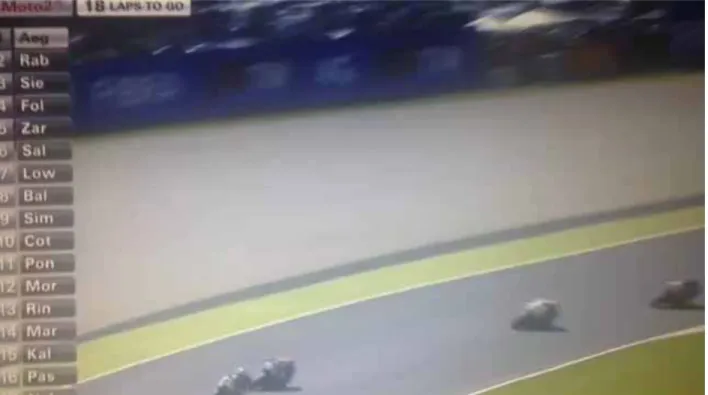
Illustration of the top speed gain achieved : Mugello 2015
Tito Rabat (1) not able to pass Dominique Aegerter (77) instead of speed gain obtained by aspiration.
CONCLUSIONS
! Gain on the aerodynamic drag of about 20%! Selection of the best pilot position, seat design (thicknesses)
! Suit design (back) and helmet choice (deflector). Interaction between these
two elements.
! Better design of several bike parts
! Definition of a correlation between the wind tunnel (with high aspect ratio)
and the track
! All conclusions done in the wind tunnel, even with a high aspect ratio, are
confirmed on track. The small size of the wind tunnel appears in this study as a cost advantage and offers the possibility to work more. This will be increased by the use of 50% models.
! CFD simulations correlate well with experimental results for such body (high
Reynolds numbers, no zones with unclear separation regions)
CFD simulations gives us understanding of the flow and will lead to new ideas in a way to progress quickly
THANKS, QUESTIONS?
Patrick Haas, Prof. HES
Christophe Balistreri, Assistant de recherche