Rapid multiplex polymerase chain reaction for detection of 1 to
mcr-5 genes
Mathilde Lescat
a,b,c,d, Laurent Poirel
a,b,e,⁎
, Patrice Nordmann
a,b,e,fa
Emerging Antibiotic Resistance Unit, Medical and Molecular Microbiology, Department of Medicine, University of Fribourg, Fribourg, Switzerland b
INSERM European Unit (LEA, IAME), Paris, France c
Université Paris Nord, Sorbonne Paris Cité, Paris, France
dAP-HP, Hôpitaux Universitaires Paris Seine Saint-Denis, Bondy, France
eSwiss National Reference Center for Emerging Antibiotic Resistance (NARA), University of Fribourg, Fribourg, Switzerland f
University of Lausanne and University Hospital Center, Lausanne, Switzerland
Keywords:
Polymyxin resistance6 mcr genes
Multiplex PCR
A rapid (total timeb2 h) and reliable multiplex polymerase chain reaction for screening of mcr-1 to mcr-5 genes conferring resistance to colistin has been developed. This technique has been tested on a collection of isolates previously identified as bearing mcr-1, mcr-2, and mcr-like genes and had a sensitivity and a specificity of 100%. Using this method, we were also able to identify a single isolate possessing both mcr-1 and mcr-5 genes.
Infections due to multidrug-resistant bacteria are increasing in health care facilities, which lead physicians to reintroduce the old antibiotic polymyxins (colistin, polymyxin B) as possible therapeutic options (Vincent et al., 2009; Wright et al., 2017). However, resis-tance to polymyxins in Gram-negative bacteria is now increasingly described and is mostly due in Enterobacteriaceae to chromosomal mutations in genes involved in modification of the lipopolysaccha-ride (LPS) (Poirel et al., 2017). Recently, the plasmid-mediated poly-myxin resistance determinant MCR-1, responsible for acquired resistance to polymyxins, has been reported from Escherichia coli and Klebsiella pneumoniae isolates in China (Liu et al., 2016). Then, the mcr-1 gene has b6een reported worldwide in various enterobac-terial species including Enterobacter, Salmonella, and Shigella and from various animal and environmental origins (Poirel et al., 2017). The encoded MCR-1 protein is a phosphoethanolamine transferase that adds a phosphoethanolamine goup to the lipid A, a portion of the LPS, leading to a more cationic LPS structure and consequently to resistance to polymyxins (Liu et al., 2016). Epidemiologic surveys show that the livestock is the most important reservoir of MCR pro-ducers (Irrgang et al., 2016; Liu et al., 2016; Perrin-Guyomard et al.,
2016). A recent study showed a very high prevalence (99%) of MCR-1–producing Enterobacteriaceae among pigs receiving colistin from 2 farms in Portugal (Kieffer et al., 2017). A recent large epide-miologic study in Chinese individuals showed a prevalence of mcr-1–positive Enterobacteriaceae isolates close to 1% in clinical samples, and comprised between 0.5% and 3% in carriage samples from volun-teers and patients (Wang et al., 2017). In parallel, other mobile colis-tin resistance genes have been identified recently (mcr-2, mcr-3, mcr-4, and mcr-5) mostly from single isolate (Borowiak et al., 2017;
Carattoli et al., 2017; Xavier et al., 2016; Yin et al., 2017). Comparison
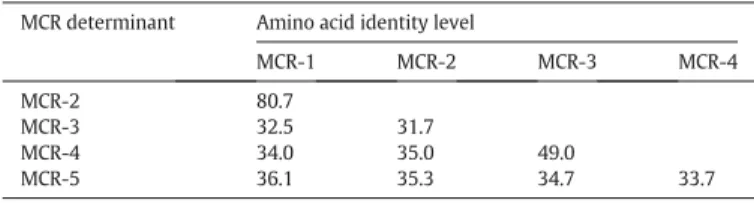
of protein sequences of MCR-like proteins shows a low level of iden-tity (ca. 30%–50%), except MCR-1 and MCR-2 that share ca. 80% amino acid identity (Table 1). Searching the mcr genes progenitors among Moraxella sp. strains led to the identification of the progenitor of mcr-2 gene (Poirel et al., 2017) being Moraxella pluranimalium, and other Moraxella species (commensal of the trachealflora) were considered as potential sources of other mcr-like genes (Kieffer
et al., 2017). Multiple variants have been reported within the past
2 years, to date, 5 major groups, namely, 1, 2, 3, mcr-4, and mcr-5 each possessing 13, 2, 10, 2 and 2 variants, respectively (Table S1). Although mcr-2 and mcr-4 have been only reported in Europe, mcr-1 and mcr-3 are identified worldwide (Di Pilato et al., 2016; Liu et al., 2017; Lu et al., 2017; Teo et al., 2017; Zhao et al., 2017). Most of the bacteria carry a single mcr gene, but a single
⁎ Corresponding author: Tel.: +41-26-300-9582. E-mail address:[email protected]. (L. Poirel).
1
http://doc.rero.ch
Published in "Diagnostic Microbiology and Infectious Disease 92(4): 267–269, 2018"
which should be cited to refer to this work.
isolate possessing 2 mcr genes has been reported (Liu et al., 2017). More studies including the detection of mcr genes are needed to evaluate the emergence of these colistin resistance genes with high transferability potency.
The aim of this work was to design an easy-to-perform polymerase chain reaction (PCR) technique to detect all of mcr-1 to mcr-5 genes in a single mix. For this purpose, a PCR-based method was designed and has the advantage to give result in less than 2 h (amplification and electrophoresis).
For optimization of the multiplex PCR, 5 control strains harboring the mcr-1 to mcr-5 genes were used as positive controls, being all en-terobacterial isolates. We obtained the positive mcr-5 isolate by eletroporating in the E. coli strain TOP10 a plasmid in which the mcr-5 gene was cloned by the manufacturer RD-Biotech (
http://www.rd-biotech.com). An easy interpretation (avoiding similar-in-size
amplicons for 1 given PCR tube) of the PCR results was obtained. We also tested mixes of all couples of DNA of the 5 positive controls (mixes of DNA of isolates containing 1 and 2, 1 and 3, 1 and 4, 1 and 5, 2 and 3, 2 and 4, 2 and 5, 3 and 4, 3 and 5, 4 and mcr-5 genes, separately). We also tested isolates containing other mcr-like genes (a M. pluranimalium isolate harboring the mcr-2.2 gene, an isolate of Moraxella porci, and 2 recombinant strains of E. coli bearing mcr-like genes from Moraxella osloensis and Moraxella lincolnii; Table S1)
(Kieffer et al., 2017).
Different primers were designed for each gene by using the Primer Blast software from the NCBI (https://www.ncbi.nlm.nih.gov/tools/
primer-blast/) to amplify fragments of mcr-1, mcr-2, mcr-3, mcr-4,
and mcr-5 genes. We used an internal control detecting fragment of 16S DNA gene previously designed (Arunasri et al., 2013). We used for the development of the PCR method the 5 control isolates, the mix of DNA of the different positive controls, and the isolates containing mcr-like genes. This PCR method amplifies fragments of 502 bp for mcr-1
(primers mcr1–mtpF [5′-ATGCCAGTTTCTTTCGCGTG-3′] and
mcr1-mtpR [5′-TCGGCAAATTGCGCTTTTGGC-3′]), 379 bp for mcr-2 (primers
mcr2–mtpF GATGGCGGTCTATCCTGTAT-3′] and mcr2–mtpR
[5′-AAGGCTGACACCCCATGTCAT-3′], 296 bp for mcr-3 (primers mcr3–
mtpF [5′-ACCAGTAAATCTGGTGGCGT-3′] and mcr3–mtpR
[5′-AGGACAACCTCGTCATAGCA-3′], 207 bp for mcr-4 (primers mcr4–mtpF
[5′-TTGCAGACGCCCATGGAATA-3′] and mcr4–mtpR [5′-GCCGCATGA
GCTAGTATCGT-3′], 608 bp for mcr-5 (primers mcr5–mtpF
[5′-GGACGCGACTCCCTAACTTC-3′] and mcr4–mtpR [5′-ACAACCAGTACG
AGAGCACG-3′], and finally 93 bp for the 16S rDNA as control (primers
16SF [5′-GTGCAATATTCCCCACTGCT-3′] and 16SR [5′-CGATCCCTA
GCTGGTCTGAG-3′]). DNA template of each isolate was extracted by using the GenElute™ Bacterial Genomic DNA kit (Sigma-Aldrich, USA), and 200 ng (2μL) of total DNA was subjected to the multiplex PCR in a 20-μL reaction mixture containing 2 μL of 10× buffer (supplied with Taq polymerase); 20 pmol of each primer detecting mcr-1, mcr-2, and mcr-3 genes; 10 pmol of each primer detecting mcr-4 and mcr-5 genes; and 5 pmol of each primer detecting the 16S rDNA gene, each deoxynucleoside triphosphate at a concentration of 2μM, 2 U of Taq po-lymerase (GenScript, USA). We used the cycling conditions of the rapid PCR method previously developed (Clermont et al., 2000) to determine the phylogroups of E. coli and which last 48 min. The conditions were as follows: denaturation at 94 °C for 4 min; followed by 30 cycles of 94 °C for 5 s, 59 °C for 20 s, and a single,final, elongation step at 72 °C for 5 min. We avoided the elongation step because all PCR products have sizes under 600 bp. Thefinal elongation step is sufficient to allow for the elongation of PCR products. DNA fragments were analyzed by elec-trophoresis in a 2.5% agarose gel (Fig. 1) for 50 min. The DNA from the 5 positive controls (used separately and in mix of 2 DNA) (Fig. 1) and the progenitor of mcr-2 gene, M. pluranimalium, presented the expected bands of mcr-1 to mcr-5 gene fragments. The M. porci isolate and the 2 E. coli recombinant strains harboring the mcr-like genes from the M. osloensis and M. lincolnii isolates did not give a positive result and confirmed the specificity of the PCR primers used in this multiplex approach.
Then, a total of 43 isolates of enterobacterial species (38 E. coli and 2 K. pneumoniae isolates and 2 Salmonella enterica) bearing the mcr-1 gene and a single mcr-4 positive S. enterica isolate from our collections were tested (Table S2). We detected that one isolate, the S. enterica named FR-290, previously identified as mcr-1 gene–positive isolate, was also positive for mcr-5 gene. All other isolates yielded the expected band for mcr-1 or mcr-4 amplicons and no amplification of the other mcr genes as attempted (sensitivity and specificity of 100%).
PCR, real-time PCR, or loop-mediated isothermal amplification– based methods have previously been developed to assess the detection of colistin resistance genes. However, for most of these techniques, only a single mcr gene is detected (mcr-1 gene) (Bontron et al., 2016; Donà
et al., 2017; Liu et al., 2016; Xavier et al., 2016; Zou et al., 2017). In a
sin-gle test, both the mcr-1 and mcr-2 genes could be detected (Mavrici
Table 1
Amino acid identity of MCR polymyxin resistance determinants. MCR determinant Amino acid identity level
MCR-1 MCR-2 MCR-3 MCR-4 MCR-2 80.7 MCR-3 32.5 31.7 MCR-4 34.0 35.0 49.0 MCR-5 36.1 35.3 34.7 33.7 M 1 2 3 4 5 mcr-4 (207 b p) mcr-1 (502 b p) mcr-2 (379 b p) mcr-3 (296 b p) 100 200 300 400 500 10 6 7 8 9 11 12 13 14 15 16 17 16S (93 b p) mcr-5 (608 b p)
Fig. 1. Agarose gel electrophoresis (2.5%) used for the separation of multiplex PCR products. Lanes: 1, negative control (susceptible E. coli isolate); 2, mcr-1–positive isolate; 3, mcr-2– positive isolate; 4, mcr-3–positive isolate; 5, mcr-4–positive isolate; 6, mcr-5–positive isolate; 7, mix of DNA of mcr-1– and mcr-2–positive isolates; 8, mix of DNA of mcr-1 and mcr-3– positive isolates; 9, mix of DNA of mcr-1- and mcr-4–positive isolates; 10, mix of DNA of mcr-1 and mcr-5 isolates; 11, mix of DNA of mcr-2– and mcr-3–positive isolates; 12, mix of DNA of mcr-2– and mcr-4–positive isolates; 13, mix of DNA of mcr-2– and mcr-5–positive isolates; 14, mix of DNA of mcr-3– and mcr-4–positive isolates; 15, mix of DNA of mcr-3– and mcr-5–positive isolates; 16, mix of DNA of mcr-4– and mcr-5–positive isolates; and 17, negative control (water). M = molecular size marker (GeneRuler™, 100-bp DNA Ladder Plus; Thermo Fisher Scientific, USA). The size of each PCR product is indicated in base pairs.
2
et al., 2017), and in these studies, several mcr genes were separately de-tected (El Garch et al., 2018; Mavrici et al., 2017). A microarray detec-tion method of several genes including mcr-1 and mcr-2 genes was also developed (Bernasconi et al., 2017). Also, a multiplex SYBR green real-time PCR detecting mcr-1, mcr-2, and mcr-3 genes was developed
(Li et al., 2017). However, although these methods are sensitive, they
can-not be applied in numerous laboratories because they need specific and expensive equipment. A multiplex method detecting the 5 mcr genes to-gether was recently developed (Rebelo et al., 2018); however, this method uses a traditional PCR program, consequently last in time 3 h (ampli fica-tion and gel electrophoresis) and does not include an internal control.
Here we developed a rapid (b2 h; amplification and gel electropho-resis) and reliable multiplex PCR for a rapid screening of the mcr-1 to mcr-5 genes with an internal control. This technique can be adapted easily to any laboratory that possesses a PCR amplification machine. It could allow for the determination of the prevalence of these colistin re-sistance genes in other clinical collections such as human, animal, and environmental collections.
Supplementary data to this article can be found online athttps://doi.
org/10.1016/j.diagmicrobio.2018.04.010.
Acknowledgments
We are grateful to S. Kumar-Malhotra for the gift of the MCR-2-producing E. coli strain.
Conflict of interest
All authors declare that they have no conflict of interest. Funding sources
This work has been funded by the University of Fribourg and by the Swiss National Reference Center for Emerging Antibiotic Resistance, Fribourg, Switzerland. It has also been funded by the Swiss National Science Foundation (projects FNS-407240_177381 and FNS-407240-177382).
References
Arunasri K, Adil M, Venu Charan K, Suvro C, Himabindu Reddy S, Shivaji S.Effect of sim-ulated microgravity on E. coli K12 MG1655 growth and gene expression. PLoS One 2013;8, e57860.
Bernasconi OJ, Principe L, Tinguely R, Karczmarek A, Perreten V, Luzzaro F, et al. Evalua-tion of a new commercial microarray platform for the simultaneous detecEvalua-tion of β-lactamase and mcr-1 and mcr-2 genes in Enterobacteriaceae. J Clin Microbiol 2017; 55:3138–41.
Bontron S, Poirel L, Nordmann P.Real-time PCR for detection of plasmid-mediated poly-myxin resistance (mcr-1) from cultured bacteria and stools. J Antimicrob Chemother 2016;71:2318–20.
Borowiak M, Fischer J, Hammerl JA, Hendriksen RS, Szabo I, Malorny B.Identification of a novel transposon-associated phosphoethanolamine transferase gene, mcr-5, confer-ring colistin resistance in d-tartrate fermenting Salmonella enterica subsp. enterica serovar Paratyphi B. J Antimicrob Chemother 2017;72:3317–24.
Carattoli A, Villa L, Feudi C, Curcio L, Orsini S, Luppi A, et al. Novel plasmid-mediated co-listin resistance mcr-4 gene in Salmonella and Escherichia coli, Italy 2013, Spain and Belgium, 2015 to 2016. Euro Surveill 2017;22(31). https://doi.org/10.2807/1560-7917.ES.2017.22.31.30589.
Clermont O, Bonacorsi S, Bingen E.Rapid and simple determination of the Escherichia coli phylogenetic group. Appl Environ Microbiol 2000;66:4555–8.
Di Pilato V, Arena F, Tascini C, Cannatelli A, Henrici De Angelis L, Fortunato S, et al.mcr-1.2, a new mcr variant carried on a transferable plasmid from a colistin-resistant KPC
carbapenemase-producing Klebsiella pneumoniae strain of Sequence Type 512. Antimicrob Agents Chemother 2016;60:5612–5.
Donà V, Bernasconi OJ, Kasraian S, Tinguely R, Endimiani A.A SYBR® Green-based real-time PCR method for improved detection of mcr-1-mediated colistin resistance in human stool samples. J Glob Antimicrob Resist 2017;9:57–60.
El Garch F, de Jong A, Bertrand X, Hocquet D, Sauget M.mcr-1-like detection in commen-sal Escherichia coli and Salmonella spp. from food-producing animals at slaughter in Europe. Vet Microbiol 2018;213:42–6.
Irrgang A, Roschanski N, Tenhagen B-A, Grobbel M, Skladnikiewicz-Ziemer T, Thomas K, et al.Prevalence of mcr-1 in E. coli from livestock and food in Germany, 2010–2015. PLoS One 2016;11, e0159863.
Kieffer N, Aires-de-Sousa M, Nordmann P, Poirel L.High rate of MCR-1–producing Escherichia coli and Klebsiella pneumoniae among pigs, Portugal. Emerg Infect Dis 2017;23:2023–9.
Kieffer N, Nordmann P, Poirel L. Moraxella species as potential sources of MCR-like poly-myxin resistance determinants. Antimicrob Agents Chemother 2017;61(6).https:// doi.org/10.1128/AAC.00129-17.
Li J, Shi X, Yin W, Wang Y, Shen Z, Ding S, et al. A multiplex SYBR Green Real-Time PCR assay for the detection of three colistin resistance genes from cultured bacteria, feces, and environment samples. Front Microbiol 2017;8.https://doi.org/10.3389/ fmicb.2017.02078.
Liu L, Feng Y, Zhang X, McNally A, Zong Z. New variant of mcr-3 in an extensively drug-resistant Escherichia coli clinical isolate carrying mcr-1 and blaNDM-5. Antimicrob Agents Chemother 2017;61(12).https://doi.org/10.1128/AAC.01757-17.
Liu YY, Wang Y, Walsh TR, Yi LX, Zhang R, Spencer J, et al.Emergence of plasmid-mediated colistin resistance mechanism MCR-1 in animals and human beings in China: a microbiological and molecular biological study. Lancet Infect Dis 2016;16: 161–8.
Lu X, Hu Y, Luo M, Zhou H, Wang X, Du Y, et al. MCR-1.6, a new MCR variant carried by an IncP Plasmid in a colistin-resistant Salmonella enterica serovar Typhimurium isolate from a healthy individual. Antimicrob Agents Chemother 2017;61(5).https://doi. org/10.1128/AAC.02632-16.
Mavrici D, Yambao JC, Lee BG, Quiñones B, He X.Screening for the presence of mcr-1/mcr-2 genes in Shiga toxin–producing Escherichia coli recovered from a major produce-production region in California. PLoS One 2017;12, e0187827.
Perrin-Guyomard A, Bruneau M, Houée P, Deleurme K, Legrandois P, Poirier C, et al. Prev-alence of mcr-1 in commensal Escherichia coli from French livestock, 2007 to 2014. Euro Surveill 2016;21(6).https://doi.org/10.2807/1560-7917.ES.2016.21.6.30135.
Poirel L, Jayol A, Nordmann P.Polymyxins: antibacterial activity, susceptibility testing, and resistance mechanisms encoded by plasmids or chromosomes. Clin Microbiol Rev 2017;30:557–96.
Poirel L, Kieffer N, Fernandez-Garayzabal JF, Vela AI, Larpin Y, Nordmann P. MCR-2–medi-ated plasmid-borne polymyxin resistance most likely originates from Moraxella pluranimalium. J Antimicrob Chemother 2017;72:2947–9.
Rebelo AR, Bortolaia V, Kjeldgaard JS, Pedersen SK, Leekitcharoenphon P, Hansen IM, et al. Multiplex PCR for detection of plasmid-mediated colistin resistance determinants, mcr-1, mcr-2, mcr-3, mcr-4 and mcr-5 for surveillance purposes. Eurosurveillance 2018;23(6).https://doi.org/10.2807/1560-7917.ES.2018.23.6.17-00672.
Teo JWP, Kalisvar M, Venkatachalam I, Tek NO, Lin RTP, Octavia S.mcr-3 and mcr-4 vari-ants in carbapenemase-producing clinical Enterobacteriaceae do not confer pheno-typic polymyxin resistance. J Clin Microbiol 2017;56, e01562-17.
Vincent JL, Rello J, Marshall J, Silva E, Anzueto A, Martin CD, et al.International study of the prevalence and outcomes of infection in intensive care units. JAMA 2009;302:2323–9.
Wang Y, Tian G-B, Zhang R, Shen Y, Tyrrell JM, Huang X, et al.Prevalence, risk factors, out-comes, and molecular epidemiology of mcr-1-positive Enterobacteriaceae in patients and healthy adults from China: an epidemiological and clinical study. Lancet Infect Dis 2017;17:390–9.
Wright H, Bonomo RA, Paterson DL.New agents for the treatment of infections with gram-negative bacteria: restoring the miracle or false dawn? Clin Microbiol Infect 2017;23:704–12.
Xavier BB, Lammens C, Ruhal R, Kumar-Singh S, Butaye P, Goossens H, et al. Identification of a novel plasmid-mediated colistin-resistance gene, mcr-2, in Escherichia coli, Belgium, June 2016. Euro Surveill 2016;21(27).https://doi.org/10.2807/1560-7917. ES.2016.21.27.30280.
Yin W, Li H, Shen Y, Liu Z, Wang S, Shen Z, et al. Novel plasmid-mediated colistin resis-tance gene mcr-3 in Escherichia coli. MBio 2017;8(3).https://doi.org/10.1128/mBio. 00543-17.
Zhao F, Feng Y, Lü X, McNally A, Zong Z. Remarkable diversity of Escherichia coli carrying mcr-1 from hospital sewage with the identification of two new mcr-1 variants. Front Microbiol 2017;8:2094.https://doi.org/10.3389/fmicb.2017.02094.
Zou D, Huang S, Lei H, Yang Z, Su Y, He X, et al. Sensitive and rapid detection of the plasmid-encoded colistin-resistance gene mcr-1 in Enterobacteriaceae isolates by loop-mediated isothermal amplification. Front Microbiol 2017;8:2356.https://doi. org/10.3389/fmicb.2017.02356.
3