Development of Oil-Filled Microcellular Foam
for Transformer Insulation
by
Julie Anshun Yang B. S., Mechanical Engineering
University of Michigan, 1991
Submitted to the Department of Mechanical Engineering in Partial Fulfillment of the Requirements for the Degree of
MASTER OF SCIENCE in Mechanical Engineering
at the
Massachusetts Institute of Technology May, 1994
© 1994 Massachusetts Institute of Technology. All rights reserved.
Signature of Author SA
Department of Mechanical Engineering
hA _ 4r I CI'" A SIvay, 1iYY
C7
Certified by Ralph E. and FT--- (" 1 i•am r. Dun Eloise F. Cross Professor of Manufacturing Head of the Department Thesis Advisor Accepted by . j4 AssAGCHUSF- iNTirW
f .
; ý
.i:
W I
MT 1RES
ON)~
Ain A. Sonin Chairman, Graduate Committee Department of Mechanical Engineering'1
I
. I II I .... . g... -. ; .. ' .; - ,Development of Oil-Filled Microcellular Foam
for Transformer Insulation
by
Julie Anshun Yang
Submitted to the Department of Mechanical Engineering on May 6, 1994, in Partial Fulfillment of the Requirements for the Degree of
Master of Science in Mechanical Engineering
ABSTRACT
Microcellular plastics are investigated for a basis for application as insulation in large electrical transformers. These cellular foams contain billions of cells per cubic centimeter with diameters smaller than 10 microns. The insulation material concept involves saturating microcellular plastics with mineral oil. The electrical strength of the insulation is dependent on completely filling all voids with oil. An understanding of the mechanism by which the oil penetrates the matrix is necessary to determine this degree of saturation. Toward this end, microcellular foamed low-density polyethylene samples have been produced and subjected to a pressurized oil environment. An experimental procedure for oil saturation is discussed and presented. A theoretical model based on porous flow and
molecular diffusion is compared to the experimental data. The effects of various parameters such as pressure, void fraction, and cell morphology are interpreted.
Thesis Advisor: Nam P. Suh
Title: Ralph E. and Eloise F. Cross Professor of Manufacturing Head of the Department
ACKNOWLEDGMENTS
I joined the Microcellular Plastics Lab because I though I could get my hands dirty and learn some new things. I've had very few regrets.
Thank you, Professor Nam Suh. Your wisdom and depth of knowledge is truly inspiring to me.
I wish to thank Mr. and Mrs. Lee and Jerry Martin for their generous financial assistance during my first year here. Your fellowship allowed me the freedom to test the waters and find my place.
The National Science Foundation also has my appreciation for allowing me the luxury to look forward in time without financial worry.
Thank you, Sung Cha, for teaching me how to make foam.
Thank you, Dan Baldwin, for stimulating my brain into thinking more like the engineer I should be.
Many thanks to all my friends, especially Benjamin Linder and Matthew Wall. I am so fortunate to know your friendship and love. You have truly held me up when I would have fallen.
Thank you, Mom and Dad. Your unwavering love and support has carried me through.
FOREWORD
The Microcellular Plastics Research Laboratory in the Laboratory for Manufacturing and Productivity at MIT has been engaged in a program of
research on microcellular plastics since the early 1980's. The goals of the research program have progressed from demonstrating the feasibility of foaming various polymers with cell sizes less than ten microns, through characterizing the
properties of microcellular plastics, to designing and manufacturing an extrusion system which would produce microcellular plastics continuously.
Commensurate with these goals, the research group is seeking industrial
applications in which microcellular plastics can be used. The research group, in collaboration with Asea Brown Boveri, Co., is now involved with the design and development of a microcellular plastic insulation for use in high voltage
transformers. The work performed for this thesis is motivated and supported by this project. This support is gratefully acknowledged.
CONTENTS
A BSTR A C T ... 2
ACKN O W LEDGM EN TS ... 3
FO REW O RD ... ... 4
C O N TEN TS .. ... ... 5
LIST O F FIG U RES ... 7
LIST O F TA BLES ... 9
1 IN TRO D U CTIO N ... ... 10
1.1 Thesis Objectives ... 10
1.2 Thesis Overview ... 11
2 BA C KG RO U N D ... ... 12
2.1 Microcellular Plastics Technology ... 12
2.2 Transformer Technology ... ... 14
3 INSULATION CONCEPT GENERATION ... ... 19
3.1 Open cell structures ... 21
3.2 Closed cell filled with SF6 gas ... 21
3.3 Oil Saturation Methods ... ... ... 24
3.3.1 Spinodal Decomposition ... ... 25
3.3.2 Mixing Molten Polymer and Oil ... .. 28
3.3.3 High Pressure Saturation ... ... 28
4 EXPERIMENTAL METHODS ... ... ... 30
4.1 Design of Experimental Apparatus ... ... 30
4.2 Sample Production Sequence ... ... ... 37
4.3 Material Evaluation ... 40
4.3.1 Determining Void Fraction ... ... 41
4.3.2 Determining Cell Density ... ... 41
4.3.3 Optical Methods ... 42
5 THEORETICAL METHODS ... 47
5.1 Introduction ... ... 47
5.2 Governing Equations ... 47
5.3 Applications of Equations to Experiment... ... 49
5.3.1 General Remarks ... ... ... 49
5.3.2 Boundary Conditions for the Diffusion Equation ... 49
5.3.3 Solution of the Diffusion Equation ... 52
6 RESULTS AND DISCUSSION ... .... ... 54
6.1 Porous Flow ... ... 54
6.2 D iffusion ... ... 54
6.3 Sam ples ... ... 58
6.4 Calculation of Oil Saturation ... ... ... 60
7 CONCLUSIONS AND FUTURE WORK ... ... 62
LIST OF FIGURES
Figure 2.1. Typical fracture micrograph of microcellular plastics. ... 13
Figure 2.2. Flux lines in a one-phase iron core transformer ... 15
Figure 2.3. Internal components of a transformer ... 17
Figure 3.1. Insulation concepts ... 20
Figure 3.2. The breakdown voltage of various insulating materials as a function of pressure. ... .... ... 22
Figure 3.3. Increasing the pressure above the critical pressure and tem perature ... 23
Figure 3.4. A phase diagram showing the spinodal region. ... 27
Figure 4.1. Hierarchical tree of the functional domain for a mechanical press ... ... 31
Figure 4.2. Hierarchical tree of the design domain for a mechanical press ... 32
Figure 4.3. Schematics for sealing oil chamber and preventing overflow... 33
Figure 4.4. 0-ring configurations for piston seal ... 34
Figure 4.5. Mechanical oil press apparatus. ... ... 35
Figure 4.6. Point counting with a 9 point test grid ... 43
Figure 4.7. Lineal analysis using a test line. ... ... 44
Figure 4.8. Differences in grid spacing for point counting. ... 44
Figure 5.1. Filling of the interconnected voids with oil. ... 50
Figure 5.2. Generalized weight gain curve ... ... 51
Figure 6.1. Comparison of weight gain data to theoretical curve for porous flow . ... ... 55
Figure 6.2. Comparison of experimental data to theoretical curves for diffusion of oil into microcellular foam. ... . 56
8
Figure 6.3. Comparison of experimental data to theoretical data for
diffusion of oil into microcellular foam (log time scale). ... 57 Figure 6.4. Comparison of porous volume to void volume to total volume
of samples ... 58 Figure 6.5. Growth of nucleated cells. ... ... 59
LIST OF TABLES
Table 2.1. Typical insulation specifications. ... ... 18 Table 4.1. Experimental parameters. ... ... 41
Introduction 10
CHAPTER 1
INTRODUCTION
1.1 Thesis Objectives
Currently, most transformers manufactured in the U.S. are insulated with layers of cellulose. These layers are then completely dried and then impregnated with oil. Together, the cellulose and oil provide the characteristics required by daily transformer operation. However, inherent in this cellulose-based insulation system are some disadvantages which lead to a motivation to develop a new insulation system.
Cellulose is a fibrous material which is hydrophillic; it absorbs moisture. Moisture resident in transformers decrease the electrical insulating capabilities leading to possible breakdown of the system. Therefore, transformers which use cellulose must be completely dried in an oven for a lengthy period of time. After the insulation is completely free of moisture, the entire system is impregnated with oil under a pressure differential. Because of these lengthy manufacturing processes, a viable replacement is desired.
Insulating materials must be able to withstand high temperature environments as well as mechanical and electrical stresses resulting from normal operating conditions. Additionally, the material must withstand unexpected system transients such as lightning and power surges. Polymers have thus far not been commercially used as an insulating material in transformers. This is partially
due to the methods used to manufacture polymer sheet. Commercially available plastics cannot be guaranteed to be free from defects such as microscopic voids
or cracks. These defects can be detrimental to the performance of the
transformer. However, when these voids are filled with a material with dielectric properties similar to the insulant, the effects of void spaces can be negated.
The use of microcellular plastics offers the opportunity for creating a new base for an insulation system. Microcellular plastics, which have extremely small cell
Introduction 11
similar mechanical properties to the parent material. In order to achieve the electrical strength necessary for transformer application, oil is introduced into the voids of the polymer. Determining the feasibility of using microcellular plastics as insulation is the primary research goal of this project.
1.2 Thesis Overview
Incorporating oil into the cells of microcellular foam is the main objective of this thesis. Choosing an appropriate method by which to introduce oil into the voids is an issue. Using hydrostatic pressure to produce oil filled microcellular foam was one of three methods thought possible to accomplish this task.
Microcellular foamed samples are produced using the batch processing
capabilities in the lab. These samples are placed in an oil chamber and a pressure differential is applied. A mechanical oil chamber was designed and built for these oil saturation experiments. Various experimental parameters for these oil saturation experiments include time, pressure, and sample morphology. At the end of each experiment, the samples are removed from the chamber and the weight gain is recorded.
The morphology of the sample prior to oil saturation is determined through use of an electron scanning microscope. Through optical methods, the cell size and density as well as void fraction and surface to volume ratio may be determined. The experimental results show that the voids are filled with oil and the oil remains in the cells when the sample is returned to the ambient environment. Questions arise concerning the mechanisms by which the oil enters the voids. Therefore, a mathematical model is developed for the purpose of understanding this oil filling phenomena. This model shows the affect of changing parameters on the final sample in terms of the amount of oil residing in the voids.
This mathematical model consists of the superposition of two different mechanisms. The first mechanism is based on the flow of a liquid through a porous medium in this case oil through interconnected cells in the matrix. The
second mechanism is molecular diffusion through the cell walls. This theoretical model is compared to the experimental data.
Background 12
CHAPTER 2
BACKGROUND
2.1 Microcellular Plastics Technology
Microcellular plastics are a unique cellular material in which the cells are smaller than the natural flaw size pre-existing in polymers. These nucleated cells result in material costs savings without significant reductions in mechanical properties and in some cases improved properties compared to the unfoamed parent material. In general, microcellular plastics have better mechanical properties than currently available structural polymer foams [Martini et al., 1982; Baldwin and Suh, 1992]. These improved properties can lead to reduced material usage per unit part and reduced costs.
Microcellular plastics technology has been applied to most polymers including amorphous thermoplastics, semi-crystalline thermoplastics, elastomers, and thermosets. This technology is unique in the fact that unlike conventional foams which are produced using chlorofluorocarbons (CFC's) as the blowing agent, microcellular plastics are foamed using inert gases such as carbon dioxide. A typical fracture micrograph is shown in figure 2.1.
Microcellular plastics are characterized by foams having spherical cells less than 10 micrometers in diameter, cell densities greater than 109 cells per cubic
centimeter, and specific density reductions of 20 to 90 percent. Microcellular plastics processing consists of three steps which are basic to batch processes and continuous manufacturing processes. These three steps are: 1) the formation of gas/polymer solution formation, 2) the inducement of a thermodynamic
instability to nucleate a very large number of cells (109 to 1015 cells per cubic centimeter), and 3) the growth of these cells to the desired size.
Formation of gas and polymer solutions is accomplished by saturating a polymer with a high pressure gas such as carbon dioxide. The diffusion of the gas into the polymer matrix is the governing process of this first step. Increasing the gas pressure and temperature will increase the diffusivity resulting in shorter cycle
Background 13
SCALE: 100 pm--
Background 14
times. Lowering the solubility of the gas in the solution will result in a thermodynamic instability of the system. The solubility can be decreased by increasing the temperature and/or decreasing the pressure. The gas molecules now seek a state of lower free energy and form cell nuclei. The gas molecules will tend to diffuse into these nucleation sites lowering the free energy of the
system. Once the cells have nucleated, the cells continue to grow limited by the stiffness of the polymer matrix. The stiffness is primarily controlled by the time allowed for growth, the system temperature, mechanical stress or pressure applied to the matrix, and the viscoelastic properties of the solution.
2.2 Transformer Technology
Transformers are used by the power industry to step up or step down the
voltages transmitted to the public sector from the power plant. Transformers are available in a variety of sizes and are almost always custom designed to meet the specific needs of the customer whether it is for residential home or industrial usage.
The two basic types of transformers differ in the types of cores used to direct the magnetic field generated. In an air core transformer, the flux lines of the
magnetic field are varying and flow in all directions in the air surrounding the windings. This type of transformer core is not effective in producing an induced voltage in output coil and is therefore limited to low frequencies such as radio frequencies. A much more effective and efficient configuration is an iron core transformer. In an iron core transformer, almost all magnetic field lines are concentrated through the core (see figure 2.2).
Asea Brown Boveri, Co., (ABB) is the largest transformer manufacturer/supplier in the United States. Although many variations of transformers exist, the basic iron core configuration remains the same. ABB transformers consists of a stacked or step-lapped iron core heavily insulated by several layers of specially treated Kraft@ paper. Many components of the transformer require insulation: layer insulation, turn insulation for the conducting strap wire, lead wire insulation and inner phase barrier insulation. Each type of insulation is currently satisfied using different forms of cellulose. The internal components of a transformer are shown
Background 15
I.. LaILJ LIux .l 1ei I
(flux lines)
Figure 2.2. Flux lines in a one phase iron core transformer.
Background 16
in figure 2.3.
Cellulosic insulation is available in several forms. Large sections of thick pressboard approximately Y4 to Y2 inch thick are used as barrier insulation. Paper rolls approximately 2 to 3 feet wide and 8 mils thick are used for the layer insulation. Crepe paper approximately 3 mils thick is wrapped around the conducting strap wire. This crepe paper is also used to form rolls for lead wire insulation where the rolls are placed around the wires.
Several layers of layer insulation is used between the helically wound layer of windings. The paper used is specially coated with epoxy such that the layers are bonded together to provide strength. This epoxy bond also restrains the
windings from shifting during operation. The epoxy is applied to the paper in a diamond pattern to allow for the free flow of oil through the layers for cooling purposes.
Insulation surrounding conducting strap wire is currently manufactured in two ways. The first method uses a wrapping machine which wraps either crepe paper strip or Nomex@ tape around the strap wire continuously. The strips are wrapped so that the strips overlap forming a double insulation layer. A newer second approach deposits a few mils of epoxy powder electrostatically onto the strap wire and is cured. The strap wire material is either aluminum (with epoxy) or copper (with crepe paper/Nomex@ tape).
One of the most sought-after characteristics of transformers is a long life cycle. Therefore, any insulation used in the transformers is expected to last on the order of 40 years. Other requirements of the transformer insulation depends on the type of insulation and the transformer. Typical values for insulation
sidebrace
Siron core
sidebrace
insulation inner phase barrier insulation
GEW VVIINUGNa
heet conductor with layer to layer insulation
HIGH VOLTAGE WINDING strap conductor with turn insulation
W INSULATION
(b)
Figure 2.3. Internal components of a transformer: (a)three-phase iron core, and (b) section of phase coil.
Background 17
T "t-T T T -T rV A r'l TATThkTT'TT
Background 18
Table 2.1. Typical insulation specifications.
Dielectric Strength impulse
short time ( 1 min hold)
Dissipation Factor @ 60 Hz Dielectric Constant
Mechanical Requirements Thermal Requirements
Service Life
4000 V/mil @ 5 mil thickness
3400 V/mil @ 15 mil thickness 1000 V/mil @ 5 mil thickness 800 V/mil @ 15 mil thickness 0.02 max
2.2 to 3.6; 4.0 max
10,000 psi tensile strength 1100C continuous
1800C short time (0.5 hr)
2500C heat shock (2 sec)
Insulation Concept Generation 19
CHAPTER 3
INSULATION CONCEPT GENERATION
MIT has generated six different concepts to satisfy the performance requirements of transformer insulation. These concepts are various combinations of three elements which would form a composite insulation material. The first element is a polymeric base which would provide the mechanical strength necessary for transformer application as well as physical separation between windings and layers. The second element provides the dielectric strength of the insulation and can be either transformer oil or a highly electronegative gas such as sulfur
hexafluoride (SF6). The third element is a method of containing the combination
of the first and second elements. Possible barriers include a tank enclosure or a diffusional film barrier.
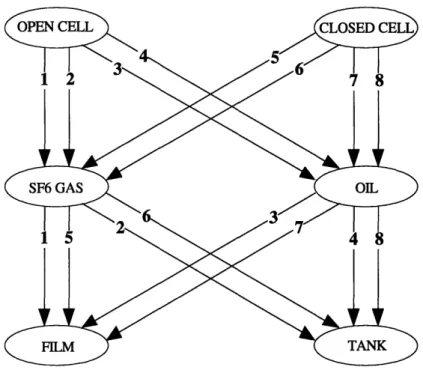
The morphology of the polymer used for the insulation material will have either open or closed cells which are created using microcellular foaming technology. There are a total of 8 combinations from the three elements (see figure 3.1): open or closed cell polymer, oil or SF6, and tank or film. Of these combinations,
however, many are similar. Only three concept types are distinctly different in the material and structure.
From figure 2, concepts 1 through 4 have an open cell structure. Presupposing that a completely open cell structure can be manufactured, the element providing the electrical strength can be alternated without affecting the polymer structure. Therefore these concepts are grouped together with the distinguishing feature being the open cell morphology. Concepts 5 and 6 are distinguished by
combining SF6 gas with a closed cell structure. Finally, concepts 7 and 8 combine
a closed cell structure with oil. Therefore, the eight concepts can be categorized into three: a) open cell structure, b) closed cell filled with SF6 gas, and c) closed
cell filled with oil. The feasibility of these concepts were determined by the research group. The focus of this thesis is the closed cell oil-filled foam concept.
Insulation Concept Generation 20
No work was done to pursue the issue of containment. It is assumed that a diffusion barrier in the form of a tank or film could be resolved independently from the first two elements making up the materials of the insulation.
Insulation Concept Generation 21
3.1 Open cell structures
The cellulose material currently used in transformers is a porous material with interconnected passages throughout the material where oil can readily penetrate. The concept of an open cell microcellular foam filled with either oil or SF6 is
analogous to the paper-oil system. However, microcellular foams typically have a closed cell structure. In order to produce an open cell structure, a polyblend
concept has been proposed. This concept suggests that two immiscible polymers which are blended with a high degree of mixing can form an open cell structure when subjected to microcellular processing techniques. The nucleation of cells will preferentially occur at the interfaces between the two different polymers,
and the subsequent growth of cells will open up the interfaces forming an open cell structure. Details of this work will be presented in a master's thesis written by Derrick Tate, a member of the MIT research group.
3.2 Closed cell filled with SF
6gas
Sulfur hexafluoride is a relatively heavy inert gas. This gas possesses many properties which make it a good candidate for transformer insulation. These
include a high dielectric strength comparable to transformer oil at 2 to 3 bars of pressure. Currently, SF6 is used in smaller gas-filled transformers for low
voltage applications. The breakdown voltage of SF6 is compared to that of
transformer oil and air in figure 3.2.
Because the microcellular foaming process uses a high pressure gas to saturate the polymer, SF6 was used as the saturating gas to determine whether this gas
could be used to form microcellular foam plastics. Initially, a few different types of sheet polymers were chosen for the experiments. These included both high and low density polyethylene, PMMA, PS, and PVC. First, the samples were saturated at the maximum pressure obtainable from the gas cylinder which was approximately 350 psi. The samples did not foam at this pressure. Therefore, the saturation pressure was increased using the steps described in figure 3.3.
Insulation Concept Generation 22
Breakdown Voltages for Insulating Materials
100 80 60 40 1 2 3 4 Pressure (bars)
Figure 3.2. The breakdown voltage of various insulating materials as a function of pressure. [redrawn from Maller and Naidu, 1981]
Insulation Concept Generation 23
:3-specific volume
gas cylinder
Figure 3.3. Increasing the pressure above the critical pressure and
temperature.
Pressure
2500 psi
1000 psi
320 psi
i open both valves 1 and 2 ii close valve 1
iii drop temperature to OoC using ice iv open valve 1
v close valve 1
vi remove ice and raise temperature to 600C using oven
I
Insulation Concept Generation 24
In order to increase the pressure inside the chamber, the temperature and pressure of the system would need to be raised above the critical temperature and pressure of SF6. The critical temp of SF6 is 460C and the critical pressure is
1000 psi. The polymer samples were placed in the pressure chamber which is
hooked up in an oven and the pressure was increased to 2500 psi. After 3 days of saturation, the samples were removed from the chamber and placed in a high temperature oil bath until the cells were grown to the desired size. From these experiments, the polyethylenes were the only polymers which showed promising results. The cell sizes of the polyethylene samples were less than 10 micrometers in diameter.
Because SF6 is a rather large molecule compared to CO2 or N2 molecules, we
looked into crosslinking the polyethylene to attempt to trap the SF6 molecules in
the matrix. After samples were removed from the oil bath and quickly placed in an air tight plastic bag, the samples were quickly transported to the high voltage lab for radiation crosslinking. Approximately 15 minutes after the samples were removed from the oil, the polyethylene samples were exposed to 5 Rads and 10 Rads for a period of 15 minutes. In order to determine whether the samples would retain SF6 in the matrix, the weight loss of the samples were measured.
The samples exposed to the higher dosage of radiation lost SF6 at a slower rate.
However, the gas still did eventually escape from the polymer matrix. 3.3 Oil Saturation Methods
Many different methods for producing cellular foam containing oil were
examined for their potential to create oil-filled cellular foam. These methods are: 1) spinodal decomposition, 2) mixing the molten polymer and oil directly in an extruder barrel, and 3) using hydrostatic pressure. This thesis focuses on the last
method of using hydrostatic pressure because this method was believed to show the most potential for obtaining samples for testing in the most direct manner. The batch process of producing microcellular foam has been shown to be
successful in producing samples with acceptable cell sizes and densities.
Therefore, creating a foamed sample of polymer and the subjecting the sample to an oil environment is the method used. The polymer chosen for the experiments
Insulation Concept Generation 25
is low density polyethylene. This polymer has a dielectric constant in the
specified range which matches or nearly matches the dielectric constant of the oil. The insulation material should have a dielectric constant similar to that of oil because differences in the dielectric constants induces electrical stress within the system.
Although many different polymers have been microcellular foamed, the foaming parameters of polyethylene was at the time not well established. Early attempts at producing microcellular foamed polyethylene samples resulted in cells in excess of 30 micrometers, too large to be considered microcellular foam. Therefore, a lot of time was spent trying to adjust experimental parameters to generate samples with a uniform structure and cell diameters of 10 micrometers or less.
3.3.1 Spinodal Decomposition
Spinodal decomposition was briefly explored for its feasibility as a method to produce oil saturated foam. Microcellular foaming is produced using
thermodynamic instability; however, the region where nucleation and growth takes place is in the metastable region of a temperature-composition curve. Spinodal decomposition is a thermodynamic phenomenon whereby two constituents of a solution separate through an unstable mechanism. At a particular pressure and temperature, a mixture of two substances, polymer and oil, will separate into two distinct phases and form an interpenetrating three dimensional network [Gutowski, 1981]. These phases, however, are not pure polymer and oil but rather a dilute and concentrated solutions of polymer and oil. A brief overview of the thermodynamics of spinodal decomposition is described below.
For a polymer-solvent (oil) solution, the Gibb's free energy of mixing is given by:
AGm = AHm - TASm (3.1)
where AHM = enthalpy of mixing, T = temperature, and ASm = entropy of mixing.
Insulation Concept Generation 26
Spontaneous mixing occurs when the Gibb's free energy of mixing is negative
(AGm < 0). However, this does not guarantee that the two components are
miscible in all concentration proportions. Therefore, in areas of local concentration where AGm is positive, separation is implied.
The solution will seek the states of lowest free energy, or where AGioca is
minimum. If there is more than one local minimum, the chemical potential, AP, of these co-existing phases must be equal. For a stable solution, the chemical potentials of the components must increase with increasing concentration for stability. The relationship for one component (solvent) is given by:
dApl o 2AG
= C
> 0
(3.2)
d(1- C) dC2
where C = concentration of polymer.
Solutions remain stable because molecules in any regions of high concentration will migrate to lower concentration areas which equilibrates the solution. Unstable solution exhibit the opposite behavior. When a solution becomes unstable, the chemical potential decreases with increasing concentration. Therefore, molecules will migrate from low to high concentrations resulting in spontaneous separation. When this phenomena occurs in the spinodal region of the temperature-composition curve, it is termed spinodal decomposition. This can result in an interpenetrating network of two phases of different
concentrations.
The graphs in figure 3.4 show a possible phase diagram for polymer/gas systems used in microcellular processing. By raising the temperature at a set pressure, the system is brought into a metastable region where the nucleation of cells occurs. The existence of a spinodal curve above which spontaneous separation into two unique phases is not known for the gas/polymer solutions studied.
AGm
;table region
ndary
Concentration of Polymer
Figure 3.4. A phase diagram showing the spinodal region. [redrawn from Gutowski, 1981]
Insulation Concept Generation 28
3.3.2 Mixing Molten Polymer and Oil
The method of producing foam with oil in an extrusion barrel was not pursued. Currently, the research personnel is developing a microcellular extrusion system to continuously extrude foam. The current system developed by the research group is a prototypical extrusion system which is very promising. The
continuous extrusion system can be modified to include an inlet for oil. The high rate of mixing in the barrel will break up the oil and form inclusions of the oil within the polymer matrix.
3.3.3 High Pressure Saturation
The method with the most potential to generate oil filled samples seemed to be using pressurized oil environment to force oil into the foam. To create a high pressure environment, the gas pressure in the cylinder was used to push the oil into the sample. A foamed sample is placed in a container of oil and this
container is then placed in a gas pressure chamber. The polymer chosen for these experiments is TPX and LDPE. The pressure is slowly raised to the desired
pressure and then held at the high temperature for a period of time. The sample is then removed from the environment and weighed.
An interesting phenomena has been noted during these experiments. The CO2
gas that provides the pressure readily diffuses into the oil faster than the oil diffused into the plastic. It is not certain whether the gas assists or resists the oil penetration into the polymer. The interesting point is that when the sample is taken out of the chamber, the sample is opaque white. After a period of time, the sample becomes translucent (almost transparent). It is hypothesized that the gas that had diffused in with the oil is now leaving the matrix when exposed tot he ambient environment. What is remaining in the polymer is the oil. The oil has an index of refraction similar to that of the polymer resulting in the translucency of the sample.
Experiments were also conducted at ambient pressure. The foamed sample was weighted down in a container of oil over a period of time. Weight gain
Insulation Concept Generation 29
measurements were taken at several intervals. The weight gain for these particular samples varied from no gain to an approximate weight gain of 10%. Questions arose concerning whether the oil evaporated when samples are left in ambient conditions. To determine oil evaporation, a measured amount of oil is placed in a container and weighed. The beaker was weighed again after a span of several weeks. A negligible amount of oil had evaporated. However, when oil is heated above its boiling point, oil will boil off relatively quickly.
Experimental Methods 30
CHAPTER 4
EXPERIMENTAL METHODS
4.1 Design of Experimental Apparatus
Previously, gas pressure was used to apply pressure to the oil. However, because the gas diffused into the oil, the effects of the gas on the oil penetration were difficult to separate. Therefore, a mechanical apparatus was needed to
determine the behavior of the oil alone. Many designs for producing a hydrostatic environment were considered. These included using weights to provide the pressure, piston cylinder devices, using a hydraulic press, and using a thin metal diaphragm.
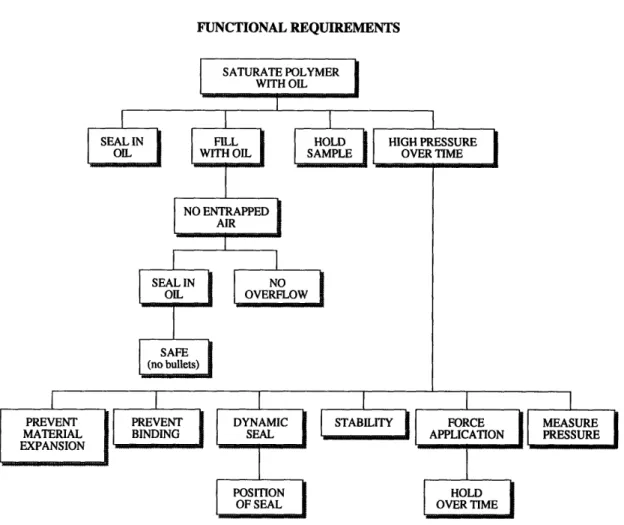
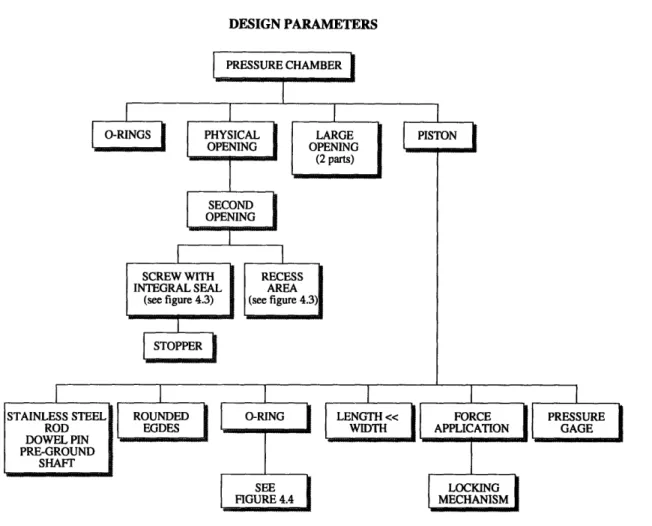
The design of the pressure chamber needed to meet ASME pressure vessel codes. The cylinder was designed to see a maximum pressure of 3000 psi. The final design of the system consisted of a cylinder, piston, plug and pressure gage. Axiomatic design methodology was used to direct the design of this apparatus. Choices for the functional requirements and design parameters were based on achieving high pressure saturation over a period of time. The hierarchical trees for the functional domain and physical domain are shown in figures 4.1 and 4.2. A mechanical drawing of the apparatus is shown in figure 4.5.
Experimental Methods 31
FUNCTIONAL REQUIREMENTS
Figure 4.1. Hierarchical tree of the functional domain for a mechanical press.
Experimental Methods 32
DESIGN PARAMETERS
Figure 4.2. Hierarchical tree of the design domain for a mechanical press.
Experimental Methods 33
Figure 4.3. Schematics for sealing oil chamber and preventing overflow.
SCREW WITH NPT PLUG RECESSED
INTEGRAL SEAL AREA
Fr-ilI
O-RING ON PLUG
IL~
Figure 4.4. O-ring configurations for piston seal.
Experimental Methods 34
I I
I
Experimental Methods 35 01.778+ .0 0 0 0.25 "°1+.002 01.997+O000 +.oo1 1/4-20 NPT TAP THRU
Figure 4.5. Mechanical oil press apparatus.
1/4-20 NI TAP THR
Experimental Methods 36
The piston cylinder apparatus is built out of aluminum bar stock. An o-ring is fitted in a groove for the oil seal. An opening exists in the bottom of the cylinder for removing any entrapped air when filling the cylinder. A viton O-ring was chosen for the oil seal for its applicability to high pressures.
Several ideas on generating a pressurized environment were conceived. Using metal bellows was one of the ideas that was thought to have potential. Metal bellows are manufactured by Parker, Co. The idea of using the metal bellows is
described. First, the bellows are immersed in the oil environment in the
collapsed position. Then, the bellows are hooked to a pressurized gas cylinder. When a gas pressure is applied, the bellows will expand into the oil and apply pressure.
The bellows that would meet the specifications needed for this type of
application cost approximately $350. It was decided that an apparatus which could provide the pressurized environment could be built within MIT for considerably less.
Another idea for using a force-displacement mechanism to provide pressure was also discussed. This mechanism for this idea would be a thin metal diaphragm. This diaphragm would be actuated by a gas source on one side and then the diaphragm is deflected into the oil environment creating a pressurized
environment. The problem with this idea is that in order to have any significant deflection, the diameter of the diaphragm must be significant. Pressure
chambers which have large diameters must have correspondingly thick walls and covers. The increase in material results in increased cost as well as more difficulty in handling.
Another idea involved modifying an existing hand-held hydraulic pump for the experimental apparatus. However, the pump had a significant leakage problem; it would not hold a set pressure for more than a few hours. Instead, we thought that the pump could instead be the pressure source. The leak could be overcome with a check valve positioned between the pump and the pressurized
environment. This idea was not pursued because the pump did not provide a suitable access for placing and removing samples.
Experimental Methods 37
The other part of the design of the experiment involves a method or source to apply force or pressure. Different types of sources are gravity and weights, a mechanical force provided by a lever or screw, gas cylinder pressure, and a hydraulic press. The cylinder/piston apparatus was design with the hydraulic press in mind. The press in the lab was an old Wabash hydraulic press. The
press in working condition is capable of providing 15 tons of force on a 5 in diameter ram. However, the press was not functioning properly at the time of the experiments. The maximum force that could be applied was 2 tons of force on a 5 in diameter ram. This force, however, was enough for a 2 in cross section to provide a pressure of 2000 psi.
4.2 Sample Production Sequence
Producing oil filled microcellular foam results from two stages. First, a sample of microcellular foam is batch produced, and second, the foamed sample is
saturated in oil. Low-density polyethylene is the polymer used. The mineral oil used is a Diala A oil produced by Shell Oil Company. A production sequence for an oil impregnated microcellular foamed test sample is now given:
Steps 1-16 is the batch production offoamed microcellular samples.
1. A sample of desired size is cut from commercially available stock (i.e. low
density polyethylene, 0.0625 in thick).
2. optional---For solubility of gas experiments, weigh sample.
3. The sample is held within a fine wire mesh and together is placed inside a
pressure chamber. The wire mesh is used to keep all sizes of the sample exposed to the gas.
4. The chamber is connected to a high pressure gas supply (i.e. CO2 gas
cylinder). An o-ring or gasket is used to seal in the gas and the cover is positioned and bolted on.
5. The protective safety enclosure (0.5 in thick Lexan) is then placed over the
Experimental Methods 38
6. The outlet valve is closed and the inlet valve is opened.
7. The pressure regulator is closed at which point the gas cylinder valve is
opened.
8. The pressure regulator is opened slowly to the desired pressure (i.e. 900 psi). 9. The sample remains in the chamber under saturation pressure over several
days (i.e. 3 days).
10. When the sample is ready to be removed, prepare a hot glycerin bath large
enough to accommodate the sample size. The temperature should be slightly above the melting point of the polymer (i.e. 1450C for LDPE).
11. To release the pressure, close the gas cylinder and then open the outlet valve.
Stand clear of the exiting gas stream.
12. Work quickly for as soon as the outlet valve is opened, gas begins to diffuse out of the polymer matrix. After the pressure is released, remove the safety enclosure and pressure chamber door.
13. optional---To measure weight gain of gas, weigh sample.
14. Immerse the sample in the glycerin bath until sample foams and becomes opaque (i.e. 15-20 sec for LDPE).
15. Quickly remove sample from the heat and quench sample in a water bath. 16. Clean the sample. A portion of the sample can
be prepared for photo micrographs using the scanning electron microscope.
Steps 17-30 is the oil saturation of the foamed sample.
17. Record the weight of the foamed sample. 18. Place the sample in a wire mesh and place
inside the cylinder. (see figure)
Experimental Methods 39
19. An o-ring is placed in the groove of the piston
and the piston is positioned within the cylinder. Lubricate with oil, if necessary. (see figure) 20. Wrap the threads of the pressure gage with
Teflon tape and screw into side of cylinder. (see figure)
21. Turn the piston/cylinder system upside down and support cylinder on a stand. Slowly pour mineral oil into the opening until oil just overflows the opening into the recessed area.
Take care not to create any turbulence when S pouring so as not to entrap air inside the
cylinder. (see figure)
tep 21
22. Wrap the threads of the NPT plug with Teflon
-0
tape and screw into the opening. (see figure) 23. Pour off any extra oil.
24. Place the piston/cylinder system between the plates of the hydraulic press and slowly compress the piston/cylinder system while
S
carefully noting the pressure reading on the gage. When the desired pressure is reached,
.1 • I 4 f~fr'• ,\ i ,, \
stop me compression (i.e. 1uuu psi). (see ngure) 25. After the desired period of time, release the
pressure by removing the clamping force of the hydraulic press.
26. Unscrew the NPT plug and pour out the oil. 27. Support the system on a stand by the cylinder.
tep 22
Experimental Methods 40
28. Using a metal rod inserted through the top
opening, tap out the piston. (see figure)
29. Remove the sample from the cylinder and wipe
to excess oil off the surfaces.
-30. Weigh the sample to record the amount of oil
that is taken up by the polymer.
KB
.4 I
I I
Step 28
4.3 Material Evaluation
The evaluation of the insulation material was to be performed by ABB. Tests of interest are the electrical properties of microcellular foamed LDPE with and with oil. Evaluation of mechanical and thermal properties to determine the viability of the material would also need to be performed. Results from these tests would determine the feasibility for using microcellular foamed plastics as insulation. LDPE has already been determined by ABB to not satisfy the thermal
requirements for transformer insulation. Polyethylene continued to be used in experiments because the focus was on obtaining a theoretical model for
explaining the mechanisms by which the oil enters the polymer matrix. The final material selection became less important at this stage of the research.
A significant portion of time was spent trying to obtain microcellular foamed
samples with the desired cell sizes. Early foaming experiments with LDPE resulted in cell sizes of 30 to 50 micrometers. The experimental parameters which needed to be adjusted include saturation pressure, saturation time, foaming temperature, and foaming time. Cell sizes of 1 to 2 gm were finally achieved using the experimental parameters shown in table 4.1. Although the final morphology is sensitive to all the parameters, the dominating parameter for achieving these smaller cell sizes is a saturation time of at least 48 hours for Y6
IC
Lq
Experimental Methods 41
in thick sheet. Through examination of the photo-micrographs, a portion of the cells are interconnected.
Table 4.1. Experimental parameters. Sample Saturation pressure Saturation time Foaming temperature Foaming time 1/16 in thick LDPE 900 psi 48 hrs 1200C 30 sec
4.3.1 Determining Void Fraction
The void fraction of microcellular foam is defined as the ratio of the volume of voids or cells to the total volume. The void fraction can be obtained by
physically measuring the dimensions of the sample to determine the initial volume, Vi. Re-measuring after the foaming process results in the foamed
volume, Vf.
vlfractln 1r
v
(4.1)
4.3.2 Determining Cell Density
The cell density of microcellular foam is expressed as the number of cells per cubic centimeter of unfoamed original material. Typical values for microcellular foam cell density are 109 to 1015 cells/cubic centimeter. The cell density can be
measured in several ways. The cell density can be obtained by looking at a photomicrograph of the microstructure of the foam.
..
Experimental Methods 42
A scale is shown on the micrographs. By approximating each cell as a sphere, the
volume of each cell can be approximated by an average cell diameter. Then, from the void volume, the cell density can be obtained as the number of cells/unit volume.
A procedure for obtaining the cell density is described. A sampling area containing approximately 100 cells is used. The number of cells n are counted for the sampling area of edge length 1.This number of cells is normalized to the number of cells in a square with an edge length of 10 gtm, nc. Generally, a microcellular structure would have nc greater than or equal to unity. The
3
number of cells in a cube with an edge length of 10 gm would be (nc )2. This
value is then converted to the number of cells per cubic centimeter Nc by
multiplying by a factor of 109. This value when multiplied by the volume
expansion ratio Vf/Vi becomes the cell density.
cell density = (n(10 ~m 109)(*ii
=
(nc)
(109{i(LI
A (Vf(4.2)
4.3.3 Optical Methods
Another method to determine void fraction and surface to volume ratio was used based on stereology used in fields such as metallurgy. This method is based on statistical methods. By positioning a grid over the micrograph, counting the number of hits to the total number of counts over a large enough sampling can determine the void fraction and surface to volume ratio.
For example, in figure 4.6 shown below, a grid with 9 points can be placed over the micrograph in different positions. Every time the intersection of the grid lines fall on an item of interest, it is recorded. Therefore, out of 9 possible
Experimental Methods 43
positions, the number of hits of 9 taken over several samplings will give an approximate volume fraction. This technique can also be applied to asymmetric morphologies.
This method is called point counting. There are also methods called lineal analysis and areal analysis. An example of lineal analysis is shown in figure 4.7. From lineal analysis, the value for PL can be obtained from equation (4.7). Of the three methods for estimating the volume fraction, point counting is preferred. Systematic point counting requires the least amount of effort to obtain an estimate with a given sampling error. This error is generally less than 10%.
9 point test grid 7.5/9 hits
Experimental Methods 44
test line 7 intersections
Figure 4.7. Lineal analysis using a test line.
To ensure efficiency of the analysis, the grid spacing should be such that the average number of points falling in any a-phase area in an ( a + Pf)-phase mixture does not greatly exceed unity. Therefore, in figure 4.8, grid A shown below is better for the example micrograph than grid B.
grid A grid B
Experimental Methods 45
4.3.4 Point Count Procedure [from Underwood, 1970]
1. Determine the maximum error that can be tolerated. The effort required will
vary inversely as the square of the error.
2. Determine an approximate value of the volume fraction by applying the grid a few times to determine Pp.
3. On the basis of this rough estimate, calculate a provisional value of the total
number of lattice points PT required to achieve the desired accuracy.
P= 200 '(Pp)
2
PT[Oo-ac
cPp
(4.3)
4. Select a grid with 9, 16, 25,... points. If the grid contains n points, one will have to examine (PT/n) fields of view.
5. Only one point on the average falls on any one areal feature.
6. The spacing between adjacent fields of view should be selected so the entire
specimen area is uniformly sampled.
7. Points falling on the boundary should be counted as 2.
8. Halfway though the analysis, the volume fraction should be recalculated to
obtain a more accurate value for PT.
9. When the measurements are completed, the final value of Pp can be
calculated.
The variance for the volume fraction a2(VV) or a(Vv) can be obtained from the
following equation.
PP(1- Pp) P 2( P )
The volume fraction can be written as follows.
vv = Pp
The surface to volume ratio is found with the following equation. Sv = 2PL
where PL is the value obtained from a lineal analysis and is equal to the following.
number of intersections unit length of test line
Experimental Methods
(4.5)
(4.6)
Theoretical Methods 47
CHAPTER
5
THEORETICAL METHODS
5.1 Introduction
A theoretical model of the oil saturation of microcellular plastics is developed.
The experiments conducted in this study involved the observation of mass uptake of oil in foamed plastics samples. By understanding the mechanisms involved in saturating the voids with oil, we will know whether all the voids completely fill with oil. Any voids not filled with oil will have negative effects on the electrical strength of the insulation material. A reasonably complete theoretical description of the experiments can be obtained through the use of governing equations for two mechanical phenomena: porous flow and diffusion through cell walls.
5.2 Governing Equations
Two mechanisms are involved in the oil saturation of microcellular foam: porous flow and diffusion. Porous flow of the oil through the interconnected cells of the matrix takes place rather quickly compared to the diffusion of the oil through cell walls. The governing equations for these two mechanisms are shown.
The flow of a homogeneous fluid in porous media can be described by Darcy's law. Darcy's law states that the volume flow rate is proportional to the pressure differential. It is a force potential which governs flow through porous media. The general equation for Darcy's law is as follows. [Scheidegger, 1974]
k (p2 - P1)
q = (5.1)
pL L
where
Q volume / time ="filtervelocity"
q A area rea
filtervelocity"
[tr
secTheoretical Methods 48
1 = absolute viscositY[ cm sec2
p = pressure[ dy
and L = thickness[rcm]
The filter velocity is related to the pressure differential through the viscosity of the fluid and the influences of the porous medium. The porous medium can be described by its specific permeability. The dimensions of specific permeability is length squared, which in the c.g.s. system should be [cm 2].
Diffusion is the second mechanism involved in oil saturation. The diffusion of oil through the cell walls governs the saturation of microcellular foam. The rate of transfer of a diffusing substance in an isotropic medium through a unit area of a section is proportional to the concentration gradient measured normal to the section [Crank, 1964]. This describes the theory of diffusion as recognized by Fick and is written as follows.
dC
F = -D (5.2)
dx
where F is the rate of transfer per unit area of a section. C is the concentration of diffusing substance, x is the space coordinate measured normal to the section, and D is the diffusion coefficient. Equation (5.2) is referred to as Fick's first law of diffusion.
The fundamental differential equation of diffusion in an isotropic medium is derived from Fick's first law. If the diffusion coefficient is constant, Fick's second law which describes the rate at which the amount of diffusing substance changes can be written as follows.
dC d2C
=D
Theoretical Methods 49
5.3 Applications of Equations to Experiment
5.3.1 General Remarks
The governing equations may be used to show that the mass uptake profile in a sample evolves according to porous flow as well as diffusion. Applications of the governing equations for oil saturation proceeds via consideration of the morphology of the microcellular foamed samples.
The foamed samples which were produced using batch processing techniques exhibit a certain degree of porosity. A significant percentage of the void volume is interconnected. A sketch of the interconnected volume filled with oil is shown in figure 5.1. The filling of these interconnected voids can be described by
Darcy's law on porous flow. The weight gain associated with the filling of the porous volume is Wp as shown in figure 5.2.
Porous flow occurs quite rapidly compared to diffusion. The cells which are nearest neighbors to the interconnected cells and which are separated by cell walls are first to demonstrate the diffusion of oil through cell walls. So, not only does diffusion take place at the surface of the sample, but it also occurs within the sample itself. Because of the interconnected voids within the matrix, the entire saturation process occurs more quickly. The weight gain, Wd, shown in figure 5.2 corresponds to the state at which all voids are filled with oil.
5.3.2 Boundary Conditions for the Diffusion Equation
The required boundary conditions are related to the geometry of the medium and the concentration distribution of the diffusing substance. In this case, we have flow of the diffusing substance through a cell wall of specified thickness.
One face of the wall (x = 0) is kept at concentration C1. The concentration of the
other face of the cell wall is C2 at x = 1. This face might be an interconnected
void which has been filled with oil.
The assumption of constant concentration of diffusing substance is reasonable. If a plane sheet is suspended in a volume of solution large enough that the amount
Theoretical Methods 50
of substance taken up by the sheet is a negligible fraction of the whole, then the concentration in the solution can be assumed to remain constant.
Therefore, the boundary conditions for diffusion are described below.
C=C
1@ x=O
C=C2 @ x=l
C=Co @ 0 x<1 (5.4)
Weight Gain Wd
Wp
diffusion
Time
Figure 5.2. Generalized weight gain curve.
Theoretical Methods 52
5.3.3 Solution of the Diffusion Equation
The solution of the diffusion equation for C with the boundary conditions (5.4) is possible by separation of variables. The results of such an approach give a
solution in the form of a trigonometric series. There is a finite interval of time during which the steady state condition is set up. During this time the
concentration changes according to the following equation [Crank, 1964].
x 2 'C2cosni-C 1 -n 8 -•Dn2X2t/12 C =C 1 + (C2 - C1)- +- - s e
1
n=l1 n 1 4Co 1 (2m + 1)rx -D(2m+1)2 r2t/12 + - sin eS '2m +1
m=12m+11
(5.5) As t approaches infinity, the terms involving the exponentials vanish and we are left with a linear concentration distribution.C = C1 + (C2 -C1) /
1
(5.6)
The rate of transfer of diffusing substance across a membrane is given by
F = D (C1 -C 2)
1
(5.7)
If Mt denotes the total amount of oil entering the cell wall during time t, and M., represents the corresponding amount during infinite time, the an equation
for mass uptake can be written [Crank, 1964].
Mt 8 0- 1 e-D(2n+1)2 7r2t/12
M. T2 n=0(2n + 1)2 (5.8)
By integrating equation (5.5) with respect to time, we can obtain the total amount of diffusing substance Qt which has passed through the cell wall in time t
Theoretical Methods 53
t
2C2COSnK-C1
l2 -Dn 2Qt
= D(C2 - C1) +csnr 1- e-Dn22t12 n=1 4Col+ 1 (1- D(2m+1)2 2t/12 2 m~= (2m + 1)2 (5.9)The diffusion coefficient deduced from observations of the uptake of component A by a plane sheet of component B. The diffusion coefficient is assumed constant and its value is determined from the half-time of a sorption curve. The value of
t/12 for which Mt/M, = 1, written as (t/12)
12, is given by the following equation.
(
P
t)
PD 16 9 16
I
2
7
2D
(5.10)
Rearranging equation (5.10) for the diffusion coefficient, we obtain the following equation.
D
=
0.049/(t/12)
1
(5.10)
Results and Discussion 54
CHAPTER 6
RESULTS AND DISCUSSION
6.1 Porous Flow
Weight gain versus pressure is plotted in figure 6.1 for two sample types which differ in void fraction. The plot shows both the experimental results as well as the theoretical curves obtained using Darcy's law. The samples were placed in the oil chamber under different pressure conditions. The duration of the
experiments were kept constant at 1 minute each. The theoretical curves show a linear relationship between weight gain and pressure which is expected from the equations for porous flow. For the relatively short period of one minute, only the interconnected voids have the opportunity to fill. Diffusion is negligible. The experimental data drops off from a linear plot. This signifies that at those
pressures, one minute is enough elapsed time to fill all the interconnected voids. From the experimental data, the porosity of the samples can be calculated.
6.2 Diffusion
The experimental curves and theoretical curves for the mass uptake of oil in microcellular foamed samples are shown in figures 6.2 and 6.3. The theoretical
curves are obtained from the plot of equation (5.8) from section 5.3.3. The diffusion coefficient obtained from equation (5.11) is 4.9E10-14 cm2/sec for a
half-time of approximately 3 hours and a conservative cell wall thickness of 1 gm. The only difference in the two figures are the time scales. One is linear and the other is logarithmic. In the curves for times less than 1000 sec, the initial amount
of oil in the sample is due to the porous nature of the samples. The theoretical curves are superposed onto the porous flow portion of the curve. The total amount of diffusing substance M. includes the amount collected in the porous volume. The amount of oil diffusing into the sample continues to increase for a
period of about 24 hours until the entire sample is completely filled. The experiments were conducted at a constant pressure of 900 psi. The experimental data shows that the void volume fills completely at a faster rate compared to the theoretical model. This could be due to several reasons. The cell wall thickness
Results and Discussion 55
Weight Gain vs. Pressure
0 200 400 600 800
Pressure [psi]
1000
Figure 6.1. Comparison of weight gain data to theoretical curve for porous flow.
Time Duration = 1 minute
-. theoretical curve o Sample A void fraction = 0.5 porosity = .285 O Sample B void fraction = 0.4 porosity = .188
Results and Discussion 56
Mass Uptake vs. Time
010 0
0 10000 20000 30000 40000
Time
I
50000 60000 70000 80000 90000
Figure 6.2. Comparison of experimental data to theoretical curves for diffusion of oil into microcellular foam.
Pressure = 900 psi theoretical curve D Sample A void fraction = 0.5 porosity = .285 0 Sample B void fraction = 0.4 porosity = .188
Results and Discussion 57
Mass Uptake vs. Time [log]
-
-o .
I i I I I I II I
10000
Time log [sec]
I I I I 10 00 100000
Figure 6.3. Comparison of experimental data to theoretical data for diffusion of oil into microcellular foam (log time scale).
0.9 . 0.8 0.7 -i I I I I I I 1000 Pressure = 900 psi ---- theoretical curve 1 Sample A void fraction = 0.5 porosity = .285 O Sample B void fraction = 0.4 porosity = .188 L | • • L
Results and Discussion 58
used in the theoretical model is quite conservative. The model is quite sensitive to the value for the thickness. The diffusion rate increases as the thickness decreases. Also, swelling of the polymer matrix was not taken into account. As the oil penetrates the cell walls, the polymer chains swell allowing more oil molecules to diffuse through at a faster rate. The pressure has theoretically no effect on the diffusion of the oil through the cell walls. However, the pressure is necessary to maintain the levels of oil concentration throughout the porous cells of the samples.
6.3 Samples
The samples used in the experiments are microcellular foamed LDPE sheet. The morphology of the samples are both porous and closed cell. The void fractions of the samples are 50% and 40%, respectively. A significant portion of this void volume is porous as can be seen in the bar charts in figure 6.4.
SAMPLE A 0
void volume solid volume
28.5% porous volume
SAMPLE B O
void volum solid volume
18.8% porous volume
Figure 6.4. Comparison of porous volume to void volume to total volume of samples.
50%
Results and Discussion 59
Because approximately half of the void volume is porous, the oil needs only to diffuse through about one cell wall thickness. The assumption is made that the interconnected cells are distributed throughout the polymer matrix randomly. This is a reasonable assumption considering the method by which the foam is produced. Depending on the amount of gas diffused into the polymer matrix during the batch process, the nucleation of cells occurs when the solubility of the gas in the polymer matrix changes. The nucleation of cells occurs almost
instantaneously and uniformly through the matrix. Afterwards, the cells begin to grow to their final size. Cells become interconnected when the cells grow to the stage where the walls between cells become so thin that they rupture forming an opening between the cells. As more cell walls rupture, more cells become
interconnected in a random distribution.
The interconnected cells in the matrix make it possible to completely saturate the cells with oil in a relatively short period of time compared to a non-porous foam. It follows that if the cells are grown to an even larger size the cells wall
thicknesses will become thinner and the fraction of porous void volume will become larger. This is possible because the number of nucleated cells remains the same for the experimental conditions used to create the foamed samples. This is depicted in figure 6.5. Note that the ideal structure for the distribution of cells throughout the matrix is a hexagonal close packed structure.
Nucleated cells Partially grown cells Fully grown cells
Figure 6.5. Growth of nucleated cells.
* p D 0 p