HAL Id: hal-01170042
https://hal.inria.fr/hal-01170042v2
Submitted on 12 Sep 2015
HAL is a multi-disciplinary open access
archive for the deposit and dissemination of
sci-entific research documents, whether they are
pub-lished or not. The documents may come from
teaching and research institutions in France or
abroad, or from public or private research centers.
L’archive ouverte pluridisciplinaire HAL, est
destinée au dépôt et à la diffusion de documents
scientifiques de niveau recherche, publiés ou non,
émanant des établissements d’enseignement et de
recherche français ou étrangers, des laboratoires
publics ou privés.
Virtual Network Functions Placement and Routing
Optimization
Bernardetta Addis, Dallal Belabed, Mathieu Bouet, Stefano Secci
To cite this version:
Bernardetta Addis, Dallal Belabed, Mathieu Bouet, Stefano Secci. Virtual Network Functions
Place-ment and Routing Optimization. CloudNet 2015 - IEEE 4th International Conference on Cloud
Networking, Oct 2015, Niagara Falls, ON, Canada. pp.171-177, �10.1109/CloudNet.2015.7335301�.
�hal-01170042v2�
Virtual Network Functions
Placement and Routing Optimization
Bernardetta Addis∗, Dallal Belabed†, Mathieu Bouet‡, Stefano Secci† ∗LORIA, France. Email: [email protected].
† Sorbonne Universit´es, UPMC Univ Paris 06, UMR 7606, LIP6. Email: {dallal.belabed, stefano.secci}@upmc.fr ‡Thales Communications & Security. Email: [email protected]
Abstract—Network Functions Virtualization (NFV) is incre-mentally deployed by Internet Service Providers (ISPs) in their carrier networks, by means of Virtual Network Function (VNF) chains, to address customers’ demands. The motivation is the increasing manageability, reliability and performance of NFV systems, the gains in energy and space granted by virtualization, at a cost that becomes competitive with respect to legacy physical network function nodes. From a network optimization perspective, the routing of VNF chains across a carrier network implies key novelties making the VNF chain routing problem unique with respect to the state of the art: the bitrate of each demand flow can change along a VNF chain, the VNF processing latency and computing load can be a function of the demands traffic, VNFs can be shared among demands, etc. In this paper, we provide an NFV network model suitable for ISP operations. We define the generic VNF chain routing optimization problem and devise a mixed integer linear programming formulation. By extensive simulation on realistic ISP topologies, we draw conclusions on the trade-offs achievable between legacy Traffic Engineering (TE) ISP goals and novel combined TE-NFV goals.
I. INTRODUCTION
With the emergence of Network Functions Virtualization (NFV) [1], [2] the attention of network virtualization research is now focusing on key aspects of NFV systems that were either not considered relevant or not conceived before industry effort at Standards Developing Organizations (SDOs). Key aspects that are worth being mentioned are the:
• NFV service chaining provisioning;
• flow orchestration over VNF chains as a function of
demand assignment to existing VNF chains or sub-chains;
• ingress/egress bit-rate variations at VNFs due to specific
VNF operations (e.g., compression/decompression);
• VNF processing and forwarding latency as an
orchestra-tion parameter to take into account for emerging fastpath solutions such as [3].
ETSI is de-facto the reference SDO for the NFV high-level functional architecture specification. ETSI specifies three layers for the NFV architecture: Virtual Network Functions (VNFs), the nodes; NFV Infrastructure (NFVI), including the elements needed to run VNFs such as the hypervisor node and the virtualization clusters; MANagement and Orchestration (MANO), handling the operations needed to run, migrate, optimize VNF nodes and chains, possibly in relationship with transport network orchestrators.
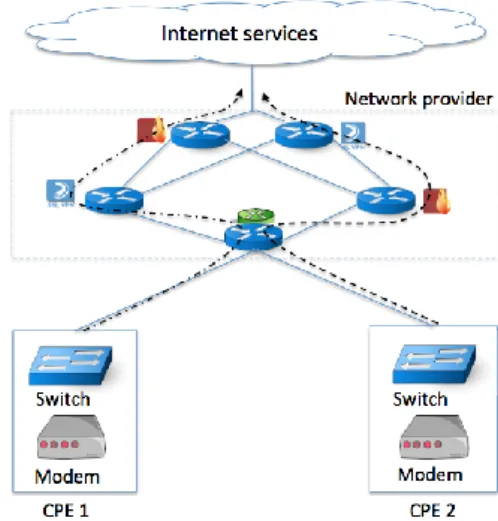
Fig. 1. VNF chaining with virtualized Customer Premises Equipment (vCPE).
A promising NFV use-case for carrier networks is the virtual Customer Premises Equipment (vCPE) that simplifies the CPE equipment by means of virtualized individual network functions placed at access and aggregation network locations, as depicted in Fig. 1. MANO operations must take into consideration the special nature of NFV architectures, such as the latency/traffic bounds at both the VNF node and the end-to-end levels, the fact that some VNFs can modify the incoming bitrate by compressing or decompressing it, etc. In this context, the paper contribution is as follows:
• we define and formulate via mathematical programming
the VNF Placement and Routing (VNF-PR) optimiza-tion problem, including compression/decompression con-straints and two forwarding latency regimes (with and without fastpath), under both TE and NFV objectives.
• we design a math-heuristic approach allowing us to run
experiments also for large instances of the problem within an acceptable execution time.
• we evaluate our solution on realistic settings. We draw
considerations on NFV deployment strategies.
The paper is organized as follows. Section II presents the state of the art on NFV orchestration. Section III describes the network model and the Mixed Integer Linear Programming (MILP) formulation. Analysis and discussion of optimization results are given in Section IV. Section V concludes the paper.