Publisher’s version / Version de l'éditeur:
Technical Translation (National Research Council of Canada), 1960
READ THESE TERMS AND CONDITIONS CAREFULLY BEFORE USING THIS WEBSITE.
https://nrc-publications.canada.ca/eng/copyright
Vous avez des questions? Nous pouvons vous aider. Pour communiquer directement avec un auteur, consultez la
première page de la revue dans laquelle son article a été publié afin de trouver ses coordonnées. Si vous n’arrivez pas à les repérer, communiquez avec nous à [email protected].
Questions? Contact the NRC Publications Archive team at
[email protected]. If you wish to email the authors directly, please see the first page of the publication for their contact information.
NRC Publications Archive
Archives des publications du CNRC
For the publisher’s version, please access the DOI link below./ Pour consulter la version de l’éditeur, utilisez le lien DOI ci-dessous.
https://doi.org/10.4224/20386689
Access and use of this website and the material on it are subject to the Terms and Conditions set forth at Experimental Investigation of Soil Freezing
Balduzzi, F.
https://publications-cnrc.canada.ca/fra/droits
L’accès à ce site Web et l’utilisation de son contenu sont assujettis aux conditions présentées dans le site
LISEZ CES CONDITIONS ATTENTIVEMENT AVANT D’UTILISER CE SITE WEB.
NRC Publications Record / Notice d'Archives des publications de CNRC:
https://nrc-publications.canada.ca/eng/view/object/?id=18a7865a-0bc2-4763-97fd-9b9a420d6fc4 https://publications-cnrc.canada.ca/fra/voir/objet/?id=18a7865a-0bc2-4763-97fd-9b9a420d6fc4
ABセイ
Q:'LJ NRC }/.2
ti
JTT • 912NRC TT·912
NATIONAL RESEARCH COUNCIL OF CANADA
TECHNICAL TRANSLATION 912
EXPERIMENTAL INVESTIGATION OF SOIL FREEZING
BY
F. BALDUZZI
FROM
MITT. DER VERSUCHSANSTALT FUR WASSERBAU UNO ERDBAU, NO. 44, 1959
TRANSLATED BY
D.A. SINCLAIR
THIS IS THE SIXTY· NINTH OF THE SERIES OF TRANSLATIONS
PREPARED FOR THE DIVISION OF BUILDING RESEARCH
OTTAWA
PREFAq:r;
The Work described in this publtcatiqn from the Federal .Institute of Technology in Zurich, represents an original approach to the problems of frost heaving
in soils.
Dr. Balduzzi has observed the freezing and
thawing processes in real and artificial soils, with a test apparatus allowing measurement of the signif-icant factors of pore water tension, heaving pressures,
and stress conditions in general. He made a detailed
comparison of 'these observations with the behaviour of similar materials, under the conditions of triaxial stress developed in shear strength tests.
The Division has been actively engaged in research
into frost 。」エゥッセ for some years, both in connection
with highway and other construction in southern Canada, and also in connection with the phenomenon of
perma-frost. The relationship of this work with other soil
mechanics studies has always been appreciated.
tイセョウャ。エゥッョ of this paper into English was accordingly
felt very desirable.
The Division is grateful to Mr. Sinclair of the Translations Section of the N.R.C. Library for the translation.
Ottawa,
September 1960
NATI:)NAL rmSEARCH C0UNCIG OF CANADA
Technical Translation 912
Title: Experimental investigation of soil freezing
(Experimentelle Untersuchungen uber den Bodenfrost)
Author: F. Balduzzi
Reference: ,Mitteilungen der Versuchsanstalt fur Wasserbau und Erdbau, no.44, 1959
EXPERIl1ENTAL INVESTIG;ATI01L.QF SOIL FREEZING
The penetration of frost into the ground results "in changes in its properties, the most obvious and most technically important
of which 」ッョウゥセエウ in the increase of volume expressed in the form
of frost heav-e.
An investigation of frost heave shows that in the majority of cases the underlying increase of volume is greater than that which can be attributed to the volumetric expansion of the water present in the ground.
Just as important a cause of frost heave lies in the displace-ment an1 accumulation of pore water or ground water in the vicinity of the frost boundary, where this water forms more or less coherent
ice layers on freezing. The primary consequences of frost
penetra-tion into the ground are:
the separation (segregation) and movement (migration) of the water;
changes in the ground structure due to this separation and movement of the water and due to its expansion on freezing. Secondary consequences of frost action are deformations of the ground and changes in its bearing capacity on freezing and thawing. To begin with, the latter has harmful effects on constructions
built on such soils. If the structures suffer damage, this, along
wi th other types, is referred to as frost damage.
Knowledge of these processes has hitherto been derived chiefly from studies of road damage, where both actual damage due to frost heave and apparent frost damage due to loss of bearing capacity
during thaw can occur. The nature of the damage can seldom be
determined definitely from such reports, but it is usually found that the seat of the underlying causes rests in fine-grained SOils, or in coarse-grained or medium-grained soils if they contain fine-grained COmponents.
-4-No correlation can be established between the extent of the damage and its causes nor between certain climatic and topographical conditions and the causes of the damage, owing to the complexity
of the factors involved. Experience to date can be more or less
ウオュセ・、 up as follows: "In the presence of an adequate water supply
(ground or pore water) substantial frost heave may be expected
wherever non-uniform soils contain more than 3% by weight particles
of diameter セ・ウウ than 0.02 mm and wherever uniform unconsolidated
sOils contain more than 10% by キ・セァィエ particles of diameter smaller
than 0.02 mm. In loose rocky soils with less than 1% by weight
particles of diameter less than 0.02 mm, no ice growth was observed even when the ground water table lay within the frost limit."
The conclusions derived from this empirical evidence are widely applied in the testing of soils, in the form of the
Casagrande criterion(l). So far, no observations have been made
which contradict what has been formulated here.
Taber(2) investigated this phenomenon in the laboratory in order to determine what soils were responsible for the formation
of ice. He succeeded in showing that the formation of intermediate
layers of ice was clearest in cohesive and weakly cohesive fine-grained soils, but could not be detected in non-cohesive soils of
medium or coarse grain. This was most strikingly demonstrated by
Taber's experiment in which he studied the freeZing behaviour of a cylindrical sample of which the cross-section consisted half of
sand and half of frost-heaving soil (Fig. 1). On penetration of
the flat "frost boundary" into the sample perpedicularly to the cylinder axis, definite intermediate ice strata form in the half consisting of frost-heaving soil and this results in an increase
of volume perpendicular to the frost boundary. At the same time
the sand half shows no perceptible change. Taber was also able to
show that the increase of volume of the water On freezing is not
essential for the formation of the ice lenses. He replaced the
water by an organic liquid which does not expand on freezing and found that on penetration of the critical frost limit for this
Mセ
of the solidified organic phase had formed just like the lenses. geskow(3), DUcker(4) and Peltier(5) demonstrated in tests that
freezing samples which communicate with a supply of water can under
certain 」ゥイ」オュセセ。ョ」・ウ attract the water during frost penetration.
However the regular relationships between water supply and frost heave in part suspected by these authors are already very hypo-thetical, as i& the measurement of the capillary height of climb,
attempted from セゥュ・ to time in these investigations or of the
tension in the water. With this, all our established information
concerning ground frost today is described, and all further
laboratory investigations often very time-consuming, have thus far revealed no regularities of general validity and applicability, but have merely succeeded in confirming the mentioned empirically
discovered facts.
Ground frost is clearly a complex phenomenon, the nature of Which is by no means revealed by the experiences depicted above. From the need to get an understandable idea of it, however, certain hyptheses have been advanced which attempt to interpret at least
the most obvious features of the phenomenon. The imagination has
been stimulated most by the phenomenon of a water transport at the intermediate layer (ice lens), which explains Why almost all
pertinent hypotheses deal first with this problem. These are the
theories of Beskow(3) , Peltier(5) and Jumikii(6), all of which attempt to explain the value of the frost heave on the basis of a theory that takes into account the permeability of the material, the distance between the ground-water table and the frost boundary and a gradient (capillary height of rise, tension, etc.), and,
depending on the particular problem, has the general form of Darcy's
law. To test these hypotheses apparatuses for freezing tests were
built, all of which are derived ヲイッセ a common prototype known as the
Enslin apparatus (Fig. 2). In this setup a material sample for
determining the water absorptivity in placed on the porous plate and either the amount of water absorbed is measured (valve 1 closed, valve 2 open) or with the Hg manometer, the water column with which
-6-carry out the freezing test the sample holder is cooled, and the sample is either frozen through or a 0° isotherm is kept stationary within the sample (by means of separate thermostatic control of the
lower and upper"'halves of the sample). Specifically, the following
tests have been carried out:
1. Measurement of the capillarity (Beskow).
2. Measurement of the water taken up and the frost heave
(DUcker, Peltier). ,
3. The same with the sample loaded (A.C. of Engineers,
Jumikis).
4. The same with freezing and thawing cycles, on both natural
soils and fractions of given grain size and petrographic character.
The results' or these investigations, however, do not establish
any regularities 「・エセイ・・ョ the classification properties of the soils
and their behaviour in the frost test, especially in the case of
silty or clayey gravels. The only significant result of these
tests lies in whether or not ice lenses were formed. As far as the
tests with pure fractions are concerned it may be said that the soil-mechanics behaviour of a fraction taken from its natural association could not be representative of the general behaviour
of the combination because it セIッオャ、 not represent the decisive
fraction.
The first and most basic criticism of the previously formulated hypotheses is that they take into account only the behaviour of the
water and the ice. However, water and ice, as so11 components,
behave in more or less the same way in all soils, although the soils themselves react differently to the penetration of frost.
hセョ」・ the essential criterion Which will determine the behaviour of
soils in the presence of frost must be a soil property and not a
water property. Any relationship between the frost heave and water
supplied can only exist if it be assumed that the ground experiences no other change in structure except that due to the formation of
ice lenses. This assumption cannot be proved. In any case such
-7-ignores the essential fact that certain soils form intermediate
layers of ice without heaving. Furthermore any attempt at an
explanation on the basis of capillarity must fail because ice
lenses form even in soils which are capillary saturated or totally saturated, that is to say even in soils in which the capillarity as
such can have no effect. All in all, therefore, any "hydraulic"
explanation of ' ground frost appears オョウ。エゥウヲ。」セッイケN In particular,
it cannot eX'flla,in the differences between frost-susceptible and
other soils. Under any such hypothesis all soils would have to be,
termed frost-susceptible and would differ from each other in the extent of their susceptibility as a function of the transport
distance, the permeability, etc. No final conclusions can be
reached in this way, therefore, on the formation of ice lenses. The testing devices constructed on the basis of these hypotheses
for the most part measure phenomena which depend on the test
apparatus (frost heave and water supply) or processes which are not representative of the desired magnitude, e.g. the measurement
tension of un'sa tu rat ed samples.
In addition to the many discussions on the behaviour of the water and its supply to the ice lenses, data are to be found here and there in the earlier literature on the freezing behaviour of the
solI. Taber observed the formation of cracks due to stresses in
clays during freezing tests in which no additional water was
supplied, if the water going into the ice lens was derived from the
unfrozen part of the sample. Terzaghi(7) showed that the forces
required to convey the water from the unfrozen ground to the ice lenses must be equal to the external pressures which are required
in order to produce an equal change of volume in the unfrozen ground
i.e., they must be very great. Casagrande (8) attempted to
demon-strate this experimentally by determining the water content of the "unfrozen" clay remaining between intermediate ice layers and
comparison With the water content-consolidation curve of the same
materials. Unfortunately only one such test has been published,.
namely a frost penetration test, which however did not prove very much because the temperature gradient was not kept stationary for
-8-a long enough time in order to bring -8-about complete consolid-8-ation
of the material. In any case it was found that as a result of
frost penetration pressures of the order of 4 to 8 kg/cm2 could
occur. In his tension hypothesis Ruckli(9), in order to explain
the formation of ice lenses, has defined a suction force p which is
claimed to be a specific soil coefficient. In order to determine
this soil coefficient a measurement of the tension immediately
below the 1ce'lsns 1s suggested. However, such a measurement could
scarcely be carried out 1n this f'or-m, These observations lead to the
only theorems which cannot be rejected a priori. Specifically they
conta1n what 1s essential in order to distinguish between soils
that are frost susceptible and soils that are not. Whereas by the
"hydraulic" hypo the ses , as already ment roned , all soils must in the
last analysis be frost susceptible, the Bウッゥャセュ・」ィ。ョゥ」ウB approach
leaves room for the possibility of distinguishing between two or more classes of frost-susceptible and non-frost-susceptible soils, and, provided the presumed soil coefficient has some real
signifi-cance, a quant t t at ;ve potential degree of frost susceptibility of
a soil can be stated independently of all other factors. This
possibility alone is sufficient to justify the implementation of further studies in the direction thus indicated.
The relationship between labour expended ,and the usefulness of results in frost research here and elsewhere is definitely poor. Early failures of an empirical, speculative procedure can be
attributed to lack of knowledge about the principles of the
phenom-enon itself. This also means that the results cannot be interpreted
on a common basis. We are just as far from solving the problem
of the reasons for the formation of ice lenses as that of the extent
of potential frost susceptibility of a soil. However, as long as
there is no clarity concerning the mechanism of the phenomenon there is no possibility of influencing the process in any suitable manner.
The purpose of our study is to clarify the principles of the phenomenon of ground frost so that the potential degree of frost susceptibility of a soil can be determined and thus reasonable
p
Mセ
further into the problem from the standpoint of both theory and
measuring technique and takes us so far away from the representation and test tecbnique based on models that in the course of the
investigation the relationships between what is being investigated and practical solutions may not always seem as clear as a practical
person might desire. The lack of even the most elementary data on
the forces ッ」」オセイゥョァ in connection with ground frost and their
effects on the セッゥャ compel us to consider the phenomenon at first
as a whole, so that we may thereby find suitable starting points for an experimental investigation.' For this purpose it is necessary to measure the forces which act in the frost phenomenon on ground
and water, using the classical methods. This implies preliminary
studies, first to find the conditions under which direct measure-ments are possible; and secondly to show that these conditions do not (neither the conditions themselves nor the measurements as such)
influence the process under investigation. It is hoped that the
results of this preliminary work and these first investigations will enable us to determine what soil properties are of decisive
importance for' frost behaviour and will permit us to study these
properties more closely. Following a suggestion by Dr. P. Niggli,
the studies begin with a monomineral material and are gradually extended to relatively homogeneous, representative soils.
The assumptions underlying the planning 'of this work and the view resulting therefrom concerning the process can be outlined as
follows: The "hydraulic" point of view considers the ground frost
as purely a question of water supply, the soil itself playing the part of a passive medium in which only a migration and a change of phase from liquid to solid on the part of the water takes place. As a logical consequence of this we get the heave measurement in order to determine the amount of the water supplied, the application of Darcy's law to determine the gradients responsible for this
supply, and finally the attempt to classify the soils as to frost
susceptibility on the basis of their permeability properties. The
only soil coefficient Which can be taken into account in this is the
-10-supplementary, unproved assumption. The only available measurements
have to do with the amount of water supplied or the extent of the heave, since it is assumed that there is a correlation between the heave and the quantity of water available.
In what follows, however, the ground will be treated as the bearer of the ground frost phenomenon, although this occurs solely on the penetrat-ion of frost into certain soils ,. the particular
character ッヲセィャ」ィ is to be characterized as a function of their
soil coefficients. At the same エゥセ・L for the case of frost
penetra-tion in general and the occurence of ground frost in particular,
the state of the solI ls naturally changed. Two principal problems
must therefore be glven special attention:
What 」ィ。イ。」セ・セゥコ。エゥッョ of the solI is logical and useful for
considering its frost properties?
What forces are involved in the penetration of frost into the ground'l
Thus we shall be .interested primarily in the measurement of the forces whlch act .on the ground on penetration of the frost -i.e., the heaving pressure instead of the heave, the pressure in the Tiquid phase (pore water) instead of the water consumption - for characterization of a SOil, the determination of its mechanical
strength properties instead of its permeability (classical property),
and further, the determination of the state of the soil before and
after penetration of the frost. While some of these measurements
can be carried out with known means, most required development and testing from both the theoretical and the practical standpoint for the purposes of this study.
From our previous knowledge of. g round frost we can first distinguish between those soils which heave on the penetration of
frost and those which do not. Laboratory investigations also
enable us to divide soils into those which show the formation of
ice lenses and those which show no such formations. There is no .
three classes of soil:
heaving ice lens
not heaving ice lens
not heaving not ice
-11-forming forming lens forming
The not heaving, not ice-lens-forming soils can be subdivided further into soils with and without storage of water.
The order of magnitude of the forces occurring on penetration
of frost into 。セ soil sample can most easily be 、・エ・イセゥョ・、 by
measurement of the heaving pressur? This can be carried out with
heaving, ice-lens-forming material. With free lateral expansion
it is executed perpendicularly to the direction of the force and the st'3.tionary temperature gradient in the direction of a force is
so chosen that the 0°-isotherm is inside the sample. The unfrozen
portion is in communication with a supply of water. For a
cylindrical sample, on this basis, we get the test arrangement
ahown in Fig. 3:; the sample stands on a fil ter plate heated to 10°C, which guarantees the supply of water from a reservoir; the
sample is prevented from expanding ax
ra
l Ly upvrar-ds by a balance.The force just required to prevent tris expansion on penetration of
the frost is measured. The determining factor in this is the
constant value which sets in when the position of the 0°-isotherm
in the sample is steady. The execution of such a measurement on a
test material shows that forces of the order of 10 kg/cm2 can occur.
With free expansion in all directions, but the water supply shut
off, a tension of the same order of magni t ude in the liquid phase
may be expected. Since a measurement of the tension is only
possible if the liquid phase forms a continuum, and then only if no cavitation occurs, a few special problems of a technical and
fundamental nature arise in connection with this task. The
require-ment that the liquid phase must constitute a continuum can only be satisfied if the measurements can take place within a saturation region which is in contact on the one hand With the measuring probe
and on the other with the ice lens. (A'saturation region is defined
here as that part of an unsaturated soil sample inside which the liquid phase is continuous, and the boundary surface of which is in
-12-contact only with a gaseous phase or a particle of the soil). In
an unsaturated soil, however, the dimensions of the local saturation
regions are not known. The only feasible solution for the
measure-ment of the tension in the local saturation region of an unsaturated sample therefore consists in so increasing the saturation region that it embraces the entire sample (i.e., the measurement of the
tension is carried out in the two-phase system ,soil/water). For
this, of 」ッオイウ・セ it must be demonstrated that in the two-phase
system the same forces act as in エセ・ local saturation region of the
unsaturated samples, both for the case of processes during the penetration of frost and for the mechanical properties of the
samples which determine this. Such a demonstration is equivalent
to saying that i:o セィ・ three-phase system of the ground, the gaseous
phase (air) is incidental (Ruckli), i.e., all the phenomena that occur only in the presence of the gaseous phase are of secondary importance or constitute mere interferences with the process under
consideration. This applies among other things to the IIcapillary
componentll of'the cohesion of soils and the II ca pillarityll of soils
to which importance is attached by various authors in explaining the
ground frost. The requirement that no cavitation be permitted to
occur in the liquid phase sharpens the already well-founded require-ment that the system under investigation shal,l in its initial state constitute a two-phase system; this must remain during the entire measurement regardless of the pressure region which must be passed
through. From what has been stated here it follows that the effects
of frost penetration (for the class of heaving, ice-lens-forming soils) can be determined in the case of unsaturated samples only by measuring the heaving pressure, and in the case of saturated samples by measuring both the heaving pressure and the tension which acts on the liquid phase (or more generally the pressure which occurs in
the liquid phase). If we are to determine the ground frost
phenom-enon in its entirety this measurement cannot be avoided. A
description of how it is carried out will therefore constitute the first part of the present paper.
-13-From what has been said above the following working plan
イ・」ッュセ・ョ、ウ itself:
1. Production of saturated ウ。セーャ・ウ of soils and determination
of their saturation;
2. Effect of saturation on the mechanical properties of soils
and measurements thereof at saturation;
3. Execution of freezing tests from saturated samples
accompanied by measurement of the pressure in the liquid phase;
4;
Measurement of other frost properties of the soil.The monomlneral material for the first test should have the
following properties: it must be inert, be of a grain distribution
similar to ョ。エオセ。ャLュ。エ・イゥ。ャウL be accessible to wetting and on
penetration of frost be able to form ice lenses; in addition it must meet all demands with respect to workability and economy.
After examination of available materials it was found that titanium dioxide of the type used as a pigment was suitable for the purpose. The material 'no. 6618 consisted of isodiametric grains of anatase with 1.2% rutile*.
Other test materials are: homogenized Uetliberg loam 4002 of
vaセeL a clayey silt representative of Swiss conditions and a
naturally occurring pure silt 8699 from Sufers. Finally, in order
to test the effect of saturation on the mechanical properties alone a structurally sensitive material - undisturbed marine chalk 7071 from Lake Zurich - was used, which is regarded as particularly
sensitive to manipulation. The classification of these materials
is shown in Table I.
2. Determination of the Shearing Strength of Saturated sッゥャセ
A natural or artificially prepared soil ウセューャ・ consists of a
solid phase (the soil), a liquid phase (the water) and a gaseous
phase (the air). In the natural samples the proportion accounted
lit These data are taken from investigations which were kindly
carried out by Dr. Hochweber and Dr. Preis of the Eidgenossische Materia1-Prllfungsanstalt.
...
-14-for by the gaseous phase may vary considerably owing to special circumstances, but this can also occur in the artificial samples
as the result of special manipulations. Only in very rare cases,
however, will this component disappear entirely. A great many
suggestions have been made in order to obtain completely saturated
soil samples. It can be stated, however, that neither the
forcing-through of liquid (even under pressure), nor c?TIsolldation over
many years, セッセ sedimentation under water are sufficient to enable
this goal to be completely achieved. ,
The same is true of the "chemical" methods which replace the
air, prior to wetting, by a more water-soluble gas. This method,
however, does suggest another possibility. Instead of replacing
the air by a soluble gas, the aoLubi.Laty of the air itself may be
increased by pressurizing the water. This compression, Which is
attainable on the basis of the laws of Boyle and Henry, and the
dissolving of エセ・ air can be achieved, for the practical case of a
soil sample, in two different ways:
1. The .soil sample can be closed in a watertight and airtight
manner by a membrane and then deformed by the application of
pressure in all directions until any further increase of pressure
produces no further change of volume of the sample. A measurement
of the pressure of the liquid phase in the sample (pore water) shows that a further increase in the cell pressure corresponds to an equal increase in the pore water pressure (i.e., that the
effective state of stress does not change any further). (If
o is the total normal stress on a plane,
0' the mean ァイ。ゥョMエッセァイ。ゥョ pressure per unit area, i.e., the
effective stress,
u the hydrostatic pressure in the liquid phase, which from now on
will be termed the pore water, and
a r the effective grain contact area per unit area, then
a = a' + (1 - a ) u (1 ) r
-15-If Cc
=
セN
VNセvi
the compressibility of the soil and_ _
1 •
.iN.
Cu
=
nV 6u that of the pore water andCc
n the porosity of the so iI, then 60'
=
n · • 6 u must hold,C
セ
with B =
1/(1
+ョセIL
ilu=
B. 6.0,where, at saturation,
a
=
1 (according to Bishop and Eldin(lO».)In obtaintng saturation in this manner, it must be borne in mind that the sample is at the same time being deformed and
saturation exists only beyond a certain value of the cell pressure, depending on the original degree of saturation.
2. The soil sample can also be saturated by closing it off
hermetically with a membrane and connecting it to a source of
water the pressure of which is initially equal to the cell pressure
against the sample. In this case, if the cell pressure and the
pressure of the 'water source connected to the pore water are
together raised by a certain amount depending on the initial degree of saturation of the sample, then saturation of the sample can be
obtained without its deformation. Whether saturation prevails or
not can be determined by discovering the increase of pore water pressure corresponding to an increase in the cell pressure, at
constant water volume (B-factor) (cf. Bjerrum and Huder(ll». A
practical embodiment of the method is represented in Fig. 4. Sample 1 is installed in a compression cell and connected to a
water tank 2. Tank 3 is connected to the liquid surrounding the
sample in the compression cell.
Among the mechanical properties of soils the shearing strength
is the one which is most sensitive to the test conditions. For
certain conditions, of course, the shearing strength is defined as the maximum shearing stress that a sample is able to withstand. The investigation of the shearing strength consists generally in an analysis of the effect of the cell pressure, the rate at which the load is increased, the change of volume and the pressure in the
ーッセ・
water, on the strength of the soilHsォ・ューエッョHャRセIN
For this
-16-present paper the consolidated, undrained, cylindrical pressure test is used in which the first principal stress acts in the axial direction on the sample, the second is chosen equal to the third
and these two dre given by the hydraulic cell pressure. The soil
sample is insulated from the environment by a membrane, it is
installed in a compression cell and connected by a porous plate to
a water reservoir. For consolidation (i.e., for the adjustment of
the volume aod ,water content corresponding to セ given cell pressure)
the line to the water reservoir is open and the sample is drained. After consolidation is complete tne line is closed and thereafter
the pressure test is carried out at constant water volume. The
pressure in the pore water is measured at constant volume by means
of a compensation manometer. The cell pressure is measured with a
manometer, the supplementary axial load with a ring balance and the axial deformation of the sample with a dial gauge.
The first test material used was Ti02 6618 (see above). The
size of the sample was the same in all tests and the deformation
rates were the same in the first four tests. The cell pressure 1s
determined in 'advance. The following quantities are measured:
03 in kg/cm2 ;
01 - 03 in kg/cm2 ;
the deformation in cm and
the pressure in the pore water in kg/cm2•
From these measurements the effective state of stress corre-sponding to each deformation can be determined and represented in
a Mohr circle diagram. The increase of load and change of pressure
in the pore water can be represented by stress-strain diagrams. However, the analysis of the test results is facilitated by using a representation introduced by Casagrande, termed a vector curve. This representation takes into account simultaneously, for each state of deformation of the sample (from the start of deformation to fracture), the cell pressure, the supplementary axial load and
the pressure in the pore water. This is achieved by describing the
course of the resultant vector of the effective normal stress and
-17-which joins the terminal points of all vectors (from the initial
state of the sample to the end of the test). The construction of
the vector curve for each test is evident from the representation
in Fig. 5a-e. Fig. 5a shows the resultant vector of a state of
stress, Fig. 5b the resultant vectors of all the states of stress passed through during a test in the plane of fracture, Fig. 5c the
vector curve obtained for this for a typical test. By taking into
account the effective stresses, the changes of volume of the pores are implicitly determined as a function of the state of stress and
,
the degree of saturation of the material. For example, if the
supplementary axial load up to fracture produces no change of pressure in the pore water (Fig. 5d), then the effective cell
pressure remains constant and the カセ」エッイ curve 1s accordingly a
straight line. On the other hand, if the supplementary axial load
produces a change of pressure in the pore water for each state of deformation then the effective cell pressure will also change, and
if the ratio of 」ィ。ョァセ of pressure in the pore water to the increase
of axial load be termed the pore water stress parameter,
A
=
セH。Qaセ 03) , then the following result is Obtained. Thepara-meter A depends, at complete saturation, only on the material
properties. To every change of A there will correspond, at
saturation, a change in the deformation properties of the material or, at a certain degree of saturation, a change in the deformation
properties and the degree of saturation of the material. The
influence of the degree of saturation on the vector curve is
expressed in a departure of the latter from the rectilinear course; similarly, any change in the deformation properties of the material,
which are dependent in turn on the degree of saturation. Therefore,
the general form of the vector curve of an unsaturated material
has an appearance like that of Fig. 5e. The variation of A
between zero and unity depends on the degree of saturation of the material, the latter being varied by the increase of pressure in
the pore water until saturation is attained. Between one and two,
-18-structure. Between two and three (after the occurrence of fracture)
A depends on the deformation properties of the material and the degree of saturation, the latter varying in turn as a function of
the reducing pressure in the pore water. Hence, the representation
of the triaxial shearing test in the form of a vector curve constitutes a description of the deformation properties of the material and therefore also of its structure, these properties de-pending indeed 'on the degree of saturation, and also taking the degree of saturation itself into account.
In our tests for determining the shearing strength, therefore, the case of less than 100% saturation must be distinguished from
that of saturation itself. In the first case it must be borne in
mind that for every deformation and 'change in the state of stress
of the material a migration of the liquid phase occurs. This
migration is expressed in an increase or reduction of the local saturation zone; depending on whether the pressure in the pore
water increases or decreases. These changes in the boundaries of
the saturation region correspond to changes in the local water
content of the sample. The rate at which they occur is determined
by the permeability of the material and the area of the saturation
zone. For each change in the state of stress, the state of
equilibrium is attained when the stresses of,all local saturation
zones are the same. The dependence of this process on the time,
for continuous deformation at a constant rate, can be determined by investigating the relationship between the deformation properties
and the rate. At saturation, on the other hand, the deformation
properties of the material セオウエ be independent of the rate of
deformation.
Tests with Ti02-.£'§'1.§
The first three tests to determine the shearing strength in
unsaturated Ti02 are summarized in Fig. 6a. Similar samples of this
material were consolidated at cell pressures of 2, 6 and 12 kg/cm2
and were loaded at equal pressures until failure. The vector curves
7
•
-19-behaviour, while that of the test at 12 kg/cm2 shows the strong
influence of the degree of saturation of the sample on the test
curve. A fourth test was conducted in which the first-mentioned
method of produclng saturated samples was applied. After
consolida-tion at 6 kg/cm2 the cell pressure was increased until セオ
=
セPSGand after reaching the state of equiliorium (at the then resulting
cell pressure of 9 kg/cm2
- effective cell ーイ・セウオイ・ 7 kg/cm2 ) the
sample was loaded until failure occurred (Fig. 6b). This result
confirms the above views on the effect of saturation on the course ,
of theexperirnent and permits formulation of a plan for a series of
tests to examine the phenomenon systematically. That is to say,
our experiment is to ShON that in the two-phase system ウッゥャMセGj。エ・イ
in which the elementary saturation セッョ・ involves the entire sample,
its deformation properties are independent of the loading or
deformation rate. For this purpose three tests were carried out
under otherwise similar conditions at rates of 10, 100 and 1000
min/em. The results of these tests are summarized in Fig. 6c and,
within the limits of accuracy they do in fact yield the desired
proof. In addition to this result examination of the vector curve
shows the following: it consists of three sections, each of which
is characterized by a certain stress and strain. To explain the
first two sections certain assumptions have to be made concerning
the structural and compressibility properties of the material. In
the present paper we are chiefly interested in the character of the material after failure, in which condl tion only the friction
proper-ties are still effective. The change of volume after failure of
the material under shearing stress depends, according to the vector
curve, solely on the angle ¢ of the $hearing strength. At the same
time this gives us a new criterion of failure that may also be made
useful in the general investigation of the shearing strength. The
other tests on the dependence of the material properties on the cell pressure have all been carried out at the lowest deformation
rate (1000 min/em) of the previous test series. Fig. 5c shows that
investigation of the shearing strength in the two-phase system at saturation gives the same angle of the shearing strength as in the
-20-investigation in the three-phase system (i.e., the extension of the elementary saturation zone to the entire sample has no effect on
its shearing strength). As expected, the tests at complete
satura-tion can be carried out at any rate of the change of state without
thereby affecting the material property being investigated. This
fact is partioularly important in connection with tests accompanied
by a change in. the thermal state. It must still be determined, of
course, whether these results have general validity and are charac-teristic for each material.
Tests キゥエィtセrゥ」。ャ Soils
To clarify this question it was necessary to apply the same determination of material properties to the soil samples, i.e.,
clayey silt 4002 and marine chalk 7071. The results of this
investigation are given in Fig. 6e and 6f. The test results show
that the vector curve. does in fact give a suitable description of the material'properties and enables us to give a positive answer
to the question posed above: the vector curve of a material
investigated at saturation generally speaking reflects its volu-metric behaviour under stress, while the rate of change of states, generally speaking, does not affect the determination of the
I
shearing strength. Consideration of the part of a vector curve
whicn corresponds to the deformation of the sample after failure
results in the following. While Ti02 6618 on further deformation
at a constant rate shows an increase of pore volume - and an increase in the effective cell pressure due to decrease of pore water stress - which corresponds to an increase in the axial load, the extremely sensitive marine chalk displays precisely the
opposite behaviour, since on deformation at a constant rate a reduction of the pore volume sets in - accompanied by a decrease in the effective cell pressure due to the increase of pore water
stress - and a corresponding decrease in axial load. In both
cases, however, the vector curve shows the same tendency with
respect to the angle of shearing strength. The silty clay 4002, on
-21-deformation at constant rate after fracture, shows const&Dt pore volume, 1.e., constant effective cell pressure and pore water
stress, to which a constant axial load corresponds. In this case
the vector curve degenerates to a point: the material is deformed
plastically. In general we may distinguish between two classes of
material, namely dilatant and plastic. In the dilatant materials
there is grain-to-grain pressure and after breakdown of the
structurally determined strength the deformation takes place here
through relative displacement of セィ・ grains, resulting in either
a looser or closer packing. In the plastic materials, on the other
hand, the deformation after fracture proceeds at constant pore
volume. This is only possible if the fluid shell around each
individual grain, being completely Without shearing strength is
closed, Le., if there is no grain-to-grainpressure. Only under
these conditions can the individual grains change their relative positions without at the same time altering their area of contact
(Which is and イ・ュ。セョウ here equal to zero; in all other cases
displacement is associated wlth a change of area of contact and consequently a change of pore volume).
3. Determination of the Frost Properties of Saturated Soils
The planning of our frost tests is based on the experience of other authors, as mentioned in the introduction, as well as our
own studies. For convenience, cylindrical samples have been used
in the majority of the test arrangements where the temperature gradient in the direction of the cylinder axis is stationary or
non-stationary. In the literature various arrangements of side
insulation or controlled side cooling are described, all of which
have the purpose of maintaining a OoC isotherm plane perpendicular
to the cylinder axis. The tests conducted for the purpose of the
present work show that in a cylinder of which the length is twice
its diameter, the OoC isotherm, even without additional insulation
or controls, constitutes a plane perpendicular to the cylinder axis (it is advantageous, therefore, to dispense with these,
-22-because they delay the attainment of a state of equilibrium).
Accordingly, we have the test setup illustrated in Fig. 7a. If a
clear measurement of the pressure in the pore water is obtainable only with a completely saturated sample, then the occurrence of a tension requires additionally that the entire range of pressures
covered shall lie within the saturation region. This can be
realized by applying, in addition to the hydrostatic pressure on sample and pore water, a prestressing of the pore water equal to
the expected pressure difference セョ、 imparting this to the sample
itself as well, in order to keep the effective state of stress
constant. Because the value of the occurring tensions is at first
unknown the chosen ーイ・ウエイ・ウウゥョセ may prove inadequate in individual
tests. In エィ・ウセ c?ses the tests with comparatively large
pre-ctressing should be repeated. All this leads to the following
procedure: the sample is installed in a pressure cell similar to
the one used for conducting the shearinG strength investigation.
The apparatuses ヲoセ measuring the pore water stress, the cell
pressure and'for producing the supplementary pressure for saturation
of the sample remain the same. Of course, the fluid by means of
which the cell pressure on the sample is produced is changed -alcohol instead of water - and in addition, an apparatus is
installed to cool the upper half of the sample and one to heat the
lower part. Cooling and heating are separated by a porous foam
rubber diaphragm; no provision is made for temperature measurement within the sample because this would disturb the process (Penner(14» anQ in any case it is only necessary to know that the frost boundary
lies within the sample. The only consequence of a change of
temperature gradient is a displacement of the frost boundary.
Fig. 7b shows the frost test apparatus schematically. The practical
execution of the frost test takes place in three stages: consolidation of the material;
saturation of the sample; the frost test itself.
The actual frost test begins when the upper part of the con-solidated and saturated sample is cooled while the lower one is
-23-kept at constant temperature. Simultaneously, the axial deformation
or the heaving pressure, and the pressure in the pore water or the
consumption are measured. Hence we get the arrangements in Fig. 8a,
b, c, d, which are as follows:
(a) Measurement of the deformation and the water consumption, free axial expansion, free water movement (drainage open).
(b) Measurement of the heaving pressure and the water comsumption, axial exoansion prevented, free water movement (drainage open). (c) Measurement of the pressure in the pore water and the
deforma-tion, free axial expansion, constant water volume (drainage closed).
(d) Measurement of the heaving pressure and pressure in the pore water, axial expansion prevented, constant water volume
(drainage closed).
Finally, a thawing test was to determine the change in the
state of the material due to freezing and thawing. However, since
it was found useful to investigate the frozen state of the sample as such, thawing tests were included only as exceptions within the scope of the present work.
Tests with Ti02 6618
Simple tests had shown that this material is subject to
forma-tion of ice lenses and heaving on penetraforma-tion of frost. As an
initial extension of the test technique developed by Taber, the heaving pressure in this material was measured on an unsaturated
sample for the freeZing test in the open system. The results of
the test, shown in Fig. 9a, revealed a heaving pressure of 7 kg/cm2
• A check of the water content of the unfrozen part of the sample
with the water content-consolidation curve of the material gave
the same result. The other tests, the results of which are
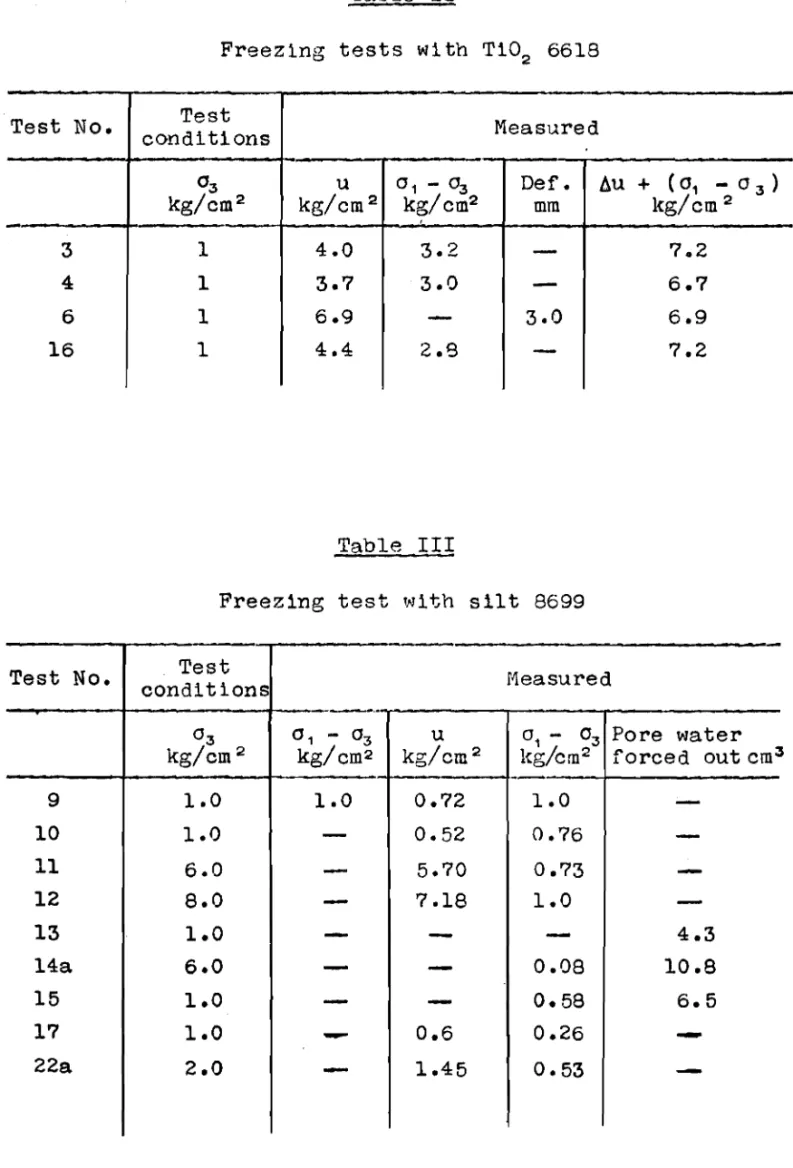
con-tained in Table II, were carried out at complete saturation. Determination of the pressure in the pore water for free axial deformation and constant water volume in test 6 showed a tension
in the pore water of 6.9 kg/cm2• From a comparison of the results
-24-following basic conclusions may be drawn:
The tension in the pore water for free axial deformation and constant water volume is equal to the heaving pressure for free water migration.
The forces which occur in the elementary saturation zones are
independent of the size of these zones. As a special case,
the saturation zone may involve the ・ョエゥイセ sample.
At the Same time, however, other questions arise, espe c ially the following:
Does the tension depend on the prestressing in the pore water?
(The heaving pressure does not t)
What is the connection between the heaving pressure and the pressure in the pore water?
What happens on thaWing?
On the basis of tests 3 and 4, which were carried out with various prestress values superimposed on the cell pressure and the pressure in the pore water, the first question can be answered in
the negative: The second question is answered by tests 3, 4, 6 and
16 in which aXial deformation was prevented at constant water
content. These tests show that the measured tension in the pore
water is less in these tests than in the tests with free axial
deformation by an amount equal to the heaving pressure. The two
forces behave additively, which means that the state-of stress in the unfrozen part of the sample caused by the penetration of the
frost is always the same, regardless of the test arrangement. The
last question is decided by test 6, where, after attainment of the state of equilibrium and determination of the pressure in the pore
water the cooling was shut off. The deformation did not merely
reverse itself, but the sample showed an additional settlement of
0.5%. At the same time, the measurement of the pressure in the
pore water showed a superpressure equal to 82% of the effective
cell pressure. This by itself is enough to destroy the bearing
capacity of the sample (What is surprising is the fact that
apparently a single freeze-thaw cycle 1s sufficient to bring about
-25-follows that direct measurement with classical methods can provide information whicn goes beyond our experience without contradicting
it. The sufficiently tested measuring methods themselves are now
to be applied to the other selected test materials.
Tests with Silt XVYセ
The first of the natural materials to be investigated was
silt, a ュ。エ・イゥセャ which is well known and feared as a
frost-susceptible foundation セ。エ・イゥ。ャN For the classification
charac-teristics of the naturally occurring material of our test see
Table I. The vector curve of the material indicates a dilatant
one. For the first test (No.9) which is represented in Fig. 9b,
the sample was not consolidated under cell pressure, but aniso-tropically, at a certain relationship between vertical load p and
side pressure k • p, where k < 1. The freezing test was 。ヲエ・セm。イ、ウ
carried out at constant water volume and with axial expansion
pre-vented. The test showed that after the occurrence of a small
tension during penetration of the frost in the steady state a eoyセ
water suuerRressure sets in. At the same time the unfrozen part of
the sample under the constant vertical load at which it was con-solidated collapses as soon as the pressure in the pore water rises.
This unexpected result was verified by tests 10, 11, 17 and
22a (see Table III). For this purpose the arrangement With the
「ャッ」セ・、 axial expansion and constant water volume was employed.
The superpressure measured in these tests was between 60 and 90%
of, the effective cell pressure. The drained tests (13, 14a and 15)
in which the pore water was forced out during penetration of the
frost served to confirm the discovered fact. Examination of the
samples in the frozen state showed that in no case was there any
formation of ice lenses. The determinations of water content showed
that a migration of water takes place from above downward at the
frost boundary. The only possible conclusion from these results
therefore is that in these non-cohesive soils the pore water is forced downward from the freezing into the unfrozen layers during
•
»
-26-non-cohesive ュ。エ・イゥセャウL are ver,r sensitive to changes of water
content the consequences of this phenomenon, namely the reduction in the strength of the material in the unfrozen layers, are
obvious. A single field observation of N. Goldstein so far confirms
this fact:
"The effects of (water) migration in cohesive and non-cohesive
soils are different. When cohesive soils are frozen the moisture
is always at'tracted to the frost boundary. In ョッョM」セィ・ウゥカ・ soils
セqe・。イウ as if on freezing セィ・ セッゥウエオイセキセイ・ forced to receqe
before 」ッョウエ。ョエセク⦅セイッキゥーァ ice crystals. This makes it possible to
use sandy soils as barriers to the flow of water towards the frost
boundary." (In the literature Which is influenced by representation
of the effect of "capillarity" during penetration of the frost this same layer is called "capillary breaking", and it is possible that this false idea has made correct observation of the phenomenon more difficult.)
In the first of セィ・ materials investigated, Ti02 , a migration
of the water' from the unfrozen part of the sample to the frost
boundary was clearly demonstrable. The tests with silt 8699, on
the other hand, showed that water from the frozen layers is forced
downward into the unfrozen part of the sample. To explain this
divergent behaviour it must be assumed in the case of Ti0
2 that the
penetration of the frost brings about changes in the structure of the ·sample which are expressed in an increase of pore volume, if only to provide room for the water present which is freezing, and
hence expanding. This structural change, already taking place
during the rapid penetration of the frost may be the reason for the
well-defined ice lenses forming in the stiattonary state. In the
case of silts, however, セ such change of structure of the soil
takes place during freezing, for which reason here also the growing
ice crystals can force the water downwards. Whereas in the case of
Ti02 the unfrozen part of the sample consolidates and the
destruc-tion of the strength during thawing in the previously frozen part of the sample is caused by the superpressure in the pore water, in the case of silt the collapse of the strength must be attributed
-27-to the properties of the unfrozen part of the sample, i.e., its sensitive reaction to changes of water content, and no change in
the properties of エィセ frozen part of the sample can be attributed
directly to freezing.
Tests with Clayey Silts 1002
On penetration of frost this material, 「セエィ in laboratory
tests and in tpe field, shows clear formation of ice lenses,
with-out any manifestation of heaving pressure. For this reason small
or zero tensions are to be expected in the pore water in freezing
tests with free axial expansion and constant water volume. The
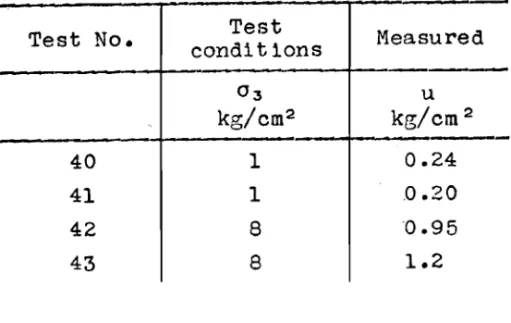
results of tests 40 and 41 (Table IV) do in fact show a sub-pressure
in the pore water of only 0.2 ォァO」ュセN This finding must be
reconciled with the observation that the material forms ice lenses. However it must first be determined whether or not the sub-pressure
in the pore water depends on the con.solidation pressure, i.e., on
the state of the material. Tests 42 and 43 reveal that any such
relationship'in only very insignificant. It is evident from these
tests that the formation of ice lenses and the tension in the pore
water are not directly associated. Therefore, if ice lens formation
is a necessary condition for the occurrence of a tension,
neverthe-less it cannot account for it completely. Rather, other conditions
which depend on the medium in which the freezing occurs, must be
satisfied. On the other hand, precisely this ice lens formation
points to a radical change in the structure of the soil as a
consequence of the penetration of the frost, which can occur even without (or with only slight) migration of water from the unfrozen part of the sample.
cィセョァ・ of Soil sエセ」エオイ・ During the Penetration of Frost
In order to verify directly the structural change of the soil during freezing, which was assumed in explanation of the previous
freezing tests, the following method was applied: a number of
samples of the three materials investigated were prepared either with a Proctor apparatus or by consolidation in a large odometer
-28-and were subjected to a pressure test with unobstructed lateral
expansion. The results obtained are compared with the results of
samples with the same materials prepared in the same manner but which had passed through a freezing and thawing cycle prior to
being tested for compressive strength. This freezing and thawing
cycle consisted of the following:
Rapid freezing throughout of the sample protected by a rubber sheath in an alcohol-dry ice bath with a temperature of -70°C, and
slow thawing at a constant temperature of 20°C.
The samples are frozen under these extreme temperature condi-tions so that during the freezing process, which here occupies only
a few minutes, no migration of the water can take place. The
results of the compression tests are contained in Table V.
The tests reveal very sharply the different effects of frost
penetration on the three materials investigated. The most
signif-icant results came from the silt test, but here it is evident that the freezing and thawing cycle may also be without influence on
the state of the material, a result which reinforces the conclusions
from the other two series of tests. The reduction of compressive
strength in the case of clayey silt 4002 anJ in the case of Ti02 is
such that it must be regarded as an essential change. The change
from the unfrozen to the frozen state takes place here, unlike the preceding freezing tests, in such a short time that no migra-tion of the water over large distances can have been possible.
It can be concluded from this that the structural change is a locally restricted one which can only involve the particles in the
immediate neighbourhood of each region of influence. This tact
points to a coagulation process(16} in Which previously bound water that was repelled by the solid soil components, in association with a simultaneous structural change of the soil, itself reduces the
compressive strength of the soil. This confirms our conclusion,
drawn from the results of the freezing tests, that in materials which form ice lenses on penetration of frost, rapid penetration
?
-29-slowly progressing or stationary freezing boundary, becomes the obvious structural change of the ice lenses.
It must also be remarked that the results contained in Table V
are of a purely qualitative nature. The water liberated owing
to a change of soil structure and coagulation does of course affect
the 」ッューイ・ウウゥカセ strength of the samples. The values measured are
at least a qualitative proof of this reaction of the soil to the rapid penetration of the frost.
4. 1?iscussion of the Results
Our tests were in all cases carried out in three steps: Saturation of the sample
Investigatidn of the effect of saturation on the shearing strength of the samples
Investigation of the freezing of saturated samples.
The materials investigated have been chosen here for their
particularly ,interesting properties, e.g. Ti02 and the marine chalk,
or their typical properties, e.g. the silt and clayey silt.
Although the experimental basis is a restricted one, some of the conclusions to be drawn from the results, and in particular those which relate to the methods of investigation, are of general
validity. The other conclusions, however, which point to the
properties of the materials apply for the present, strictly speak-ing, only'to the materials investigated; as qualitative indications of the behavlour of various kinds of soil, in the meantime, even these latter conclusions can be extended to all solIs belonglng to the same classes as those investigated here.
The flrst and most important conclusion is that lt ls possible to measure the forces acting on the soil and the pore water at
saturation during the penetration of frost, while at the same time lt has been demonstrated that the forces acting in the saturation zones are independent of the size of the zones bounded by the soil components and macropores (the point of view explained at the
-30-of saturation in the testing -30-of the shearing strength and in the freezing tests of soils is supported by the investigations of
T.e. Powers(l?) and by T.C. Powers and B.A. Helmuth(lS) on freezing
tests with concrete and cement: there too, the total degree of
saturation of a sample is not regarded as a valid measure of the
decisive saturation occurring in local saturation zones). The
methods based on these tests make possible the. general investigation
of the frost properties of the soil. A further possibility is also
gained of developing ways of inflyencing these properties in the
laboratory either by changing the properties of the soil components
(e.g. by increasing the cohesion with cement) or by partial sub-stitution of the fluid phase (e.g. stabilization with oil).
The second 」セョ」ャオウゥッョ is that a relationship exists between
the volumetric properties of the soils when sUbjected to shearing stress, as described by the vector curve, and its behaviour on
penetration of the frost. The application of the vector curve for
characterization of a soil-water system offers decisive advantages
over a characterization by classification properties alone. This
is particularly true in view of the division into materials which are deformed plastically and dilatent ones, made possible by the vector curve.
The tests With Ti02 6618 and clayey silt 4002 as well as
silt 8699 show that on penetration of the frost the forces acting on the soil and pore water are together determined by the charac-teristic properties of the soil, an hypothesis that was formulated
at the beginning. They give information concerning the formation
of ice lenses which in the materials under investigation are caused by the instability of the soil structure in the presence of the
penetrating frost.
The two studied materials which form ice lenses, i.e., Ti02
and clayey silt, for the first time permit a relationship between heaving pressure and tension in the pore water to be demonstrated. It was found that heaving pressure and tension in the pore water behave additively, i.e. that when either a heaVing pressure
-31-(deformation prevented) or a tension (water supply prevented)
occurs, or both at the same time, the forces acting on the unfrozen part of the sample are always of the same magnitude.
The tests also enable us to state that the formation of ice lenses may be caused either by migration of water from the unfrozen
strata (in our case in the dilatant Ti02 ) or by separation of pore
water in the freezing strata (in the plastically deforming clayey
sil t). The 'measured tensions in the pore water (Large in the case
of Ti02 , vanishingly small in the,case of clayey silt) confirm
this fact and show that obviously the formation of ice lenses is a necessary, but Dot in itself a sufficient condition for the occurrence of a tension and a consequent migration of pore water.
The fact that the ,tension is so great in the dilatant material Ti02
and is vanishingly small in the plastic clayey silts, leads to the establishment of a relationship between the occurrence and magnitude of the tension on the one hand and the volumetric
properties in the presence of a shearing stress on the other. The
. ,
tests with silt 8699 led to the at first surprising result that on penetration of the frost into this material the pore water is
forced out of the freezing stratum into the unfrozen, a behaviour that can be explained by assuming that the silt, already being of sandy character, possesses a structure which is proof against
freezing. It thus becomes possible that water is forced out by
growing ice crystals, a phenomenon which must be attributed to all
soils with frost-proof structure (i.e., sands and gravels). In
the case of the most fine-grained of the frost-proof soils investi-gated, i.e. the silt, its sensitivity to changes of water content leads to the conclusion that this material collapses due to loss of bearing capacity in the unfrozen strata as soon as the frost
penetrates. This explanation does not conflict with the behaviour
of the coarse-grained frost-proof soils, which, moreover, are
insensitive to changes of water content. Obviously the latter fact
alone would explain their insensitivity to the penetration of frost.
-32-The problem of frost susceptibility of the soils can be interpreted generally with the concepts of frost-proof structure
and sensitivity to changes of water content. While sensitivity
to changes of water content is a problem of soil mechanics related to the order of magnitude of the specific grain-to-grain pressure and can be explained by consideration of the geometric properties of the soil (particle size and grain distribution), the
frost-proof 」ィ。イ。Vエ・セ of a soil is also related to its petrographic
nature and the condition of the system in question, and is thus a problem of the coagulation properties of a soil falling within the sc?pe of soil physics.
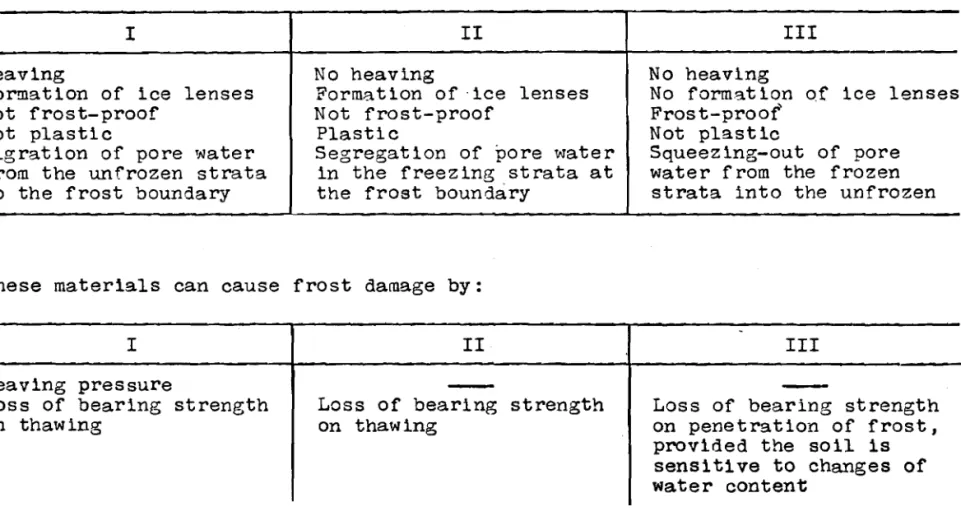
To sum up, the criterion of frost-proof quality enables us to
distinguish be tween the soils whtcb form ice lenses on penetration
of the frost and soils which do not display this phenomenon. The
soils which form ice lenses can be further subdivided by measure-ment of the heaving pressure into soils in which a migration of
pore water takes セャ。」・ from the unfrozen strata to the frost
boundary, and soils in which the ice lenses are' formed predominantly
by separation (segregation) of pore water. This subdivision is in
agreement With that based on the plastic or dilatant character of the soil.
The criterion of sensitivity to changes of water content further enables us to single out those soils Which, despite their frost-proof structure, suffer a loss of bearing capacity owing to this sensitivity and the forced recession water from the freezing
strata into the unfrozen ones on penetration of frost. It thus
becomes possible to reclassify the frost-sensitive soils described at the beginning in the manner shown in Table VI.
Generally speaking this enables us to recognize, and to
determine quantitatively, those measurable properties of the soil and of the soil-water system which reveal direct relationships between ground frost and soil properties, and also we are able to characterize the latter with suitable measurements.
7
セSSMᄋ
References
1. Casagrande, A. Bodenuntersuchungen im Dienste des
Strassen-baues (Soil investigations in the service of road
construction). Der Strassenbau, 25 (3), 1934.
2. Taber, S. Frost heaving. J. Geo1. 37 (5),1929.
3. Beskow, G. Soil freezing. 1935 Sveriges Geologiska
Under-soknlng, sere C, no.375.
4. DUcker, A. Untersuchungen uber die frostgefahrlichen
Eigen-schaften nicht bindiger,Boden (Investigations of the frost susceptibility properties of non-cohesive soils). 1939 Forschungsarbeiten aus dem Strassenwesen, vol.17.
セ
5. Peltier, R. Theorie capillaire du gel des sols routiers
(Capillary theory of soil freezing). Proc. of the 3rd
Int. cッセヲ・イ・ョ」・ on Soil セ・」ィ。ョゥ」ウN SWitzerland, 1953.
6. Jumikis, A.R. The frost penetration problem. New Brunswick,
1955.
7. Terzaghi, kセ Principles of soil mechanics. Eng. News Record,
vo1.95, .1925.
t
8. Casagrande, A. The pressure 、・エ・イュャョセエゥッョ in clay solls.
Eng. News Record, 115 (4), 1935.
9. Ruckli, R. Der Frost im Saugrund (Frost in building soil).
Vienna, 1950.
10. Bishop, A. and Eldin, G. Geotechnique (2),1950.
11. セェ・イイオュL L. and Hude r , J. Measurement of the permeability of
clays. Proc. of the 4th Int. Conference on Soil
Mechanics. London, 1957.
12. Skempton, aNセN Soils. Building Materials Edit. Reiner,
Amsterdam, 1954.
13. Casagrande, A. Prestress induced tn consolidated quick triaxial
test. Proc. of the 3rd rnt.Conference on Soil Mechanics.
Switzerland, 1953.
14. Penner, E. Soil moisture tension and ice segregation. H.R.B.
Bull. 168, 1957. Washington, D.C.
15. Goldstein, M.N. Ordujanz, Grllndungen fur Bauwerke (Foundations
for buゥャ、ゥョァウIセ Berlin 1954.
-34-17. Powers, T.C. Basic consideration pertaining to freezing and
thawing tests. Research Bulletin 58 of the Portland
Cement Association. Chicago, 1955.
18. Powers, T.C. and Helmuth, R.A. Theory of volume changes in
hardened portland cement paste during freezing. Research
Bulletin 46 of the Portland Cement Association. Chicago, 1953.
Taqle I
Classification of test materials
.
Laboratory No. 4002 6618 7071 8699 Plastic limit 40.9 29.5 45.1 ⦅ᄋセw Plasticity index 24.0 7.2 16.7-%w
Grain distribution Less than 2 mm 100.0-
100.0 100.0%Less than 0.2 mID 99.6 100.0 84.8 98.3%
Less than 0.02 mm 88.2 95.0 93.1 74.1%