Digitized
by
the
Internet
Archive
in
2011
with
funding
from
Boston
Library
Consortium
Member
Libraries
HB31
.M415
\o.ol-Massachusetts
Institute
of
Technology
Department
of
Economics
Working
Paper
Series
CURRENT
ACCOUNT
DEFICITS
IN
RICH
COUNTRIES
Olivier
Blanchard
Working
Paper
07-06
Feb
10,
2007
Room
E52-251
50
Memorial
Drive
Cambridge,
MA
02142
This
paper can be
downloaded
without
charge
from
the
Social
Science Research
Network Paper
Collection
atMASS.' ~: ~"' ITE
OF TECH
FEE
2 22007
LIBRARIES
Current
Account
Deficits in
Rich
Countries
Olivier
Blanchard
*February
10,20007
(first draft:October
30,
2006).
*
MIT
andNBER.
Mundell-Fleminglecture given, at theIMF
inNovember2006.Ithank
Ricardo Caballero, Francesco Giavazzi, Guido Lorenzoni, AndreiShleifer, Roberto Rigobon,
andJoseTessadaforcommentsanddiscussions.Ithank TatianaDidierforexcellentresearch
Abstract
Current account imbalances havesteadily increased in richcountries over the
last 20 years. While the U.S. current account deficit dominates the numbers
andthenews, othercountries, especiallywithintheEuroarea, are alsorunning
largedeficits.
Thesedeficitsaredifferent from the LatinAmericandeficitsofthe early 1980s, or the Mexican deficit ofthe early 1990s.
They
involve rich countries; theyreflectmostly private savingand investment decisions, andfiscal deficitsoften
playa marginalrole; and thedeficitsare financed mostlythrough equity, FDI,
andown-currency bondsratherthan throughbank lending.
Yet, thereappears a widely shared worry that thesedeficits aretoo large, and governmentinterventionisrequired.
My
purpose,in this lecture,is toexaminethe logic ofthis argument. I ask the following question:
Assume
that deficitsreflect private saving and investment decisions.
Assume
also that people andfirms have rationalexpectations. Should thegovernment intervene, and, ifso,
how?
To
answer thequestion,Iconstructasimplebenchmark.Inthebenchmark, theoutcomeisfirstbest andthereisnoneed norjustification forgovernment
inter-vention. Ithen introduce simple distortionsin eithergoods, labor, or financial
markets, andcharacterizetheequilibriumin each case. Ideriveoptimalpolicy
andthe implications for the current account. I show that optimal policy
may
or
may
not lead tosmaller current account deficits.Iseethemodel andthe extensionsvery
much
asafirstpass.Sharper conclusionsrequireabetterunderstandingoftheexactnatureandthe extent of distortions,
and
we
donot have it. Such understanding is needed howeverto improvetheIntroduction
The
lasttwenty
years havebeen
characterizedby
steadily larger current ac-count imbalancesinrich countries. This isshown
inFigure 1,which shows
theevolution ofthe cross-country standard deviation ofratios of current account
balances to
GDP,
since 1988,for three sets of countries.The
firstlinegives theevolution ofthe standarddeviation forthe countries
which
aremembers
oftheOECD
today; thishowever
isan
unbalanced panel,and
new members
such asMexico
orCentralEuropean
countries are quitedifferentfrom
earliermembers.
For this reason, the second line gives the evolution of the standard deviation
for the countries that
were
alreadymembers
oftheOECD
in 1988.The
line isvery similar to the first:
The
increase is not drivenby
the addition ofthenew
members.
The
third line gives the evolution of the standard deviation for thesetofcountries
which
aretoday
in theEuro
area.The
evolutionis again quitesimilar.
Figure 1.
Standard
deviation ofCA
deficits/GDP1990 1995 2000 2005
All
OECD
Euroarea
Balanced
OECD
Source:
OECD
database.Behind
these trends aretwo
major
stories.The
first isan
increase in deficits within theEuro
area. Countries suchasPortugaland
Spainarerunningdeficits closeto10%
oftheirGDP.
The
otheris the increaseinU.S. deficits,which
now
From
the LatinAmerican
deficits ofthe early 1980s to theMexican
deficit ofthe
mid
1990s, currentaccount deficitshave regularlymade
the news.1Today's
current account deficits are
however
quite differentfrom
their predecessors.The
countries in deficit arerich countries.The
deficitsare notprimarily drivenby
fiscal deficits, but ratherby
private savingand
investment decisions.The
deficitsare typicallyfinancedthroughequityflows,
FDI
flows,and
own-currencygovernment
bonds, rather thanthrough
bank
lending.Thus,
many
oftheconcernsassociated with, say, the LatinAmerican
deficitsofthe 1980s,
seem
much
less relevant here. Yet, policymakers
and
many
econo-mists
worry
thatthedeficits are toolarge.To
caricature, there areroughlytwo
views:
The
first isknown
as the"Lawson
doctrine",named
after NigelLawson,
theChancellor ofthe
Exchequer
who
articulated it inthe 1980s. This "doctrine" isbasically a restatement ofthe first welfare theorem:
To
the extent that currentaccount deficits reflect private saving
and
investment decisions, that there areno
distortions,and
thatexpectations arerational, thenthere areno reasons forthe
government
to intervene.The
second—
and
more
prevalentview—
could be calledthe "prudential" or the"IMF"
view. It is that, even ifdeficits reflected private savingand
investmentdecisions, distortions are present
and
lead to deficitsthat aretoo large.Govern-ment
intervention toreduce these deficitsis desirable. Thisview
is reflected inthe frequent use ofsuch terms as "global imbalances"
and
"fragility" tochar-acterize current evolutions.
What
exact distortions,and whether
theseindeedjustifypolicies
aimed
at reducingdeficits, has nothowever
been
worked
out.The
purpose
ofmy
lectureistoexplorethis issue.Moving away
from
particulars,I take
up
anarrow
question, namely:Assume
that a current account deficit reflects private savingand
investment decisions.Assume
rational expectations.Is there
any
reason for thegovernment
to intervene,and
what
is the optimalform
ofthatintervention?It isclearthattheanswer
depends
on
the existenceand
thespecificform
ofdis-tortions presentin the economy. Thus, Istart
from
abenchmark
inwhich
suchdistortions are absent, the equilibrium is the first-best outcome,
and
there isno
role forgovernment
intervention. I then introduce variousdistortions,which
are often thought to be important in this context. In each case, I characterize
the effect ofthe distortion
on
the equilibrium,and
discuss the role of policy.Clearly theroleof policyis to increase welfare, not reducethedeficit perse.
As
we
shall see, optimal policymay
ormay
notimply
a reductionin the deficit.Isee the
model and
itsextensionsverymuch
asafirstpass. Sharperconclusionsrequireabetterunderstandingoftheexact nature
and
theextentofdistortions,and
we
do
not have it.Such
understanding isneeded however
toimprove
thequality ofthe current debate.
The
lecture is organized as follows.Section 1 looks at current account deficits within the
Euro
area, with apar-ticular focus
on
Portugal,which
is, inmany
ways, a poster child for the issuesraised in thislecture. Section 2 brieflyreviews the evidence
on
the U.S. currentaccount deficit,
and on
"global imbalances".Section 3develops the
benchmark.
My
focusbeingon
distortions, Idevelop thesimplest
benchmark
needed
for the purposes,namely
a two-periodeconomy,
withtradables,non-tradables
and
leisure, log-logpreferencesand Cobb-Douglas
production. I focus
on
the effects ofa shift in preferences,namely
a decrease in the discount factor.As
is well understood,two
mechanisms
are at work: intertemporal reallocation ofconsumption
(and leisure) across periods,and
in-tratemporal reallocation of production
between
tradablesand
non-tradables.Distortions
may
affect either orboth
mechanisms,
and by
implication, affectcurrent account deficits. Sections 4 to 6 look at the implications of different
distortions.
The
first-best equilibrium is associated with increases in the relative price ofnon-tradables
and
in thewage
in the first period,and
corresponding decreasesinthesecond period. Section 4looks at the implications of price or
wage
rigidi-ties,
and
characterizes optimal policy.The
optimal policy is to eliminate theboom/slump
innon-tradables generatedby
priceorwage
rigidities; thismay
ormay
not imply a decrease in the current account deficit.The
first-best equilibrium is also associated with a decrease in the productionoftradables in the first period,
and
an increase in the production oftradablesinthe second period.
One
may
thinkof distortionswhich
may
make
it difficultto recover
and
expand
production in the second period. Financial constraintsthe funds
needed
for production in the second period. Section 5 looks at theimplications ofsuch adistortion,
and
characterizesoptimalpolicy.The
purposeofoptimal policy in this case is clearly to limit the decrease in tradables
pro-duction in the first period. This
may
ormay
notimply
a decrease the currentaccount deficit.
One
ofthe current worries of policy makers, even in theUnited
States, is thepossibility of a
"sudden
stop", a sharp increase in the rate ofreturn requiredby
foreign investors.By
itselfand
absentdomesticdistortions, thepossibilityofa
sudden
stop does not changethe first-best nature ofthe equilibrium: Privateagents will take this possibilityinto account
when
making
plans.The
questionis
whether sudden
stops can interact with distortions in away
that justifiesgovernment
intervention.Many
potentialmechanisms
havebeen
identified, butmost seem
largely irrelevant in rich countries. Section 6 discusses these issuesby
extending thebenchmark
to athree-period model. This allows us tolook at the effects of a positive probability of asudden
stop in the second periodon
the equilibrium,
and
the potential role ofpolicyin that context.There
is a long leapfrom
these simple exercises to actual deficits. Section 7nevertheless takes the leap,
and draws
tentative policy implications,both
forcountries within theEuro,
and
for "global imbalances".1
Current account
deficitswithin the
Euro
area
Today,
two
member
countries oftheEuro
area, Spainand
Portugal,havecurrentaccountdeficitsclose to
10%
ofGDP.
Inthe contextofthispaper, theexperienceofPortugal is particularly interesting, solet
me
start there.2The
basicmacroeconomic
evolutions areshown
in Figure 2,which
gives theevolution of the
unemployment
rate,and
of the ratio of the current accountdeficit to
GDP
in Portugal, since 1995.The
figure points totwo
very differentperiods:
The
first isan
economic
boom, from
1995 to 2000.There
is generalagreement
that the sources of the
boom
were twofold,both
associated with the prospectofjoining the Euro.
The
firstwas
a steady decrease in real interest rates,due
in large part to the disappearance of the currency
premium.
The
secondwas
theexpectationthat joiningthe
Euro would
accelerateconvergence,and
lead tohigherproductivity growth.
Both had
theeffect ofincreasing private spending,leading
both
to higher outputgrowth and
to a steady increase in the currentaccount deficit.
By
2000, theunemployment
ratewas below 4%, and
the currentaccount deficit slightly above
10%
ofGDP.
Figure 2.
Unemployment
rateand
currentaccount
deficitPortugal,1995-2007
gm
Q.D
co<3( CO CD O (0 1995 19961997 1998 1999 20002001 2002 2003 2004 2005 2006 2007 Unemploymentrate CurrentaccountdeficitNote, as this goes to the
theme
ofthe lecture, that expectationsmay
not havebeen
rational, butwere
surely not crazy.Note
also that theboom
was
drivenby
private spending, not public spending.From
1995 to 2000, the ratio ofthe
budget
deficit toGDP
decreasedfrom
5%
to3%;
theOECD
measure
ofthe cyclically-adjusted deficit
remained
roughly constant.Note
finallythat theboom
was
associated with steady real appreciation:From
1995 to 2000, unitlabor costs increased
by
12%
relative to theEuro
area average.Expectations offasterconvergence
may
havebeen
reasonable.But
theyturned out not tobe
borne outby
the facts: Productivitygrowth
hasremained
verylow, indeed lower
than
itwas
in the 1990s. Starting in 2001, privatespend-ing
growth
sharply decreased, leading to lowgrowth
and
a steady increase inunemployment. Attempts by
thegovernment
to sustaingrowth
have led toan
increaseinfiscaldeficits,
which
arenow
around
5%
ofGDP.
The unemployment
rateis
back around 8%.
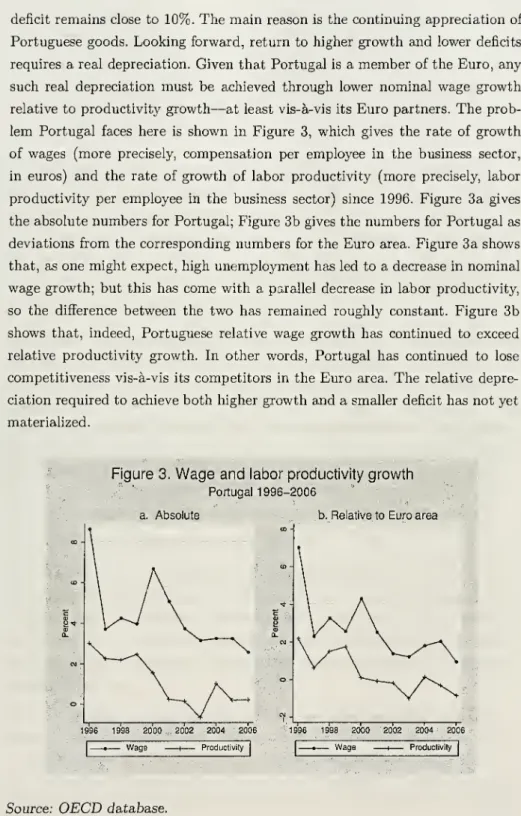
deficit remains close to 10%.
The main
reasonisthe continuing appreciation ofPortuguese goods.
Looking
forward, return to highergrowth
and
lower deficitsrequires areal depreciation.
Given
that Portugalis amember
ofthe Euro,any
such real depreciation
must be
achieved through lowernominal
wage
growth
relative to productivity
growth
—
at least vis-a-vis itsEuro
partners.The
prob-lem
Portugal faces here isshown
in Figure 3,which
gives the rate ofgrowth
of
wages (more
precisely,compensation
peremployee
in the business sector,in euros)
and
the rate ofgrowth
oflabor productivity(more
precisely, laborproductivity per
employee
in the business sector) since 1996. Figure 3a gives theabsolutenumbers
forPortugal; Figure 3bgivesthenumbers
forPortugalasdeviations
from
the correspondingnumbers
for theEuro
area. Figure3a
shows
that, asone
might
expect, highunemployment
has ledto a decreaseinnominal
wage
growth; but this hascome
with a paralleldecrease in labor productivity,so the difference
between
thetwo
hasremained
roughly constant. Figure3b
shows
that, indeed, Portuguese relativewage growth
has continued to exceed relative productivity growth. In other words, Portugal has continued to lose competitiveness vis-a-vis itscompetitors in theEuro
area.The
relativedepre-ciationrequired toachieve
both
highergrowth and
asmallerdeficit has notyetmaterialized.
Figure 3.
Wage
and
labor productivitygrowth
Portugal 1996-2006 a. Absolute....
.
. .
b.RelativetoEuro area
Wage Productivity Wage Productivity
Should
Portuguesemacroeconomic
policyhavebeen
different inthesecondhalf of the 1990s?Given
what
we
now
know, namely
that expectationswere
toooptimistic, the answeris obviously yes.
The
relevantquestion ishowever
what
should have
been
done
givenwhat was
known
then? Shouldgovernment
poli-cieshave
reduced theboom,
limited the appreciation,and
limited the currentaccount deficit?
The
question ofwhat
should havebeen done
during theboom
in Portugal isnow
academic.But
the question is very relevant for Spain today. Since themid-1990s,steady
growth
hasledto alargedecreaseintheunemployment
rate,down
from
20%
tounder
9%
today—
a decreaseoften referred to asthe "Spanishmiracle." This
growth
hasbeen
sustainedby growth
inprivate spendingratherthan
public spending:The
fiscal positionhas turned from a largedeficit in themid
1990s toasurplus of1%
ofGDP
today.At
thesame
time,growth
hascome
with a steadyrealappreciation. Since 1995,unit labor costs haveincreased
by
21%
relative to theEuro
area.The
currentaccountdeficithasincreased
from rough
balanceinthemid
1990sto9%
ofGDP
today. This raises aset ofobvious questions. Will Spain go through the
same
adjustment
processasPortugal?Should government
policieshave beendifferent overthelastdecade?Should
they havelimitedoutput growth,appreciation,and
thecurrent account deficit?
What
should the Spanishgovernment
do today?2
The
U.S. current
account
deficitThe
U.S. current accountdeficit hasdominated both
thenews and
much
oftheresearch ininternational
macroeconomics
inthe recentpast.3My
purposehereis onlyto pointto the aspects directlyrelevant to the
theme
ofthelecture, therole of private saving
and
investment versus fiscal policy, theway
the deficithas
been
financed,and
the rationality ofexpectations underlying decisionsand
investors's choices:
The
U.S. deficit is very large,and
reflected in current account surplusesvis-a-vis the
United
States inmost
regions of the world.The
composition of the3.
A
goodsurveyoftheoriesand factsis providedbyCline (2005).An
insightfulanalysis ofthe relative roles of saving, investment, andporfolio flows, intheUnited States andcreditor
corresponding current account surpluses for the third quarter of
2006
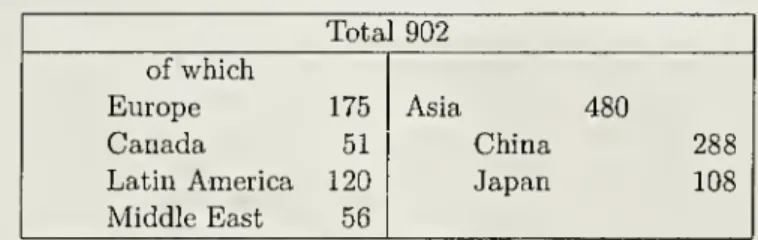
is given in Table 1.Roughly
half is accountedby
Asia, primarilyChina and
Japan.Roughly
one fourthis accounted forby
Europe.Of
the rest, an increasing but stiUsmall proportionisaccountedforby
theMiddle
East, reflectingthe increasein oil prices.
Table
1.The
U.S. current
account
deficitand
itscounterparts.
2006-3, in billions
of
dollars, atannual
rates.Total 902
of
which
Europe
175 Asia 480Canada
51China
288Latin
America
120Japan
108Middle
East 56Source:
BE
A
International Transactions. Table 11,January 2007
The
U.S. deficitand
the corresponding foreign surpluses havemany
causes.I believe that there is
now
a broad consensusabout
the following proximatecauses. First, low U.S. saving, reflecting primarily low private saving, but also
budget
deficits. Second, high foreign saving, particularly from Asia—
what
Ben
Bernanke
(2005) has referred to as the "savingglut." Third, lowforeign invest-ment, inboth
Europe and
Asia. Fourth, a strong preferenceby
investors forU.S. overforeign assets. All four factors are
needed
to explain thecombination
ofcurrent accountbalances, thestrongdollar,low world realinterest rates,
and
apparently low expected returns
on
U.S. assets.4The
important point formy
purposes is that fiscal policies,whether
in theUnited
States or abroad, while notirrelevant,are clearlynotthemain
cause ofthe U.S. current accountdeficit.Private saving
and
investment decisions—
sometimes mediated
through policy,such as the combination of capital controls
on
capital outflowsand
reserve ac-cumulation inChina
—
around
theworld are.Bank
lending,which
was
central to the LatinAmerican
deficits, is nearlyir-relevant in the case of theU.S. deficit.
The
composition offoreign holdings of4. For more discussion, see in particular Bernanke (2005), Blanchard, Giavazzi, and Sa
(2005), and Caballero, Farhi,and Gourinchas (2006).
financialassets, for
both
stocksand
flows,is giveninTable 2.The
compositionof flows has
changed
over time, but the picture givenby
the stocknumbers
isvery clear: In the third quarter of 2006, gross foreign holdings of U.S. assets were roughly equal to 11 trillion dollars.
Of
those, roughly40%
took theform
ofholdingsofcorporateequities
and
directinvestment—
a verydifferentpicturefrom
the financing ofLatinAmerican
deficits.Table
2.Composition
of foreignholdings
ofU.S.
assets (billionsof
dollars).
2006
Flows
Stocks Total 1,406 11,946 T-bills 101 2,069 Official holdings 111 1,371 Privateholdings -10 698 Corporate equities 112 2,601Corporate bonds
377 2,596 Direct investment 185 2018Source:
Flow
of Funds, FederalReserve Board. TablesF.107,and
L.107. Stocks:"Total U.S. financial assetsheld
by
therestofthe world", asof2006:3. Flows:"Net acquisitionoffinancial assets
by
therestoftheworld", over thefirstthreequartersof2006.
There
hasbeen
much
discussion as towhether
investors behind these capitalflows
have
rational expectations.There
isno
question that, sooner or later,current account deficits will have to decrease,
and
this willmost
likely requireasubstantialrealdepreciation of U.S. goods. For thisreason,
and
given thelowU.S. interest rates, a
number
ofeconomists have argued that foreign investorswere
too optimisticabout
expected returnson
U.S. assets. If investors havea strong preference for U.S. assets however,
and
if they anticipate the rateof depreciation to be positive
but
small, then the evidence against rationalexpectationsis
much
weaker. Indeed, overthepastfewyears, financialinvestorsrather
than
these economists appear to havebeen
right about the strength ofthedollar.
In short: Current "global imbalances" appear to
come
primarilyfrom
shiftsin private saving
and
investment. In the absence of strong evidence to thecontrary, the
assumption
that expectations are rational does not appearun-reasonable. This takes us back to the question raised in this lecture.
Beyond
reducingthe U.S. budget deficit
—
a reductionwhich
indeed appearsjustifiedon
its
own,
but,by most
estimates,would
onlymake
a dentinthe current account deficit—
should the U.S. (andother)governments
aim
atreducingtheremaining imbalances further?Why,
and
ifso,how?
3
A
benchmark
For this
and
the next three sections, I shall focuson
the followingnarrow
question:
Assume
current account deficits are the result ofprivate savingand
investmentdecisions.
Assume
expectationsare rational. Shouldthegovernment
intervene,
and
ifsohow?
To
do so, I startwith the followingbenchmark:
The
model
The economy
goeson
—
and
peoplelivefor—
two
periods.Ineachperiod,peoplederive utility
from
theconsumption
oftwo
goods, tradablesand non
tradables,and from
leisure.5Utility is given by:
where
and
maxV =
U
+
/3U'U
=
\og(C)+
<j>\og(L)\og(C)
= hog(C
T
)+
^\og(C
N
)where
primes denote second period variables,Ct
and
Cn
denotetheconsump-tionoftradables
and
non-tradables respectively,and
L
denotesleisure. (3 is thediscount factor.
As
is wellknown,
the log-log assumptions,and
the implication of equalin-fratemporal
and
intertemporal elasticities of substitution eliminate anumber
5. Iintroducealabor-leisurechoicebecause,when,later, Iintroducedistortionswhichimply that employment ispotentially offthe labor supply, I wantto be ableto assess thewelfare
cost ofsuchadeviationandderivethe optimalpolicy.
of interesting issues, in particular with respect to the path of tradables
con-sumption.6; but they are fine for the points I
want
tomake
in this lecture.Taking
tradables as thenumeraire,and assuming
for simplicity that the world interest rate, theinterestrate intermsof tradables,isequaltozero, thebudget
constraint ofconsumer-workers isgiven by:
qC
N
+
C
T
+
q'C'N
+
C
T
= A = w(N
t
+
N
N
)+
w'(N
T
+
N'
N
)+ir
+
n'with
N
T
+
N
N
= L-L,
N
T
+
N'
N
=
L
-
L'where
A
is total wealth,Nx
and
Nn
denoteemployment
in the tradablesand
non-tradables sector respectively, q
and
iu denote the relative price ofnon-tradables
and
thewage
in terms in tradables respectively. 7r is profit. For themoment,
there isno
government; I shall introduceit later.On
the production side, competitive firms in the tradablesand
non-tradablessectors
maximize
profitsubject to the following production functions:Y
T
=
Nf,
Y
N
=
N
N
awith similar equations holding for the second period. Capital is implicitly
as-sumed
tobe fixed, sothere isno
investment decisionin themodel. I shallfocuson
current account deficitscoming
fromvariations in saving.The
equilibrium
Equilibrium requires that,ineach period, the non-tradables
and
the labormar-ket clear. This gives us four equations:
_
111.
,W
a/(a-l)C
N
=
Y
N
=>-
—
—
-
A =
—
2 1+
p
q aq18
1 w' /(0_1)and
»r T r ,W,l/(a-l),W
,1/(0-1) ? 1N
T
+
N
N
=
L-L
=>(-)
+(—
)=L
a aq 1+
Q
w
6. Seeforexample ObstfeldandRogoff(1996), 4-4, equation(34), and Dornbusch (1983).
w' 1/(a_1) w' 1/(a_1)
6
where
1 '
' '
'W
A =
Y
T
+
Y^
+
qY
N
+
q'Y^The
four equilibrium conditions are straightforward:Wealth
is equal to thepresentdiscounted valueofoutputintermsof tradables.
Spending
on
tradables,on
non-tradables,and on
leisure are all proportional to wealth.The
supplyof non-tradables
—
equivalently thedemand
for laborfrom
the non-tradablessector
—
is a decreasing function of thewage
in terms of non-tradables; thedemand
for laborfrom
the tradables sector is a decreasing function of therealwage
in terms oftradables.If
=
1, (so thediscount rate is equalto theworld interest rate,namely
zero), then the equilibrium is thesame
inboth
periodsand
the current account isbalanced. Itwill benotationally convenient to
assume
that, in thisequilibrium,all quantities are equal to one, i.e. that Cj
=
Yi=
TVj=
L
=
C[=
Y(=
N[
=
L'=
1, for i=
T,N.
This in turn requires thatL
=
3and
<j>=
a/2. Forour purposes, these restrictions are innocuous.
Under
this normalization also, q=
q'=
1,and
w
=
w'=
a. It is alsoconvenient to introducew
=
w/a,
so inthe initial equilibrium
w =
w'=
1.Increased
impatience
and
current
account
deficitsI shall consider throughout the effects of
an
increase in impatience,d0
<
0,starting
from
=
1. Exactly thesame
analytical resultswould
obtain—
with aminor
differencewhich
Ishallpointoutbelow
—
if Ilookedinsteadatadecreaseinthe rate ofinterest at
which
thecountrycan borrow, dr<
0,startingfrom
r=
—
anexperiment
which
would
capture forexample
part ofwhat happened
in Portugalinthe 1990s.Other
shocks,forexample
the anticipation of increasesin productivityineithertheproduction oftradables or non-tradablesnextperiod,would
lead todifferentanalyticalresults,butthesame
generalconclusionsabout distortions,and
the role for policy.The
decrease in leads totwo
reallocations, intertemporal,and
intratemporal:•
Being
more
impatient, peoplewant
tospend
more and work
lessin thefirstperiod.
•
Consumption
ofnon-tradablesand
tradablesincrease.The
consumption
of tradables increases
more
than theconsumption
ofnon-tradables.Tak-inga linear approximation
and
solvingthe equationsabove
gives:dC
N
=
\
T
±
ir
(-df3)>
0;dC
T
=
\{-dp)
>
16 —
la I•
Employment
decreases(leisure increases).Employment
innon-tradablesincreases, but
employment
intradables decreasesby
more:dN
N
=
i^Mfl
>
0;dN
T
=
j^i-dP)
<
•
The
price of non-tradables, q, increases.So
does the tradables productwage, w.
The
non-tradables product wage,w/q
decreases:dqv
=
-
l^±(-d0)
> dw
= ^—^(-dp)
>
2
3-2a
v '3-2a
v 'The
realconsumption
wage,w/y/q
increases.• Increased
demand
for,and
decreasedsupplyoftradables lead toacurrentaccount deficit:
1 3
d (current account deficit)
=
-
-—
—
{—dp)
>
£ o /id
• All changes hold with opposite signsin thesecond period.
•
As
a, the degree ofreturns to labor, increases, the production frontierbecomes
lessconcave,and
itbecomes
easierto shiftproductionbetween
tradables
and
non-tradables. Thus, the price of non-tradablesand
thewage
increaseby
less.The
productionofnon-tradablesincreasesby
more,theproductionof tradables decreases
by
more,leading toalargercurrentaccount deficit.
Thus, theequilibriumresponseexhibits
an
appreciation followedby
adeprecia-tion, and,correspondingly, adecreaseintheproductionoftradables followed
by
an
increaselateron.The
current accountdeficit inthefirst period,due
to bothhigher
consumption
and
lower production of tradables, is offsetby
a currentaccount surplus in the second period.7
7. Underthealternativeassumption ofa decrease intheinterestrate,dr
<
0, alltheequa-tionsabovewouldhold,with dr replacing d/3.Theonlydifferenceisthat,whilethe decrease
Clearly,
under
the assumptionsmade
so far, theoutcome
is the first-bestout-come,
and
there isno
need nor justification forgovernment
intervention.The
questionsare then:
What may
be the relevant distortionsin this context?How
do
they affect the equilibrium?And
what
is the optimal policy? In the nextthree sections, I explore three general directions:
The
potential role ofwage
or price rigidities in distorting the adjustment; the potential role of financial
constraintsindistortingadjustmentinthe tradables sector;the implications, if
any, ofthe possibility of
sudden
stops, inwhich
the countryis either cutfrom
world financial markets, or has to
pay
amuch
higher rate of return.4
Wage
and
price
rigidities,and
current
account
deficitsDuring
the 1990s, the increase in spending in Portugalcame
not only witha current account deficit, but also an output
boom
and
a large increase inemployment.
This is in clear contrast to theoutcome
in ourbenchmark,
where
the current account deficit
comes
with a decrease inemployment.
8The
result in thebenchmark
ismore
general thanitmay
first appear:The same
would be
true of an increase in expected productivity, leading to an increaseinwealth,
and
thus to an increase in bothconsumption
and
leisure in the firstperiod.Thispoints tothe potentialroleof
wage and
pricerigiditiesindistortingthe adjustment:
The
price of non-tradablesand
the realwage
may
not haveincreased
enough
to achieve the desired infratemporal reallocationbetween
thetwo
sectors.The
slump
since2000points toanother typeof potentialwage and
pricerigidity.In the first best, shifting
from
a currentaccount deficit in the first period to acurrent accountsurplusinthe secondrequires a decreasein therelativeprice of
non-tradables
and
intherealwage.Such
arealdepreciationhas provendifficult to achieve inPortugal. This points tosomething
likedownward wage
rigidity.There
aremany
ways
of formalizingwage and
pricedistortions, and, inthe end,the details matter. In this section, I take a first pass
by
simplyassuming
thatboth
qand
w
do
not adjust at all,and
thusremain
equal to one throughout.in Phas noeffectonwealth A, the decreaseinr increaseswealthbydA
=
-2dr.8. Oneofthe
many
problemsinmappingany modeltothedata: Theinitialunemploymentrate in Portugal (7% in 1995) was probably higher than the naturalrate at thetime. Thus, someoftheemployment increasein the1990swasprobablyjustified.
I
assume
thatemployment
is determinedby
labordemand.
That
is, Iassume
that, inthe tradablessector,
demand
isdeterminedby
profitmaximization,and
that, in the non-tradables sector, labor
demand
is determinedby
thedemand
for non-tradables.9 I leave the discussion of
downward wage
rigidity to later; itturns outthatitseffectsarequitedifferent
from
thoseinthis section,and
closelyrelated to the effectsoffinancial constraints, discussed inthenext section.
The
equilibrium
Inadditionto the assumptions that q
=
q'=
1and
w =
w'=
1, theequilibrium is givenby
the condition that the non-tradablesmarket
clearseach period:Y
N
= C
N
=>Y
N
!2(1+/?)
Y'N
-C'
N
=
Y'N
-^-j-^
where
2+
Y
N
+
Y^
Output
of non-tradables is givenby
thedemand
for non-tradables,which
isproportional to wealth.
Wealth
is in turn equal to thesum
of outputs in thetradables
and
non-tradables sectors over the two periods.Given
w =
w'=
1,profit
maximization
in the tradables sector implies constant production Y-j-=
Y±
=
\.Together, these
two
equations determine output of non-tradables inboth
pe-riods,
and
thus total output,and
wealth.Wealth
in turn determines thecon-sumption
of tradablesinboth
periods,and by
implication the current accountbalance.
Increased impatience
Consider again anincreaseinimpatience, adecreasein/?.
Given
wage and
price9. Theusualrationalizationwouldbetoassumemonopolisticcompetitiveprice-settingfirms
in the non-tradablesector,willing to satisfy demandso longas price exceedsmarginal cost.
An
explicit formalizationwould then havean additional distortion, namely the presenceofthe monopolisticmarkup. Thisdistortion, so long as the markupisconstant,isirrelevant for
my
purposes.rigidities, only one
mechanism
isnow
at work,namely
intertemporal realloca-tion:• People again
want
tospend
more
and work
lessin the current period.•
Consumption
ofnon-tradablesand
tradables increase,and
now
increaseby
thesame
amount. Denote
first-bestchangesby
a star.Then:
dCN
=
\{-dj3)>
dC
N
>
0;dC
T
=
\(-d(3)=
dC*
T
>
The
increase in theconsumption
oftradables is thesame
as in the firstbest. But, because the price of non-tradables does not increase, the
in-crease in the
consumption
on
non-tradables is higher than in the firstbest.
•
Employment
in non-tradables increases.Employment
in tradablesre-mains
unchanged.So, incontrast tothefirstbest,employment
increases:dN
N
=
—
{-dp)
> dN*
N >
0;dN
T
=
> dN%
dN =
--!-(-dp)
>
2a• Increased
demand
fortradables,togetherwithan
unchanged
supply, leadto a current account deficit:
d (current account deficit)
=
-
{—d(3)>
Because
the increase indemand
for tradables is thesame
as in the firstbest,
and
supply does not decreasewhereas
it does in thefirst best, thecurrent account deficit is actually smaller than in thefirst best.10
• All changes hold with opposite signs inthe second period.
Thus, the
economy
goes through aboom
cum
current account deficit in thefirst period, a
slump
cum
current account surplus in the second period.Both
the
boom
and slump
areinefficient.Workers
would
ratherwork
less than theydo
inthe first period,and
more
than they do inthe second period.A
role forpolicy?
10. Thisresultisnot robusttomoregeneralpreferences,and
may
notholdiftheintertemporaland intratemporal elasticities of substitution are different. But the point that the current accountdeficitneednotbe largerundersuchrigidities, is general.
Can
policyimprove
theoutcome
and, ifso,how?
A
fullanswer
would
requireafull other lecture. Let
me
briefly talkabout monetary and
tax policy,and
thendeal
more
formallywith the potential role ofgovernment
spending.Depending on
theexact natureofrigidities,monetary
policycangetthealloca-tion close to oreven
back
tofirst best.Take
forexample
the casewhere wages
are flexible
and
onlynominal
non-tradable prices are rigid(w
isflexibleand
qisfixedintermsofdomestic currency).
Then,
theappropriatenominal
depreci-ation can achievethe first-best q,
and by
implication, replicate thebenchmark
allocation
—
eliminatingboth
theboom
and
theslump, while allowingforacur-rentaccountdeficit
and
intertemporalreallocation.In thepresenceofboth
wage
and
pricerigidities,monetary
policycannot ingeneralsimultaneouslyreplicatethefirst-bestvalues of q
and
w.But
it canstillimprove
the outcome.11For the countries within the
Euro
such as Portugal,monetary
policy is notavailable
however
—
at least with respect to country-specific shocks. This shiftsthe focustowardsfiscalpolicy.
Here
again, giventhenatureofthe distortions,asufficientrichsetof taxes,say taxes
on
non-tradablesand on
labor, can achievefirst best. Let
me
however
focuson
the potential role ofgovernment
spending.Let'sextend the
benchmark
toallow utilitytodepend on government
spending,according to:
U
=
log(C)+
cj>log(L)+
a
log(G)where
\ogG=
-\og{GT
l )+
\\og{G
N
)Assume
also that allgovernment
spendingis financedthroughlump
sum
taxa-tion.
To
maintainthesimplepropertythat,if /?=
1, allsteadystateproductionsare equal to one, <j>
must
now
satisfy <j>—
(1+
a)a/2; Imake
thisassumption
in
what
follows.Given
thesymmetry
intreatmentbetween
privateconsumption
and government
spending, it is clear that, in the absence of distortions, optimal fiscal policy
would
simplybe given by:Gi
=
ad,
i=
T,TV;G
•=
a
C[, i=
T,N
11. Thisiswelltraveled groundintheresearch onoptimalmonetarypolicyin an open
econ-omy. Seefor example Devereux and Engel(2006).
so, that for /3
=
1,1+a
1+a
Ishallcallthis the "neutral"
component
offiscalpolicy,and
focuson
deviationsfrom
this neutralcomponent,
denoted dgi,i= T,N
and
dg[,i=T,N
for thefirst
and
second periodrespectively.Now
turn to the role ofgovernment
spending in the case of priceand wage
rigidities.
Given
thesymmetry
offirst-periodand
second-period effects ofthedecrease in /?, it follows that the optimal policy satisfies dg'
N
=
—dg^
and
dg'r
=
—dgr-
Thus,we
can focuson
the determination of justdg^
and
dgr-Going through
the characterization of the equilibrium,now
in the presence of the government, gives:dY
N
=
\{-dP)
+
dgN
,dCN
=
i—
L-(-d/3),dGN
=
I-5L_(-d/3)
+
dgN
z
zi
+
q
z l+
a
An
increaseingovernment
spendingon
non-tradablesincreases output ofnon-tradables one-for-one. It has
no
effecton
theconsumption
of non-tradables.The
reasonwhy
consumption
is unaffected is the absence ofa wealth effect:Any
increase indg^
is expected to be offsetby an
equal decrease in dg'N
;any
increasein
dY^
inducedby
higherdg^
is alsoexpected tobe
offsetby an
equaldecrease in
dY^:
dY
T
=
0,dC
T
=
\
-L-
{-dp),dG
T
=
I
-~
(-dp)
+
dgT
z 1
+
a
Z 1+
a
An
increase ingovernment
spendingon
tradables hasan
effect neitheron
pro-duction nor
on consumption
of tradables. Thus, it affects the current account deficit one-for-one.The
reasonwhy
consumption
is unaffected is again theab-senceofa wealtheffect.
Any
increaseindgx
isexpectedtobe
offsetby an
equal decrease indg
T
.12
Thus, the right tool to reduce the inefficiency is clearly dg^.
A
negativedg^
in the first period, associated with apositive dg'
N
inthe second period allowsthe
government
toeliminatetheboom
and
the slump.A
negative dgx, followedby
a positive dg'T
would
reduce the current account, but have no effecton
theinefficiency. This suggests that theoptimal policyis to use only
dg^
and
dg'N
.12. Theextreme formofsomeoftheseresultsdependsagainonthelog-log restrictions. But
themessage abouttherelativeeffectsofdgN and dgr isgeneral.
Indeed, under a quadratic approximation to the utility function
and
a linear approximation to the equilibrium conditions, the optimalpolicyis given by:2(a
+
a+
aa)This policy leaves the current accountdeficit unaffected, but reducesthe
boom
and
theslump.The
message
from
thisfirst extensionis that priceand
wage
rigiditiesmay
welldistort the allocation.
The
optimal policymay
nothowever
be
to reduce thecurrent account deficit. Indeed, inthe simplecase
worked
out here, the currentaccount deficit is unaffected.
One
question iswhether
more
asymmetric
formsofrigidity, such as
downward
wage
rigidity,would
leadto differentconclusions.The
answer
is yes,and
Ishall return to this below.5
Financial
constraints,
and
current
account
deficitsAdjustment
inthe first best implies first a decrease, thenan increase (equal totwice theinitialdecrease) intradables output.
One
worry
isthat itmay
indeedbe difficultforthetradables sector to
expand
aftera long periodof appreciationand
low production.One
may
think of anumber
of reasonswhy
thismight
be. Internal costs ofadjustment are not the issue:
These
will indeed affect the adjustment,and
thus affect in turn first-period decisions
and
the current account deficit; but,absent other considerations, the
outcome
will stillbe
the first-best outcome,and
there isno
role forgovernment
policy.Other
distortionsmay
however be
relevant.
Krugman
(1987)emphasized
forexample
external learningby
doing,and
the fact that a long period of low productionmay
lead topermanently
lower productivity. Others have
emphasized
financial constraints, the fact thatthe tradables sector
may
not, after a long period oflowprofits, have thefundsneeded
to investand
increase production later on.I explore this idea
by
making
a simple, ifhighly reduced form, assumption. Iassume
that production oftradables in the second period is givenby:w
a~1Y±
=
min(Y
T
,(-)
)Production
of tradablesisequal totheminimum
oftheprofitmaximizing
levelof
output
in the second period,and
the level of production oftradables in thefirstperiod. Fortheshock
we
shalllookat,namely
anincreaseinimpatience,theconstraint is binding,
and
second-period tradables output is thus constrainedto be
no
larger than first-period output.Some
generalitywould
be obtainedby
allowing the parameter in front offirstperiodoutput tobe different
from
one; but thisisinessential.A
rough
justifica-tion for this
assumption
may
be the following: Tradables firms canborrow
up
to
some
multiple offirstperiod earnings—
which
areproportional tooutput—
topay
the second-periodwage
bill,which
is itself proportional to second-period output.A
more
explicitand
richer micro-grounding is givenby
Caballeroand
Lorenzoni (2006):
During
the appreciation period, firms incur losses.Because
of financial constraints, these losses
may
forcethem
to decrease their capitalstock
beyond
what
would
be efficient, putting constraints on the recovery inthe second period.
Another
issueiswhether
firmsinthe tradables sector internalizethis constraintwhen
takingoutput
decisions in the first period (and so choose a higher levelofproduction in the first period inorder to relaxthe constraint
on
production in the second period). Thisdepends on whether
the constraint holds at thelevel of the firm or for the tradables sector as a whole. I
assume
that theconstraintholdsforthe sector asa
whole
(thatthereis,forexample, asegmented
financial
market where
only tradables firms can participate),and
so firmsdo
not internalize it intaking decisionsinthe firstperiod.
The
equilibrium
Equilibrium requiresthat the tradables
market
and
the labormarket
eachclearineach period, yielding four equilibrium conditions. Let
me
introduce thegov-ernment from
the start, soas to prepare forthe discussion of policy later on:C
N
+
G
N
=
Y
N
=>1-LpkA
+
dgn
=
(f) o/( ° !)N
T
+
N'
N
=
L-L'
=> ffii/(*-D+
(f)^"-1)=
I-^A
where
A =
(YT
+
Y
T
+
qY
N
+
q' Yj,)-
(q dgN
+
q' dg'N
+
dgT
+
dg'T
)Leaving aside the additional terms
coming from
the presence of fiscal policy,the onlydifference
between
these equationsand
thoseofthebenchmark
areinthe specification ofthe second-period
demand
for labor in the tradables sectorin the fourth equation:
Assuming
the constraint is binding, labordemand
inthe second periodis equal to labor
demand
in the first period,and
sodepends
on
the first-period rather than the second-period realwage.The way
fiscalpolicy entersisalsostraightforward,dgn
and
dg'N
directlyaffect thedemand
fornon-tradables,both
directlyand
throughtheir effect on wealth.dgT and
dg'T
affectspendingand
laborsupply onlyto theextentthat theyaffectwealth. This is
what
isshown
in thelast equation.Increased
impatience
Consider
now
the effects of an increase in impatience, d(5<
0,assuming
firstthat there is
no
fiscal policy response, so all dg's are equal to zero.Then:
• Just as in the
benchmark,
peoplewant
to intertemporally substitute,enjoy
more
consumption
and
more
leisure in the first period.But
theynow
also take into account that lower tradables production in the firstperiodimplieslower tradablesproductioninthesecond period,
and
thus lowerincome
in the second period. This leads to a decrease in theirwealth,
and
thus lowerconsumption and
higher labor supply inboth
periods.
• Thus,the
demand
fortradablesand
non-tradablesincreases, but,inboth
cases,
by
lessthan
in the firstbest:dC
N
+dG
N
= dY
N
=
J(-d/3)>
dC'
N
+dG'
N
=
dY^
=
%{-d0)
>
D
dC
T
+
dG
T
=
^—^-(-dp)
>
dC'T
+
dG'T
=
-i±i£(-d/?) <
6
Both
because the increasein non-tradables outputin the first period issmaller than in the first best,
and
because the decrease in labor supplyis smaller than in the first best, the decrease in tradables output in the
first period is alsosmaller than in the first best.
As
the financialmarket
constraint is binding, the decrease in tradables output in the second
period is the
same
as in thefirst period.dy
r
=
-|(-d/3)<o
dy^
=
-^(-d/?)
<
oHigher
demand
and
lower supplyof tradables lead to acurrent accountdeficit.
The
current account deficit ishowever
smallerthan
in the firstbest:
d(current account deficit
=
-(—
d(3)>
Because
the increase in thedemand
for non-tradablesis smallerthan inthe first best, so are theinitial appreciation
and wage
increase:dg
=
^(-d/3)>0
dq'=
_l±£(-d/3) <
dw
=
^-—
-(-dp)
>
dw'=
-
a^{-dp)
<0
In contrast to the first distortion, adjustmentsin the second period are
not mirror images ofthose in the first period.
Output
oftradablesgoesdown
inboth
periods, output of non-tradables goes up.The
currentaccount deficit
comes
with aslump
in the tradablessector.The
misallocation of laborbetween
thetwo
sectorsinthe second periodleads to a decrease inwealth,
and
to afirst-order loss in welfare:dA
=
-|(-d/3)
<
0;dV
=
-a{1
+
a
\
-d/3)<
Optimal
fiscalpolicy
Given
thisoutcome,
is there a role for fiscal policy? Intuition suggests thatthere is:
A
decrease inGn
can decrease thedemand
and
the production ofnon-tradables,
and
thus increase the production of tradables in the firstpe-riod and,
by
implication, in the second period. Increases in eitherGt
or G'T
,while theyhave
no
directeffecton
the productionof tradables, decrease wealthand
thusprivate spending, includingspendingon non-tradables. This againin-creases production of tradables in the first period,
and by
implication, in thesecond period. This suggeststhat optimalpolicyincludes decreasesinG/v,
and
increases in
Gt
and
G'T
.Figure
4.Optimal
fiscalpolicy
X 10~3 Optimaldgn x-jo -3Optimaldgnprime x10 0.7 a Optimaldgt 0.9 0.7 a x -|q-3Optimaldgtprime 0.9
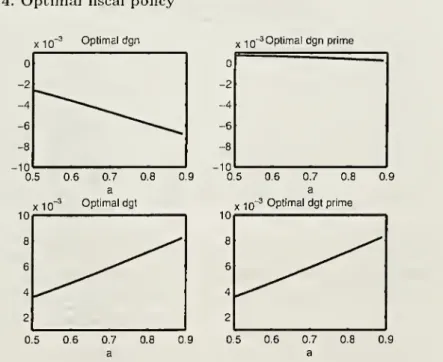
This is indeed the case. Figure 4 gives the optimal values of the dgi's (the
deviation from neutral fiscal policy) obtained
by
maximization of asecond-order
approximation
to the utility function subject to a linear approximationofthe equilibrium conditions given above.
The
figure gives values fora
=
0.5and
a rangingfrom
0.5 to 0.9. Itshows
that, indeed, optimaldg^
is negative,optimal dg'
N
is close to zero,and
optimaldgr and
dg'T
are equal to each otherand
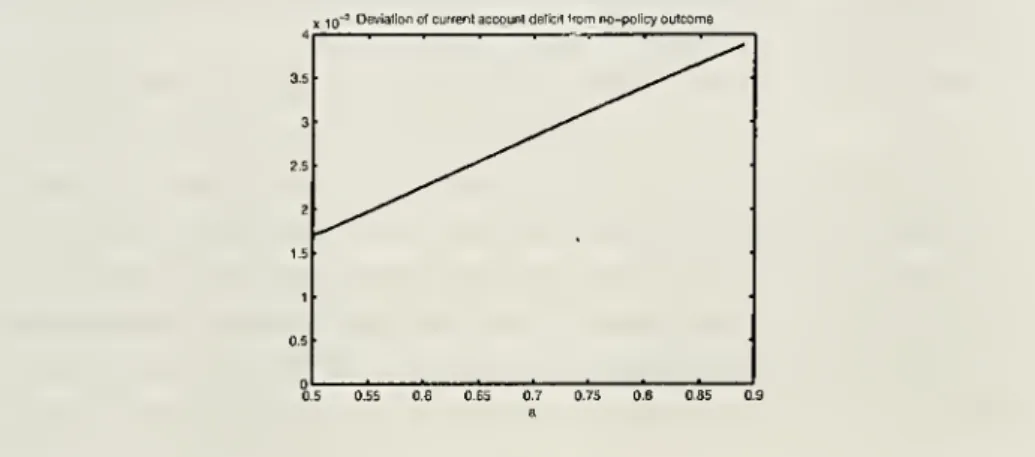
positive.Figure5
shows
the deviation of the currentaccount deficitfrom
itsvalueabsentfiscalpolicy.
Note
thatthe current accountdeficitis actually larger underopti-mal
fiscalpolicy (forexample, 0.004 higherifa=
0.9).The
reason isthatwhilethedecrease in
government
spendingon
nontradables increases the productionof tradables, the optimal policyalso requires
an
increaseingovernment
spend-ing
on
tradables,which
directly increases the currentaccount deficit. Isee thisresult not as a
major
implication, but, again, as awarning
that the presenceofdistortions does not necessarily require policies
aimed
at reducingthe currentaccount deficit.
Figure
5.Current account
deficit,with
and
without
fiscalpolicy
Deviationofcurrentaccountdeficit'rom no-policyoutcome
0.55 0.6 0.65 0.7 0.75 0.6 0.85 0.9
The
message
from this second extension is that, to the extent that financialconstraints matter in the tradables sector, there is indeed a role for policy to
limit reallocation in the first period.
The
optimal policyhowever
may
ormay
not decrease the current account deficit.
How
important are the relevant financialmarket
imperfections,and
how
much
do
theylimitreallocation?13One
might
guessthat tradables firmsinrich coun-trieswould
beamong
those with the best access tofinancialmarkets,and
thuswould be
least likely to be financially constrained. But, as far as I can tell,we
do
notknow. Recent work by
Calvo, Izquerdio,and
Talvi (2006) suggeststhat,eveninArgentinaafterthe collapse
and
thedisorganization ofcreditmar-13. The question has been explored, in a different but related context, by Caballero and
Hammour
(2005), who have looked at whether recessions lead tothe disappearance oflow productivity versusfinanciallyconstrainedfirms.kets, tradables firms have
been
able to increase production in response to the(admittedlyverylarge) peso depreciation.
Let
me
return briefly to an issue I left aside in the previous section,namely
the implications of
downward wage
rigidity.Under
theassumption
that thewage
in terms of tradables can increase but cannot decrease, the equilibriumlooks very
much
like the equilibrium I havejust characterized. In response toan
increaseinimpatience,downward
rigidityprevents thefirst-bestreallocationofproduction:
The
realwage
goesup
in the first period, but cannot godown
in the second period, leading to lower production of
both
tradablesand
non-tradables in the secondperiod. Anticipations oflower future income,
and
thuslower wealth (relative to first best), lead people to
want
toconsume
lessand
work
more
inthe first period (again,relative to first best).The
result is a lowercurrent accountdeficit
and
boom
in the firstperiod,and
an outputslump
cum
current account surplus inthe second period.
Note
that,under
financialmarket
constraints,the labormarket
clears inthesec-ond
period, but the allocationis distorted towards non-tradables; underdown-ward
rigidity, the labormarket
does not clear,and both
the production oftradables
and
non-tradables are lower. In terms of policy however, thecon-clusions are roughlysimilar.
Optimal
policy requires measureswhich
limit thewage
increaseinthefirstperiod, eitherby
decreasingdemand
for non-tradablesor the supply of labor.
6
Sudden
stops, distortions,
and
policy
I suspect that,
up
to this point, I have not dealt with themain
worry
in themind
ofanumber
ofeconomistsand
policymakers,namely
"suddenstops."Thisis the
worry
that a countrymay
find itselfsuddenly cutfrom
world financial markets, ormore
realistically for a country such as the United States, thatforeign investors
may
ask suddenlyfor amuch
higher rate of return.14That
sudden
stopscanhappen
isamply
demonstrated
by history,most
recentlyby
theAsiancrisis.15That
they canlead tosharpdepreciations,and sometimes
14. Thisis forexamplea recurringtheme inNourielRoubini'sblogcommentary on the U.S.
current accountdeficit.
15. TheAsiancrisisindeedshowsthatsuddenstopscanhappeneveninthe absenceof large
current accountdeficits.