
PFC/RR-91-8 DOE/PC-90350-2 DC CICC Retrofit Magnet Preliminary Design,
Protection Analysis and Software Development
Quarterly Progress Report Contract No. DE-FG22-90PC90350
J.H. Schultz, P.G. Marston and A.M. Dawson December 1990
Issued April 1991
Plasma Fusion Center
Massachusetts Institute of Technologyy Cambridge, Massachusetts 02139, USA
This work was supported by the U.S. Department of Energy, Pittsburgh Energy Technology Center, Pittsburgh, PA 15236, under Contract No. DE-FG22-90PC90350. Reproduction. translation, publication, use and disposal, in whole or part, by or for the United States Government is permitted.
Preliminary Analysis of the Proof-of-Concept Conductor Tests On a CICC for Large-scale MHD Magnets
INTRODUCTION
The work reported herein is part of that necessary to analyse a retrofit MHD genera-tor built using advanced DC cable-in-conduit conducgenera-tor that was developed under DOE PETC contract DE-AC22-84PC70512 and which is now being further evaluated and stud-ied analytically.
The work reported herein is the first step in the development of more sophisticated analytical software necessary to evaluate and predict the behavior of cable-in-conduit su-perconductors. This work and magnet design efforts are proceeding in parallel.
BACKGROUND
MIT has conducted a series of protection/quench experiments of two different topologies of candidate ICCS conductors for use in MHD magnets. The principal difference between them was that one had an insulating sleeve between the superconducting cable and its conduit, while the other, more conventional, conductor did not. The dimensions of the two conductors are described in Table 1.
Table I
Dimensions of Candidate Conductors Dimension Units Sleeved Unsleeved
No. Strands 27 27 Cable RRR loo? -TM Ic (kA) Strand Diameter ( 0.76 Cu:SC 1.35 1.35 Astrand (MM2) 0.456 0.456 Anoncu (m2 0.194 0.194 ACu (mm7) 0.262 0.262 Astrands (mu ) 12.3 12.3 Anoncu,cable (mm ) 5.23 5.23 ACucable (M2) 7.07 7.07 AHe (mm ) 6.6 7.5 fhe -cable (mi 'cable+conduit (mm . tsleeve (12 mils) (mm) . Conduit I(mm). Conduit ODH tconduit (m) 0.85 Acable space (MM ) 19.79 19.79
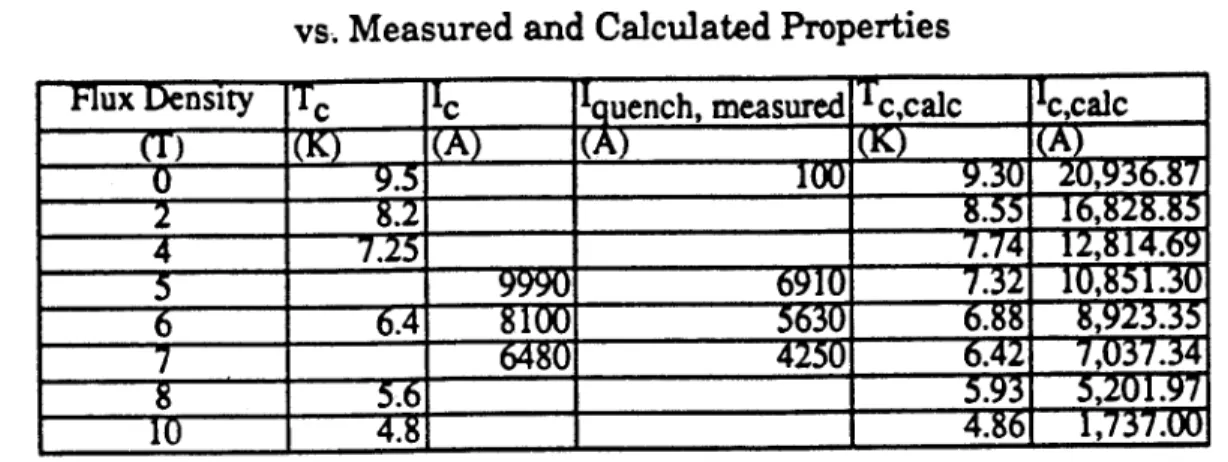
The manufacturer of the superconductor was Supercon. Their data on the supercon-ductor critical properties are shown in Table II.
Table II
Manufacturer's Data on Superconductor Properties vs. Measured and Calculated Properties
Flux Density T - I quench, measured Tc,calc 'c,calc
(TM() A (A) (KWA 0 9. 1 9.30F 20,936.87 2 8.2 8.35 16,828.85 4 7.25 7.74 12,814.69 5 9990 6910 7.32 0,513T 6 6.4 8100 5630 6.88 8,923.35 7 6480 4250 6.42
-7,37.34
8 5.6 5.93 5,201.97 W1 I 4.8SI 4.861 1,737.00 ANALYSISThe analysis is proceeding along two parallel paths. One includes the development of detailed software to understand the complex electromagnetic and thermodynamic mech-anisms inside the cable-in-conduit conductor subsequent to the initiation of a propagat-ing normal zone (durpropagat-ing quench). This will allow design perturbation and optimization analysis and predict the failure mode (protection) behavior of large-scale MHD magnets. Although this work is progressing more slowly than expected, it continues to indicate the expected fail-safe operation.
The other path is to develop simple analytical solutions which bound the general de-sign problem and enable the preliminary magnet dede-sign, which also parallels the conductor analytical effort. The following represents such a simplified analysis and shows good cor-relation with the experimental data.
1. Critical Current
As a check, we compare the manufacturer's number to the equations we are using for critical properties. For NbTi, the critical temperature is:
Tc(B) = Teo(B)(1 -B )o.5 9
Bc20
Miller in the ITER guidelines [M189A], following Lubell's method [LU83]: Jc(B, T) = J)
[1
- b Tc(b) where - b Jco (B) - Jcoo (1 W) Be20and Jcoo = 7300 A/mm2. The calculated values of Tc and I, are shown in Table II. The calculated values of T, are sometimes a little higher, sometimes a little lower than the manufacturer's numbers. The calculated values of Ic are systematically about 10% higher than Supercon's. This implies that it might be acceptable to use 90% of the calculated values at fields other than 5, 6, and 7 T.
2. Power and Energy Balance
As a first approximation, the enthalpy available for recovery should be comparable to the enthalpy difference of helium between the bath and current sharing temperatures at constant mass density, when the conductor is in the well-cooled regime. The initial condition of the helium is believed to be 1 atm, 4.2 K, a mass density of 125 kg/M3 and an enthalpy of 9.71 kJ/kg. However, our version of the NBS Helium Properties code returns 9.986 kg/kJ at 4.2 K and a density of 125 kg/M3. Since we have to use this code to
obtain untabulated values, this approximate value will be accepted throughout as the base enthalpy for calculations for energy margin. A table of calculated enthalpy differences and energy margins is shown in Table III.
5 T (4.2 K, 1 atm, 125 kg/M3, 9.986 kJ/kg, TC = 6.9 K, Astrands'1 2.3 mm2) ________ PCs ______ hcs-hb A e3 EMsleeved EMunsleev (K) M~a (k/kg I (J/k) (J/m (mJ/CC) (MJ/CC) _.8 18.41 8.424 -- M - M -
.5
5.5
1.1
682
M22 -7M
52.1
0.52
_5.25.23
654.2
351.0
39.9
0. -. 4.23 ~~ 4 5& 30. 284.6 324 0. -1.4246T
(4.2 K, 1 atm, 125 kg/m
3, 9.986 kJ/kg, T0
=
6.5 K, Asaids=
12.
3mm
2)
c _Tcs Pcs hcs hcs-hb he EMsceeved EMunsieev(MPa)
(kJ/k)
'kJ/kg)
(kJ/m()
(Mjcc)
nd/cc)
ST1.
120
153
838.68
73
7 T
(4.2 K, 1 atm, 125 kg/n
3, 9.986 kJ/kg, T
=6.5 K)
_______Tcs P 1
'cs
hcs-hb'he
EMsieeved EMunsleev0.2_ 6.04 19.73 9.4 28--6T ' 726
.2 3
2 5.812
8.35
3UM.
617-5
0.41. __33.00 4 ..
0.5
5.3
15.3
70.
378.5
430.18
compared with the values measured in the experiments
[MA896.
5 T Sleeved lp Fc Energy Dc Quench (kA - FUR - = Ye s
____M
301
75-
T
397
.401
500
TM~ 0.0
59-8
6 T Sleeved Io EM Quench_kA)
iM/cc)
1-Yes1.978 0.244197531 439 0 2.011 0.248271605 500 0 2.026 0.25 598 1 2.96 .37 439 3.032 0.37 500 1 3.98 0.49 439 3.99 0.49 500 1 4.502 0.56 500 1 4.521 0.56 439 0 4.724 0.58 500 0 4.735 0.58 564 1 4.736 0.58 439 C
7 T Sleeved
IfJ ? nergy Dp Quench
U.31
2.04
.32
3 _ 3 3~ -- - a .541 1 4.00 .62 305 0 7 T Unsleevedfc EnryDp
Qec
2.057 .321 2-TW 321 0 3.07 .471 3 0 .46 -2.93 U.658 i~334391 333051To simplify, take the average of the lowest quench energy and the highest nonquench energy at each field and current, and compare them with the available energy margin of the helium.
Bfe Emexv Range EMHe,avail
2 689.5 183 782.3 5 651.5 107 673 5 0.4 549 98 565 6 0.25 549 98 607.28 6 0.37 469.5 6f 497.146 6 0.49 469.5 61 387.682 6 0.56 4M9. 6 1 345.158 6 0.58 532 14 334.024 70 0.46 330.5 51 349.586
-
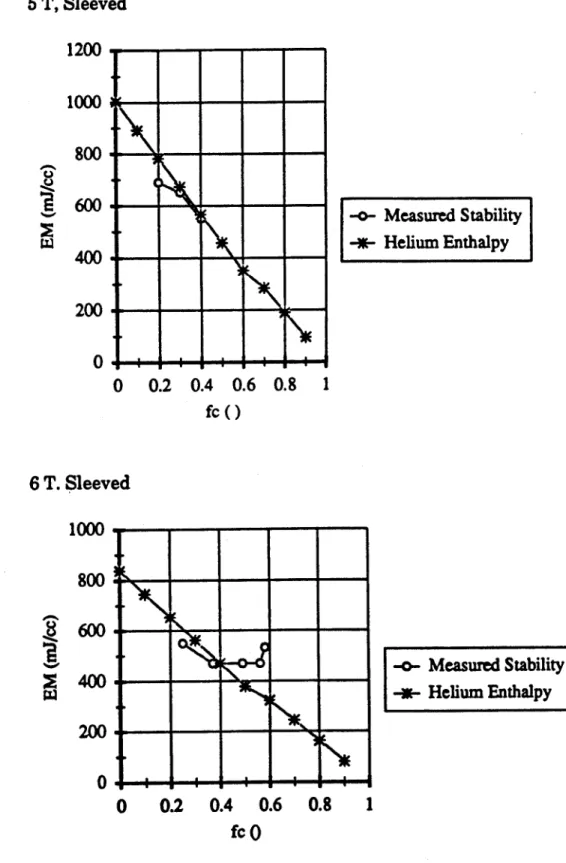
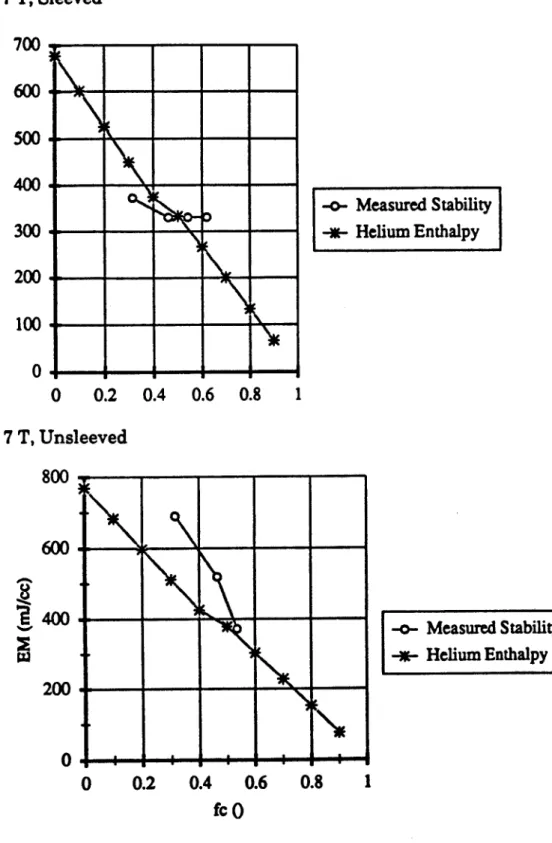
7 4 -s 3. 51-_0.6 51--723 ~3253The difference between the measured values of energy margin and the available enthalpy in the helium from the bath to the current-sharing temperatures are illustrated in the four
figures below. When the range between the minimum quenched case and the maximum recovery case is considered, the provable discrepancies, already small-looking, become even smaller.
CONCLUSION
For the most part, the discrepancies between the measured values of energy margin and the calculated enthalpy available in the helium between bath and current-sharing temper-atures is not very large. Some of the disagreements cannot be explained qualitatively by simply looking at the available enthalpy. These include the rise in energy margin at the highest current point at 6 T and the flatness of the energy margin with fraction of critical current at 6 T and 7 T with an insulating sleeve. However, given the strong agreement between the crudest possible estimate of energy margin and the actually measured results over a broad range of discharges, we question whether further investigation of anomalous, "weird" results is justified. We suggest that we should proceed directly to attempt dynamic simulations of quench propagation.
The close agreement between measured energy margin and available helium enthalpy also suggests that helium enthalpy in the local heated region is the dominant source of stability, and that the following phenomena are secondary:
(1) The enthalpy of the copper, superconductor, conduit, and insulation. (2) Axial heat leakage out of the heated region.
(3) Deposition of energy directly from the conduit to the cable in the uninsulated case, making power balance a factor at higher f,.
5 T, Sleeved 0 0.2 0.4 0.6 fc () 0.8 1200 1000 800 600 400 200 0 1 6 T. Sleeved 1000 800 600 400 200 0 0 0.2 0.4 0.6 0.8 fc0
-o- Measured Stability -*- Helium Enthalpy
1
Figure 1 - Measured Stability and Helium Enthalpy - Sleeved Conductors
-4- - 4- -4--4 U
w
-o- Measured Stability -*- Helium Enthalpy
7 T,S 700 600 500 400 300 200 100 0 7 T, heved 0 0.2 Jnsleeved
800
600 ,400 200 0 0.4 0.6-o- Measured Stability -*- Helium Enthalpy
0.8 1
-o- Measured Stability -we- Helium Enthalpy
0 0.2 0.4 0.6 0.8 1
fc0
Figure 2 - Measured Stability and Helium Enthalpy - Unsleeved Conductors
![Amplitude analysis of B[superscript +] →J/ψϕK[superscript +] decays](data:image/gif;base64,R0lGODlhAQABAIAAAP///wAAACH5BAEAAAAALAAAAAABAAEAAAICRAEAOw==)