HAL Id: hal-02313578
https://hal.sorbonne-universite.fr/hal-02313578
Submitted on 11 Oct 2019
HAL is a multi-disciplinary open access
archive for the deposit and dissemination of
sci-entific research documents, whether they are
pub-lished or not. The documents may come from
teaching and research institutions in France or
abroad, or from public or private research centers.
L’archive ouverte pluridisciplinaire HAL, est
destinée au dépôt et à la diffusion de documents
scientifiques de niveau recherche, publiés ou non,
émanant des établissements d’enseignement et de
recherche français ou étrangers, des laboratoires
publics ou privés.
Fe I in the β Pictoris circumstellar gas disk
Flavien Kiefer, Alfred Vidal-Madjar, Alain Lecavelier Des Etangs, Vincent
Bourrier, David Ehrenreich, Roger Ferlet, Guillaume Hebrard, Paul A. Wilson
To cite this version:
Flavien Kiefer, Alfred Vidal-Madjar, Alain Lecavelier Des Etangs, Vincent Bourrier, David
Ehren-reich, et al.. Fe I in the β Pictoris circumstellar gas disk: II. Time variations in the circumstellar
iron gas. Astronomy and Astrophysics - A&A, EDP Sciences, 2019, 621, pp.A58.
�10.1051/0004-6361/201834274�. �hal-02313578�
arXiv:1810.10421v1 [astro-ph.EP] 24 Oct 2018
Astronomy & Astrophysicsmanuscript no. FeI_HARPS_paper_2_arxiv ESO 2018c
October 25, 2018
Fe I in the Beta Pictoris circumstellar gas disk
II. The time variations in the iron circumstellar gas
F. Kiefer
1,2, A. Vidal-Madjar
1,2, A. Lecavelier des Etangs
1,2, V. Bourrier
3, D. Ehrenreich
3, R. Ferlet
1,2,
G. Hébrard
1,2, and P. A. Wilson
1,2,41
CNRS, UMR 7095, Institut d’Astrophysique de Paris, 98bis
boulevard Arago, F-75014 Paris, France
2
UPMC Univ. Paris 6, UMR 7095, Institut d’Astrophysique de Paris, 98bis
boulevard Arago, F-75014 Paris, France
3
Observatoire de l’Université de Genève, 51 chemin des Maillettes, 1290, Sauverny, Switzerland
4
Department of Physics, University of Warwick, Coventry, CV4 7AL
ABSTRACT
βPictoris is a young planetary system surrounded by a debris disk of dust and gas. The gas source of this disk could be exocomets (or “falling and evaporating bodies”, FEBs), which produce refractory elements (Mg, Ca, Fe) through sublimation of dust grains at several tens of stellar radii. Nearly 1700 high resolution spectra of β Pictoris have been obtained from 2003 to 2017 using the HARPS spectrograph. In paper I, we showed that a very high S/N ratio allows the detection of many weak Fe I lines in more than ten excited levels, and we derived the physical characteristics of the iron gas in the disk. The measured temperature of the gas (∼1300 K) suggested that it is produced by evaporation of grains at about 0.3 au (38 R⋆) from the star. Here we describe the yearly variations of the column densities of all
Fe I components (from both ground and excited levels). The drop in the Fe I ground level column density after 2011 coincides with a drop in Fe I excited levels column density, as well as in the Ca II doublet and a ground level Ca I line at the same epoch. All drops are compatible together with photoionisation-recombination equilibrium and β Pic like relative abundances, in a medium at 1300 K and at 0.3 au from β Pictoris. Interestingly, this warm medium does not correlate with the numerous exocomets in the circumstellar environnement of this young star.
Key words. Stars: Individual: Beta Pictoris; Circumstellar disk; Exocomets.
1. Introduction
The β Pictoris system is particularly famous for harboring one the most massive debris disk in the close neiborhood of the Sun (Smith & Terrile 1984). Despite being 20 Myr old (Mamajek & Cameron 2014), this star has gone through the phase of dissipating dust and gas in its protoplanetary disk, which remnant should be a gas-poor dust-poor debris disk. Observations however show that the disk is one of the most dusty gas-poor disk among known debris disk (Arty-mowicz et al. 1997, Vidal-Madjar et al. 1998). With the age of β Pictoris being much larger than typical timescales of destruction of dust particles (<1 Myr), this led to the conjecture that a replenishment from either collisions or evaporation of hidden planetesimals was necessary to ex-plain the overabundance of dust in this system (Backman & Paresce 1993, Lecavelier et al. 1996).
Moreover, absorption spectroscopy of β Pic revealed the presence of a stable gas component at the star’s radial ve-locity and variable absorptions attributed to transiting star-grazing exocomets (Ferlet et al. 1987, Beust et al. 1990) ; see also the review of Vidal-Madjar et al. (1998). The origin of the stable gas disk is still unknown, although highly sus-pected to be connected to the star-grazing exocomets that strongly evaporate dust and ionized species. Exocomets might be the common vector of gas and dust replenishment
Send offprint requests to: F. Kiefer (e-mail: [email protected])
in the disk of β Pictoris (Weissman 1984, Lecavelier et al. 1996, Li et al. 1998).
β Pictoris was observed with the HARPS instrument (see e.g. Pepe et al. 2011) for several years, from 2003 to 2017 thanks to large programs of follow-up (Lagrange et al. 2012, Kiefer et al. 2014, Lagrange et al. 2018). Thou-sands of spectra were gathered and several hundreds of exocometary events detected (Kiefer et al. 2014). In Pa-per 1 (Vidal-Madjar et al. 2017, VM17 hereafter), stacking the 1686 HARPS spectra collected between 2003 and 2015, we presented the measurements of the physical properties of the iron gas from the detection of a large number of FeI ab-sorption lines, from the ground level up to the 12969 cm−1 excited level. We concluded that the measured temperature of the gas (∼1300 K) coincides with the sublimation tem-perature of iron from solid compounds, and therefore that this gas is likely produced by the evaporation of grains at about 38 R⋆or 0.32 au from the star. Moreover, the ground level absorption lines of Fe I presented evidences of two com-ponents at different radial velocities. The component cen-tred on the same radial velocity as the one found for the excited levels at 20.41±0.05 km s−1 for which we derived the temperature of 1300 K, and a blueshifted component at 20.07±0.02 km s−1.
Independently, Welsh & Montgomery (2016) found that the ground level Fe I absorption lines in the same β Pic HARPS spectra were experiencing a strong drop of equiva-lent width between 2011 and 2013. They proposed that the
A&A proofs:manuscript no. FeI_HARPS_paper_2_arxiv 2004 2006 2008 2010 2012 2014 2016 Epochs (year) 0 500 1000 1500 2000 2500 Spectrum number
Fig. 1. The time distribution of the HARPS observing nights used in our study. The horizontal dotted lines show the limits of the selected observing periods.
source of the Fe I experiencing the drop is the "D-family" of exocomets identified in Kiefer et al. (2014). These exo-comets are composed of strongly evaporating bodies lying about a common orbit, with heliocentric radial velocities in the range +20 to +50 km s−1.
Here we explore in more details the time variations of both ground and excited levels absorptions of Fe I in the "stable" circumstellar medium, and how they correlate with exocomet activity in the vicinity of the star.
The analysis is presented in Sect. 3. The discussions and conclusion are given in Sect. 4 and 5, including a study on the variations also observed in the Ca II doublet (at 3934 and 3968 Å) and the Ca I line (at 4227 Å).
2. Observations
β Pictoris has been observed with the HARPS spectrograph mounted on the 3.6m telescope of La Silla (ESO Chile) from 2003 to 2017 on a (mostly) regular basis (except between 2004 and 2007 and in 2012). Since β Pictoris is observable only during summer in southern hemisphere, the observa-tions were done essentially from September to April of each season. The 1D-spectra were extracted via the standard, most recent, HARPS pipeline (DRS 3.5) including local-ization of the spectral orders on the 2D-images, optimal order extraction, cosmic-ray rejection, wavelength calibra-tion, flat-field corrections, and 1D-reconnection of the spec-tral orders after correction for the blaze. More details can be found in VM17. We organized the spectra into different samples, each constituting one summer of observation, with the exception of the period 2004-2007. During this period, the average number of spectra observed per summer was 14, which is very small compared to the other periods aver-age (234 spectra per summer). For that reason we created a special sample covering the 3 summers from 2004 to 2007. This repartition is summarized in Table 1 and Fig. 1.
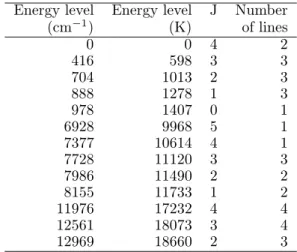
Because of the high S/N ratio achieved, we were able to detect numerous Fe I absorption lines of the ground level, as well as, of several excited levels. All the detected Fe I lines are listed in Table 2. The energy of the initial electronic levels of the corresponding transitions are summarized in Table 3. In the paper we always refer to the individual levels by their energy expressed in cm−1, as e.g. Fe I
416 for the
Table 1. The repartition of the 2946 HARPS observations. The signal-to-noise is calculated next to the main Fe I line between 3859.30 Å and 3859.70 Å.
Periods Nobs Nnight ∆tspan SNR Average
(year) (day) (3860 Å) Epoch
2003-2004 255 53 127 962 2004.025 2004-2007 42 14 651 390 2006.235 2007-2008 198 12 108 492 2008.203 2008-2009 417 12 196 909 2009.070 2009-2010 54 1 1 278 2009.847 2010-2011 207 4 159 467 2011.081 2013-2014 453 19 250 799 2013.929 2014-2015 60 4 4 493 2015.091 2015-2016 190 4 162 591 2016.063 2016-2017 1080 11 109 639 2017.041
Table 2. Transition parameters for the detected FeI lines, (i lower level, k upper level. A is the transition probability in s−1,
f is the oscillator strength, and E is the energy in cm−1.
Fe I lines Aki fik Ei Ek (Å) (s−1) (cm−1) (cm−1) 3795.002 1.15×10⁷ 3.47×10⁻² 7986 34329 3799.547 7.31×10⁶ 2.04×10⁻² 7728 34040 3812.964 7.91×10⁶ 1.23×10⁻² 7728 33947 3815.840 1.12×10⁸ 1.90×10⁻¹ 11976 38175 3820.425 6.67×10⁷ 1.20×10⁻¹ 6928 33096 3824.443 2.83×10⁶ 4.83×10⁻³ 0 26140 3825.881 5.97×10⁷ 1.02×10⁻¹ 7377 33507 3827.822 1.05×10⁸ 1.65×10⁻¹ 12561 38678 3834.222 4.52×10⁷ 7.13×10⁻² 7728 33802 3840.437 4.70×10⁷ 6.24×10⁻² 7986 34017 3841.047 1.36×10⁸ 1.80×10⁻¹ 12969 38996 3849.966 6.05×10⁷ 4.49×10⁻² 8155 34122 3856.371 4.64×10⁶ 7.39×10⁻³ 416 26340 3859.911 9.69×10⁶ 2.17×10⁻² 0 25900 3865.523 1.55×10⁷ 3.47×10⁻² 8155 34017 3878.573 6.17×10⁶ 8.36×10⁻³ 704 26479 3886.282 5.29×10⁶ 1.20×10⁻² 416 26140 3895.656 9.39×10⁶ 7.13×10⁻³ 888 26550 3899.707 2.58×10⁶ 5.89×10⁻³ 704 26340 3906.479 8.32×10⁵ 1.90×10⁻³ 888 26479 3920.257 2.60×10⁶ 1.79×10⁻² 978 26479 3922.911 1.08×10⁶ 3.19×10⁻³ 416 25900 3927.919 2.60×10⁶ 1.00×10⁻² 888 26340 3930.296 1.99×10⁶ 6.46×10⁻³ 704 26140 4045.812 8.62×10⁷ 2.12×10⁻¹ 11976 36686 4063.594 6.65×10⁷ 1.65×10⁻¹ 12561 37163 4071.738 7.64×10⁷ 1.90×10⁻¹ 12969 37521 4271.760 2.28×10⁷ 7.62×10⁻² 11976 35379 4307.902 3.38×10⁷ 1.21×10⁻¹ 12561 35768 4325.762 5.16×10⁷ 2.03×10⁻¹ 12969 36079 4383.544 5.00×10⁷ 1.76×10⁻¹ 11976 34782 4404.750 2.75×10⁷ 1.03×10⁻¹ 12561 35257
first excited level at 416 cm−1. We will collectively refer to the excited levels as Fe IExc, as opposed to the ground level Fe I0.
The profile of a few individual lines can be found in pa-per I, where we also describe the fitting procedure to derive the column densities, velocities and turbulent parameter.
Kiefer et al.: Fe I in the Beta Pictoris circumstellar gas disk 2004 2006 2008 2010 2012 2014 2016 2018 12.2 12.25 12.3 12.35 12.4 12.45 12.5 29 %
Total Fe I column density
Fig. 2.Column density variations in the ground state of the circumstellar Fe I of β Pic. Left: Temporal variations of the total Fe I0
column density showing a 30 % drop after year 2011. Middle and right: Sum of the Fe I HARPS fluxes, over the two separate periods, from 2003 to 2011 (solid) and after 2011 (dashed) at the ground state Fe I transition lines wavelengths, 3860 Å(middle) and 3824 Å(right).
Table 3. Fe I initial levels of the 32 electronic transitions de-tected in absorption in the HARPS spectrum of β Pictoris.
Energy level Energy level J Number
(cm−1) (K) of lines 0 0 4 2 416 598 3 3 704 1013 2 3 888 1278 1 3 978 1407 0 1 6928 9968 5 1 7377 10614 4 1 7728 11120 3 3 7986 11490 2 2 8155 11733 1 2 11976 17232 4 4 12561 18073 3 4 12969 18660 2 3
3. Temporal variations of Fe I circumstellar gas
3.1. Variation of the Fe I ground level
The time variation of the “stable” Fe I ground level absorp-tion lines is given in Table 4, and plotted on Fig. 2. We fitted one single component for each separated period of observation, using the Owens.f code (Hébrard et al. 2002, Lemoine et al. 2002). It fits a Gaussian line-spred-function of 3.6 pixels wide, further broadened by a turbulent pa-rameter b, centered on a radial velocity v and with depth fixed by the column density N and the levels transition parameters as given in Table 2. The continuum is fitted simultaneously using a 4-degree polynomial. The two Fe I lines of the ground level are plotted on Fig. 2.
The column density changes significantly, showing first a stable value of the order of 2.5 1012cm−2lasting about 7 years, followed by a 3.5σ drop down to about 1.8 1012cm−2, lasting at least 4 years. This drop of about 30 % in the Fe I total column density was already noted by Welsh & Montgomery (2016) from the same HARPS observations. It seems that the column density is increasing again in 2017. Future observations should confirm this recent evolution.
The turbulent parameter b is stable up to a few hundreds of m s−1 indicating this gas ensemble is thermodynamicaly stable over nearly 12 years of observation. However, we ob-serve a slow and monotonic reddening of the ground level
Table 4. Properties of the FeI gas over the different epochs of observations, evaluated by fitting simultaneously the two ab-sorption lines from the ground state (3859.30 Å and 3859.70 Å) with a single component.
Periods Nb. v b logNFeI
(year) Obs. (km/s) (km/s) (cm−2) 2003-2004 215 20.15±0.01 0.73±0.02 12.418±0.002 2004-2007 42 20.16±0.02 0.81±0.06 12.398±0.005 2007-2008 198 20.20±0.01 0.84±0.04 12.383±0.004 2008-2009 417 20.21±0.01 0.77±0.02 12.427±0.002 2009-2010 54 20.22±0.02 0.58±0.13 12.408±0.020 2010-2011 207 20.24±0.02 0.93±0.05 12.401±0.005 2013-2014 453 20.14±0.01 0.87±0.03 12.258±0.004 2014-2015 60 20.18±0.02 0.85±0.07 12.253±0.007 2015-2016 190 20.16±0.02 0.47±0.08 12.215±0.010 2016-2017 1080 20.20±0.01 0.40±0.05 12.328±0.015
absorption over years up until 2011, followed by a sudden blueshift simultaneous to the column density drop. Thus the column density variation must be stronger in the red wing than on the blue wing of the Fe I line.
In the light of the two components model of VM17, it strongly suggests that only the reddest component at 20.4 km s−1 is experiencing the drop. Moreover, we show in the next section that a column density drop is also ob-served in the absorption lines of the excited levels that are centered on 20.4 km s−1. We will revisit the Fe I ground level absorption lines analysis with a 2 components model in Sec-tion 3.3.
3.2. Variation of the Fe I excited levels
To further study the time behaviour of the Fe I source, we examine the variations of the Fe I excited levels absorption lines. These evaluations are given in Table 5, as calculated by fitting simultaneously all Fe I excited levels absorption lines with Owens.f. We fixed that the radial velocity and turbulent parameters vFe I Exc and bFe I Exc are common to all excited levels, while the column density can vary sepa-rately for each individual level. Only the strongest transi-tions show well distinguishable absorptransi-tions, since the noise wipes the weaker transition signatures away.
In VM17, we have observed for the whole 2003-2015 period that vFe I Exc=20.41+0.03−0.05km s−1, and
A&A proofs:manuscript no. FeI_HARPS_paper_2_arxiv
that in accordance to VM17, both the v and b of excited levels component remain stable in time about 20.39 km s−1 and 0.96 km s−1 respectively, except after 2014 where the velocity is more poorly determined. Conversely, the column densities from the excited levels present a time behaviour similar to the ground level with an important drop after 2011.
To have a better look at the column density variations of the excited levels, we plotted in Fig. 3 all excited lev-els values (and upper limits), compared to the ground level NTotal
FeI 0 variations. The cleanest Fe I416 and Fe I6928 levels
and the total column density in all excited levels are high-lighted. All levels column densities are normalized to their corresponding median value before the drop, over the 2003 - 2011 period. To calculate the total column density and their uncertainties, we drew at each epoch 104series of es-timations of the column density at all excited levels accord-ing to their measurements distribution, then calculated the sum leading to 104estimations of the total column density, and determined the final measurement as the median of the sample with errorbars as the 1-σ percentiles.
The drop observed on the total column density of the excited levels is significant at the 6-σ level, with an ampli-tude of 37±4%. It is larger for the excited levels than for the ground level, for which we measure a 31±2% relative decrease in the column density, leading to a 2-σ significant difference in amplitude. This suggests again that only part of the ground level is undergoing the same drop than the excited levels. 2004 2006 2008 2010 2012 2014 2016 2018 Time [year] −0.6 −0.4 −0.2 0.0 0.2 0.4 0.6 ∆ lo g Nc o m p 1 , F e I e x c
Fig. 3.The spread and evolution of the (log) Fe I column density among the 12 excited levels over time. The black circles refer to each excited level’s column density relative to its median value as observed from 2003 to 2017. The grey triangles are upper limits derived from weaker absorptions. A few points outside the plot window are figured by arrows next to the axis. The black solid line shows how the total column density of excited Fe I varies over time. The cyan and green solid lines show the evolution of the column densities derived respectively for the Fe I416 and
Fe I6928 excited levels. The Fe I0 variations derived in Table 4
are shown as a solid red line.
3.3. Revisiting the ground level variations with a 2 components model
It has been proposed by VM17 that the absorption lines of the ground level can be divided into 2 components, one of which, at about 20.4 km s−1, is common with excited levels
transition lines, and a second one lying at about 20.0 km s1. In the rest of the paper, we will refer to these 2 hypothesized components as the red component and the blue component respectively. Besides the variations observed in the excited levels, additional clues suggest two components might be indeed present in the Fe I ground level lines.
First, as observed in section 3.1, the velocity variations of the one-component fit of the Fe I0 absorption lines show that simultaneously to the column density drop there is a blueward shift of the centroid wavelength, suggesting that only the red part of the lines undergoes a drop. Second, the amplitude of the drop in ground level column density is 2-sigma lower than the excited levels column density drop suggesting that only a part of the total amount of Fe I in ground level is vanishing. Revisiting the analysis of the Fe I0 absorption lines using a 2 components model should confirm these assertions.
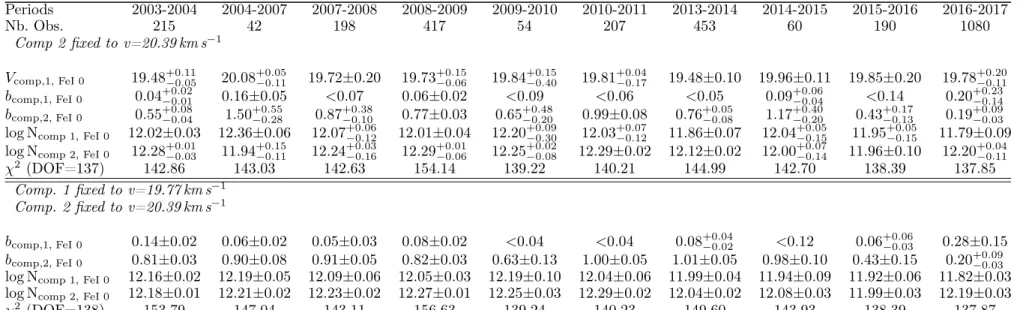
From the fit of the excited levels absorption lines in Table 5, the radial velocity of the red component fluctu-ates about the average value v2=20.39 km s−1, without any trend. We will thus assume that the red component radial velocity is constant and fix it to this value. We then pro-ceed to a 2-components fit of the ground level absorption line, adding a new component and letting all parameters free except v2. The results are given in Table 6.
We find that the derived radial velocity of the blue component is weakly fluctuating around the average value v1=19.77 km s−1. However, the derived turbulence parame-ters have strong scatparame-ters with values lower than 0.05 km s−1 for b1 and as high as 1.5 km s−1 for b2. This is not surpris-ing since we are fittsurpris-ing strongly blended features. Other parameters should be fixed to lower such overfitting effects. We thus fix both radial velocities v1 and v2 to re-spectively 19.77 km s−1 and 20.39 km s−1. This time the values of the turbulent parameters are better behaved, with b1∼0.11±0.02 km s−1 and b2∼0.77±0.09 km s−1. The two periods 2015-2016 and 2016-2017 stands aside: as for the excited levels the transition line is not well fit with the common model (for excited levels we measured v∼20.20 km s−1). This shift is likely to be imputed to the upgrade of the instrument done in June 20151. Fortunately, it does not impact the measurement of the column density, so the 2015-2017 period remains valuable for the present analysis.
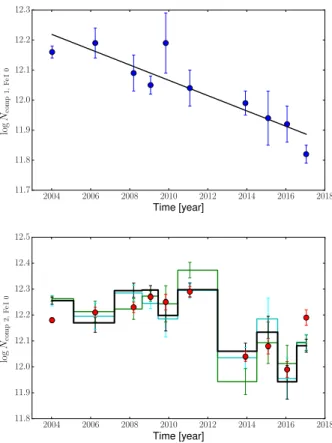
The measured ground level column density variations in each component are plotted in Fig. 4. The column density of the blue component is found monotonically decreasing, while the red component undergoes a strong drop. This difference is especially pronounced between 2011 and 2013 during the drop, with the red component column density divided by a factor of 2, and the blue component remain-ing essentially stable. Interestremain-ingly, the red variations fol-low well the excited levels variarions with a slight increase of column density between 2003 and 2011.
A Pearson’s R test shows that the total excited levels column density calculated in Table 5 explains the variations of the red component with R=0.87 (null-hypothesis rejec-tion probability p=9.8 10−4), while it only explains the vari-ations of the blue component with R=0.59 (p=0.074). This means that the red component measurements, having also smaller errorbars (∼0.02) than the blue component column
1
https://www.eso.org/sci/publications/messenger/archive/no.162-dec15/messenger-no162-9-15.pdf.
Kiefer et al.: Fe I in the Beta Pictoris circumstellar gas disk 2004 2006 2008 2010 2012 2014 2016 2018 Time [year] 11.7 11.8 11.9 12.0 12.1 12.2 12.3 lo g Nc o m p 1 , F e I 0 2004 2006 2008 2010 2012 2014 2016 2018 Time [year] 11.8 11.9 12.0 12.1 12.2 12.3 12.4 12.5 lo g Nc o m p 2 , F e I 0
Fig. 4. Column density variations measured in the Fe I ground level absorption lines. Top panel: blue component at 19.80 km/s. The solid black line is a linear model fit of the data. Bottom panel: red component at 20.4 km/s. The coloured solid lines are the variations observed in excited levels column densities of Fe I416(cyan), Fe I6928(green) and total excited Fe I (black), as
given in Table 5. They are scaled up to ground level column density.
density (∼0.06), are much better explained by the excited levels variations. However it is difficult to firmly conclude on the compatibility of the blue component column density variations with the excited levels, because although they have larger scatter, they also have larger measurement un-certainties.
Conducting another Pearson’s R test on linear relation-ship of the components column density with time shows that the blue component is better explained by a contin-uous decrease through the different epochs, with R=-0.90 (p=3.7 10−4), while the red component has only R=-0.56 (p=0.093).
The red and the blue are thus most likely uncorrelated, and the drop in the ground level column density is bet-ter explained, as initially suspected, by only the variation of a single component centered on 20.4 km s−1. Observing this red component in the absorption lines of both excited and ground levels, and keeping in mind the measured tem-perature of this medium by VM17 (1300 K), leads to in-fer that the dropping component is located at close dis-tance (∼38 R⋆) to the star and varies from a yet unknown process, perhaps exocomets activity drop, as proposed by Welsh & Montgomery (2016) and studied in more details in Section 4.
Since there is no evidence for a blue component in the excited levels lines, it should thus be located at larger
dis-tance to the star, certainly several AU where temperatures are much lower than 1000 K. This would explain the ab-sence of a correlation with the inner red component. It is moreover strongly pushed-out in the anti-stellar direction, and slowly dissipating. This component might be part of the distant expanding circumstellar gas identified by Bran-deker et al. (2004,2011).
4. Exploring the link with β Pictoris circumstellar
environnement
4.1. Exocomets activity in the Ca II doublet
It has been suggested by Welsh & Montgomery (2016) and VM17 that the circumstellar (CS) Fe I originates from the numerous exocomets observed in the system of β Pictoris. One possible way to test this conjecture would be to determine if variations in the Fe I absorption lines of the circumstellar gas correspond to variations in the cometary activity, or the quantity of particles evaporated from these exocomets.
In the same HARPS spectra as those used here to anal-yse Fe I lines, there are the Ca II doublet lines that were used in Kiefer et al. (2014) to show that the β Pic’s ex-ocomets separate into 2 families. The D-family would be composed of strongly evaporating comets about a common orbit, while the S-family would be composed of older comets with smaller amounts of gas released in the circumstellar medium. The D-family absorption signatures are all located within the -10 to 50 km s−1 range in the β Pic rest frame, while the S-familly signatures are scattered on a wider ve-locity range, spanning from -100 to 150 km s−1.
In order to quantify the cometary activity around β Pictoris, we can calculate the average absorption depth in different velocity domains of the Ca II normalized spec-trum. In the small region about the tip of the circum-stellar line that reaches almost zero, there could be deep features strongly blended with the circumstellar line; we thus first exclude that region from the analysis, within the range bounded by the instrument resolution (±2.6 km s−1) about 21.57 km s−1, the tip of the CS line close to the β Pic systemic velocity. We fixed the velocity domain for the D-family to be +5-25 km s−1 and for the S-family to be 50-100 km s−1. These two domains are not overlapping and are centered on the core regions of each family detection statis-tics, as found in Kiefer et al. (2014).
The reference spectrum that is divided out of the spectra contains the stellar lines and the stable circumstellar and interstellar components. Thus, in the normalized spectra, only flux variations due to exocomet absorption or circum-stellar disk fluctuations remain.
The average absorption depth (AAD, hereafter) is mea-sured by averaging each normalized spectrum over the spec-ified spectral band. It is thus proportional to the equivalent width, by a factor ∆λ, the wavelength width of the calcu-lation window. Therefore, as long as the absorbing medium is optically thin, this quantity reflects the amount of ma-terials released in the circumstellar medium by transiting exocomets. It also provides information on the typical depth of signatures that are present in the spectrum within the velocity bounds.
Table 5.The temporal variations of the Fe I excited levels in vFe I Exc, heliocentric velocity (km/s), bFe I Excvalue (km/s) and Log N column density (in Log cm−2, identified
by the energy level in cm−1) evaluated by fitting simultaneously all excited levels absorption lines, epoch by epoch. The sum of the column density in all excited levels is given
on the last line. The † sign individualizes the rows with the cleanest column density determination. Those are plotted as solid lines in Fig. 3.
Periods 2003-2004 2004-2007 2007-2008 2008-2009 2009-2010 2010-2011 2013-2014 2014-2015 2015-2016 2016-2017 Nb. Obs. 215 42 198 417 54 207 453 60 190 1080 vFe I Exc 20.39±0.03 20.37±0.09 20.39±0.08 20.45±0.03 20.47±0.14 20.33±0.07 20.34±0.08 20.85±0.17 20.19±0.15 20.18±0.06 bFe I Exc 0.80±0.10 0.78±0.33 1.20±0.20 0.98±0.09 1.00±0.53 1.22±0.17 0.89±0.29 1.47±0.51 1.14±0.54 1.00 (fixed†) †log NFeI 416 11.61±0.02 11.55±0.05 11.64±0.03 11.60±0.02 11.54±0.07 11.65±0.03 11.39±0.04 11.54±0.08 11.31±0.08 11.45±0.03 log NFeI 704 11.25±0.03 10.84+0.15−0.28 11.38±0.05 11.40±0.03 11.15+0.15−0.24 11.30±0.08 11.09±0.08 11.11±0.15 10.84+0.16−0.36 11.16±0.06 log NFeI 888 11.01±0.06 11.18±0.08 10.69+0.20−0.30 10.88±0.07 <10.96 11.03±0.10 10.81+0.11−0.16 10.86+0.20−0.37 10.73+0.20−0.50 10.74+0.12−0.20 log NFeI 978 10.51+0.08−0.12 <10.47 <10.10 10.45+0.16−0.29 10.73+0.24−0.57 <10.65 10.50+0.12−0.19 <10.65 <10.06 <9.91 †log NFeI 6928 10.92±0.01 10.87±0.04 10.88±0.04 10.93±0.02 10.90±0.07 11.03±0.03 10.60±0.05 10.75±0.08 10.67±0.07 10.75±0.03 log NFeI 7377 10.47±0.03 10.49±0.08 10.45±0.09 10.54±0.03 10.51+0.13−0.19 10.45±0.09 10.06+0.10−0.14 9.92+0.31−0.97 10.22±0.20 10.34±0.06 log NFeI 7728 <9.67 <10.74 10.83+0.17−0.26 10.27−0.38+0.22 10.88+0.19−0.33 <10.41 <9.80 <10.23 <10.40 <9.93 log NFeI 7986 <9.90 <9.98 <10.14 9.87+0.18−0.33 <10.07 10.31+0.15−0.24 10.15+0.16−0.26 <9.67 <10.02 <9.10 log NFeI 8155 <8.90 <10.15 9.95+0.25−0.78 10.18−0.13+0.10 <10.36 <10.08 <9.35 <9.33 10.17+0.18−0.32 <9.63 log NFeI 11976 9.68+0.04−0.05 9.56+0.12−0.16 9.59+0.10−0.12 9.61+0.07−0.08 9.55+0.21−0.46 9.82±0.08 9.43+0.10−0.15 9.67±0.13 <9.11 9.49±0.12 log NFeI 12561 9.24+0.07−0.11 <8.39 9.15+0.24−0.40 9.35+0.08−0.10 <9.48 9.43+0.14−0.22 9.00+0.19−0.41 <9.18 9.14+0.23−0.46 9.12+0.11−0.43 log NFeI 12969 9.12+0.08−0.11 9.27+0.14−0.21 9.35+0.11−0.16 9.28−0.09+0.06 <9.44 9.24+0.16−0.28 <8.47 9.28+0.19−0.34 <9.11 9.23+0.14−0.20 †log NTotal FeI Exc 11.93±0.01 11.84±0.04 11.96±0.03 11.97±0.02 11.87±0.06 11.97±0.03 11.73±0.03 11.80±0.06 11.61±0.07 11.75±0.03
† The b-value was fixed at the median value from past measurements, because Owens.f was unable to converge on a realistic value.
Table 6.Table of fitting parameters, modelizing the Fe I ground level absorption lines with 2 components.
Periods 2003-2004 2004-2007 2007-2008 2008-2009 2009-2010 2010-2011 2013-2014 2014-2015 2015-2016 2016-2017 Nb. Obs. 215 42 198 417 54 207 453 60 190 1080 Comp 2 fixed to v=20.39 km s−1 Vcomp,1, FeI 0 19.48+0.11−0.05 20.08 +0.05 −0.11 19.72±0.20 19.73 +0.15 −0.06 19.84 +0.15 −0.40 19.81 +0.04 −0.17 19.48±0.10 19.96±0.11 19.85±0.20 19.78 +0.20 −0.11 bcomp,1, FeI 0 0.04+0.02−0.01 0.16±0.05 <0.07 0.06±0.02 <0.09 <0.06 <0.05 0.09 +0.06 −0.04 <0.14 0.20 +0.23 −0.14 bcomp,2, FeI 0 0.55+0.08−0.04 1.50 +0.55 −0.28 0.87 +0.38 −0.10 0.77±0.03 0.65 +0.48 −0.20 0.99±0.08 0.76 +0.05 −0.08 1.17 +0.40 −0.20 0.43 +0.17 −0.13 0.19 +0.09 −0.03
log Ncomp 1, FeI 0 12.02±0.03 12.36±0.06 12.07+0.06−0.12 12.01±0.04 12.20
+0.09 −0.30 12.03 +0.07 −0.12 11.86±0.07 12.04 +0.05 −0.15 11.95 +0.05 −0.15 11.79±0.09
log Ncomp 2, FeI 0 12.28+0.01−0.03 11.94 +0.15 −0.11 12.24 +0.03 −0.16 12.29 +0.01 −0.06 12.25 +0.02 −0.08 12.29±0.02 12.12±0.02 12.00 +0.07 −0.14 11.96±0.10 12.20 +0.04 −0.11 χ2 (DOF=137) 142.86 143.03 142.63 154.14 139.22 140.21 144.99 142.70 138.39 137.85 Comp. 1 fixed to v=19.77 km s−1 Comp. 2 fixed to v=20.39 km s−1 bcomp,1, FeI 0 0.14±0.02 0.06±0.02 0.05±0.03 0.08±0.02 <0.04 <0.04 0.08+0.04−0.02 <0.12 0.06 +0.06 −0.03 0.28±0.15 bcomp,2, FeI 0 0.81±0.03 0.90±0.08 0.91±0.05 0.82±0.03 0.63±0.13 1.00±0.05 1.01±0.05 0.98±0.10 0.43±0.15 0.20+0.09−0.03
log Ncomp 1, FeI 0 12.16±0.02 12.19±0.05 12.09±0.06 12.05±0.03 12.19±0.10 12.04±0.06 11.99±0.04 11.94±0.09 11.92±0.06 11.82±0.03
log Ncomp 2, FeI 0 12.18±0.01 12.21±0.02 12.23±0.02 12.27±0.01 12.25±0.03 12.29±0.02 12.04±0.02 12.08±0.03 11.99±0.03 12.19±0.03
Kiefer et al.: Fe I in the Beta Pictoris circumstellar gas disk 2004 2006 2008 2010 2012 2014 2016 2018 Time [year] 0 0.02 0.04 0.06 0.08 0.1 0.12 0.14 0.16
Average absorption depth
2004 2006 2008 2010 2012 2014 2016 2018 Time [year] 0 0.05 0.1 0.15 0.2 0.25 0.3 0.35 0.4
Average absorption depth
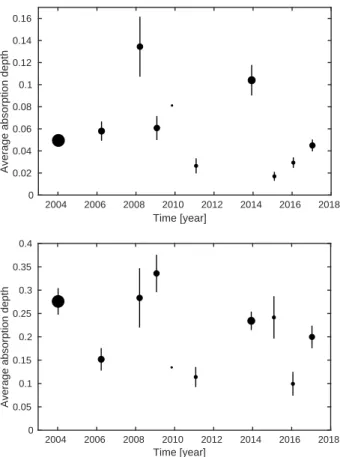
Fig. 5. Average absorption depth variations in the co-added Ca II K and H absorption spectra. Top: S-familly, between 50 and 100 km s−1. Bottom: D-familly, between 5 and 25 km s−1.
The marker size is proportionnal to the number of nights where β Pic was observed by HARPS in each period (see Table 1). The errorbars indicate the scatter of average absorption depth during each period. See text for explanations.
Most of the time, several spectra are observed on the same night; this allows us to obtain an average AAD per night, a measure of exocometary activity during a single night. Averaging these night-based AAD over each of the periods considered in this paper (Table 1) we get a measure of how much the exocometary activity varies through time from one period to the other. It could then be compared to the Fe I variations in Fig. 4. Using the night-based AAD for this computation, rather than averaging over all spectra of a given period, makes more sense, because it prevents nights with many collected spectra to dominate the period-based AAD. These average absorption depth are plotted for each exocomet familly on Figure 5.
As can be seen, there is no obvious long-term variations or sudden drop in the exocomet activity. On the contrary, the measurements scatter and the errorbars show that the total quantity of particles evaporated from the many tran-siting exocomets is variable even within a given period. Thus we see no evidence here for any correlation between exocomet activity and Fe I disk column densities.
4.2. Variability in the core of the Ca II CS line
We first excluded the strongly blended CS line region (0±5 km s−1), since we were initially interested in exocomet absorption. However, the CS line region incorporates
cir-2004 2006 2008 2010 2012 2014 2016 2018 Time [year] 0.2 0.3 0.4 0.5 0.6 0.7 0.8 0.9 1
Ca II average absorption depth
Fig. 6. Average absorption depth (AAD) variations in the Ca II circumstellar line region 0±5 km s−1. In blue, the K-line AAD
and in red the H-line. They are compared to the total Fe I ground level column density variations in Table 4. The marker size is proportionnal to the number of nights where β Pic was observed by HARPS in each period (see Table 1). For the sake of com-parison, the Fe I column densities are scaled to the Ca II AAD median.
cumstellar disk variations, as well as exocomets transit sig-natures. It is interesting to see if significant Ca II variations show up in that region, even though we are not able to know their origin. We plotted the AAD variation in this domain in Fig. 6.
This time, we observe a neat decrease in average ab-sorption depth. The varying blended features in that region have an average depth of about 0.68±0.03 in 2003-2011 and decrease to 0.50±0.04 in 2013-2017, for a total 3.6σ drop of 26% along the 14 years of observations. This is com-parable to the measured drop of column density of Fe I. This variation is confirmed by measuring a flux increase in the 5 pixels at the tip of the K-line from 0.0096±0.0012 to 0.0196±0.0021 in arbitrary unit, and from 0.0166±0.0019 to 0.037±0.0064 at the tip of the H-line.
Given that the average absorption depth is directly pro-portional to equivalent width, and thus at first approxima-tion to average column density in the absorbing medium, we see that both Ca II medium and Fe I medium varied in about the same proportions. This has implications on the Fe and Ca relative abundance in the circumstellar medium close to the star, that we will explore in more details in the next section.
In conclusion, the variations experienced by the Fe I components column density are likely connected to Ca II variations in the circumstellar medium. Ca and Fe are thus part of a common reservoir that suddenly dissipated be-tween 2011 and 2013. We cannot firmly identify the origin of these variations, which could be either large low-velocity exocomets or local gas disk inhomogeneities. The exocomets scenario is however less likely as they would have to be dis-connected to the already known exocomets which families show no sign of long-term or sudden variations.
A&A proofs:manuscript no. FeI_HARPS_paper_2_arxiv
Table 7.The variation of the Ca II average absorption depth and average flux around Ca II K and H circumstellar lines. Average absorption depths are calculated from the normalized spectra, either separating K and H spectra, either co-adding the K and H absorption lines. Average fluxes are calculated from the raw spectra. Their continuum is scaled to an arbitrary level that is common to all spectra.
Periods Average absorption depth Average flux [arb. unit]
CS-line D-family S-family tip of CS-line blue wing K only H only K & H coadded K only H only K only ±5 km s−1 ±5 km s−1 5 - 25 km s−1 50 - 100 km s−1 0±2 km s−1 0±2 km s−1 -150±5 km s−1 2003-2004 0.704±0.014 0.61597±0.010 0.276±0.028 0.0495±0.0045 0.01118±0.00063 0.01843±0.00062 0.3881±0.0010 2004-2007 0.753±0.029 0.68788±0.027 0.152±0.024 0.0580±0.0088 0.0105±0.0016 0.0162±0.0024 0.3864±0.0024 2007-2008 0.701±0.013 0.61683±0.013 0.283±0.064 0.134±0.027 0.01146±0.00074 0.01679±0.00080 0.3768±0.0038 2008-2009 0.828±0.020 0.75697±0.026 0.336±0.040 0.061±0.011 0.00437±0.00059 0.00801±0.00091 0.3810±0.0017 †2009-2010 0.72174 0.64518 0.135 0.081 0.0079 0.0204 0.3869 2010-2011 0.610±0.036 0.54054±0.037 0.114±0.022 0.0265±0.0069 0.0124±0.0022 0.0198±0.0029 0.39563±0.00057 2013-2014 0.531±0.012 0.48492±0.012 0.234±0.020 0.104±0.014 0.02185±0.00060 0.02788±0.00065 0.3820±0.0024 2014-2015 0.634±0.016 0.52135±0.015 0.242±0.045 0.0170±0.0041 0.01436±0.00060 0.0233±0.0011 0.3949±0.0014 2015-2016 0.46±0.11 0.34875±0.12 0.099±0.035 0.0294±0.0048 0.0241±0.0060 0.049±0.012 0.3950±0.0021 2016-2017 0.602±0.034 0.4145±0.026 0.200±0.024 0.0450±0.0054 0.0182±0.0012 0.04530±0.00092 0.3858±0.0013
†With only 1 night observed it is not possible to evaluate uncertainties.
5. Discussing the relation between Ca and Fe
5.1. Implication for the Fe II/Fe I ionization ratio
Independently in both K and H line of the Ca II doublet, we measure an average absorption depth drop of about 0.36±0.04. The average K/H-line ratio of the dropped Ca II component is therefore about 1±0.2. Comparing the indi-viduals AAD of K and H lines in Table 7 leads to a refined K/H ratio closer to 1.2. Thus, the Ca II varying medium is likely not fully saturated. In terms of equivalent width, with the core of the variation concentrated within ±5 km s1 of β Pictoris velocity, we can estimate that
WK,H = AAD ×
10 km s−1
c ×λK,H (1)
The lower limit from simple linear relation between equivalent width and column density in the K and H lines gives that the variation of the column density of Ca II should be ∆NCa II>4.5 1011cm−2. Using Somerville (1988) equivalent width ratio method, best to use in close-to-saturated cases, we find a range of possible column density for a ratio of 1.2:
∆NCa II∼1 − 4 1012cm−2 (2)
This should be compared to the
∆NFe I=(7.5±0.9) 1011cm−2 lost during the 2011-2013 drop in the ground level column density. Assuming that Ca is fully ionized below 1 au (Fernandez et al. 2006), we can obtain an estimation of the abundance of Ca with respect to Fe in this medium, by calculating ∆NCa II/∆NFe I. We find a ratio of about
Ca II/Fe I ∼ 1 − 5 (3)
Therefore, Ca II and Fe I are almost as abundant in this medium. If it follows β Pic standard abundances (Roberge et al. 2006), with Fe/Ca∼15, then we must have Fe II/Fe I∼15-75, implying a low ionization rate for Fe. This is in fairly good agreement with the results of VM17, proposing that Fe I/Fe II.1 in the 20.4 km s−1 component at 1300 K.
Fig. 7. Ca I absorption line at 4226.728 Å with a shift of 20 km s−1. All HARPS spectra from 2003 to 2017 are here
co-added.
5.2. Ca I line variations
In the HARPS spectra, we also found a Ca I circumstel-lar absorption line about 4226.728 Å, as plotted on Fig. 7. Measuring its variation allow comparing Ca I and Fe I and determining independently the Ca/Fe abundance ratio. We thus analysed as for Fe I the variation of the column density in this line using Owens.f. The results are given in Table 8, and compared to Fe I and Ca II variations in Fig. 8.
Again we found a 2-σ significant drop of column density compatible with 30% between 2011 and 2013. The mea-sured column density variation is ∆NCa I=(1.54±0.70) × 108cm−1. This means that Ca I, Ca II and Fe I variations are all compatible and most likely originate from a common medium.
First comparing the column density variation of Ca I, to the one estimated above for Ca II, we find that indeed Ca is almost fully ionized with a ratio Ca II/Ca I∼104, much higher than what primarily found by Hobbs et al. (1985) but closer to the theoretical estimations of Fernandez et al. (2006). Second, comparing this Ca I variation to ∆NFe I we find that Fe I is ∼5000 (±2400) times more abundant than
Kiefer et al.: Fe I in the Beta Pictoris circumstellar gas disk Table 8. The variation of the Ca I velocity shift, b value and
column density evaluated by fitting the ground base line at 4226.728 Å. Upper-limits for b-values are given at 1-sigma.
Periods SNR v b logNFeI
(year) (km s−1) (km s−1) (cm−2) 2003-2004 2120 19.80±0.25 <2.0 8.48±0.08 2004-2007 870 21.29±0.42 <1.4 8.60+0.10 −0.20 2007-2008 1200 19.53±0.35 <1.00 8.52+0.10−0.16 2008-2009 1980 19.85±0.22 1.30±0.45 8.69±0.09 2009-2010 590 15.42+0.93 −0.67 — <8.25† 2010-2011 860 19.56±0.63 <1.5 8.44+0.15−0.43 2013-2014 1350 20.08±0.45 <1.1 8.35+0.13 −0.25 2014-2015 800 20.70±0.44 <1.6 8.66±0.15 2015-2016 950 31.40+0.35 −0.70 — <8.51† 2016-2017 1450 20.35±0.65 <1.1 8.17+0.16 −0.63 †2-sigma upper-limit calculated varying v in range 19-21 km s−1. 2004 2006 2008 2010 2012 2014 2016 2018 Time [year] -0.6 -0.4 -0.2 0 0.2 0.4 0.6 Ca I, Ca II and Fe I variations
Fig. 8. Scaled-to-median Ca I column density variations at 4226.728 Å, in green, compared to Ca II-K (in blue), Ca II-H (in red) and Fe I variations (black). Absolute values for Ca I column densities are reported in Table 8. The median of all datasets was shifted to 0. The size is proportional to the number of observed nights for Ca II, while it is proportional to SNR for Fe I and Ca I, as given in Tables 7, 4 and 8 respectively.
Ca I. If originating from a common medium, then according to photoionisation-recombination balance (Lagrange et al. 1995), Ca and Fe should follow, at a given distance to the central star, a one-to-one correspondance in first ionization ratio
NFe I/NFe II= 200 × NCa I/NCa II (4)
Assuming that NFe∼NFe II and NCa∼NCa II is a fairly good approximation even if Fe II/Fe I∼10. In this case, we derive an abundance ratio Fe/Ca of about 25 (±12). It is compatible with the solar value for this ratio ∼15 (Lod-ders 2003, Lod(Lod-ders 2010) and the value found in β Pic by Roberge et al. (2006), 15±10.
We can also confirm that Fe ionisation ratio is low with the direct measurement of Fe II/Fe I∼30-100, using the above formula and the estimation of NCa I/NCa II.
6. Conclusion
To summarize the reported results, we observed in the cir-cumstellar gas disk of β Pictoris that
– The Fe I ground level column density drop of 2011-2013 is also observed in the Fe I excited levels absorption lines centered around velocity 20.4 km s−1,
– The blue and red components of Fe I0 absorption lines have different variability, with the 20.4 km s−1 more compatible with a sudden drop, while the blue com-ponent seems to have an independent behavior, – We identified a varying Ca II component in the
circum-stellar line region, which equivalent width is dropping in average with an amplitude comparable to that of Fe I. – The Ca I circumstellar line also experiences a drop
be-tween 2011 and 2013. This drop is compatible with β Pic-like relative abundances for Ca and Fe,
– The varying component of Fe has a low ionisation ratio, in agreement with VM17 results.
First we conclude that the VM17 1300 K medium at 20.4 km s−1 contains not only Fe, but also Ca, and both stands at photoelectric equilibrium. It is located at close distance to the star ∼38 R⋆ to sustain the 1300 K temper-ature and the high ionisation ratio of Ca. The Fe I blue component is likely not connected to this inner disk and belongs to a colder outer location with different photoion-ization conditions, possibly from recombination of Fe II be-yond 100 AU, as described by Brandeker et al. (2004,2011). Second, although the Ca II absorptions due to exo-comets in the β Pictoris spectrum have a strong variability, they do not show any long term or sudden variations as in the column density of the 20.4 km s−1 component of Fe I. On the other hand, depth variations in the core of the Ca II circumstellar line have a stronger compatibility with the Fe I drop. Large and slow transiting exocomets could be at the origin of such absorptions, blended within the circum-stellar line, such as members of the D-family, as suggested by Welsh & Montgomery (2016). However, the absence of correlated variations at larger velocity (up to +30 km s−1 in β Pic rest frame) where most D-family objects lie does not support this hypothesis.
Small scale disk inhomogeneities with yearly density variations are another alternative scenario. Such variations could be triggered by an outer planet, through direct gravi-tational interaction or indirectly by changing the flux of in-coming dust within an inner disk at 0.3 au. However in that case a periodic behaviour would be expected. The base-line is not long enough to confirm or exclude periodicity, but a slight increase of the Fe I column density is already observed. The continuation of the monitoring of β Pic op-tical spectrum with high resolution spectrograph such as HARPS will allow testing this scenario.
Acknowledgements. We thank the anonymous referee for his help on greatly improving the quality of the article. We warmly thank T. Lanz for fruitful discussions on the subject of the present article. F.K. ac-knowledge support by a CNES fellowship grant. A.L.E, A.V-M and F.K thank the CNES for financial support. This work has been partly carried out thanks to an award from the Fondation Simone et Cino Del Duca. P.A.W. acknowledge support from the European Research Council under the European Unions Horizon 2020 research and in-novation programme under grant agreement No. 694513. V. B. and D. E. acknowledge support by the Swiss National Science Foundation (SNSF) in the frame of the National Centre for Competence in Re-search PlanetS, and has received funding from the European ReRe-search Council (ERC) under the European Union’s Horizon 2020 research and innovation programme (project Four Aces; grant agreement No 724427). HARPS data were obtained at ESO 3.6m telescope from 2003 to 2017, with Program IDs, 60.A-9036, 072.C-0636, 075.C-0234, 076.C-0073, 076.C-0279, 078.C-0209, 079.C-0170, 0032, 080.C-0664, 080.C-0712, 081.C-0034, 082.C-0308, 082.C-0412, 084.C-1039,
A&A proofs:manuscript no. FeI_HARPS_paper_2_arxiv
091.C-0456, 094.C-0946, 098.C-0739, 099.C-0205, 099.C-0599, 184.C-0815, & 192.C-0224
References
Artymowicz, P., 1997, Annual Review of Earth and Planetary Sci-ences, 25, 175
Backman, D. E., Paresce F., 1993, Protostars and Planets III, 1253 Beust, H., Vidal-Madjar, A., Ferlet, R., & Lagrange-Henri, A. M.
1990, A&A, 236, 202
Brandeker, A., Liseau, R., Olofsson, G., & Fridlund, M. 2004, A&A, 413, 681
Brandeker, A. 2011, ApJ, 729, 122
Ferlet, R., Vidal-Madjar, A., & Hobbs, L. M. 1987, A&A, 185, 267 Fernández, R., Brandeker, A., & Wu, Y. 2006, ApJ, 643, 509 Hébrard, G., Lemoine, M., Vidal-Madjar, A., et al. 2002, ApJS, 140,
103
Hobbs, L. M., et al., 1985, ApJ, 293, L29
Kiefer, F., Lecavelier des Etangs, A., Boissier, J., et al. 2014, Nature, 514, 462
Lagrange, A. M., et al., 1995, A&A, 296, 499 Lagrange A.-M., et al., 2012, A&A, 542, A18 Lagrange, A.-M., et al., 2018, A&A, 612, A108
Lecavelier des Etangs, A., Vidal-Madjar, A. & ferlet, R. 1996a, A&A, 307, 542L
Lemoine, M., Vidal-Madjar, A., Hébrard, G., et al. 2002, ApJS, 140, 67
Li A., Greenberg, J. M., 1998, A&A, 331, 291 Lodders, K. 2003, ApJ, 1220, 591
Lodders, K., 2010, Astrophysics and Space Science Proceedings, 16, 379
Mamajek, E. E., Bell C. P. M., 2014, MNRAS, 445, 2169 Pepe, F., Lovis, C., Ségransan, D., et al. 2011, A&A, 534, 58 Roberge, A., Feldman, P. D., Weinberger, A. J., Deleuil, M. & Bouret,
J-C. 2006, Nature, 441, 724
Smith, B. A. & Terrile, R. J. 1984, Science, 226, 1421
Vidal-Madjar, A., Lecavelier des Etangs, A., & Ferlet, R. 1998, Planet. Space Sci., 46, 629
Vidal-Madjar, A., et al., 2017, A&A, 607, A25 Weissman, P. R., 1984, Science, 224, 987
Weissman, P. R., 1984, Lunar and Planetary Science Conference, 15, 904
Welsh, B. Y., & Montgomery, S. L., 2016, PASP, 128, 064201