HAL Id: hal-00302845
https://hal.archives-ouvertes.fr/hal-00302845
Submitted on 4 Jun 2007HAL is a multi-disciplinary open access
archive for the deposit and dissemination of sci-entific research documents, whether they are pub-lished or not. The documents may come from teaching and research institutions in France or abroad, or from public or private research centers.
L’archive ouverte pluridisciplinaire HAL, est destinée au dépôt et à la diffusion de documents scientifiques de niveau recherche, publiés ou non, émanant des établissements d’enseignement et de recherche français ou étrangers, des laboratoires publics ou privés.
Contribution of carbonaceous aerosol to cloud
condensation nuclei: processes and uncertainties
evaluated with a global aerosol microphysics model
J. R. Pierce, K. Chen, P. J. Adams
To cite this version:
J. R. Pierce, K. Chen, P. J. Adams. Contribution of carbonaceous aerosol to cloud condensation nuclei: processes and uncertainties evaluated with a global aerosol microphysics model. Atmospheric Chemistry and Physics Discussions, European Geosciences Union, 2007, 7 (3), pp.7723-7765. �hal-00302845�
ACPD
7, 7723–7765, 2007 Contribution of carbonaceous aerosol to CCN J. R. Pierce et al. Title Page Abstract Introduction Conclusions References Tables Figures ◭ ◮ ◭ ◮ Back CloseFull Screen / Esc
Printer-friendly Version Interactive Discussion
EGU
Atmos. Chem. Phys. Discuss., 7, 7723–7765, 2007 www.atmos-chem-phys-discuss.net/7/7723/2007/ © Author(s) 2007. This work is licensed
under a Creative Commons License.
Atmospheric Chemistry and Physics Discussions
Contribution of carbonaceous aerosol to
cloud condensation nuclei: processes
and uncertainties evaluated with a global
aerosol microphysics model
J. R. Pierce1, K. Chen2, and P. J. Adams2,3
1
Department of Chemical Engineering, Carnegie Mellon University, Pittsburgh, PA, USA
2
Department of Civil and Environmental Engineering, Carnegie Mellon University, Pittsburgh, PA, USA
3
Department of Engineering and Public Policy, Carnegie Mellon University, Pittsburgh, PA, USA
Received: 10 April 2007 – Accepted: 16 May 2007 – Published: 4 June 2007 Correspondence to: J. R. Pierce ([email protected])
ACPD
7, 7723–7765, 2007 Contribution of carbonaceous aerosol to CCN J. R. Pierce et al. Title Page Abstract Introduction Conclusions References Tables Figures ◭ ◮ ◭ ◮ Back CloseFull Screen / Esc
Printer-friendly Version Interactive Discussion
EGU
Abstract
This paper explores the impacts of carbonaceous aerosol on cloud condensation nu-clei (CCN) concentrations in a global climate model with size-resolved aerosol micro-physics. Organic matter (OM) and elemental carbon (EC) from two emissions invento-ries were incorporated into a preexisting model with sulfate and sea-salt aerosol. The 5
addition of carbonaceous aerosol increased CCN(0.2%) concentrations by 65–90% in the globally averaged surface layer depending on the carbonaceous emissions inven-tory used. Sensitivity studies were performed to determine the relative importance of the organic “solute effect”, in which CCN concentrations increase because of the added soluble carbonaceous material, versus the “seeding effect”, in which CCN concentra-10
tions increase because of increased particle number concentrations. In a sensitivity study where carbonaceous aerosol was assumed to be completely insoluble, concen-trations of CCN(0.2%) still increased by 40–50% globally over the no carbonaceous simulation because primary carbonaceous emissions were able to become CCN via condensation of sulfuric acid. This shows that approximately half of the contribution 15
of carbonaceous particles to CCN comes from the “seeding effect” and half from the “solute effect”. The solute effect tends to dominate more in areas where there is less in-organic aerosol than in-organic aerosol and the seeding effect tends to dominate in areas where is more inorganic aerosol than organic aerosol. It was found that an accurate simulation of the number size distribution is necessary to predict the CCN concentration 20
but assuming an average chemical composition will generally give a CCN concentra-tion within a factor of 2. If a “typical” size distribuconcentra-tion is assumed for each species when calculating CCN, such as is done in bulk aerosol models, the mean error relative to a simulation with size resolved microphysics is on the order of 35%. Predicted values of carbonaceous aerosol mass and aerosol number were compared to observations and 25
the model showed average errors of a factor of 3 for carbonaceous mass and a factor of 4 for total aerosol number. These errors may be reduced by improving the emission size distributions of both primary sulfate and primary carbonaceous aerosol.
ACPD
7, 7723–7765, 2007 Contribution of carbonaceous aerosol to CCN J. R. Pierce et al. Title Page Abstract Introduction Conclusions References Tables Figures ◭ ◮ ◭ ◮ Back CloseFull Screen / Esc
Printer-friendly Version Interactive Discussion
EGU
1 Introduction
Radiative forcing by aerosols is an important contributor to climate change (IPCC, 2001). Compared to the positive (warming) radiative forcing caused by greenhouse gases, the magnitude of the negative (cooling) radiative forcing by aerosols remains uncertain. The largest uncertainty in aerosol forcing of climate is the indirect effect, 5
wherein anthropogenic aerosols perturb the earth’s climate by increasing cloud re-flectance (Albrecht, 1989; Twomey, 1974). This occurs when anthropogenic activi-ties increase the number of aerosol particles that serve as nuclei upon which cloud droplets form (cloud condensation nuclei or CCN). The consequent increase in cloud droplet number concentrations (CDNC) leads to brighter clouds that may have longer 10
lifetimes. The Intergovernmental Panel on Climate Change (IPCC) has estimated that the globally and annually averaged indirect aerosol radiative forcing lies between 0 and –2.0 W m−2, as compared with +2.5 W m−2 imposed by changes in greenhouse gases
(IPCC, 2001). This estimate includes only the effect of aerosols on cloud brightness, neglecting changes in cloud cover. Uncertainty in the magnitude of aerosol forcing has 15
plagued efforts to quantify the sensitivity of climate to anthropogenic perturbations (An-dreae et al., 2005; Schwartz, 2004). Clearly it is necessary to improve our estimates of the indirect effect.
To estimate the indirect radiative forcing, it is essential to understand the activation of aerosol particles to form cloud droplets under supersaturated conditions. Whether 20
or not a particle activates depends on the ambient supersaturation as well as particle size and composition. Therefore, a physically based model of the indirect effect should predict the number size distribution of aerosols and the chemical composition of each size range to predict the number of CCN for any supersaturation. Knowledge of aerosol mixing state is also essential for correct prediction of CCN activation behavior.
25
Carbonaceous aerosols, mainly produced from fossil fuel and biomass combustion, are composed of two classes of material: elemental carbon (EC) and organic matter (OM). Elemental carbon is emitted directly from primary sources. OM, in contrast, is
ACPD
7, 7723–7765, 2007 Contribution of carbonaceous aerosol to CCN J. R. Pierce et al. Title Page Abstract Introduction Conclusions References Tables Figures ◭ ◮ ◭ ◮ Back CloseFull Screen / Esc
Printer-friendly Version Interactive Discussion
EGU
both emitted as particulates (primary OM) and also condensed in the atmosphere from semi-volatile oxidation products of volatile organic compounds. The latter is referred to as secondary organic aerosol (SOA).
Carbonaceous aerosols are considered to be a strong contributor to the indirect ef-fect (Novakov and Penner, 1993). Lohmann et al. (2000) predict an indirect efef-fect of 5
–0.9 W m−2from anthropogenic carbonaceous aerosol alone compared to –0.4 W m−2
from sulfate aerosol alone, and –1.1 W m−2from an internal mixture of the two. Chuang
et al. (2002) estimate a total cloud brightness forcing of –1.85 W m−2, with –0.30 W m−2
and –1.51 W m−2 from sulfate and carbonaceous aerosols alone, respectively.
Hitzen-berger et al. (1999) observed, in rural Europe sites, that carbonaceous material con-10
tributed up to 67% of total aerosol mass in CCN size range; in urban areas, the con-tribution of OM to the total mass concentration in this size range was 48%. Based on these studies, it seems likely that carbonaceous aerosol plays a significant or even dominant role in the tropospheric CCN budget. Therefore, it is essential to understand the global distribution of mass and number concentrations and size distribution of car-15
bonaceous aerosols.
A number of previous modeling studies using bulk aerosol models have been per-formed to estimate the global distribution of carbonaceous aerosols (Chung and Sein-feld, 2001; Cooke et al., 1999; Cooke and Wilson, 1996; Liousse et al., 1996; Lohmann et al., 2000; Penner et al., 1998; Reddy and Boucher, 2004). However, these studies 20
must use empirical relations to predict CDNC from their predicted aerosol mass. Be-sides the uncertainties inherent in the empirical approach, it has the disadvantage of concealing the physical processes that control CCN concentrations, introducing the dif-ficulty of testing the sensitivity of model behavior to uncertainties or changes in specific microphysical processes such as nucleation.
25
The most fundamental, albeit computationally intensive, method for predicting aerosol size distributions results from solving explicitly the aerosol general dynamic equation, which governs how the aerosol size distribution evolves as a result of the mi-crophysical processes of nucleation, condensation, and coagulation. Numerical
algo-ACPD
7, 7723–7765, 2007 Contribution of carbonaceous aerosol to CCN J. R. Pierce et al. Title Page Abstract Introduction Conclusions References Tables Figures ◭ ◮ ◭ ◮ Back CloseFull Screen / Esc
Printer-friendly Version Interactive Discussion
EGU
rithms for treating aerosol microphysics can be broadly categorized as modal, moment-based, or sectional. To our knowledge, moment-based approaches have not been implemented into global models for the purposes of predicting CCN concentrations al-though regional-scale applications have been demonstrated (Yu et al., 2003). Modal algorithms that represent the aerosol size distribution as the sum of several lognormal 5
distributions, each characterized by a number concentration, median diameter, and geometric standard deviation, have been developed by Herzog et al. (2004), Jung et al. (2004) and Vignati et al. (2004) and implemented in Easter et al. (2004), Ghan et al. (2001), Stier et al. (2005) and Wilson et al. (2001) global models. Except for Jung et al. (2004), the versions of the modal approach cited here have prescribed constant 10
values to the geometric standard deviations such that only two of the three lognormal parameters are predicted variables. Zhang et al. (1999) demonstrated that allowing the geometric standard deviation to vary results in greater accuracy under some con-ditions. An advantage of the modal approach is its computational efficiency compared to sectional algorithms. This efficiency permits an explicit treatment of aerosol mixing 15
(Stier et al., 2005; Vignati et al., 2004; Wilson et al., 2001). The modal representation has an inherent disadvantage, however, in treating processes such as activation and cloud chemistry that create discontinuities in the size distribution. For example, in box model simulations with cloud processing of aerosol particles, Zhang et al. (2002) found normalized absolute errors of 6% to 34% in the number of activated particles predicted 20
by the modal approach with either two or three predicted variables.
Single-moment aerosol sectional algorithms have been applied to the problem of global aerosol microphysics (Gong et al., 2003; Rodriguez and Dabdub, 2004). In the single-moment sectional approach, the masses of each aerosol species in each size section are calculated while the number of aerosol particles in each bin is inferred. 25
Because the aerosol microphysical equations are formulated in terms of aerosol mass, they generally do not conserve aerosol number concentrations during the condensa-tion process. Although the treatment of condensacondensa-tion may be formulated to conserve aerosol number in these algorithms, such a formulation induces unwanted numerical
ACPD
7, 7723–7765, 2007 Contribution of carbonaceous aerosol to CCN J. R. Pierce et al. Title Page Abstract Introduction Conclusions References Tables Figures ◭ ◮ ◭ ◮ Back CloseFull Screen / Esc
Printer-friendly Version Interactive Discussion
EGU
diffusion in the aerosol size distribution (Adams and Seinfeld, 2002). Note that we do not include in this category numerous size-resolved global models of predominantly coarse mode aerosols such as sea-salt and mineral dust (e.g. Tegen and Lacis, 1996), which are not microphysical models because they do not solve the aerosol conden-sation and coagulation equations. In such models, the size resolution accounts for 5
important size-dependent optical properties and depositional behavior while conden-sation and coagulation processes generally have a negligible impact on the coarse mode.
Two-moment sectional approaches (Tzivion et al., 1989; Tzivion et al., 1987) and the similar “moving-center” approach (Jacobson, 2002) represent a highly accurate 10
and flexible treatment of aerosol microphysics. In these approaches, the mass (of each aerosol component) and number concentrations are tracked as independent pa-rameters for each size section, thereby avoiding the limitations of other approaches discussed above. Although they are computationally intensive, several applications to tropospheric aerosol microphysics in three-dimensional, global-scale models have 15
been demonstrated (Adams and Seinfeld, 2002; Jacobson, 2001; Pierce and Adams, 2006; Spracklen et al., 2006; Spracklen et al., 2005a; Spracklen et al., 2005b).
Carbonaceous particles may affect the CCN concentrations through two different pathways. The first pathway, which we refer to as the “carbonaceous seeding effect”, occurs when carbonaceous emissions increase the number of particles in the atmo-20
sphere and potentially increases the number of CCN. The increase in CCN due to carbonaceous seeding can occur regardless of the size and solubility of the primary carbonaceous particles if more hygroscopic gases such as sulfuric acid condense onto these particles (Adams and Seinfeld, 2003; Pierce and Adams, 2006). The second pathway for CCN increase from carbonaceous particles is the contribution of OM to 25
the number of soluble molecules within atmospheric particles, which we refer to as the “organic solute effect”. The implications of the competition between these two pathways are as follows. To the extent that the carbonaceous seeding effect is im-portant, the number and sizes of primary emissions must be understood to accurately
ACPD
7, 7723–7765, 2007 Contribution of carbonaceous aerosol to CCN J. R. Pierce et al. Title Page Abstract Introduction Conclusions References Tables Figures ◭ ◮ ◭ ◮ Back CloseFull Screen / Esc
Printer-friendly Version Interactive Discussion
EGU
predict CCN. Subsequently, if the organic solute is important, understanding OM chem-istry/composition becomes important in the prediction of CCN. It is not obvious a priori which one of these two effects contributes more to CCN and will be explored in this paper.
This paper documents the incorporation of carbonaceous aerosols in the highly size-5
resolved TwO-Moment Aerosol Sectional (TOMAS) microphysics model (Adams and Seinfeld, 2002). We estimate the contribution of carbonaceous aerosol to CCN forma-tion on a global scale. Since most of the carbonaceous aerosol number is emitted in the ultrafine size range, we determine how ultrafine carbonaceous particles grow to be CCN by coagulation and condensation processes. Although this model does not yet 10
take into account mineral dust, the simulation has included almost all aerosol number and CCN concentrations because mineral dust is mostly in coarse mode and does not contribute much to CCN concentrations. We perform sensitivity runs to test model assumptions regarding carbonaceous aerosol solubility and mixing state. Using these sensitivity runs we determine the relative contributions of carbonaceous seeding and 15
organic solute to the CCN concentrations.
Section 2 of this paper describes the essential elements of the model we devel-oped to simulate the global distributions of carbonaceous aerosol. Section 3 is the main results and discussion including carbonaceous budgets, comparisons of carbona-ceous mass and aerosol number to observations and the contribution of carbonacarbona-ceous 20
aerosol to CCN. Finally, Sect. 4 presents the main conclusions from this work.
2 Model description
2.1 Overview
We use the TwO-Moment Aerosol Sectional (TOMAS) microphysics model developed by Adams and Seinfeld (2002), which adapted cloud microphysics algorithms Stevens 25
ACPD
7, 7723–7765, 2007 Contribution of carbonaceous aerosol to CCN J. R. Pierce et al. Title Page Abstract Introduction Conclusions References Tables Figures ◭ ◮ ◭ ◮ Back CloseFull Screen / Esc
Printer-friendly Version Interactive Discussion
EGU
TOMAS tracks two independent moments, number and mass, of the aerosol size dis-tribution for each size bin or category.
The TOMAS microphysics model is implemented in the Goddard Institute for Space Studies (GISS) II-prime GCM. In the GISS GCM II-prime, the time step for tracer pro-cesses is one hour. It has a horizontal resolution of 4 degrees latitude by 5 degrees 5
longitude and 9 vertical layers from the surface to the model top at 10 mb (Hansen et al., 1983). A fourth-order scheme for momentum advection is included in the GCM. Chemical tracers, heat, and moisture are advected every hour using a quadratic up-stream scheme (Prather, 1986). In the GCM, TOMAS is configured to include 30 size bins defined in terms of dry particle mass and spanning a size range roughly corre-10
sponding to particle diameters of 10 nm to 10 µm. For each size bin, the model tracks eight quantities: sulfate mass, sea-salt mass, mass of pure EC, mass of mixed EC, mass of hydrophobic OM, mass of hydrophilic OM, mass of water and also the number of aerosol particles in that bin. Besides these size-resolved aerosol tracers, the model tracks four bulk gas-phase species: H2O2, SO2, DMS and H2SO4. One bulk aerosol
15
species, MSA, is also predicted. Therefore, a total of 245 (30 bins × 8 tracers per bin + 5 bulk species) tracers are tracked online in the GISS GCM II-prime. We use the binary nucleation scheme detailed in Adams and Seinfeld (2002), in-which new particles are generated when sulfuric acid concentrations exceed threshold values given in Wexler et al. (1994).
20
The size-resolved dry deposition of sulfate aerosols, sea-salt, EC and OM is calcu-lated as in work of Adams and Seinfeld (2002), which is based on a resistance-in-series parameterization (Wesely and Hicks, 1977). The scheme calculates quasi-laminar re-sistances as a function of particle size, accounts for gravitational settling of aerosols, and assumes there is no surface resistance for aerosols.
25
Wet deposition consists of in-cloud scavenging and below-cloud scavenging. In-cloud scavenging removes particles that activate to form In-cloud drops if those drops precipitate. In large-scale and convective clouds, particles that activate at 0.2% and 1.0% supersaturation, respectively, are considered to nucleate into cloud droplets. The
ACPD
7, 7723–7765, 2007 Contribution of carbonaceous aerosol to CCN J. R. Pierce et al. Title Page Abstract Introduction Conclusions References Tables Figures ◭ ◮ ◭ ◮ Back CloseFull Screen / Esc
Printer-friendly Version Interactive Discussion
EGU
critical supersaturation for activation of each size section is found using modified K ¨ohler theory (Hanel, 1976; Laaksonen et al., 1998; Raymond, 2003; Seinfeld and Pandis, 1998). This will be discussed more in Sect. 2.3. In these simulations, we neglect interstitial scavenging in clouds. The fraction of aerosol that activates and is subject to wet removal accounts for essentially all the aerosol mass. Below-cloud scavenging 5
removes particles colliding with falling raindrops. A first-order removal scheme (Koch et al., 1999) is applied to aerosol below precipitating clouds to simulate below-cloud scavenging with a size-dependent removal constant (Adams and Seinfeld, 2002).
In all simulations, externally mixed or pure populations are treated as externally mixed only for purposes of cloud processes such as activation and wet deposition. 10
During microphysics, all aerosols are treated as internally mixed. While this is a limi-tation of the present work, it does allow us to explore the sensitivity of CCN and wet deposition to aerosol chemical composition without the computational expense of a multi-population microphysics model.
2.2 Emissions 15
In this work, we adopt an earlier size-resolved sulfur cycle model by Adams and Seinfeld (2002). The anthropogenic sulfur emissions are from the GEIA inventory (Benkovitz et al., 1996). As discussed in Adams and Seinfeld (2002), three percent of the total anthropogenic sulfur is emitted as particulate sulfate, mostly ultrafine, to represent plume processing of power plant emissions. This work uses the sea-salt 20
emissions parameterization given in Clarke et al. (2006) and applied to the model as in Pierce and Adams (2006). Clarke et al. (2006) conducted a coastal field campaign to find the sea-salt number flux and fit the size distribution of the emissions flux to polynomials spanning dry diameters of 10 nm to 8 µm.
Anthropogenic carbonaceous aerosol emissions result mainly from biomass burning 25
and fossil fuel combustion. We use two different carbonaceous emissions inventories in the model. The first inventory is that used by the IPCC Third Assessment Report (IPCC, 2001). In that report, the fossil fuel EC emissions inventory is based on the work
ACPD
7, 7723–7765, 2007 Contribution of carbonaceous aerosol to CCN J. R. Pierce et al. Title Page Abstract Introduction Conclusions References Tables Figures ◭ ◮ ◭ ◮ Back CloseFull Screen / Esc
Printer-friendly Version Interactive Discussion
EGU
of Penner et al. (1993), and other emission inventories including biomass EC, biomass OM, fossil fuel OM are based on the work of Liousse et al. (1996). The biomass burning EC and OM in this work uses monthly averaged emissions whereas the fossil fuel EC and OM are annually averaged. The second inventory is that of Bond et al. (2004). To convert the organic carbon (OC) mass presented in Bond et al. (2004) to OM we 5
assume an OM:OC ratio of 1.8 (El-Zanan et al., 2005; Yu et al., 2005; Zhang et al., 2005). The assumption of a single value for this ratio is a source of uncertainty. We add seasonality to the Bond et al. (2004) open burning emissions by scaling the emissions by the fractions of the grid cells that are on fire as used by Liousse et al. (1996), while keeping their total annual emissions from open burning constant. In grid cells where 10
Bond et al. (2004) has open burning emissions and Liousse et al. (1996) does not specify fire fraction, the open burning emissions are constant from month to month.
As pointed out by Adams and Seinfeld (2003), emissions of primary particles have a disproportionate impact per unit mass on global CCN concentrations via a “seed-ing” effect. Carbonaceous emissions inventories have not traditionally compiled size 15
distribution data. Stanier et al. (2004), estimated that the size distribution of primary aerosols emitted by vehicles in a highway tunnel during the Pittsburgh Air Quality Study was approximately lognormal with a mass median diameter of 100 nm and a geometric standard deviation of 1.8. By measuring aerosol size distributions near a road, Janhall et al. (2004) found the number median diameter of particle emissions to be 25 nm with 20
a standard deviation of 2. Similar to both these results, this work assumes the size distributions of primary emissions fit a lognormal size distribution function with mass median diameter of 100 nm and a geometric standard deviation of 2 for both EC and OM. The use of a single size distribution to represent emissions of all carbonaceous species will add uncertainty to our predictions because the size of particles emitted 25
from open burning and internal combustion differ (Rissler et al., 2004, 2006). In a later section, we will compare the number concentrations predicted by our model against observations to evaluate this assumption.
ACPD
7, 7723–7765, 2007 Contribution of carbonaceous aerosol to CCN J. R. Pierce et al. Title Page Abstract Introduction Conclusions References Tables Figures ◭ ◮ ◭ ◮ Back CloseFull Screen / Esc
Printer-friendly Version Interactive Discussion
EGU
2.3 Carbonaceous aerosol hydroscopicity, chemistry, and mixing state
This model divides carbonaceous aerosols into four categories: pure EC, mixed EC, hydrophobic OM and hydrophilic OM. For purposes of activation calculations and nu-cleation scavenging, we consider two populations of aerosols. The first population con-sists solely of externally mixed or pure EC while the second population is an internal 5
mixture of all remaining carbonaceous species plus sea-salt and sulfate. We will refer to these as the “pure EC” and “mixed” populations, respectively. As pure EC is insol-uble, it is not able to activate to CCN. We assume that the mixed EC is itself insoluble but may activate because it is mixed with soluble species. Hydrophobic and hydrophilic OM are assumed to be insoluble and completely soluble, respectively. While represent-10
ing the entire spectrum of OM species with only two model tracers is a simplification, the mixing rule of the hygroscopicity parameter (κ) in Petters and Kreidenweis (2006) suggests that any complex organic mixture can be represented by a correctly weighted mixture of a highly hydrophilic group and a highly hydrophobic group (high/low κ).
Hydrophobic and hydrophilic OM each represent a mix of organic components with 15
varying activation behaviors. The assumed activation properties for hydrophilic OM is based on glutamic acid, pinic acid, norpinic acid, gasoline, glutaric acid, limonene, adipic acid, cholesterol, pinonic acid and α-pinene (Raymond and Pandis, 2002). Based on the work of Raymond and Pandis (2002), we assume that hydrophilic OM has a critical dry diameter of activation of 140 nm at 0.2% supersaturation (the correspond-20
ing value of the κ parameter discussed in Petters and Kreidenweis (2006) is 0.18), a value of the more hygroscopic organic compounds. We assume hydrophilic OM has a density of 1.4 g cm−3. For the hydrophobic OM component, we treat low solubility
organics such as oxalic acid, β-pinene, diesel fuel, leucine, hexadecane, myristic acid, hexadecanol, palmitic acid, stearic acid as insoluble (κ=0). Model simulations that 25
assumed a low solubility (0.01 g per 100 cm3H2O) were performed, and the resulting
CCN(0.2%) concentrations differed by <1%. The assumed density of hydrophobic OM is 1.8 g cm−3.
ACPD
7, 7723–7765, 2007 Contribution of carbonaceous aerosol to CCN J. R. Pierce et al. Title Page Abstract Introduction Conclusions References Tables Figures ◭ ◮ ◭ ◮ Back CloseFull Screen / Esc
Printer-friendly Version Interactive Discussion
EGU
In this work, 80% of EC is emitted into the pure EC population while the other 20% is added to the mixed EC population; half of total primary OM emitted is assumed to be hydrophobic and the other half hydrophilic following Cooke et al. (1999). In the atmosphere, hydrophobic carbonaceous aerosols become hydrophilic by several means: coating by condensation of soluble species such as sulfate or secondary or-5
ganic aerosols (SOA) (Park et al., 2005; Riemer et al., 2004; Weingartner et al., 1997), coagulation with hydrophilic aerosols (FassiFihri et al., 1997; Riemer et al., 2004; Strom et al., 1992), or by heterogeneous chemistry (Eliason et al., 2003, 2004; FassiFihri et al., 1997; Moise and Rudich, 2002; Park et al., 2005; Riemer et al., 2004; Strom et al., 1992; Weingartner et al., 1997; Zuberi et al., 2005). The time scale for convert-10
ing hydrophobic carbonaceous aerosols into hydrophilic aerosols is one of the main factors that affects the wet deposition lifetime of aerosols and thus has significant ef-fect on aerosol mass and number concentrations (Cooke and Wilson, 1996; Park et al., 2005). However, this time scale remains uncertain and previous studies generally assume somewhat arbitrary time scales. In previous studies, the assumed time scale 15
has been as low as 1.15 days (Cooke et al., 1999) and as high as 1.8 days (Koch et al., 1999). In this work we assume hydrophobic aerosols convert to hydrophilic aerosols with a lifetime of 1.5 days.
In this work we do not consider SOA. Representation of SOA in global aerosol mod-els is a developing field and current global estimates of SOA have high uncertainty 20
(Kanakidou et al., 2005); future work should consider SOA formation as it may con-tribute largely to the carbonaceous mass (Volkamer et al., 2006). It should be noted that the model does underpredict OM mass compared to observations (Sect. 3.2). The omission of SOA is likely to account for some of this underprediction and thus the contribution of carbonaceous aerosol to CCN may be underestimated.
25
2.4 Overview of simulations
The various base case and sensitivity simulations discussed in this paper are summa-rized in Table 1. The NOCARB model simulation contains no carbonaceous aerosol
ACPD
7, 7723–7765, 2007 Contribution of carbonaceous aerosol to CCN J. R. Pierce et al. Title Page Abstract Introduction Conclusions References Tables Figures ◭ ◮ ◭ ◮ Back CloseFull Screen / Esc
Printer-friendly Version Interactive Discussion
EGU
and is the same as the CLRK simulation in Pierce and Adams (2006) with the excep-tion that the aerosol activaexcep-tion cutoff diameters in NOCARB depend on the composiexcep-tion (ratio of sulfate and sea-salt) according to K ¨ohler theory, where in CLRK the cutoff di-ameters were constant. This does not greatly affect the aerosol burdens and CCN predictions because both sulfate and sea-salt are similarly hygroscopic. BBASE and 5
IBASE are the base case simulations for the Bond et al. (2004) and IPCC (2001) emis-sions, respectively. In these runs, the assumptions about carbonaceous solubility and aerosol mixing state are as described in the previous sections. In the BCINS and ICINS simulations, the mixing assumptions of the base case runs are the same, but all carbonaceous aerosol is treated as insoluble. These simulations give a lower bound 10
of CCN production with the current emissions in this model due to uncertainty in the solubility of OM and also isolate the effect of carbonaceous seeding on CCN concen-trations. The BCEXT and ICEXT simulations use the solubility assumptions of the base cases, but treat four populations as externally mixed during cloud processes: 1) sulfate, 2) sea-salt, 3) hydrophobic OM, hydrophilic OM and mixed EC and 4) pure EC. The in-15
ternally mixed carbonaceous are lumped together to simulate carbonaceous sources that have a mixture of OM and EC. These simulations explore how the mixing state of carbonaceous aerosol with inorganic salts affects CCN concentrations. In the BCEXT and ICEXT simulations, all species are treated as internally mixed during aerosol pro-cesses such as coagulation, condensation and dry deposition, but externally mixed 20
during cloud processes such as wet deposition and aqueous oxidation. This is a lim-itation of the current study; nevertheless, these sensitivity simulations provide insight about the importance of mixing state on cloud processes.
ACPD
7, 7723–7765, 2007 Contribution of carbonaceous aerosol to CCN J. R. Pierce et al. Title Page Abstract Introduction Conclusions References Tables Figures ◭ ◮ ◭ ◮ Back CloseFull Screen / Esc
Printer-friendly Version Interactive Discussion
EGU
3 Results and discussion
3.1 Aerosol budgets
The burden and lifetime of EC and OM for the two base case runs and various previous publications are given in Table 2. The lifetimes of OM differ between the BBASE and IBASE runs due to the emissions in different regions, whereas the lifetime of EC is the 5
same between the two simulations. The average global burdens for both components are different between the two simulations due to different emissions rates. The burden and lifetime values for the BBASE and IBASE simulations are generally within the range of values presented in the previous work with a few values marginally outside of the range.
10
3.2 Carbonaceous mass
Figure 1 shows the annual-average OC and EC mass concentrations for the model surface layer of the BBASE and IBASE simulations. Note that we present our OC con-centration as µ g C m−3 rather than the total mass of OM to aid in the comparison to
observations presented as OC. We assumed an OM:OC ratio of 1.8 for the conver-15
sion (El-Zanan et al., 2005; Yu et al., 2005; Zhang et al., 2005). In most regions, the IBASE has higher concentrations of both OC and EC than BBASE, especially in East-ern Europe. This is representative of the differences in the emissions inventories. Two exceptions are higher OC concentrations in western North America and Spain in the BBASE run.
20
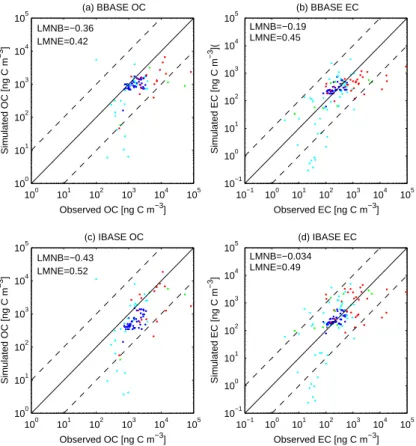
A comparison of OC and EC concentrations to observations are shown in Fig. 2. These are the same observations used in Chung and Seinfeld (2001) that include data from the Interagency Monitoring of Protected Visual Environments (IMPROVE) database that consists of approximately 140 rural sites in the United States (Malm et al., 2000) along with various rural, remote and marine sites with locations and refer-25
ACPD
7, 7723–7765, 2007 Contribution of carbonaceous aerosol to CCN J. R. Pierce et al. Title Page Abstract Introduction Conclusions References Tables Figures ◭ ◮ ◭ ◮ Back CloseFull Screen / Esc
Printer-friendly Version Interactive Discussion
EGU
are similar to the simulations in Chung and Seinfeld (2001) with the same mass emis-sions rates in the same host GCM; however Chung and Seinfeld (2001) do not include aerosol size resolution and we use an OM:OC ratio of 1.8 rather than 1.3 in Chung and Seinfeld (2001), so our simulated OC values are approximately 30% smaller. In gen-eral, the results for IBASE are similar to that of Chung and Seinfeld (2001), with several 5
locations having observed values more than a factor of ten greater than the simulated values in remote and marine areas. In general, the data in the IMPROVE database falls most closely to the 1:1 line and better agreement is shown for the EC than for OC. The BBASE simulation shows better agreement for OC with the IMPROVE database due to the higher levels of OM in the western United States. It should be noted that 10
the methods for quantifying BC/EC for the observations networks and the emissions inventories vary by a factor of two (Andreae and Gelencser, 2006; Heintzenberg et al., 2006; Subramanian et al., 2006).
To assess the comparison, the log-mean normalized bias (LMNB) and log-mean normalized error (LMNE) for the comparisons (data from all networks lumped together) 15
are included on each panel. The simulations using both inventories are biased low for OC with LMNB of –0.36 and –0.46 corresponding to underpredictions by factors of 2.3 and 2.9 for the BBASE and IBASE simulations. The predictions of EC are less biased with LMNB of –0.19 and –0.034 corresponding to underpredictions by factors of 1.5 and 1.1 for the BBASE and IBASE simulations. The LMNE for all simulations are 20
similarly high, between 0.42 and 0.52. This means that the model predictions are, on average, within observed values to a factor of 3.
3.3 Aerosol number
Figure 3 shows the annual-average predicted aerosol number (condensation nuclei, CN) concentration (cm−3
with 10 nm lower cutoff) for the model surface layer from the 25
NOCARB, BBASE and IBASE simulations. The changes in CN concentration due to addition of carbonaceous aerosol is the difference between the BBASE or IBASE simulation and the NOCARB simulation. The largest increases in aerosol number occur
ACPD
7, 7723–7765, 2007 Contribution of carbonaceous aerosol to CCN J. R. Pierce et al. Title Page Abstract Introduction Conclusions References Tables Figures ◭ ◮ ◭ ◮ Back CloseFull Screen / Esc
Printer-friendly Version Interactive Discussion
EGU
in the biomass burning regions of tropical South America, Africa and Southeast Asia. The addition of primary carbonaceous aerosol in these regions causes CN prediction to increase by more than a factor of 20 in some places. Recent work, however, suggests that CN concentrations in these areas may be overpredicted, as the size distribution of primary particles from biomass burning more likely have a number median diameter 5
on the order of 100 nm rather than the 25 nm number median diameter used here (Rissler et al., 2004; Rissler et al., 2006). Other notable increases in CN occur in polluted regions, particularly India and China where CN increase by a factor of 2–5 with the addition of the primary carbonaceous aerosol. Not shown in Fig. 3 is the sensitivity of CN concentrations to the assumptions about mixing state and organic 10
solubility (BCEXT, ICEXT, BCINS, and ICINS simulations). The CN concentrations were quite insensitive to these assumptions with no more than a 10% change in CN in any model grid cell and less than a 1% change in CN globally averaged.
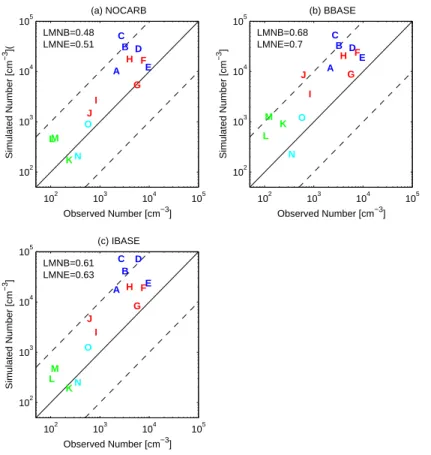
We have assembled a set of long-term CN observations to compare to our simu-lations, shown in Table 3. The data we have chosen was restricted to sites outside 15
of urban areas with a minimum sample time of about one year. The sites included are part of a European network of sites presented in Van Dingenen et al. (2004), the Global Monitoring Division of the Earth Systems Research Laboratory (Schnell, 2003) (http://www.esrl.noaa.gov/gmd/) and the Thompson Farm site of AIRMAP (http:
//airmap.unh.edu/). The comparison of CN measured at these sites to the NOCARB, 20
BBASE and IBASE simulation results is shown in Fig. 4. The log-mean normalized bias (LMNB) and log-mean normalized error (LMNE) for the comparisons are included on each panel. In general, the model tends to overpredict the CN concentrations in these areas even without carbonaceous aerosol included. The LMNB for the NOCARB run is 0.48 so on average the model overpredicts by a factor of 100.48or 3. This may be a 25
consequence of the assumption that 3% of sulfur mass from anthropogenic emissions is assumed to be emitted as aerosol sulfate with ultrafine sizes (Adams and Seinfeld, 2003). In Adams and Seinfeld (2002), it was shown that most of the CN in polluted re-gions of the model is from primary sulfate rather than from nucleation. This implies that
ACPD
7, 7723–7765, 2007 Contribution of carbonaceous aerosol to CCN J. R. Pierce et al. Title Page Abstract Introduction Conclusions References Tables Figures ◭ ◮ ◭ ◮ Back CloseFull Screen / Esc
Printer-friendly Version Interactive Discussion
EGU
either too much of the sulfate mass is being emitted as primary sulfate or the primary sulfate particles are emitted at sizes that are too small. Adding primary carbonaceous emissions has a range of impacts on predicted CN concentrations from no change to increases of more than a factor of 5 at a given site. Because the NOCARB simula-tion already overpredicted CN, the addisimula-tion of primary carbonaceous aerosol causes 5
the model to overpredict further CN concentrations in some areas. The LMNB for the BBASE and IBASE runs are 0.68 and 0.61 corresponding to average overpredictions by factors of 4.8 and 4.1, respectively. The LMNE is essentially the same as the LMNB for each simulation because the model overpredicts aerosol number at nearly every lo-cation. In the small number of comparisons shown, the IBASE simulation predicted the 10
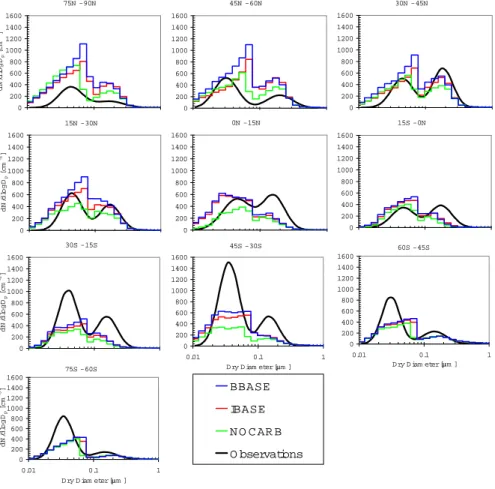
concentrations of remote and free tropospheric areas more accurately than polluted areas, whereas this trend is not as clear in the BBASE simulations. This may be due to the increase in emissions from developing areas in the Bond et al. (2004) inventory. Figure 5 shows a comparison of predicted marine number size distributions from the NOCARB, BBASE and IBASE simulations with observations compiled in Heintzen-15
berg et al. (2000). Heintzenberg et al. (2000) collected a large set of observations of marine aerosol size distributions and summarized them by fitting the aerosol number distributions to two lognormal modes for each latitudinal zone. These data came from a wide array of sampling sites and field campaigns and used many different sampling instruments. The latitudinal bands are 15◦wide with no data between 75◦S–90◦S and
20
60◦N–75◦N. The 15◦by 15◦grid cells from which the data were obtained is presented
in their Fig. 1. Rather than using all ocean grid cells for comparison, we generally used model results from the same 15◦ by 15◦ regions where observations were collected.
However, some of the 15◦ by 15◦ grid areas include continental areas (e.g.
observa-tions from Mace Head, Ireland are in the same 15◦ by 15◦ grid cell as most of the
25
British Isles). Because the GCM grid resolution is finer, we exclude these continental sub-areas from our comparison as they greatly increase (and bias) ultrafine number concentrations. For the 0◦to 15◦N, we used the model predicted average values from
re-ACPD
7, 7723–7765, 2007 Contribution of carbonaceous aerosol to CCN J. R. Pierce et al. Title Page Abstract Introduction Conclusions References Tables Figures ◭ ◮ ◭ ◮ Back CloseFull Screen / Esc
Printer-friendly Version Interactive Discussion
EGU
move biomass burning influence from the marine aerosol.
Figure 5 shows that, in most latitude bands, the model does a good job of repre-senting the bimodal size distribution represented by the Heintzenberg et al. (2000) data. Throughout most the Northern Hemisphere and also in the 45◦S–30◦S latitude
band, the addition of carbonaceous particles increases the number of particles signif-5
icantly; throughout the rest of the Southern Hemisphere the contribution of carbona-ceous aerosol is minor. Moreover, it can be seen that the “Hoppel Gap” between the two modes of the distribution shifts toward larger sizes in the simulations with carbona-ceous aerosol. The location of the Hoppel Gap depends on the average activation di-ameter, so this shift is the direct result of the mixed carbonaceous/sulfate/sea-salt par-10
ticles being somewhat less hygroscopic than the sulfate/sea-salt only particles. This influence on the activation diameter can be seen even in the southernmost latitude bands. In Fig. 5, all of the simulations overpredict at the North Pole, underpredict in the Southern Hemisphere and compare best in the Northern Hemisphere mid-latitude bands. Averaging over all latitude bands, the BBASE simulation overpredicts total num-15
ber by 30%, the IBASE overpredicts by 15% and the NOCARB simulation underpre-dicts by 10%. This contrasts with the results shown in Fig. 4, where the model largely overpredicts the total number of particles in most areas. It is possible that because these marine areas are away from large primary particle sources, the overprediction of particles near sources has been dampened by aerosol number removal processes 20
such as coagulation and deposition. 3.4 Cloud condensation nuclei
The annual-average CCN concentrations at 0.2% supersaturation (CCN(0.2%)) for the model surface level of the NOCARB, BBASE, BCINS, BCEXT, IBASE, ICINS and ICEXT simulations are shown in Fig. 6. The CCN(0.2%) concentrations are 25
found using modified K ¨ohler theory as discussed earlier with the annually averaged size distributions and chemical compositions. The addition of the Bond et al. (2004) primary carbonaceous emissions to the NOCARB model simulation (BBASE)
in-ACPD
7, 7723–7765, 2007 Contribution of carbonaceous aerosol to CCN J. R. Pierce et al. Title Page Abstract Introduction Conclusions References Tables Figures ◭ ◮ ◭ ◮ Back CloseFull Screen / Esc
Printer-friendly Version Interactive Discussion
EGU
creases CCN(0.2%) by 65% globally averaged. The addition of the IPCC (2001) pri-mary carbonaceous emissions to the NOCARB model simulation (IBASE) increases CCN(0.2%) by 89% globally averaged. The differences in CCN(0.2%) between the BBASE and IBASE are notable in eastern Europe and the Amazon basin where IBASE predicts higher CCN(0.2%) concentrations and in western North America where 5
BBASE predicts higher CCN(0.2%) concentrations. These results confirm that, for the base case assumptions, the contribution of carbonaceous aerosol is quite large and cannot be ignored. However, it is unclear from the base case simulations alone whether the increase in CCN from carbonaceous aerosol comes from the “carbonaceous seed-ing effect”, the “organic solute effect”, or some combination of the two. The sensitivity 10
of the number of CCN to the mixing and solubility assumptions must also be explored.
3.4.1 Sensitivity to OM solubility
We tested the sensitivity of model predictions to the base case assumptions of organic solubility by assuming that all carbonaceous aerosol is insoluble in the BCINS and the ICINS simulations (see Sect. 2.4). This simultaneously gives information about the 15
relative magnitudes of the “carbonaceous seeding effect” and the “organic solute ef-fect” because the “organic solute efef-fect” is turned off. The CCN(0.2%) predicted by the BCINS and ICINS are shown in Fig. 6. For the simulations using the Bond et al. (2004) carbonaceous emissions, the global-average CCN(0.2%) concentration increased from 193 cm−3 to 268 cm−3 (at 1 bar and 293 K) by adding insoluble carbonaceous
parti-20
cles to the NOCARB simulation. By allowing most of the organics to be soluble in the BBASE run, the global-average CCN(0.2%) concentration increases to 320 cm−3.
This shows that for the solubility assumptions used in the BBASE run, “carbonaceous seeding” accounts for just over half of carbonaceous aerosol’s globally averaged con-tribution to CCN while the “organic solute” accounts for the remainder. This fraction 25
varies regionally, however. In areas with large amounts of carbonaceous emissions compared to inorganics, such as central Africa, the effect of carbonaceous seeding is more modest (20–40%) in the BCINS and ICINS simulations because there is not
ACPD
7, 7723–7765, 2007 Contribution of carbonaceous aerosol to CCN J. R. Pierce et al. Title Page Abstract Introduction Conclusions References Tables Figures ◭ ◮ ◭ ◮ Back CloseFull Screen / Esc
Printer-friendly Version Interactive Discussion
EGU
enough inorganic aerosol to condense onto the insoluble carbonaceous particles to make them CCN active. Conversely, in regions with an abundance of sulfur emissions such as the western United States or Western Europe, the “carbonaceous seeding effect” dominates the increase of CCN from carbonaceous emissions (responsible for
>70% of CCN enhancement by carbonaceous aerosol). Similar results are found for 5
the simulations using the IPCC (2001) carbonaceous emissions. The global-average CCN(0.2%) increased from 193 cm−3 to 295 cm−3 by adding insoluble carbonaceous
particles to the NOCARB simulation. By allowing carbonaceous aerosol to be soluble in the IBASE run the CCN(0.2%) increased to 365 cm−3. In this globally averaged case,
“carbonaceous seeding” again accounts for just over half of the increase in CCN(0.2%) 10
due to carbonaceous particles.
There is a relatively large uncertainty in the solubility and ionic nature of organic matter (Kanakidou et al., 2005); however, varying the solubility of organic matter in these simulations from largely soluble to completely insoluble changed the number of CCN(0.2%) predicted by the simulations by less than 20% globally averaged, with up 15
to 50% reductions in biomass burning areas and smaller reductions in high sulfate areas. The range of uncertainty in organic solubility and ionic ability explored here likely spans beyond the range of the real atmosphere. With this we would expect that the uncertainty in CCN(0.2%) due to uncertainty in organic solubility is significantly less than 20%.
20
3.4.2 Sensitivity to mixing assumption
In the BCEXT and ICEXT simulations we assume that the carbonaceous aerosol is externally mixed during wet removal processes (see Sect. 2.4). The four populations are, however, still assumed to be internally mixed during aerosol microphysical pro-cesses so their sizes may change due to coagulation, condensation and aqueous ox-25
idation. The CCN(0.2%) concentrations of these two simulations are shown in Fig. 6. For both emissions sets, the externally mixed cases show slightly higher CCN(0.2%) concentrations than the base case scenarios. This happens because for most of the
ACPD
7, 7723–7765, 2007 Contribution of carbonaceous aerosol to CCN J. R. Pierce et al. Title Page Abstract Introduction Conclusions References Tables Figures ◭ ◮ ◭ ◮ Back CloseFull Screen / Esc
Printer-friendly Version Interactive Discussion
EGU
aerosol distributions predicted by the model, assuming the particles are externally mixed when calculating CCN(0.2%) yields approximately the same number of CCN as assuming that the particles are internally mixed. This is shown by applying the ex-ternally mixed assumption to calculate the CCN(0.2%) from BBASE and IBASE size distributions and chemical compositions offline rather than using the internally mixed 5
assumption. In doing this the CCN(0.2%) changes from 320 cm−3 to 318 cm−3 for
BBASE and 365 cm−3 to 354 cm−3 for IBASE. Another reason why the BBASE and
BCEXT simulations and the IBASE and ICEXT simulations have similar CCN predic-tions is because the aerosols are not assumed to be externally mixed during aerosol microphysical processes. This means that ultrafine carbonaceous aerosol may grow in 10
size to sizes where the carbonaceous aerosol will activate to form CCN whereas if it were truly externally mixed this would not occur.
These results have shown that, for the assumptions made in the model, the number of CCN in areas well mixed and away from sources does not greatly depend on the mixing assumption as long as OM is soluble. If the hygroscopicity of the carbonaceous 15
particles is reduced, then the number of CCN will approach the NOCARB results as the hygroscopicity/solubility is reduced to zero.
3.5 Aerosol size distribution versus aerosol composition
K ¨ohler theory and observations (Dusek et al., 2006) indicate that knowing the size distribution is more important than knowing the chemical composition when predicting 20
CCN concentrations. While Dusek et al. (2006) showed that time variability in aerosol composition at their measurement site in Germany had little effect on CCN concen-trations, we use our model predictions to test the importance of regional variability in aerosol composition. Specifically, we will explore the error in CCN prediction that occurs when assuming global-average chemical composition or global-average size 25
distributions rather than using location-specific information about both. All data used in this section are taken from the BBASE simulation.
ACPD
7, 7723–7765, 2007 Contribution of carbonaceous aerosol to CCN J. R. Pierce et al. Title Page Abstract Introduction Conclusions References Tables Figures ◭ ◮ ◭ ◮ Back CloseFull Screen / Esc
Printer-friendly Version Interactive Discussion
EGU
size across the lowest model layer and used it with the predicted size distribution in each grid cell to predict the number of CCN(0.2%) (cm−3) in that grid cell. In Fig. 7a
we have plotted these CCN predictions versus the CCN predictions using the size distribution and chemical composition predicted for each grid cell (Fig. 6b). In gen-eral, the CCN(0.2%) calculated using the global-average chemical composition agrees 5
within a factor of two with the CCN(0.2%) calculated using no averaging. This is a much wider range of error than shown in Dusek et al. (2006) due to the wider range of compositions in the model than in the test region of Dusek et al. (2006). The areas where the CCN(0.2%) with average chemical composition overpredict are areas with large amounts of less CCN-active carbonaceous particles such as the biomass burn-10
ing influenced tropical regions. In these regions the average chemical composition is more CCN active than their actual chemical composition. Conversely, regions where the CCN(0.2%) with average chemical composition underpredict are areas with large amounts of inorganic species.
For Fig. 7b, we calculated the global-average size distribution across the lowest 15
model layer and used it with the predicted chemical composition (as a function of size) in each grid cell to predict the number of CCN(0.2%) (cm−3) in that grid cell.
We plotted these values against the CCN predictions using the size distribution and chemical composition predicted for each grid cell (Fig. 6b). The CCN(0.2%) using the global-average size distribution vary only between about 200 cm−3 and 600 cm−3,
20
whereas the CCN(0.2%) predicted not using the global-averaging range from 0 cm−3
to 3000 cm−3. There is essentially no correlation between the two data sets. The areas
with much more sea-salt aerosol than carbonaceous aerosol appear on the high end of the CCN(0.2%) prediction with the global average size distributions, even when their total number of particles is actually very low, such as southern hemisphere marine en-25
vironments. On the other hand, areas that have large amounts of aerosol but a large portion of if its mass is carbonaceous aerosol, such as the tropical biomass burning re-gions, will have the lowest predicted CCN(0.2%) in the global-average size distribution calculation.
ACPD
7, 7723–7765, 2007 Contribution of carbonaceous aerosol to CCN J. R. Pierce et al. Title Page Abstract Introduction Conclusions References Tables Figures ◭ ◮ ◭ ◮ Back CloseFull Screen / Esc
Printer-friendly Version Interactive Discussion
EGU
Figure 7c shows an additional comparison to evaluate the ability of global models without microphysics (bulk aerosol models) to calculate CCN. In this figure, we com-pare the BBASE CCN(0.2%) to CCN(0.2%) calculated assuming that the shape of the size distribution of each of the six chemical species or groups is the same as the glob-ally averaged size-distribution of those species, but is scaled by the total mass of each 5
species in each grid cell. This is similar to GCM simulations that calculate the total mass of each species and then assume a size distribution of each species when cal-culating the CCN. Figure 7c shows that the “bulk mass” model agrees with the BBASE CCN(0.2%) with a normalized error of 35%. This shows that bulk models can, in gen-eral, calculate the general spatial distribution of CCN(0.2%). There are, however, other 10
reasons why microphysical models are advantageous over bulk models. Although the size distribution of particles for the current time period may be measured, this is not the case of past or future time periods where the size distributions may be different. The relative contribution of primary particles and nucleated particles to CN and CCN may be explored using microphysical models but cannot be in bulk models.
15
Obviously there are major differences between this analysis and the one shown in (Dusek et al., 2006); however, both clearly show it is impossible to predict CCN con-centrations without an accurate size distribution. In contrast to that work, these results suggest that regional variability in aerosol composition are important in predicting CCN. In our case, up to a factor of two error is introduced when a (size-dependent) chemical 20
composition is assumed.
4 Conclusions
We explored the impact of carbonaceous aerosol on cloud condensation nuclei (CCN) concentrations in a global climate model with online size-resolved aerosol micro-physics. Two emissions inventories of organic matter (OM) and elemental carbon (EC) 25
were tested in the model along with sulfate and sea-salt aerosol. Simulations were run with various assumptions of the solubility and mixing state of the carbonaceous aerosol
ACPD
7, 7723–7765, 2007 Contribution of carbonaceous aerosol to CCN J. R. Pierce et al. Title Page Abstract Introduction Conclusions References Tables Figures ◭ ◮ ◭ ◮ Back CloseFull Screen / Esc
Printer-friendly Version Interactive Discussion
EGU
to provide bounds on its impacts on CCN concentrations.
Predicted carbonaceous aerosol mass and aerosol number concentrations were compared to observations. Errors in predictions of OC and EC masses were a fac-tor of 3 on average and OC predictions were biased towards too little mass whereas EC predictions showed little bias. A comparison to a network of total aerosol num-5
ber measurements shows that the model predicted number concentrations were on average about a factor of 4 too high, although even without carbonaceous particles included, the number concentrations are a factor of 3 too high. This is likely due to the emission of too many particles through primary sulfate emissions. In contrast, a comparison of CN to marine observations showed very little overprediction (<30%). 10
It was found that adding carbonaceous aerosol increased CCN(0.2%) concentrations by 65–90%, depending on which emissions dataset was used, compared with a model with sulfate and sea-salt aerosol only. The largest increases in CCN(0.2%) occurred in the biomass burning regions of South America and Africa and in regions of eastern Asia and Australia. Assuming that all carbonaceous aerosol is insoluble, rather than 15
mostly soluble in our base case, the carbonaceous aerosol still increases CCN(0.2%) by 40–50% over the sulfate/sea-salt only simulation. This shows that around half of the increase in CCN due to carbonaceous aerosol occurs due to the addition of new aerosol particles (seeding effect) where the CCN are created by regardless of carbona-ceous solubility (because they end up coated with hydrophilic material). The other half 20
of the CCN generated by carbonaceous aerosol depends on carbonaceous solubility (solute effect). The solute effect tends to dominate (responsible for >70% of the car-bonaceous CCN) more in areas where there is less inorganic aerosol than organic aerosol, such as biomass burning regions, and the seeding effect tends to dominate in areas where is more inorganic aerosol than organic aerosol, such as eastern North 25
America. The effect of the assumption of internal versus external mixing of the car-bonaceous aerosol with inorganic aerosol during cloud processes was found to have little effect on the number of CCN generated as long as the carbonaceous aerosol was mostly soluble.
ACPD
7, 7723–7765, 2007 Contribution of carbonaceous aerosol to CCN J. R. Pierce et al. Title Page Abstract Introduction Conclusions References Tables Figures ◭ ◮ ◭ ◮ Back CloseFull Screen / Esc
Printer-friendly Version Interactive Discussion
EGU
To evaluate the importance of chemical composition and the aerosol size distribu-tion globally, we calculate the CCN(0.2%) in each grid cell by using globally averaged chemical composition or globally averaged size distributions. We found that, in general, the CCN(0.2%) calculated by assuming a uniform globally averaged chemical compo-sition for the entire globe (while using the predicted size distribution in each location) 5
was within a factor of 2 of the CCN(0.2%) calculated with both chemical composition and size distribution information. The CCN(0.2%) calculated from assuming a uniform globally averaged size distribution for the entire globe (while using the predicted chemi-cal composition in each location) gave very bad results compared to the full chemi-calculation. Additionally, we tested the ability of global models that simulate only the total mass of 10
each species to predict CCN by assuming the globally averaged size distribution shape for each species and recalculating the CCN(0.2%). It was found that assuming the size distribution shape of each species yields an average error of 35% against our base simulation with size resolved aerosol microphysics.
The results of this study show that understanding carbonaceous aerosol is very im-15
portant to understanding how humans have altered the radiative balance of the planet through emissions of particles. Specifically, this has shown that the contribution of car-bonaceous particles to CCN is large; however, the uncertainties of the magnitude of primary organic aerosol emissions and volatility along with the generation of secondary organic aerosol are large, so this contribution to CCN is still quite uncertain.
20
Acknowledgements. This research was supported by the United States National Aeronautics
and Space Administration through grant RSP-0153-0289 and by the Environmental Protection Agency through the Science to Achieve Results (STAR) Graduate Fellowship (91668201–0). The authors would like to thank A. Jefferson from NOAA for help with Global Monitoring Division (GMD) data.
ACPD
7, 7723–7765, 2007 Contribution of carbonaceous aerosol to CCN J. R. Pierce et al. Title Page Abstract Introduction Conclusions References Tables Figures ◭ ◮ ◭ ◮ Back CloseFull Screen / Esc
Printer-friendly Version Interactive Discussion
EGU
References
Adams, P. J. and Seinfeld, J. H.: Disproportionate impact of particulate emissions on global cloud condensation nuclei concentrations, Geophys. Res. Lett., 30, ISI:000182151300004, 2003.
Adams, P. J. and Seinfeld, J. H.: Predicting global aerosol size distributions in general
circula-5
tion models, J. Geophys. Res. Atmos., 107, 4370, 2002.
Albrecht, B. A.: Aerosols, Cloud Microphysics, and Fractional Cloudiness, Science, 245, 1227– 1230, 1989.
Andreae, M. O. and Gelencser, A.: Black carbon or brown carbon? The na-ture of light-absorbing carbonaceous aerosols, Atmos. Chem. Phys., 6, 3131–3148,
10
ISI:000239346600001, 2006.
Andreae, M. O., Jones, C. D., and Cox, P. M.: Strong present-day aerosol cooling implies a hot future, Nature, 435, 1187–1190, ISI:000230140500033, 2005.
Benkovitz, C. M., Scholtz, M. T., Pacyna, J., Tarrason, L., Dignon, J., Voldner, E. C., Spiro, P. A., Logan, J. A. and Graedel, T. E.: Global gridded inventories of anthropogenic emissions of
15
sulfur and nitrogen, J. Geophys. Res. Atmos., 101, 29 239–29 253, ISI:A1996VZ78800050, 1996.
Bond, T. C., Streets, D. G., Yarber, K. F., Nelson, S. M., Woo, J. H., and Klimont, Z.: A technology-based global inventory of black and organic carbon emissions from combustion, J. Geophys. Res. Atmos., 109, ISI:000222916600001, 2004.
20
Chuang, C. C., Penner, J. E., Prospero, J. M., Grant, K. E., Rau, G. H., and Kawamoto, K.: Cloud susceptibility and the first aerosol indirect forcing: Sensitivity to black carbon and aerosol concentrations, J. Geophys. Res. Atmos., 107, ISI:000180860300016, 2002. Chung, S. H. and Seinfeld, J. H.: Global distribution and climate forcing of carbonaceous
aerosols, J. Geophys. Res. Atmos., 107, 4407, 2001.
25
Clarke, A. D., Owens, S., and Zhou, J.: An ultrafine sea-salt flux from breaking waves: Im-plications for CCN in the remote marine atmosphere, J. Geophys. Res.-Atmos., D06202, 2006.
Cooke, W. F., Liousse, C., Cachier, H., and Feichter, J.: Construction of a 1 degrees × 1 degrees fossil fuel emission data set for carbonaceous aerosol and implementation and
30
radiative impact in the ECHAM4 model, J. Geophys. Res.-Atmos., 104, 22 137–22 162, ISI:000082789200006, 1999.
ACPD
7, 7723–7765, 2007 Contribution of carbonaceous aerosol to CCN J. R. Pierce et al. Title Page Abstract Introduction Conclusions References Tables Figures ◭ ◮ ◭ ◮ Back CloseFull Screen / Esc
Printer-friendly Version Interactive Discussion
EGU
Cooke, W. F. and Wilson, J. J. N.: A global black carbon aerosol model, J. Geophys. Res.-Atmos., 101, 19395-19409, ISI:A1996VE25800041, 1996.
Dusek, U., Frank, G. P., Hildebrandt, L., Curtius, J., Schneider, J., Walter, S., Chand, D., Drewnick, F., Hings, S., Jung, D., Borrmann, S., and Andreae, M. O.: Size matters more than chemistry for cloud-nucleating ability of aerosol particles, Science, 312, 1375–1378,
5
ISI:000237961600054, 2006.
Easter, R. C., Ghan, S. J., Zhang, Y., Saylor, R. D., Chapman, E. G., Laulainen, N. S., Abdul-Razzak, H., Leung, L. R., Bian, X. D., and Zaveri, R. A.: MIRAGE: Model de-scription and evaluation of aerosols and trace gases, J. Geophys. Res.-Atmos., 109, ISI:000224882100001, 2004.
10
Eliason, T. L., Aloisio, S., Donaldson, D. J., Cziczo, D. J., and Vaida, V.: Processing of unsaturated organic acid films and aerosols by ozone, Atmos. Environ., 37, 2207–2219, ISI:000182778900004, 2003.
Eliason, T. L., Gilman, J. B., and Vaida, V.: Oxidation of organic films relevant to atmospheric aerosols, Atmos. Environ., 38, 1367–1378, ISI:000189102000013, 2004.
15
El-Zanan, H. S., Lowenthal, D. H., Zielinska, B., Chow, J. C., and Kumar, N.: Determination of the organic aerosol mass to organic carbon ratio in IMPROVE samples, Chemosphere, 60, 485–496, ISI:000231038200006, 2005.
FassiFihri, A., Suhre, K., and Rosset, R.: Internal and external mixing in atmospheric aerosols by coagulation: Impact on the optical and hygroscopic properties of the sulphate-soot
sys-20
tem, Atmos. Environ., 31, 1393–1402, ISI:A1997WR16000002, 1997.
Ghan, S., Easter, R., Hudson, J. and Breon, F. M.: Evaluation of aerosol indirect radiative forc-ing in MIRAGE, J. Geophys. Res.-Atmos., 106, 5317–5334, ISI:000167635900016, 2001. Gong, S. L., Barrie, L. A., Blanchet, J. P., von Salzen, K., Lohmann, U., Lesins, G., Spacek,
L., Zhang, L. M., Girard, E., Lin, H., Leaitch, R., Leighton, H., Chylek, P., and Huang, P.:
25
Canadian Aerosol Module: A size-segregated simulation of atmospheric aerosol processes for climate and air quality models – 1. Module development, J. Geophys. Res.-Atmos., 108, ISI:000181553400003, 2003.
Hanel, G.: Single-Scattering Albedo of Atmospheric Aerosol-Particles as a Function of Relative Humidity, J. Atmos. Sci., 33, 1120–1124, ISI:A1976BV24200020, 1976.
30
Hansen, J., Russell, G., Rind, D., Stone, P., Lacis, A., Lebedeff, S., Ruedy, R., and Travis, L.: Efficient 3-Dimensional Global-Models for Climate Studies - Model-I and Model-II, Mon. Wea. Rev., 111, 609–662, ISI:A1983QU10600001, 1983.
ACPD
7, 7723–7765, 2007 Contribution of carbonaceous aerosol to CCN J. R. Pierce et al. Title Page Abstract Introduction Conclusions References Tables Figures ◭ ◮ ◭ ◮ Back CloseFull Screen / Esc
Printer-friendly Version Interactive Discussion
EGU
Heintzenberg, J., Covert, D. C., and Van Dingenen, R. V.: Size distribution and chemical com-position of marine aerosols: A compilation and review, Tellus B, 52, 1104–1122, 2000. Heintzenberg, J., Leck, C., Birmili, W., Wehner, B., Tjernstrom, M., and Wiedensohler, A.:
Aerosol number-size distributions during clear and fog periods in the summer high Arctic: 1991, 1996 and 2001, Tellus B, 58, 41–50, ISI:000235520500005, 2006.
5
Herzog, M., Weisenstein, D. K., and Penner, J. E.: A dynamic aerosol module for global chem-ical transport models: Model description, J. Geophys. Res.-Atmos., 109, 18 202–18 213, 2004.
Hitzenberger, R., Berner, A., Giebl, H., Kromp, R., Larson, S. M., Rouc, A., Koch, A., Marischka, S., and Puxbaum, H.: Contribution of carbonaceous material to cloud condensation nuclei
10
concentrations in European background (Mt. Sonnblick) and urban (Vienna) aerosols, Atmos. Environ., 33, 2647–2659, ISI:000080975600005, 1999.
IPCC: Intergovernmental Panel on Climate Change 2001: The Scientific Basis – Technical Summary, 2001
Jacobson, M. Z.: Analysis of aerosol interactions with numerical techniques for solving
coag-15
ulation, nucleation, condensation, dissolution, and reversible chemistry among multiple size distributions, J. Geophys. Res. Atmos., 107, ISI:000180428300033, 2002.
Jacobson, M. Z.: Strong radiative heating due to the mixing state of black carbon in atmospheric aerosols, Nature, 409, 695–697, ISI:000166816400037, 2001.
Janhall, S., Jonsson, A. M., Molnar, P., Svensson, E. A., and Hallquist, M.: Size
re-20
solved traffic emission factors of submicrometer particles, Atmos. Environ., 38, 4331–4340, ISI:000223019500006, 2004.
Jung, C. H., Kim, Y. P., and Lee, K. W.: Multicomponent aerosol dynamics model with gas/particle transport and modal approach, Environ. Eng. Sci., 21, 437–450, ISI:000222488300003, 2004.
25
Kanakidou, M., Seinfeld, J. H., Pandis, S. N., Barnes, I., Dentener, F. J., Facchini, M. C., Van Dingenen, R., Ervens, B., Nenes, A., Nielsen, C. J., Swietlicki, E., Putaud, J. P., Balkanski, Y., Fuzzi, S., Horth, J., Moortgat, G. K., Winterhalter, R., Myhre, C. E. L., Tsigaridis, K., Vignati, E., Stephanou, E. G., and Wilson, J.: Organic aerosol and global climate modelling: a review, Atmos. Chem. Phys., 5, 1053–1123, ISI:000228024100001, 2005.
30
Koch, D.: Transport and direct radiative forcing of carbonaceous and sulfate aerosols in the GISS GCM, J. Geophys. Res.-Atmos., 106, 20 311–20 332, ISI:000171044200023, 2001. Koch, D., Jacob, D., Tegen, I., Rind, D., and Chin, M.: Tropospheric sulfur simulation and sulfate