Publisher’s version / Version de l'éditeur:
Vous avez des questions? Nous pouvons vous aider. Pour communiquer directement avec un auteur, consultez la première page de la revue dans laquelle son article a été publié afin de trouver ses coordonnées. Si vous n’arrivez pas à les repérer, communiquez avec nous à [email protected].
Questions? Contact the NRC Publications Archive team at
[email protected]. If you wish to email the authors directly, please see the first page of the publication for their contact information.
https://publications-cnrc.canada.ca/fra/droits
L’accès à ce site Web et l’utilisation de son contenu sont assujettis aux conditions présentées dans le site
LISEZ CES CONDITIONS ATTENTIVEMENT AVANT D’UTILISER CE SITE WEB.
ASCE International Pipeline Conference 2009 [Proceedings], p. 10, 2009-08-16
READ THESE TERMS AND CONDITIONS CAREFULLY BEFORE USING THIS WEBSITE.
https://nrc-publications.canada.ca/eng/copyright
NRC Publications Archive Record / Notice des Archives des publications du CNRC :
https://nrc-publications.canada.ca/eng/view/object/?id=fa9decd0-8bb2-486d-b6b9-46b75753fe37 https://publications-cnrc.canada.ca/fra/voir/objet/?id=fa9decd0-8bb2-486d-b6b9-46b75753fe37
NRC Publications Archive
Archives des publications du CNRC
This publication could be one of several versions: author’s original, accepted manuscript or the publisher’s version. / La version de cette publication peut être l’une des suivantes : la version prépublication de l’auteur, la version acceptée du manuscrit ou la version de l’éditeur.
Access and use of this website and the material on it are subject to the Terms and Conditions set forth at AC pipe in North America: rehabilitation/replacement methods and current practices
http://www.nrc-cnrc.gc.ca/irc
AC pipe in N ort h Am e ric a : re ha bilit a t ion/re pla c e m e nt m e t hods a nd c urre nt pra c t ic e s
N R C C - 5 1 1 6 7
H u , Y . ; W a n g , D . L . ; B a k e r , S . ; C o s s i t t , K .
A u g u s t 2 0 0 9
A version of this document is published in / Une version de ce document se trouve dans: ASCE International Pipeline Conference 2009 (San Diego, CA, USA, August 16-19, 2009), pp. 1-10
The material in this document is covered by the provisions of the Copyright Act, by Canadian laws, policies, regulations and international agreements. Such provisions serve to identify the information source and, in specific instances, to prohibit reproduction of materials without written permission. For more information visit http://laws.justice.gc.ca/en/showtdm/cs/C-42
Les renseignements dans ce document sont protégés par la Loi sur le droit d'auteur, par les lois, les politiques et les règlements du Canada et des accords internationaux. Ces dispositions permettent d'identifier la source de l'information et, dans certains cas, d'interdire la copie de documents sans permission écrite. Pour obtenir de plus amples renseignements : http://lois.justice.gc.ca/fr/showtdm/cs/C-42
AC Pipe in North America: Rehabilitation/Replacement Methods and
Current Practices
Yafei Hu1*, Dunling Wang1, Samar Baker1, and Karen Cossitt2
1
Centre for Sustainable Infrastructure Research
Institute for Research in Construction, National Research Council Canada #301, 6 Research Drive, Regina, SK S4S 7J7
2
City of Regina
2476 Victoria Avenue, Regina, SK S7P 3C8
ABSTRACT
Asbestos cement (AC) pipe was first introduced in North America in the late 1920s and became a common choice for potable water main construction from the 1940s to the 1970s. The use of AC pipe was largely discontinued in North America in the early 1980s but AC pipe is still a significant portion of the water distribution systems in many North American cities. As the pipes deteriorate and fail to meet service requirements, appropriate rehabilitation/replacement methods need to be determined. This paper summarizes survey data on the rehabilitation/replacement methods for AC pipes provided by 19 water utilities in the United States and Canada. The paper also reviews current available rehabilitation/replacement methods to provide some background of the current practices used by the utilities. The survey indicates that trenching is the main method used to repair, rehabilitate, and replace AC pipes. Cost was cited as the main reason for utilities to choose a particular repair/rehabilitation/replacement method. Although most of the rehabilitation/replacement methods have potential social and environmental effects because of possible release of asbestos fibers, the effects were generally not given high priority when selecting methods for renewing AC pipes.
1. INTRODUCTION
Asbestos cement (AC) pipe was first introduced in North America in 1929 and became a common choice for potable water main construction from the 1940s to the 1970s. Two prior surveys indicated that about 12 to 15% of water mains in the water distribution systems of the United States and Canada are AC pipes (Kirmeyer et al., 1994; Rajani and MacDonald, 1995). Like pipes made from other materials, AC pipes deteriorate with time. The deterioration results in negative impacts such as impaired water quality, reduced hydraulic capacity, and high leakage rate. The release of asbestos fibers is also an indicator of pipe deterioration. Some utilities reported increased breakage frequency. For instance, during the ten-year period from 1995 to 2004, the City of Regina had an average AC pipe breakage of 0.27 breaks/year/km, which was
*
Corresponding author. Research Officer, NRC CSIR, Tel (306) 780-5432, Fax (306) 780-3421, Email: [email protected]
more than double the average rate of 0.13 breaks/year/km in the previous 10-year period from 1985 to 1994 (Hu and Hubble, 2007).
Once a water main fails to meet service requirements, rehabilitation or replacement options should be considered. Many factors affect the decisions including pipe age, extent of pipe deterioration, breakage rate, and coordination with other capital projects in the same street. For AC pipes, asbestos fiber concentration in the water distribution systems may also be a factor. Some utilities systematically replace AC pipes due to health concerns expressed by utility management or the public, or based on long-term strategy.
With numerous pipe rehabilitation and replacement technologies available, the most appropriate techniques should be selected for a specific project. Traditionally, the majority of water main replacements in the United States and Canada were performed using open-cut or open-trench methods. In the last 20 years, trenchless technologies have been gaining prominence. These technologies have been well described in various reports and manuals (American Water Works Service Co., 2002; NRC, 2003). In general, the criteria used for selecting rehabilitation/ replacement technologies for AC water mains can be the same as those used for any other water mains. But health- and safety- related concerns must be addressed when selecting renewal technologies for AC water mains because of the possible release of asbestos fibers during rehabilitation/replacement activities.
Asbestos fibers are considered hazardous air pollutants and therefore are regulated by emission standards, e.g. National Emission Standards for Hazardous Air Pollutants (NESHAP) (USEPA, 2008). There are two main types of asbestos containing materials (ACM): friable and non-friable (USEPA, 2008). Friable ACMs can be crushed by hand pressure when they are dry and therefore they are likely to emit asbestos fibers (AWWA, 1995; DEQ, 2006; USEPA, 2008). Non-friable ACMs cannot be crushed by hand pressure when they are dry; however, they may release asbestos fibers if they are crumbled to powder by force during demolition or renovation operations (USEPA, 2008).
AC water mains are generally considered to be comprised of non-friable ACMs as the asbestos fibers are held in a solid matrix and are not easily released. Therefore, AC water mains are not considered a threat to public health in normal use. However, AC water mains can emit airborne fibres during renewal due to activities like cutting, demolition, handling, and disposal. These activities are regulated to reduce the concentrations of asbestos fibers released to the air (Von Aspern, 2008).
A survey was conducted by the National Research Council Canada, in collaboration with the Water Research Foundation (WRF) (formerly known as American Water Works Association Research Foundation – AwwaRF), and responses were obtained from 19 utilities with AC pipes inventories in the United States and Canada. The survey included questions about pipe length/break information, pipe working environments, current rehabilitation/replacement and other management practices for AC pipes. This paper presents the part of the survey results that address current rehabilitation/replacement practices employed by utilities. It also provides a background, describing currently available rehabilitation/replacement methods.
2. RENEWAL TECHNOLOGIES FOR AC WATER MAIN
The renewal of AC water main includes replacement and rehabilitation. Replacement is the installation of new pipes to replace original AC pipes. Rehabilitation is done by installing a full structural liner, a semi-structural liner, or a non-structural liner inside original AC pipes. Pipe repair made during regular maintenance is also considered to be rehabilitation in this paper even though no liner installation occurs during this process. Figure 1 categorizes the technologies that can be considered by water utilities to rehabilitate or replace their AC water mains.
Trenchless methods Pipe eating Pipe Bursting Pipe reaming Trenching Cured-in-place pipe (CIPP)
Trenching and repair
Pipe sliplining Pipe lining Rehabilitation Replacement Renewal technologies
Figure 1. Rehabilitation/replacement technologies for water main rehabilitation
Rehabilitation methods include trenching and repair, pipe lining, sliplining, and the installation of cured-in-place pipe (Deb et al., 2002). Pipe rehabilitation and the subsequent provision of service connections may involve cleaning, cutting, and drilling AC host pipes. Asbestos fibers may be released during these activities and this should be considered when selecting rehabilitation technologies. Utilities may also elect to decommission AC pipe rather than rehabilitation if there are health concerns.
Renewal methods for replacing water mains can be grouped into two main categories: trench methods and trenchless methods. Trench methods access the buried pipe by digging a trench along the entire length of a pipe segment. Trenchless methods use pits to access buried pipe without digging along the entire length of a pipe segment. Both trenching and trenchless methods involve handling and disposing AC pipe pieces or debris. Trenchless replacement methods also destroy the old pipe and displace its pieces into the ground or the pieces are removed. Pipe bursting displaces all pieces of destroyed pipe into the ground. Pipe reaming and pipe eating results in the removal of part of the destroyed pipe by using fluid to transport pipe debris (ISTT, 2006).
A site with asbestos debris left in place may be classified as an active waste disposal site and be subject to regulations such as NESHAP (Von Aspern, 2008; BAAQMD, 2006). To avoid the creation of vast waste disposal sites subject to the asbestos NESHAP, utilities may wish to
consider other options for dealing with abandoned AC pipe debris such as decommissioning where this is feasible.
3. SURVEY RESULTS
The survey questionnaire comprised 63 questions that covered five areas: background information, AC pipe inventory and break history, condition assessment and performance, rehabilitation and replacement, and safety- and health-related management practices. Current practices for rehabilitating/replacing AC pipes used by the participating utilities and are summarized in the following sections.
Rehabilitation/replacement program
Participating utilities were asked whether they have progressive programs in place for rehabilitation/replacement of AC pipes in place. Of the 17 utilities that responded to this question, nine indicated that they have such programs and use them for managing AC water distribution pipes. The programs included regular maintenance and strategic rehabilitation/ replacement.
Repair methods for broken AC section
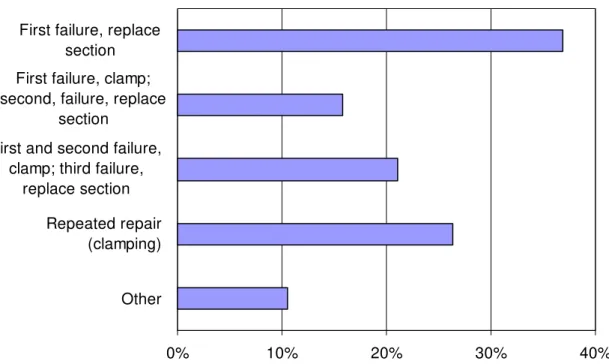
Figure 2 shows the methods used by participating utilities to repair broken AC pipes. Of the 19 utilities that responded, 37% replaced broken AC sections without any clamping. The others repaired broken pipes by clamping one or more times before resorting to replacement (depending on pipe conditions). As some utilities use more than one approach, the total can be more than 100 percent. Some utilities replaced 100 mm diameter AC pipes whenever a failure occurred.
0% 10% 20% 30% 40%
First failure, replace section First failure, clamp; second, failure, replace
section
First and second failure, clamp; third failure,
replace section Repeated repair
(clamping)
Other
Rehabilitated/replaced AC pipe length
Utilities with rehabilitation/replacement programs were asked to report the length of AC pipe that was rehabilitated/replaced over the past six years. Eight utilities that responded to this question (Figure 3). The length of AC pipe rehabilitated/replaced generally increased during this period.
Rehabilitation/replacement factors
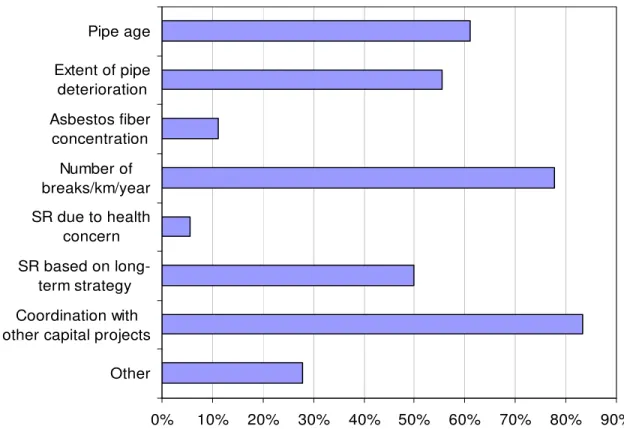
When asked to indicate the leading factors that determine which segments of AC pipe are rehabilitated or replaced, participating utilities cited ‘coordination with other capital projects’ and ‘number of breaks’ (Figure 4). Pipe age, extent of deterioration and long-term strategy were also factors frequently used to make rehabilitation/replacement decisions. Asbestos fibre concentration in the conveyed water and strategic replacement due to health concern were the least considered factors.
28% of utilities (five of the 18 utilities that responded to this portion of the survey) also considered other criteria such as hydraulic limitations for fire-fighting demand, risk based on probability of failure, consequence of failure, and social and environmental impact of breakage.
0 1 2 3 4 2002 2003 2004 2005 2006 2007 A v e ra g e r e h a b ilit a te d /r e p la c e d A C p ip e p e r u tilit y ( k m)
0% 10% 20% 30% 40% 50% 60% 70% 80% 90% Pipe age Extent of pipe deterioration Asbestos fiber concentration Number of breaks/km/year SR due to health concern SR based on long-term strategy Coordination with other capital projects
Other
Figure 4. Factors determining pipe segment rehabilitation or replacement
Rehabilitation/replacement priority
Although most utilities used the similar factors for deciding which segments of AC pipes were to be rehabilitated or replaced, they put different weights on each of the factors. Table 1 shows the priority factors of the 18 participating utilities. 39% of utilities (seven) ranked pipe breakage rate as the most important factor. 17% of utilities (three) ranked pipe age as the most important factor. One utility considered health concerns as the most important criterion. No utility considered asbestos fiber concentration in the conveyed water is an important factor when considering the segments of AC pipes to be rehabilitated or replaced.
Replacement methods
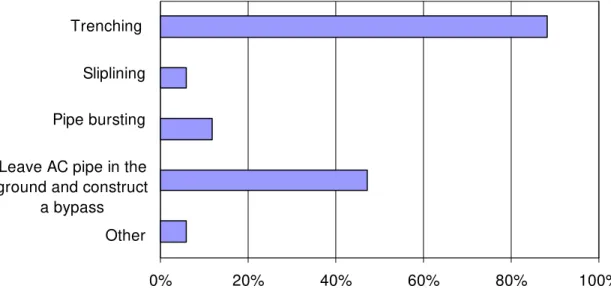
The common replacement methods used by the 17 participating utilities are shown in Figure 5. Utilities reported their use one or more of the methods. 88% (15 of 17 utilities) used trenching as the primary replacement method. About half the utilities (8 of 17) constructed a bypass when a segment of AC needed to be replaced. Two utilities (12%) indicated that pipe bursting was used. Pipe sliplining was the least used method, used by only one utility (6%).
Table 1. Priority factors for pipe segment rehabilitation/replacement Factor Priority 1 (highest) 2 3 4 5 6 7 8 (lowest) Pipe age 17* 6 28 0 6 11 6 6 Pipe deterioration 6 22 6 6 17 0 0 11 Fiber concentration 0 6 0 0 6 0 11 17 Breaks/ km/ year 39 11 11 17 0 6 0 6 Health concern 6 0 11 0 6 6 17 0 Long-term strategy 0 0 0 0 6 0 11 17 Coordination 0 28 22 17 6 11 0 6 Other 11 6 6 0 0 0 6 6 * percentage of utilities
The primary reasons for choosing a particular replacement method are summarized in Table 2. The most cited reason was service life improvement (47%), followed by total cost (40%) and previous experience (13%). Environmental effect (including possible active asbestos waste site) and social effect (including health concern due to activities related to cutting, demolishing, handling, and disposing AC pipe pieces or debris during AC pipe replacement) were not considered as the first priority.
0% 20% 40% 60% 80% 100%
Trenching Sliplining
Leave AC pipe in the ground and construct
a bypass Other Pipe bursting
Table 2. Replacement methods by rank Factor Priority 1 (highest) 2 3 4 5 6 (lowest) Total cost 40* 20 27 7 0 0
Service life improvement 47 33 7 0 7 0
Local availability 0 7 13 47 7 13 Previous experience 13 20 33 7 13 7 Social effect 0 7 7 0 40 27 Environmental impact 0 0 7 27 20 27 * percentage of utilities Rehabilitation methods
All 14 of the utilities that responded to queries about rehabilitation methods used trenching (excavation and repair). Only one utility used cured-in-place pipe (CIPP) to rehabilitate AC pipes. Options not used included cement mortar lining, epoxy resin lining, and sliplining.
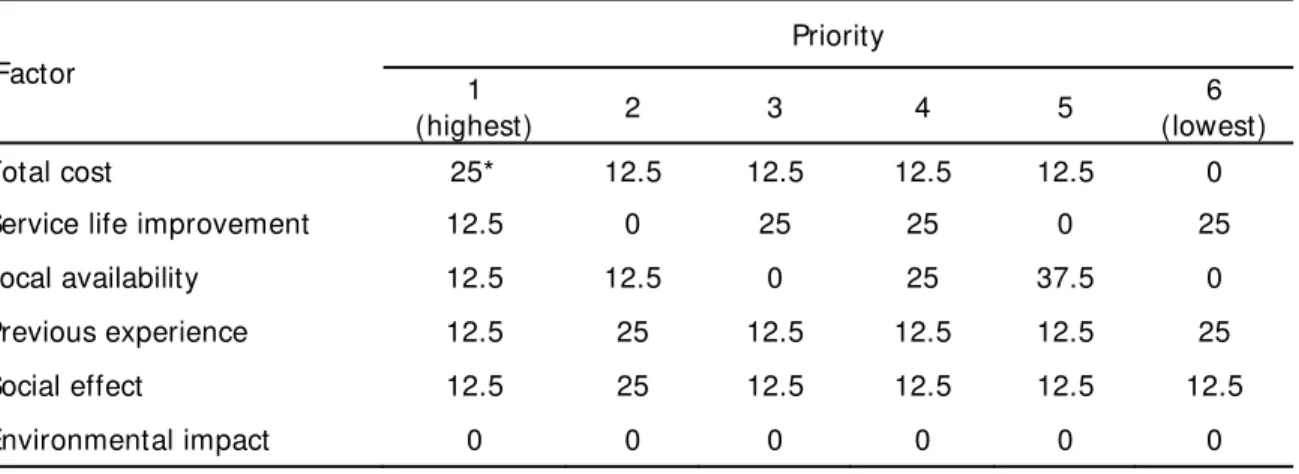
Utilities were also asked about the reasons for choosing a particular rehabilitation method and eight utilities responded (Table 3). Total cost was ranked as the most important consideration, followed by service life improvement, local availability, social effect, and previous experience. Environmental effect was not considered by any utilities.
Table 3. Rehabilitation methods by rank
Factor Priority 1 (highest) 2 3 4 5 6 (lowest) Total cost 25* 12.5 12.5 12.5 12.5 0
Service life improvement 12.5 0 25 25 0 25
Local availability 12.5 12.5 0 25 37.5 0
Previous experience 12.5 25 12.5 12.5 12.5 25
Social effect 12.5 25 12.5 12.5 12.5 12.5
Environmental impact 0 0 0 0 0 0
4. CONCLUSIONS
This paper reviewed the rehabilitation and replacement methods available for AC water mains. It also summarized data on the current rehabilitation/replacement practices of AC pipes, obtained from a survey of 19 participating utilities in the United Sates and Canada.
In general, technologies used to renew non-AC water mains are applicable to AC water mains. However, the possibility that the asbestos in AC water mains becomes friable during cutting or demolition activities may become a factor in deciding the methods to be used.
Trenching is the main method used by utilities to repair, rehabilitate, and replace AC pipes. Cost was cited as the main reason of utilities for choosing a particular repair/rehabilitation/ replacement method. Of the many factors that determine the segment of AC pipes to be rehabilitated or to be replaced, coordination with other capital projects is the key consideration for most utilities, followed by pipe breakage rate and pipe age. Although most of the rehabilitation/replacement methods have social and environmental effect because of possible release of asbestos fibres during these activities, the utilities generally did not consider it as their highest priority when selecting methods for renewing AC pipes.
5. ACKNOWLEDGEMENTS
The authors wish to acknowledge the financial support from National Research Council and the WRF. We also thank Dr. Jian Zhang, the project manager of the WRF project, and members of the project advisor committee, Toni Lyons, Steve MacKellar, Showri Nandagiri, and Julie Spacht for their useful suggestions during the questionnaire development. We greatly appreciate the contributions of the 19 participating utilities that submitted detailed AC pipe information.
6. REFERENCES
1. AWWA (American Water Works Association). 1995. Work practices for asbestos-cement pipe. American Water Works Association, Denver, CO
2. BAAQMD (Bay Area Air Quality Management District). (2006). Compliance advisory: asbestos control requirements for pipe bursting and pipe reaming.
http://www.baaqmd.gov/enf/compliance_assistance/advisories/adv_062006_asbestos_pipe_r eaming.pdf (accessed on May 12, 2008).
3. Deb A. K., Hasit Y. J., Schoser H. M. and Snyder J. K. 2002. Decision support system for distribution system piping renewal. American Water Works Association Research Foundation and American Water Works Association.
4. DEQ (Department of Environmental Quality). 2006. How to remove nonfriable asbestos (AC) water pipe: a guide for meeting DEQ rules.
http://www.deq.state.or.us/AQ/asbestos/docs/ASBPIPE.pdf (accessed on May 1st, 2008). 5. Hu, Y. and Hubble, D. 2007. Factors contributing to the failure of AC water mains. Canadian
6. The International Society for Trenchless technology (ISTT). 2006. Trenchless Guidelines.
http://www.istt.com/index.cfm?menuID=74 (accessed on May 14, 2008)
7. Kirmeyer, G.J., Richards, W. and Smith, C.D. 1994. An assessment of water distribution systems and associated research needs. AwwaRF: Distribution Systems, Denver, CO.
8. NRC (National Research Council). 2003. Selection of technologies for the rehabilitation or replacement of sections of a water distribution system – best practice. NRC, Ottawa, ON. 9. Rajani, B.B. and McDonald, S.E. 1995. Water mains break data on different pipe materials
for 1992 and 1993. National Research Council Canada, August 01, pp. 11.
10. USEPA (United States Environmental Protection Agency). 2008 “Asbestos/NESHAP regulated asbestos containing materials guidance”
http://www.epa.gov/region4/air/asbestos/asbmatl.htm (accessed on May 10th, 2008).
11. Von Aspern, K. 2008. Asbestos cement pipe: what are the real rules. Underground Construction Technology International Conference and Exposition, Atlanta, Georgia.