
About Sharing
by
Martina Gratanin Yuksek B.A., University of Zagreb, 1998
M.A. Syracuse University, 2002
Submitted to the Department of Linguistics and Philosophy in partial fulfillment for the requirements of the degree of
Doctor of Philosophy in Linguistics at the
Massachusetts Institute of Technology
June 2007
© 2007 Martina Gra'anin Yuksek. All rights reserved.
The author hereby grants to MIT permission to reproduce and to distribute publicly paper and electronic copies of this tS,, document in whole or in part in any medium now
n or hereafter created.
A uthor... .... ... ... ... Department of Linguistics and Philosophy
May 23, 2007
C ertified by.. .... ... .. ... .. ... . . ...
David Pesetsky
Ferrari P. Ward Professor of Modem Languages and Linguistics Thesis supervisor
A ccepted by ... ... .. ... ... ... Irene Heim Professor of Linguistics MASSACHUSETTS INSTT"E
OF TECHNOLOGY Chair of the Linguistics program
JUN
1
2007
I
ARCHNES
About Sharing
by
Martina Gra'anin Yuksek
Submitted to the Department of Linguistics and Philosophy On June 1st in Partial Fulfillment for the Requirements of the
Degree of Doctor of Philosophy in Linguistics
ABSTRACT
This thesis is about multidominance or sharing in syntax. The term sharing is used in a technical sense, to refer to a situation where a syntactic node has more than one mother. I assume that multidominance is allowed by the grammar. I argue that sharing configurations are more diverse than it has been proposed. I identify two kinds of sharing: bulk sharing and non-bulk sharing. A string of multidominated material may be shared as a single constituent, resulting in a bulk sharing structure or its subparts may be shared individually, which results in a non-bulk sharing configuration.
I argue that all sharing structures are constrained by a single condition: Constraint On Sharing (COSH). COSH is a filter on derivations, which imposes an identity requirement on the sets of terminal nodes completely dominated by horizontal mothers of any shared node. Horizontal mothers are mothers that do not dominate each other. I propose that effects of COSH are reducible to conditions that must be satisfied for a structure to be linearizable.
Empirical evidence for COSH and non-bulk sharing comes from Bi-Clausal Multiple Wh-questions (BMWs), which I investigate in English and Croatian. In a BMW, two wh-phrases appear to be coordinated at the left periphery of the clause: "What and where did Bob cook?". I present arguments that these questions are bi-clausal, with one wh-phrase belonging to each CP conjunct. Next, I propose an analysis of BMWs that involves non-bulk sharing constrained by COSH. I argue that this analysis explains the puzzling properties that BMWs have in both languages.
I show that while English has only BMWs, in Croatian there is also a construction that mimics a BMW in the surface string, but is actually a result of a very different derivation, one that
involves only one clause with two wh-phrases. I refer to this structure as a Coordinated Multiple Question (CMW). I propose that the placement of second-position clitics in Croatian can
disambiguate a BMW from a CMW. Thesis supervisor: David Pesetsky
Contents
Contents.. ...
Conte n 5
Chapter 1: Overview ... ... 9
1. Background on sharing ... 12
2. Constraint on sharing (CO SH ) ... ... 13
2.1. Non-bulk sharing, constrained by COSH ... . ... 16
2.2. Bi-clausal M ultiple W h-questions: Evidence for non-bulk sharing and COSH... 18
2.3. Bulk-sharing and COSH ... ... ... ... 21
3. Lim itless non-bulk sharing? ... 23
4. Im plicit Argum ents ... 28
4.1. OTVs as True Transitives ... 30
4.2. An OTV as Two Verbs ... ... ... 32
Chapter 2: BMWs, Non-Bulk Sharing and COSH... ... 35
1. Introduction ... 35
2. BM W s in English ... 36
2.1. Obligatorily vs. Optionally Transitive Verb in a BMW... ... 38
2.2. Subject vs. Object Depictives ... ... .. . ... 40
2.3. Interpretation of the grammatical BM W s ... ... 40
2.4. Coordination of the wh-subject and a wh-adjunct... ... 41
2.5. Preposition stranding ... 42
3. BM W s in Croatian ... 44
3.1. Clitic repetition ... ... 44
3.2. The Absence of the it-reading ... 48
3.3. Obligatorily vs. Optionally Transitive Verb in a BM W ... 49
3.4. Subject vs. Object Depictives ... ... ... 50
4. Interim Sum m ary ... 52
5. Analysis ... 53
5.1. Properties of a BM W explained... ... 54
5.1.1. COSH ... 55
5.1.2. COSH In Action ... ... ... 58
5.2. M ore COSH Action ... 65
6. W hen M ore G oes Unshared ... 68
6.1. A BM W with Unshared Subjects ... ... ... ... 68
6.2. 'Clitic Identity' Puzzle in a Croatian BM W ... 74
6.2.1. Identity of Auxiliary Clitics ... 76
6.2.2. Identity of Pronominal Clitics ... 82
7. Conclusion ... 85
Chapter 3: D eriving COSH ... ... ... ... ... . 86
1. Introduction ... 86
2. Linearizing a BM W ... 94
3. Non-linearizable structures ... 100
5. Conclusion ... 109
Chapter 4: Extensions and Predictions ... ... 110
1. Introduction ... 110
2. RNR, COSH and Linearization ... 110
2.1. RNR and COSH ... ... 114
2.2. Linearization of RNR ... ... .... ... 117
3. ATB questions and COSH ... 119
4. Gapping and COSH ... 126
4.1. Differences between gapping and BMWs... ... 135
5. Left-Node Raising? .. . . . .. . . .. . .. . . .. . . .. . . . .. . . .. . . . .. . . .. ... 139
6. Conclusion ... 145
Chapter 5: Plausible alternatives ... 147
1. Introduction ... 147
2. Against backwards sluicing in a BMW ... 151
2.1. Against backward sluicing in English BMWs ... 151
2.2. Against backward sluicing in Croatian BMWs ... 158
3. Against bulk-sharing in a BMW ... 166
3.1. Binding unbound traces of wh-phrases by another operator ... ... ... 168
4. ... And against its subsequent ATB movement to the right ... 175
5. Against non-bulk movement ... 177
6. Conclusion ... 180
Chapter 6: BMWs and CMWs in Croatian ... 181
1. Introduction ... 181
2. &-cl Wh&Wh's may be both mono- and bi-clausal...83
2.1. Non-repeated clitics in &-cl Wh&Wh's ... 184
2.2. Optionally versus obligatorily transitive verbs ... ... 186
2.3. Subject versus object depictives... ... 188
2.4. The it-reading and the at-all-reading ... 189
2.5. Interim summary ... ... ... 191
3. CL-& Wh&Wh's are mono-clausal ... ... 192
4. The structure of a CMW ... 195
5. Conclusion ... 207
Chapter 7: Conclusion ... 208
Acknowledgments
Writing this dissertation taught me why it is that Ph.D. programs end with dissertation-writing. It is so that you, the "dissertator", stop feeling miserable about leaving the department and facing the big world out there. About ceasing to be "one of us" and becoming "one of them." About the prospect of finding yourself at the other side of the great divide that separates (still!) us, students from them, professors. You spend a fair amount of time worrying about these things as you begin your final year (at least I did). And then the dissertation-writing happens, and before you know it, you can't wait to become "one of them"! You find yourself thinking that the other side of the great divide is a place you want to be. You eagerly anticipate the joys of having the dissertation finished, bound and filed. And by the time it actually happens, you have already made your peace with the thought of facing the big world. And that is why we write dissertations.
I wrote mine with enormous help from all my committee members, starting with my Chair,
David Pesetsky. I do not intend to acknowledge David about how great a linguist and teacher he is. It has been done before, and there is little new I could say in that respect (see numerous MIT dissertations that bear his signature). My personal and deep gratitude goes to David for being my mentor in every sense of the word, during the five years I spent at MIT. I want to thank him for always being there for me, not just by supporting my work and solving my linguistic problems, but also by literally 'being there' when, having had a baby at the beginning of my fifth year, I could only meet with David at odd times, and could use all the help I could get just to remember what my dissertation was about. I honestly don't see how I could have done it if David had been
less considerate.
Working with Sabine Iatridou was a wonderful experience. Every department should have a Sabine. She is, well... she is overwhelming, because she is quick and harsh and matter-of-factly (one of her comments on a part of my thesis was a plain, simple and quite telling, No!). But I can think of noone who has your interests more at heart than Sabine does. The way she cared for my academic, but also personal well-being during my stay here deserves more than just a paragraph in these acknowledgments, but time flies, and the filing date is almost here, so this much will have to do.
Norvin Richards is one of the nicest people I know. He is so nice that he apologizes when he spots a problem in your work or a gap in your argument. And he is so nice that when he comes up with an idea that saves your otherwise doomed theory, he starts his sentence with, "As you yourself pointed out..." After some time, I actually started to believe that I really did point out some of this stuff he was talking about. And it did wonders for my not always rock-steady academic self-esteem. I thank him for that.
For the longest time, I didn't dare ask Danny Fox to be on my committee. I enjoyed working with Danny, of course, it wasn't that. It was that more often than not, when Danny asked me a question about my work, I had to ask him five other questions, just to understand what he is asking about and possibly (on a good day) also why he is asking it. That's how far ahead he always was. And yet, he took the time and the patience to answer my five questions and bring me to the same page. And it feels good to be on the same page with Danny. I thank him for giving me that feeling.
I would also like to thank Elena Anagnostopoulou, Asaf Bachrach, Noam Chomsky, Irene Heim, Roni Katzir, Winfried Lechner, and Shigeru Miyagawa for the insightful discussions about the ideas that went into the making of this dissertation. I have benefited from all of them. For their English judgments, thanks go to Seth Cable, Jessica Coon, Franz Cozier, Benjamin Ellis, Ezra Keshet, Sarah Hulsey, Jillian Mills, Omer Preminger, Raj Singh, Tamina Stevenson, MaryAnn Walter.
I didn't work with Donca Steriade on this thesis, but I spent a lot of time working with her in my previous years. Her enthusiasm and a genuine thirst for knowledge made me work ever harder, so I could "teach her" something new every time we met. And "teaching her," I was learning. I am deeply indebted to Donca for all the mental energy she invested in my academic
development.
Thanks also go to Karlos Arregi, Michel DeGraff, Edward Flemming, Suzanne Flynn, Michael Kenstowicz, and Alec Marantz. I learned a lot from them.
My time at MIT would have been much less enjoyable if it hadn't been for my fellow students. I would like to thank Sarah Hulsey, Feng-fan Hsieh, Valentine Hacquard, and Ivona Ku'erovai for their friendship and support. I was also fortunate enough to have spent time here with Marta Abrusan, Tamina Stevenson, Seth Cable, Shoichi Takahashi, Joey Sabbagh and Sonny Webb (even though in the course of doing linguistics, Sonny decided he wanted to be a lawyer instead). So much for the people at MIT. However, I never would have made it here if it hadn't been for my Advisor in the M.A. program at Syracuse University, Jaklin Kornfilt. I am greatly indebted to her for all she has done to help me get where I am today.
Special thanks are due to my family for supporting me, both emotionally and practically, throughout my "American adventure." My warmest gratitude goes to my husband, Eray, for his love and support throughout my Ph.D. program, and to my baby boy Jan, for loving me as much as he does even when I left him for hours-on-end in order to finish chapter such-and-such. Dedicate this work to him is the least I can do.
Chapter 1: Overview
This dissertation is an investigation of multidominance or sharing. I propose that sharing is in principle free and that the range of structures that involve shared material is more diverse than it has so far been proposed in the literature.
Let us first take a look at what it means for a node to be multiply dominated.
XP in (1) has two mothers, YP and ZP. This makes XP multiply dominated or shared. 1
1.P
WP
c YP ZP d
a XP b
Before we go on to discuss questions that arise once MD is proposed, let me introduce some terminology that will be helpful in defining relevant notions and constraints, and will also facilitate the discussion that follows. In the dissertation I will be using the term immediately share in a technical sense, defined in (2) below.
2. Immediately share
X and Y immediately share a if X * Y, and X is a mother of a and Y is a mother of a.
The use of the term sharing in this dissertation is distinct from its use in the literature on gapping, most notably from its use in Lin (2002) and Johnson (2004). In these works, the term sharing structure is used to denote a structure in which two coordinated vPs share To. In my work, the term shared is synonymous with the term
multi-dominated: two nodes are shared if they have more than one mother nodes. This is not the case in the literature on
Thus, in (1), XP is immediately shared by YP and ZP. We also will wish to say that XP is shared between, for example WP and MP or YP and MP, although not all of these nodes immediately share XP. This intuition is captured by the definition of horizontal sharing, given in (3) below.
3. Horizontally share
X and Y horizontally share a if X # Y and:
i. X does not dominate Y and Y does not dominate X; and
ii. X reflexively dominates X' and Y reflexively dominates Y', and X' and Y' immediately share a.
The notion reflexively dominates is defined in (4).
4. Reflexively dominate
X reflexively dominates Y if i. X dominates Y, or
ii. X=Y.
According to the definition in (3), the pairs of nodes that horizontally share XP in (1) are (YP, ZP), (YP, MP), (ZP, WP) and (WP, MP). Nodes that stand in a domination relation, for example, QP and MP do not horizontally share XP, according to the definition in (3).
The reference to horizontal in the term horizontally share is useful to distinguish the case of sharing illustrated in (1) from the case of sharing illustrated in (5) below.
5. ZP
I Z'
iZ YP
I Y , XP
In (5), XP has been internally merged with a node that dominates it (Z'). In other words, it has been moved to a position higher than the position of its original merge. If we think about internal merge as remerge of a phrase with a node that dominates it (Blevins (1990), Frampton (2004), Bachrach & Katzir (2006)), we must conclude that following the remerge (or movement), XP in (5) has two mothers, YP and ZP. This means that XP is multiply dominated or shared.2 To refer to the instance of sharing illustrated in (5), I will use the term vertically share, defined in (6).
6. Vertically share
X and Y vertically share a if X * Y and:
i. X dominates Y or Y dominates X, and ii. X and Y immediately share a.
Thus, in (5), YP and ZP vertically share XP, but neither YP nor ZP vertically share XP with Z'.
In the dissertation I will be using the term share as shorthand for the notion horizontally share. Similarly, a shared node is to be understood as a node that is horizontally shared. I will refer to a node that is not horizontally shared as an unshared node (even though such a node may be
2 Thus, according to the present proposal, movement does not involve creating copies of the element that moves. Rather, we are dealing with a single element, and what "movement" does is create multiple mothers of the element.
vertically shared). Whenever I need to make reference to sharing that results from internal merge, I will use the term vertically share.
Below, I give a brief overview of the phenomena that sharing analyses have been proposed for.
1.
Background on sharing
Structures like (1) have been proposed in the literature to account for various phenomena. A sharing analysis has been proposed to account for the phenomenon of Right-Node Raising
(RNR), illustrated in (7) (McCawley (1982), Goodall (1983), Levine (1985), McCloskey (1986), Muadz (1991), Moltmann (1992), Wilder (1999) and Bachrach & Katzir (2006)).3
7. John read and Mary only skimmed the latest article about bats.
Goodall (1983, 1987), Muadz (1991) and Moltmann (1992) propose that gapping, in (8), is also derived by sharing.
8. John met Sue and Mary Bill.
Goodall (1983, 1987), Muadz (1991), Moltmann (1992) and Citko (2000, 2005) propose a sharing structure for Across The Board (ATB) wh-questions, in which a single wh-phrase seems to move out of two (or more) conjoined TPs. An ATB question is illustrated in (9).
9. What will John buy and Mary think Sam should read?
Citko (2000, 2005) proposes that free relatives, illustrated in (10), are also derived from a structure in which the wh-phrase that introduces a free relative (whatever in (10)) is multiply dominated by the matrix and embedded VPs. A similar proposal for free relatives is suggested by Van Riemsdijk (2006).
10. Gretel reads whatever Hansel recommends. (Citko 2000, ex. 81, pg. 72)
2. Constraint on sharing (COSH)
I assume that the grammar in principle allows sharing structures.4 It is tacitly assumed in
the current literature on MD that, given a string of shared material, the only shared constituent is the smallest constituent that dominates the entire string, as illustrated in (11). 5
4 This is not necessarily a trivial assumption. Citko (2005, pg. 475) argues that the operation needed for the creation
of MD structures, Parallel Merge, is a 'natural consequence of Chomsky's (2001) view of phase structure and movement'. However, Chomsky (p.c.) points out that Parallel Merge has properties that distinguish it from both External and Internal Merge and has argued that a system that posits Parallel Merge is not a natural extension of the generative system that employs Merge as its sole (and unbounded) structure-building operation. In particular, Chomsky (2006, footnote 12, pg. 6) criticizes Parallel Merge as requiring 'new operations and conditions on what counts as a copy, hence additional properties of UG'. Given the empirical coverage of Parallel Merge, I assume that it is part of the grammar. However, further research is needed to determine how to resolve important theoretical considerations raised by acquiring a system that employs Parallel Merge.
5 Abbott (1976) discusses RNR and points out that the right-node raised material is not always a constituent. If RNR
involves shared material, it follows from Abbott's discussion that a string of shared material may be shared even if it is not the case that the entire string is a single constituent (see examples (27) and (28) in this Chapter).
11. XP YP ZP Y QP Z HP Q H WP W MP M N
This implies that there exists a constraint in the grammar that requires a complex constituent, WP in the diagram (11), to be shared as a single unit, i.e. that material can only be shared "in bulk." I refer to this kind of sharing as bulk sharing. In this dissertation I argue that the grammar does not contain such a constraint. In particular, I argue that a string may be shared so that its subparts are shared individually. On the other hand, we will see that such non-bulk sharing is allowed only under a special set of circumstances. I argue that these circumstances are governed by a Constraint On Sharing (COSH). COSH is given in (12).
12. Constraint On Sharing (COSH) For any a, M, and N,
where M # N, and
i M and N immediately share a, and ii M and N horizontally share a, and
iii there is no node K that vertically shares a with both M and N 6
For any terminal node 3, M completely dominates P iff N completely dominates P.
6 Clauses (ii) and (iii) of COSH just say that a does not have a single highest mother (a single mother not dominated
Both clauses (i) and (ii) are needed in the definition of COSH in order to prevent cases of movement (vertical sharing) from being ruled out by it.
The notion of complete dominance is defined in (13).
13. Complete dominance
a completely dominates P if every path from P upwards to the root includes a.
(Fox & Pesetsky, in preparation)
COSH can be informally paraphrased as follows: two mothers of a shared node that horizontally share it, must completely dominate identical sets of terminal nodes.
I argue that COSH is the only constraint on MD structures in the grammar. This means that sharing is in principle free, and a string may be shared either in a bulk or in a non-bulk manner, as long as the structure it appears in satisfies COSH.
Before we take a look at how COSH operates, let me note that COSH is a condition that holds of representations. Thus, a piece of structure that is ruled out by COSH at a certain stage in the derivation may still survive, if by the end of the derivation the structure conforms to it.7
Finally, if COSH is correct, and I argue that it is, we would like to understand why it is so. In Chapter 3 I explore the possibility that effects of COSH are a consequence of principles of linearization, which we independently needed to linearize syntactic structures. I propose a linearization algorithm that is capable of linearizing MD structures and derives most (although
7 The reader will have noticed that, as it stands, the structure in (11) is ruled out by COSH. I will return to (11) in
not all) of the results that COSH accomplishes. The only case where the linearization algorithm makes different predictions from COSH is RNR. I discuss RNR in Chapter 4, section 2.
2.1. Non-bulk sharing, constrained by
COSH
Let us now take a look at the representation in (14), which is an instance of non-bulk sharing. 14. XP YP ZP
Y
WPI
Z
WP
2 W MPI MP2 M Q HThe two conjuncts in (14), YP and ZP, share two nodes, W and M.8 The representation, however, crucially differs from the one in (11) in that there is no node that dominates the shared nodes W and M to the exclusion of the unshared nodes Q and H. In other words, W and M do not form a constituent to the exclusion of Q and H. This makes it impossible for the string WM to be shared as a bulk. Thus, W and M must be shared individually. The question is whether (14) is a
legitimate representation, i.e. whether it satisfies COSH.
It does not. Consider first W. It has only two mothers, WP1 and WP2, and they do not
dominate each other. Note first that by our definition of complete dominance in (13), neither WP1 nor WP2 completely dominates W. Next, let us examine the set of terminal nodes that are
completely dominated by WP1 and WP2. WP1 completely dominates Q, and WP2 completely
dominates H. This is because every path from Q upwards to the root includes WPI and similarly, every path from H upwards to the root includes WP2. Since { Q } is not identical to {H }, COSH is
not satisfied. The same conclusion emerges when we consider the other shared node, M. M also has only two mothers, MPI and MP2, that do not dominate one another, and neither completely
dominates M. The set of terminal nodes completely dominated by MPI, {Q }, is not identical to the set of nodes completely dominated by MP2, { H }.
Suppose now that by the end of the derivation, Q and H move out of the WPI and WP2
respectively, as illustrated in (15). 15i. XP RP NP I I I I I~ I I I I I YP ZP Y WP - WP2 W MP - MP2 ... M -Q H
.---The representation in (15) conforms to COSH, since now the moved elements in the two conjuncts (Q and H) are no longer completely dominated by the two mothers of W, WPI and WP2. They are also no longer completely dominated by the two mothers of M, MP, and MP2.
This is because, as mentioned above, movement is remerge of an element with a node that dominates it, as shown in (15). By virtue of being remerged with YP and ZP respectively, Q and H become multiply dominated themselves (vertically shared), since now each of them has two
mothers: Q has multiple mothers, MP1 and RP, and H has multiple mothers, MP2 and NP. Since
now there is a path from Q to the root that does not include WP1 and similarly, there is a path
from H to the root that does not include WP2, it follows that WPi does not completely dominate
Q and WP2 does not completely dominate H. Since WP1 and WP2 do not completely dominate W
or M, the set of nodes completely dominated by both WPI and WP2 is reduced to the empty set.
This makes the two sets identical, in accordance with COSH. The same holds of the two mothers of M. Because Q and H are remerged in a position that is higher than MPi and MP2, these nodes
no longer completely dominate Q and H respectively. The set of terminal nodes completely dominated by both MP1 and MP2 is the empty set.
Note that COSH only rules out representations in which there is an unshared node, say Q
in (15) above, which is completely dominated by one/some, but not all mothers of a shared node, for example M. COSH has nothing to say about unshared nodes that are not completely
dominated by any mother of a shared node. Thus, unshared nodes Y and Z are not problematic
either in (14) or in (15).
Let us now turn to examples that provide empirical support for COSH.
2.2. Bi-clausal Multiple Wh-questions: Evidence for non-bulk
sharing and
COSH
Empirical evidence for COSH comes from multiple questions in which the wh-phrases seem to be coordinated, illustrated in (16) for English and in (17) for Croatian.
17. Sto i gdje Ivan pjeva? Croatian What and where Ivan sings
'What and where does Ivan sing?'
One of the wh-phrases in both (16) and (17) is a direct object, and the other one is an adjunct. This is important because it rules out a possible derivation of (16) and (17) that involves a single clause where the wh-phrases are coordinated in the base position. This derivation is, however, possible for examples such as (18).9
18. [Which book and which person] did Bob remember [whieh book and which perfon]?
In this dissertation, I refer to strings like (16) and (17) as Wh& Wh's. Importantly, I reserve this term only for those questions in which a derivation in (18) can be excluded.
Cross-linguistically, Wh&Wh's appear to derive from at least two different structures, one bi-clausal and one mono-clausal. I refer to the bi-clausal structure as a Bi-clausal Multiple Wh-question (BMW), and to the mono-clausal structure as a Coordinated Multiple Wh-Wh-question
(CMW).o1 In Chapter 2 I will argue for the claim that in English, sentences like (16) always involve a BMW structure, while Croatian allows both BMWs and CMWs.11 In particular, I first
argue that (16) is derived from two coordinated CPs. Evidence for this claim is given in Chapter 2, section 2. I further argue that the two underlyingly coordinated CPs, shown in (19), share all
9 If both wh-phrases are adjuncts, as in (i), it is unlikely that they are coordinated in the base position, given the
proposals that different adverbs occupy particular (and distinct) positions in the structure (Cinque, 1999). Thus, (i) is probably a BMW.
(i) Where and when did Sally sing?
10 The term CMW is borrowed from Gribanova (2007).
the terminal nodes (indicated by underlining), except the wh-phrases, what and where. Crucially,
I present arguments that neither of the two conjuncts contains the wh-phrase that introduces the
other at any level of representation.
19. [CPl what did Sally sing] and [cP2 where did Sally sing]?
Thus, I argue that the BMW in (16) has the structure given in (20).
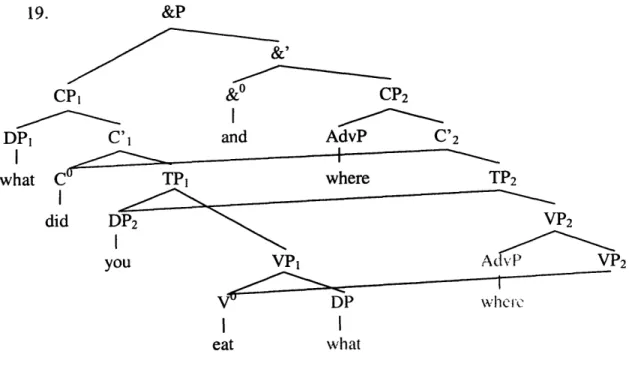
20. &P CPI and CP2 C'1 C'2 did TPI TP2 Sally VP2 VP 1 - ... where VP2 sing what
Structure (20) conforms to COSH, by virtue of having the same properties as (15) above. The mothers of the relevant shared nodes, did, Sally and sing, (VP, TP and C' in both conjuncts) all completely dominate the same set of terminal nodes, namely the empty set. Neither of them completely dominates the shared nodes, and in addition, they do not completely dominate what or where.
In Chapter 5 I argue that the properties of BMWs illustrated in Chapter 2 cannot be
explained by other analyses that seem at first glance plausible, for example, backwards sluicing, ATB movement or bulk sharing. This leaves non-bulk sharing (constrained by COSH) as the most adequate analysis of BMWs.
2.3. Bulk-sharing and
COSH
Let us now return to the representation in (11), repeated here as (21) for convenience.
21. XP YP ZP Y QP Z HP Q H WP W MP M N
COSH rules (21) out. The structure contains only one shared node (WP), which has only two mothers neither of which dominates the other (QP and HP). By our definition of complete dominance, QP completely dominates Q, and HP completely dominates H. Thus, the two sets of nodes completely dominated by QP and HP, {Q} and {H} are not identical, in violation of COSH.
There are at least two ways in which (21) can be made compatible with COSH. One is the solution that was employed in order to make (14) conform to COSH: to remerge both Q and H to a higher position, thus exempting them from complete dominance by QP and HP respectively.
There is a second strategy that can eliminate the COSH violation in (21) - remerging the shared node, WP, to a position that is higher than XP. This strategy also rescues (21), although
in a different way. The structure ends up vacuously obeying COSH, since moving WP to a position higher than XP - for example adjoining WP to XP - has the effect of creating a mother
of WP, namely XP2, that does dominate all the other mothers of WP (YP and ZP). Having a
mother that dominates all other mothers in a structure "exempts" a shared node from COSH, since the clause (iii) in the definition of COSH is no longer satisfied. The structures in (22) and
(23) are therefore well-formed.12,13
XP2 Remerge ýf WP to the left
XP
YP ZP
Y Z --- WP
-"- W MP
M N
12 The structure in (23) is the one proposed for RNR by Postal (1998), Sabbagh (in press), Fox and Pesetsky (in
preparation) among others. I discuss RNR in Chapter 4, section 2.
Creating a mother that dominates all other mothers is in principle also available to shared nodes W and M in (14). However, this would require that W and M move to a position higher than XP independently of each other. This possibility is discussed in Chapter 5, section 5.
22. r r r r r r r r r r I I I
23. XP2 Remerge of WP to the right XP YP ZP ",
Y
z
w
~----I W MP M NThus, it is not the case that in this dissertation I argue against bulk sharing. In fact, I argue that sharing is free, and that all structures that satisfy COSH are legitimate, and therefore generated by the grammar, regardless of whether they instantiate bulk sharing, non-bulk sharing or no sharing at all.
3. Limitless non-bulk sharing?
I assume that a derivation proceeds by iterative application of Merge to lexical items and already formed syntactic objects, as in Chomsky (1995, pg. 243-260). Each instance of Merge creates a two-membered set, of the form { y, { a,
3
} }, where the first member, y is the label, and the second member, { a, p } is a set containing objects that have undergone Merge. A derivation may be informally represented by a diagram we refer to as a syntactic tree. However, the tree notation is not quite precise, since a single derivation may map onto two different diagrams. For example, consider the diagram in (24), which involves a representation that looks quite different from that in (21). Moreover, while (21) is ruled out by COSH, (24) is not, as the reader may verify for herself. We might therefore think that (24) involves a derivation that differs from the derivation in (21), but this is in fact not the case.24. XP YP ZP Y QP Z HP Q WP1 H WP2 W MP1 MP2 M N
To make this obvious, it is helpful to think about the derivations in (21) and (24) in terms of sets, along the lines of Chomsky (1995).14
The first four steps in the derivation in (21) are given in (25). In the interest of clarity, the "splitting" of the workspace that occurs the moment WP in (21) becomes multiply dominated is represented by parallel derivations, one on the right, and one on the left of
"I".
In (25) and (26), I call these derivations, Derivation 1 and Derivation 2.25. Set-theoretic representation of the derivation in (21)
Derivation 1 Derivation 2
Step 1: {M, {M, N}
Step 2: {W, {W, {M, {M, N }}}}
Step 3: {Q, {Q, {W, {M, {M, N} }}}
I
{H, H, {H, {(W, {M, {M, N}Step 4: {Y, {Y, {Q, {Q, {W, {M, {M, N II}}}} } I Z, {Z, {Q, {Q, {W, {M, {M, N} }} }
14 Under Chomsky's assumptions about what syntactic objects may be put together by Merge, neither (21) nor (24) can be generated by the grammar. For present purposes, I gloss over these differences. See footnote 4 for relevant considerations.
In Step 3, which is the point in the derivation at which WP becomes multiply dominated, the set on the left hand side of I is not identical to the set on the right hand side. The set on the left contains an element Q, while the set on the right contains H (Q and H are also the labels of the relevant sets). The same holds of sets created in Step 4.
Creating different sets in a sense justifies the splitting of the workspace. In other words, it is plausible to claim that a derivation m and a derivation n are different derivations if they
involve creating different sets. Since sets are defined by their members, it follows that
derivations differ iff an instance of the set-creating operation Merge in each derivation applies to different objects.
With this in mind, let us examine the derivation represented in (24). It differs from the derivation in (25) in that it involves workspace splitting from Step 1. The derivation is given in (26).
26. Set-theoretic representation of the derivation in (24)
Derivation 1 Derivation 2
Step 1: {M, {M, N}}
I
{M, {M, N}}
Step 2: {W, {W, {M, {M, N} } } }
{W, {W, {M, {M, N} } } }
Step 3: {Q, {Q, {W, {M, {M, N } } } }
{ H, {H, {W, { M, {M, N} } } } }
Step 4: {Y, {Y, {Q, {Q, {W, {M, {M,N}}}}}})
)
{Z, {Z, {Q, {Q, {W, {M, {M, N}}}}}}}
Here, the sets formed in Steps 1 and 2 on either side of I are identical. If an instance of Merge in a derivation m, creates the same set as an instance of Merge in a derivation n, then m and n are
not two different derivations. Thus, even though the tree in (21) looks very different from the tree in (24), inspection of the sets created in the course of each of those two derivation reveals that they are identical, i.e. that (26) is identical to (25). So, even though a representation in (24) is not ruled out by COSH, it is disallowed by the general principles of the set-theory, namely, that two sets are distinct only if they have different elements. 5
The idea of allowing non-bulk sharing is not new. That it is possible has already been proposed in the literature, although indirectly and with some imprecision. Levine (1985) notes, for example, that a non-raising (or sharing) analysis of RNR is preferable to a raising anlaysis for the treatment of sentences where the "raised" element is not a constituent, as in (27), given in Abbott (1976).16
27. Mary baked and George frosted [twenty cakes] [in less than an hour].
Assuming that RNR involves sharing of the material that seems to be right-node raised, the structure of (27) is that in (28).17
15 Note that the splitting of the workspace in Step 1 in (26) is only disallowed if derivation proceeds bottom-up.
16 Non-bulk sharing seems to be implicitly assumed for sentences like (27) in Bachrach & Katzir (2006).
17 Abbott (1976) hypothesizes that the structure of this example might be as in (i).
(i)
S AdvP
S and S in less than an hour
Mary baked George frosted 20 cakes 20 cakes
28. &P
&I
TPI and TP
Mary vP1 George vP1
vP1 vP1 PP
baked frosted DP in less than an hour
twenty cakes
A representation like (28) amounts to non-bulk sharing, since there is unshared material, namely the verb in each TP (baked and frosted), that is sandwiched between the shared PP, in less than an hour, and the shared DP, twenty cakes. In other words, the shared string cannot be
shared as a single constituent. We notice that COSH rules (28) out. However, we have by now seen two possible rescue operations that can save (28): one is to remerge the verb in each
conjunct to a position where it will not be completely dominated by the mother of the shared PP, and the other is to move both the PP and the DP so that for each of them we create a mother that dominates all of its other mothers.
The theoretical contribution of this dissertation is not the idea of non-bulk sharing per se. It is rather the identification of the conditions under which such sharing is possible - namely, the claim that all unshared material that is at one point in the derivation completely dominated by the multiple mothers of the shared material must by the end of the derivation undergo movement. This accounts for the fact that the surface string never contains shared material interleaved with unshared material, even when the shared nodes are shared in a non-bulk manner.
Recall from section 2.2 that empirical evidence for COSH comes from BMWs, like that in (29), repeated here from (16).
29. What and where did Sally sing?
In Chapter 2 of the thesis, I present a detailed discussion of BMWs. We will see in section 2.1 of Chapter 2 that a BMW is only well-formed if it contains an optionally transitive verb, as opposed to an obligatorily transitive verb. Thus, (29) contrasts with (30) below.
30. *What and where did Sally buy?
Given that this contrast is crucial for the analysis I propose, I feel it is necessary to spell out for the reader the assumptions that I make about the representation of verbs such as eat, that are optionally transitive. I do so in the following section.
4. Implicit Arguments
Verbs like eat, drink, sing, read, etc. differ from verbs such as buy, fix, hit, love, etc. in that, unlike the latter, the former may surface with an overt argument or with an implicit one. The relevant contrasts are shown in (31) and (32).
31. a. John drank water. b. John drank.
32. a. John bought water. b. *John bought.
The alternation illustrated in (31) is commonly referred to as Indefinite/Unspecified Object Alternation or Indefinite/Unspecified NP deletion. I will use the term Optionally Transitive Verb (OTV) for verbs that appear in the alternation in (31).
In this section I discuss OTVs, with a particular focus on the syntactic status of their implicit arguments. I argue that in a BMW, the verb surfaces with an explicit argument (wh-phrase) in one conjunct and with an implicit argument in the other conjunct. It is therefore
crucial for my analysis to reconcile the difference in transitivity of the verb across conjuncts with the fact that the verb is argued to be shared, and that we are therefore dealing with a single lexical item. I therefore adopt the view of optionally transitive verbs proposed in Chomsky
(1965), according to which the OTVs are lexically subcategorized for an optional object, as in (33).
33. eat: V, [ (NP)]
This view allows the requirements of the shared verb in a BMW to be satisfied in the VPs of both conjuncts: in one of the VPs, the verb cooccurs with an overt object, which is allowed by (33), and in the other it surfaces without it, which is again allowed by (33). The data from BMWs therefore give support to the 'optional subcategorization' approach to OTVs, over the proposals according to which they are either uniformly transitive (Bresnan (1978), Rizzi (1986), Zwicky (1987), among others) or involve two separate verbs in the lexicon, one transitive and
one intransitive (Fodor & Fodor (1980), Mittwoch (1982), Rice (1988). In the following paragraphs I outline these alternatives.
4.1.
OTVs as True Transitives
Approaches to OTVs that I discuss in this section regard them as being true transitive verbs in the lexicon. The proposals differ as to whether OTVs are transitive in the sytax as well.
According to Belletti & Levin (1985), Zwicky (1987), Culy (1996), and Culicover and Jackendoff (2005), verbs with optional internal arguments have phonologically null lexical items in object positions. According to these authors, these null arguments are syntactically present in the structure. These verbs are uniformly transitive and the alternation in (31) arises due to the fact that in (31)a the object is overt, while in (31)b it is covert.
The problem with these proposals is the nature of the lexical item that is posited in the object position of an OTV. English does not seem to possess null pronouns (pro) that might fill the object position of the verb, and it is hard to see how a different null element, for example a PRO, might survive in the relevant configuration, since it normally cannot occupy an object position. For this reason, I reject this approach, even though my theory could be made
compatible with it, if COSH were formulated so that it only pays attention to overt elements that are completely dominated by horizontal mothers of a shared node.
For 'lexicalist' approaches, such as Bresnan (1978), Hale & Keyser (1985), Rizzi (1986), Fellbaum & Kegl (1989), and Jackendoff (1990), the object theta-role of OTVs in English is discharged and satisfied in the lexicon. For these authors, although OTVs are functionally
transitive, they are syntactically intransitive. Thus, in these approaches, the implicit argument of an OTV is absent from the syntactic structure in which the verb appears.
Johnson's (2001) analysis is slightly different, in that he proposes that implicit arguments are intrinsic variables bound at LF by existential quantifiers.'8 This approach is reminiscent of
Bresnan's (1978) proposal, according to which the verb eat is transitive in the lexicon, but its argument structure can be converted from a two-place relation to a one-place relation by the variable-binding operation of quantification. Bresnan thus derives (34)b from (34)a, by an application of a lexical rule.
34. a. x EAT y b. (3y) x EAT y
For Johnson, the intransitive eat is also interpreted as (34)b, but for him this interpretation is obtained at LF. 19
None of these proposals, I think, is compatible with the data from BMWs that we will see in Chapter 2. The reason for this is that, according to these analyses of OTVs, by the time the verb is inserted into the syntactic structure, its object theta-role has either been saturated in the lexicon, or it has not been. Thus, if these proposals are correct, it is impossible for an OTV to be shared between two conjuncts, such that in one of them it is interpreted transitively and in the
18 A similar approach seems to be assumed in Romero (1998).
other intransitively. Since this is exactly the situation we find in a BMW, I conclude that the lexicalist approach to OTVs is not correct.
4.2. An OTV as Two Verbs
Finally, Fodor & Fodor (1980) and Mittwoch (1982) propose that lexicon contains two entries for OTVs like eat, one transitive and one intransitive, as shown in (35).
35. eat1: V, [ NP]
eat2: V, [ ]
These authors argue against the view advocated by Bresnan (1978), that intransitive eat is represented as (34)b. Thus, their arguments are centered around the effort to show that there are
important differences between (36)a and (36)b that are not predicted by Bresnan's proposal.
36. a. John ate.
b. John ate something.
Fodor & Fodor argue for (35) based on the observation that implicit arguments of OTVs obligatorily take narrow scope with respect to other scope-bearing elements in the sentence, as
shown by the lack of ambiguity in (37)a. The sentence only has the reading in (37)b, but not the one in (37)c.
37. a. Everyone ate.
b. Everyone is such that there is something that they ate. c. # There is something such that everyone ate it.
(Fodor & Fodor 1980, pg. 759)
Example (37)a crucially differs from (38)a, which is ambiguous between the readings in (38)b and (38)c.
38. a. Everyone ate something.
b. Everyone is such that there is something that they ate. c. There is something such that everyone ate it.
Mittwoch (1982) shows that while eat is an activity predicate, eat something is an accomplishment. Hence, for example, the contrast in (39).
39. a. John ate (porridge) for 10 minutes. (Mittwoch 1982, ex. 10, pg. 115)
b. *John ate something for 10 minutes. (Mittwoch 1982, ex. 12, pg. 115)
Like the 'lexicalist' proposals discussed in 4.1, this view is also incompatible with the proposal advanced in this thesis. If the verb in the first conjunct of a BMW is transitive (eat]), and the verb in the second conjunct is intransitive (eat2), then the two are by definition different verbs. It
is then implausible to claim that the verb in a BMW is shared. However, given that the data introduced and discusses in Chapter 2 strongly favor the analysis according to which the verb in
a BMW is shared, I cannot adopt the approach to OTVs according to which the alternation in (31) involves two different lexical entries.
Rather, as mentioned at the beginning of this section, I will assume that OTVs are listed in the lexicon as a single entry, subcategorized for an optional internal argument, as noted in (33), repeated here as (40).
40. eat: V, [ _ (NP)]
Thus, an OTV may be thought of as an intransitive verb that can accommodate a direct object. Under this proposal, it is not surprising that in a BMW, a shared verb may have different adicity in each of the conjuncts.
With this much in mind, let us return to the main focus of the dissertation, the investigation of sharing.
Chapter 2: BMWs, Non-Bulk Sharing and
COSH
1.
Introduction
In Chapter 1 I outlined the claim that sharing is in principle free and that any given string may be shared either in bulk (so that the only shared node in the structure is the constituent that dominates the whole string), or in a non-bulk manner (so that its subparts are shared
independently form one another). In this chapter, I present a construction, Bi-clausal Multiple Wh-question, illustrated in (1) for English and in (2) for Croatian, which I use to argue that the phenomenon of non-bulk sharing is real.
1. What and where did you eat? English
2. Sto i za'to Petar jede? Croatian
what and why Petar eats 'What and why does Petar eat?'
3. &P &I
CPi
and
CP2
S
C'
C)2 Sdid TPI TP2 you VP2 VP1 ---- where VP2 eat whatThus, a BMW is argued to involve a coordination of full-fledged interrogative clauses (CPI and CP2), which share individual nodes, in our case did, you and eat, but do not share the wh-phrases
what and where.
In this chapter, I discuss questions like (1) and (2), and argue that properties they display are best explained by the structure in (3).
2. BMWs in English
We have already seen, in (1) above, an example of wh-questions in English in which two wh-phrases appear at the front of the sentence, and they seem to be coordinated. In this section, I argue that appearances are deceiving in this construction. We will see that the underlying
interrogative CPs. 20 I refer to this structure as a BMW. I present arguments that the Wh&Wh in
(4)a has the underlying structure in (4)b, i.e. that (4)a is a BMW.
4. a. What and where did Sally eat?
b. What did Sally eat and why did Sally eat?
Support for this claim comes from several converging arguments. In section 2.1 we will see that a Wh&Wh becomes ungrammatical if it contains an obligatorily transitive verb. I argue that the reason for this is the fact that the wh-object, what, is not syntactically present in the clause introduced by the wh-adjunct. Another piece of evidence to this effect comes from the fact that a Wh&Wh may contain a subject depictive, but not an object depictive. This asymmetry, presented in section 2.2, again argues for the syntactic absence of the wh-object from the clause introduced by the adjunct wh-phrase. In section 2.3 we will see that the wh-object, what, is not interpreted in the same clause as the other wh-phrase. I will show that Wh&Wh's like (4)a have only one kind of reading, which I call the at-all-reading, that crucially arises only in the absence of the object argument of the verb. A Wh&Wh is also ungrammatical if one of the wh-phrases is the subject (section 2.4). This fact receives a natural explanation under the present proposal, since in English an overt subject is required for a sentence to be well-formed. If in a BMW wh-phrases are not shared, it follows that if one of the wh-wh-phrases is the subject, it will be absent from one of the conjuncts, which leads to ungrammaticality. Finally, in section 2.5 we will see that a Wh&Wh does not allow preposition stranding, even though regular multiple wh-questions
20 Recall from Chapter 1 that the term Wh&Wh is reserved for those questions in which the wh-phrases are unlikely
in the language do.21 All of the evidence presented in this section thus argues for the claim that a question in (4)a is a BMW. Let us go through each piece of evidence in more detail.
2.1.
Obligatorily vs. Optionally Transitive Verb in a BMW
The most striking evidence that a Wh&Wh in English obligatorily involves CP-coordination comes from the following contrasts.5. a. What and why did you eat? b. *What and why did you fix? 6. a. What and where did you sing?
b. *What and where did you buy? 7. a. What and when did you dance? b. *What and when did you see? 8. a. Which juice and why did you drink?
b. *Which juice and why did you sell?
v(Transitive) verb in a BMW
x Transitive verb in a BMW
Examples in (5) - (8) show that a Wh&Wh is grammatical in English only if the verb is
optionally transitive. Consequently, only the (a) examples above are well-formed. The contrast between (a) and (b) examples in (5) - (8) is predicted by the present proposal that sentences in
21 In all these respects, Wh&Wh's contrast with examples like (i), which presumably also involve bi-clausal
structure. I assume that (i) is derived by sluicing of the TP in the second conjunct, as shown in (ii). Because the antecedent clause in (ii) contains a trace of the moved wh-phrase, I refer to this kind of sluicing as trace-sluicing. I discuss trace-sluicing in more detail in Chapter 5, section 3.1.
(i) What did you fix and why?
(5) - (8) are instances of a BMW. Underlyingly, the (a) examples contain two well-formed conjuncts, while in (b) examples the second conjunct contains a verb that is missing the internal argument. This leads to ungrammaticality. The simplified underlying structure of example (5)a is represented in (9), and that of (5)b in (10).22
9. &P
CP
and CP
[Whati did you eat ti]
[whyj did you eat tj]
10. &P
CP
and CP
[Whati (lid you fix ti]
[*whyj did you fix tj]
The contrast between (a) and (b) examples in (5) - (8) provides evidence that in English, the grammatical Wh&Wh strings are derived from coordinated CPs. The fact that nothing can save the (b) examples indicates that no other underlying structure is available.23
22 For ease of exposition, in this section I represent the structure of a BMW as if it did not involve sharing. The
reader should keep in mind, though, that this is only done for convenience. In particular, the shaded part of the first conjunct in the diagrams is just meant to indicate that this TP is omitted, and not that it has been elided.
2.2. Subject vs. Object Depictives
Another piece of evidence that Wh&Wh's in English involve coordinated CPs comes from the contrast illustrated in (11) below. Example (11)a, which contains a subject depictive, is grammatical, and (11)b, which contains an object depictive, is ungrammatical. This is expected if the two coordinated CPs both contain the subject, which is not a wh-phrase, while only one contains a wh-object. The second conjunct in (11)b is a CP, 'Why did Bob eat raw?', which is ungrammatical, ruling the whole sentence out.
11. a. What and why did Bob eat drunk? *Subject depictive in a BMW
b. *What and why did Bob eat raw? x Object depictive in a BMW
2.3. Interpretation of the grammatical BMWs
In previous sections we saw that in English, only those verbs that are optionally transitive can occur in a Wh&Wh in which one wh-phrase, but not the other is a direct object. We also saw that a Wh&Wh may contain a subject depictive, but not an object depictive. Both pieces of evidence argue for the syntactic absence of the wh-object from the clause introduced by the adjunct wh-phrase. In this section I focus on the interpretation of grammatical Wh&Wh's (those that contain an optionally transitive verb).
In English, a Wh&Wh in (12) only has the reading in (13)a, but not that in (13)b.
12. What and why did you eat?
13. a. What did you eat and why did you eat at all? VThe at-all-reading of a BMW b. #What did you eat and why did you eat it? x The it-reading of a BMW
I refer to the reading in (13)a as 'the at-all-reading', and to the one in (13)b as 'the it-reading'. Confirmation for the fact that (12) does not have the it-reading in (13)b comes from the fact that the discourse in (14)a induces a strong feeling of contradiction, while that in (14)b does not.24
14. a. #1 know what you ate and why. But tell me, why pizza? I
b. ?I know what and why you ate. But tell me, why pizza?
If Wh&Wh's in English could also be derived from a representation that does not involve two clauses (for example, by coordination of fronted wh-phrases), we would expect examples like (12) to be at least ambiguous between the two readings in (13), contrary to fact.
2.4.
Coordination of the wh-subject and a wh-adjunct
The data presented in the previous sections support the claim that Wh&Wh's in English are derived from two coordinated clauses. We saw several pieces of evidence that the clause introduced by the adjunct wh-clause does not contain (at any level) the argument wh-phrase. In other words, the "coordinated" wh-phrases always come from different clauses. Each wh-phrase
is interpreted only in its own conjunct. Given this observation, we expect that in English, those Wh&Wh's that contain a wh-subject are ungrammatical (since English requires that [Spec, TP]
be filled by an overt subject). The ungrammaticality of the following examples shows that this prediction is borne out. 25,26
24 For additional evidence for the fact that (14)a is a contradiction, see Chapter
5, section 3.1.
25 Here, I use embedded, rather than matrix BMWs in order to avoid any confounding effect of movement of the
auxiliary to Co, which would be required in the CP introduced by the adjunct wh-phrase, but not in the CP introduced by the subject wh-phrase. In the embedded BMWs, T-to-C movement is not required.
15. *Tell me who and when sang. x Wh-subject in a BMW 16. *Tell me who and why ate.
17. *Tell me who and how fixed the sink. 18. *Tell me who and where gave a talk.
2.5. Preposition stranding
Finally, the claim that in English all Wh& Wh's are BMWs is supported by examples in which one of the wh-phrases is fronted stranding a preposition behind. Native speakers report the following contrast. 27
19. a. ?About which phenomenon and why did you read a book? b. *Which phenomenon and why did you read a book about?
This is also due to the bi-clausal structure of these questions. In (19)a, both conjuncts are well formed, as shown in (20), while in (19)b the second conjunct is missing the object of the preposition. This is illustrated in (21).
26 Note that the badness of examples in (15) to (18) may not be attributed to the fact that the subject wh-phrase is not
adjacent to the verb, since (i) below is also ill-formed.
(i) *When and who sang?
27 Example (19)a is not perfect for most speakers, presumably because preposition stranding is independently
preferred to pied piping. Thus, a single wh-question (i) is also somewhat degraded.
20. &P
and CP
[[About which phenomenon]i did you read a book ti]
[whyj did you read a book tj]
21. C
and CP
[[Which phenomenon]i did you read a book about ti]
[*whyj did you read a book about tj]
The contrast observed in (19) is replicated in (22) - (24).
22. a. ?To who and when did you complain? b. *Who and when did you complain to? 23. a. ?For who and where did you work?
b. *Who and where did you work for? 24. a. ?Of who and why are you thinking?
b. *Who and why are you thinking of?
The contrast in (19) and (22) - (24) is not expected if both wh-phrases originate in the same CP. Preposition stranding in English multiple questions is not prohibited, as shown by (25).
Thus, if fronted wh-coordination were available for the English examples (19) and (22)
-(24), we would expect all (a) and all (b) examples to be grammatical, contrary to fact.
3. BMWs in Croatian
In this section I discuss properties of Wh&Wh's like (2) in Croatian. I show that in Croatian, a question like (2) may be parsed by a speaker as a BMW. I argue that if such a question contains two (sets of) clitics, one following each wh-phrase, then it may only be parsed as a BMW. Consequently, the repetition of clitics may be used as a diagnostic for a BMW. In this chapter I am only interested in BMWs, since only they are derived by non-bulk sharing. Thus, all Croatian examples in this chapter involve repeated clitics.
In section 3.1, however, I briefly note that it is also possible for clitics to not be repeated. If clitics are not repeated and they follow only the first wh-phrase, it can be shown that the underlying structure of such a question is mono-clausal, i.e. that it is a CMW (Coordinated Multiple Wh-question). If, however, clitics are not repeated and follow only the second wh-phrase, then the question is structurally ambiguous between a CMW and a BMW. For a detailed
discussion of these cases, see Chapter 6.
Let us first take a look at why clitic repetition is an indication of a bi-clausal underlying structure of a Wh&Wh.
3.1. Clitic repetition
In Croatian, evidence that CP-coordination is a possible source of (2) comes from sentences that contain auxiliary and/or pronominal clitics. There are several options for the
position in which the clitics can be pronounced in such a question. Clitics can follow the first wh-phrase, as in (26)a, the second wh-phrase, as in (26)b, or they can follow both, as in (26)c.
26. a. Sto MU JE i za'to Petar pjevao? Whl-clitics
What him.cl Aux.cl and why Petar sung 'What and why did Petar sing to him?'
b. Sto i za'to MU JE Petar pjevao? Wh2- clitics
What and why him.cl Aux.cl Petar sung
c. Sto MU JE i za'to MU JE Petar pjevao? Whl-clitics, Wh2- clitics What him.cl Aux.cl and why him.cl Aux.cl Petar sung
Croatian clitics are second position elements - they must follow the first position in their CP. Either the first word or the first maximal projection may count as a first position.28 Putting
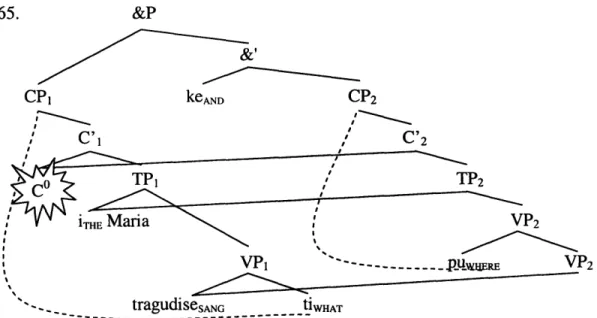
aside for the moment the clitic placement in (26)a and (26)b, which I will discuss in Chapter 6, let us focus on example (26)c. We know that clitics in Croatian occupy a high position: second in the clause. The fact that in (26)c a clitic cluster occurs twice suggests that the two conjuncts in the sentence are clausal, with clitics occupying the second position in each. This is illustrated in
(27).29
28 The facts of clitic placement in Croatian are controversial. For the purposes of this work, this simplified
description of clitic placement is sufficient. Furthermore, both prosodic (Halpern, 1995, Radanovic-Kocic, 1996, among others) and syntactic (Franks and Progovac, 1994, Progovac, 1996, 1998, 2005, among others) analyses have been proposed to account for the placement of clitics in the language. For our purposes, the exact nature of clitic placement is irrelevant. For concreteness, I assume that the placement of clitics is an output of syntax, but the arguments advanced in this dissertation equally hold if it turns out to be prosodic.
29 The reader might notice that the size of the shaded material in the first conjunct in (27) might also be such as to
include the clitics. This is indeed a possibility, giving rise to the clitic placement in (26)b. As mentioned in the main text, I discuss these examples in Chapter 6.
27. &P
and
[Sto MU JE Petar pjevao]
what him Aux Petar sung [za'to MU JE Petar pjevao]
why him Aux Petar sung
Under the hypothesis that the sentence in (26)c underlyingly contains only one CP (i.e. that fto ('what') and zalto ('why') belong to the same CP), we would have a hard time explaining where the second set of clitics comes from. Such an analysis would not only require a (phonological) rule of clitic 'copying', but it would also have to stipulate that this rule is unique to Wh&Wh's. This stipulation would be required because in sentences that clearly involve only one CP - in sentences with, for example, a coordinated-DP subject, clitics can follow the first conjunct (28)a, or the second conjunct (28)b, but they cannot be repeated (28)c. The sentence in (28)c does not have the reading in which the Romans and the Gauls were participating in the same war. 30
28. a. Stari Rimljani su i Gali medusobno ratovali.
Old Romans Aux.cl and Gauls with-each-other waged-war
'The Old Romans and the Gauls were at war with each other.' b. Stari Rimljani i Gali su medusobno ratovali.
Old Romans and Gauls Aux.cl with-each-other waged-war 'The Old Romans and the Gauls were at war with each other.'
30 Clitics can, in fact, also follow the first word of the first conjunct, as in (i). As far as the present proposal is
concerned, this possibility is equivalent to the placement in (28)a.
(i) Stari su Rimljani i Gali medusobno ratovali. Old Aux.cl Romans and Gauls with-each-other waged-war
![X amp;;(]/$.E W^$G amp;^*2&](data:image/gif;base64,R0lGODlhAQABAIAAAP///wAAACH5BAEAAAAALAAAAAABAAEAAAICRAEAOw==)