THE COMPUTATION PROBLEM WITH SEQUENTIAL DECODING
J. E. SAVAGE
ITECHNICAL REPORT 439
FEBRUARY 16, 1965r
MASSACHUSETTS INSTITUTE OF TECHNOLOGY
RESEARCH LABORATORY OF ELECTRONICS
CAMBRIDGE, MASSACHUSETTS
The Research Laboratory of Electronics is an interdepartmental laboratory in which faculty members and graduate students from numerous academic departments conduct research.
The research reported in this document was made possible in part by support extended the Massachusetts Institute of Tech-nology, Research Laboratory of Electronics, by the JOINT SERV-ICES ELECTRONICS PROGRAMS (U. S. Army, U. S. Navy, and U. S. Air Force) under Contract No. DA36-039-AMC-03200(E);
additional support was received from the National Science Founda-tion (Grant GP-2495), the NaFounda-tional Institutes of Health (Grant MH-04737-04), and the National Aeronautics and Space Adminis-tration (Grants NsG-334 and NsG-496).
The research reported in this document was also performed at Lincoln Laboratory, a center for research operated by the Massa-chusetts Institute of Technology, with the support of the United States Air Force under Contract AF19 (628) -500.
Reproduction in whole or in part is permitted for any purpose of the United States Government.
MASSACHUSETTS INSTITUTE
OF TECHNOLOGY
RESEARCH LABORATORY OF ELECTRONICS
Technical Report 439
LINCOLN LABORATORY
Technical Report 371
February 16, 1965
THE COMPUTATION PROBLEM WITH SEQUENTIAL DECODING
J. E. Savage
This report is based on a thesis submitted to the Department of
Elec-trical Engineering, M.I. T., February 5, 1965, in partial fulfillment
of the requirements for the degree of Doctor of Philosophy.
Abstract
Fano Sequential Decoding is a technique for communicating at a high information
rate and with a high reliability over a large class of channels.
However, equipment
cost and variation in the time required to decode successive transmitted digits limit its
use. This work is concerned with the latter limitation.
Others have shown that the average processing time per decoded digit is small if
the information rate of the source is less than a rate Rcomp. This report studies the
probability distribution of the processing time random variable and applies the results
to the buffer overflow probability, i.e., the probability that the decoding delay forces
incoming data to fill and overflow a finite buffer. It is shown that the overflow
proba-bility is relatively insensitive to the buffer storage capacity and to the computational
speed of the decoder, but quite sensitive to information rate. In particular, halving the
source rate more than squares the overflow probability.
These sensitivities are found
to be basic Sequential Decoding and arise because the computation per decoded digit is
large during an interval of high channel noise and grows exponentially with the length of
such an interval.
A conjecture is presented concerning the exact behavior of the overflow probability
with information rate.
This conjecture agrees well with the (limited) experimental
evidence available.
TABLE OF CONTENTS
CHAPTER I-INTRODUCTION 1
A. Background and Previous Work 1
B. Formulation of Problem 1
CHAPTER II- DESCRIPTION OF FANO SEQUENTIAL DECODING
ALGORITHM 5
A. Tree Codes 5
B. Convolutional Codes 7
C. Fano Algorithm 8
D. Computation 13
E. Buffer and Dynamics of Decoder 15
CHAPTER III- LOWER BOUND TO DISTRIBUTION
OF COMPUTATION 19
A. Behavior of Distribution of Computation 19
B. Lower Bound Argument 20
CHAPTER IV - "RANDOM CODE" BOUND ON THE DISTRIBUTION
OF COMPUTATION 35
A. Random Variable of Computation 35
B. Moments of Computation 38
C. Preliminary Counting Arguments 39
D. Probability Term 43
E. Bound on Moments 49
F. Composite Bound of Distribution 52
CHAPTER V- INTERPRETATION OF RESULTS
AND CONCLUSIONS 55
A. Computation Exponent 55
B. An Experimental Result 61
C. A Conjecture 61
D. Interpretation of Computation Exponent 62
E. Overflow Question 63
F. Some Research Problems 67
APPENDIX - Lemmas 71
REFERENCES 76
THE COMPUTATION PROBLEM WITH SEQUENTIAL DECODING
CHAPTER I INTRODUCTION
A. BACKGROUND AND PREVIOUS WORK
The branch of statistical communication theory known as coding theory has received much
attention since the results of C, E. Shannon in 1948. Many investigations were and are attracted
to coding theory because of the potential for ultrareliable communication suggested by Shannon's
Noisy Coding Theorem. Loosely stated, this theorem says that data can be encoded for
trans-mission over a noisy channel in such a way that the probability of a decoding error is arbitrarily small,provided that the information rate of the source is less than a rate called channel capacity; the converse to the Noisy Coding Theorem essentially says that channel capacity is the largest rate at which the probability of error can be made arbitrarily small.
The implications of the Coding Theorem are obviously stimulating. The fact that codes
ex-ist for noisy channels which achieve small error probabilities while operating at a fixed informa-tion rate is quite surprising. A priori, one would have expected that reliability could be achieved only by repeating the transmitted message, that is, that reliability is obtainable only at the ex-pense of less information per unit time, i.e, a reduction in rate.
Although the Coding Theorem indicates the potential for ultrareliable communication, it has been found that this ultrareliability costs either a great deal in equipment or in decoding delay. Both costs are exorbitant if the decoder operates so as to strictly minimize error probability. Practical considerations force one to consider less than optimum codes and decoders (in a
probability of error sense). A number of such codes and decoders have been invented. Included
among these various coding techniques are Massey's Threshold Decoding, Gallager's Low
Den-sity Parity Check Codes,3 Bose-Chaudhuri Codes with the Peterson Decoding Procedure,4
Itera-tive Decoding, '6and Sequential Decoding ' 8as first presented by J. M. Wozencraft and later
modified by R. M. Fano. Each of these procedures and others9 ' not mentioned find application
depending upon the performance requirements which are set and the economics of the application.
Sequential Decoders score reasonably well in both the performance and economic categories. We
shall concentrate on Sequential Decoding, and in particular on the Fano Sequential Decoding Algo-rithm, in this report.
B. FORMULATION OF PROBLEM
In many ways, the Fano algorithm is an attractive decoding procedure. It applies to a large
variety of channels in contrast with the algebraic codes such as Bose-Chaudhuri codes which are best adapted to symmetric channels with an equal number of inputs and outputs (which is a power
of a prime 4). The Fano algorithm is also recommended by the fact that it will operate with high
reliability at a substantial fraction of channel capacity. Thus, it is ideally suited for systems handling high-quality, high-volume traffic.
The Fano algorithm, however, possesses at least two disadvantages. The first is that the necessary encoding and decoding equipment is expensive. The second and most damaging dis-advantage of the Fano algorithm is that the time required to process the incoming data is varia-ble and assumes very large values during intervals of high channel noise. The variability of the processing time requires that incoming data be buffered. The fact that this processing time assumes large values implies that occasionally and eventually a finite buffer will fill and over-flow. After overflow, it is found that the decoder often performs erroneously. Such an event is catastrophic unless moderated with periodic resynchronization, the use of a feedback channel, or some other means.
Not only is overflow serious, but it occurs much more frequently than do undetected decod-ing errors (i.e., errors without overflow). Thus, it is the controlling event in the design of the decoder. Although the overflow event is serious, the decoder can be so designed and the infor-mation rate be so restricted that overflows are very infrequent. It is, therefore, a problem which can be resolved.
Our concern in this report is to obtain some understanding of the sensitivity of the overflow probability to the following: the buffer capacity, the machine speed and the information (or signaling) rate. This is a difficult analytical problem. As a result, we have been forced to analyze the machine performance and to determine the various sensitivities indirectly. Our approach to the overflow question has been to consider a random variable of computation (called
"static" computation) which is related to the computation performed by the machine as it decodes. We have shown that the cumulative probability distribution function PR [C > L] of the random variable of "static" computation C is an algebraic function of the distribution parameter L, that is, it behaves as L c, a > 0, for large L. From this behavior and a study of the exponent c, we have found through a heuristic argument that the probability of buffer overflow is relatively insensitive to a change in machine speed or to the size of the buffer but that it is quite sensitive to information rate, being more than squared by a halving of rate.
The deductions on the sensitivities of the overflow probability indicate that practical limits on the size and speed of a decoder are set primarily by the overflow probability and that the machine performance is really only sensitive to information rate. This sensitivity is due to the fact that PR [C > L] behaves as L a for large L. We shall find that PR [C > L] behaves as L -for large L because -for every transmitted codeword there exists an interval of high channel noise such that "static" computation is large and growing exponentially with the length of the interval of high channel noise. The probability of such a noisy interval decreases exponentially with the length of the interval. It is the balance between the two exponentials which forces the algebraic nature of the distribution of "static" computation, PR [C > L]. Since this same balance is fundamental to the entire concept of Sequential Decoding, it does not appear that the buffer overflow problem can be avoided unless some major modification of the decoding procedure can be devised.
These results and arguments are explained in detail in the following chapters.
Chapter II focuses on the Fano Sequential Decoding Algorithm. The algorithm is defined, motivated and discussed. Many of its properties are clearly outlined. The buffer overflow problem is discussed and the random variable of "static" computation is defined.
Chapter III is prefaced with a discussion of the connection between an exponential growth in computation with the length of an interval of high channel noise and the algebraic nature of the distribution of "static" computation. The main purpose of the chapter is to underbound the distribution of "static" computation. A general underbound is found which applies to all codes on the "completely connected" discrete memoryless channel (DMC). A lower bound is also found for the (small) subset of codes which have fixed composition, again for the "completely connected" DMC. Both bounds to PR [C > L] are algebraic in L.
Chapter IV concentrates on obtaining an upper bound to the distribution of "static" computa-tion, PR [C > L]. Since there are "poor" codes, codes for which PR [C > L] is large so that large computation occurs with high probability, we must establish that codes exist with a PR [C > L] which decreases as an algebraic function in L. (It cannot decrease any faster be-cause of the lower bound result.) We show that such codes exist by averaging PR [C > L] over the ensemble of all tree codes. This average is algebraic in L so that many codes exist with an algebraic distribution function.
Chapter V interprets the upper and lower bounds to PR [C > L], describes an experiment performed at Lincoln Laboratory and compares the results of this experiment to the tail be-havior of PR [C > L], i.e., its behavior for large L. The comparison leads to a conjecture on the true tail behavior of PR [C > L]. It is shown that this conjecture has a very close connec-tion to some fundamental results in informaconnec-tion theory which are expressed in the Coding Theorem. Finally, a heuristic connection between the distribution of "static" computation and the overflow probability is established and the sensitivity of the overflow probability to machine
speed, buffer size and information rate is brought out. Some problems deserving further re-search are also suggested.
-CHAPTER II
DESCRIPTION OF FANO SEQUENTIAL DECODING ALGORITHM
This chapter briefly discusses the encoding problem and introduces the Fano Sequential
Decoding Algorithm. The dynamics of the algorithm are described and a definition of
computa-tion is presented. This chapter serves as preparation for the following analytical chapters.
A. TREE CODES
Let us assume that the output of a source with a b-letter alphabet is encoded for transmission
on a discrete memoryless channel (DMC). (The DMC is characterized by the set of transition
probabilities {p(yj/xk)} where {Xk}, 1 kg K is the channel input alphabet and {yj}, i j J is
the channel output alphabet.) Consider encoding the source by mapping a sequence of source digits into a sequence of channel digits. The channel digits are selected from an array that topologically resembles a tree and will henceforth be called a tree (see Fig. 1).
For the moment, consider mapping a finite sequence On = (1' 2' '.,n) of n digits drawn
from the source alphabet onto a finite channel sequence un (u1 U2. . un), where uq =
(uql .... uqu ... UqQ) is the subsequence of digits (or a tree branch) drawn from the channel input alphabet. At the qth node of the tree,
pq
qq directs a path along the bottom branch if = al,3-62-3206
0
-= ( 12,010, 201,221.) 221 112 000 010 211 201 122 000 102 221 112 020 020 211 102 INCORRECT SUBSET 7/~;~7~7~7~ /B/7 AT r 2 201 000 221 102 NODE No. (3,2,2) 122 1 020
-a
'"
122m
-J
CORRECT PATH 201 211 221 102 020 201 112 122 010 221 000 112 000Fig. 1. Convolutional tree code.
along the second branch from the bottom if q = a2, and along the top branch if /iq = ab. (A path
is a contiguous sequence of branches.) For example, the channel input sequence 3 =
(112, 010, 122) corresponds to the source sequence 3 = (1, 0, 2) in Fig. 1 when the source and channel input alphabets are both {O, 1, 2}.
The extended source sequence /3(=P,) specifies an infinite path u(=o ) through the tree. The th
path will be called the correct path. For each node of the correct path, say the q , q
0, 1, 2, ... , where the 0th node is the origin, we define an "incorrect subset." The incorrect sub-set at the qth node consists of (1) the q node itself and (2) all nodes (of depth greater than q) diverging from the qth node, which are not part of the correct path. For example, see Fig. 1 where the incorrect subset at the 2 d node of the correct path is shown.
We shall find it useful to classify nodes in each incorrect subset. Consider the qth such subset. Consider a node "at penetration s" in this subset (such a node is the terminus of a path of q + s branches). There are a number of nodes at this penetration s. Let the node in question be mth from the bottom of this set of nodes. Then, it is uniquely identified by the triplet (m, s, q). This triplet indicates that the particular node is m in rank among nodes at penetration s in the qth incorrect subset (see Fig. 1). The qth node of the correct path (or the reference node) is identified by the triplet (1, 0, q). (By convention, this single node is said to be at penetration zero in the qth incorrect subset.) Denote by M(s) the number of nodes at penetration s in the
th
q incorrect subset. Then,
M(O) = 1 M(1) (b - 1) M(2) (b - 1) b
s-I
M(s) = (b - 1) b for s1 . (1)
There are M(s) paths at penetration s in the qth incorrect subset, and each of these paths con-tains q + s branches.
Given that n = (u .... n) is transmitted, let n = (1' v. .vn) be the received sequence,
th
where v (Vql ... Vq, . . ., Vq) is the q subsequence of channel output digits. The prob-ability that Vn is received when un is transmitted is computed from the transition probabilities of the DMC as follows:
n n £
PR [Vn/Un=] "I PR -q/Uq] = 1 P [qh/uqh] (2)
q=1 q=1 h=1
where p [vqh/uqh] = p [yj/xk] when vqh yj and u h = xk
The data (or signaling) rate (in bits per channel use) is defined as
log2b
R =
l
(3)
If the successive source digits are equally likely and statistically independent, then R is also the source entropy (or information rate) per transmitted digit. We shall assume that successive
source digits meet these conditions.
B. CONVOLUTIONAL CODES
Although we shall later assume for analytical convenience that data are encoded with an arbitrary tree code, we present convolutional codes here to show that tree codes may be realized with a minimum of equipment.
Define a basic sequence = (g,-g2 . gS 0, 0, ... ), called the code generator, where
.-gr= (grl' . - gr ) is the rth subsequence of digits, and S is called the code constraint length.
We also define translates of by
n
gn
(, 0,...,0,g'
.
'
'
.
where 0 indicates a subsequence of zeros. Assume that the letters in the generator and
the letters of the source alphabet coincide and consist of the set of integers {0, ... b - I b
a prime. Then, the source sequence 1 = (31' R2 ... ) generates the channel sequence u =
(u,
u
,
2 ... ) byE= 0
}3nn
(4)Multiplication and vector addition are taken modulo b. Following this rule the tree, partially
shown in Fig. 1, may be constructed from the code generator g = (112, 010, 201, 221, 000, ... ). In particular, the source sequence 3 = (1, 0, 2, ... ) generates the channel sequence u = (112, 010, 122, .... ).
13-62-3201
DATA
-Fig. 2. Convolutional encoder.
ENCODED DATA
This code can be realized (see Fig. 2) with a standard shift register of S stages (the code
constraint length), multiplierst and adders (modulo b). Clearly, the size of the convolutional
encoder does not increase faster than linearly in the code constraint length. Others have shown that the probability of a decoding error with Sequential Decoding on convolutional codes decreases exponentially in the code constraint length (for almost all codes). In a probability of error sense, convolutional codes are near optimum.
t The circles in Fig. 2 indicate multiplication by the enclosed numbers.
This example has assumed that the source alphabet and channel alphabet are identical. Neither this restriction nor the restriction that the alphabets contain the same number of ele-ments is needed (see Ref. 11). In addition, the constraint that b be prime is not essential. For example, b may be a power of a prime and the components of : and may be chosen as ele-ments of a general Galois field, addition and multiplication taken in this field.
C. FANO ALGORITHM
In preparation for a discussion of the Fano search procedure, we introduce and motivate the "metric" with which the procedure operates.
1. Metric
Assume that a source generates a sequence of outputs 3. This sequence directs a path u through a tree code. The branches of this path are transmitted over a discrete memoryless channel. A sequence of branches is received at the channel output. The Fano decoder is a device that operates on this sequence and produces a replica of the transmitted sequence, unless decoding errors occur.
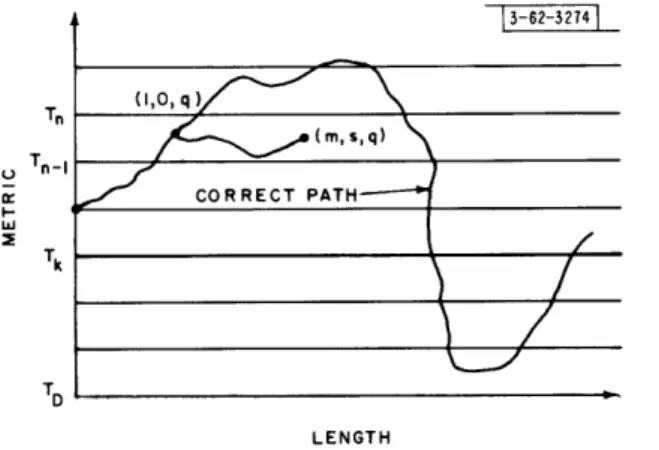
The Fano decoder (or algorithm) is a rule for searching efficiently through the paths in the tree code in an attempt to find a "best fit" with the received sequence v. To determine a "best fit," values are assigned to nodes in the tree. The value of a node is said to be the value of the metric between the path terminating on this node and the corresponding received sequence. As the decoder searches nodes, values of the metric are compared to the criteria of Fig. 3. The criteria Ti = i t are straight lines of zero slope separated by an amount t.
T2 o
aro:
I T rr 13-62-32151 CORRECT PATH/1~~~~~~~
~LENGTH
Fig. 3. Criteria and typical paths. INCORRECT PATHIt
E
~~~~~~~~~'-Let us be precise about the definition of metric. We define a "branch metric" and associate a value of this branch metric with each branch of the tree? Let u0 = (uol, uo2 ... , Uo£) be a tree branch and let v = (v o Vo.. , .o Vo) be the corresponding received branch. The branch metric between u and v-o oo , d(u-- 0 -o, v ), is defined as
d(u o, v ) ~ X [I(uohVoh) - (5R])
h=l
t This is not a metric in the mathematical sense because d(uo,vo) may be negative.
8 -I
T_2 T.3
wheret
I(uh v ) Alog P [Voh/uoh]
i(Uoh Voh) log2 f(voh) (6)
Here, p [voh/uoh] = p [xj/xk] when Voh = yj and Uoh = xk. We let f(voh) be a probability-like
func-tion. It may be interpreted as the probability of channel output symbol Voh when the channel in-puts are assigned probabilities {Pkl} 1 < k< K. The function f(voh) and the probability assignment {pk} will appear during the "random code" argument of Chapter IV and an interpretation will be attached to f(yj) and {pk}.
The "path metric," d(m, s, q), on the path containing q + s branches and terminated by node (m, s, q), is defined as the sum of the branch metric on each of the q + s branches. The value of this path metric is associated with node (m, s, q). When we plot d(m, s, q) for paths in the tree, we indicate the values of the path metric with nodes. The nodes in this plot have a one-to-one correspondence to nodes in the tree and will be indexed with the same triplet (m, s, q).
This definition of path metric is justified by two facts - it leads to a workable decoder and this decoder can be studied analytically. The definition is recommended by the fact that a large value of the path metric indicates that the path in question is very probable a posteriori (see below) which is equivalent to saying that with high probability this path is the transmitted path. We now show that the value of the metric is monotone increasing in the a posteriori probability of a path.
Let un, n = q + s, represent the tree path (m, s, q) and let vn be the corresponding received
sequence. Then, the value of the metric on Un is
n I
d(m, s,q) A L
Z
[I(urh, vrh)-R]r=l h=l
PR [Vn/un]
= log 2 I- n -n R (7)
where urh, vrh are the hth digits on the rt h branch of un, vn, respectively, and
n n
f(vn
)_ II
H
f(Vrh)
(8)
r=l h=l
In obtaining Eq. (7), we have used Eqs. (4) and (5), together with the definition of PR [Vn/n] of Eq. (2). Now, PR [vn/Un]' the conditional probability that vn is received when un is transmitted,
is proportional to PR [Un/vn]' the a posteriori probability of un, since (from Baye's Rule)
PR [Un]
(9)
PR [un/vnl = PR [n/n] [ PR Vn] (9)
and PR [un] ' the a priori probability of un, is constant under variation of un. (We have assumed that successive source digits are statistically independent and identically distributed.) Thus, we have established for the given source that the path of n branches with the largest value of the
metric is that path of n branches which is a posteriori most probable.
t If output y occurs with probability f(y) then I(x,y) is the "mutual information" between x and y.
9
We have attached a value of the branch metric to each of the b branches stemming from a node. We observe by analogy with the argument above, that of these branches, that branch with the largest value of the branch metric is the a posteriori most probable branch at that node. Then, we order branches at a node according to their value of the branch metric and say that they are "most probable," "second most probable," etc.
We consider next the motivation for and definition of the Fano algorithm.
2. Search Procedure
Sequential Decoding procedures in general, and the Fano algorithm in particular, are moti-vated by the following consideration: For a properly chosen code and for signaling rates which are suitably restricted, the a posteriori probability of the correct path and the value of the path
metric on it will typically increase (see Fig. 3). On the contrary, any incorrect path branching
from the correct path will typically decrease in path metric (see Fig. 3). Thus, a separation
will typically occur between the correct path and some incorrect path. Using a set of thresholds,
a decoder can eliminate from consideration a large number of improbable, hence, incorrect paths. As long as the channel "noise" is not too severe, the separation between the correct and incorrect paths will become increasingly evident. A period of high channel noise, however, may force a large amount of searching and even cause decoding errors. We shall consider these two points later.
The set of rules for searching tree paths which we shall consider here is known as the Fano
Sequential Decoding Algorithm. A logical flow chart of this proceduret is given in Fig. 4. To
13-6-32141
START
SET THRESHOLD = 0
r- --- 1 r--- 1
LOOK FORWARD ON BAD BAD
XMOST PROBABLE' BRANCH
r
LOOK BACK BAA OK I I B OK
STEP FORWARD ) ( STEP BACK
NO FIRST TIME I NO S THERE A
AT THIS NODE? BRANCH OF THIS NODE?
I D L---J l I I EI
YES j
L_______
YES-iGHTEN THRESHOL)
L_______-__- I lII ILOOK FORWARD
_ _ _ BAD ON IT
C OK
LOWER TRE SHOLD
ONE STEP
Fig. 4. Flow chart of Fano algorithm.
tSee Ref. 8 for the flow chart of the computer program which realizes the chart of Fig. 4. The bookkeeping
re-quired by D of Fig. 4 is accomplished with a small number of instructions in the computer program. This chart
is based on a flow chart suggested by Professor . M. Jacobs.
describe the operation of this algorithm we introduce the notions of forward mode and search mode operations. The machine operates in the forward mode when it is searching for the first time a path whose metric is nondecreasing. (We shall be more precise about this point later.) Roughly speaking, the machine operates in the search mode when it is looking for a path which has a continuously growing metric.
Let us now be specific. Suppose that the decoder is following a path which is growing in metric and that this path is being followed for the first time so that the machine is operating in the forward mode. Then, at each node of this path the decoder raises a threshold, called the running threshold T in units of to until it lies just below the value of the path metric at each node. In Fig. 4 this operation is performed by D. After the threshold is tightened at a node, the decoder looks forward along the "most probable" branch (that one which has the largest value of the branch metric). If the path metric on the extended path remains above the existing value of the running threshold T, and if the extended path is examined for the first time, forward mode operation continues. If the extended path falls below T, as in Fig. 5, search mode operation begins. Operation B of Fig. 4 is then performed.
J U r ,0 so 3-62-32291 , "a---RUNNING THRESHOLD
ENTER AND LEAVE
I4 [ I I r I I I I= SEARCH MODE
LENGTH
Fig. 5. Typical machine search.
When the machine enters B it is looking for a path which will remain above T. Hence, it
looks back to the preceding node to determine whether it remains above T. If so, (OK) perhaps
the "next most probable" branch extending forward from the original node will remain above T. At E, the machine determines whether a "next most probable" node exists, and if not, it looks back again with the same intention, that is, of finding an extendable path. If in looking forward
in C the machine finds that the extended path remains above T, it steps forward tightening the running threshold if this node is visited for the first time. (This threshold is tightened and the machine enters or remains in the forward mode only when a node is examined for the first time. Otherwise, looping would occur.) If the forward look in C is successful, the machine steps forward and continues to look forward, as indicated by Fig. 5. If the forward look in C is
un-successful, the machine again looks back in search of a node from which an extendable path may be found (i.e., a sequence of nodes which remains above T). If an extendable path cannot be
found, that is, if every sequence remaining above T and connected to the node at which searching
begins eventually crosses T, then the running threshold T must be reduced. After the threshold
is reduced, the decoder looks forward along "most probable" branches until it reaches the node
at which it entered the search mode. The branch on which the decoder looks forward is a new
branch, so that the threshold may be increased if this extended path lies above T (see Fig. 6).
11
1 3-62-3230[
A- , ' IUNNING THRESHOLD ENTER SEARCH MODE
' THRESHOLD REDUCED LENGTH
Fig. 6. Threshold reduction, b = 2.
13-62- 32261
Z
RUNNING THRESHOLDI I I I I I
LENGTH
Fig. 7. Branch examination with a threshold.
13-82-32 131 jf4--- CORRECT PATH I '( I
~~~~~~~~~~~mrq)
LENGTHFig. 8. Minimum threshold TD.
12 O 2 cr U, 2 ( o T =tO i T =O D To
-- f A-- ; -
---Ez
( f'O'q )The machine operation may be summarized as follows: The decoder operates in the forward mode, extending along "most probable" branches and increasing the running threshold as it pro-gresses, until an extension fails the running threshold T. At this point, search mode operation begins and the decoder looks for a sequence of nodes which remains above T. If each sequence of nodes connected to the node at which search mode operation began is such that it crosses T before forward mode operation resumes, then T is reduced. As soon as the decoder finds a new path remaining above the existing value of T, forward mode operation begins and T may be increased.
D. COMPUTATION
We now establish that the decoder does not look forward or back on any given branch more than once with each value of the running threshold. There are three situations which need to be considered. There is a node at each end of the given branch. We need to consider the case where both nodes lie above a given threshold, and where either the preceding or following node lies below the given threshold. If both nodes fall below some threshold, the branch considered will not be examined with this threshold.
If the node preceding the branch in question lies above the given threshold, while the follow-ing node lies below this threshold (see a of Fig. 7), then the decoder may look forward on.this branch, but it cannot look back because it would have to step forward to do so. But from A of Fig. 4, it cannot step forward while this threshold is in effect. Next consider the situation of b in Fig. 7. The decoder can look back on the given branch, but it cannot look forward because it would have to step back to do so, which is prevented by the restriction OK in B of Fig. 4. The third situation to be considered is that of c in Fig. 7. Both nodes terminating the branch in ques-tion lie above the given threshold. With this threshold the decoder may look forward and then step forward (A of Fig. 4) from the preceding to the following node. The decoder may then search forward and later return to the second node with this same threshold. We now show that the de-coder cannot return to the first node and then retrace this branch. We observe from B, E, and C of Fig. 4 that this branch with the given threshold cannot be retraced because the decoder can extend only along either the "next most probable" branch at the first node, or along the "next most probable" branch at an earlier node. The decoder can only retrace the original branch by exiting from B on BAD (Fig. 4) and lowering the threshold. Thus, with any given threshold any particular branch cannot be examined in the forward and reverse directions more than once.
Now let us consider the lowest threshold which is used by the decoder. Consider paths branching from the q node of the correct path and terminating on nodes labeled (m, s, q),
th
1< m < M(s), 0 s · . Let D be the correct path minimum at or following the q node and let TD be the threshold just below Dt (see Fig. 8). Assume that the received path is decoded correctly, that is, that decoding errors are not made. Then paths which cross TD will not be examined beyond the point at which they cross TD. This is true since threshold TD - t o is
used only if all paths fall below TD; but by definition the correct path remains above TD. This implies that the decoder will not step forward to a node which lies below TD nor to any node
connected to and following such a node (see (m, s, q) of Fig. 8).
t Since the decoder operation depends only on incremental values of the metric, we may assume that the q cor-rect node lies between T and T1, and measure D and TD from T = 0.
13
We may also deduce that if D < 0 and all nodes connecting any node such as (m', s', q) in Fig. 8 to (1, 0, q) [including (m', s', q)] be above TD + to, then the decoder must look forward
from (m', s', q) before the threshold is reduced to TD . (The constraint D < 0 is necessary
be-cause if D > 0 the machine may never be forced back to (1, 0, q) so that forward or backward looks from (m, s, q) may never occur.)
The two central results of the last three paragraphs may be summarized as follows:
(1) Consider a node (m, s, q) branching from the qth node of the correct path. Let D be the correct path minimum on or following the qth node. Let TD be the threshold just below D. Assume that node (m, s, q) lies between thresholds Tn+l and Tn where Tn a TD as in
Fig. 9. Let Nk be the number of forward or backward looks from this node with threshold Tk. Then, for each threshold Tk > TD and Tk < T , Tni > ... Tk . . TD, we have
0 4Nk b +
Nk is zero for any other threshold. The lower limit represents a situation of the type represented by (m, s, q) in Fig. 8; in this case, the machine does not look forward or backward from the node in question.
The conditions under which Nk = 0 and the bounds on Nk in Eq. (10)
are central to the arguments of Chapter IV, which is concerned with overbounding the statistics of the decoder behavior.
(2) Consider a node such as (m', s', q) of Fig. 8. This node remains above TD + to and is connected to (1, 0, q) through a set of nodes
all of which lie above TD + to. If D 0, the decoder must look
forward at least once from this node before the threshold T is re-duced to TD (to which it must be rere-duced, since the decoded path is the correct path and this path lies below TD + to at some point).
U
I
xi
LENGTH
Fig. 9. Typical path trajectories.
14
The conditions under which the decoder must look forward at least once from node (m', s', q) are central to the arguments of Chapter III, which is concerned with underbounding the statistics of the behavior of the decoder.
We shall call the number of forward and backward looks at a node the "computation" at this node. These looks are the operations which require machine time. In the remainder of this report, we use this definition of computation to investigate the computational demands of the decoder.
E. BUFFER AND DYNAMICS OF DECODER
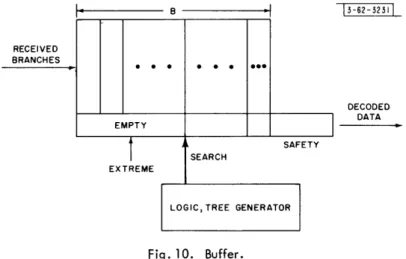
In the previous section, we assumed implicitly that the decoder is capable of searching back indefinitely into the tree in the process of decoding. Although this assumption will be needed for later analysis, it is not consistent with a physical machine. To search back indefinitely requires that all received branches be stored in the decoder. Practical limitations on the cost and size of the decoder force one to consider buffers for storage which are of finite size. We shall con-sider now a particular buffer realization and discuss the dynamics of the decoder operation. 2
RECEIVED BRANCHES Is .R EMPTY EXTREME EXTREME 0 . 0 0.. 13-62-3231 DECODED DATA SAFETY SEARCH
LOGIC, TREE GENERATOR
Fig. 10. Buffer.
Assume that the decoder operates with the buffer of Fig. 10. Received branches are inserted at the left end of the buffer and progress through the buffer at the rate at which they arrive. The buffer stores B branches. Below each branch there is space to register an element of the source alphabet. As the decoder operates, it inserts into these places tentative source digit decisions. Insertions are made at the position of the "search" pointer. When these tentative decisions reach the left-hand side of the safety zone they are considered to be final. When they reach the right-hand side of the safety zone they are considered to have been decoded. If a digit released from the right end of the safety zone disagrees with the corresponding source output digit, a decoding error is said to have occurred.
The "search" pointer indicates the received branch at which the decoder is looking. The "extreme" pointer indicates the most recently received branch that has been examined. As the machine operates the two pointers may advance together toward the left-hand side of the buffer until a search is necessary. At that time the search pointer and the extreme pointer will drift back, the search pointer moving away from the extreme pointer. (When the extreme pointer is not moving forward, it drifts back because branches are arriving at a constant rate.) As the
15
S S w
I ,,
search pointer moves back it erases previous tentative decisions, and in moving forward it in-troduces new tentative decisions. Digits in the safety zone cannot be changed.
It has been found from simulation13that under normal operating conditions the two pointers usually hover near the left-hand side of the buffer. Occasionally, however, they will drift back a substantial distance. During this drift, the two pointers usually are separated by a small frac-tion of the distance they have drifted from the buffer end. (This behavior is rationalized by the observation that the number of machine computations tends to grow exponentially with the depth of the search from the extreme point.)
Occasionally, the search pointer reaches the far end of the buffer. Then, the decoder is likely to release an incorrect digit into the safety zone; thereafter, the decoder tries to advance on an incorrect tree path. Since this is difficult, the machine must do a large amount of computa-tion. The search pointer then hovers near the far end and additional erroneous source digits
are released into the safety zone. Thus, if the search pointer is forced to the far end of the buffer, it will tend to remain at this end and to decode in error. We call this event buffer over-flow. This report is motivated by a concern for this event.
Although, decoding errors may occur without causing a large machine computation, it is noted from simulation1 3 (and may be rationalized heuristically) that for safety zones of moderate
size, decoding errors are almost always preceded by overflow. The heuristic argument states, in effect, that the noise sequences, which are responsible for errors in the absence of overflow, occur with vanishingly small probability, especially for safety zones of large capacity.
Since buffer overflow can be detected, the decoder can discard the unreliable digits in the safety zone. Thus, the probability that an erroneous digit is released to the user before the buffer overflows can be made very small, much smaller than the probability of overflow. This observation is equivalent to the statement that the probability of a machine failure, where fail-ure means overflow or error is dominated by the probability of buffer overflow. Represent this probability by PBF(N). We define PBF(N) as the probability that the first buffer overflow occurs on or before the time at which the Nth source decision enters the safety zone.
We shall be concerned in this report with the sensitivity of PBF to buffer size B, to the speed of the decoder and to the data rate R. We shall find that PBF is relatively insensitive to buffer size and machine speed, but quite sensitive to data rate. We shall establish the mechanism
which is responsible for the particular sensitivities of PBF' Throughout, we assume that the decoder is working with a fixed channel.
A preliminary statement can be made here concerning the largest signaling rate R at which PBF is "small" or at which the decoder will function well. Others7'8' 4 have shown, through analysis and simulation, that the largest rate at which the average computation per decoded digit is small is a rate called Rcomp. Since large average computation implies frequent buffer over-flows, R is an upper limit on the rate at which the machine will function properly. R
comp comp
is strictly less than channel capacity, except for pathological channels, and is a large fraction of channel capacity for many but not all channels.
F. "STATIC" COMPUTATION
Unfortunately, the statistics of the dynamical computation performed by the Fano decoder as it operates in time are too difficult to study directly through analysis. Consequently, we are
led to consider a kind of computation called "static" computation which is at once analytically tractable and closely connected to the real machine computation. Through an investigation of "static" computation, we shall be able to make strong qualitative statements about the sensi-tivities of PBF'
A restriction to the study of "static" computation has been found necessary without exception by all others who have investigated the Fano algorithm. By "static" computation we mean a computation which is eventually performed by the decoder, if no digits are decoded in error
and if the buffer is infinite. Thus, the assumptions are that the decoder has a buffer of infinite capacity, that it has operated for an indefinite length of time, and that it has decoded correctly. Let (m, s, q) be a node of the qth incorrect subset where 1 m M(s), 0 s < , and M(s) is given by
M(O) = 1
s-i
M(s) = (b - 1) b , for s 1 [Eq. (1)]
We define "static" computation associated with the qth correct node as the number of computa-tions made on each node (m, s, q) of the qth incorrect subset.
The connection between "static" computation and the probability of overflow will be made later.
CHAPTER III
LOWER BOUND TO DISTRIBUTION OF COMPUTATION
In this chapter, we underbound the cumulative probability distribution of the random variable of "static" computation C, namely, PR [C > L]. This underbound applies to discrete, memory-less channels (DMC) which are completely connected (all channel transition probabilities are
strictly positive). We show that this lower bound is an algebraic function of the distribution
parameter L for large L; that is, PR [C L] (A/La) for all L greater than some constant
Lo, where A, a > 0.
The lower bound derivation is preceded by a discussion of the condition on the random vari-able of "static" computation which is responsible for its having an algebraic distribution function. Roughly speaking, this condition states that the distribution is algebraic if "static" computation is large during an interval of high channel noise and grows exponentially with the length of such
an interval. This important result is responsible for the particular sensitivities of the overflow
probability mentioned in Chapter II.
A. BEHAVIOR OF DISTRIBUTION OF COMPUTATION
The computation performed by the Fano decoder is a random variable. It is large during
periods of high channel noise and small otherwise. The same is true of the random variable of
"static" computation C associated with the qth node of the correct path. We now argue some-what loosely that exponential growth of "static" computation implies that it has an algebraic dis-tribution function.
Let be the sequence of s channel transitions (corresponding to s tree branches) following
th
the q correct node. The sequence is alone is not sufficient, as a rule, to determine C
com-pletely. Knowledge of 4s is sufficient, however, to determine whether C is large or not.
If s for large s represents a long interval of high channel noise, then C will still be random, but all values in its range of values will be very large. In particular, let us assume that for each s > s there exists a s such that C >AoS 2 where Ao, > 0, that is, the "static"
compu-tation grows exponentially with the length of an interval of high channel noise. (Following
argu-ments similar to those of the next section, it may be verified that such an assumption holds for all codes on the completely connected DMC.)
PR [C > L] >PR [C >Ls] PR [s ] 10)
where PR [s ] is the probability that the particular sequence
4s
of s channel transitions is thesequence of s transitions following the qth reference node. Both s and s in Eq. (10) are
arbi-trary. For each s let s be a high channel noise sequence. Now choose s such that
Ao2s o >L >A2 ( (11)
Then, for this s and the high channel noise sequence
4s
we have by assumption that C > Ao2 Therefore, from Eq. (11), C > L which implies that PR [C > L I s] = 1. Thus, for the particular value of s defined by Eq. (11) and for the high channel noise sequence s of that length, we havePR [C > L] >PR [ s] (12)
For the completely connected DMC (the only channels considered in this chapter) we have
PR [s ] >-2 ' s (13)
where p A -I log2 min p [yj/Yk because PR [s ]
is the product of s channel transition proba-j, k
bilities all of which exceed the smallest transition probability, the latter being nonzero by the connectedness assumption. Combining Eqs. (11) and (13) we have the following lower bound to PR [C > L]. The bound applies only for s > so or L > Ao2
PR [C > L]>A ) 2 9 for L > L A2 0 (14)
PR [C > >/0 LL] - 1
Exponential growth of computation with the length of an interval of high channel noise implies that the distribution of "static" computation is algebraic, which in turn implies the particular sensitivities of the overflow probability discussed in Chapter II. The existence of exponential growth is, therefore, a most important characteristic (or defect) of a decoding scheme.
B. LOWER BOUND ARGUMENT
Our intention in this section is to underbound, without a loss of rigor, the probability PR [C > L]. To underbound PR [C > L], we find an event which implies that C > L. The proba-bility of the former event underbounds the probaproba-bility that C > L and is used as the underbound to PR [C > L]. As a preliminary, we recall some of the definitions and statements of Chapter II.
"Static" computation associated with the qth incorrect subset is defined as the number of forward or backward "looks" required by the Fano decoder on the reference node (the q correct
th
node) or on nodes in the q incorrect subset. "Static" computation is measured under the as-sumption that the decoder decodes without error, that the qth correct node is in the infinite past of the decoding process, and that the buffer has infinite storage capacity. The latter assumption is equivalent to the assumption that the machine can search forward or backward to any length in the tree.
A node in the qth incorrect subset is labeled (m, s, q) to indicate that it is at penetration s th
in this subset (there are s branches between it and the reference node) and it is m in order among the M(s) nodes at that penetration in the qth incorrect subset; M(s) is given below.
M(O) = 1
M(s) = (b - 1) bs - for s 1 [Eq. (1)]
There are bt nodes at penetration t or less, since t
M(s) = 1 + (b- 1) + (b- 1) b ... + (b- 1) bt s=O
= 1 + (b- ) (1 + b + b +...+ bt- )
+(b-)bt - = b (15)
The reference node is labeled (1, 0, q) and is said to be at penetration zero in the qth incorrect subset.
A path metric is defined and the value of the path metric on a path terminated by node (m, s, q) is associated with node (m, s, q) and is called d(m, s, q). Let un represent the path of n = q + s branches terminated by (m, s, q) and let vn be the corresponding portion of the received
sequence.t Then, d(m, s, q) is defined as
n 2
d(m, s, q) _ , [I(Urh, vrh) - RI [Eq. (7)]
r=1 h=1
where
P [Vrh/urh]
I(Urh, vrh) log2 f(vrh) [Eq. (6)]
and urh, vrh are the ht h of digits on the rth branches of un, respectively. p [vrh/u h] is a
channel transition probability and f(vrh) is a probability-like function which is interpreted as the probability of the channel output digit vrh when channel inputs are assigned probabilities
Pk)'}, 1 < k < K.
As the Fano decoder operates, it attempts to extend along a path which increases in path metric. A set of threshold Ti = i to, -0 < i < -, is used to ascertain whether a path being
ex-amined grows or decreases in metric. The decoder operation depends on increments in the path metric. Thus, we may assume that the reference node (1, 0, q) lies between To = 0 and T1 = to, i.e., 0 < d(l, 0, q) < t
Our intent is to find an event which implies that C > L and to underbound the probability of this event. It was observed in Chapter II that if D is defined as the minimum value of the cor-rect path metric at or following (1, 0, q), and TD is the threshold just below D, then at least one
computation (a forward look) is required on node (m, s, q) and on each node connecting it to (1, 0, q) if D < 0, and node (m, s, q) and all nodes connecting it to (1, 0, q) lie above TD + to
One forward look on node (m, s, q) and each of the connecting nodes is required under these conditions before the decoder reduces the running threshold from TD + to to TD. This latter
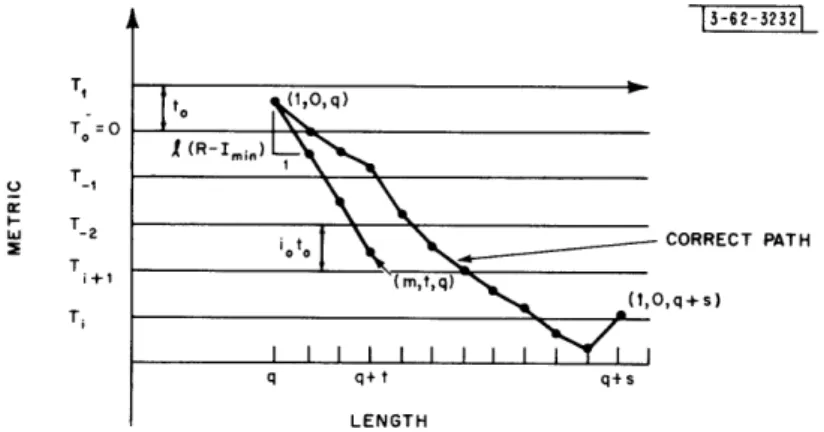
threshold is used at least once since the decoded path is the correct path (by assumption)- and this path dips below TD + to (see Fig. 11).
We assume that the channel is completely connected. This implies that the path terminated by some node (m, t, q) cannot fall from the value of the metric on the reference node, d(l, 0, q), with a slopet of magnitude larger than (R - Imin ) where
§
min min log2 /] (16)
rin j, k y
That is,
d(m, t, q) >- d(1, 0, q) -tf(R - Imin ) (17)
t The subscript n on u or V is reserved for sequences of n branches measured from the origin. The subscript s on U or will indicate sequences of s branches measured from the qth correct node.
t Slope is defined as the increment in the metric for a one-node change in path penetration. § It may be shown that Imin < 0.
21
I_-T, T.=O t T_, Ti+ T. i i I 3-6 2-3232 to (tOq)
I
(R-I,,in)1 i I \ CORRECT PATH I I I I I I IY
I q q+t q+s LENGTHFig. 11. Trajectories of correct path and incorrect path.
We are now prepared to describe an event which implies C > L. As shown by Eq. (15),
there are bt nodes at penetration t or less in the qth incorrect subset. If each of these bt nodes, bt > L > b-t , lies above some threshold Ti, and if the correct path falls below Ti at some node beyond (1, 0, q), say at node (1, 0, q + s) [which is s branches removed from (1, 0, q)], we find that the "static" computation on just the bt nodes of the incorrect subset equals or exceeds L (since t is defined by bt > L > bt-l) so that the total"static" computation C equals or exceeds L.
We have the desired underbound if we let Ti be the threshold below the value of the path metric on the path (m, t, q) which falls at the maximum rate. In particular, we have that
d(1, 0, q) - t (R - Imin) Ti > d(l, 0, q) - l(R - Imin) - to (18)
If the correct path falls below this underbound to Ti., then threshold T. is used and at least bt, bt > L > b , nodes in the q incorrect subset will have at least b computations done
on them. Therefore, the probability that the correct path falls below the T. of Eq. (18)
under-bounds PR [C > L].
The metric on the (q + s)t h correct node is defined as d(l, 0, q + s). If d(l, 0, q + s) is less than the underbound to Ti, this threshold will be used. This condition is written as
d(l, 0, q + s) < d(l, 0, q) -ti(R - Imin ) -t o (19)
If we let Us represent the s branches of the correct path which follow node (1, 0, q) and let VS be the corresponding section of the received sequence, we have from Eqs. (6) and (7)
s 1
d(l, 0, q + s)--d(l, 0, q) = Z [I(Urh, vrh)-R] (20)
r=1 h=1
d(1, 0, q + s) - d(l, 0, q) A I(usI, V) - s R (21)
where urh, Vrh are the hth digits on the rt h branches of Us, respectively. Equation (19) is
now rewritten with the aid of Eq. (21).
I(us, vs)< sl R - t(R - Imin ) - t° (22) 22 -- -- ---- -- -- ---l '( m, t, q),~q~s I
Recalling that bt > L > bt- and remembering that R (log2b)/I, we obtain the final result,
namely, if
I(us, v< s ) sR-(log 2 L + 1) ( R-In)t (23)
then the static computation C must exceed L. Therefore, the probability of the event in Eq. (23) underbounds PR [C > L]. We note that s is arbitrary. It is chosen to maximize the underbound to PR [C > L]. The desired result then is
PR [C > L] > max PR [I(Us, Vs) < s R -t -(log 2 L + ) ( R )] (24) S
It should be noted that the random variable I(us, vs) is assigned with probability PR [Us' Vs]' which is the probability that the first s branches of the transmitted and received sequences fol-lowing the q correct node are Us, vs, respectively. The inequality of Eq. (24) applies to any particular code and Us is a codeword (of s branches) in this code.
Let p (X) A PR [I(Us, Vs) < x]. Then, the lower bound result is formally summarized below.
Theorem 1.
The "static" computation in the qth incorrect subset, when the Fano algorithm is used on the completely connected DMC, has the following bound on its cumulative probability distribution:
PR [C L] > max s sIR-to-(log 2 L + 1) ( mi)1 (25)
where Imin is defined by Eq. (16).
Next we further lower bound Eq. (25) so that the dependence of the bound on L and R be-comes explicit. First, we lower bound p s(x) in terms of the smallest value of the conditional probability ps(xl s), defined as the conditional probability that I(Uis, vs) < x given Us
p S(X) A
,
Ps(xIUs) PR [s
](26)
U in the code
S
Ps(X) > min p (XIUs) (27)
all U
Here the minimum is taken over all words of sl digits, not just words in the code. Since Eq. (27) is independent of code, we shall use it to obtain a bound valid for all codes. Equality holds in Eq. (27) under certain conditions on the channel and the probability-like function f(yj). Equality is equivalent to saying that Ps(x) is independent of the code. The conditions are:
(a) The channel is uniform at the input, i.e., the set of transition proba-bilities {p(yj/xk)}, 1 < j < J is independent of k;
(b) f(yj) = constant for all 1 < j < J.
In the second major step directed at exhibiting the dependence of the bound on L and R, we introduce and apply a theorem due to Gallager.l7 We shall use it to underbound ps(xlus). Al-though it is a weaker theorem than the Central Limit Theorem for Large Deviations (Ref. 18),
23
it is sufficient to demonstrate the dependencies of PR [C > L] for theorems are asymptotically equal.
Theorem 2. (Gallager)
Let {i)}, 1 < i < N be a set of statistically independent random J values w.i, 1 < j < J, with probabilities {PR(wij)}. Let be the
N iD
= Z ii. Define i(a) byt
i=1
large L because the two
variables. i assumes the sum of these N variables,
(28) log2 li(- ) - log2 Then, N '(c) log2 2a =
Z
i(a) i=land for a < 0 we have
B()- (a)] 4 2 N(1 -Pin
PR [ < 1'(C)] a > 2 exp2
Pmin
where the prime indicates differentiation with respect to cr, and Pmin is defined by
pmin- min PR [min w]
Pmin i
j wj
(29)
(30)
(31)
To use this theorem in underbounding Ps(xlUs), we must associate the N random variables {4 i} with the random variables appearing in the definition of ps(xlUs). We recall that
P s(x s) = PR [I(us', s) < x s]
where I(-us, s) is defined from Eqs. (20) and (21) as
l I p [Vrh/Urh]
I(S, V )=
Z
Z
log2 f(vrh)r=1 h=1
(32)
(33)
and Urh, vrh are the h of digits on the r branches of Us, Vs, respectively. With us fixed, this random variable I(Us, V s) is assigned with probability
s Q
PR [Vsus] r r P [Vrh/urh]
r=1 h=1
[Eq. (2)]
The s random variables
f| p [Vrh(/Urh]l
1°g2 f(Vrh)
tThe bar notation indicates a statistical average.
24
are therefore statistically independent and assigned with probabilities p [vrh/urh]. Thus, if we make the following indentifications, Theorem 2 applies to ps(x s):
N S i (r - 1) + h A logP [vrh/urh] i- log2 f;vf(Vrh) A P [yj/Urh w. i log? f(yj) 1J YJ PR [wij] p [yj/urh] 1'(a) A x . (34)
The particular definition of the index i is one which leads to a natural ordering of the s pairs (urh, Vrh).
Before we apply Theorem 2 to Ps(xlus) we observe that by decreasing Pmin we further weaken the inequality of Eq. (30). Therefore, we may replace Pmin with Pmin'
min min p [yj/xk] (35)
minj, k
Now let us consider the form of i(a) and of ((u). From the definitions of Eq. (34) we have
J
11i() = log2 p [yj/urh] f(y)- (36)
j=1
If we define Q0 = (q . . ., qk) as the composition of codeword Us, that is, if Nqk represents the K
number of times channel input symbol xk appears in Us, qk = i, then we have for (a) the
following: k
N K
() = i( N
Z
qk'Yk(c) (37)i=1 k=1
where
yk(u) = log2 E p [yj/xk]1+ f(y)- (38)
j=4
All terms of Theorem 2 have been defined so that we may now state the desired lower bound to p s(xl s). If Us has composition Q , then,
K Np [2( k k ( [) 4 2N(1-P k=1 4k__1(min Ps(X s) 2 P (39) min 25
_
_ li
11
__I L · _II_
I_
I pll _
This bound is independent of the order of symbols in the codeword. Therefore, for that (unusual) class of codes having all codewords of the same composition, this lower bound applies directly to all words Us in the code. Moreover, independence of the order of symbols in a codeword applies to p(xIus ) as well as to its lower bound: it can be shown that ps(xlus) = p (xlI s) when
U' and US have the same composition. s s It follows that the inequality of Eq. (27) is weaker than necessary for codes of fixed and known composition; for this class of codes we may write
Ps(X) = Ps(xliUs) (40)
for any Us in the code. It should be noted again that Eq. (40) applies only to codes of fixed com-position, whereas Eq. (27) applies to all codes.
Our primary task is to exhibit the dependence of the bound of Theorem 1 on L and R. We now have the necessary tools to do this. We use either Eq. (40) or Eq. (27), depending on whether the bound is to apply to a code of fixed composition or is to apply to all codes, together with the bound of Eq. (39) and the inequality of Eq. (25) of Theorem 1. We shall consider the fixed composi-tion case first since it serves as an introduccomposi-tion to the general lower bound.
For fixed Qo, we have from Theorem 1, the definition of Eq. (34), the equivalence of the state-ment in Eq. (40), Theorem 2 and the bound of Eq. (39') the following lower bound to PR [C > L]:
PR [C >_ L] > max ps(x) > max ps(xlUs)
N N N Z q k[k() ()] 2N(i -- P ) k=i 4 n - in _ max 2 [ exp P (41) N min where x = NR-F F t + (log2L + i) ( R Imin N s (42)
The maximization over N in Eq. (41) is taken subject to the following constraint
K
Z
qky (a) R k=1 or F N K (43) R- qk¥y( a) k=1which is implied by the first equation in Eq. (42), the last equation in Eq. (34) and the definition of (a), Eq. (37). The function F is independent of Qo and N, and is constant with respect to the maximization.
26