HAL Id: hal-01719410
https://hal.archives-ouvertes.fr/hal-01719410
Submitted on 13 Jul 2018
HAL is a multi-disciplinary open access
archive for the deposit and dissemination of
sci-entific research documents, whether they are
pub-lished or not. The documents may come from
teaching and research institutions in France or
abroad, or from public or private research centers.
L’archive ouverte pluridisciplinaire HAL, est
destinée au dépôt et à la diffusion de documents
scientifiques de niveau recherche, publiés ou non,
émanant des établissements d’enseignement et de
recherche français ou étrangers, des laboratoires
publics ou privés.
Effect of hydraulic coefficient on membrane performance
for rejection of emerging contaminants
V.S. Babu, Mahesh Padaki, Laveena d’Souza, Sébastien Déon, R. Geetha
Balakrishna, A.F. Ismail
To cite this version:
V.S. Babu, Mahesh Padaki, Laveena d’Souza, Sébastien Déon, R. Geetha Balakrishna, et al.. Effect
of hydraulic coefficient on membrane performance for rejection of emerging contaminants. Chemical
Engineering Journal, Elsevier, 2018, 334, pp.2392-2400. �10.1016/j.cej.2017.12.027�. �hal-01719410�
E
ffect of hydraulic coefficient on membrane performance for rejection of
emerging contaminants
V.S. Babu
a, Mahesh Padaki
a,b,⁎, Laveena P. D'Souza
a, Sébastien Déon
c, R. Geetha Balakrishna
a,⁎,
A.F. Ismail
daCentre for Nano and Material Sciences, Jain University, Jain Global Campus, Bangalore 562112, India bNational University of Science and Technology“MISIS”, Moscow 119049, Russia
cInstitut UTINAM (UMR CNRS 6213), Université de Bourgogne Franche-Comté, 16 route de Gray, 25030 Besançon Cedex, France dAdvanced Membrane Technology Research Center (AMTEC), Universiti Teknologi Malaysia, 81310 Skudai, Johor Bahru, Johor, Malaysia
TheefficientremovalofEndocrineDisruptiveChemicals(EDCs)namelyoxybenzoneand atrazine using poly-sulfone (PSf) composite membranes is reported in this article. A negatively charged hydrophilic mixed matrix membrane was prepared byusingPolyaniline modifiedhalloysitenanotubes(PANi-HNT)andpolysulfone.TheX-raydiffraction(XRD) and attenuated total reflectance infrared (ATR-IR) technique confirm the conversion of Halloysite nanotubes to Polyaniline modified halloysite nanotubes and their presence in membrane matrix. The microvoids observable in the SEM images depict the internal structure of the membrane. Further, increasing in the water uptake and decreasing in the contact angle with respect to increasing the concentration of Polyaniline modified halloysite nanotubes confirm the enhancement of the membrane hydrophilicity. This hydrophilicity increases for higher concentrations of PANi-HNT leads to a significant improvement of the waterflux. The removal efficiency of prepared mixed matrix membranes was found to be 98% for oxybenzone and 50% for atrazine. The separation process was discussed in terms of adsorption coefficient, membrane charge and mean pore size. Considering the performances highlighted in this study, the proposed membranes appear usable for the removal of EDCs from contaminated solutions.
⁎Corresponding authors at: Centre for Nano and Material Sciences, Jain University, Jain Global Campus, Bangalore 562112, India (M. Padaki). E-mail addresses:[email protected](M. Padaki),[email protected](R. Geetha Balakrishna).
1. Introduction
The chemicals or natural by-products in the environment that mimic the hormones in the body are called Endocrine Disruptive Chemicals (EDCs) [1]. They have major impacts on human and wild life due to their influence on the networks of endocrine glands such as pituitary, thyroid, parathyroid, adrenals, and pancreas[2]. Human activity can sometimes introduce many endocrine compounds into the environ-ment, which are capable of disturbing the endocrine system of aquatic, wildlife and sometimes humans. EDCs can also cause imbalance in immune system resulting in reproductive disorders. Moreover, certain types of cancer, birth defects and neurological disorders can also be induced by these contaminants. The foremost sources of EDCs arefish, meat, industrial waste water, dairy products, cosmetics and cleaning products, pesticides, herbicides and insecticides. These man-made compounds or natural products act on human body by fitting into hormone receptors, blocking the normal hormone or acting instead of the normal hormone in an irregular manner[3,4].
Oxybenzone and atrazine are the major EDCs present in the en-vironment. Oxybenzone is used as a broad-band UV filter in many concentrations ranging up to 10% in sunscreen products. It is usually used either alone or in combination with other UVfilters .since it ab-sorbs UVB (290–320 nm) and short-wave UVA (320–400 nm). It is also incorporated into environment by many other types of cosmetic pro-ducts at concentrations ranging between 0.05 and 0.5% when used for photoprotection[5]. When it is exposed to UV light, it was found to undergo oxidation and form an intermediate semiquinone which in-activates the anti-oxidant enzyme thioredoxin reductase, resulting in homeostasis of the epidermis[6]. On the other hand, atrazine is an EDC that alters the natural hormone system in animals[7]. It is widely used in agriculture as an herbicide. Although it is the most widely used herbicide in US[8], its use remains controversial because of drinking water contamination. Atrazine also causes cancer, reproductive dis-order, neurotoxicity, menstrual problems and birth defects. The half-life of the chemical was found to be in the range of 13 to 261 days in surface soil, and therefore, it can slowly migrate to underground water[9].
Considering their toxicity, there is a lot of researches devoted to the development of new methodologies or processes for the elimination of hazardous organic moieties. Among them, membrane separation is getting thoughtful attraction from the scientific community, perhaps due to the simple synthetic procedure and high separation efficiency
[10–13]. PANi-HNT is a widely studied polymer for its electrical and optical properties, and it has been extensively used in many applica-tions such as sensors, rechargeable batteries, anticorrosion coatings and selective membranes[14,15]. Their inclusion in PSf membranes allows a modification of their properties leading to a significant improvement of performances such as water flux and separation of contaminants
[16]. These membranes can be recycled many times, which is eco-friendly and cost effective[17].
Present work involves the synthesis of various Wt.% PANi-HNT/PSf mixed matrix membranes (MMM) by phase inversion process. To the best of our knowledge, the rejection of oxybenzone and atrazine by PANi-HNT/PSf membranes was rarely investigated in the literature. Moreover, the manuscript provides a deep discussion about the para-meters involved in the separation of emerging contaminants. XRD and ATR-IR spectroscopy were used to study the microstructure of the membranes and the morphology was also characterized by SEM images. Hydrophilicity of the various membranes was investigated by contact angle measurement and their performances in EDCs rejection were explored using different Wt%PANi-HNT/PSf membranes. Finally, the rejection measurements were also extended to thefiltration of solutions containing EDCs mixed with water collected from a lake.
2. Experimental section 2.1. Materials
The various compounds used in this study are 2-Hydroxy-4-methoxy-benzophenone (oxybenzone) (Merck), 2-chloro-4-(ethyla-mino)-6-(isopropylamino)-s-triazine (atrazine) (Merck), polysulfone (Mw: 32,000 Da) (Sigma-Aldrich), 1-methyl-2-pyrrolidone (NMP) (Merck), HNT (Sigma-Aldrich), ammonium persulfate and HCl (Merck). All the chemicals used were of the reagent grade, and the solvents were dried and distilled before use as per the standard protocols.
2.2. Methods
2.2.1. Preparation of PANi-HNT
Polyaniline coated HNT was synthesized using in situ polymeriza-tion technique following the method reported by Zhang et al.(2008) with slight modifications[18]. 1.5 g of HNT was sonicated in 100 mL of distilled water to which 3 mL of aniline and 270 mL of 1 M HCl were added with continuous stirring at 10 °C. Temperature plays a critical role in this reaction as it avoids sudden dissociation of the acid. A so-lution of ammonium persulfate (7.5 g in 300 mL of 1 M HCl)was slowly added to the reaction mixture over a period of 90 min, and the mixture was then kept for 4 h at room temperature without any disturbance. Then, dark colored PANi modified HNT with chlorine salt was filtered and washed with distilled water. Finally the product was stirred with aqueous ammonium hydroxide to remove any excess of acid and to neutralize the product. In this process, chlorine is replaced by OH to form free base[19]. The obtained PANi-HNT was dried in oven at 70 °C for 48 h.Scheme 1depicts the chemical reactivity of prepared PANi-HNT.
2.2.2. Preparation of PANi-HNT/ PSf composite membranes
The PANi-HNT/PSf composite membranes with desired weight percent of PANi-HNT were prepared by phase inversion process[20]. The desired amount of PANi-HNT was taken into 16 mLof N-methyl-pyrollidine (NMP) of 99% purity, sonicated for 5 h at room temperature and stirred about30 min for uniform dispersion. Polysulfone (PSf) (MW = 32,000 Da) was discharged into the solution mixture and stirred for 24 h to obtain a viscous solution, which was casted on glass plate using glass rod and dipped in a coagulation bath to get composite membrane sheet of thickness ca.1 to 1.2 µm. The thickness of the membranes was kept uniform using side tape. Finally, membranes were washed several times with distilled water to remove excess of solvent that might be present during the preparation process and further by dipping into distilled water for 24 h[21]. The different ratios of poly-sulfone, PANi-HNT and NMP used for the preparation of the different membranes are showcased inTable 1.
2.3. Characterization of the PANi-HNT and mixed matrix membranes 2.3.1. ATR-IR and XRD
Attenuated total reflectance-infrared (ATR-IR) spectra were re-corded on a Perkin Elmer FTIR 1650 Spectrophotometer in the range 400 and 4000 cm−1. The PANi-HNT and mixed matrix membranes were compared by ATR-IR; the membranes were thoroughly dried for 24 h in a vacuum desiccator before recording the IR spectra. X-ray diffraction patterns of the PANi-HNT and mixed matrix membranes were recorded using a Shimadzu XRD-model 7000 with Cuka radiation scan rate of 1°
min−1, and the crystalline nature of HNT on mixed matrix membranes was studied by XRD technique.
2.3.2. SEM analysis
SEM images of the membrane cross section were used to study the membrane morphology. The cross section was observed using a Scanning Electron Microscope (Technai 10 Phillips). The samples were
prepared by freezing and fracturing the membranes with liquid ni-trogen to provide smooth break of the membrane cross section. The prepared samples were affixed on carbon tape, making an aluminum disc stand and then sputter-coated with 15 nm of gold prior to SEM analysis.
2.3.3. Wettability study of membranes
The water uptake and contact angle are the two main two para-meters to determine the hydrophilicity of the membranes [22]. The water uptake of the prepared membrane was performed by recording the change in the weight of the dry membrane and the membrane which was soaked in distilled water. Membranes were thoroughly rinsed with distilled water, and then dried in vacuum desiccators with a vacuum of 120 mm Hg for 24 h. The dried membrane was sliced into small pieces of ca.1 cm2area and was further immersed in distilled
water. Eventually, these pieces of membranes were taken out after 24 h interval of time, and excess water on the surface was gently removed by a blotter. Finally, the weight of the soaked membranes was quickly measured. And the water uptake percentage was calculated using the Eq.(1). ⎜ ⎟ = ⎛ ⎝ − ⎞ ⎠ × %water uptake W W W 100 w d d (1)
where, Wwand Wdare the weights of wet and dried membranes,
re-spectively.
The contact angle between the water and the membrane was mea-sured by using a FTA-200 Dynamic contact angle measurement by sessile drop method. A water droplet was placed on the membrane at five different places and the average value is reported.
2.3.4. Ion exchange capacity (IEC)
The determination of the ion exchange capacity consists in mea-suring the number of counter ions exchangeable in membrane in mil-liequivalents of H+per weight of the dry membrane. The ion exchange
capacity gives information about the density of ionizable functional groups present on the membrane. These ionizable groups are majorly responsible for the charged nature of the membrane and for membrane conductivity[23]. The membranes were cut into 1cm2square shaped
pieces, dried well and weight was noted. Then, they were kept in a 10 mL of 1 M HCl solution for 24 h for exchange of cations and rinsed with distilled water. Finally, the membranes were kept in 10 mL of 1 M NaCl solution for 24 h. The ion exchange capacity was calculated by obtained HCl solution through titration method as described in the literature[24]. The IEC was calculated using Eq.(2)
⎜ ⎟ = ⎛ ⎝ ⎞ ⎠ × IEC AB mdry 100 (2)
where, A = Concentration of the NaOH used, B = Volume of NaOH-solutionconsumed during the titration and Mdry= weight of the dry
membrane.
2.4. Membrane performance study 2.4.1. Rejection of oxybenzone and atrazine
The rejections of EDCs were carried out by using self-constructed dead-end filtration unit. The experimental filtration procedure pro-posed by Jyothi et al.[25]was followed for rejection measurements. Prepared membranes of desired Wt.% were cut into round shape of 5 cm2andfixed at the bottom of the unit. The unit is then filled with 500 mL of solution containing 3 ppm of afore-mentioned EDCs. The filtration experiments were run separately for oxybenzone and atrazine. For each applied pressure, 20 mL of the solution was collected for de-termination of EDCs concentration. Solution were analyzed at λmax= 235 nm for oxybenzone and at λmax= 225 nm for atrazine,
using a UV-Visible Spectrophotometer. The applied pressure was varied from 200 to 1000 kPa with the difference of 200 kPa. For each pressure, a new membrane and feed solution was used. The percentage of re-jection was calculated using Eq.(3).
Scheme 1. Preparation of PANi-HNT by chemical reaction
Table 1
Different concentration of PSf and PANi-HNT in the various membranes.
Membrane type Polysulfone PANi-HNT NMP 0.25% PANi-HNT/PSf membrane 18.75% 0.25% 81% 0.5% PANi-HNT/PSf membrane 18.5% 0.5% 81% 0.75% PANi-HNT/PSf membrane 18.25% 0.75% 81% 1% PANi-HNT/PSf membrane 18% 1% 81%
⎜ ⎟ = ⎛ ⎝ − ⎞ ⎠ × C % rejection 1 C 100 p f (3)
where, Cp and Cfare the permeate and feed concentrations,
respec-tively.
The above procedure was repeated by using each of the following membranes one by one, viz, 0.25 wt% of PANi-HNT/PSf membrane, 0.5 wt% of PANi-HNT/PSf membrane, 0.75 wt% of PANi-HNT/PSf membrane, and 1 wt% of PANi-HNT/PSf membrane for oxybenzone and atrazine.
2.4.2. Pore size identification
In this paper, the mean pore radius rpof the various membranes was
estimated by fitting rejection of atrazine and oxybenzone with a hy-drodynamic model that considers only steric exclusion. This approach has been implemented many times in literature and the value of pore radius is usually adjusted in Eq.(4)tofit a complete rejection curve of a neutral solute such as glucose[26].
= − − − − φK φK Pe %rejection 1 1 [(1 )(exp( ))] c c (4)
Pe denotes the Peclet permeation number defined as: = ∞ Pe K P K D ηr Δ 8 c d p 2 (4.1) With Kcand Kdthe hindrance factors for convection and diffusion,
respectively andϕ the steric partition coefficient defined by[27]:
= − + + Kd 1 2.30λ 1.154λ2 0.224λ3 (5) = − + − − Kc (2 φ)(1 0.054λ 0.988λ2 0.441 )λ3 (5.1) ⎜ ⎟ = ⎛ ⎝ − ⎞ ⎠ φ r r 1 s p 2 (5.2) In this study, the pore radius has been identified for each pressure separately to discuss the exclusive phenomena governing rejection of atrazine and oxybenzone.
2.4.3. Rejection of oxybenzone and atrazine from a lake water
The rejections of EDCs were also carried out by using feed solution collected from a nearby lake. Thefiltration procedure is identical to that previously described. The feed solution was prepared in the la-boratory by mixing the compounds in the lake water. Water was col-lected from the lake and stored in laboratory for 24 h without dis-turbing. Afterwards, upper layer of water was collected and used for the preparation of feed sample. The rejection of EDCs was studied in the same conditions that those used for synthetic solutions.
3. Results and discussion
3.1. Characterization of the membranes
Fig. 1depicts the XRD spectra of HNT, PANi-HNT and composite membranes. The XRD spectra of HNT with a set of characteristic peaks at 13°, 21°and 27°of two theta, whereas XRD spectrum of PANi-HNT,
which shows peaks with decreased intensity compared with HNT spectra. Further, the peaks were shifted towards left to 12°, 20°and 27° of two theta, which may be attributed to the fact that the interaction of in situ generated polymer chain into the intra molecular layer of HNT
[28]. The XRD spectrum of HNT and PANi-HNT matches with literature standard, which clearly shows the successful modification of HNT to PANi-HNT [18].The XRD spectrum of PSf membrane showing broad peaks at 18°of two theta, while the XRD spectra of 1% PANi-HNT/PSf membrane. In the case of these mixed matrix membranes, PANi-HNT peaks were not observed due to low concentration in the polymer matrix.
Fig. 1. XRD spectra of HNT, PANI-HNT, PSf membrane and 0.5% PANi-HNT/PSf mem-brane.
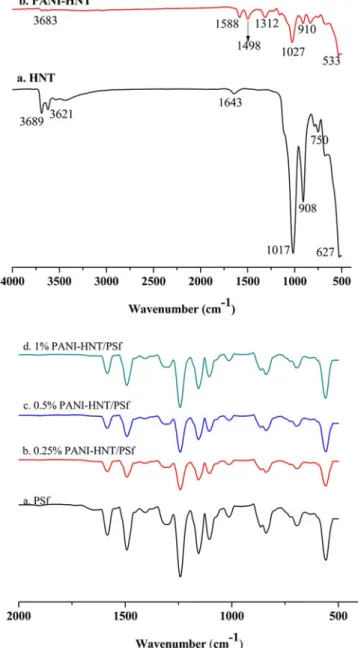
Fig. 2. ATR-IR spectra of (a) HNT and HNT (b) membranes of plane PSF and PANi-HNT/PSf.
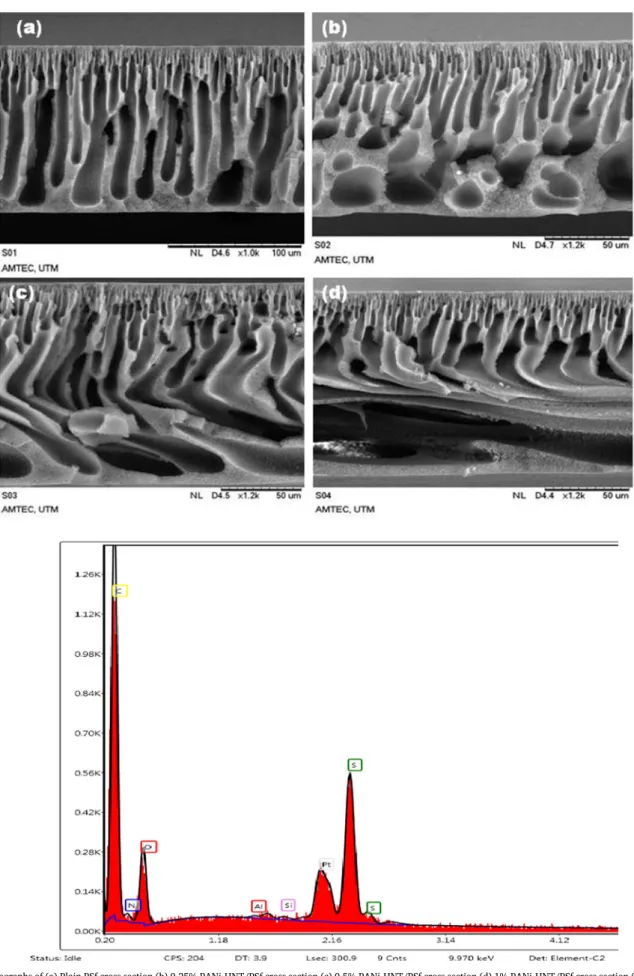
Fig. 3. SEM monographs of (a) Plain PSf cross section (b) 0.25% PANi-HNT/PSf cross section (c) 0.5% PANi-HNT/PSf cross section (d) 1% PANi-HNT/PSf cross section (e) EDAX analysis of the membrane
Fig. 2portrays the stacked ATR-IR spectra of PSf membrane, PANi-HNT and mixed matrix membranes. Of particular interest,Fig. 2a ex-hibits a band characteristic for NH stretching vibrations of PANi-HNT in the range 3600–3683 cm−1. Two distinguishing bands observed at
1588 and 1498 cm−1were attributed to C]C stretching of benzenoid ring and C]N stretching vibrations of quinoid rings, respectively. Further, the peaks at 1312 cm−1correspond to CeN stretching modes. These all peaks are not observed in HNT spectrum, which confirms the formation of PANI HNT.Fig. 2b represents the IR spectra of membranes which shows bending vibrations of CeH stretch at 1156 cm−1 and
stretching vibrations in the range 1105 cm−1due to O]S]O of the PSF. IR spectra of 0.5 wt% PANi-HNT/PSf and 1 wt% PANi-HNT/PSf membranes. The presence of PANi-HNT on PSf membrane could modify the resulting bands either by change in the relative intensity or by shifting some of the bands this is evident as C]N and C]C bands have been shifted from 1589 and 1508 cm−1to 1585 and 1503 cm−1.This observation can be attributed to the intra molecular bonding between PANi-HNT and PSf.
Figure 3illustrates the cross-section images of PSf and mixed matrix membranes. EDAX study of the membrane was performed and it shows presence of Al, Si, and N in the membrane, which confirms the presence of PANi-HNT in the membrane matrix. Of particular interest,
Fig. 3(b–d) exhibit mixed matrix membranes with the concentration of PANi-HNT increases from 0.25 to 1%, respectively. The cross-section reveals the presence of a dense layer, afinger like middle layer and a bottom supportive layer system. Thefinger like projections are narrow in PSf membrane, whereas increasing the concentration of PANi-HNT, this projection became broad while micro channels on the surface layer become thinner. In the bottom layer, however, the macrovoids are longer with the increase in the concentration of the PANi-HNT, below thefinger like projections. There are two important parameters, effec-tively for such macrovoids during phase inversion are; i) hydrophilicity and ii) viscosity of the casting solution[28]. Hydrophilicity increases the intake of non-solvents (water) in the solvent/non-solvents exchange and higher the viscosity decreases the rate of solvent exchange which causes macrovoids[29]. In this case the PANi-HNT is hydrophilic in nature meanwhile metal oxides decrease the viscosity of the casting solution. Hence, macrovoids are larger with respect to higher con-centration of PANi-HNT The hydrophilicity of the membranes also supports the above phenomenon, and was confirmed by water uptake and contact angle studies. In higher concentration, the water movement is irregular because of more hydrophilic interaction doing phase in-version. Hence, twistedfinger like projections were observed in higher concentration of PANi-HNT membranes.
Fig. 4 demonstrates the water uptake and contact angle for the prepared membranes of various concentrations of PANi-HNT dis-tributed over PSf membranes. The contact angle decreases from 74 ± 2 to 55 ± 4°as the concentration of the PANi-HNT increases from 0 to
1%. The water uptake was increased from 29.9 to 31.43%, after the incorporation of 0.25% PANi-HNT over PSf membrane. Similarly, the water uptake increases substantially upon the increase in the con-centration of PANi-HNT, that is, 0.5% PANi-HNT, 0.75% PANi-HNT, and 1% PANi-HNT to 46.67%, 85.15% and 90.18%, respectively. The presence of PANi-HNT on the surface of the PSf membrane drastically improves the water uptake/hydrophilicity. Hydroxyl polarity is able to interact with water molecules through Van der Waal’s force and hy-drogen bonding, which helps to enhance the hydrophilicity of the membrane[30]. In PANi-HNT, the presence of NH2groups leads to the
increase of Van der Waal’s interactions with water molecules. However, it is also possible that the higher affinity of PANi-HNT for water com-pared to polysulfone, which increases the penetration velocity of water into mixed matrix membrane during the phase inversion process[28]. Hence, mixed matrix membranes are hydrophilic in nature as compare to plane PSf membrane.
PANi-HNT is a charged molecule, and therefore, IEC of the mem-brane (given inTable 2) is also an important characteristic to enhance the membrane performance. The amine group from PANi has capability to do the ion exchange. Meanwhile, prepared PANi-HNT is in basic form with OH–counter ions. Hence, prepared membranes exhibit the charge interaction phenomenon in performance. Table 2shows the ion ex-change capacity of the membranes. IEC capacity depends on the con-centration of PANi-HNT; higher concon-centration of the PANi-HNT en-hances the exchange capacity.
3.2. Waterflux study
Pure waterflux study is one of the important parameters in judging the porous nature of the membrane[31].Fig. 5shows the pure water flux at different operating pressures for various PANi-HNT/PSf mem-branes. In the case of the plain PSf membrane and 0.25% PANi-HNT/ PSf membrane, no waterflux is observed even at 800 kPa of pressure indicating the hydrophobic nature of these membranes, which hinders the penetration of water. However, a high waterflux was observed in the cases of higher percentage of PANi-HNT membranes with the in-crease in pressure. These results are almost linear with respect to transmembrane pressure. It was observed that there is a constant in-crease in the waterflux with respect to increase in the weight percen-tage of PANi-HNT. This is perhaps due to the hydrophilic nature of the substance. Hydrophilicity increases with respect to concentration of PANi-HNT and the same trend was followed in the waterflux study. The highest concentration i.e. 1% PANi-HNT evinced maximum waterflux of 40.15 L/m2h at 200 kPa and 86.5 L/m2h at 800 kPa pressure. The waterflux was found to decrease with the decrease in concentration of PANi-HNT irrespective of the pressure considered. Hence, the pro-ductivity of the membrane depends basically on its hydrophilic char-acter.
3.3. Rejection study using PANi-HNT/PSfmembrane
The rejection of trace organic molecules by membranes depends on
Fig. 4. Water uptake and contact angle of the membranes
Table 2
Ion exchange capacity of the mixed membrane.
Membrane type IEC (m equ/g) 0.25% PANi-HNT/PSf membrane 13.88 0.5% PANi-HNT/PSf membrane 15 0.75% PANi-HNT/PSf membrane 15.6 1% PANi-HNT/PSf membrane 15.6
the feed parameters like molecular weight (MW), molecular size (length and width), acid dissociation constant (pKa), hydrophobicity/hydro-philicity (log Kow), diffusion constant (Dp) and membrane properties
such as pore size (MWCO value), surface charge (IEX), or hydro-phobicity/hydrophilicity (measured as contact angle and water uptake) and surface morphology[32]. PANi-HNT is more hydrophilic and ne-gatively charged. Hence, PSf /PANi-HNT composite membrane were used for the removal of atrazine and oxybenzone.
Fig. 6shows the extent of rejection of oxybenzone with respect to various applied pressures. The results reveal that the membrane of lower concentration of 0.25% PANi-HNT/PSf evinced a rejection of ca. 55% of these organics. The 0.5, 0.75 and 1% PANi-HNT/PSf mem-branes evidenced 95% of rejection as higher hydrophilicity enhances the rejection. The membrane performance was studied for various pressures, from 200 to 800 kPa, however, the same rejection values were found for all the applied pressures.
The extent of rejection of atrazine with respect to applied pressure is showcased in Fig. 7. The 1% PANi-HNT/PSf membrane displayed maximum rejection of ca.50% was observed at a lower pressure of 200 kPa while the same performance was continuously found even at higher pressure. In the cases of 0.25, 0.5 and 0.75% PANi-HNT/PSf membranes, a rejection of around 30% was observed at lower pressure of 200 kPa. The rejection increases with increase in Log Kowfor both the
compounds (oxybenzone and atrazine having Log Kow> 2.5), which
indicates their hydrophobic nature. Therefore, higher rejection was observed with highly hydrophilic membranes[33]. In the instance of atrazine (Fig. 7), the 1% PANi-HNT/PSf membrane exhibitedca.50% of rejection; however, decreasing concentration of PANi-HNT of 0.25, 0.5 and 0.75% illustrated30% of the atrazine rejection. Furthermore, the rate of the rejection decreases with an increase in the applied pressure. The anomalous behavior of the separation results was justified using properties of organic compounds.
Almost 95% and 35% of rejections were observed in the cases of oxybenzone and atrazine, respectively, using the same membranes. The transport mechanism in the membrane separation was affected by the properties of feed solution[32].Table 3shows the physical properties of the oxybenzone and atrazine. The pKa value of atrazine is 1.7 which is acidic in nature, and it can undergo chemical reaction with the mem-branes as it is a chloro substituted derivative. Hence, it can damage the surface of the membrane by increasing the pore size. Surface which cause enlarging the pore size, meanwhile, diffusion coefficient of the atrazine is higher than the oxybenzone. Moreover, oxybenzone is con-siderably larger in size than atrazine and the steric exclusion is also strongly lower with the latter. Hence, the rejection of atrazine is dras-tically lower than that of oxybenzone.
Each PANI-HNT/Psf membranes shows significantly higher rejec-tion than the Psf membranes and it is especially true when the per-centage of PANI-HNT is high (1%). Moreover, rejection obtained with the 1% PANI-HNT/Psf is found to be notably higher than those reported in literature for UF membranes (0–10% for atrazine[34,35]and 70% for oxybenzone[35]) and even for loose NF membranes (30–40% for
Fig. 5. Pure waterflux of the membranes
Fig. 6. Rejection of Oxybenzone at different pressure
Fig. 7. Rejection of Atrazine at different pressure
Table 3
Physical properties of atrazine and oxybenzone.
Properties Atrazine Oxybenzone Molecular Weight 215.68 Da 228.24 Da Molecular size (length and width) 0.788 nm 3.16 nm Acid dissociation constant (pKa) 1.7 7.6 Log Kow 2.7 3.79 Diffusion coefficient 5.4 × 10⁻¹⁰m2/s 3 × 10⁻⁸cm2/s Structure N N N Cl H3C CH3 CH3 O OH O H3C
atrazine[34,35]and 70%–80% for oxybenzone[36]). For this reason, EDCs are usually removed from contaminated solution by hybrid membrane processes, such as membrane bioreactor and/or membrane distillation[37]. However, considering the performances highlighted in this study, PANI-HNT-Psf membranes seems to be a relevant alternative to hybrid processes due to their modified properties.
The rejections obtained for the variousfiltration experiments were used to estimate the mean pore radius of the two membranes by con-sidering only steric exclusion (Eqs.45.2). It is expected that only one pore radius can describe a whole curve of rejection, but the rejection decrease when pressure increases does not allow the determination of a unique pore size. Thus, pore radius was estimated for three pressures corresponding to 200, 500 and 800 kPa, as it is depicted inFig. 8in the case of atrazine rejection by the 1% PANI-HNT/PSf membrane. The values estimated for all conditions are summarized inTable 4for dis-cussion.
As it can be seen inTable 4, the identified pore radius increases with
pressure, which is obvious since experimental rejection was found to decrease when pressure increases. Nonetheless, identified values are close to 2–4 nm, meaning that membranes can be classified as ultra-filtration membranes with low molecular weight cut-off. The decrease of rejection for increasing pressure being probably induced by a strong concentration polarization, it is probably more coherent to discuss the pore radii obtained at 200 kPa. From values identified with the two solutes, it can be seen that membrane exhibits different pore sizes, which is physically incoherent. This observation tends to show that rejection is probably governed by other phenomena than steric exclu-sion, such as electrostatic interactions. Consequently, a hydrodynamic model is not sufficient to describe rejection of such molecules and a more complex model including electric and dielectric exclusions[38]
should be developed for this purpose.
3.4. Rejection study for the laboratory prepared feed sample
Further, the membrane was used to remove EDCs from laboratory feed samples prepared with a real water. Indeed, it was previously re-ported that rejection of EDCs can also vary depending on feed water chemistry[39].
The solution containing 3 ppm of oxybenzone and atrazine were prepared using waste water collected from a lake and the rejection was investigated using the samefiltration unit and procedure.Fig. 9shows the evolution of oxybenzone rejection with respect to various applied pressure. In case of 0.25% PANi-HNT/PSf membrane, there was no rejection, but in the cases of 0.5, 0.75 and 1% PANi-HNT/PSf an average rejection of 20% was observed. Almost the same average re-jection was observed for atrazine inFig. 10with the same mixed matrix membranes. With these samples, the rejection of atrazine and oxyben-zone appears no longer to be governed by steric exclusion, leading to similar rejections although their sizes are significantly different.
With an increase in the feed water concentration, a concentration differential is created across the membrane and resulting in ahigh dif-fusion potential. Diffusion across the membrane is one of the main driving forces for the maximum permeation of organic compounds
[32]. The recovery of the HAAS, DBP and total THM by NF membranes was studied by Chellam and Taylor, who found that the rejection de-creases by increasing recovery[40]. Hence, in this case, the feed so-lution was full of other organic compounds. It increases the diffusion potential across the membrane which causes the falls in rejection. 4. Conclusion
The prepared membranes have the ability to remove the hydro-phobic organic trace compounds. The polysulfone is a hydrohydro-phobic membrane and it was converted hydrophilic by mixing with PANI-HNT. The hydrophilic and negatively charged membrane showed better performances with both charge and hydrophilicity, which are the main
Fig. 8. Estimation of the mean pore radius from experimental rejection of atrazine by the 1% PANI-HNT/PSf membrane
Table 4
Pore radius of the various membranes estimated for 3 pressures from atrazine and oxybenzone rejection. Membranes 0.25% PANi-HNT/PSf 0.5% PANi-HNT/PSf 0.75% PANi-HNT/PSf 1% PANi-HNT/PSf Pressures (kPa) 200 500 800 200 500 800 200 500 800 200 500 800 rp(nm) from atrazine 2.35 4.5 8 2.2 3.9 8 2.3 3.9 8 1.7 2.1 2.3 rp(nm) from oxybenzone 2.5 2.6 2.65 3.3 3.9 3.9 3.6 3.8 3.9 3.7 3.8 3.8
Fig. 9. Rejection of laboratory preparedfield water with oxybenzone at different pres-sure.
properties governing transport through the membrane. The water up-take andflux were higher for higher concentrations of PANi-HNT. The physical properties of the feed solution play a crucial role in the re-jection studies. For instance, the log Kowand the size of the molecule
have shown a great influence on the separation performances. The compounds which are having log Kow> 2.8 can be removed using these
membranes. Oxybenzone showed 95% and atrizines ca.50% of rejection by the reported membranes.
Acknowledgements
The authors sincerely acknowledge the Indian Ministry of Drinking water and Sanitation (no. 11017/33/2012-WQ), Department ofscience and technology for SERB (SB/FT/CS-045/2014), Nano mission projects (SR/NM/NS-20/2014) and the Ministry of Education and Science of the Russian Federation in the framework of Increase Competitiveness Program of NUST MISiS» (№ К3-2016-032) for financial support. References
[1] T.M. Crisp, E.D. Clegg, R.L. Cooper, W.P. Wood, D.G. Anderson, K.P. Baetcke, J.L. Hoffmann, M.S. Morrow, D.J. Rodier, J.E. Schaeffer, L.W. Touart, M.G. Zeeman, Y.M. Patel, Environmental endocrine disruption: an effects assessment and analysis, Environ. Health. Persp. 106 (1998) 11–56.
[2] L. Sherwood, Human Physiology: From Cells to Systems, Wadsworth Pub Co, ISBN 0495391840, 1997.
[3] A.C. Johnson, J.P. Sumpter, Removal of endocrine-disrupting chemicals in activated sludge treatment works. Environmental Science and Technology, Environ. Sci. Technol 35 (2001) 4697–4703.
[4] M.B. Schlumpf, M.C. Cotton, V. Haller, B. Steinmann, Lichtensteiger, In vitro and in vivo estrogenicity of UV screens, Environ. Health. Persp. 109 (2007) 239–244. [5] M.E. Burnett, S.Q. Wang, Current sunscreen controversies: a critical review,
Photodermatol. Photoimmunol. Photomed 27 (2011) 58–67.
[6] C. Sundaram, W. Koster, K.U. Schallreuter, The effect of UV radiation and sun blockers on free radical defence in human and guinea pig epidermis, Anti. Dermatol. Res. 282 (1990) 326–331.
[7] H. Jiang, C. Adams, N. Graziano, A. Roberson, M. McGuire, D. Khiari, Occurance and removal of chloro-s-triazines in water treatment plants, Environ. Sci. Technol. 40 (2006) 3609–3616.
[8] L.P. Gianessi, M.B. Marcelli, Pesticide use in U.S. crop production 1997:“National Summary Report” National Center for Food and Agricultural Policys, 2000. [9] A. Frank, The economics of atrazine, Int. J. Occup. Env Heal. 13 (2007) 437–445. [10] W.S.W. Ho, K.K. Sikar, Membrane Handbook, Van Nostrand Reinhold, NY, 1992. [11] R.W. Baker, E.L. Cussier, W. Eykamp, W.J. Koros, R.L. Riley, H. Strathmann,
Membrane Separation Systems: Recent Developments and Future Directions, NDC, Park Ridge, NJ, 1991.
[12] V.T. Magalad, A.R. Supale, S.P. Maradur, G.S. Gokavi, T.M. Aminabhavi, Preyssler type heteropolyacid-incorporated highly water-selective sodium alginate-based in-organic–organic hybrid membranes for pervaporation dehydration of ethanol,
Chemic Eng. J. 159 (1–3) (2010) 75–83.
[13] V.T. Magalad, S.S. Pattanashetti, G.S. Gokavi, M.N. Nadagouda, T.M. Aminabhavi, Proton conducting properties of nanocomposite membranes of chitosan, Chem Eng. J. 189–190 (2012) 1–4.
[14] M.L. Arrascue, H.G. Maldonado, O. Horna, E. Guibal, Gold sorption on chitosan derivative, Hydrometallurgy 71 (2003) 191–200.
[15] M. Baghalha, Laeching of an oxide gold ore with chloride/hypochlorite solutions, Int. J. Miner. Process 82 (2007) 178.
[16] R.S. Murali, M. Padaki, T. Matsuura, M.S. Abdullah, A.F. Ismail, Polyaniline in situ modified halloysite nanotubes incorporated asymmetric mixed matrix membrane for gas separation, Sep. Puri. Tech. 132 (2014) 187–194.
[17] S. Tuprakay, W.J. Liengcharensit, Lifetime and regeneration of immobilized titania for photocatalytic removal of aqueous hexavalent chromium, J. Hazard. Mater. 124 (2005) 53–58.
[18] L. Zhang, T. Wang, P. Liu, Polyanilline– coated halloysite nanotubes via in-situ chemical polymerization, Appl. Surf. Sci. 255 (2008) 2091–2097.
[19] Jaroslav Stejskal, Pavel Kratochvíl, Aubrey D. Jenkins, The formation of polyaniline and the nature of its structures, Polymer 37 (1996) 367–369.
[20] M. Padaki, A.M. Isloor, P. Wanichapichart, A.M. Ismail, Preparation and char-acterization of sulfonatedpolysulfone and N-phthloyl chitosan blend composite cation exchange membrane for desalination, Desalination 298 (2012) 42–48. [21] Y.H. Teow, A.L. Ahmaqd, J.K. Lim, B.S. Ooi, Preparation and characterization of
PVDF/TiO2 mixed matrix membrane via in situ colloidal precipitation method, Desalination 295 (2012) 61–69.
[22] M.S. Jyothi, Vignesh Nayak, Mahesh Padaki, R. Geetha Balakrishna, Khantong Soontarapa, Eco-friendly membrane process and product development for complete elimination of chromium toxicity in wastewater, J. Hazard. Mater. 332 (2017) 112–123.
[23] R. Vignesh Nayak, Geetha Balakrishna, Mahesh Padaki, Khantong Soontarapa Zwitterionic, Ultrafiltration membranes for As (V) rejection, Chem. Eng. J. 308 (2017) 347–358.
[24] C. Klayson, B.P. Ladewig, G.Q. Max Lu, L. Wang, Preparation characterization of sulfonatedpolyethersulfone for cation-exchange membranes, J. Membr. Sci. 368 (2001) 48–53.
[25] M.S. Jyothi, V. Nayak, M. Padaki, R.G. Balakrishna, A.F. Ismail, The effect of UV irradiation of PSf/TiO2 mixed matrix membrane for chromium rejection, Desalination 354 (2014) 189–199.
[26] A. Escoda, S. Déon, P. Fievet, Assessment of dielectric contribution in the modeling of multi-ionic transport through nanofiltration membranes, J. Membr. Sci. 378 (2011) 214–223.
[27] C.Y. Lang, P. Uchytil, R. Petrychkovych, Y.C. Lai, K. Friess, M. Sipek, M.M. Reddy, S.V. Suen, Comparison on gas separation between PES (polyethersulfone)/MMT (Na-montmorillonite) and PES/TiO2mixed matrix membranes, Sep. Purif. Technol. 92 (2012) 57–63.
[28] M. Padaki, D. Emadzadeh, T. Masturra, A.F. Ismail, The effect of UV irradiation on PSf/TiO2 mixed matrix membrane for chromium rejection, Desalination 362 (2015) 141–150.
[29] V. Nayak, M.S. Jyothi, R.G. Balakrishna, M. Padaki, S. Deon, Novel modified poly
vinyl chloride blend membranes for removal of heavy metals from mixed ion feed sample, J. Haz. Mat. 331 (2017) 289–299.
[30] N. Sakai, K. Fukuda, T. Shibata, Y. Ebina, K. Takada, T. Sasaki, Photoinduced hy-drophilic conversion properties of titaniananosheets, J. Phys. Chem. B 110 (2006) 6198–6203.
[31] S. Fengmei, Y. Ma, J. Ma, P. Wang, W.J. Sun, Preparation and characterization of PVDF/TiO2hybrid membranes with different dosages nano TiO2, J. Memb. Sci. 389 (2012) 522–531.
[32] Y. Yoon, P. Westerhoff, S.A. Snyder, E.C. Wert, J. Yoon, Removal of endocrine disrupting compounds and pharmaceuticals by nanofiltration and ultrafiltration membranes, Desalination 202 (2007) 16–23.
[33] C. Bellona, J.E. Drewes, P. Xu, G. Amy, Factors affecting the rejection of organic solutes during NF/RO treatment–a literature review, Water Res. 38 (2004) 2795–2809.
[34] E.C. Devitt, F. Ducellier, P. Cote, M.R. Wiesner, Effects of natural organic matter and the raw water matrix on the rejection of atrazine by pressure-driven mem-branes, Water Res. 32 (9) (1998) 2563–2568.
[35] Y. Yoon, P. Westerhoff, S. Snyder, E. Wert, Nanofiltration and ultrafiltration of endocrine disrupting compounds, pharmaceuticals and personal care products, J. Membr. Sci. 270 (1–2) (2006) 88–100.
[36] A. Comerton, R. Andrews, D. Bagley, C. Hao, The rejection of endocrine disrupting and pharmaceutically active compounds by NF and RO membranes as a function of compound and water matrix properties, J. Membr. Sci. 313 (1–2) (2008) 323–335. [37] K. Wijekoon, F. Hai, J. Kang, W. Price, T. Cath, L. Nghiem, Rejection and fate of
trace organic compounds (TrOCs) during membrane distillation, J. Membr. Sci. 453 (2014) 636–642.
[38] S. Déon, A. Escoda, P. Fievet, P. Dutournié, P. Bourseau, How to use a multi-ionic transport model to fully predict rejection of mineral salts by nanofiltration mem-branes, Chem. Eng. J. 189–190 (2012) 24–31.
[39] S. Kim, K.H. Chu, Y. Al-Hamadani, C.M. Park, M. Jang, D.-H. Kim, M. Yu, J. Heo, Y. Yoon, Removal of contaminants of emerging concern by membranes in water and wastewater: a review, Chem. Eng. J. 335 (2018) 896–914.
[40] S. Chellum, J.S. Taylor, Simplified analysis of contaminant rejection during ground and surface water nanofiltration under the information collection rule, Water Res. 35 (2001) 2460.