Publisher’s version / Version de l'éditeur:
Construction Technology Update, 1998-05-01
READ THESE TERMS AND CONDITIONS CAREFULLY BEFORE USING THIS WEBSITE.
https://nrc-publications.canada.ca/eng/copyright
Vous avez des questions? Nous pouvons vous aider. Pour communiquer directement avec un auteur, consultez la
première page de la revue dans laquelle son article a été publié afin de trouver ses coordonnées. Si vous n’arrivez pas à les repérer, communiquez avec nous à [email protected].
Questions? Contact the NRC Publications Archive team at
[email protected]. If you wish to email the authors directly, please see the first page of the publication for their contact information.
NRC Publications Archive
Archives des publications du CNRC
Access and use of this website and the material on it are subject to the Terms and Conditions set forth at
Controlling sound transmission through concrete block walls
Warnock, A. C. C.
https://publications-cnrc.canada.ca/fra/droits
L’accès à ce site Web et l’utilisation de son contenu sont assujettis aux conditions présentées dans le site LISEZ CES CONDITIONS ATTENTIVEMENT AVANT D’UTILISER CE SITE WEB.
NRC Publications Record / Notice d'Archives des publications de CNRC:
https://nrc-publications.canada.ca/eng/view/object/?id=8fe95aff-adf1-4a91-bc2e-f150870a5aee https://publications-cnrc.canada.ca/fra/voir/objet/?id=8fe95aff-adf1-4a91-bc2e-f150870a5aeeb y A .C.C. Wa rnock
This Update discusses the various factors that affect sound transmission
through different types of concrete block w alls, including single-leaf w alls,
double-leaf w alls and w alls w ith gypsum board attached. Know ledge of
these factors w ill assist construction practitioners to design and build w alls
w ith high levels of acoustic performance economically.
C o n s t r u c t i o n T e c h n o l o g y U p d a t e N o . 1 3
Con crete block w alls are com m on ly u sed to sep arate d w ellin g u n its from each oth er an d to en close m ech an ical equ ip m en t room s in both resid en tial an d office bu ild -in gs becau se of th eir -in h eren t m ass an d stiffn ess. Th e ben d in g stiffn ess of th e m ate-rial m akin g u p th e w all is also im p ortan t. Neith er of th ese fu n d am en tal p rop erties (m ass an d stiffn ess) can be altered by u sers.
How ever, th ere are ad d ition al factors th at n eed to be con sid ered in bu ild in g h igh -qu ality w alls.
Single -Le a f Conc re t e Bloc k Wa lls
Mass per Unit Area
For sin gle-leaf w alls, th e m ost im p ortan t d eterm in an t of sou n d tran sm ission class (STC) is th e m ass p er u n it area: th e h igh er it is, th e better. A sin gle-leaf con crete block w all is h eavy en ou gh to p rovid e STC ratin gs of abou t 45 to 55 w h en th e block su rface is sealed w ith p ain t or p laster.
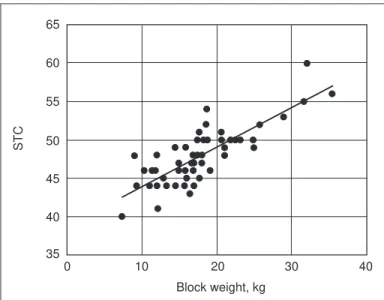
Figu re 1 sh ow s m easu red STC ratin gs for sin gle-leaf con crete block w alls from a n u m ber of p u blish ed sou rces. Th e con sid -erable scatter d em on strates th at, w h ile im p ortan t, block w eigh t is n ot th e on ly factor th at d eterm in es th e STC for th is typ e of w all. In th e absen ce of m easu red d ata, th e regression lin e in Figu re 1 can be u sed to estim ate th e STC from th e block w eigh t. Altern atively, Table 1 p rovid es rep resen ta-tive STC valu es for 50% solid blocks th at h ave been sealed on at least on e sid e. It sh ow s th e relatively m od est effects of sign ifican t in creases in w all th ickn ess on STC.
Ad d in g m aterials su ch as san d or grou t to th e cores of th e blocks sim p ly in creases th e w eigh t; th e in crease in STC can be
Controlling Sound
Transmission through
Concrete Block Walls
Som e Ba sic Conc e pt s — Tra nsm ission Loss (T L) a nd Sound Tra nsm ission Cla ss (ST C)
For sign ifican t n oise red u ction betw een tw o room s, th e w all (or floor) sep aratin g th em m u st tran sm it on ly a sm all fraction of th e sou n d en ergy th at strikes it. Th e ratio of th e sou n d en ergy strikin g th e w all to th e tran sm itted sou n d en ergy, exp ressed in d ecibels (d B), is called th e tran sm ission loss (TL). Th e less sou n d en ergy tran s-m itted , th e h igh er th e tran ss-m ission loss. In other words, the greater the TL, the better th e w all is at red u cin g n oise.
Sou n d tran sm ission class (STC) is a sin gle-n u m ber ratigle-n g th at su m m arizes tragle-n sm is-sion loss d ata. It is obtain ed by fittin g a stan d ard referen ce con tou r to th e d ata (see Figu res 2 an d 3).
2
estim ated from Figu re 1. Ad d in g sou n d -absorbin g m aterials to th e cores is n ot effective becau se th e sou n d byp asses th e in su lation , takin g th e m ore d irect p ath th rou gh th e block.
Figu re 1 also sh ow s th at u sin g h eavier block to get an STC ratin g of m u ch m ore th an 50 leads to impracticably heavy constructions. High STC ratin gs are m ore easily obtain ed by ad d in g layers of gyp su m board m ou n ted on stu d s or resilien t (flexible) fu rrin g th at d o n ot h ave a solid con n ection to th e con crete block.
Effect of Porosity
Wh en th e con crete block is p orou s, sealin g th e su rface w ith p laster or block sealer sign ifican tly im p roves th e sou n d in su la-tion ; th e m ore p orou s th e block, th e greater th e im p rovem en t. Im p rovem en ts of 5 to 10 STC p oin ts, or even m ore, are n ot u n com m on for som e ligh tw eigh t block w alls after sealin g. Con versely, n orm al-w eigh t blocks u su ally sh oal-w little or n o im p rovem en t after sealin g. Th is im p rove-m en t in STC in ligh tw eigh t blocks is related to th e in creased airflow resistivity of th ese blocks. Th e leakage of sou n d th rou gh th e m aterial of th e block is d ifferen t on ly in d egree from leakage of sou n d th rou gh in ad equ ate m ortar join ts. To en su re good sou n d in su lation , m ortar join ts m u st alw ays be p rop erly fin ish ed — th at is, free from obviou s p en etration s.
Gyp su m board attach ed d irectly to blocks by m ean s of glu e or screw s d oes n ot seal th e su rface as w ell as p laster or p ain t sin ce th e gyp su m board d oes n ot bon d com p letely to th e blocks an d beh aves as a sep arate layer. Sou n d rad iated from th e gyp su m board con tin u es to leak th rou gh th e blocks. Table 2 p rovid es exam p les of tw o very d ifferen t typ es of block an d th eir rela-tive STC ratin gs. In each case, th e p laster allow s th e sou n d in su lation of th e w all to reach its fu ll p oten tial; th e gyp su m board d oes n ot. Th e effect of th e p laster on th e very p orou s (w ood -aggregate) blocks, w h ich h ave been in clu d ed for p u rp oses of com p ar-ison , is p articu larly d ram atic. Block sealer w ou ld yield th e sam e resu lt as p laster.
Concrete 90-mm w ood- 190-mm block aggregate lightw eight treatment blocks concrete blocks
Un sealed 14 42 Gyp su m 29 46 board
on on e face
Plastered 43 49
Table 2.STC for very porous wood-aggregate blocks and lightweight concrete blocks sealed with gypsum board or plaster
Wall Lightw eight Normal Thickness, block w eight
mm block STC STC 90 43 44 140 44 46 190 46 48 240 47 49 290 49 51
Table 1.STC ratings for 50% solid normal-weight and lightweight block walls sealed on at least one side
Figure 1.Effect of block weight on STC for single-layer concrete block walls
65 60 55 50 45 40 35 0 10 20 30 40 Block weight, kg STC
In oth er tests carried ou t at IRC, a n u m -ber of d ou ble-leaf cavity block w alls, in w h ich th e layers w ere stru ctu rally isolated from each oth er, ach ieved STC ratin gs in th e ran ge of 70 to 80. Th e con stru ction s p rovid ed th e least am ou n t of stru ctu ral vibration tran sm ission th at can be ach ieved in th e laboratory, w h ich is better th an w h at can be ach ieved in n orm al p ractice. In p ractical situ ation s, carefu l d esign , m eticu -lou s w orkm an sh ip an d skilled su p ervision are n eed ed for su ch w alls to ach ieve th eir fu ll p oten tial.
Conc re t e Bloc k Wa lls w it h Gypsum Boa rd Adde d
Ad d in g gyp su m board su p p orted on fu rrin g or stu d s at a d istan ce from th e su rface of th e block w all can greatly im p rove th e sou n d in su lation of th e w all assem bly. Th ree factors th at govern th e d egree of im p rovem en t are:
1. Th e m eth od of su p p ort — id eally, th e gyp su m board sh ou ld n ot be solid ly con n ected to th e block;
2. Th e d ep th of th e cavity (th e d istan ce betw een facin g su rfaces of th e block an d th e gyp su m board );
3. Th e u se of sou n d -absorbin g m aterial in th e cavity betw een th e gyp su m board an d th e su rface of th e block.
If th e fu rrin g su p p ortin g th e gyp su m board is rigid , sou n d can travel d irectly th rou gh it from th e gyp su m board to th e blocks. How ever, if th e fu rrin g is su fficien tly flexible, th e sou n d w ill be atten u ated . Bu t th e best m eth od of su p p ort for th e gyp su m board is th e u se of in d ep en d en t stu d s th at h ave n o d irect con n ection to th e block. Resilien t m etal fu rrin g m ay be u sed on its ow n or in com bin ation w ith w ood fu rrin g.
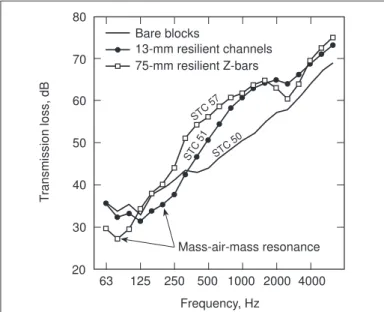
Figu re 2 p rovid es tw o sets of tran sm ission loss (TL) d ata for w alls w ith u n filled cavities of tw o d ifferen t d ep th s, as w ell as d ata for an u n fin ish ed block w all. Th e effect of th e added gypsum board on acoustic performance is striking — at high frequencies, the perform-an ce of th e w alls w ith th e gyp su m board is better th an th at of th e bare block w all; at low frequ en cies, it is w orse. Th ere is a d ecrease in TL at low frequ en cies an d an in crease in TL at h igh frequ en cies in both w alls relative to th e u n fin ish ed block w all.
Double -Le a f Conc re t e Bloc k Wa lls
In p rin cip le, d ou ble-leaf m ason ry w alls can p rovid e excellen t sou n d in su lation . Th ey ap p ear to m eet th e p rescrip tion for an id eal d ou ble w all: tw o in d ep en d en t, h eavy layers sep arated by an air sp ace. In p ractice, con stru ctin g tw o block w alls th at are n ot solid ly con n ected som ew h ere is very d ifficu lt. Th ere is alw ays som e tran sm is-sion of sou n d en ergy alon g th e w ire ties, th e floor, th e ceilin g an d th e w alls abu ttin g th e p erip h ery of th e d ou ble-leaf w all, an d th rou gh oth er p arts of th e stru ctu re. Th is tran sm itted en ergy, kn ow n as flan kin g tran sm ission , seriou sly im p airs th e effec-tiven ess of th e sou n d in su lation . Flexible ties an d p h ysical breaks in th e floor, ceilin g an d abu ttin g w alls are n eed ed to red u ce it. Even if su ch m easu res are con sid ered in th e d esign , m ortar d rop p in gs or oth er d ebris can brid ge th e gap betw een th e layers an d in crease sou n d tran sm ission . Su ch errors are u su ally con cealed an d im p ossible to rectify after th e w all h as been bu ilt. In on e test con d u cted by IRC research ers, a d ou -ble-leaf w all th at w as exp ected to attain an STC of m ore th an 70 p rovid ed an STC of on ly 60 becau se of m ortar d rop p in gs th at con n ected th e tw o leaves of th e w all.
Figure 2.Sound Transmission Loss (STC) through a 190-mm concrete block wall with 15.9-mm gypsum board attached to one side using a) 13-mm resilient metal channels, and
80 70 60 50 40 30 20 63 125 250 500 Frequency, Hz T ransmission loss, dB 1000 2000 4000 13-mm resilient channels Mass-air-mass resonance Bare blocks 75-mm resilient Z-bars STC 50 STC 51 STC 57
In gen eral, th e greater th e cavity d ep th an d th e greater th e m ass, th e low er th e m ass-air-m ass reson an ce frequ en cy, w h ich u su ally m ean s an in crease in STC. Th ere is an excep tion to th is tren d , h ow ever, w h ich occu rs at frequ en cies arou n d 100 Hz, w h ere th e STC of th e cavity w alls d ecreases relative to th at of th e u n fin ish ed block w all. Wh ile voices are n ot a sou rce of low -frequ en cy n oise, m od ern stereos can be, as can m ech an ical equ ip m en t, m ean in g th at w alls arou n d m ach in e room s sh ou ld be d esign ed w ith great care if th ese room s are ad jacen t or close to livin g or w orkin g sp aces.
Sou n d -absorbin g m aterial is com m on ly ad d ed to th e cavity in a w all or floor to im p rove th e sou n d in su lation . Th e ad d i-tion of th is m aterial:
• low ers th e m ass-air-m ass frequ en cy an d u su ally im p roves th e STC, an d
• red u ces th e d etrim en tal effects of oth er cavity reson an ces at h igh er frequ en cies. Fibrou s m aterials, su ch as cellu lose fibre, glass fibre or rock w ool in su lation , are good m aterials for th is p u rp ose; closed -cell m aterials, su ch as exp an d ed p olystyren e, are n ot, as th ey d o n ot sign ifican tly absorb sou n d .
Figu re 3 sh ow s th e effect of ad d in g glass fibre to th e cavity of th e w all w ith 13-m m resilien t m etal ch an n els. Th e m ass-air-m ass reson an ce frequ en cy d rop s to arou n d 100 Hz an d th e STC in creases to 54.
Figu re 3 also sh ow s th at w h en gyp su m board is ap p lied to both sid es of th e blocks, th e TL in creases to a greater d egree at h igh er frequ en cies, bu t d ecreases d ram ati-cally arou n d th e m ass-air-m ass reson an ce. Th e STC for th e w all w ith gyp su m board on both sid es is on e p oin t less th an th at for th e w all th at d oes n ot h ave gyp su m board ad d ed . More im p ortan tly, in th e case of th e w all w ith gyp su m board ad d ed to both sid es, th e effectiven ess of th e sou n d in su la-tion arou n d 100 Hz is sign ifican tly red u ced by th e ad d ed m aterial. Th is d im in ish ed p erform an ce occu rs becau se th e cavity d ep th is too sm all, w h ich lead s to a m ass-air-m ass reson an ce th at low ers th e STC. To m axim ize th e im p rovem en t in sou n d in su lation , th e cavity d ep th sh ou ld be as large as is p ractical. As a gen eral gu id e-lin e, th e p rod u ct of th e m ass p er u n it area of th e gyp su m board (in kg/ m2) an d th e cavity d ep th (in m m ) sh ou ld exceed 425 for a cavity filled w ith sou n d -absorbin g m aterial, an d 720 for an u n filled cavity.
Est im a t ing ST C for Conc re t e Bloc k Wa lls w it h Gypsum Boa rd Adde d
Normal-w eight, non-porous block
Data from an exten sive series of m easu re-m en ts on n orre-m al-w eigh t block w alls w ere u sed to d evelop an em p irical m eth od for p red ictin g STC for block w alls w ith gyp su m
4
Figure 3.Sound Transmission Loss (STC) for a 190-mm concrete block wall with glass fibre batts in the cavity and with 15.9-mm gypsum board attached on 13-mm resilient metal channels to a) one side and b) both sides of the wall
90 80 70 60 50 40 30 20 63 125 250 500 Frequency, Hz T ransmission loss, dB 10 1000 2000 4000 Bare blocks
One side only Both sides
Mass-air-mass resonance
STC 50 STC 54
STC 49
M a ss-a ir-m a ss re sona nc e fre que nc y
Th is is th e sp ecific frequ en cy at w h ich tw o layers of m aterial sep arated by an air sp ace reson ate, som ew h at like th e skin of a d ru m . In th e case of a block w all w ith gyp su m board ad d ed , vibration al en ergy tran sfers from th e gyp su m board th rou gh th e air in th e cavity to th e block w all m ore effectively th an it d oes th rou gh th e bare block w all.
board su p p orted on resilien t fu rrin g or in d ep en d en t stu d s. Th e sim p lified version of th is m eth od , p rovid ed in Table 3, u ses on ly STC ratin gs bu t still p rovid es reason -able accu racy. Th e equ ation s give th e STC in crem en t (∆STC) th at can be ach ieved , w ith or w ith ou t sou n d -absorbin g m aterial, w h en gyp su m board is ad d ed to on e or both sid es of a bare block w all.
For exam p le, if 15.9-m m gyp su m board is ad d ed to both sid es of a block w all filled w ith sou n d -absorbin g m aterial, u sin g 65-m 65-m steel stu d s, ∆STC is 0.44x65 - 7.37 = 21.2. Th u s th e STC ratin g of th e bare w all im p roves from 46 to abou t 46 + 21 = 67.
Note th at for sm all valu es of d (i.e., sm all cavities), ∆STC can be n egative — in oth er w ord s, th e effectiven ess of th e w all in con -trollin g sou n d is red u ced . Pred iction s m ad e u sin g th is p roced u re h ave an u n cer-tain ty of abou t ±2d B, bu t can be u sed w ith som e d egree of reliability for 12.7- or 15.9-m m th ick gyp su m board .
Porous block w alls
Th e leakage of sou n d th rou gh a p orou s con crete block w all can be u sed to ad van -tage w h en gyp su m board is ad d ed to fin ish th e w all. Becau se sou n d p en etrates th e block, th e effective d ep th of th e cavity is greater th an th e actu al d istan ce betw een th e in n er faces of th e gyp su m board an d th e block. Th e effective d ep th d ep en d s on th e p orosity of th e block. Th e best w ay to fin ish a leaky con crete block w all is as follow s:
• Plaster or p ain t on e sid e on ly. If a gyp su m board fin ish is requ ired on th is sid e, it sh ou ld be glu ed or screw ed on d irectly as th is h as th e least d etrim en tal effect on STC.
• On th e secon d sid e of th e w all, u se resilien t m etal fu rrin g or in d ep en d en t stu d s to su p p ort a layer of gyp su m board . As w ith n on -p orou s block, th e larger th e cavity d ep th , th e better. • Ad d sou n d -absorbin g m aterial to th e
cavity.
Porou s block w alls fin ish ed in th is m an n er can p rovid e STC ratin gs as good as th ose p rovid ed by n on -p orou s, h eavier blocks. Cu rren tly, it is n ot p ossible to p red ict th e STC for com p osite w alls su ch as th ese. Ap p roxim ate estim ates m ay be obtained using the procedures for non-porous blocks. In critical situ ation s, m easu rem en t of th e sou n d tran sm ission loss (TL) valu es m ay be n eed ed .
Sum m a ry
Becau se of th eir w eigh t, w ith little effort on th e p art of th e d esign er, con crete block w alls p rovid e good sou n d in su lation . In gen eral, th e greater th e
• m ass of th e w all • th e d ep th of th e cavity
• th e am ou n t of sou n d -absorbin g m aterial th e better th e p erform an ce of th e block w all, alth ou gh th ere are som e excep tion s to th is ap p roach . How ever, by ap p lyin g th e p rin cip les d escribed in th is Up d ate, it is p ossible to con stru ct h igh -qu ality w alls th at can m eet th e m ost acou stically d em an d in g situ ation s.
Re fe re nc e s
1. A.C.C. Warn ock an d D.W. Mon k. Sou n d tran sm ission loss of m ason ry w alls: tests on 90, 140, 190, 240 an d 290 m m con -crete block w alls w ith variou s su rface fin ish es. Division of Bu ild in g Research , Nation al Research Cou n cil, Bu ild in g Research Note 217, Ju n e 1984.
2. T.D. North w ood an d D.W. Mon k. Sou n d transmission loss of masonry walls: twelve-in ch ligh tw eigh t con crete blocks — com p arison of latex an d p laster sealers. Division of Bu ild in g Research , Nation al Research Cou n cil, Bu ild in g Research Note 93. Sep tem ber 1974.
∆STC = 0.11xd - 1.22 on e sid e on ly ∆STC = 0.14xd - 2.78 both sid es ∆STC = 0.12xd + 1.87 on e sid e on ly ∆STC = 0.44xd - 7.37 both sid es
Table 3.Equations for estimating increments in STC using the cavity depth d (in mm) and assuming a single layer of gypsum board
No sou n d -absorbin g m aterial in th e cavity Cavity filled w ith sou n d -absorbin g m aterial
3. T.D. North w ood an d D.W. Mon k. Sou n d tran sm ission loss of m ason ry w alls: tw elve-in ch ligh tw eigh t con crete blocks w ith variou s su rface fin ish es. Division of Bu ild in g Research , Nation al Research Cou n cil, Bu ild in g Research Note 90. Ap ril 1974.
4. A.C.C. Warn ock. Factors affectin g sou n d tran sm ission loss. In stitu te for Research in Con stru ction , Nation al Research Cou n cil, Can ad ian Bu ild in g Digest 239, Ottaw a, 1985.
5. A.C.C. Warn ock. Sou n d tran sm ission loss m easu rem en ts th rou gh 190 m m an d 140 m m blocks w ith ad d ed d ryw all an d th rou gh cavity block w alls. In stitu te for Research in Con stru ction , Nation al Research Cou n cil, In tern al Rep ort 586, 1990.
Dr. A .C.C. Wa rnockis a sen ior research officer in th e In d oor En viron m en t Program of th e N ation al Research Cou n cil’s In stitu te for Research in Con stru ction .
“Construction Te chnology Up d a te s” is a se rie s of te chnica l a rticle s conta ining p ra ctica l inform a tion d istille d from re ce nt construction re se a rch.
For more information, contact Institute for Research in Construction, National Research Council of Canada, Ottaw a K1A 0R6
Telephone: (613) 993-2607; Facsimile: (613) 952-7673; Internet: http://irc.nrc-cnrc.gc.ca
© 1998
Nation al Research Cou n cil of Can ad a May 1998