Publisher’s version / Version de l'éditeur:
Vous avez des questions? Nous pouvons vous aider. Pour communiquer directement avec un auteur, consultez la
première page de la revue dans laquelle son article a été publié afin de trouver ses coordonnées. Si vous n’arrivez pas à les repérer, communiquez avec nous à [email protected].
Questions? Contact the NRC Publications Archive team at
[email protected]. If you wish to email the authors directly, please see the first page of the publication for their contact information.
https://publications-cnrc.canada.ca/fra/droits
L’accès à ce site Web et l’utilisation de son contenu sont assujettis aux conditions présentées dans le site LISEZ CES CONDITIONS ATTENTIVEMENT AVANT D’UTILISER CE SITE WEB.
Combustion Institute Canadian Section, Spring Technical Meeting [Proceedings], pp. 1-6, 2005
READ THESE TERMS AND CONDITIONS CAREFULLY BEFORE USING THIS WEBSITE.
https://nrc-publications.canada.ca/eng/copyright
NRC Publications Archive Record / Notice des Archives des publications du CNRC :
https://nrc-publications.canada.ca/eng/view/object/?id=3775e262-edb2-4a5e-80e4-889b3a5fa446 https://publications-cnrc.canada.ca/fra/voir/objet/?id=3775e262-edb2-4a5e-80e4-889b3a5fa446
NRC Publications Archive
Archives des publications du CNRC
This publication could be one of several versions: author’s original, accepted manuscript or the publisher’s version. / La version de cette publication peut être l’une des suivantes : la version prépublication de l’auteur, la version acceptée du manuscrit ou la version de l’éditeur.
Access and use of this website and the material on it are subject to the Terms and Conditions set forth at S.I. engine operation on lean mixtures
S.I. Engine Operation on Lean Mixtures Hailin Li*1, Ghazi A. Karim2 and W. Stuart Neill1
1
National Research Council Canada-Ottawa-ON-Canada
2
University of Calgary-AB-Canada Abstract
The operation of S.I. engines on lean or diluents containing fuel-air mixtures is attractive since it can provide, in principle, improved fuel economy, reduced tendency to knock and extremely low
NOx emissions combined with a possible longer operational life. However, the flame propagation
rate then becomes degraded and drops sharply as the operational mixture is leaned or diluted. There is an ever increasing interest in examining the performance of S.I. engines when operated on lean or diluted mixtures and to investigate the deterioration in engine performance.
The paper presents experimental data obtained in a single cylinder, variable compression ratio, S.I., CFR engine when operated on gaseous fuels. A gradual leaning of the operating mixture was demonstrated to affect in turn, CO emissions and cyclic variation, emissions of unburned fuels and would lead eventually to the occurrence of misfire. The deterioration in these parameters was found to correlate well with the key combustion variables, notably the combustion duration. A similar effect was noted when diluents were added increasingly to a
stoichiometric CH4-air mixture. The reasons behind the trends observed will be discussed.
Introduction
The operation of spark ignition (S.I.) engines on lean mixtures is attractive since it can provide,
in principle, improved fuel economy and extremely low NOx emissions with longer operational
life. There is also an increasing interest to apply exhaust gas recirculation (EGR) in S.I. engine
applications to reduce the engine out NOx emissions and suppress the onset of knock, [Grandin,
et al., 1999]. However, the engine power output drops rapidly when leaning or diluting significantly the operational mixture due mainly to the associated reduction in flame propagation rates and the possible incompleteness of combustion combined with a reduction in the energy density of the intake mixtures. These may also lead to increased emission of unburned fuel, deteriorated power production efficiencies, unacceptably high cycle-to-cycle variation and even the eventual occurrence of misfire [Bade Shrestha, et al., 2000]. Correspondingly, there exist distinct operational limits beyond which satisfactory engine performance can not be maintained. There is increasing recent interest in examining the lean operation performance and extending the operational region of S.I. engines when operated on either gaseous or liquid fuels. For example, Gupta et al., [1996] examined the lean operation performance of a S.I. production engine operated on natural gas and gasoline. Natural gas was shown having superior lean operation performance over gasoline, though relatively lower power outputs were reported at around stoichiometric mixture operation. Søgaard, et al. [2002] investigated exhaust the emissions of unburned hydrocarbon (UHC) and cyclic variations in S.I. engines fuelled with a mixture of natural gas and products of its reforming that were described as Reformed Natural
*
Gas (RNG). Such fuel mixtures were shown to have fast flame propagation rates and wider
operational regions than with natural gas. The emission of unburned CH4 could be reduced
significantly, especially for lean mixture operation. Al-Fakhri, et al. [2000] examined the cyclic variation of S.I. engines and defined a new parameter called the “completeness of combustion” to describe such degradation of the combustion process with lean operation. Quader et al. [2003] examined the performance of a S.I. engine operated at around the operational limits of reformed
gases. These H2-rich gases permitted operation of S.I. engines with either extremely lean or with
a high level of (EGR) to enhance the power production efficiency and reduce dramatically
engine-out NOx emission. Bade Shreshta et al. [2000] examined in detail the operating limits of a
S.I. engines operated on common gaseous fuels. The addition of H2 to CH4 was shown to extend
the lean operational limits significantly. However, much of the research reported in the open literature tended to focus mainly on only one or some aspects of engine performance affected, which tends to be insufficient to understand fundamentally the detailed effects of lean or diluents operation on the combustion process. Also, the choice of any particular experimental approach is often dictated by the specific needs of the investigation and the availability of experimental facilities needed.
This paper presents results of an experimental investigation into the performance for lean mixture operation of a single cylinder, variable compression ratio, S.I., CFR engine operated
with variable equivalence ratio on commercial CH4 and its mixture with H2. These fuels were
demonstrated to have superior combustion properties in comparison with liquid fuels in their tolerance for lean and/or diluents presence operation. The effect of lean operation on the indicated power production efficiency, exhaust emissions, cyclic variations and misfire processes
was experimentally examined and discussed. The effect of the addition of diluents such as CO2
and N2 to CH4 in stoichiometric mixture operation was also examined. The behaviour of the
exhaust emission of unburned fuel and cyclic variation was shown to correlate well with changes in the values of the combustion duration.
Experimental Set-up
A single cylinder, four stroke, S.I., CFR engine of 82.6 mm bore and 114 mm stroke was used while operating unthrottled under atmospheric pressure conditions (about 660 mm Hg). The engine is of variable compression ratio (from 4.5:1 to 16:1) and spark timing (up to 40 °CA before and after top dead centre). The induction system was modified to permit the admission of either single or multi-fuels or diluents simultaneously. The gaseous fuels and diluents employed were supplied from a set of high-pressure cylinders and metered individually using a series of calibrated choked nozzles. Different fuel mixtures were prepared by precisely controlling the flow rates of the pure fuels and diluents and mixing them with the air into the intake manifold just before entry into the cylinder. The flow rate of the air was determined using a laminar flow air meter having a low pressure-drop. Thermocouples were employed to measure the temperatures of the intake mixture and exhaust gas. The intake temperature could be varied by electric heating the intake air. The in-cylinder pressure was measured with a high frequency-response, water-cooled piezoelectric type transducer mounted flush with the pan-shaped cylinder head. The overall combustion duration, which is also indicative of the average flame propagation rate, was determined through analysis of the instantaneous variation of the apparent polytropic index of the compression, combustion and expansion processes, as described by Bade Shrestha and Karim [2001]. The exhaust gases were sampled at a point of around 10 cm beyond the exhaust valve. The exhaust analysis system employed consisted of a range of N.D. infra-red
analyzers that measured the concentrations of CH4, CO and CO2 and with a chemiluminescence
analyzer for NO/NOx. Unutilized oxygen was measured using a paramagnetic detector. Unless
otherwise indicated, the engine was operated at a constant engine speed of 900 rev./min, a fixed spark timing of 15 °CA BTDC, a compression ratio of 8.5:1, and an ambient intake mixture of
22 °C.The commercial CH4 employed was processed pipeline natural gas having the following
average volumetric composition: 93.07%CH4, 5.74%C2H6, 0.16%CO2 and 1.03%N2. The purity
values of CO and H2 were over 99.5% by volume.
Experimental Results and Discussions
The lean mixture operation of S.I. engines has been shown to improve the power production
efficiency. For example, Figure 1 shows the indicated power production efficiency with CH4, H2
and their mixture, (having a composition of 70%CH4+30%H2) with the variation in equivalence
ratio. The indicated power production efficiency increases gradually with leaning the mixture but drops rapidly when excessively lean mixtures are employed. Also, it is shown that a much leaner
mixture could be tolerated for H2 and its mixture with methane reflecting the superior lean
operational performance of H2 in comparison to CH4.
0 0.1 0.2 0.3 0.4 0.5 0 0.2 0.4 0.6 0.8 1 Equivalence Ratio
Indicated Thermal Efficiency
CH4
70%CH4+30%H2
H2
Figure 1 Variation of the indicated power production efficiency with changes in
equivalence ratio for H2, CH4 and
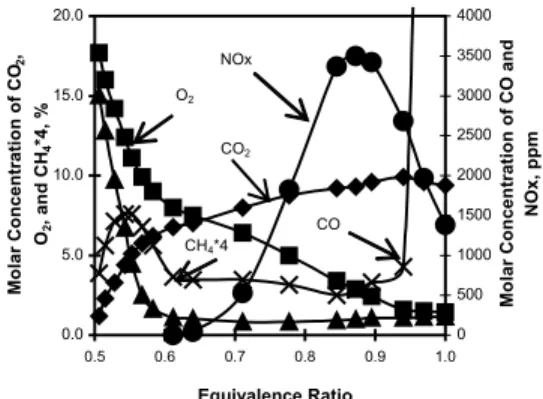
(70%CH4+30%H2) operations 0.0 5.0 10.0 15.0 20.0 0.5 0.6 0.7 0.8 0.9 1.0 Equivalence Ratio Mo lar C o n cen tr atio n of C O2 , O2 , a nd C H4 *4 , % 0 500 1000 1500 2000 2500 3000 3500 4000 Mol a r C onc e n tr a ti on of C O a nd N O x , ppm NOx CO2 O2 CO CH4*4
Figure 2 Variations of the exhaust emissions of
NOx, unburned CH4, CO, CO2, and O2 with
changes in equivalence ratios, Fuel: CH4
The emissions of products, CO and unburned fuel, is an important tracer to any incomplete combustion, bulk quenching and the onset of misfire. As shown in Figure 2, when the operating
mixture is significantly leaned, both CO and unburned CH4 emissions increased substantially
combined with a sudden drop in CO2 emissions. These reflect the increasing extent of
incomplete combustion and possibly bulk quenching and even failure of flame initiation,
[Søgarrd et al., 2002]. Such behaviour also was supported by the associated rapid increase in O2
concentrations in the exhaust gases. The emissions of CO and CH4 were also evaluated in terms
of a relative emission, defined as the molar ratio of these components in the exhaust gases
relative to that of CH4 in the intake mixture. The combustion efficiency is defined as the molar
ratio of CO2 in the exhaust gases relative to intake CH4. As shown in Figure 3, the emissions of
the unburned CH4 contribute in comparison significantly towards the deterioration of the
combustion efficiency at lean operation. Figure 4 shows the corresponding indicated power production efficiency, CO emissions and coefficient of variation (COV) in indicated mean effective pressure (imep). The CO emission was found to keep pace with the increase in the
value of COV as the operating mixture was leaned gradually reflecting the development of incomplete and unstable combustion. Both of these parameters start to increase when the power production efficiency begins to decrease rapidly. However, as shown in Figure 5, the relative
emission of CH4 starts increasing at relatively leaner mixtures than for the COV in imep, which
indicates that bulk quenching occurs at a leaner mixture than that associated with significant combustion instability. Leaning the operating mixture further, increases the relative emissions of
CH4 and leads to the occurrence of misfire in some cycles and eventually to a total loss of
combustion, as shown in Figure 6.
0 10 20 30 40 0.5 0.6 0.7 0.8 0.9 1 Equivalence Ratio Rel a ti ve emi s si o n o f CO and CH 4 , % 0 20 40 60 80 100 C o m bus ti on E ffi c ie n c y , % Combustion Efficiency Relative Emission of CO Relative Emission of CH4
Figure 3 Typical variation of combustion
efficiency, and relative emission of CO and CH4
with changes in equivalence ratio when operated
on CH4 400 800 1200 1600 2000 0.4 0.5 0.6 0.7 0.8 0.9 1 Equivalence Ratio CO E m is s ion, ppm 0 10 20 30 40 50 60 In d icated T h e rm al E ffi ci en c y , C O V in ime p , % COV in imep CO Emission
Indicated Power Production Efficiency
Figure 4 Comparison of the variation trends of the CO emission and COV in imep with leaning
operation when operated on CH4
0 20 40 60 80 100 0.4 0.5 0.6 0.7 0.8 0.9 1 Equivalence Ratio C O V in im e p , R e la ti v e E m is s ion of C H4 , % Relative Emission of CH4 COV in Imep
Figure 5 Comparison of the variation trends of
the COV in imep and relative emission of CH4
with leaning operation, fuel: CH4
0 20 40 60 80 100 0.4 0.5 0.6 0.7 0.8 0.9 1 Equivalence Ratio M isf ir e F req u en cy, R el at ive E m is s ion of C H4 , % Relative Emission of CH4 Misfire frequency
Figure 6 Comparison of the variation trends of
the relative emissions of CH4 and misfire
frequency with leaning operation, fuel: CH4
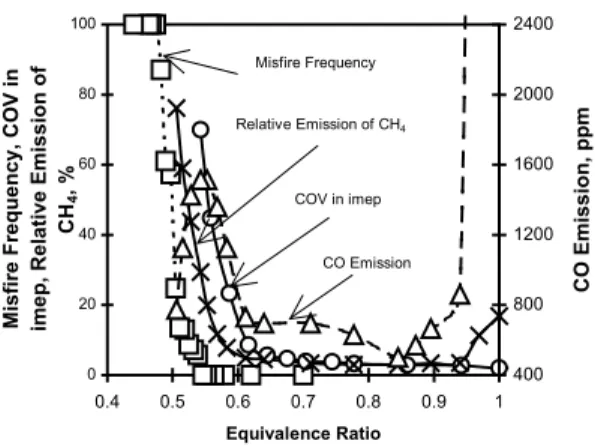
The deterioration in these processes with leaning operation is shown in Figure 7 and can be summarized by the following steps:
1) With a gradual leaning of the operating mixture, significant cyclic variation was first observed and accompanied by a relatively substantial increase in CO emissions. 2) Leaning the
operating mixture yet further, a dramatic increase in the relative emissions of unburned CH4 is
observed, reflecting the increased contribution of flame quenching or the occasional lack of full flame propagation through the whole mixture. 3) A further leaning of the operating mixture leads
to a rapid increase in the relative emissions of the unburned CH4 accompanied by a sudden
increase in the frequency of misfire until misfire is observed in all cycles when operated at sufficiently lean mixture. Similar trends were also found when using the other fuels, as shown in Figure 8.
0 20 40 60 80 100 0.4 0.5 0.6 0.7 0.8 0.9 1 Equivalence Ratio Mi sfi re Fr equency, CO V i n im ep, Rel a ti ve E m issi on of CH 4 , % 400 800 1200 1600 2000 2400 CO Emission, ppm Relative Emission of CH4 Misfire Frequency COV in imep CO Emission
Figure 7 Comparison of the variation trends of the CO emissions, COV in imep, relative
emissions of CH4 and development of misfire
frequency with leaning operation, fuel: CH4
0 20 40 60 80 100 0.3 0.4 0.5 0.6 0.7 0.8 Equivalence Ratio
Misfire Frequency, COV in imep, Relative Emission of CH4, %
400 800 1200 1600 2000 2400 CO Emission, ppm CO Emission Misfire Frequency COV in imep Relative Emission of CH4
Figure 8 Comparison of the variation trends of the CO emissions, COV in imep, the relative
emission of CH4 and development of misfire
frequency with leaning operation, fuel:
70%CH4+30%H2
The effect of EGR on the combustion process is evaluated approximately through adding the
pure diluents CO2 and N2 to a stoichiometric CH4-air mixture. As shown in Figure 9, adding
these diluents appear not to affect substantially the power production efficiency until an excessive amount of a diluent was added, reflecting a relatively stable combustion process. This was also evident in the cyclic variations, as shown in Figure 10. As expected, distinctly poor and unstable combustion could be observed only when relatively large amounts of diluents were added. 0.1 0.15 0.2 0.25 0.3 0.35 0 5 10 15 20 25 CO2/(CO2+CH4), N2/(N2+CH4), % Indi cat ed Pow e r Pr o duct ion Ef fi ci ency, % Adding CO2 Adding N2
Figure 9 Comparison in variations of the indicated power production efficiency with the
amount of CO2 and N2 added to stoichiometric
CH4-air mixture. 0 10 20 30 40 50 60 0 5 10 15 20 25 N2/(N2+CH4), CO2/(CO2+CH4), % C O V in IME P , % Adding CO2 Adding N2
Figure 10 Comparison in variations of the
COV in imep with the amount of CO2 and N2 added to stoichiometric CH4-air mixture.
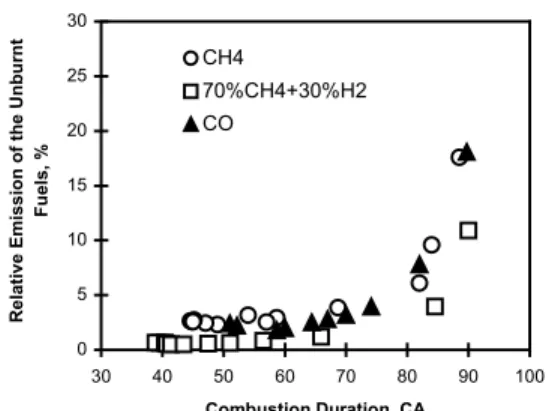
The correlation of the extent of deterioration in engine performance with the key combustion parameter, the combustion duration was also made. Figure 11 shows a correlation of the relative emission of unburned fuel with the corresponding value of the combustion duration when
operated on lean mixtures of CH4, CO and (70%CH4+30%H2) [Li and Karim, 2005]. Significant
unburned fuel emissions were obtained only when the combustion duration becomes relatively long as a result of the slow flame propagation. As shown in Figure 12, the values of COV in imep also correlated well with the combustion duration when varied through either leaning or diluting operation of common gaseous fuels. It appears that keeping a rapidly propagating flame reduces the emission of unburned fuels and the development of cyclic variation.
0 5 10 15 20 25 30 30 40 50 60 70 80 90 100 Combustion Duration, CA
Relative Emission of the Unburnt
Fuels, %
CH4
70%CH4+30%H2 CO
Figure 11 Variations of the relative emissions of the unburned fuels with changes in combustion
duration while operated on CO, CH4 and
70%CH4+30%H2. 0 10 20 30 40 50 60 40 50 60 70 80 90 Combustion Duration, CA COV in Indic a te d Powe
r, % ER=1.0, Adding CO2
ER=1.0, Adding N2
70%NG+30%H2, Vary ER
Natural Gas, Vary ER
Figure 12 Variations of the COV in imep with changes in combustion duration when varied through either leaning or diluting operation of
CH4 and 70%CH4+30%H2
Conclusions
A gradual increase in the leaning of the operating mixture of an S.I. engine operated on gaseous fuels was shown to affect in turn CO emissions, cyclic variation, emissions of unburned fuel and will lead eventually to the occurrence of misfire. The deterioration in engine performance during lean or diluted operations was found to correlate well with the key combustion variable of the combustion duration. Keeping a relatively fast flame helps to reduce exhaust emissions and suppress the development of cyclic variation.
Acknowledgement
The financial support of Natural Canadian NSERC and University of Calgary is gratefully acknowledged. The contribution of Dr. A. Sohrabi to the testing made is also gratefully acknowledged.
References
1. Al-Fakhri, Y., and Rain, R.R. (2000), SAE Paper 2000-01-1213
2. Bade Shrestha, S.O. and Karim, G. A. (2001), Proc Instn. Mech. Engrs., Part A, J. of
Power and Energy Vol. 215, No.1, pp. 63-74.
3. Bade Shrestha, S.O., Karim, G.A. and Wierzba, I. (2000), SAE Paper 2000-01-1944
4. Grandin, B. and Ångströmet, H.E. (1999), SAE Paper 1999-01-3505
5. Gupta, M., Bell, S.R. and Tillman, S.T. (1996), Transaction of ASME, J. of Energy Resource Technology, Vol.118, pp.145-151.
6. Li, H.L. and Karim, G.A. (2005), in Press, International Journal of Green Energy
7. Quader, A.A., Kirwan, J.E. and Grieve, M.J. (2003) SAE Paper 2003-01-1356 8. Søgarrd, C., Schramm, J. and Jenken, T.K. 2002, SAE Paper 2002-01-2823