EDITORIAL
Annie Darwin’s death, the evolution of
tuberculosis and the need for systems
epidemiology
Lukas Fenner,1,* Matthias Egger1 and Sebastien Gagneux2
Accepted 17 November 2009
Keywords HIV, AIDS, tuberculosis, co-evolution, evolution, Charles Darwin, Annie Darwin, genomics, multi-disciplinary, host, pathogen, interactions
When Charles Darwin’s daughter Anne Elizabeth (‘Annie’, Photograph 1) died at the age of 10 years on April 23, 1851 her parents were devastated. Charles Darwin was a devoted father and constantly concerned about the health of his 10 children. His concerns were also motivated by fear of the conse-quences of marriage between relatives: Emma Wedgewood, his wife, was also his first cousin.1 The possible adverse effects of consanguineous marriage, which was not uncommon in England at that time, were a matter of debate. Annie’s death, and self-fertilization experiments in plants, made him suspect that ‘marriage between near relations is like-wise injurious’.2 In 1870, Darwin motivated his mathematician son George to study the prevalence of close-kin marriages in patients in asylums in com-parison with the prevalence of the general population. The study, which is reprinted in this issue of the journal,3 with several commentaries,1,2,4,5 was first published in 1875 and concluded that ‘the evil [of marriages between cousins] has been often much exaggerated’ and that ‘under favourable conditions of life, the apparent ill-effects were frequently almost nil’.3
Indeed, Annie died after a lingering illness, most likely of tuberculosis (TB) caused by Mycobacterium tuberculosis,6 and not of the consequences of a high coefficient of inbreeding (the F coefficient that features in one commentary2). Of note, although
Darwin may have been aware of the studies by his contemporaries, Pasteur and Koch, he did not con-sider the role of microbes and infectious diseases in his work.7 M. tuberculosis would, however, surely have
1Institute of Social and Preventive Medicine, Finkenhubelweg
11, University of Bern, CH-3012 Bern, Switzerland.
2Division of Mycobacterial Research, MRC National Institute
for Medical Research, London, UK.
* Corresponding author. [email protected]
Photograph 1 Daguerreotype photograph of Anne Elizabeth (’Annie’) Darwin 1849. Annie Darwin died in 1851, probably of tuberculosis. ß English Heritage Photo Library. Reproduced with permission
Published by Oxford University Press on behalf of the International Epidemiological Association ß The Author 2009; all rights reserved.
International Journal of Epidemiology 2009;38:1425–1428 doi:10.1093/ije/dyp367
been of interest. This obligate human pathogen has co-evolved with humans for millennia8 and has been extremely successful: today one-third of the world’s population is estimated to be infected and 1.7 million people die from TB each year, more than anytime during previous human history.9,10 Co-infection with HIV is an important risk factor for TB, increasing the lifetime risk of progression from infection to active disease from 5% per lifetime to 5% per year,11 which is a particular problem in sub-Saharan Africa. Moreover, the emergence of bac-terial strains resistant to most current antimicrobial drugs threatens to make TB untreatable.9 Edmonds and colleagues,12in this issue, document the stagger-ingly high incidence of TB in HIV-infected children in Kinshasa, Democratic Republic of Congo: 20.4 per 100 person-years. Anti-retroviral therapy halved the incidence of TB, but as Boulle and Eley emphasize in their commentary,13 additional interventions are needed to control TB in this population, including efforts to improve the diagnosis of TB in children co-infected with HIV.
Darwin would of course understand: the theory of evolution which he outlined in his seminal work On the Origin of Species by Means of Natural Selection, or the Preservation of Favoured Races in the Struggle for Life is also ‘the modern story of TB’.14The recent emergence
of HIV and the introduction of effective drugs represent selection pressures that M. tuberculosis has not experienced for most of its evolutionary history. As one consequence of the widespread (and not always well supervised) use of drugs, resistant strains have developed. Many drug resistance-conferring mutations in M. tuberculosis lead to a reduction in bacterial fitness, although compensatory evolution may mitigate fitness defects.15 In HIV-infected, immune-compromised hosts even strains with high-cost resistance mutations could be propagating efficiently, which might explain why drug-resistant TB has been associated with HIV co-infection.16,17 TB patients could thus serve as a ‘breeding ground’ for highly compensated drug-resistant strains, with an increased capacity to spread in the general population. To date, no study has addressed this disturbing possibility. The strain genetic background has also been shown to influence the fitness of drug-resistant M. tuberculosis. For example, the Beijing lineage has been associated with drug resistance,18 suggesting that this lineage might be ‘pre-adapted’ to resistance. Importantly, Beijing has also been associated with
HIV19,20 and is now emerging in South Africa,
probably as a consequence of the HIV epidemic.21,22 Genomics, the study of the genomes of organisms, is becoming increasingly important for communicable
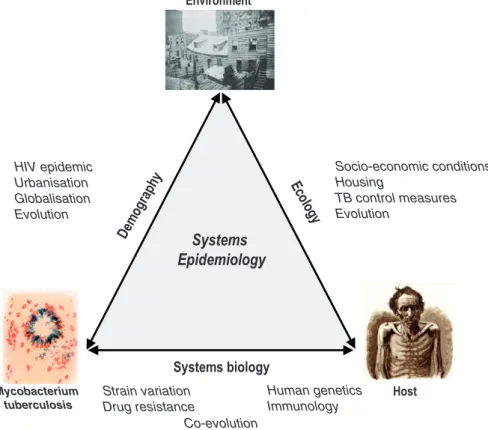
Mycobacterium tuberculosis HIV epidemic Urbanisation Globalisation Evolution Strain variation Drug resistance Human genetics Immunology Socio-economic conditions Housing TB control measures Evolution Co-evolution
Figure 1 A ‘systems epidemiology’ approach to tuberculosis, which integrates demography, ecology and systems biology. Picture credits: Drawing from Koch R. Die Aetiologie der Tuberkulose. Berliner Klinische Wochenschrift, 1882; Dens of Death. Photograph from Riis JA. The Battle with the Slum. New York: MacMillan Company, 1902; Drawing of man with tuberculosis (source unknown).
disease epidemiology and control. Infectious diseases result from complex interactions between microbes, host and the environment, which are subject to evo-lutionary pressures and ecological changes (Figure 1). Genetic and immunological studies can answer fun-damental questions about host–pathogen interaction, pathogenesis, host genetic susceptibility and the factors influencing response to treatment and progno-sis.23 Humans show remarkable variation in their response to infectious agents. For example, particular human gene polymorphisms explain some of the vari-ation among individuals who differ in their ability to control HIV infection.24,25 In addition to host genetic diversity, genetic variation within particular microbial species can influence the outcome of infection and disease. In M. tuberculosis, for example, a recent study demonstrated that the rate of progression to active TB depended on the bacterial lineage.26 Other studies showed M. tuberculosis lineages to be associated with different clinical manifestations of TB.27,28
Both the recent changes in the human host (i.e. the emergence of HIV) and in the bacterium (i.e. the emergence of drug resistance) will influence the evolutionary trajectory of M. tuberculosis. We urgently need a better understanding of the genetic diversity and evolution of M. tuberculosis and the epidemio-logical and clinical consequences. How does co-infection affect the genetic population structure and evolution of M. tuberculosis in sub-Saharan Africa? What are the clinical and epidemiological implications of these effects? Does HIV co-infection influence the frequency and distribution of antimicro-bial resistance-conferring mutations in M. tuberculosis? Do the clinical correlates of M. tuberculosis genetic diversity and the transmission dynamics of M. tuber-culosis differ depending on HIV status and degree of HIV-induced immunodeficiency?
Improved understanding of the complex interactions between genetically diverse hosts and pathogens in changing environments will require new multidisci-plinary approaches. In particular, the integration of systems biology with population sciences and ecology, in what might be described as ‘systems epidemiology’ is promising (Figure 1).29 This involves combining genomic and evolutionary analyses of the host and the pathogen, with immunology, molecular and clinical epidemiology, and mathematical modelling. ‘Darwinian Medicine’, where evolutionary biology and biomedicine interact to enhance our understand-ing of both biological and evolutionary processes, is part of this concept.30 If successful, such an integrated approach will inform the development of new diagnostics, drugs and vaccines, and guide future public health interventions. Thus, even though Charles Darwin might not have fully appre-ciated the significance of infectious microbes at the time, his legacy will play a crucial role in addressing challenges such as the dual epidemics of HIV and TB. Conflict of interest: None declared.
References
1Kuper A. Commentary: A Darwin family concern. Int J Epidemiol 2009;38:1439–42.
2
Brittle AH. Commentary: the background and outcomes of the first cousin marriage controversy in Great Britain. Int J Epidemiol 2009;38:1453–58.
3
Darwin GH. Reprints and reflections: marriages between first cousins in England and their effects. Int J Epidemiol 2009;38:1429–39.
4
Stoltenberg C. Commentary: of the same blood. Int J Epidemiol 2009;38:1442–47.
5
Evans A. Commentary: Darwin’s origin: the Irish connec-tion. Int J Epidemiol 2009;38:1448–52.
6
Keynes R. Annie’s Box: Charles Darwin, His Daughter, and Human Evolution. London: Fourth Estate Publishers, 2001.
7
Lederberg J. J. B. S. Haldane (1949) on infectious disease and evolution. Genetics 1999;153:1–3.
8
Hershberg R, Lipatov M, Small PM et al. High functional diversity in Mycobacterium tuberculosis driven by genetic drift and human demography. PLoS Biol 2008;6:e311.
9
World Health Organization. WHO report 2008. Global tuberculosis control. Geneva: WHO, 2008.
10
Corbett EL, Watt CJ, Walker N et al. The growing burden of tuberculosis: global trends and interactions with the HIV epidemic. Arch Intern Med 2003;163:1009–21.
11
Selwyn PA, Alcabes P, Hartel D et al. Clinical manifesta-tions and predictors of disease progression in drug users with human immunodeficiency virus infection. N Engl J Med 1992;327:1697–703.
12
Edmonds A, Lusiama J, Napravnik S, Kitetele F, Van Rie A, Behets F. Anti-retroviral therapy reduces incident tuberculosis in HIV-infected children. Int J Epidemiol 2009;38:1612–21.
13
Boulle A, Eley B. Commentary: reducing HIV-associated tuberculosis in children. Int J Epidemiol 2009;38:1621–23.
14
Iseman MD. Extensively drug-resistant Mycobacterium tuberculosis: Charles Darwin would understand. Clin Infect Dis 2007;45:1415–16.
15
Gagneux S, Long CD, Small PM, Van T, Schoolnik GK, Bohannan BJ. The competitive cost of antibiotic resistance in Mycobacterium tuberculosis. Science 2006;312: 1944–46.
16
Gandhi NR, Moll A, Sturm AW et al. Extensively drug-resistant tuberculosis as a cause of death in patients co-infected with tuberculosis and HIV in a rural area of South Africa. Lancet 2006;368:1575–80.
17
Raviglione MC, Smith IM. XDR tuberculosis– implications for global public health. N Engl J Med 2007; 356:656–59.
18
Borrell S, Gagneux S. Infectiousness of drug-resistant Mycobacterium tuberculosis. Int J Tuberc Lung Dis 2009;13: 1456–66.
19
Middelkoop K, Bekker LG, Mathema B et al. Molecular epidemiology of Mycobacterium tuberculosis in a South African community with high HIV prevalence. J Infect Dis 2009;200:1207–11.
20Caws M, Thwaites G, Stepniewska K et al. Beijing
geno-type of Mycobacterium tuberculosis is significantly associated with human immunodeficiency virus infection and multidrug resistance in cases of tuberculous meningitis. J Clin Microbiol 2006;44:3934–39.
21
Emergence of Mycobacterium tuberculosis with extensive resistance to second-line drugs–worldwide, 2000–2004 MMWR Morb Mortal Wkly Rep 2006;55:301–5.
22
Cowley D, Govender D, February B et al. Recent and rapid emergence of W-Beijing strains of Mycobacterium tubercu-losis in Cape Town, South Africa. Clin Infect Dis 2008;47: 1252–59.
23
Cooke GS, Hill AV. Genetics of susceptibility to human infectious disease. Nat Rev Genet 2001;2:967–77.
24
Fellay J, Shianna KV, Ge D et al. A whole-genome association study of major determinants for host control of HIV-1. Science 2007;317:944–47.
25
Telenti A. Adaptation, co-evolution, and human suscept-ibility to HIV-1 infection. Infect Genet Evol 2005;5:327–34.
26de Jong BC, Hill PC, Aiken A et al. Progression to
active tuberculosis, but not transmission, varies by
Mycobacterium tuberculosis lineage in the Gambia. J Infect Dis 2008.
27Caws M, Thwaites G, Dunstan S et al. The influence of
host and bacterial genotype on the development of disseminated disease with Mycobacterium tuberculosis. PLoS Pathog 2008;4:e1000034.
28Thwaites G, Caws M, Chau TT et al. Relationship between
Mycobacterium tuberculosis genotype and the clinical pheno-type of pulmonary and meningeal tuberculosis. J Clin Microbiol 2008;46:1363–68.
29Comas I, Gagneux S. The past and future of tuberculosis
research. PLoS Pathog 2009;5:e1000600.
30
Shanks N, Pyles RA. Evolution and medicine: the long reach of ‘‘Dr. Darwin’’. Philos Ethics Humanit Med 2007; 2:4.