Hannah Schmid-Petri* and Dorothee Arlt
Constructing an illusion of scientific
uncertainty? Framing climate change in
German and British print media
DOI 10.1515/commun-2016-0011
Abstract: This article uses quantitative content analysis data from June 1, 2012 to May 31, 2013 to examine the salience and construction of scientific uncertain-ty about climate change in German and British press coverage using quan-titative content analysis data from June 1, 2012 to May 31, 2013. The results show that uncertainty about climate change − against overwhelming consensus among climate scientists − is prominent in the press coverage of both countries. The findings indicate that it is important to distinguish whether scientific un-certainty can be found at the level of single articles, or at the level of the coverage as a whole. The study also reveals that uncertainty is constructed differently in German and British press coverage in terms of the media’s fram-ing of climate science and the types of actors who are involved in the construc-tion of scientific uncertainty.
Keywords: uncertainty, framing, climate change, skeptics, newspaper coverage, quantitative content analysis
1 Introduction
Most people don’t obtain their scientific knowledge through direct involvement in science or scientific publications but through media coverage. Consequently, how the media portray an issue is crucial for people’s perception, knowledge, and understanding of science (Cacciatore et al., 2012). Thus, in order to form thorough and reasonable opinions about scientific issues, citizens depend on accurate and comprehensible coverage.
There are very few research areas in which the overwhelming majority of scientists agree about the current scientific evidence, and thus a consensus
*Corresponding author: Hannah Schmid-Petri, Institute of Communication and
Media Studies, University of Bern, E-mail: [email protected]
Dorothee Arlt, Institute of Communication and Media Studies, University of Bern,
exists. One such area is climate change. Previous research has shown, however, that for many scientific topics, mass media reporting has created an image that diverges from the actually existing majority view in science (e.g., the link be-tween tobacco smoke and cancer [Miller, 1992] or the absence of a link bebe-tween vaccines and autism [e.g., Clarke, 2008; Dixon and Clarke, 2012; Speers and Lewis, 2004]). In the case of climate change, several studies have shown that the media, especially in the United Kingdom and the United States, spread climate skepticism (e.g., Painter and Ashe, 2012; Painter and Gavin, 2015; Schmid-Petri, Adam, Schmucki, and Häussler, 2015). As a result, the media present scientific evidence as being more controversial and uncertain than it actually is within the scientific community (Stocking, 1999).
Given that a basic acceptance of the occurrence of climate change and anthropogenic contributions is an important condition for effectively tackling its causes and consequences on a sociopolitical level, the media’s role is of vital importance both globally (e.g., in the context of the recently achieved adoption of the Paris Agreement in December 2015) and nationally (e.g., by implementing measures to reduce a country’s greenhouse emissions). It be-comes necessary to ask how salient different images of scientific uncertainty are in reporting about climate change in different countries, and how journal-ists frame the scientific evidence.
While the majority of previous studies examined the prevalence of scientific uncertainty in US media (e.g., Antilla, 2005; Boykoff and Boykoff, 2004; Zehr, 2000), scholars have recently focused more strongly on European countries (e.g., Boykoff and Mansfield, 2008; Kaiser and Rhomberg, 2015; Olausson, 2009; Painter and Gavin, 2015; Schmid-Petri, in press). However, so far very little is known about national differences regarding the prominence and con-struction of scientific uncertainty across Europe (e.g., Painter and Ashe, 2012). Against this background our study examines the salience and construction
of scientific uncertainty about climate change from a comparative perspective
within Europe by comparing Germany and the UK. Comparing these two Euro-pean member states is especially interesting as both have taken leading posi-tions in the adaptation to climate change at the European political level (Juhola and Westerhoff, 2011; Lorenz, Dessai, Paavola, and Forster, 2013), while on national level the political and societal context of debates about climate change differs.
In Germany climate protection has become deeply rooted in national poli-tics over the last thirty years (Böhler-Baedeker and Mersmann, 2013). The latest milestone in German climate politics is the country’s energy strategy (launched by the government in 2010), which plans for a massive expansion of renewable energies through 2050. However, against the background of recent energy
poli-tics, German climate skeptics have started to gain ground by criticizing these political measures (Brunnengräber, 2013). In contrast, in British politics there has been a strong shift from cross-party consensus towards politically motivat-ed climate skepticism (Carter, 2014). In particular, since 2010, British climate politics have become more contentious and the conservative right has “devel-oped a deep partisan hostility climate policy” and “received frequent and en-thusiastic support in the right-wing media” on this matter (Carter, 2014, p. 429). Moreover, climate debate also differs on the societal level between the two countries. Various studies have shown that climate awareness is more pro-nounced among the German population than among the British population. Compared to people in Britain, citizens in Germany thus take the problem of climate change more seriously (Eurobarometer, 2011), view increases in global temperatures as more of a threat (ISSP Research Group, 2012), and support the idea that humans contribute to climate change more strongly (see also Engels, Hüther, Schäfer, and Held, 2013; Poortinga, Spence, Whitmarsh, Capstick, and Pidgeon, 2011). Thus, the question arises whether we find national differences regarding the prevalence and construction of scientific uncertainty in German and British media coverage of climate change.
Our study contributes to previous research in various ways. Most of the current studies that have investigated media coverage of climate change have focused on the quantity of skeptical arguments (e.g., Grundmann and Scott, 2014; Kaiser and Rhomberg, 2015; Painter and Ashe, 2012; Painter and Gavin, 2015), but they have not tried to explain how scientific uncertainty is construct-ed. Our study furthers such analyses by examining the construction processes that can lead to an illusion of certainty or uncertainty in three respects: first, we distinguish two levels on which uncertainty is constructed within newspaper coverage: within a single news article and across all news articles (i.e., the level of the whole coverage). Second, we examine which frames are used to construct scientific uncertainty. Third, our study analyzes which actors are able to voice their opinions within climate change coverage and thus also the role that journalists themselves play within these construction processes (Dearing, 1995).
The remainder of this paper proceeds as follows: first, we focus on different types of scientific (un)certainty and how uncertainty is constructed in the me-dia, and we derive our guiding research questions. Second, we introduce the logic of our quantitative content analysis and the measurement of uncertainty in our study. We present the results in the third section, and finally close with a broader discussion of the importance and effects of uncertainty in any societal discussions about climate change.
2 The construction of scientific uncertainty
within media coverage
2.1 Different types of scientific uncertainty
Varying degrees of scientific uncertainty are an inherent part of the knowledge-gaining process within science (Ruhrmann, Guenther, Kessler, and Milde, 2013). In general, certainty or uncertainty about scientific evidence may be found at two levels. First, scientific uncertainty may be designated at the level of individual scientific results, for example, by declaring probabilities, margins of error, and significance levels for statistical coefficients. Second, on a more general level, scientific uncertainty may be indicated in the way in which differ-ent groups of scidiffer-entists presdiffer-ent and evaluate the state of the art in a given research field. Especially at this second level, scientific uncertainty in a specific context is not a ‘given’; instead, it is a matter of interpretation – and thus is a social construction (Einsiedel and Thorne, 1999).
Within specific scientific fields, the evaluation of different levels of certain-ty or uncertaincertain-ty can either be found in terms of the core assumptions or in the specification of details and conditions. In the field of climate science it is the duty of the Intergovernmental Panel on Climate Change (IPCC) to continu-ously summarize, update and evaluate the existing scientific evidence and as-sumptions about climate change. Since the early 1990s, the IPCC has released five reports that demonstrate that climate scientists have reached a widely ac-cepted consensus regarding the following core assumptions: 1) global warming exists; 2) this warming has been caused largely by humans through increasing CO2emissions; 3) global warming has negative impacts and causes major
prob-lems; and 4) urgent actions are needed to limit future warming (IPCC, 2013; see also Anderegg, Prall, Harold, and Schneider, 2010; Oreskes, 2004).
However, besides these core assumptions, climate scientists hold ongoing discussions and argue for varying levels of uncertainty about several details (the exact mean sea-level rise, for instance) or about future climate predictions by using complex mathematical models.
When reporting on scientific issues, the media can handle these varying levels of uncertainty in core assumptions or specific details/predictions in dif-ferent ways.
2.2 Covering scientific uncertainty
In most modern societies, the mass media remain the most important forum for discussions and information about scientific issues and any remaining
un-certainties (e.g., Maier, Rothmund, Retzbach, Otto, and Besley, 2014). As we know from previous work, the media actively construct reality, as they must contend with huge amounts of information, and journalists must select which aspects of an issue they want to highlight and/or which actors will be able to voice their opinions within their coverage. For the presentation of uncertainty, this means that “in news coverage of risk, scientific uncertainty can be a func-tion of what is included as well as of what is excluded in coverage” (Dixon and Clarke, 2012, p. 362).
The framing approach treats the manner in which the media present and interpret issues. With reference to Entman’s definition (1993), framing means that actors try to promote their problem definitions, causal interpretations, mor-al evmor-aluations, and treatment recommendations for an issue; they do this by selecting and emphasizing certain aspects while neglecting others. Following this definition, frames consist of different elements that form various patterns within texts (see also Matthes and Kohring, 2008).
Because we are interested in the construction of scientific uncertainty, we focus on Entman’s frame elements problem definition, causes, and consequen-ces, as well as on their evaluation, but we exclude the treatment recommenda-tions in our conceptualization of frames. The reason for their exclusion is that we do not view the treatment recommendations as being part of the principal scientific discussions, but as one result of a certain interpretation of the scien-tific evidence. However, we consider references to scienscien-tific studies to be a further instrument for constructing an image of scientific uncertainty, since journalists often cite studies as a source of authority or to legitimate a certain viewpoint (Boykoff and Mansfield, 2008; Schäfer, 2011; Taylor and Nathan, 2002), and thus include this referencing as a further frame element.
The combination of different frames within an article can create an image of either scientific certainty or uncertainty. At the article level, scientific certain-ty can be conveyed in two ways: articles can either exclusively contain frames that agree with the scientific consensus (certainty following the scientific con-sensus), or only skeptical frames that oppose anthropogenic climate change (certainty opposing the scientific consensus). Uncertainty within an article, in contrast, is created when contradicting frames are presented, and thus journal-ists give space and/or credibility to both sides of a controversy (e.g., Dunwoody and Peters, 1992; Stocking, 1999). This creates the impression that different groups of scientists do not agree. The journalistic norm of objectivity often leads to this (false) balance of different viewpoints in the coverage (Bennett, 2011). In doing so, they may ignore the actual majority-minority distributions within science and thus over-represent skeptical views. And as conflict and uncertainty are more newsworthy than consensus, most journalists emphasize
contention in order to create drama (Dearing, 1995; Guenther, Bader, Kessler, and Ruhrmann, 2015; Stocking and Holstein, 2009).
Across all articles (and thus at the level of the whole coverage) an image of certainty is conveyed when either of the following is published: 1) only arti-cles that follow the scientific consensus, or 2) only artiarti-cles that oppose the scientific consensus. Uncertainty at this level means that either controversial articles appear, or that articles that follow the scientific consensus are placed in opposition to purely skeptical ones.
When considering previous studies that examined European media cover-age of climate change, we find that the prevalence of scientific certainty or uncertainty, respectively, varies. The most dominant way of covering climate change in Europe is by following the scientific consensus and thus emphasizing scientific certainty (e.g., Brossard, Shanahan, and McComas, 2004; Olausson, 2009; Painter and Ashe, 2012). While in British tabloids the portion covering the scientific consensus ranged from 67 % to 83 % (Boykoff and Mansfield, 2008), the British ‘quality’ press in the years 2003 to 2006 almost exclusively (98–100 %) reported significant human contributions to global warming (Boy-koff, 2007). The most recent study on press coverage in the UK found that the number of articles that followed the scientific consensus ranged from 78 to 93 % between 2007 and 2011 (Painter and Gavin, 2015). In Germany the media started to cover climate change predominantly with the scientific consensus from early on and thus conveyed an image of scientific certainty (e.g., Grund-mann, 2007; Weingart, Engels, Pansegrau, 2000). This trend continued until recent years: between 2001 and 2003 the German media closely portrayed the scientific consensus (Peters and Heinrichs, 2008) and mirrored the position of the scientific community in the context of the yearly climate summits from 1995 to 2007 (Maurer, 2011; Schmid-Petri, in press).
Although scientific certainty that follows the scientific consensus is still the most dominant perspective in covering climate science, more recent studies found that both scientific uncertainty as well as opposition to the scientific consensus is increasing in both countries. In the UK, the proportion of articles that contained skeptical voices increased dramatically, from 7 % in 2007 to 22 % in 2009/2010 (Painter and Gavin, 2015). They even revealed a significant in-crease of articles containing uncontested skeptical voices. Likewise, for Germa-ny Kaiser and Rhomberg (2015) found that 15 % of the articles covering the Durban climate summit in 2011 contained skeptical arguments. Taken together, the former certainty with which British and German media used to present human contributions to global warming and its negative impacts seems to de-cline, since the number of climate-skeptical voices in the media has increased in both countries. By presenting uncontested skeptical voices and completely
neglecting human contributions to global warming, the media even construct an illusion of certainty opposing the scientific consensus on the occurrence of global warming. As previous studies ended in 2011 and did not specifically focus on the trends in Europe from a comparative perspective, it is necessary to find out which tendencies we can observe across Germany and the UK for the following years. Is the salience of scientific uncertainty and uncontested climate skepticism in these two countries still increasing, or can we observe different trends in the presentation of images of scientific certainty between Germany and the UK? Thus, our first research question is:
[RQ1] Are there differences in the prevalence of scientific uncertainty about climate change in British and German press coverage within single arti-cles and across all artiarti-cles?
In order to gain deeper insights into how uncertainty is constructed within articles, and thus to reveal how scientific uncertainty is constructed through the selection and emphasis of certain aspects of climate science, we ask the following question:
[RQ2] Which frames are used to construct varying degrees of scientific uncer-tainty about climate change within articles in the British and German press coverage?
Furthermore, framing can be understood to be a discourse between various actors in society who try to make their interpretations of climate change promi-nent among the public (Carragee and Roefs, 2004; Gamson and Modigliani, 1989). As a result, frames are always bound to specific actors. We may assume that articles that follow scientific consensus, in an effort to increase scientific certainty about climate change, will pay more attention to those actors who have higher levels of authority and credibility within the scientific community (Grundmann and Scott, 2014). On the other hand, scientists can be found on both sides of a controversy; previous research has shown that journalists often cite scientists with conflicting positions – called the ‘dueling scientists scenar-io’ – and thus create an image of uncertainty (e.g., Painter, 2013).
Finally, at least in some cases, journalists may themselves be supportive of opposing claims, and thus pursue their own attitudes and interests (Guenther and Ruhrmann, 2016; Ruhrmann et al., 2013; Stocking and Holstein, 2009) by providing room for maverick science (Dearing, 1995). In the case of climate change, for example, previous studies have shown that journalists from right-leaning newspapers in particular are more likely to actively promote images of
scientific uncertainty about global warming (Painter and Ashe, 2012; Painter and Gavin, 2015). Journalists thus influence the construction of scientific uncer-tainty about global warming through the decisions they make about which sources they will include in their coverage. Therefore, our third question is: [RQ3] Who are the leading actors in the creation of scientific uncertainty about
climate change in British and German press coverage?
3 Methods and measurement
3.1 Quantitative content analysis
We conducted a quantitative content analysis to answer our research questions. The media sample we used included the most important daily and weekly newspapers and magazines for each country in terms of nationwide circulation and their opinion-leading roles.1In order to draw a national sample of relevant
articles, as a first step using the Factiva and LexisNexis search engines, we identified all articles (including news and opinion pieces) that contained the keywords ‘climate change’ or ‘global warming’ (or ‘Klimawandel*’ or ‘globale* Erwärmung’, respectively) that were published during our study period of June 1, 2012 to May 31, 20132. For the newspaper Frankfurter Allgemeine Zeitung and
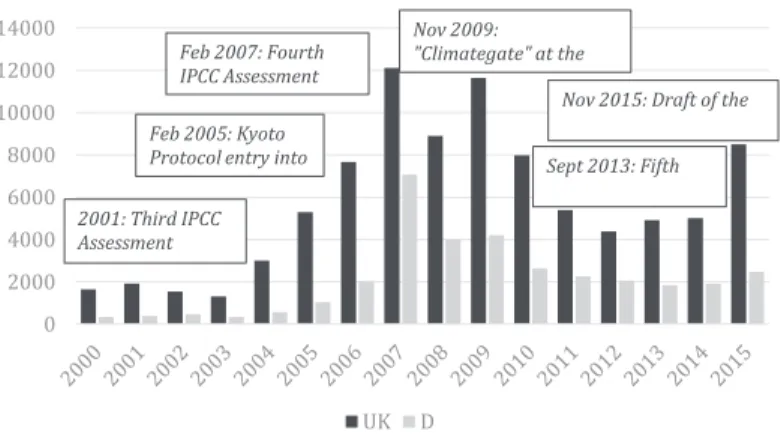
the news magazine GEO, the articles were searched manually (using their own archives) following the same procedure. To locate our sample within the large issue cycle of climate change, Figure 1 (Appendix A) displays the total number of articles containing the keywords for all the (available) newspapers and mag-azines in our sample from 2000 onwards. The figure shows that our sample was drawn in a period with a medium amount of coverage, which leads us to conclude that we were studying today’s typical debate about climate change in the German and British print media. Secondly, we drew a random sample of
1 UK: tabloids: Daily/Sunday Mirror, The People (now SundayPeople), Daily/Sunday Express,
Daily/Sunday Mail, The Sun, Daily/Sunday Star; broadsheets: The Guardian/The Observer, The Times/The Sunday Times, The Independent/The Independent on Sunday/i, The Telegraph/The Sunday Telegraph, Financial Times (UK edition).
D: tabloids: BILD/BILD on Sunday; broadsheets and weeklies: Süddeutsche Zeitung, Frankfurter
Rundschau, Die Welt/Welt on Sunday, taz, Frankfurter Allgemeine Zeitung/FAZ on Sunday, Der Spiegel, Der Focus, Der Stern, Financial Times Deutschland (included until its final publication on 7 December 2012), Die ZEIT, Handelsblatt, GEO.
35 articles per month for each country, which resulted in 420 articles for both the United Kingdom and Germany (henceforth ‘UK’ and ‘D’).
3.2 Frame identification
The selected articles were coded on two levels.3First, several formal variables
and up to three ‘most important actors’ (MIAs) were identified at the article level. An MIA might be an external source that was directly or indirectly cited by the journalists, or the journalists themselves expressing their views on cli-mate change. The journalist was coded as ‘MIA’ when either arguments about climate change were mentioned in an article but were not explicitly attributed to an external source, or in cases in which a journalist clearly expressed his or her own opinion. Actor importance was defined by the amount of space that was devoted to their statements (number of MIAs: D: N = 779, UK: N = 778).
At the actor level (the second level of the coding), several variables about the actor type and the content of the actors’ statements were coded, as follows.
Actor type. All MIAs were coded for their actor type (political actor,
socio-economic actor, civil-society organizations/NGOs, scientists/experts, journal-ists/media, and individual citizens).
Frame elements. As mentioned above, we understand framing as a social
discourse in which different actors try to promote their interpretations of an issue. In this understanding frames are always bound to specific actors who express them. Consequently, we measure frames on the actor-level and not on the level of the whole article.
In order to explore which frames were used to construct scientific uncer-tainty about climate change for each actor, we coded argument sequence vari-ables on 1) the actors’ problem definitions of climate change (beliefs or denials that climate change is occurring, opinions that climate change is a problem or not, and perspectives concerning climate change); 2) their causal interpreta-tions of climate change (i.e., human or natural causes) and any positive or negative consequences of global warming; and 3) actors’ references to scientific studies. For this last point, any references to scientific studies for all actors were coded up to three times in cases in which they cited scientific studies either to support or contradict anthropogenic climate change.
Thus, we did not code ‘whole’, previously defined, frames, but instead fol-lowed Matthes and Kohring’s methodology (2008, p. 263); they suggest splitting
3 The codebook is available at: http://www.ikmb.unibe.ch/ueber_uns/personen/e211585/
“up the frame into its separate elements, which can quite easily be coded in a content analysis”. This approach has several advantages: first, frames are not subjectively defined in advance, but are empirically determined. Second, the coder does not know which frames he or she has to search for, which minimizes the influence of coder schemata on the coding process. Third, it is possible to detect newly emerging frames using this approach (Matthes and Kohring, 2008).
The single frame-elements included in the codebook were first developed deductively, using earlier studies (e.g., Antilla, 2005; Boykoff and Boykoff, 2004; Painter and Ashe, 2012) and the Fourth IPCC Assessment (IPCC, 2007) report as a starting point. Second, the elements then became fully defined by inductively examining a sample of newspaper articles for further statements to ensure the integrity of our codebook. The aim of this combined approach was to identify all relevant and available arguments in the societal discussions about climate change. We undertook the quantification of the different argu-ments/frame-elements once the codebook had been fully defined and pretested. The coding was completed by six trained coders. The reliability of the variables at the actor-argument level was Krippendorff’s Alpha = .77, see Appendix B for detailed reliability scores.
Identification of frames. During the course of the data analysis, the single
frame elements were summarized into frames via hierarchical cluster analysis using different steps. First, we excluded any variables that occurred fewer than ten times in both countries (Matthes and Kohring, 2008); in the end, 33 vari-ables were included in the cluster analysis. Second, we computed a hierarchical cluster analysis using the single-linkage algorithm in order to identify any outli-ers. As no outliers could be identified, all actor-frame sequences (D: N = 779, UK: N = 778) were included in the analysis. We then ran a hierarchical cluster analysis using the Ward algorithm and the Euclidian distance measure for the binary data to identify the actual frames. We included the data of both coun-tries in one cluster analysis instead of running two separate analyses. The key advantage of this procedure is that the results can be compared directly; fur-thermore, since both countries entered the analysis with nearly equal numbers of cases, neither country had undue influence on the cluster solution.4
Using the elbow criterion (i.e., the increase of the error square sum), a five-cluster solution seemed to best fit our data, although this solution ended up with one cluster out of the five which was hardly interpretable. We thus decided
4 We ran two separate cluster analyses to further check this approach (one each for the
German and British actor-frame sequences); we then compared them to the overall analysis. The resulting frames appeared to be fairly stable, which substantiated our approach.
to stick to four clusters, which could be interpreted quite well. In order to interpret the clusters, we examined the shape of the means of the cluster-form-ing variables (tested with an ANOVA; p-value < .05, see Appendix C). As men-tioned above, we identified four frames: Frames 1 and 2 represented aspects of the scientific consensus, while Frames 3 and 4 conveyed the skeptical views of the countermovement.
Frame 1: The phenomenon of climate change (D: 45 %/UK: 45 %)
The first and most frequently used frame describes the general phenomenon of climate change; it explains that climate change is occurring, and that it is problematic. The specific view of the problem is based on technologies or tech-nical innovations in terms of energy generation or energy supply. The frame mentions anthropogenic contributions as causes of climate change, and the negative consequences that global warming can have. This position on climate change is further emphasized by the citation of scientific studies in support of human-caused climate change.
Frame 2: Negative consequences of climate change (D: 34 %/UK: 32 %)
Similarly, the second frame also states that climate change exists, and it ac-knowledges that global warming involves several problems. This is the second most dominant frame in the media coverage. The frame emphasizes several negative consequences of global warming: deglaciation, the increase of extreme weather events and natural disasters, sea-level rises and coastal/island flood-ing, and the shortage of water for drinking and agriculture. On a more general level, the frame also highlights the negative consequences for the ecosystem (i.e., damage to ecological systems, decrease of vegetation zones, the expulsion of species), the economy (i.e., damages to infrastructure and buildings, crop failure), or society (i.e., poverty, damage to health, dissemination of diseases).
Frame 3: Positive consequences of climate change (D: 19 %/UK: 16 %)
In contrast, the third frame also acknowledges that climate change occurs, but it neglects to mention or questions the idea that global warming is a problem. While the perspectives taken by actors who use this frame include the causes of climate change, as the second frame does, the third frame focuses on the consequences of climate change. In contrast to the second frame, however, actors mention the consequences 1) without an evaluation; 2) with both positive and negative evaluations (thus, the evaluation is ambivalent); or 3) with an explicitly positive assessment. For instance, this third variety might include positive economic consequences (i.e., higher profits for the tourism industry) or positive ecological consequences (i.e., new cultivable land, or an increase in
species diversity). O’Neill, Williams, Kurz, Wiersma, and Boykoff (2015) found a similar frame in their qualitative study – which they named ‘opportunity (O2)’ – that emphasizes the beneficial impacts of climate change. They stated that this frame often corresponds to an emphasis on uncertainty in climate science (and its related solutions and impacts) and thus, may be linked to climate skepticism. This frame also contradicts one of the core assumptions of the IPCC: that global warming poses a severe threat to humanity (IPCC, 2013). Thus, we interpret this frame to be skeptical, although the argumentation is more subtle than in the fourth frame.
Frame 4: ‘Trend and attribution’ skepticism (D: 3 %/UK: 7 %)
The fourth frame can be perceived as an interpretative pattern that is purely skeptical. First, it includes the opinion that climate change is not occurring, or at least that it is not possible to prove whether or not climate change is occur-ring. This form of skepticism is labelled ‘trend skepticism’ (Rahmstorf, 2004). The perspective on climate change is very general; no specific aspect is high-lighted. Concomitant with this general denial of climate change is the notion that anthropogenic contributions are not clear, and that natural causes are responsible for the phenomenon – a position named ‘attribution skepticism’ (Rahmstorf, 2004). The fourth frame also denies that rising temperatures are a consequence of climate change, or it describes any correlation as being unclear.
3.3 Frame aggregation
Finally, the information about the frames that were identified was aggregated at the article level. As described in the theoretical section, certain articles were defined as articles that either only contained frames of climate advocates who follow scientific consensus (Frames 1 and/or 2) or as articles that present only frames of the skeptical countermovement (Frames 3 and/or 4). Articles were considered ‘uncertain’ when they contained at least one frame from both sides, and thus presented the issue as being contested.
4 Results
Based on previous research, our first research question asked whether we can observe differences regarding the prevalence of scientific uncertainty about cli-mate change between British and German press coverage. As Table 1 shows, there are only marginal, statistically non-significant differences between the
Table 1: Salience of uncertainty in German (D) and British (UK) coverage.
D UK
Certainty
Purely advocating articles (articles that follow scientific consensus) 71 % 71 %
Purely skeptical articles 19 % 15 %
Uncertainty 10 % 14 %
Basis: N = 420 articles in each country; Cramer’s V = .07, n.s.
two countries: at the article level controversial articles that relay an image of uncertainty appear slightly more frequently in the United Kingdom (14 %) than in Germany (10 %). Across all newspaper articles, thus taking the whole picture displayed in Table 1 into account, purely skeptical articles were somewhat more pronounced in German newspapers (19 %) than in British ones (15 %)5.
In order to address the second research question (about which frames are used to create different images of uncertainty), we examined the distribution of frames in certain and uncertain articles (Table 2 and Table 3). The results show that in both countries, journalists frequently used both advocate frames of the phenomenon of climate change (Cramer’s V = 0.003, n.s.) and negative consequences (Cramer’s V = .013, n.s.) to create certainty about climate change, although the more general frame was used somewhat more frequently in both countries. Again, there was no statistically significant difference between the two countries.
In contrast, we found that journalists who tried to construct an image of certainty opposing the consensus mainly based their argumentation on one frame that emphasized the positive consequences of global warming (Cramer’s
V = .13, n.s.). This argumentation was more widespread in German newspaper
coverage (91 %) than in British coverage (83 %), where certainty opposing the consensus was also created by the spreading of ‘trend and attribution’ skepti-cism (25 %; Cramer’s V = .22, p < .05).
5 As complementary analysis we analyzed the actors’ treatment recommendations on
mitiga-tion and adaptamitiga-tion acmitiga-tions. The results show that in the majority of articles in which the scientific consensus was followed, the actors discussed or supported adaptation or mitigation measures (D: 75 %, UK: 64 %). This numbers declined within the controversial (and thus uncertain) articles: Treatment recommendations were mentioned in only 53 % of the German and 59 % of the British articles. Finally, among the purely skeptical articles, only 13 % of German and 8 % of British articles featured actors who supported regulations to adapt to or mitigate climate change. We may thus see that the way in which the scientific evidence of climate change is discussed has a direct influence on actors’ support of policy actions.
Table 2: Frames used to create an image of certainty (article level).
Certainty
Purely advocating articles Purely skeptical articles
Frames D UK D UK
Phenomenon of climate change 60 % 60 % − −
Negative consequences 50 % 51 % − −
Positive consequences − − 91 % 83 %
Trend/attribution skepticism − − 9 % 25 %
N (number of articles) 300 300 79 63
Note: Multiple frames per article possible.
Table 3: Frames used to create an image of uncertainty (article level).
Uncertainty
Controversial articles
Opposing frames D UK
Phenomenon of climate change vs. Positive consequences 37 % 28 % Phenomenon of climate change vs. Trend/attribution skepticism 17 % 32 % Negative consequences vs. Positive consequences 56 % 44 % Negative consequences vs. Trend/attribution skepticism 10 % 14 %
N (number of articles) 41 57
Note: Multiple “opposing frames” per article possible.
Table 3 displays the different combinations of the identified frames journal-ists could use to create controversy within an article. The results show that uncertainty was differently constructed in the two countries: In the German coverage, the negative and positive consequences were more strongly played off against one another. In the United Kingdom, in contrast, the phenomenon of climate change was more frequently due to trend/attribution skepticism. However, none of the differences was statistically significant.
Our third research question addresses the role of cited actors and journal-ists in portraying climate change either in a certain or uncertain way. Figures 1 and 2 show the proportions of the different actor groups in both types of certain articles, the purely advocating and the purely skeptical ones.
The results show that in purely advocating articles, political actors, fol-lowed by journalists and scientists/experts, mainly speak for the climate
(Fig-Figure 1: Actors in purely advocating articles.
Figure 2: Actors in purely skeptical articles.
ure 1); there are hardly any differences between the two countries. One reason for the large number of political actors in the articles is that journalists consider such actors to be newsworthy due to their influence and prominence. On the other hand, politicians themselves have an interest in being publically per-ceived as climate advocates, as this will provide the basis for them to legitimize political actions that will adapt to or mitigate climate change.
For the purely skeptical articles, the most striking finding is the large pro-portion of journalists who express their own views on climate change in
addi-Figure 3: Opposing actors in uncertain/controversial articles (top five).
tion to those of the skeptical scientists they cite (Figure 2). This means that in both countries journalists play an active role in constructing climate skepti-cism. More skeptical scientists are cited in German articles than in British arti-cles, whereas more civil-society organizations present skeptical arguments in the United Kingdom than in Germany.
Figure 3 displays the five most frequently mentioned pairs of actors who oppose one another in controversial articles. As already shown for the usage of frames for creating uncertainty (Table 3), in terms of the actors who oppose one another in controversial articles, we also found differences in the coverage between the two countries. Whereas in Germany the ‘dueling scientist’ scenario was the most common in contested articles, in the British coverage the dispute was mainly between political actors and journalists. In general, controversy in the German print media more often involves scientists, whereas in the United Kingdom politicians are more prominent in conflictual articles.
5 Discussion
The aim of our study was to examine the salience and construction of scientific uncertainty in European media coverage of climate change from a comparative perspective. To do this, we used quantitative data to compare climate change coverage in the German and British print media from June 2012 to May 2013, a time span where no unusual external events, except from the annual climate conferences, occurred.
In both countries the majority of articles follow the scientific consensus on the occurrence, the anthropogenic contributions and the negative
consequen-ces of global warming. Most of the coverage thus conveys an image of scientific certainty on climate change, which is in line with findings from previous re-search (e.g., Painter and Ashe, 2012). Consequently, the results also show no cross-national differences regarding the general prevalence of scientific uncer-tainty. In both countries uncertainty appears both within single news articles and across all news articles (i.e., at the level of the whole coverage).
Additionally, our findings show that the number of articles containing skeptical voices increased in both countries, compared to former studies (Kaiser and Rhomberg, 2015; Painter and Gavin, 2015). But the type of skepticism dif-fers: whereas skepticism in the German press coverage focuses more on the positive impacts of climate change, in the United Kingdom trend and attribu-tion skepticism is far more widespread. These types of skepticism discount either the occurrence of global warming or anthropogenic contributions to glob-al warming, and are thus fundamentglob-al forms of skepticism. Considering the public debate on climate change, such uncontested, purely skeptical articles create the illusion of uncertainty, since they contradict the scientific consensus that the majority of the coverage provides. One explanation for these differen-ces regarding the stressed type of skepticism could be the dominant position of the tabloid press within the British media system. Tabloids usually have no fixed group of subscribers and depend heavily on direct ‘on the street’ sales. Thus, they use different mechanisms to generate the highest possible attention to attract readers and buyers. Furthermore, the British press market is very competitive, which further creates the need to draw attention and to find unique selling points that will differ from other news outlets. One way to gain attention is to highlight conflict and controversy; involving influential and prominent actors such as politicians makes the coverage even more enticing for potential readers. The highlighting of ‘trend and attribution’ skepticism fits into this pattern, as this is one of the simplest and most undifferentiated forms of skepticism. This type of coverage (and, in particular, the emphasis on funda-mental skepticism) could perhaps be related to the more skeptical attitudes of the British population compared to their counterparts in Germany.
Our findings regarding the actors involved in the climate debate reveal that the British controversy is mainly dominated by political actors whereas in Germany scientists and experts are more strongly engaged in the debate. This finding, that the climate discourse in the British media is mainly political in nature rather than scientific, supports the observation that in Britain climate skepticism has become more strongly politically motivated over the past years (Carter, 2014). Thus, the open question remains of whether and how the rising climate skepticism in the German media will affect public opinion and climate politics in the long run.
Strikingly, in both countries journalists themselves played a very active role in the construction of uncertainty through climate skepticism. Based on our results, we can thus state that journalists transform (and not merely convey) information about climate change (Dearing, 1995). It would appear that journal-ists may be found in both countries that personally hold skeptical views about climate change (see also Brüggemann and Engesser, 2014); they promote these views in their coverage of the issue and thus create, intentionally or not, the illusion of scientific uncertainty.
This controversial and uncertain coverage can have several effects on the audience. First, by lending prominence (and thus credibility) to maverick sci-ence, there appears to be far more controversy than there actually is within the scientific community. Second, this controversy reduces the audience’s percep-tions of scientific certainty (Corbett and Durfee, 2004), and can thus decrease people’s trust in science (for example, see Jensen and Hurley, 2012). Third, this leads to an over-representation in the coverage of the views of a small minority of opposing scientists, which makes these ‘outliers’ seem more important in the scientific discourse than is actually the case. One consequence of this situa-tion may be that the credibility of the ‘majority’ science suffers. The popular perception that conflicting standpoints exist within climate science may also lead to decreasing support for binding policies that would mitigate global warming within different societies. This may in turn hinder the transformation into national regulations of the success achieved at the most recent conference of the parties (COP) in Paris 2015.
On a more general level, the question arises: which external reality should the media reflect in its coverage? Because climate scientists have reached a widely accepted consensus on the core assumptions of global warming, it seems reasonable to assume that the media should reflect this consensus (in-stead of creating uncertainty), since this may distort the way in which the audience perceives global warming (see above). One could also argue, however, that the media should primarily reflect any discussions that are prevalent with-in civil society (e.g., followwith-ing Habermas’ claims). Withwith-in this lwith-ine of reasonwith-ing, they should also report on any skeptical arguments. Following the liberal model, media should mainly cover any discussions among the political elites (which, in Germany and the United Kingdom, also mainly follow the scientific consensus).
A further limitation of our study, of course, is that we only examined news-paper coverage; uncertainty and controversial reporting about climate change also occur in other important media outlets (e.g., TV and radio). Online commu-nication would be an especially interesting area for further research: with its low entry barriers and the absence of journalistic selection criteria, online news
outlets appear to be an important platform, especially for skeptical and contro-versial (and, thus, uncertain) reporting about climate change. Additionally, we examined the construction of uncertainty only for one year from June 2012 to May 2013. As this year was not distorted by unexpected or unusual natural, scientific or political events, media coverage might appear different in another time period. Thus, to examine how external events trigger the media’s construc-tion of scientific uncertainty, further studies taking a longitudinal approach are needed.
Acknowledgment: This publication was created in the context of the Research Unit “Political Communication in the Online World” (1381), subproject 7, which is funded by the DFG, German Research Foundation. The subproject is also funded by the Swiss National Science Foundation (SNF, 100017E-135915).
References
Anderegg, W., Prall, J. W., Harold, J., & Schneider, S. 2010. Expert credibility in climate change. PNAS. 107. 12107−12109.
Antilla, L. 2005. Climate of scepticism: US newspaper coverage of the science of climate change. Global Environmental Change. 15(4). 338−352.
Bennett, W. L. 2011. The politics of illusion (9thedition). Chicago: University of Chicago Press.
Böhler-Baedeker, S., & Mersmann, F. 2013. Ein Ziel, viele Strategien. Klimapolitik in
Deutschland [A common goal, many strategies. Climate policy in Germany].
Bundeszentrale für politische Bildung. Retrieved 11 November 2015 from http:// www.bpb.de/gesellschaft/umwelt/klimawandel/38554/klimapolitik-in-deutschland. Boykoff, M. T. 2007. Flogging a dead norm? Newspaper coverage of anthropogenic climate
change in the United States and United Kingdom from 2003 to 2006. Area. 39(4). 470− 481.
Boykoff, M. T., & Boykoff, J. M. 2004. Balance as bias: Global warming and the US prestige press. Global Environmental Change. 14(2). 125−136.
Boykoff, M. T., & Mansfield, M. 2008. ‘Ye olde hot aire’: Reporting on human contributions to climate change in the UK tabloid press. Environmental Research Letters. 3(2). 1−8. Brossard, D., Shanahan, J., & McComas, K. 2004. Are issue-cycles culturally constructed? A
comparison of French and American coverage of global climate change. Mass
Communication & Society. 7(3). 359−377.
Brüggemann, M., & Engesser, S. 2014. Between consensus and denial: Climate journalists as interpretive community. Science Communication. doi:10.1177/1075547014533662 Brunnengräber, A. 2013. Klimaskeptiker in Deutschland und ihr Kampf gegen die
Energiewende [Climate skeptics in Germany and their fight against national energy
transition]. Berlin: Forschungszentrum für Umweltpolitik. Retrieved 01 December 2015 from http://edocs.fu-berlin.de/docs/receive/FUDOCS_document_000000017134.
Cacciatore, M. A., Anderson, A. A., Choi, D.-H., Brossard, D., Scheufele, D. A., Liang, X., … Dudo, A. 2012. Coverage of emerging technologies: A comparison between print and online media. New Media & Society. 14(6). 1039−1059.
Carragee, K. M., & Roefs, W. 2004. The neglect of power in recent framing research. Journal
of Communication. 54(2). 214−233.
Carter, N. 2014. The politics of climate change in the UK. Wiley Interdisciplinary Reviews:
Climate Change. 5(3). 423−433.
Clarke, C. E. 2008. A question of balance: The autism-vaccine controversy in the British and American elite press. Science Communication. doi:10.1177/1075547008320262 Corbett, J. B., & Durfee, J. L. 2004. Testing public (un)certainty of science. Media
representations of global warming. Science Communication. 26(2). 129−151.
Dearing, J. W. 1995. Newspaper coverage of maverick science: Creating controversy through balancing. Public Understanding of Science. 4(4). 341−361.
Dixon, G. N., & Clarke, C. E. 2012. Heightening uncertainty around certain science: Media coverage, false balance, and the autism-vaccine controversy. Science Communication. 35. 358−382.
Dunwoody, S., & Peters, H. P. 1992. Mass media coverage of technological and environmental risks: A survey of research in the United States and Germany. Public
Understanding of Science. 1(2). 199−230.
Einsiedel, E., & Thorne, B. 1999. Public responses to uncertainty. In
S. M. Friedman, S. Dunwoody & C. L. Rogers (Eds.), Communicating uncertainty: Media
coverage of new and controversial science (pp. 43−57). Mahwah, NJ: Lawrence Erlbaum.
Engels, A., Hüther, O., Schäfer, M., & Held, H. 2013. Public climate-change skepticism, energy preferences and political participation. Global Environmental Change. 23(5). 1018−1027.
Entman, R. M. 1993. Framing: Toward clarification of a fractured paradigm. Journal of
Communication. 43(4). 51−58.
Eurobarometer 2011. Special Eurobarometer 372 – Climate change. Brussels: European Commission.
Gamson, W., & Modigliani, A. 1989. Media discourse and public opinion on nuclear power: A constructionist approach. The American Journal of Sociology. 95(1). 1−37.
Grundmann, R. 2007. Climate change and knowledge politics. Environmental Politics. 16(3). 414−432.
Grundmann, R., & Scott, M. 2014. Disputed climate science in the media: Do countries matter? Public Understanding of Science. 23(2). 220−235.
Guenther, L., Bader, C., Kessler, S. H., & Ruhrmann, G. 2015. Journalistische Wahrnehmung und Darstellung von (Un)Sicherheiten, Risiken und Chancen von Zukunftstechnologien [Journalistic perception and representations of (un)certainties, risks and chances of future technologies]. In H. Bonfadelli, S. Kristiansen, & M. S. Schäfer (Eds.),
Wissenschaftskommunikation im Wandel (pp. 205−231). Köln: Herbert von Halem.
Guenther, L., & Ruhrmann, G. 2016. Scientific evidence and mass media: Investigating the journalistic intention to represent scientific uncertainty. Public Understanding of
Science (online before print). doi:10.1177/0963662515625479
IPCC 2007. Climate change 2007: Synthesis report. Retrieved 15 March 2016 from https:// www.ipcc.ch/publications_and_data/publications_ipcc_fourth_assessment_report_ synthesis_report.htm.
IPCC 2013. Summary for Policymakers. In: T. F. Stocker, D. Qin, G.-K. Plattner, M. Tignor, S. K. Allen, J. Boschung, … P. M. Midgley (Eds.), Climate change 2013: The physical science
basis (pp. 3−29). Retrieved 15 March 2016 from
https://www.ipcc.ch/pdf/assessment-report/ar5/wg1/WG1AR5_Frontmatter_FINAL.pdf.
ISSP Research Group 2012. International social survey programme: Environment III − ISSP
2010. GESIS Data Archive, Cologne. ZA5500 data file, version 2.0.0. doi:10.4232/1.11418
Jensen, J. D., & Hurley, R. J. 2012. Conflicting stories about public scientific controversies: Effects of news convergence and divergence on scientists’ credibility. Public
Understanding of Science. 21(6). 689−704.
Juhola, S., & Westerhoff, L. 2011. Challenges of adaptation to climate change across multiple scales: A case study of network governance in two European countries.
Environmental Science & Policy. 14(3). 239−247.
Kaiser, J., & Rhomberg, M. 2015. Questioning the doubt: Climate skepticism in German newspaper reporting on COP17. Environmental Communication. doi:10.1080/ 17524032.2015.1050435
Lorenz, S., Dessai, S., Paavola, J., & Forster, P. M. 2013. The communication of scientific
uncertainty in European national adaptation strategies. Retrieved 29 September 2015
from http://www.see.leeds.ac.uk/fileadmin/Documents/research/sri/workingpapers/ SRIPs-43.pdf.
Maier, M., Rothmund, T., Retzbach, A., Otto, L., & Besley, J. C. 2014. Informal learning through science media usage. Educational Psychologist. 49(2). 86−103.
Matthes, J., & Kohring, M. 2008. The content analysis of media frames: Toward improving reliability and validity. Journal of Communication. 58(2). 258−279.
Maurer, M. 2011. Wie Journalisten mit Ungewissheit umgehen. Eine Untersuchung am Beispiel der Berichterstattung über die Folgen des Klimawandels [How journalists cope with uncertainty. A study on the coverage of the effects of climate change]. Medien &
Kommunikationswissenschaft. 59(1). 60−74.
Miller, K. 1992. Smoking up a storm: Public relations and advertising in the construction of the cigarette problem, 1953−1954. Journalism Monographs. 136. 1−35.
Olausson, U. 2009. Global warming, global responsibility? Media frames of collective action and scientific certainty. Public Understanding of Science. 18(4). 421−436.
O’Neill, S., Williams, H. T. P., Kurz, T., Wiersma, B., & Boykoff, M. 2015. Dominant frames in legacy and social media coverage of the IPCC Fifth Assessment Report. Nature Climate
Change. 5(4). 380−385.
Oreskes, N. 2004. Beyond the ivory tower: The scientific consensus on climate change.
Science. 306(5702). 1686.
Painter, J. 2013. Climate change in the media: Reporting risk and uncertainty. London: I. B. Tauris.
Painter, J., & Ashe, T. 2012. Cross-national comparison of the presence of climate scepticism in the print media in six countries, 2007–10. Environmental Research Letters. 7(4). 1−8. Painter, J., & Gavin, N. T. 2015. Climate skepticism in British newspapers, 2007−2011.
Environmental Communication. 1−21.
Peters, H. P., & Heinrichs, H. 2008. Legitimizing climate policy: The ‘risk construct’ of global climate change in the German mass media. International Journal of Sustainability
Communication. 3(1). 14−36.
Poortinga, W., Spence, A., Whitmarsh, L., Capstick, S., & Pidgeon, N. F. 2011. Uncertain climate: An investigation into public scepticism about anthropogenic climate change.
Global Environmental Change. 21(3). 1015−1024.
Rahmstorf, S. 2004. The climate sceptics. Potsdam: Potsdam Institute for Climate Impact Research.
Ruhrmann, G., Guenther, L., Kessler, S. H., & Milde, J. 2013. Frames of scientific evidence: How journalists represent the (un)certainty of molecular medicine in science television programs. Public Understanding of Science. doi:10.1177/0963662513510643
Schäfer, M. S. 2011. Sources, characteristics and effects of mass media communication on science: A review of the literature, current trends and areas for future research.
Sociology Compass. 5(6). 399−412.
Schmid-Petri, H. (in press). Do conservative media provide a forum for skeptical voices? The link between ideology and the coverage of climate change in British, German, and Swiss newspapers. Environmental Communication.
Schmid-Petri, H., Adam, S., Schmucki, I., & Häussler, T. (2015, online first). A changing climate of skepticism? The factors shaping climate change coverage in the US press.
Public Understanding of Science. doi:10.1177/0963662515612276
Speers, T., & Lewis, J. 2004. Journalists and jabs: Media coverage of the MMR vaccine.
Communication & Medicine. 1(2). 171−181.
Stocking, S. H. 1999. How journalists deal with scientific uncertainty. In
S. M. Friedman, S. Dunwoody & C. L. Rogers (Eds.), Communicating uncertainty: Media
coverage of new and controversial science (pp. 23−41). Mahwah, NJ: Lawrence Erlbaum.
Stocking, S. H., & Holstein, L. W. 2009. Manufacturing doubt: Journalists’ roles and the construction of ignorance in a scientific controversy. Public Understanding of Science. 18(1). 23−42.
Taylor, N., & Nathan, S. 2002. How science contributes to environmental reporting in British newspapers: A case study of the reporting of global warming and climate change. The
Environmentalist. 22. 325−331.
Weingart, P., Engels, A., & Pansegrau, P. 2000. Risks of communication: Discourses on climate change in science, politics, and the mass media. Public Understanding of
Science. 9(3). 261−283.
Zehr, S. C. 2000. Public representations of scientific uncertainty about global climate change. Public Understanding of Science. 9(2). 85−103.
Appendix A
Figure 1: Amount of coverage about climate change in British and German newspapers,
2000−2015.
Displayed is the number of articles of the newspapers included in the sample using the same search procedure and the search terms as used for the sample of the study. Excluded are the Financial Times, the Daily Star Sunday, “i”, GEO and BILD/BILD on Sunday as they are not (or not for the whole time period from 2000 to 2015) available in our databases. The boxes contain information about climate-change-related events which may have influenced the coverage significantly (the IPCC Assessment Report release dates correspond to the publi-cation of the “Summary for Policymakers”).
Appendix B: Average reliability scores for the
used variables
1. Average agreement concerning the identification of the three most important actors (MIAs): 77 %
2. Variables on the actor-argument level (Krippendorff‘s Alpha):
Group the actor belongs to .82
Occurrence of climate change .69
Climate change seen as a problem .75
Perspective on climate change .70
Causes of climate change .75
Consequences of climate change .76
Treatments .76
Reference to scientific studies .77
Type of study (supporting anthropogenic climate change: yes/no/ .79 not identifiable)
Position of the MIA with regard to the study .91
N = 30 commonly identified MIAs; each coder was compared separately to a master coding.
Appendix C: Mean values for the binary coded
frame element variables
F1: F2: Neg. F3: Pos. F4: Phenomenon consequences consequences Skepticism Problem definition/perspective
cc occurs 1.0 1.0 1.0
cc does not occur .55
not identifiable if cc .41
occurs
cc seen as problem .99 .99
cc not seen as problem .06
not identifiable if cc is a .94
problem
Persp.: consequences .09 .78 .62 .19 Persp.: technologies .03 Persp.: cc in general .06 .45 Causes Anthropogenic causes .42 .15 .13 mentioned Natural causes .08 .11 mentioned Anthropogenic contribu- .11 tion unclear Negative consequences warming/rise of temp. .24 .40
extreme weather events .38
shortage of water .25
neg. ecological cons. .31
neg. economic cons. .21
neg. social cons. .17
unspecific neg. cons. .18 .08
Positive consequences
Pos. ecological cons. .05
Pos. economic cons. .06
Denied as consequence/unclear if consequence
warming/rise of temp. .47
extreme weather events .06
unspecific consequences .16
As consequence mentioned (without assessment)
warming/rise of temp. .11 .41 .08
shortage of water .17
ecol. consequences .12
Reference to scientific studies
studies in support of .11 anthropogenic climate change
Notes: “cc” = climate change.
All variables that occurred fewer than ten times in both countries were excluded from the cluster analysis.
Not displayed in the table are variables which either did not differ significantly between the clusters or their mean appeared to be negligibly small (< .05). These were: perspective: role of science & cause: CO2in general mentioned, consequences: extreme weather events men-tioned, sea-level rise as neg. consequence.