HAL Id: hal-00298191
https://hal.archives-ouvertes.fr/hal-00298191
Submitted on 6 Jul 2007HAL is a multi-disciplinary open access
archive for the deposit and dissemination of sci-entific research documents, whether they are pub-lished or not. The documents may come from teaching and research institutions in France or abroad, or from public or private research centers.
L’archive ouverte pluridisciplinaire HAL, est destinée au dépôt et à la diffusion de documents scientifiques de niveau recherche, publiés ou non, émanant des établissements d’enseignement et de recherche français ou étrangers, des laboratoires publics ou privés.
Changes in C3/C4 vegetation in the continental interior
of the Central Himalayas associated with monsoonal
paleoclimatic changes during the last 600 kyr
M. Mampuku, T. Yamanaka, M. Uchida, R. Fujii, T. Maki, H. Sakai
To cite this version:
M. Mampuku, T. Yamanaka, M. Uchida, R. Fujii, T. Maki, et al.. Changes in C3/C4 vegetation in the continental interior of the Central Himalayas associated with monsoonal paleoclimatic changes during the last 600 kyr. Climate of the Past Discussions, European Geosciences Union (EGU), 2007, 3 (4), pp.871-898. �hal-00298191�
CPD
3, 871–898, 2007 Changes in C3/C4 vegetation in the Central Himalayas M. Mampuku et al. Title Page Abstract Introduction Conclusions References Tables Figures ◭ ◮ ◭ ◮ Back CloseFull Screen / Esc
Printer-friendly Version Interactive Discussion
EGU
Clim. Past Discuss., 3, 871–898, 2007 www.clim-past-discuss.net/3/871/2007/ © Author(s) 2007. This work is licensed under a Creative Commons License.
Climate of the Past Discussions
Climate of the Past Discussions is the access reviewed discussion forum of Climate of the Past
Changes in C
3
/C
4
vegetation in the
continental interior of the Central
Himalayas associated with monsoonal
paleoclimatic changes during the last
600 kyr
M. Mampuku1, T. Yamanaka1,*, M. Uchida2,**, R. Fujii1, T. Maki1,***, and H. Sakai1
1
Department of Evolution of Earth Environments, Graduate School of Social and Cultural Studies, Kyushu University, Ropponmatsu, Fukuoka 810-8560, Japan
2
Institute of Oceanographic Research for Global Changes (IORGC), Japan Agency for Marine-Earth Science and Technology (JAMSTEC), Yokosuka 237-0061, Japan *
now at: Division of Earth Science, Graduate School of Natural Science and Technology, Okayama University, Okayama 700-8530, Japan
**
now at: Environmental Chemistry Division, National Institute for Environmental Studies, Tsukuba 305-8560, Japan
CPD
3, 871–898, 2007 Changes in C3/C4 vegetation in the Central Himalayas M. Mampuku et al. Title Page Abstract Introduction Conclusions References Tables Figures ◭ ◮ ◭ ◮ Back CloseFull Screen / Esc
Printer-friendly Version Interactive Discussion
EGU
∗∗∗now at: Center for Deep Earth Exploration (CDEX), Japan Agency for Marine-Earth Science and Technology (JAMSTEC), Yokohama 236-0001, Japan
Received: 18 June 2007 – Accepted: 2 July 2007 – Published: 6 July 2007 Correspondence to: M. Mampuku ([email protected])
CPD
3, 871–898, 2007 Changes in C3/C4 vegetation in the Central Himalayas M. Mampuku et al. Title Page Abstract Introduction Conclusions References Tables Figures ◭ ◮ ◭ ◮ Back CloseFull Screen / Esc
Printer-friendly Version Interactive Discussion
EGU
Abstract
A continuous lacustrine sediment core obtained from the Kathmandu Valley in the Central Himalayas revealed that cyclical changes in C3/C4 vegetation corresponded
to global glacial-interglacial cycles from marine isotope stages (MIS) 15 to MIS 4. The C3/C4vegetation shifts were reconstructed from significant changes in the δ
13
C values
5
of bulk organic carbon. Glacial ages were characterized by significant13C enrichment, due to the expansion of C4 plants, attributed to an intensification of aridity. Thus, the southwest (SW) summer monsoon, which brings the majority of rainfall to the Central Himalayan southern slopes, would have been weaker. Marine sediment cores from the Indian Ocean and Arabian Sea have demonstrated a weaker SW monsoon during
10
glacial periods, and our results confirm that arid conditions and a weak SW monsoon prevailed in the continental interior of the Central Himalayas during glacial ages. This study provides the first continuous record for the continental interior of paleoenviron-mental changes directly influenced by the Indian monsoon.
1 Introduction
15
The climate of East and South Asia is controlled greatly by the highly seasonal mon-soonal climatic system, with wet summers and dry winters (Hastenrath, 1985; Webster, 1987). The Indian monsoon system is characterized by strong southwest (SW) mon-soon winds blowing from the ocean toward the continent and carrying moisture and rain over the land during summer; northeast dry winds, blowing from the continent toward
20
the ocean, dominate during winter. Climate model simulations have demonstrated that the Asian monsoon system and its evolution are closely linked to the uplift of the Ti-betan plateau (Manabe, 1974; Hahn and Manabe, 1975; Kutzback et al., 1993; Kitoh, 1997; Ruddiman, 1997; Abe et al., 2003; Kitoh, 2004). Geological data obtained from both the continent (Quade and Cerling, 1995; Dettman et al., 2001) and ocean (Kroon
25
CPD
3, 871–898, 2007 Changes in C3/C4 vegetation in the Central Himalayas M. Mampuku et al. Title Page Abstract Introduction Conclusions References Tables Figures ◭ ◮ ◭ ◮ Back CloseFull Screen / Esc
Printer-friendly Version Interactive Discussion
EGU
change and the uplift of the Himalayas and Tibetan plateau.
During the late Quaternary, monsoon strength differed between glacial and inter-glacial periods. Many paleoclimatic records from Indian Ocean and Arabian Sea ma-rine sediment cores indicate that the SW monsoon was stronger during interglacial pe-riods and weaker during glacial pepe-riods (Van Campo et al., 1982; Prell and Van Campo,
5
1986; Sarkar et al., 1990; Muzuka, 2000). Although monsoonal climate change affects both continents and oceans, terrestrial information on these changes in the Indian sub-continent is very limited (Krishnamurthy et al., 1986; Agrawal et al., 1989; Sakai, 2001). An arid climate is presumed to have prevailed on land during glacial periods, because of the weak SW monsoon. However, Niitsuma et al. (1991) concluded that the climate
10
of the Arabian Peninsula was more humid during glacial periods than during inter-glacial periods, on the basis of the paleoclimatic record contained in sediment cores obtained on ODP Leg 117 (Neogene Package). Thus, the continuous monsoonal cli-mate change record during the Quaternary glacial-interglacial period is still uncertain. Continuous climatic records from the continental interior are needed to clarify how the
15
Indian monsoon system changed during the Quaternary.
The Kathmandu Valley is a key site for tracing the terrestrial climate effects of changes in the Indian monsoon. The valley is an intermontane basin, located on the southern slopes of the Central Himalayas, and is under the direct influence of the present monsoon. The dry lakebed of Paleo-Kathmandu Lake (PKL) is filled with thick
20
lacustrine and fluvial sediments from the late Pliocene to Quaternary (Sakai, 2001). PKL was about 25 km in diameter, with a water depth estimated at 75 m or more (Sakai et al., 2001a). In 2000, a core-drilling program was undertaken in the lacustrine basin-fill sediments, which were expected to record long-term, continuous paleoenvironmen-tal changes in the region (Sakai, 2001). A continuous 218-m-long core was obtained
25
at Rabibhawan, in central Kathmandu Valley (Fig. 1). We used this core (RB core), composed mainly of clayey and muddy lacustrine sediments, for multi-proxy paleoen-vironmental analyses.
CPD
3, 871–898, 2007 Changes in C3/C4 vegetation in the Central Himalayas M. Mampuku et al. Title Page Abstract Introduction Conclusions References Tables Figures ◭ ◮ ◭ ◮ Back CloseFull Screen / Esc
Printer-friendly Version Interactive Discussion
EGU
vegetation changes controlled by climatic changes. Land plants are classified as C3 or C4 on the basis of different photosynthetic pathways. The C3 (mainly trees) and
C4 (herbs) plants can be clearly distinguished by their carbon isotopic compositions
(δ13C). The average δ13C value for C3plants is about –28‰, whereas that for C4plants
is –14‰ (O’Leary, 1988). C3/C4vegetation shifts are controlled mainly by precipitation,
5
temperature, and the partial pressure of atmospheric carbon dioxide (pCO2) (Collatz
et al., 1998). Although identifying the underlying causes of C3/C4 vegetation shifts is
complex, C4plant expansions have been recognized in the Cretaceous, late Miocene, and last glacial maximum (LGM) (Cole and Monger, 1994; Cerling et al., 1997; Street-Perrott et al., 1997; Kuypers et al., 1999).
10
We analyzed the terrestrial C3/C4 vegetation changes associated with monsoonal climatic changes in the valley during the middle to late Pleistocene. Here, we present changes in total organic carbon (TOC), total nitrogen (TN), the stable carbon iso-topic composition (δ13C) of TOC, and the n-alkane compositions recorded in the RB core. This is the first report on the continuous terrestrial record of paleoenvironmental
15
changes on the southern slopes of the Central Himalayas obtained from an organic geochemical study.
2 Samples and methods
2.1 Study area and samples
The Kathmandu Basin, located around lat. 27◦40′N, lies in warm temperate-subtropic
20
climatic zones and has an annual average temperature of 18◦C. The annual average precipitation is 1500 mm. More than 80% of rain falls in the three summer months. The basin is surrounded by 2400–2800-m-high mountains, and the average eleva-tion of the valley floor is about 1340 m above sea level. The Kathmandu Valley is an isolated, closed basin, and basin-fill sediments are supplied only from the mountains
25
CPD
3, 871–898, 2007 Changes in C3/C4 vegetation in the Central Himalayas M. Mampuku et al. Title Page Abstract Introduction Conclusions References Tables Figures ◭ ◮ ◭ ◮ Back CloseFull Screen / Esc
Printer-friendly Version Interactive Discussion
EGU
Shima-Castanopsis forest, but index plants of subtropical climates, such as Bombax in
the southern area of the valley, are also present. Quercus is predominant on mountain slopes from 1800 to 2700 m in altitude (Stainton, 1972; Malla et al., 1976).
The RB core drilled by percussion method up to 83 m (core diameter: 6.5 cm) and by wire-line method below 89 m in depth (core diameter: 4.5 cm). The core was composed
5
mainly of continuous clayey and muddy lacustrine sediments (Sakai et al., 2001a). From 12 m to 180 m, the Kalimati Formation was predominant. This clay bed was rich in organic matter and yielded carbonaceous fragments and plant and animal remains (Sakai et al., 2001a). The Kalimati Formation showed open lacustrine facies, judging from the presence of laminated clay with abundant fossil leaves and diatomaceous
10
laminite (Sakai et al., 2001a). From 83 m to 89 m was a sand bed, interpreted as an event-deposit, caused by a sudden lowering of the lake level for a short period (Sakai et al., 2001b).
Throughout the whole sequence of the clayey and muddy sediments, the core recov-ery rate was >95% (Sakai et al., 2001a). The core with 6.5 cm in diameter was split
15
into two vertical halves, one half of the core was archived. Another half and the whole 4.5 cm diameter core were used for multi-proxy analyses. The cores for analyses were cut at 5-cm intervals. Then, each 5 cm sample was subdivided into three parts and one of them was for chemical analyses. The samples were stored in a freezer until analysis. The upper 10 m of the core was not collected, as the sediments had been
20
artificially disturbed.
2.2 TOC, C/N, δ13C, and accelerator mass spectrometry14C dating
The sediment samples were analyzed at 1-m intervals for depths from 10 m to 180 m (excepting the sand bed at 83–89 m). The surface of the core sample was removed to avoid contamination. The discrete samples were freeze-dried and powdered. Prior to
25
analysis, TOC and TN concentrations were measured by the dry combustion method with an elemental analyzer (NA-1500, CE Instruments, Italy), using ∼20 mg powdered dry sample treated with 1 N HCl to remove carbonate. The precision of the TOC and
CPD
3, 871–898, 2007 Changes in C3/C4 vegetation in the Central Himalayas M. Mampuku et al. Title Page Abstract Introduction Conclusions References Tables Figures ◭ ◮ ◭ ◮ Back CloseFull Screen / Esc
Printer-friendly Version Interactive Discussion
EGU
TN measurements was better than ±5% for all samples analyzed. The C/N ratio was defined as the weight ratio of TOC to TN, as measured by the above method.
The carbon isotope of the total organic carbon in the acid-treated samples was mea-sured using a mass spectrometer (Delta Plus, Thermo Quest, USA) in line with an elemental analyzer (NA-2500, CE Instruments). Each sample was run in duplicate. All
5
carbon isotopic ratios were expressed in ‰, relative to the Vienna Pee Dee Belemnite (VPDB) standard. The precision of the δ13C measurements was ±0.1‰.
Accelerator mass spectrometry (AMS)14C dates were used to construct the chronol-ogy of the top part of the RB core. AMS14C dating was conducted on bulk organic carbon. The inorganic carbon fraction in the sample was removed using 1 N HCl.
Ra-10
diocarbon measurements were performed at the Institute of Accelerator Analysis (IAA), Ltd. (Japan). Sample graphitization was carried out using the procedure of Uchida et al. (2004). Calibrated ages were calculated against INTCAL04 (Reimer et al., 2004), using CALIB5.0 software and the equation of Bard (1998).
2.3 Analysis of n-alkanes
15
Thirteen samples, representing major peaks and troughs in the δ13C curve (see Fig. 2), were selected for n-alkane analysis. The freeze-dried and powdered sediment samples (approx. 5 g) were extracted several times by ultrasonication in 20 ml toluene:methanol (6:4, v/v). The combined extracts were concentrated by rotary evaporation and then separated by silica-gel column chromatography into four fractions: aliphatic
hydrocar-20
bons (F1), aromatic hydrocarbons (F2), aliphatic ketones (F3), and acids and alcohols (F4).
For gas chromatographic analysis, the samples were concentrated under a gentle stream of nitrogen to 0.1- to 0.2-ml volumes in a warm sand bath. The F1 fraction was analyzed using a gas chromatograph (GC-17A, Shimadzu, Japan) with a flame
25
ionization detector and a non-polar capillary column (TC-1, GL Science, Japan; length, 30 m; i.d., 0.25 mm; film thickness, 0.25 µm). Helium was used as the carrier gas. The initial oven temperature of 50◦C for 2 min was followed by progressions from 50◦C to
CPD
3, 871–898, 2007 Changes in C3/C4 vegetation in the Central Himalayas M. Mampuku et al. Title Page Abstract Introduction Conclusions References Tables Figures ◭ ◮ ◭ ◮ Back CloseFull Screen / Esc
Printer-friendly Version Interactive Discussion
EGU
120◦C at 10◦C/min and then to 300◦C at 5◦C/min. The n-alkanes were identified by
comparing their retention times with known standards (Supelco Inc., USA).
3 Results
3.1 Bulk organic analyses of RB core sediments
Figure 2 shows the vertical profiles of TOC, C/N, and δ13C values in the RB core,
5
and Table 1 lists the AMS 14C ages. The TOC concentration changed periodically, ranging from 2% to 7% by weight. The TOC concentration decreased abruptly in sand-rich layers at depths of approximately 11 m and 90 m, perhaps owing to dilution with inorganic sandy clastics. The C/N ratio ranged from 7 to 20 below 89 m in depth and from 5 to 14 at depths of 10 to 83 m. The C/N ratio changed periodically, especially
10
below 89 m in depth. The C/N ratio is widely used to distinguish between land plant and algal origins of sedimentary organic matter (Prahl et al., 1980; Ishiwatari and Uzaki, 1987; Silliman et al., 1996). Land plants have high C/N ratios because of abundant nitrogen-free organic matter, such as cellulose. In contrast, autochthonous organisms such as algae show low C/N ratios, because amino acids, proteins, and other
nitrogen-15
containing compounds are relatively abundant in the organic matter. In the RB core sediments, the TOC concentration was well correlated with the C/N ratio. Thus, the TOC increases probably resulted from increases in organic matter input from the land around the lake.
The δ13C value ranged from –30.0‰ to –19.4‰ throughout the core, averaging –
20
23.6‰. High and low values varied greatly from 51 to 180 m in depth. At 10 to 51 m, the amplitude of the δ13C variation was small compared with that at the lower part of the core, although the δ13C value changed periodically. The δ13C value was inversely correlated with both the TOC concentration and C/N ratio. The timing of the changes in the δ13C value generally coincided with the changes in the TOC and C/N values.
25
di-CPD
3, 871–898, 2007 Changes in C3/C4 vegetation in the Central Himalayas M. Mampuku et al. Title Page Abstract Introduction Conclusions References Tables Figures ◭ ◮ ◭ ◮ Back CloseFull Screen / Esc
Printer-friendly Version Interactive Discussion
EGU
vided into 14 zones, as shown in Fig. 2. The odd-numbered zones (dark-shaded) showed high δ13C values, and the even-numbered zones showed low δ13C values. The sand bed (light-shaded area) was included in Zone 7.
3.2 Compositions of n-alkanes
We used the compositions of the n-alkanes extracted from the core sediments to
eval-5
uate the origin of the organic matter. The n-alkanes were predominately long-chain n-alkanes, especially C29 and C31. Table 2 lists the ratio of short-chain (i.e.,
low-molecular weight: L, C15–C24) to long-chain (H, C25–C33) n-alkanes (L/H). The
con-tributions of lipid matter from vascular land plants and algae are distinguished princi-pally by differences in the chain lengths of their molecular suites (Meyers, 2003). For
10
example, vascular plants contain large proportions of C27, C29, and C31 n-alkanes in
their waxy coatings (Eglinton and Hamilton, 1967; Cranwell and Eglinton, 1987; Rieley et al., 1991). Algal contributions, in contrast, are indicated by the presence of n-C17
(Blumer et al., 1971; Giger et al., 1980; Cranwell and Eglinton, 1987) and the lack of long-chain alkyl-hydrocarbons. As shown in Table 2, all the samples from the RB core
15
had low L/H values (<0.34), without regard to high or low δ13C zones, suggesting that the main origin of organic matter in the RB core was probably land plants.
4 Discussion
The δ13C value of organic matter in sediments is important in assessing the organic matter source. In the RB core, the δ13C value fluctuated markedly throughout the
20
core; the odd-numbered zones were characterized by high δ13C values (Fig. 2) that averaged about –22‰, whereas the values in the even-number zones averaged about –27‰. High δ13C values in marine sediments can be interpreted as its origins in marine algal and/or terrestrial input containing C4 plant, as both (marine algal and C4 plant) typically have high δ13C values (–22.4 to –20.3‰ for marine algae (Prahl et al., 1980;
CPD
3, 871–898, 2007 Changes in C3/C4 vegetation in the Central Himalayas M. Mampuku et al. Title Page Abstract Introduction Conclusions References Tables Figures ◭ ◮ ◭ ◮ Back CloseFull Screen / Esc
Printer-friendly Version Interactive Discussion
EGU
Gearing et al., 1984; Rodelli et al., 1984)). On the other hand, typical lake algae show relatively low δ13C values (–30.9 to –26.8‰ (Meyers, 1990, 1994; Prokopenko et al., 1993)), which are generally indistinguishable from those of C3plants (Meyers, 1999). In
both lakes and oceans, since benthic algae (common in littoral food webs) are enriched in13C compared to planktonic algae, the δ13C values that reflect a contribution from
5
littoral food webs are relatively higher than those from pelagic food webs (e.g. France, 1995). However, in the RB core drilled at the center of the Paleo-Kathmandu Lake, the muddy and clayey lacustrine sediments showed open lacustrine facies (Sakai et al., 2001a). Moreover, benthic diatoms, which are common in littoral food webs, were not abundant in the core sediment (Hayashi et al., 2006).
10
The C/N ratio, which is another source indicator, had relatively low values in the high
δ13C-value zones, decreasing to about 10. Although the low C/N values indicated that autochthonous organic matter most likely contributed to the sediments, the high δ13C values in the odd-numbered zones could not be accounted for without the contribution of C4 plants. Thus, we suggest that the significant contrast between the high and low
15
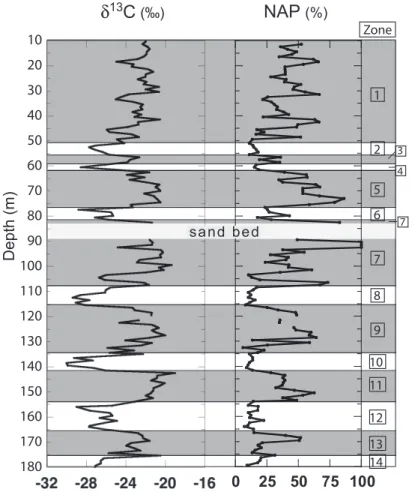
δ13C values of organic matter in the RB core is attributable to shifts in the proportions of C4 and C3 land plants. The proportion of C4 plant input to total organic matter is most likely high in the odd-numbered zones but negligible in the even-numbered zones. This interpretation is strengthened by an analysis of pollen from the RB core samples (Fig. 3, Fujii et al., 2004; Maki, 2005). Variations in the δ13C value correlated
20
well with changes in the proportion of non-arboreal pollen (NAP) to total pollen and spore throughout the core. The high NAP ratios in the odd-numbered zones suggest that the flora around the lake was dominated by herbs during high δ13C periods; thus, the proportion of C4plant increased at that time.
Some environmental constraints on the growth of C4 plants have been proposed,
25
C4 plants are more water-efficient than C3 plants (Ehleringer et al., 1991). Teeri and
Stowe (1976) demonstrated that C4 plants are more tolerant of aridity than C3plants,
if the minimum growing-season temperature does not drop below 8◦C. P’yankov and Mokronosov (1993) reported that aridity in Central Asia is closely related to the ratio
CPD
3, 871–898, 2007 Changes in C3/C4 vegetation in the Central Himalayas M. Mampuku et al. Title Page Abstract Introduction Conclusions References Tables Figures ◭ ◮ ◭ ◮ Back CloseFull Screen / Esc
Printer-friendly Version Interactive Discussion
EGU
of C4 plants to total plants. If aridity were the primary climatic factor favoring C4 over C3plants in the Kathmandu valley, then 13C-enriched sediments in the odd-numbered zones of the RB core would have been deposited under an arid climate regime, and sediments in the even-numbered zones would have been formed in more humid con-ditions. Moreover, the even-numbered,13C-depleted zones are also characterized by
5
relatively high C/N ratios and high TOC concentrations, suggesting that the input of terrestrial organic matter was greater in the even-numbered zones than that in the odd-numbered zones. Given that terrestrial organic matter was mainly transported by rivers into the lake, the increase of terrestrial organic matter in the even-numbered zones suggests an increase in river flow. Thus, the even-numbered zones may
plausi-10
bly correspond to wetter periods.
Previous palynological study on the lacustrine sediments in the Kathmandu Basin (Fujii and Sakai, 2002) reported at least seven repetitions of warm and cold cli-mates, corresponding to the global glacial-interglacial cycles. The study suggested that a dry climate prevailed during cold-glacial periods and a wet climate during
warm-15
interglacials in the Kathmandu Valley. Consequently, the dry and wet climate recur-rences we deduced from the δ13C variations most likely corresponded to the global glacial-interglacial cycles.
A marked shift in carbon isotope ratios of bulk organic matter has been reported from African lake and swamp sediments (Hamilton, 1982; Hillaire-Marcel et al., 1989;
20
Talbot and Johannessen, 1992; Aucour et al., 1994; Giresse et al., 1994; Huang et al., 1995; Street-Perrott et al., 1997, 1998). The glacial/interglacial shifts of δ13C values in these sediments show higher δ13C values for sediments deposited during glacial periods. Most of those studies attribute high δ13C values in sediments to the spread of C4 plants, as a result of a drier climate and/or lower pCO2. We expect that such
25
vegetation changes also occurred in the Kathmandu Valley: the odd-numbered zones of the RB core most likely correspond to glacial periods when C4plants flourished. The
dry climate and/or low pCO2 of the glacial period may have caused the expansion of
CPD
3, 871–898, 2007 Changes in C3/C4 vegetation in the Central Himalayas M. Mampuku et al. Title Page Abstract Introduction Conclusions References Tables Figures ◭ ◮ ◭ ◮ Back CloseFull Screen / Esc
Printer-friendly Version Interactive Discussion
EGU
difficult, Huang et al. (2001) suggest that low pCO2 alone is insufficient to trigger the
expansion of C4 plants, in the absence of favorable climatic conditions. Thus, even
with low pCO2 during glacial periods, arid conditions in the Kathmandu Valley would
be essential for the expansion of C4 plants. In short, increased aridity during glacial periods most likely induced the spread of C4plants in the valley.
5
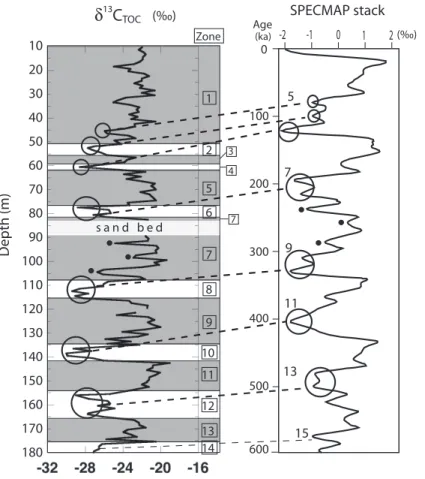
We compared the δ13C oscillation record to the SPECMAP stack (Imbrie et al., 1984) to assess its correspondence with global climate change. The upper part of Zone 1 with the AMS14C dating data corresponded to cold marine isotope stages (MIS 3–2), and thus we made a comparison between MIS stages below MIS 5 and the lower part of Zone 1. The δ13C curve was consistent with the SPECMAP curve (Fig. 4). As
10
shown in Fig. 4, the even-numbered zones of the RB core correspond to warm stages of the SPECMAP stack. The agreement between the δ13C and SPECMAP curves is supported by the correspondence of three individual minor peaks in Zone 7 to small peaks in MIS 8 and 7 (Fig. 4). We suggest that the sand bed occurring between 83 m and 89 m was deposited during a short period of a few thousand years. The cyclic
15
paleoclimatic changes in Kathmandu Valley correspond to the global climate changes represented by δ18O curve, which was mainly controlled by the ice volume change during the late Pleistocene. Zone 14 most probably corresponds to the upper part of MIS 15; thus, we presume the age of the core at 180-m depth to be approximately 600 ka.
20
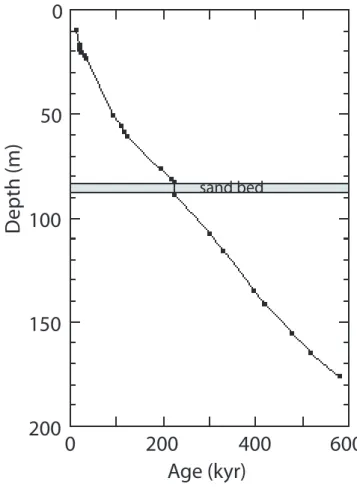
We propose the age-depth curve shown in Fig. 5, based on the14C ages in the up-per 23 m of sediment (Table 1) and a comparison of the δ13C oscillation record to the SPECMAP data below this depth (Table 3). This age-depth curve identifies sedimenta-tion rates as follows; ca. 0.24 m/kyr, 180–60 m; ca. 0.33 m/kyr, 60–50 m; ca. 0.45 m/kyr, 50–23 m; and ca. 0.7 m/kyr, above 23 m. The sedimentation rates appear to increase
25
gradually from the lower to the upper part of the sediment core. Sedimentological ob-servations show that the Kalimati-clay section (12–180 m in depth) is dominated by clayey material, and, except for the sand bed between 83 and 89 m in depth, no hiatus or thick bed formed by sedimentary events has been reported (Sakai et al., 2001a).
CPD
3, 871–898, 2007 Changes in C3/C4 vegetation in the Central Himalayas M. Mampuku et al. Title Page Abstract Introduction Conclusions References Tables Figures ◭ ◮ ◭ ◮ Back CloseFull Screen / Esc
Printer-friendly Version Interactive Discussion
EGU
Therefore, the changes in the estimated sedimentation rates may be the result of com-paction effects and/or dehydration of clay sediments with increasing burial depth.
In monsoonal regions, changes in precipitation are largely controlled by the inten-sity of the monsoon (Prell et al., 1992). The dry-wet records we obtained most likely reflect changes in the Indian monsoon intensity in the Central Himalayas during the
5
past 600 kyr. During dry glacial periods, we infer that the SW summer monsoon weak-ened and produced arid conditions, whereas wet conditions in interglacial periods re-sulted from a stronger SW summer monsoon. Most of the paleoclimatic studies on Indian Ocean marine sediments have reported that the SW summer monsoon was stronger during interglacial periods and weaker during glacial periods (e.g. Prell and
10
Van Campo, 1986; Sarkar et al., 1990). Although Niitsuma et al. (1991) concluded that the climate of the Arabian Peninsula was more humid during glacial periods with weak SW monsoons, our results confirmed that increased aridity on the Indian subcontinent during glacial ages resulted in the expansion of C4plants.
The increased aridity during glacial periods would have caused the water level in
15
Paleo-Kathmandu Lake to fall. Based on sedimentological studies of lacustrine delta deposits, Sakai et al. (2006) reported that events during which lake levels fell occurred in the late Pleistocene. Although the arid conditions during glacial periods may have been too harsh for C3plants to flourish, would be favorable for the growth of C4plants
in this region. Consequently, C4grasslands could have spread to the exposed shores
20
of PKL, as the water receded. The lower water level most probably produced an exten-sive delta plain and expanded marsh, with a concomitant proliferation of hygrophytes, including C4grasses, during glacial periods.
5 Conclusions
The organic geochemical record of a continuous core drilled in Kathmandu Valley
re-25
vealed a series of paleoenvironmental changes during the past 600 kyr. We found at least seven cyclical oscillations of TOC, C/N, and δ13C values, most likely
corre-CPD
3, 871–898, 2007 Changes in C3/C4 vegetation in the Central Himalayas M. Mampuku et al. Title Page Abstract Introduction Conclusions References Tables Figures ◭ ◮ ◭ ◮ Back CloseFull Screen / Esc
Printer-friendly Version Interactive Discussion
EGU
sponding to MIS 15–4 of the SPECMAP curve. The relatively higher δ13C values of total organic carbon during glacial periods, compared with those during interglacial pe-riods, are attributable to the significant increase in C4plant contributions. The relative abundance of C4 versus C3 plants in this region during the past 600 kyr was most
likely influenced by changes in precipitation, controlled by the SW summer monsoon
5
strength. The arid condition produced by the weaker SW monsoon during glacial peri-ods would have favored the spread of C4grasslands in this region. Our study provides
the first direct evidence of aridity changes on land being correlated to changes in the Indian monsoon strength during the past 600 kyr.
We conclude that over the past 600 kyr, the paleoclimate of the Central Himalayan
10
southern slopes was controlled mainly by global glacial-interglacial cycles. Our results show that C3/C4vegetation changes in the continental interior of South Asia are linked to the intensity of the monsoon, suggesting important implications for possible vegeta-tion changes in response to future climate change in the region. Although we analyzed the sediment samples at 1-m intervals, we nonetheless confirmed that the PKL
sedi-15
ments have the potential to provide a high-quality, high-resolution record of Quaternary climate changes in the continental interior of South Asia. We expect that further on-going studies, combined with other proxies, will provide more detailed paleoclimatic records for the region.
Acknowledgements. We are grateful to H. Tsutsumi, Kumamoto Prefectural University, for
pro-20
viding every facility for TOC, TN and carbon isotope measurements. We are also grateful with M. Suzuki (JAMSTEC) for preparation of AMS measurement. The present study was carried out as a part of the Paleo-Kathmandu Lake drilling project in collaboration with the Department of Geology, Tribhuvan University. The core-drilling and laboratory works were financially sup-ported by Grant-in-Aid for Scientific Research (A) (2), No.11304030 and (B) (2), 14340152 from
25
Japan Society for the Promotion of Science. This study is also part of the “Study on the past marine environmental changes” sponsored by the Japan Agency for Marine-Earth Science and Technology (JAMSTEC).
CPD
3, 871–898, 2007 Changes in C3/C4 vegetation in the Central Himalayas M. Mampuku et al. Title Page Abstract Introduction Conclusions References Tables Figures ◭ ◮ ◭ ◮ Back CloseFull Screen / Esc
Printer-friendly Version Interactive Discussion
EGU
References
Abe, M., Kitoh, A., and T. Yasunari, T.: An evolution of the Asian summer monsoon due to mountain uplift -simulation with the MRI atmosphere-ocean coupled GCM-, J. Meteorol. Soc. Japan, 81, 909–933, 2003.
Agrawal, D. P., Rekha, Dodia, Kotlia, B. S., Razdan, H., and Sahni, A.: The Plio-Pleistocene
ge-5
ologic and climatic record of the Kashmir valley, India: a review and new data, Palaeogeogr. Palaeocl., 73, 267–286, 1989.
Aucour, A. M., Hillaire-Marcel, C., and Bonnefille, R.: Late Quaternary biomass changes from C-13 measurements in a highland peat bog from equatorial Africa (Burundi), Quat. Res., 41, 225–233, 1994.
10
Bard, E.: Geochemical and geophysical implications of the radiocarbon calibration, Geochim. Cosmochim. Ac., 62, 2025–2038, 1998.
Blumer, B., Guillard, R. R. L., and Chase, T.: Hydrocarbons of marine plankton, Mar. Biol., 8, 183189, 1971.
-Cerling, T. E., Harris, J. M., MacFadden, B. J., Leakey, M. G., Quade, J., Eisenmann, V., and
15
Ehleringer, J. R.: Global vegetation change through the Miocene/Pliocene boundary, Nature, 389, 153–158, 1997.
Cole, D. R. and Monger, H. C.: Influence of atmospheric CO2on the decline of C4plants during the last deglaciation, Nature, 368, 533–536, 1994.
Collatz, G. J., Berry, J. A., and Clark, J. S.: Effects of climate and atmospheric CO2 partial
20
pressure on the global distribution of C4grasses: present, past, and future, Oecologia, 114, 441–454, 1998.
Cranwell, P. A., Eglinton, G., and Robinson, N.: Lipids of aquatic organisms as potential con-tributors to lacustrine sediments – II, Org. Geochem., 11, 513–527, 1987.
Dettman, D.L., Kohn, M.j., Quade, J., Ryerson, F.J., Ojha, T.P., and Hamidullah, S.: Seasonal
25
stable isotope evidence for a strong Asian monsoon throughout the past 10.7 m.y., Geology, 29, 31-34, 2001.
Eglinton, G. and Hamilton, R. J.: Leaf epicuticular waxes, Science, 156, 1322–1335, 1967. Ehleringer, J. R., Sage, R. F., Flanagan, L. B., and Pearcy, R. W.: Climate change and the
evolution of C4photosynthesis, Trends Ecol. Evol., 6, 95–97, 1991.
30
France, R. L.: Differentiation between littoral and pelagic food webs in lakes using stable carbon isotopes, Limnol. Oceanogr., 40, 1310–1313, 1995.
CPD
3, 871–898, 2007 Changes in C3/C4 vegetation in the Central Himalayas M. Mampuku et al. Title Page Abstract Introduction Conclusions References Tables Figures ◭ ◮ ◭ ◮ Back CloseFull Screen / Esc
Printer-friendly Version Interactive Discussion
EGU
Fujii, R. and H. Sakai, H.: Paleoclimatic changes during the last 2.5 myr recorded in the Kath-mandu Basin, Central Nepal Himalayas, J. Asian Earth Sci., 20, 255–266, 2002.
Fujii, R., Maki, T., Sakai, H., and Miyoshi, N.: Paleoclimatic changes during the last ca. 750 kyr recorded in the Kathmandu Valley, central Himalaya, POLEN, 14, 552–553, 2004.
Gearing, J. N., Gearing, P. J., Rudnick, D. T., Requejo, A. G., and Hutchins, M. J.: Isotopic
5
variability of organic carbon in a phytoplankton-based, temperate estuary, Geochim. Cos-mochim. Ac., 48, 1089–1098. 1984.
Giger, W., Schaffner, C., and Wakeham, S. G.: Aliphatic and olefinic hydrocarbons in recent sediments of Greifensee, Switzerland, Geochim. Cosmochim. Ac., 44, 119–129, 1980. Giresse, P., Maley, J., and Brenac, P.: Late Quaternary palaeoenvironments in the Lake
10
Barombi Mbo (West Cameroon) deduced from pollen and carbon isotopes of organic matter, Palaeogeogr. Palaeocl., 107, 65–78, 1994.
Hahn, D. G. and Manabe, S.: The role of mountains in the South Asian monsoon circulation, J. Atmos. Sci., 32, 1515–1541, 1975.
Hamilton, A. C.: Environmental History of East Africa, Academic Press, London, 1982.
15
Hastenrath, S.: Climate and the Circulation of the Tropics, D. Reidel, Boston, 1985.
Hayashi, T., Sakai, H., Yamanaka, T., Kuwahara, Y., Yahagi, W., Sakai, H., and Uchida, M.: Mid-dle to late Pleistocene monsoonal environments by analyses of fossil diatom assemblages and biogenic silica contents in Paleo-Kathmandu Lake, 17th International Sedimentological Congress, Abstract P-142, 2006.
20
Hillaire-Marcel, C., Aucour, A. M., Bonnefille, R., Riollet, G. M., Vincens, A., and Williamson, D.: 13C/palynological evidence of differential residence times of organic carbon prior to its sedimentation in East African rift lakes and peat bogs, Quaternary Sci. Rev., 8, 207–212, 1989.
Huang, Y., Street-Perrott, F. A., Perrott, R. A., Harkness, D. D., Olago, D., and Eglinton, G.:
25
Molecular and carbon isotopic stratigraphy of sediments from the last glacial/interglacial se-quence of a tropical freshwater lake, Sacred Lake, Mt. Kenya, in Organic Geochemistry: Developments and Applications to Energy, edited by: Grimalt, J. O. and Dorronsoro, C., Climate Environment and Human History, Pergamon, 826–829, 1985.
Huang, Y., Street-Perrott, F. A., Metcalfe, S. E., Brenner, M., Moreland, M., and Freeman, K. H.:
30
Climate change as the dominant control on glacial-interglacial variations in C3 and C4plant abundance, Science, 293, 1647–1651, 2001.
CPD
3, 871–898, 2007 Changes in C3/C4 vegetation in the Central Himalayas M. Mampuku et al. Title Page Abstract Introduction Conclusions References Tables Figures ◭ ◮ ◭ ◮ Back CloseFull Screen / Esc
Printer-friendly Version Interactive Discussion
EGU
Prell, W. L., and Shackleton, N. J.: The orbital theory of Pleistocene climate: support from a revised chronology of the marine δ18O record, in Milankovitch and Climate, part 1, edited by: Berger, A., et al., Plenum Reidel, Dordrecht, 269–305, 1984.
Ishiwatari, R. and M. Uzaki, M.: Diagenetic changes of lignin compounds in a more than 0.6 million-year-old lacustrine sediment (Lake Biwa, Japan), Geochim. Cosmochim. Ac., 51,
5
321–328, 1987.
Kitoh, A.: Mountain uplift and surface temperature changes, Geophys. Res. Lett., 24, 185–188, 1997.
Kitoh, A.: Effects of mountain uplift on East Asian summer climate investigated by a coupled atmosphere-ocean GCM, J. Climate, 17, 783-802, 2004.
10
Krishnamurthy, R. V., Bhattacharya, S. K., and Kusumgar, S.: Palaeoclimatic changes deduced from13C/12C and C/N ratios of Karewa lake sediments, India, Nature, 323, 150–152, 1986. Kroon, D., Steens, T., and Troelstra, S. R.: Onset of monsoonal related upwelling in the western
Arabian Sea as revealed by planktonic foraminifers, Proc. ODP, Sci. Results, 117, 257–263, 1991.
15
Kutzbach, J. E., Prell, W. L., and Ruddiman, W. F.: Sensitivity of Eurasian climate to surface uplift of the Tibetan Plateau, J. Geol., 101, 177–190, 1993.
Kuypers, M. M. M., Pancost, R. D., and Sinninghe Damst ´e, J. S.: A large and abrupt fall in atmospheric CO2concentration during Cretaceous times, Nature, 399, 342–345, 1999.
20
Maki, T.: Reconstruction of continuous paleoclimatic records in Lake Baikal and Kathmandu Valley during the Late Miocene and Pleistocene: an approach from palynological study, D.S. thesis, Kyushu.Univ., Japan, 2005.
Malla, S. B., Shrestha, A. B., Rajbhandari, S. B., Shrestha, T. B., Adhikari, P. M., and Adhikari, S. R.: Flora of Langtang and Cross Section Vegetation Survey (Central Zone), Bull. Dept.
25
Med. Plants, Kathmandu, 1976.
Manabe, S. and Terpstra, T. B.: The effects of mountains on the general circulation of the atmosphere as identified by numerical experiments, J. Atmos. Sci., 31, 3–42, 1974.
Meyers, P. A.: Impacts of regional Late Quaternary climate changes on the deposition of sedi-mentary organic matter in Walker Lake Nevada, Palaeogeogr. Palaeocl., 78, 229–240, 1990.
30
Meyers, P. A.: Preservation of elemental and isotopic source identification of sedimentary or-ganic matter, Chem. Geol., 114, 289–302, 1994.
CPD
3, 871–898, 2007 Changes in C3/C4 vegetation in the Central Himalayas M. Mampuku et al. Title Page Abstract Introduction Conclusions References Tables Figures ◭ ◮ ◭ ◮ Back CloseFull Screen / Esc
Printer-friendly Version Interactive Discussion
EGU
Quaternary paleoclimates, J. Paleolimnol., 21, 345–372, 1999.
Meyers, P. A.: Applications of organic geochemistry to paleolimnological reconstructions: a summary of examples from the Laurentian Great Lakes, Org. Geochem., 34, 261–289, 2003. Muzuka, A. N. N.: 350 ka organic δ13C record of the monsoon variability on the Oman
con-tinental margin, Arabian Sea, Proc. Indian Acad. Sci., 109 (Earth Planet. Sci.), 481–489,
5
2000.
Niitsuma, N., Oba, T., and Okada, M.: Oxygen and carbon isotope stratigraphy at site 723, Oman Margin, Proc. ODP, Sci. Results 117, 321–341, 1991.
O’Leary, M. H.: Carbon isotopes in photosynthesis, Bioscience, 38, 328–336, 1988.
Prahl, F. G., Bennett, J. T., and Carpenter, R.: The early diagenesis of aliphatic hydrocarbons
10
and organic matter in sedimentary particulates from Dabob Bay, Washington, Geochim. Cos-mochim. Ac., 44, 1967–1976, 1980.
Prell, W. L. and Van Campo, E.: Coherent response of Arabian Sea upwelling and pollen transport to late Quaternary monsoonal winds, Nature, 323, 526–528, 1986.
Prell, W. L., Murray, D. W., Clemens, S. C., and Anderson, D. M.: Evolution and variability of the
15
Indian Ocean summer monsoon: evidence from the western Arabian Sea drilling program, in Synthesis of results from scientific drilling in the Indian Ocean, Geophys. Monogr. Ser., vol. 70, edited by: Duncan, R. A., Rea, D. K., Kidd, R. B., et al., AGU, Washington, D.C., 447–469, 1992.
Prokopenko, A., Williams, D. F., Kavel, P., and Karabanov, E.: The organic indexes in the
20
surface sediments of Lake Baikal water system and the processes controlling their variation, IPPCCE Newslett, 7, 49–55, 1993.
P’yankov, V. I. and Mokronosov, A. T.: Basic Tendencies in changes of the earth’s vegetation in relation to global warming of the climate, Rus. Plant Physiol., 40, 451–466, 1993.
Quade, J. and Cerling, T. E.: Expansion of C4grasses in the Late Miocene of Northern Pakistan:
25
evidence from stable isotopes in paleosols, Palaeogeogr. Palaeocl., 115, 91–116, 1995. Reimer, P. J., Baillie, M. G. L., Bard, E., Bayliss, A., Beck, J. W., Bertrand, C. J. H., Blackwell,
P. G., Buck, C. E., Burr, G. S., Cutler, K. B., Damon, P. E., Edwards, R. L., Fairbanks, R. G., Friedrich, M., Guilderson, T. P., Hogg, A. G., Hughen, K. A., Kromer, B., McCormac, G., Manning, S., Ramsey, C. B., Reimer, R. W., van der Plicht, J., Weyhenmeyer, C.E.:
30
INTCAL04 terrestrial radiocarbon age calibration, 0–26 cal kyr BP, Radiocarbon, 46, 1029– 1058, 2004.
CPD
3, 871–898, 2007 Changes in C3/C4 vegetation in the Central Himalayas M. Mampuku et al. Title Page Abstract Introduction Conclusions References Tables Figures ◭ ◮ ◭ ◮ Back CloseFull Screen / Esc
Printer-friendly Version Interactive Discussion
EGU
Lake, UK – I: source correlation of leaf wax inputs to the sedimentary record, Org. Geochem., 17, 901–912, 1991.
Rodelli, M. R., Gearing, J. N., Gearing, P. J., Marshall, N., and Sasekumar, A.: Stable isotope ratio as a tracer of mangrove carbon in Malaysian ecosystem, Oecologia, 61, 326–333, 1984.
5
Ruddiman, W. F. (Ed): Tectonic Uplift and Climate Changes, Plenum Press, New York, 1997. Sakai, H.: The Kathmandu Basin: an archive of Himalayan uplift and past monsoon climate, J.
Nepal Geol. Soc. 25, Sp. Issue, 1–8, 2001.
Sakai, H., Fujii, R., Kuwahara, Y., Upreti, B. N., and Shrestha, S. D.: Core drilling of the basin-fill sediments in the Kathmandu Valley for palaeoclimatic study: preliminary results, Nepal, J.
10
Nepal Geol. Soc. 25, Sp. Issue, 9–18, 2001a.
Sakai, T., Gajurel, A. P., Tabata, H., and Upreti, B. N.: Small-amplitude lake-level fluctuations recorded in aggrading delta deposits of the Upper Pleistocene Thimi and Gokarna forma-tions, Kathmandu Valley, Nepal, J. Nepal Geol. Soc. 25, Sp. Issue, 43–51, 2001b.
Sakai, T., Takagawa, T., Gajurel, A. P., Tabata, H., Ooi, N., and Upreti, B. N.: Discovery of
sed-15
iments indicating rapid lake-level fall in the late Pleistocene Gokarna Formation, Kathmandu Valley, Nepal: implication for lake terrace formation, The Quaternary Research, 45, 99–112, 2006.
Sarkar, A., Ramesh, R., Bhattacharya, S. K., and Rajagopalan, G.: Oxygen isotope evidence for a stronger winter monsoon current during the last glaciation, Nature, 343, 549–551, 1990.
20
Silliman, J. E., Meyers, P. A., and Bourbonniere, R. A.: Record of postglacial organic matter delivery and burial in sediments of Lake Ontario, Org. Geochem., 24, 463–472, 1996. Stainton, J. D. A.: Forest of Nepal, John Murray & Co., London, 1972.
Street-Perrott, F. A., Huang, Y., Perrott, R. A., Eglinton, G., Barker, P., Ben Khelifa, L., Hark-ness, D. D., and Olago, D.: Impact of lower atmospheric carbon dioxide on tropical mountain
25
ecosystems, Science, 278, 1422–1426, 1997.
Street-Perrott, F. A., Huang, Y., Perrott, R. A., and Eglinton, G.: Carbon isotopes in lake sed-iments and peats of the last glacial age: implications for the global carbon cycle, in Stable Isotopes and Integration of Biological Ecological and Geochemical Processes, edited by: Griffiths, H., Bios, Oxford, 381–396, 1998.
30
Talbot, M. R. and Johannessen, T.: A high resolution palaeoclimate record for the last 27 500 years in tropical West Africa from the carbon and nitrogen isotopic composition of organic matter, Earth Planet. Sci. Lett., 110, 23–37, 1992.
CPD
3, 871–898, 2007 Changes in C3/C4 vegetation in the Central Himalayas M. Mampuku et al. Title Page Abstract Introduction Conclusions References Tables Figures ◭ ◮ ◭ ◮ Back CloseFull Screen / Esc
Printer-friendly Version Interactive Discussion
EGU
Terri, J. A. and Stowe, L. G.: Climatic patterns and the distribution of C4 grasses in North America, Oecologia, 23, 1–12, 1976.
Uchida, M., Shibata, Y., Yoneda, M., Kobayashi, T., and Morita, M.: Technical progress in AMS microscale radiocarbon analysis, Nucl. Instrum. Meth. B, 223–224, 313–317, 2004.
Van Campo, E., Duplessy, J. C., and Rossignol-Strick, M.: Climatic conditions deduced from a
5
150-kyr oxygen isotope-pollen record from the Arabian Sea, Nature, 296, 56–59, 1982. Webster, P. J.: The elementary monsoon, in Monsoons, edited by: Fein, J. S. and Stephens, P.
CPD
3, 871–898, 2007 Changes in C3/C4 vegetation in the Central Himalayas M. Mampuku et al. Title Page Abstract Introduction Conclusions References Tables Figures ◭ ◮ ◭ ◮ Back CloseFull Screen / Esc
Printer-friendly Version Interactive Discussion
EGU
Table 1. Analytical results of the AMS14C ages of the RB core.
Depth (m) 14C age Calibrated age (yr BP ± 1σ) (cal BP, 1σ) 9.75 10 960±130 12 836–13 022 (12900) 17.1 15 890±120 18 954–19 197 (19 040) 19.1 17 090±80 20 100–20 326 (20 220) 20.4 18 670±90 22 160–22 335 (22 240) 22.05 24 010±120 28 220* 23.2 27 410±160 32 080* *Calculated using the equation of Bard (1998).
CPD
3, 871–898, 2007 Changes in C3/C4 vegetation in the Central Himalayas M. Mampuku et al. Title Page Abstract Introduction Conclusions References Tables Figures ◭ ◮ ◭ ◮ Back CloseFull Screen / Esc
Printer-friendly Version Interactive Discussion
EGU
Table 2. The ratios of short-chain (L, C15-C24) n-alkanes to long-chain (H, C25-C33) n-alkanes (L/H) are listed with the δ13C values and C/N ratios. The analyzed horizons of n-alkanes are shown by arrows in Fig. 2.
Zone Depth (m) L/H δ13CTOC(‰) C/N
2 52.50 0.15 –27.7 10.1 3 56.50 0.09 –22.6 10.7 4 60.50 0.10 –28.6 9.6 5 67.48 0.16 –20.6 7.5 6 77.48 0.21 –28.8 10.8 7 99.50 0.34 –19.4 7.9 8 112.50 0.21 –29.4 13.4 9 127.50 0.33 –20.0 7.9 10 139.50 0.16 –29.9 14.6 11 142.50 0.21 –19.0 11.1 11 146.50 0.21 –20.1 9.0 12 156.00 0.14 –29.0 13.7 13 169.50 0.20 –21.6 10.4
CPD
3, 871–898, 2007 Changes in C3/C4 vegetation in the Central Himalayas M. Mampuku et al. Title Page Abstract Introduction Conclusions References Tables Figures ◭ ◮ ◭ ◮ Back CloseFull Screen / Esc
Printer-friendly Version Interactive Discussion
EGU
Table 3. The chronological tie-points below 23 m in depth of the RB core.
Zone boundary Depth (m) Age (kyr)
Zone1/2 50.9 93 Zone2/3 55.5 108 Zone3/4 58.5 116 Zone4/5 60.5 122 Zone5/6 76.5 195 Zone6/7 81.5 219
Sand bed (top) 83.0 225
Sand bed (bottom) 89.0 225
Zone7/8 107.5 300 Zone8/9 115.5 330 Zone9/10 135.0 394 Zone10/11 141.5 418 Zone11/12 155.5 477 Zone12/13 165.0 518 Zone13/14 175.5 579
CPD
3, 871–898, 2007 Changes in C3/C4 vegetation in the Central Himalayas M. Mampuku et al. Title Page Abstract Introduction Conclusions References Tables Figures ◭ ◮ ◭ ◮ Back CloseFull Screen / Esc
Printer-friendly Version Interactive Discussion EGU 0 5 km 2732 m 2762 m P atan T himi G okarna P hulchoki S hivapuri 85˚20' 27˚40' K akani L ukundol wa te rs he d N B agmati R iver R K athmandu R a bibha wa n 1400 m 1400 m 60˚ 80˚ 100˚E 0˚ 10˚ 20˚ 30˚N Kathmandu
Fig. 1. Location of RB core drilling site in the Kathmandu Valley. The separation of the valley
floor from the valley-side slope (shaded) is shown by a dark line following the 1400 m contour. Arrows mark the direction of the flow of the rivers.
CPD
3, 871–898, 2007 Changes in C3/C4 vegetation in the Central Himalayas M. Mampuku et al. Title Page Abstract Introduction Conclusions References Tables Figures ◭ ◮ ◭ ◮ Back CloseFull Screen / Esc
Printer-friendly Version Interactive Discussion EGU D epth (m) 40 20 180 160 140 120 100 80 60 30 10 170 150 130 110 90 70 50 Zone11 Zone13 Zone7 Zone2 Zone3 Zone4 (Zone7) Zone6 Zone9 Zone12 Zone14 Zone8 Zone10 Zone5 Zone1 TOC (%) C/N δ13CTOC (‰) s a n d b e d
Fig. 2. Concentrations of total organic carbon (TOC), weighted TOC/TN ratios (C/N) and δ13C of TOC (δ13C) values in the RB core of muddy lacustrine sediments from the Kathmandu Valley. TOC concentration was well correlated with the C/N ratio (r=0.7, n=164), and the δ13C values was inversely correlated with both the TOC and C/N values (r=–0.6, n=164). The muddy sec-tion of the drill core was divided into 14 zones based on the periodic changes of the δ13C val-ues. Odd-number zones (dark-shaded) correspond to high δ13C zones, while even-numbered zones correspond to low δ13C zones. The sediment between 83 m to 89 m (light-shaded area) is sand. Arrows in the figure indicate analyzed horizons for n-alkanes.
CPD
3, 871–898, 2007 Changes in C3/C4 vegetation in the Central Himalayas M. Mampuku et al. Title Page Abstract Introduction Conclusions References Tables Figures ◭ ◮ ◭ ◮ Back CloseFull Screen / Esc
Printer-friendly Version Interactive Discussion EGU 40 20 180 160 140 120 100 80 60 30 10 170 150 130 110 90 70 50 D e p th (m) 0 25 50 75 100 δ13C(‰) NAP (%) s a n d b e d 1 2 3 4 5 6 7 8 9 7 10 11 12 13 14 Zone
Fig. 3. Comparison of the δ13C records with the non-arboreal pollen (NAP) variation curve from the RB core (Fujii et al., 2004; Maki, 2005). Variations in the δ13C value correlated well with the changes in the NAP (r=0.7, n=162).
CPD
3, 871–898, 2007 Changes in C3/C4 vegetation in the Central Himalayas M. Mampuku et al. Title Page Abstract Introduction Conclusions References Tables Figures ◭ ◮ ◭ ◮ Back CloseFull Screen / Esc
Printer-friendly Version Interactive Discussion EGU 40 20 180 160 140 120 100 80 60 30 10 170 150 130 110 90 70 50 D epth (m) (‰) (‰) 0 100 200 300 400 500 600 (ka) Age 2 1 0 -1 -2 7 9 13 11 15 5 δ13
CTOC SPECMAP stack
1 2 3 4 5 6 7 8 9 7 10 11 12 13 14 Zone s a n d b e d
Fig. 4. Comparison of the δ13C variation curve from the RB core with the SPECMAP stack (Imbrie et al., 1984). The numbers in the SPECMAP stack show marine oxygen isotope stages (MIS). Individual peaks in Zone 7 (peaks with filled circles) corresponded to the small peaks in MISs 8 and 7 in the SPECMAP stack.
CPD
3, 871–898, 2007 Changes in C3/C4 vegetation in the Central Himalayas M. Mampuku et al. Title Page Abstract Introduction Conclusions References Tables Figures ◭ ◮ ◭ ◮ Back CloseFull Screen / Esc
Printer-friendly Version Interactive Discussion EGU
0
50
100
150
200
D
epth (m)
Age (kyr)
0
200
400
600
sand bedFig. 5. Age-depth curve of the RB core. The age model based on the14C ages in the upper 23 m of sediment (Table 1) and a comparison of the δ13C oscillation record to the SPECMAP data below this depth (Table 3).