Continuity and Rupture in Islamic Architecture
The MIT Faculty has made this article openly available.
Please share
how this access benefits you. Your story matters.
Citation
Rabbat, Nasser. "Continuity and Rupture in Islamic Architecture."
International Journal of Islamic Architecture 10, 1 (January 2021):
47-55.
As Published
https://doi.org/10.1386/ijia_00028_1
Publisher
Intellect
Version
Author's final manuscript
Citable link
https://hdl.handle.net/1721.1/130656
Terms of Use
Creative Commons Attribution-Noncommercial-Share Alike
International Journal of Islamic Architecture Volume 10 Number 1
This essay considers the prevalence of the binary constructs of continuity and rupture in the study of Islamic architecture, which warrants a more sustained critique at this particular historical juncture. This is so because, on the one hand, the field of Islamic architecture is steadily moving toward developing its own disciplinary methodologies and epistemological contours. On the other, the world, or at least the western part of it – which is where the field is still primarily located – is steadily moving toward a more suspicious and dismiss-ive stance vis-à-vis anything related to Islam.1 The situation is clearly
para-doxical, for although residues of old biases and archaic analytical structures still mar the development of the study of Islamic architecture – as they do in all post-orientalist fields of inquiry – new approaches, greater crossdisciplinar-ity, and an increasingly sophisticated engagement with theory and criticism are repositioning Islamic architecture in a more reflective place despite the political and inherently ideological setbacks caused by factors that are totally outside of its control, and even outside academe.
Historical Rupture?
The first issue that I will discuss is the epistemic disconnect between the study of pre-Islamic and Islamic architecture.2 These two domains, which share the
same geographical space and historical continuum, are forcibly separated into two distinct mega-periods with several sub-periods each. The rupture is also embedded in distinct academic disciplines: archaeology for the pre-Islamic and history for the pre-Islamic. The disciplinary partition is reinforced by the different sets of skills, methods, and language requirements demanded of the specialists in the two disciplines. This of course is neither a recent nor a © 2020 Intellect Ltd Article. English language. https://doi.org/10.1386/ijia_00028_1
NASSER RABBAT
Massachusetts Institute of Technology
Continuity and Rupture in Islamic
Architecture
Keywords
Islamic architecture orientalism continuity rupture discovery knowledgeCopyright Intellect Ltd 2020
Not for distribution.
1. 2. 3. 4. 5. 6. 7. 8. 9. 10. 11. 12. 13. 14. 15. 16. 17. 18. 19. 20. 21. 22. 23. 24. 25. 26. 27. 28. 29. 30. 31. 32. 33. 34. 35. 36. 37. 38. 39. 40. 41. 42. 43. 44. 45. 46. 47. 48. 49. 50. 51. 52.
Nasser Rabbat
totally arbitrary phenomenon. It dates back to the constitution of both areas of research as scholarly fields during the colonial era between the early nine-teenth and early twentieth centuries.3 For archaeology, western (and some
local) excavators dug out the history of ancient lands with deep roots in the beginning of human urbanization in Egypt, Mesopotamia, India, Palestine, Syria, and Anatolia. They then assigned them either dead-end historical trajec-tories as extinct civilizations, or ones that did not lead to the Islamic cultures flourishing on the same land in subsequent periods (and in posterior strata at the dig that were routinely sacrificed during the search for these ancient cultures).4
As memorably asserted by Garth Fowden in his little-appreciated book
Empire to Commonwealth: Consequences of Monotheism in Late Antiquity, ‘there
are roads out of Antiquity that do not Lead to the Renaissance’.5 Many of
these roads in fact led from antiquity to various Islamic cultural efflorescences of the late medieval period. This observation applies equally to Pharaonic, Ptolemaic, and Christian Egypt on the one hand, and Islamic Egypt on the other; to Mesopotamia and Iraq; Iran and Islamic Persia; Vedic and Islamic India; Semitic Aram, Seleucid and Roman Syria, and Islamic Bilad al-Sham; and other more circumscribed cultural zones. It also pertains, but with a shift of focus from geography to history and from archaeology to theory, to pre-modern Islamic and pre-modern and contemporary ‘Islamic’ (forced into quota-tion marks by many scholars and practiquota-tioners today who militate against acknowledging the possibility of a modern or a contemporary Islamic art or architecture).6
Thankfully, many contemporary Islamic archaeologists and architec-tural historians are trying to bridge that gap, especially those working on the two closer ends of the chronological divide near the transition from Late Antiquity to the early Islamic period.7 Their work shows how
conceptualiz-ing their area of study as a historical continuum encompassconceptualiz-ing pre-Islamic and Islamic periods benefits both scholarly fields on their own terms, even if they remained separate and disciplinarily independent of each other.8 The
same kind of approach is also starting to gain steam in the study of modern and contemporary architecture in the Islamic world, owing mostly to what I have previously dubbed the ‘Edward Said effect’, that is, the influence his critique of orientalism had on invigorating the study of both colonial and postcolonial cultures.9 Furthermore, one cannot ignore the tremendous impact
the Aga Khan Award for Architecture (founded in 1977) and the Aga Khan Program for Islamic Architecture at Harvard University and the Massachusetts Institute of Technology (established in 1978) had in repositioning contempo-rary ‘Islamic architecture’ as a robust contributor to the maturity and diver-sity of contemporary architecture [Figures 1 and 2].10 The ripple effect of those
sustained scholarly and professional efforts has reached beyond architecture to touch fields of visual production that are not usually associated with tradi-tional Islamic cultures, such as media arts.11
The deeper significance of this new research direction is manifold. First, working within the conceptual framework of a cultural continuity or cultural connectivity is inherently a mirror of human reality, which of course admits neither breaks nor interruptions. Second, such inquiry redresses a histori-cal wrong – exemplified in denying Islamic culture its antique roots – that had been enforced for a long time primarily for conceptual, political, and even ideological reasons. The results were quite harmful, especially to Islamic culture. Third – and probably the most important point – proposing that we
Copyright Intellect Ltd 2020
Not for distribution.
1. 2. 3. 4. 5. 6. 7. 8. 9. 10. 11. 12. 13. 14. 15. 16. 17. 18. 19. 20. 21. 22. 23. 24. 25. 26. 27. 28. 29. 30. 31. 32. 33. 34. 35. 36. 37. 38. 39. 40. 41. 42. 43. 44. 45. 46. 47. 48. 49. 50. 51. 52.
change our method of historical inquiry to thinking through connections, continuities, networks, constellations, matrixes, and other similar terms entails a moral commitment. It actually humanizes architectural history in all of its various chronological and cultural manifestations and dissimilarities by level-ling the conceptual playing field applied to its study. This should reassure our liberal and humanistic convictions, which I assume are still shared by the majority of modern scholars, although doubt is creeping into my certainty ever more rapidly.
I am reminded in this context of one of my favourite quotes from Edward Said’s Orientalism, which is central to his entire project, where he writes, ‘Can one divide human reality, as indeed human reality seems to be genu-inely divided, into clearly different cultures, histories, traditions, societies, even races, and survive the consequences humanly?’12 The issue that Saïd is
rais-ing is not the epistemological price exacted by disciplinary and classificatory divisions (although that price is high, albeit usually overlooked), but, more importantly, the ethical one. What Saïd is implying is something approaching a moral dilemma that all students of marginalized fields of research – such as Islamic architecture – have experienced. We are all made to wonder whether the status and position of our respective field in the academic constellation to which we belong are the result of its own modest and diffident self-definition and perhaps intrinsic shortcomings, or is it the outcome of a protracted process of politically motivated arrangements that located some areas of inquiry at the core of knowledge and others at the peripheries, or even outside the habitual pursuit of knowledge and in its exotic fringes. Consequently, insisting on our field’s place within its primary disciplinary environment is the most important goal for which we should strive.
Local Versus Learned: A Critique of Discovery
My second issue is the imposed gap and/or the exploitative relationship between local and professional or scholarly knowledge.13 This is a consistent
feature in the realm of Islamic architecture, as well as other aspects of Islamic cultures, which dates back to the beginning of orientalism as an organized field of scholarship.14 It was manifest in the denigration or subjugation of local
knowledge and in the Eurocentric application of the notion of discovery as a Aga Khan Award for Architecture.
Figure 1: The logo of the Aga Khan Award for Architecture with a stylized Kufic rendering of the word ‘Allah’ repeated in mirrored pair four times to form a square. Designed by Karl Schlamminger.
Aga Khan Program for Islamic Architecture.
Figure 2: The logo of the Aga Khan Program for Islamic Architecture with the word ‘Allah’ capping a rotated square. Designed by Karl Schlamminger.
Copyright Intellect Ltd 2020
Not for distribution.
1. 2. 3. 4. 5. 6. 7. 8. 9. 10. 11. 12. 13. 14. 15. 16. 17. 18. 19. 20. 21. 22. 23. 24. 25. 26. 27. 28. 29. 30. 31. 32. 33. 34. 35. 36. 37. 38. 39. 40. 41. 42. 43. 44. 45. 46. 47. 48. 49. 50. 51. 52.
Nasser Rabbat
unidirectional process applied to learning about cultures and histories unfa-miliar to Europe, but not the reverse. These practices, which gained scholarly authority over time with a little help from colonialist policies, had profound implications for our understanding of how knowledge in general is acquired and structured.15 For the specific field of Islamic architecture, they translated
into the fraught relationship the field has had with both vernacular architec-ture and the architecarchitec-ture of Islamic lands after the eighteenth century, deemed derivative and ‘un-Islamic’. This history of negligence and exclusion is only recently being actively countered by scholarly research.16
Knowledge of course comes in different forms. Some of them have been privileged in academe for their adherence to robust and well-established methods and techniques of inquiry and analysis. They have been tested, vetted, and expertly reviewed and critiqued so as to acquire acceptability and applica-bility. But privileging these scholarly forms of knowledge has also obfuscated other ways of knowing, including what can be termed traditional, vernacular, age-old, or native knowledge. This obfuscation sometimes turns into ignor-ing or belittlignor-ing the ways in which ‘local knowledge’ has been transmitted, or has produced architecture, engaged with buildings, and given them meaning. This may lead to the loss of the methods developed in these pursuits, many of which fall under the category of what Carlo Ginzburg in a not so differ-ent context has termed inductive or intuitive.17 Recovering them has become
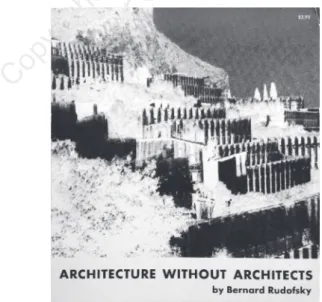
an architectural quest following the exhibition and catalogue of Bernard Rudofsky’s Architecture Without Architects: A Short Introduction to Non-Pedigreed
Architecture, published in 1964 [Figure 3].18 Despite its celebration as the index
of the accumulated and unadulterated human ingeniousness about space, the ‘non-pedigreed architecture’ remained outside the epistemological framework of the global canon of architecture largely because it did not conform to the accepted methods of acquiring, structuring, and circulating knowledge.19
Bernard Rudofsky, Architecture Without Architects: A Short Introduction to Non-Pedigreed
Architecture (New York: Museum of Modern Art, 1964), cover.
Figure 3: The cover of the first edition of Bernard Rudofsky’s Architecture
Without Architects published in 1964.
Copyright Intellect Ltd 2020
Not for distribution.
1. 2. 3. 4. 5. 6. 7. 8. 9. 10. 11. 12. 13. 14. 15. 16. 17. 18. 19. 20. 21. 22. 23. 24. 25. 26. 27. 28. 29. 30. 31. 32. 33. 34. 35. 36. 37. 38. 39. 40. 41. 42. 43. 44. 45. 46. 47. 48. 49. 50. 51. 52.
The final point I wish to mention in this regard is the notion of discovery. My interest is particularly focused on the western discovery of non-western architectural traditions of the past as if they have lain there unknown until a western explorer found them and brought them to the attention of the European knowledge community of universities, scientific societies, scholarly publications, and, ultimately, the annals of human or universal knowledge. We all have felt uneasy, to say the least, at the statements that we encounter at almost every turn of the page in our eighteenth- and nineteenth-century sources about the orientalist so-and-so discovering this site or this architec-ture, when we all know that the same places or buildings have been known and significant to the people that lived around them and that gave them meaning through their systems of signification and interpretation.20
Discovery in this context, thus, is a limited and limiting term: it claims that things cannot be properly known until they are observed through the proper scientific modes of seeing, recording, analysing, and disseminating, all normalized in post-Enlightenment Europe. Discovery, thus, becomes an exclu-sive western act. Others may see and record but they do not properly analyse, interpret, and, most importantly, historicize so that their culture, artefacts, or architecture are acknowledged as part of the global artistic/architectural or cultural heritage.21 They may intuit or revere or adore, but they do not
prop-erly understand. For that they need to be initiated into the proper methods of knowing (for which they of course need the tutelage of their western guides).
This distinction is what makes the term ‘discovery’ the antithesis of ‘local knowledge’. Discovery lays claim to giving meaning to what has already existed within another sphere of knowledge. It thus establishes the dates when sites, monuments, and objects become properly known after the first westerner gave them meaning, despite the fact that they have been built, used, and are mean-ingful to the people owning them or living around them. Local architecture before its discovery is thus unknown and undeciphered; after, it is documenta-ble, knowadocumenta-ble, and analysable. Beside its inherent arrogance, discovery then denies local knowledge any role in understanding what has been conceived and produced by it in the first place, such as its own vernacular architecture, and assigns it an understanding that depends on the knowledge of the discov-erer, who is more often than not an orientalist (in the sense of a student of the orient). The discovered architecture could then be appropriated by the tradition of the discoverer as when historic Islamic architecture was adapted in synthetic styles such as neo-Moorish, neo-Egyptian, Art Nouveau, Art Deco, or any other so-called eclectic style of the period between the middle of the nineteenth and the middle of the twentieth centuries [Figure 4].22
Discovery, as an act of epistemically taking possession of a building, an architectural tradition, or a site, is not granted to non-western architects when they first encounter western architecture, including the modern architecture first developed in the west. Their discovery does not come with the right to give the discovered architecture meaning according to their own system of knowledge or to ignore the associative meaning that the architecture had before they discovered it. Instead, non-western architects are expected to treat modern architecture as a fully formed epistemic system that does not allow reconstitution or recasting. They can take it as it comes and risk being accused of derivativeness.23 They can also struggle with alternative ways to assert their
modernity from within their own epistemological contours and face neglect and exclusion from the architectural canon.24 This dilemma has lasted for far
too long. The field of architecture needs not only to question the validity of the biased notion of ‘discovery’ as a starting point in the process of knowing about
Copyright Intellect Ltd 2020
Not for distribution.
1. 2. 3. 4. 5. 6. 7. 8. 9. 10. 11. 12. 13. 14. 15. 16. 17. 18. 19. 20. 21. 22. 23. 24. 25. 26. 27. 28. 29. 30. 31. 32. 33. 34. 35. 36. 37. 38. 39. 40. 41. 42. 43. 44. 45. 46. 47. 48. 49. 50. 51. 52.
Nasser Rabbat
both past traditions and modern and contemporary architecture, but also to readmit local forms of knowledge as constitutive epistemic tools in the under-standing not only of local architecture but of architecture tout court.
Suggested citation
Rabbat, Nasser (2020), ‘Continuity and Rupture in Islamic Architecture’,
International Journal of Islamic Architecture, 10:1, pp. 47–55, doi: https://doi.
org/10.1386/ijia_00028_1
Contributor Details
Nasser Rabbat is the Aga Khan Professor and Director of the Aga Khan Program for Islamic Architecture at the Massachusetts Institute of Technology. He is the author of many books and articles, most recently The Architecture of
the Dead Cities: Toward a New Interpretation of the History of Syria (Hamad bin
Khalifa University Press, 2018); Criticism as Commitment: Viewpoints on History,
Arabism, and Revolution (Riad Alrayyes Publisher, 2015) both in Arabic; and
as co-editor with Pamela Karimi, The Destruction of Cultural Heritage: From
Napoléon to ISIS (Aggregate Architectural History Collaborative, 2016). He is
completing a biography of al-Maqrizi and a book on the history of Cairo. Contact: Room 10-390, Department of Architecture, MIT, 77 Massachusetts Ave., Cambridge, MA 02139, United States.
E-mail: [email protected]
Nasser Rabbat has asserted their right under the Copyright, Designs and Patents Act, 1988, to be identified as the author of this work in the format that was submitted to Intellect Ltd.
Nasser Rabbat.
Figure 4: The façade of Yenidze Cigarette Factory, Dresden (1907–09), by Martin Hammitzsch.
Copyright Intellect Ltd 2020
Not for distribution.
1. 2. 3. 4. 5. 6. 7. 8. 9. 10. 11. 12. 13. 14. 15. 16. 17. 18. 19. 20. 21. 22. 23. 24. 25. 26. 27. 28. 29. 30. 31. 32. 33. 34. 35. 36. 37. 38. 39. 40. 41. 42. 43. 44. 45. 46. 47. 48. 49. 50. 51. 52.
Endnotes
1. Finbarr Barry Flood, ‘From the Prophet to Postmodernism? New World Orders and the End of Islamic Art’, in Making Art History: A Changing
Discipline and Its Institutions, ed. Elizabeth C. Mansfield (London: Routledge,
2007), 31–53; Nasser Rabbat, ‘What is Islamic architecture anyway?’,
Journal of Art Historiography 6 (2012): 1–15, http://arthistoriography.files.
wordpress.com/2012/05/rabbat1.pdf.
2. Stephennie Mulder, ‘Editorial: Imagining Localities of Antiquity in Islamic Societies’, International Journal of Islamic Architecture 6.2 (2017): 229–54. 3. Gülru Necipoğlu, ‘The Concept of Islamic Art: Inherited Discourses and
New Approaches’, in Islamic Art and the Museum, eds Benoît Junod, Georges Khalil, Stefan Weber, and Gerhard Wolf (London: Saqi Books, 2012), 1–26; Wendy M.K. Shaw, ‘The Islam in Islamic Art History: Secularism and Public Discourse’, Journal of Art Historiography 6 (2012): 1–34, https://arthistoriography.files.wordpress.com/2012/05/shaw1.pdf; Zeynep Çelik, ‘Colonialism, Orientalism, and the Canon’, Art Bulletin 78.2 (1996): 202–05.
4. Best exemplified by Banister Fletcher’s ‘Tree of Architecture’, which assigned the living trunk and the healthy branches of the tree to a succession of western styles from ancient Greece to modern America (dubbed historical styles) and relegated the architecture of all other cultures (labeled non-historical styles) to dead-end branches. See Gülsüm Baydar, ‘Toward Postcolonial Openings: Rereading Sir Banister Fletcher’s ‘History of Architecture’’, Assemblage 35 (1998): 6–17.
5. Garth Fowden, Empire to Commonwealth: Consequences of Monotheism in
Late Antiquity (Princeton: Princeton University Press, 1993), 9. Fowden
reconceptualizes the ‘antiquity to Islam continuum’ and challenges previous frameworks.
6. Sussan Babaie, ‘Voices of Authority: Locating the “Modern” in “Islamic” Arts’, Getty Research Journal 3 (2011): 133–49.
7. Gülru Necipoğlu and Finbarr B. Flood, ‘Frameworks of Islamic Art and Architectural History: Concepts, Approaches, and Historiographies’, in
A Companion to Islamic Art, vol. 1, eds Gülru Necipoğlu and Finbarr B.
Flood (Hoboken: John Wiley, 2017), 2–56, and the various essays in the collection; Hasan-Uddin Khan, ‘Editorial: Towards a New Paradigm for the Architecture and Arts of Islam’, International Journal of Islamic Architecture 1.1 (2012): 5–22.
8. See, for example, Nuha N.N. Khoury, ‘The Dome of the Rock, the Ka‘ba, and Ghumdan: Arab Myths and Umayyad Monuments’, Muqarnas 10 (1993): 57–65; Cynthia Robinson, ‘Mudéjar Revisited: A Prolegomena to the Reconstruction of Perception, Devotion and Experience at the
Mudéjar Convent of Clarisas, Tordesillas, Spain (14th Century A.D.)’, RES: Anthropology and Aesthetics 43 (2003): 51–77; Finbarr B. Flood, ‘Pillars,
Palimpsests, and Princely Practices: Translating the Past in Sultanate Delhi’,
Copyright Intellect Ltd 2020
Not for distribution.
1. 2. 3. 4. 5. 6. 7. 8. 9. 10. 11. 12. 13. 14. 15. 16. 17. 18. 19. 20. 21. 22. 23. 24. 25. 26. 27. 28. 29. 30. 31. 32. 33. 34. 35. 36. 37. 38. 39. 40. 41. 42. 43. 44. 45. 46. 47. 48. 49. 50. 51. 52.
Nasser Rabbat
RES: Anthropology and Aesthetics 43 (2003): 95–116; Emily Neumeier,
‘Spoils for the New Pyrrhus: Alternative Claims to Antiquity in Ottoman Greece’, International Journal of Islamic Architecture 6.2 (2017): 311–37. 9. Nasser Rabbat, ‘The Hidden Hand: Edward Said’s Orientalism and
Architectural History’, Journal of the Society of Architectural Historians 77.4 (2018): 388–96.
10. Sibel Bozdoğan, ‘The Aga Khan Award for Architecture: A Philosophy of Reconciliation’, Journal of Architectural Education 45.3 (1992): 182–88; William Curtis, ‘Towards an Authentic Regionalism’, Mimar 19 (1986): 24–31; Mohammed Arkoun, ‘Building and Meaning in the Islamic World’,
Mimar 8 (1983): 50–53.
11. Laura U. Marks, Enfoldment and Infinity: An Islamic Genealogy of New
Media Art (Cambridge, MA: MIT Press, 2010), 1–35, offers one of the most
innovative inquiries into the impact of Islamic art on contemporary media arts.
12. Edward Said, Orientalism (New York: Vintage Books, 1979), 45.
13. A foundational essay on this issue is Clifford Geertz ‘“From the Native’s Point of View”: On the Nature of Anthropological Understanding’, Bulletin of the American Academy of Arts and Sciences 28.1 (1974): 26–45, reprinted later in several collections. In Islamic architecture, the first to point to the relevance of local knowledge is arguably Hassan Fathy in his
Architecture for the Poor: An Experiment in Rural Egypt (Chicago: Chicago
University Press, 1973), initially published in Cairo as Gourna: A Tale of
Two Villages (Cairo: Ministry of Culture, 1969). Fathy collected, organized,
and published the accumulated traditional knowledge of building in the areas where he had been working, bringing it to the attention of the global architectural community.
14. The most wide-ranging critical repositioning of the study of Islamic history is Shahab Ahmed, What is Islam? The Importance of Being Islamic (Princeton: Princeton University Press, 2016). See also Sari Hanafi, ‘Cultural Difference or Cultural Hegemony? Contextualizing the Danish Cartoon Controversy within Migration Spaces’, Middle East Journal of Culture and Communication 2 (2009): 136–52.
15. One of the most pertinent discussions in this regard remains Johannes Fabian, Time and the Other: How Anthropology Makes Its Object (New York: Columbia University Press, 2002), 1–20 and 105–17.
16. Zeynep Çelik, ‘New Approaches to the “Non-Western” City’, Journal of
the Society of Architectural Historians 58.3 (1999): 374–81; Nasser Rabbat,
‘Islamic Architecture as a Field of Historical Inquiry’, Architectural Design 74.6 (2004): 18–23; Avinoam Shalem, ‘What Do We Mean When We Say “Islamic Art?" A Plea for a Critical Rewriting of the History of the Arts of Islam’, Journal of Art Historiography 6 (2012): 2–18, https://arthistoriography. files.wordpress.com/2012/05/shalem.pdf.
Copyright Intellect Ltd 2020
Not for distribution.
1. 2. 3. 4. 5. 6. 7. 8. 9. 10. 11. 12. 13. 14. 15. 16. 17. 18. 19. 20. 21. 22. 23. 24. 25. 26. 27. 28. 29. 30. 31. 32. 33. 34. 35. 36. 37. 38. 39. 40. 41. 42. 43. 44. 45. 46. 47. 48. 49. 50. 51. 52.
17. Carlo Ginzburg, ‘Clues: Roots of an Evidential Paradigm’, in Clues, Myths,
and the Historical Method (Baltimore: Johns Hopkins University Press,
1989), 96–125.
18. Bernard Rudofsky, Architecture Without Architects: A Short Introduction
to Non-Pedigreed Architecture (New York: Museum of Modern Art, 1964);
Anthony D. King, ‘Internationalism, Imperialism, Postcolonialism, Globalization: Frameworks for Vernacular Architecture’, Perspectives in Vernacular Architecture 13.2 (2006/2007): 64–75.
19. Nasser Rabbat, ‘The Pedigreed Domain of Architecture: A View from the Cultural Margin’, Perspecta 44 (2011): 6–11.
20. Stephen Cairns, ‘The Stone Books of Orientalism’, in Colonial Modernities
Building, Dwelling and Architecture in British India and Ceylon, eds Peter
Scriver and Vikramaditya Prakash (London: Routledge, 2007), 51–65. 21. Shatha Abu-Khafajah and Shaher Rababeh, ‘The Silence of Meanings in
Conventional Approaches to Cultural Heritage in Jordan: The Exclusion of Contexts and the Marginalisation of the Intangible’, in Safeguarding
Intangible Cultural Heritage, eds Michelle L. Stefano, Peter Davis, and
Gerard Corsane (Suffolk, UK: Boydell Press, 2012), 71–83.
22. Mark Crinson, Empire Building: Orientalism and Victorian Architecture (London, Routledge, 1996), 37–71; Tim Barringer, ‘The South Kensington Museum and the Colonial Project’, in Colonialism and the Object: Empire,
Material Culture, and the Museum, eds Tim Barringer and Tom Flynn
(London; New York: Routledge, 1998), 11–27; Roger Benjamin, ‘Andalusia in the Time of the Moors. Regret and Colonial Presence in Paris, 1900’, in Edges of Empire: Orientalism and Visual Culture, eds Jocelyn Hackforth-Jones and Mary Roberts (Malden, M.A.: Blackwell, 2005), 181–204. 23. Timothy Mitchell, ‘The Stage of Modernity’, in Questions of Modernity,
ed. Timothy Mitchell (Minneapolis: University of Minnesota Press, 2000), 1–34; Sibel Bozdogan, ‘The Predicament of Modernism in Turkish Architectural Culture, An Overview’, in Rethinking Modernity and National
Identity in Turkey, eds Sibel Bozdogan and Resat Kasaba (Seattle: University
of Washington Press, 1997), 133–56.
24. Gulsum Baydar, ‘The Cultural Burden of Architecture’, Journal of
Architectural Education, 57.4 (2004): 19–27; Dilip Parameshwar Gaonkar,
‘On Alternative Modernities’, Public Culture 11.1 (1999): 1–18; Homi Bhabha, ‘The Postcolonial and the Postmodern: The Question of Agency’, in The Location of Culture (New York: Routledge, 1994), 171–97.
Copyright Intellect Ltd 2020
Not for distribution.
1. 2. 3. 4. 5. 6. 7. 8. 9. 10. 11. 12. 13. 14. 15. 16. 17. 18. 19. 20. 21. 22. 23. 24. 25. 26. 27. 28. 29. 30. 31. 32. 33. 34. 35. 36. 37. 38. 39. 40. 41. 42. 43. 44. 45. 46. 47. 48. 49. 50. 51. 52.