Commentary Articles
ISO/DIS 14042
Commentary Articles
H o w Does ISO/DIS 14042 on Life Cycle Impact Assessment
Accommodate Current Best Available Practice?
Hellas A. Udo de Haes', Olivier Jolliet 2
' CML - Centre of Environmental Science, Leiden University, NL-2300 RA Leiden, The Netherlands
: EPFL-lnstitute of Land and Water Management, Swiss Federal Institute of Technology Lausanne, CH-1015 Lausanne, Switzerland
Abstract
This article discusses to which extent the forthcoming ISO stan- dard on life cycle impact assessment (tSO/DIS 14042) will be able to accommodate current best available practice in this field. There is, particularly, the risk that the requirement of scientific validity for public comparative assertions cannot be met sufficiently so that the standard may become counterproductive. It is concluded that current best practice for most of the impact categories is compatible with the forthcoming standard. However, difficulties will arise with the toxicity categories, in particular with human toxicity. There is no encompassing indicator is available which does not involve weighting between subcategories. A major im- provement would be if, for weighting within categories, interna- tionally accepted value choices wot, ld be established as a suffi- cient condition for public comparative assertions.
Kcywords: Category indicators; comparative assertions, public; current best available practice, LCIA; human toxicity; impact categories; ISO/DIS 14042; Life Cycle Impact Assessment (LCIA); scientific validity; toxicity categories; value choices
1 Introduction
In the standardisation of LCA in ISO, the standard on Life Cycle Impact Assessment (LCIA) has now reached the level of a so-called Draft International Standard (ISO/DIS 14042) (International Organization for Standardization, 1998). This means that for the first time the participating national bod- ies will vote on the given text. In the working group prepar- ing this draft consensus had been reached. Thus, it is likely that the present text will become a standard in about the present form. The preparation of this draft has been a long and difficult process of more than four years of debate in- volving active participation from national bodies of about 20 countries.
One of the most critical issues concerned the controversy on the acceptability of value choices in characterisation model- ling in, w h a t is called, "comparative assertions disclosed to the public"; this means, for public comparisons between product systems. Two standpoints opposed each other:
1. On the one hand, there was the viewpoint, particularly forwarded by the US delegation, stressing that the charac- terisation in LCIA must be fully based on natural science; the results must be reproducible, independent from the agent who performs the study. This viewpoint was also supported by some European countries, by Japan and a number of developing countries.
2. On the other hand, there was the viewpoint of the major- ity of European countries, in particular including the Scan- dinavian countries, Germany, Austria and the Netherlands, that LCA should be regarded as a supporting tool for deci- sion making. In this view normative elements are not a problem, as long as a good procedure is followed with a clearly defined input from stakeholders, and as long as the results are presented in a transparent way.
These two standpoints are linked to different cultural back- grounds. The North-American society is often pictured as a litigation society, with a high risk that companies will sue each other if they come up with unwarranted claims about product superiority. Normative elements in LCIA then have the risk to render the results arbitrary and are therefore open to litigation. Developing countries generally are afraid that industrialised countries will shift from virgin resources to- wards recycled materials without a clear objective basis. On the other hand, many European countries have a strong cul- tural background towards consensus building in decision making. They take the current application of Environmen- tal Impact Assessment as example, which also functions quite well despite the existing normative elements.
Both standpoints also have their limitations. The North-Ameri- can viewpoint was rather far removed from current practice, as many impact categories involve points of choice which are beyond natural science (Owra'qs, 1998). This would lead to an inconsistency, because the LCIA standard also requires that for public comparative assertions a sufficiently comprehen- sive set of indicators is employed. If strict requirements are set which cannot, or not yet, be met, such a comprehensive spec- trum of impacts would at the moment be impossible to achieve. Thus, according to this viewpoint, the application on LCIA for public comparative assertions would be factually prohibited.
On the other hand, the European viewpoint would indeed result in the situation that LCAs will produce a different out- come if performed by different agents, at different moments in time, or at different locations. And indeed this would re- duce the credibility of LCA and make it more open to litiga- tion, as was feared by the North-American delegations.
Given these two opposing views, h o w has this gap been bridged? This article discusses the relevant text elements in the present draft standard, which constitute the basis for the consensus in the working group.
2 A C o n s i s t e n t T e r m i n o l o g y f o r L C I A
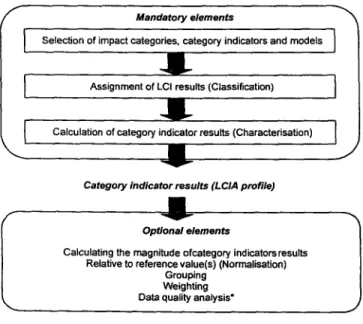
A first important basis for agreement consisted of the devel- opment of a c o m m o n framework and a c o m m o n terminol- ogy for LC1A. This was by no means an easy process, given the differences in background and in expectations on the outcome of the endeavour. The c o m m o n framework con- sists first of all of the different elements which must or can be included (-+
Fig. 1).
As the figure shows, a distinction is made between mandatory and optional elements. The ele- ments rather closely follow the SETAC framework (CoNsOLI et al., 1993) although there are some differences, particu- larly in the optional elements.Mandatory elements
I Selection of impact categories, category indicators and models ]
l
I Assignment of LCI results (Classification) I
l
I Calculation of category indicator results (Characterisation) I
. . [ ]
Category
indicator
results
(LCIA
profile)
I
Optional
e~lement$
1
Calculating the magnitude ofcategory indicators results Relative to reference value(s) (Normalisation)
Grouping Weighting Data quality analysis* *Mandatory in comparative assertions
Fig. 1: Elements of life cycle impact assessment (ISO/DIS 14042)
Another aspect of the c o m m o n framework concerns the tech- nical structure of impact assessment as defined for a single impact category (-+
Fig.
2). Regarding the terminology, an impact category is defined as a class representing environ- mental issues of concern into which LCI results m a y be as- signed. All environmental processes belonging to this cat- egory are called the e n v i r o n m e n t a l m e c h a n i s m of t h a tcategory. In the environmental mechanism, a category indi- cator is defined, being the basis for characterisation model- ling. Thus, the characterisation modelling defines the rela- tionship between the inventory results and the category indicator. In addition, the term environmental relevance is introduced, describing the links between the category indi- cator and the endpoints of the given category. Category end- points are the variables which are of direct societal concern, such as human life span or incidence of illnesses, natural resources, valuable ecosystems or species, fossil fuels and mineral ores, monuments and landscapes, man-made mate- rials, etc. (ISO term, but somewhat further explained here); the level of the endpoints is also called the "damage level" (SETAC-Europe term).
Example
[
Lifecyclei . . . . tory . . . . Its .,~ ... "~ Kg SOl, HCI etcI<c,...o.
. . . ooo,oimpact category "41" . . . -I~ Acidificatioll . . . . - . . . i , . f N ~ . SO,. etc.)
-t ... ---1 ...
\r" 7
\ I - forest
[ C~t~o.E~=nt(s) } . ... . - v e g e t a t i o n . e t c Fig. 2: The concept of "category indicator" as part of the structure of impact assessment for a single impact category (ISO/DIS 14042)
3 T h e R e a c h o f " C o m p a r a t i v e A s s e r t i o n s "
A next important point concerned the precise reach of the term "comparative assertions disclosed to the public". This is very important, as the requirements are much more strict for these applications than for others such as internal use of LCA. In ISO 14040, a comparative assertion is defined as an "envi- ronmental claim regarding the superiority or equivalence of one product versus a competing product which performs the same function". This means that single claims which are dis- closed to the public will not fall under this heading. In a de- bate on this issue in the working group, this line was re-estab- lished. Single claims may pertain, for instance, to annual reports, but possibly also to scores characterising the environ- mental characteristics of separate building materials. How- ever, the precise boundary between comparative assertions and single claims is as yet not precisely defined and will have to be further clarified in future practice.
Another point concerns the meaning of "disclosed to the public". An interesting question is whether exchange of com- parative information within a branch of industry or within a chain of companies are to be regarded as internal or pub- lic; one may well argue that this can be regarded as internal as long as the public is not the addressed party.
C o m m e n t a r y A r t i c l e s I S O / D I S 1 4 0 4 2
4 M a i n R e q u i r e m e n t s f o r C a t e g o r y I n d i c a t o r s
The core requirements regarding public comparative asser- tions pertain to the quality of the category indicators. There are three requirements:
1. category indicators should be internationally accepted 2. category indicators shall be scientifically and technically
valid
3. category indicators shall be environmentally relevant.
We will discuss these requirements in somewhat more detail.
The first requirement on international acceptance has not further been specified. There is no strict definition of "inter- national acceptance" in the draft'standard, but the discus- sions pointed at agreements reached in authoritative inter- national bodies like W H O , UN or OECD. International acceptance regards only a "should"; this means that it is desirable, but not strictly necessary. On the other hand, it is also not sufficient, as there are two additional "shalls" to be met. So, if there is international acceptance in an authorita- tive international body on certain value choices, this would effectively remove arbitrariness, but would still not be suffi- cient for a public comparative assertion.
The second requirement on scientific validity is the core re- quirement. It is further exemplified with the following text: " ... using a distinct identifiable environmental mechanism, and/or reproducible empirical observation". So there are two ways to meet this criterion. It is important to realise that the
first option
regards knowledge on the environmental mecha- nism of the impact category as a whole; it does not require strict additivety at the level of a single environmental process as was originally suggested by the US delegation. Thesecond
option
has been added in order to include empirical data, for instance on fate and exposure of substances as a complement to or as an alternative for fate modelling(JoLLIET
andCRETTAZ,
1997; 1999), or on N O E C s based on animal bio-assays with- out any knowledge about the underlying processes involved. Furthermore it is important to realise that there is no require- ment on the level of the certainty of the modelling,
The second requirement particularly aims to exclude "value choices"; it does not aim to exclude "assumptions" which are of a more technical character. Although not strictly defined in the ISO document, assumptions will particularly include choices which can empirically be validated if sufficient knowl- edge would be available. They deal for instance with the choice of the background level of the substance in question, the use of animal bio-assays as a model for assessing human toxicity, the use of QSARs, etc. Value choices are of a political, cultural or ethical character. They, for instance, deal with the use of Acceptable Daily Intakes (ADIs) or Reference Doses (RfDs) as a basis for aggregation, because the safety factors contained in these criteria are value based, at least in part. They also deal with different weights which can be attached to human life vs.
biodiversity or the availability of resources; or more in gen- eral with the relative importance of different impact catego- ries in relation to each other. Assumptions are accepted as part of characterisation modelling for public comparative as- sertions, value choices are not. It is of interest to observe, how- ever, that climate change modelling as basis for the global warming potentials (GWPs) and ozone depletion modelling as basis for the ozone depletion potentials (ODPs), are regarded as being acceptable for public comparative assertions. This is the case, notwithstanding the fact that the GWP definition makes a choice for specific time periods, whereas the ODP definition chooses for full time integration. These choices are surely not of technical character and do imply values on how to weight the future against the present. Apparently, the inter- national acceptance on these indicators was in fact regarded as a sufficient condition.
The third requirement on environmental relevance has been set as a guard against irrelevant indicators. If the link with the category endpoints, i.e. with the things which we really want to protect, is not sufficiently clear, then such an indi- cator cannot be used. For instance, the weight of material put on a landfill may, without further specification, be not sufficiently relevant as category indicator. It should be noted, however, that the link between the indicator and the end- points does not need to be of a full quantitative character; qualitative relationships together with an indication of their likelihood are sufficient.
5 T h e P o s i t i o n o f t h e C a t e g o r y I n d i c a t o r in t h e E n v i r o n m e n t a l M e c h a n i s m
The draft standard clearly states that the category indicator can be chosen anywhere in the environmental mechanism of the impact category. So it can be chosen at the level of the environmental interventions (the "LCI results" in ISO ter- minology), at the level of the category endpoints, or some- where in between (at "midpoint" level). This is significant for a number of reasons:
Firstly,
of all it opens the possibility to optimise between un- certainty in characterisation modelling and the environmental relevance of the chosen indicator. The choice of an indicator close to the environmental interventions, as is the case with the GWPs and ODPs, will generally yield relatively certain characterisation results, at the cost of uncertainties in the links to the endpoints and therefore a relatively low environmental relevance. On the other hand, the choice of an indicator at endpoint level will yield rather uncertain characterisation re- sults, but with a high environmental relevance.Secondly,
the choice of the indicator may be relevant in view of the further interpretation of the outcome. Thus, for a final evaluation of characterisation results based on indi- vidual preferences, a choice of the indicator at endpoint level seems a prerequisite (NOTARN1COLA et al., 1998), as endpoints are the variables which are of direct societal concern. Morein general, social panels will preferably deal with indicators at endpoint level, or at least require clear information on the environmental relevance of category indicators.
Thirdly,
and particularly relevant in the present context, the choice of the indicator at endpoint level may open new pos- sibilities for a science based aggregation.The second and the third point need some further elaboration.
Let us take as an example the impacts on human health caused by toxic substances. Current category indicators at midpoint level, like those based on Acceptable Daily Intakes (ADIs) or Reference Doses (RfDs), cannot be regarded scientifically valid, because of the safety factors involved which contain strong value based elements. Indicators based on NOEC, ED10 or LD50 data, which result from animal bio-assays, can in them- selves be scientifically valid but will generally only enable ag- gregation within subcategories with common types of impact (cf. BURKE et al., 1995). Science-based aggregation across these subcategories seems difficult to achieve. One may leave it like that and use a great number of human health impact catego- ries instead. However, new options for aggregation may arise if we are able to assess the impacts on human health in terms of "Years of Life Lost" (YLL) or "Years of Life Disabled" (YLD), i.e. the human health indicators developed under auspices of the W H O (Mut~l~w and Lol,~7_, 1996). These indicators are based on a combination of epidemiological human health data or on models using bio-assay data, and may in principle bring science-based ways of aggregation within reach for human toxicity impacts. This also would open up the possibility to include other types of impact on human health, as, for in- stance, caused by fine dust or by physical casualties. For these reasons they are now being further elaborated for application in LCIA context (Hovs-rErrER, 1998; GOEDKOOr et al., 1998). Data on YLL or YLD enable to aggregate across different types of causes, but still do not result in one single encompass- ing category indicator for human toxicity. This can in prin- ciple be achieved by performing a further aggregation of the YLL and YLD results in terms of the so-called disability ad- justed life years, the DALYs, which weight life shortening and different types of disability against each other
(MURRAY
and LOVEZ, 1996). The resulting DALY based indicator would in- deed be quite manageable, but would not meet the require- ment on scientific validity because of the value choices involved in the weighting step.Another example of modelling at endpoint level concerns ecotoxicity. The main problem here concerns the variety of species involved. Comparable to human toxicity, an aggre- gation on the basis of indicators which include safety fac- tors (because of too small numbers of test species) may not sufficiently meet the requirement on scientific validity (see however also Emans et al., 1993, arguing in favour for the scientific validity of these factors). A step forward concerns the use of indicators based on PNEC data, i.e. the "pre- dicted no effect concentrations" indicating the concentra- tion at which a given percentage (say, for instance, 95%) of
the species of an ecosystem is just protected
(ALDENBERG
and SLOb, 1991). This can be regarded as a common category indicator at midpoint level, with arguably a scientifically valid basis. A recent list of characterisation factors for toxic substances, which is based on the PNEC concept, includes 180 substances (HuIJBREGTS,1999).
A further improvement in scientific validity may well concern the use of the concept of the "potentially affected fraction of species" of an eco- system (PAF) (KLEv~ER and VAN DER MEENT, 1997). Indica- tors based on this PAF concept concern the endpoint level of the environmental mechanism. Their contribution to scien- tific validity lies in the fact that also the aggregation itself has a better founded basis, as the non-linearity of the dose- response curve of the impacts on the species composition is taken into account. For the above three reasons, modelling up to the endpoint level is now a major focus for LCIA de- velopment (HoFsTErrER, 1998; GOEDKOOt' et al., 1998).6 N o W e i g h t i n g A c r o s s I m p a c t C a t e g o r i e s
Given the science basis requirement, weighting across im- pact categories is not allowed for public comparative asser- tions. Because weighting across impact categories will al- ways, at least in part, be based on value choices, this requirement cannot be removed by further scientific devel- opment. This implies that results of LC1A cannot be ex- pressed in terms of a single encompassing eco-indicator (cf. GOEDKOOV, et al., 1998), if they are to be used for public comparative assertions. For specific applications, which do require routine comparisons between large numbers of prod- ucts, this indeed can be a severe limitation.
As a compromise, the 1SO working group now has proposed to accept ranking between categories. This means that in the (normalised) environmental profile of a product (i.e. the characterisation results) the relative importance of the catego- ries can be indicated; for instance, the bars representing the results can be given in different colours indicating their rela- tive importance. However, this does not solve the above men- tioned limitation. A solution could be that weighting is not allowed under ISO umbrella, but that the results can be weighted afterwards, outside this umbrella. Of course, it should then be clearly expressed that the weighted results are not obtained under rules of the ISO standard. However, the present text is clearly at variance with this rather artificial possibility. A more preferable option would be to aim at the establish- ment of a generic global set of weighting values. This would remove arbitrariness, but would also involve a change in the present draft standard that international acceptance is a suffi- cient condition for a comparative assertion.
7 Discussion
Taken together, to which extent can best current practice meet the coming ISO standard on LCIA? This question is
C o m m e n t a r y A r t i c l e s I S O / D I S 1 4 0 4 2
quite relevant, because a standard which would invalidate such best practice would rather be counterproductive than helpful.
In order to give a short overview of the implications for cha- racterisation modelling we follow the list of impact categories which has recently bcc~J established by the SETAC-Europe working group on impact assessment in a guiding document towards best available practice (UDo DE HAES et al., 1999).
For abiotic resources, there seem to be options which do com-
ply with the standard, as for example, the energy required for their extraction, the exergy content of the resources, or the total material requirement associated with their extraction.
For biotic resources, one can think of a measure of deple-
tion, which relates their present availability, their present rate of use and their potential for recovery.
For land use, science-based indicators may aim at the area of
exclusive land use; or of the vegetation structure as basis for a number of important life support functions. Indicators deal- ing with biodiversity may well be based on the loss of species diversity (e.g. of vascular plant species), in combination with the area involved (I.INDEI.IER, 1998). It is interesting to investi- gate whether a link to the potentially affected fraction of spe- cies of an ecosystem (the PAF concept) will be feasible in the near future. Climate change and stratospheric ozone deple- tion explicitly comply with the present draft standard, although values are involved in the choice of the time horizon.
For human toxicity, part of the problems can be solved by
choosing the indicators at endpoint level: years of life lost (YLL) or years of life disabled (YLD). These indicators are encompassing in that they combine different types of un- derlying causes. But they are in fact defined at a subcat- egory level and need a weighting step for further aggrega- tion (i.e. the disability adjusted life years or DALYs). So no single science-based indicator is as yet available for human toxicity, even if the modelling up to the endpoint level proves feasible. If it is not feasible or only in part feasible, then we must choose a set of subcategory indicators at midpoint level like those based on N O E C or ED10 criteria resulting from animal bio-assays. These have a lower or partial environ- mental relevance; they will better meet the requirements on scientific validity, but again they cannot easily be combined to one single category indicator.
The smog category may well be split into human toxic im-
pacts, mainly due to small particles, and the creation of photo- oxidants. For the latter, different indicators are available which may well meet ISO requirements, in particular the POCPs or photo-oxidant creation potentials (DERwENq" et al., 1998) and the MIRs or maximum incremental reactivity (CARTER, 1994). Expressing damages to human health due to ozone creation in term of YLL or YLD would allow to compare these with those due to other toxic substances. Acidification will give no severe problems, as the release of protons seems to be an ISO-com- patible indicator (PoITING et al., 1998).
For nutrification, the most commonly used approach con-
cerns a stoechiometric addition of P and N, implying an addition according to their relative occurrence in biota. This does not take limiting conditions for the nutrients into ac- count. However, at the level of nutrient availability, this can be defended as a sound approach, leaving the uncertainty of impacts to the environmental relevance of the indicator.
8 C o n c l u s i o n
The framework which has now been presented by the ISO working group, which requires scientific validity of category indicators as strict requirement for public comparative asser- tions, appears to be useful for guiding aggregation within the majority of the currently distinguished impact categories in LCIA. For most of these categories there is still considerable room for choice. To some extent this is desirable, as the differ- ent available options may meet different application require- ments. To some extent this is a matter of differences in scien- tific quality. It is a task of the SETAC-Europe working group on LCIA to identify, where possible, the best available prac- tice in this field. Major difficulties appear to be present to accommodate the toxicity categories under the coming stan- dard. Here the definition of the category indicator at the end- point level opens perspectives for increasing scientific validity of aggregation within these categories. But particularly for human toxicity, there is still weighting involved if one wants to express the results in terms of one category indicator. We suggest that for the aggregation of interventions within im- pact categories, as for instance human toxicity, international acceptance of value choices will be established as a sufficient condition for public comparative assertions in the coming ISO standard on LCIA.
For ecotoxicity, the picture is conceptually somewhat bet-
ter, as already at midpoint level PNEC based indicators are arguably ISO compatible. Indicators at endpoint level, based on the PAF concept can in principle further add to the scien- tific validity of the aggregation. And comparable to human toxicity, the PAF concept may enable the inclusion of other category results in the aggregation. We have to keep in mind, however, that for both the toxicity categories there is a very large data problem to address in view of the extreme num- ber of substances involved.
9 R e f e r e n c e s
ALDENBERG, T. and SLOB, W. (1991): Confidence limits for hazard- ous concentrations based on logistically distributed NOEC tox- icity data. RIVM report no. 719102002
BURKE, T.A.; DOULL, J.; McKoNE, T.E.; PAUSTENBACH, D.J.; SCHEUPLEIN, R.; UDO DE HAES, H.A. and YOUNG, J.L. (1995): Hu- man health assessment and life-cycle assessment: analysis by an expert panel. ILSI, Washington DC
CARTrR, W. ( 1994): Development of ozone reactivity scales for vola- tile organic compounds. Journal of the Air and Waste Manage- menr Association 44:881-889
C()NSOtJ, E; AI.LEN, D.; BOUqTEAD, L; FAVA, J.; FRANKLIN, W.; JENSEN, A.A.; DE OUDE, N.; PARRESH, R.; PERRIMAN, R.; POS'I'LETHW,\ITE, D.; QUAy, B.; S~:GUtN, J. and VIe.ON, B. (I993): Guidelines for Life-Cycle Assessment: a 'Code of Practice'. SETAC, Brussels, Pensacola DERWENT, R.G.; JENKIN, M.E.; SAUND~RS, S.M. and P~UNG, M.J.
(1998): Photochemical ozone creation potentials for organic com- pounds in Northwest Europe calculated with a master chemical mechanism. Atmospheric Environment 32:2429-2441
EMANS, H.J.B.; VAN D E PLASSCHE, E.J.; CANTON, H.J.; OKKEItMAN,
P.C. and SI'AR~'NI~URG, P.M. (1993): Validation of some extrapola- tion methods used for effect assessment. Environmental Toxicol- ogy and Chemistry 12:2139-2154
GOI'DKOOP, M.J.; HOFSTETTEP,, P.; MULLER-WENK, R. and SPRIENSMA, R. (1998): Thc Eco-lndicator 98 Explained. Int. J. LCA 3 (6): 352-360
HOFSTETTER, P. (1998): Perspectives in life cycle impact assessment. A structured approach to combine models of the technosphere, ecosphere and valuesphere. Kluwer, Boston, Dordrecht, London HulJlU~Ec;rs, M.A.J. (1999): Priority assessment of toxic substances in LCA; application of the uniform system for the evaluation of substances 2.0. Draft IVAM report, University of Amsterdam; part of updated CML guide on LCA (in prep.)
International Organizatkm for Standardization (1998): ISO/DIS 14042: Environ men tal management - Life cycle assessment - Life cycle impact assessment
JoLtJrT, O. and CRrTr^Z, P. (1997): Calculation of fate and expo- sure coefficients for the life cycle toxicity assessment of air emis- sions, lnt. J. LCA 2 (2): 104-110
JOLLIFT, O. and CRETTAZ, P. ( 1999): Modelling of exposure efficiency for the characterization of human toxicity in Life Cycle Assess- ment. Int. Journal of Risk Analysis, submitted
Klepper, O. and D. van de Meent, 1997: Mapping the potentially affected fraction (PAF) of species as an indicator of generic toxic stress. RIVM-report no. 607504001, Bilthoven (NL)
DNDEqER, E. (1998): Workshop report on land use impacts, includ- ing survey, 8th annual SETAC-Europe meeting, Bordeaux MURRAY, CH.J.L. and LoPEz, A.D. (Eds.), 1996: The Global Burden
of Disease, Volume 1 of Global Burden of Disease and Injury Series, WHO / Harvad School of Public Health / World Bank, Harvard University Press, Boston
NO'FARNICOLA, B.; HUPPES, G. and VAN DEN BERG, N.W. (1998): Evalu- ating options in LCA: the emergence of conflicting paradigms for impact assessment and evaluation. Int. J. LCA 3 (5): 289-300 OWFNS, J.W. (1998): Life Cycle Impact Assessment: the use of sub- jective judgements in classification and characterization. Int. J. LCA 3 (1): 43-46
POTrlN(;, J.; SCH()I'I', W.; Bt.OK, K. and HAUSCHIt.I), M. (1998): Site- dependent life-cycle impact assessment in acidificatio,~. Journal of Industrial Ecology 2 (2): 63-87
UDO DE HAES, H.A.; JOHJET, O.; FINNVEDEN, G.; HAUSCHII.D, M.; Kl~Ewrrr, W. and MUEI.LEII.-WENK, R. (1999): Best available prac- tice regarding impact categories and category indicators in Life Cycle Impact Assessment. Report of second working group on life cycle impact assessment of SETAC-Europe. Brussels
Received: January 21st, 1999 Accepted: March 3rd, 1999
Conference Announcements
6th International Conference: The Automotive Industry & the Environment
Vehicle Environmental Performance, Technology and Legislation
Strategies for the 21st C e n t u r y
Wednesday, 21st & T h u r s d a y 22nd April, 1999 The C o p t h o r n e Stuttgart International, G e r m a n y
Environmental measures and growing public awareness of 'green' issues will continue to force technical and strategic change in the automotive industry. Acting against these pres- sures are those perspectives which have shaped the industry - demands for lower cost, greater value, better performance, higher safety standards and improved style and utility. Environmental performance objectives for vehicles are enforced or encouraged by a wide range of instruments: legislation, taxa- tion and fiscal incentives, in addition to public opinion. The International Conference will provide a platform for the views of the automotive and oil industries, the environmen- talists, the legislators and the users. Key topics will include: 9 W h a t Vehicle E n v i r o n m e n t a l Performance (VEP) m e a n s
a n d variations in achievement
9 B e n c h m a r k i n g a n d C o n s u m e r Direction
9 H o w Organisations M e a s u r e Environmental Effective- ness - The experiences and conclusions of the A u t o m o - tive Industry
9 Industry Cultures and R e s p o n s e s - The implementation and m a n a g e m e n t of an effective process for achieving o p t i m u m Vehicle E n v i r o n m e n t a l Performance
9 The Perils of Life Cycle Assessment 9 Achieving Strategic A d v a n t a g e s
9 Legislation/Regulations a n d the I m p a c t on the A u t o m o - tive Industry
For further details of the above event, please contact: Energy Logistics International Ltd. 70-72 St. Marks Road, Maidenhead, Berkshire, SL6 6DW, UK Tel.: +44-1628-6717-17; Fax: -20 E-mail: [email protected]
Please note also the R e p o r t from the 3rd Conference o f the Society of Automotive Engineers (SAE) o n Total Life Cycle in Graz, Styria, Austria, December 1998 (-~ pp. 121-122).