HAL Id: hal-01945503
https://hal.archives-ouvertes.fr/hal-01945503
Submitted on 5 Dec 2018
HAL is a multi-disciplinary open access
archive for the deposit and dissemination of
sci-entific research documents, whether they are
pub-lished or not. The documents may come from
teaching and research institutions in France or
abroad, or from public or private research centers.
L’archive ouverte pluridisciplinaire HAL, est
destinée au dépôt et à la diffusion de documents
scientifiques de niveau recherche, publiés ou non,
émanant des établissements d’enseignement et de
recherche français ou étrangers, des laboratoires
publics ou privés.
Flying with ionic wind
Franck Plouraboué
To cite this version:
Franck Plouraboué. Flying with ionic wind. Nature, Nature Publishing Group, 2018, 563, pp.476-477.
�10.1038/d41586-018-07411-z�. �hal-01945503�
OATAO is an open access repository that collects the work of Toulouse
researchers and makes it freely available over the web where possible
This is an author’s version published in:
http://oatao.univ-toulouse.fr/21207
To cite this version:
Plouraboué, Franck Flying with ionic wind. (2018) Nature,
563. 476-477. ISSN 0028-0836
Official URL:
https://dx.doi.org/10.1038/d41586-018-07411-z
Open Archive Toulouse Archive Ouverte
Any correspondence concerning this service should be sent
F R A N C K P LO U R A B O U É
S
mall, lightweight devices called lifters can propel themselves into the air without combustion or moving parts, and have become a popular topic of discussion with technology buffs on social media in the past few years. And yet the physical mechanism behind lifters has been known for more than a century1. When charged molecules in the airare subjected to an electric field, they are accel-erated. And when these charged molecules collide with neutral ones, they transfer part of their momentum, leading to air movement known as an ionic wind. On page 532, Xu et al.2
demonstrate that an aeroplane with a 5-metre wingspan can sustain steady-level flight using ionic-wind propulsion. Improvements are required, but the authors’ proof-of-concept demonstration could pave the way for the development of enhanced propulsion systems.
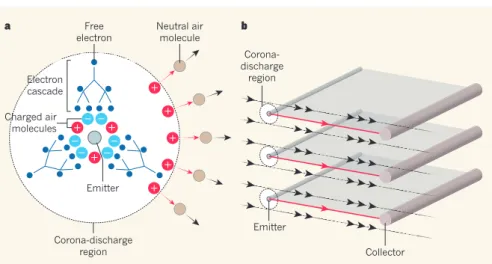
In Xu and colleagues’ plane, an electric field is applied to the region that surrounds a fine wire called the emitter (Fig. 1a). The field is strong enough to induce a chain reaction: free electrons in the region collide heavily enough with air molecules to ionize them, producing more electrons that then ionize more molecules. These electron cascades give rise to charged air molecules in the vicinity of the emitter — a phenomenon called a corona discharge. Finally, the charged molecules drift away from the emitter and generate a propul-sive ionic wind as they are accelerated by the electric field towards a device called the collec-tor (Fig. 1b). This process occurs only in gases, and not in liquids, justifying the authors’ use of the term ‘electro aerodynamics’.
Previous experiments suggested that ionic-wind propulsion could enable the steady-level flight of an aircraft, but that the feasibility of achieving this lies at the limit of what is currently technologically possible3. Xu et al.
therefore needed to systematically search through all of the possible aeroplane designs for a feasible option. They used a technique called geometric programming to find the optimum set of design variables that would also minimize the aircraft’s wingspan and, in turn, its weight, electrical-power requirements and cost.
The optimization technique found a feasible design at a wingspan of 5 metres, with a mass of
2.5 kilograms, a flight velocity of 4.8 metres per second and a power requirement of 600 watts. The authors built a full-scale plane based on this design (see Fig. 1b of the paper2). They
flew the aircraft ten times, and showed that it achieved steady-level flight.
In the 1960s, various studies4,5 seemed to
sound the death knell for propulsion based on ionic wind. They demonstrated that only about 1% of the input electrical energy was used in propulsion — not far from the 2.6% reported by Xu and colleagues. However, at least three factors make the approach appealing for aircraft.
First, it is now known that the energy efficiency improves substantially when the aircraft velocity is increased. For example, if the velocity reaches 300 m s–1, the efficiency2,6
can be as high as 50%. Second, many stud-ies have shown that ionic wind can enhance the aerodynamics of plane wings7. Third, the
technique could facilitate what is known as distributed propulsion8, which is considered
a major direction for improvement in aviation.
Aircraft propulsion is quantified by the freestream mass-flow rate — the total mass of air that passes through a given area in a given time. This rate is directly proportional to the cross-sectional area of the propulsion system, and to the increase in air velocity provided by the system. In distributed pro-pulsion, an array of propulsion systems is spread along the length of the aircraft. This increases the total cross-sectional area and, in turn, the freestream mass-flow rate. But it also enhances the aerodynamic drag (the frictional force between the aircraft and the air). Using fine wires as the propulsion system, as Xu et al. did, could allow the total cross-sectional area to be greatly increased, while having almost no impact on the aerodynamic drag.
The scalability of the authors’ propulsion system remains to be seen. Can ionic-wind propulsion fly an aircraft of several tonnes? This practical issue is still open, but predictions suggest that aircraft such as the solar-powered plane Solar Impulse 2 could sustain steady-level flight using only ionic wind9. An advantage of
Flying with ionic wind
Aeroplanes use propellers and turbines, and are typically powered by fossil-fuel combustion. An alternative method of propelling planes has been demonstrated that does not require moving parts or combustion
Neutral air molecule Electron cascade Free electron Emitter Corona-discharge region Corona-discharge region Charged air molecules Collector Emitter – – –– – – + + + + + + + + a b
Figure 1 | Ionic-wind propulsion. Xu et al.2 demonstrate that an aeroplane can sustain steady-level
flight using air movement known as an ionic wind. a, In the authors’ aircraft, an electric field (not shown) is applied to the region surrounding a fine wire called the emitter (shown in cross-section). The field induces electron cascades, whereby free electrons collide with air molecules (not shown in the cascades) and consequently free up more electrons. This process produces charged air molecules in the vicinity of the emitter — a corona discharge. Depending on the electric field, negatively or positively charged molecules drift away (red arrows) from the emitter. These molecules collide with neutral air molecules, generating an ionic wind (black arrows). b, The aircraft uses a series of emitters and devices called collectors, the longitudinal directions of which are perpendicular to the ionic wind. The flow of charged air molecules occurs mainly along the directions (red arrows) joining emitters and collectors. Consequently, the ionic wind is accelerated (black arrows) predominantly in these regions.
ionic-wind propulsion systems, as opposed to propellers, is that they can be interfaced directly with batteries — the energy-storage devices of future planes — without affecting the rate of energy conversion. In the decades to come, drones or aircraft that use ionic wind might include secondary ionic-wind propul-sion systems dedicated to energy saving and potentially coupled with solar panels.
These technological developments should provide a better understanding of the coupled physics of charged-molecule production and the resulting ionic wind that is central to such
propulsion systems. The force generated by ionic wind is directly proportional to the elec-tric current that flows in the system2,10. Because
this current is strongly dependent on the con-figuration of emitters and collectors, research into the conception and optimization of ionic-wind propulsion can now begin, thanks to the breakthrough by Xu and colleagues. Franck Plouraboué is at the Institute of Fluid
Mechanics of Toulouse, Toulouse University, CNRS, INPT, UPS, 31400 Toulouse, France. e-mail: [email protected]
1. Chattock, A. P. Phil. Mag. 48, 401–420 (1899).
2. Xu, H. et al. Nature 563, 532–535 (2018).
3. Gilmore, C. K. & Barrett, S. R. H. Proc. R. Soc. Lond. A
471, 20140912 (2015).
4. Robinson, R. Am. Inst. Elect. Engineers Pt I 80,
143–150 (1961).
5. Stuetzer, O. M. Phys. Fluids 5, 534–544 (1962).
6. Bondar, H. & Bastien, F. J. Phys. D 19, 1657–1663
(2000).
7. Kriegseis, J., Simon, B. & Grundmann, S.
Appl. Mech. Rev. 68, 020802 (2016).
8. Sehra, A. K. & Whitlow, W. Prog. Aerosp. Sci. 40,
199–235 (2004).
9. Monrolin, N., Plouraboué, F. & Praud, O. AIAA J. 55,
4296–4305 (2017).
10. Monrolin, N., Praud, O. & Plouraboué, F. Phys. Rev.
Fluids 3, 063701 (2018).