Publisher’s version / Version de l'éditeur:
Vous avez des questions? Nous pouvons vous aider. Pour communiquer directement avec un auteur, consultez
la première page de la revue dans laquelle son article a été publié afin de trouver ses coordonnées. Si vous n’arrivez pas à les repérer, communiquez avec nous à [email protected].
Questions? Contact the NRC Publications Archive team at
[email protected]. If you wish to email the authors directly, please see the first page of the publication for their contact information.
https://publications-cnrc.canada.ca/fra/droits
L’accès à ce site Web et l’utilisation de son contenu sont assujettis aux conditions présentées dans le site LISEZ CES CONDITIONS ATTENTIVEMENT AVANT D’UTILISER CE SITE WEB.
First International Workshop on Wireless Communications in Underground and
Confined Areas (IWWCUCA 2005) [Proceedings], 2005
READ THESE TERMS AND CONDITIONS CAREFULLY BEFORE USING THIS WEBSITE. https://nrc-publications.canada.ca/eng/copyright
NRC Publications Archive Record / Notice des Archives des publications du CNRC :
https://nrc-publications.canada.ca/eng/view/object/?id=08524b95-2a3c-4bdb-b7dc-705466a5ef22
https://publications-cnrc.canada.ca/fra/voir/objet/?id=08524b95-2a3c-4bdb-b7dc-705466a5ef22
NRC Publications Archive
Archives des publications du CNRC
This publication could be one of several versions: author’s original, accepted manuscript or the publisher’s version. / La version de cette publication peut être l’une des suivantes : la version prépublication de l’auteur, la version acceptée du manuscrit ou la version de l’éditeur.
Access and use of this website and the material on it are subject to the Terms and Conditions set forth at
Propagation Characteristics for Modern Wireless System Networks in
Underground Mine Galleries
Institute for
Information Technology
Institut de technologie de l'information
Propagation Characteristics for Modern
Wireless System Networks in Underground
Mine Galleries*
Ndoh, M., and Deslile, G.Y.
June 2005
* published at First International Workshop on Wireless Communications in
Underground and Confined Areas (IWWCUCA 2005). Val-d’Or, Québec,
Canada. pp. 129-132. June 6-7, 2005. NRC 48300.
Copyright 2005 by
National Research Council of Canada
Permission is granted to quote short excerpts and to reproduce figures and tables from this report, provided that the source of such material is fully acknowledged.
2005 First International Workshop on Wireless Communication in Underground and Confined Area June 6-7, 2005, Val d’Or, QC, Canada
Propagation Characteristics for Modern Wireless System Networks in
Underground Mine Galleries
M. Ndoh
(*), G.Y. Delisle
(**),
(*) National Research Council Canada,
Institute for Information Technology, Wireless Systems Group,
Sydney Nova Scotia Canada, http://www.iit-iti.nrc-cnrc.gc.ca
E-mail: [email protected]
(**) International Institute of Telecommunications, Montréal
800, de la Gauchetière, Ouest, suite 6700 Montréal Qc, Canada H5A 1K6
http://www.iitelecom.com
E-mail: [email protected]
ABSTRACT
The propagation characteristics of electromagnetic waves in mine tunnels with roughness sidewalls have been addressed. The simulation results obtained using the ray tracing technique have been compared with a new approach known as Cascade Impedances Method (CIM). The measurements referred to have been taken in a real mine at 900 MHz.
1. INTRODUCTION
Underground mine galleries can be considered as complex transmission lines in wich multipath, attenuation, reflection, diffraction and scattering effects are dominants [1-16]. However, some companies have started to deploy modern wireless system networks in mine galleries with the objective is to increase safety and production. Recent studies [17-19] have introduced the concept of geolocation using wireless sensor networks based on random and mesh topology and various hybrid networks [12], as potential ways to help increase the safety of workers underground. There is a real need to know how to characterize the environment where these wireless systems are being deployed. In this paper we are addressing the characterization of propagation using the ray tracing technique. The simulation results have been predicted in difficult boundary conditions of roughness sidewalls and reflection coefficients and they have been compared with a new approach called Cascade Impedances Method CIM [1],[9]. The measurements have been taken in a real mine at 900 MHz.
2. RAY- TRACING TECHNIQUE APPROACH
Figure 1 represents a non canonical mine segment with six access points linked in a random topology [17-19], and eight mobile transceivers positioned randomly in the mine corridor.The challenge is to characterize the received signal in a mobile system (A) taking into account, the reflection from the rough sidewalls, the diffraction and the scattering of the signal from the corners and from the obstacles. In addition to the ray tracing technique we use the geometry and uniform GTD/UTD theory of diffraction [20-21]. The received signal at the trans-receiver (A) in figure 1 is:
( )
[
]
[
(
)
]
( )( )
[
]
[ ]
⎟⎟ + ⎠ ⎞ ⎟⎟ ⎠ ⎞ ⋅ ⎟ ⎟ ⎠ ⎞ ⎜ ⎜ ⎝ ⎛ ⎜⎜ ⎝ ⎛ ⎜⎜ ⎝ ⎛ + + ⎟ ⎟ ⎠ ⎞ ⎜ ⎜ ⎝ ⎛ ⋅ ⋅ = ∆Φ − = = = = = = = = = −∑
∑
∑
∑
) ( 1 4 1 6 1 6 1 1 , , i j J j p g P Walls p AP i AP N d jkr o i i A j j j i i i d e r v h R r e f b a f r S ( )( )
[
]
[
]
(
( )
)
( ) + ⎟ ⎟ ⎠ ⎞ ⎜ ⎜ ⎝ ⎛ ⎟⎟ ⎠ ⎞ ⎟⎟ ⎠ ⎞ ⎜⎜ ⎝ ⎛ ⎜⎜ ⎝ ⎛ +∑
∑
∑
= = ∆Φ − = = = i P walls p sk j k p g K k AP i f e r v h R k k 1 1 6 1 1 ,σ
( )( )
[
]
[ ]
(
( )
)
(
)
( ) + ⎟ ⎟ ⎠ ⎞ ⎜ ⎜ ⎝ ⎛ ⎟⎟ ⎠ ⎞ ⎟ ⎟ ⎠ ⎞ ⎜ ⎜ ⎝ ⎛ + ⎟⎟ ⎠ ⎞ ⎜⎜ ⎝ ⎛ ⎜⎜ ⎝ ⎛ +∑
∑
∑
= = ∆Φ − = = = i m m m m m P walls p sm j m p g M m AP i D f e r v h R m m ' ' 1 1 6 1 1 , ρ ρ ρ ρ σ( )
( )
[
]
[ ]
(
)
( ) + ⎟ ⎟ ⎠ ⎞ ⎜ ⎜ ⎝ ⎛ ⎟⎟ ⎠ ⎞ ⎟ ⎟ ⎠ ⎞ ⎜ ⎜ ⎝ ⎛ + ⎟⎟ ⎠ ⎞ ⎜⎜ ⎝ ⎛ ⎜⎜ ⎝ ⎛ +∑
∑
∑
= = ∆Φ − = = = i v v v v v P walls p j v p g V v AP i D e r v h R v v ' ' 1 1 6 1 1 , ρ ρ ρ ρ[
( )
]
(
)
( ) 2 1 ' ' 6 1 1 , i jk N n n n n n n g AP i n n h v D e R ⎟ ⎟ ⎟ ⎠ ⎞ ⎟ ⎟ ⎠ ⎞ ⎜ ⎜ ⎝ ⎛ + ⎟⎟ ⎠ ⎞ + ⎜ ⎜ ⎜ ⎝ ⎛ − = = =∑
∑
ρ ρ ρ ρ ρ (1)(f(ai,bi) and Rg(h,v)) are respectively the function of random
dimensions of the mine tunnel segment and the reflection coefficient of the rough surface[1]. Dn is the diffraction
coefficient [20-21] and f(σsm) is the scattering coefficient
[22-23].
Figure 1: A non canonical segment with six access points in mesh topology
AP
1AP
5ρ’
2ρ
nρ
ir3r
d5r
d2AP
4AP
3AP
2r
d1r
d4r
2A
AP
6r
d6r
d3r
1 12005 First International Workshop on Wireless Communication in Underground and Confined Area June 6-7, 2005, Val d’Or, QC, Canada
The first term of the equation (1) represents all the direct paths. The second term is the reflected components of the signal which will reach the trans-receiver (A) without involving scattering or diffracting phenomena. The third term represents all the reflected paths which will reach the trans-receiver (A) after scattering on the obstacles. The fourth term represents all the reflected paths which will reach the trans-receiver (A) after scattering and diffracting on the obstacles and rough corners of mine corridors. The fifth term represents all the components of the signal which will reach the trans-receiver (A) after involving the reflection and the diffraction from the rough side walls and diffraction on the corners
.
3. RESULTS
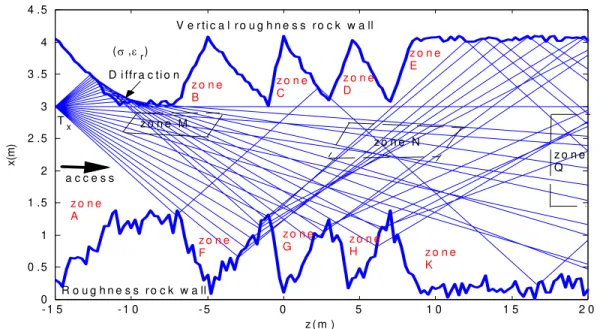
Figure 2 represents the simulated rays inside a two dimensional mine segment with several rough sidewalls. This result confirmed that, depending on the form of the segment and the position of the transmitter, one can obtain many zones. In this particular case, there are three propagation zones (M,N,Q) and other zones (A,B,C,D, E, F,G,H,K) called zones of uncertainty or neutral zones. The importance of these zones has been given by [1-2],[9].
- 1 5 - 1 0 - 5 0 5 1 0 1 5 2 0 0 0 .5 1 1 .5 2 2 .5 3 3 .5 4 4 .5 z ( m ) x( m ) a c c e s s D i ffr a c ti o n V e r ti c a l r o u g h n e s s r o c k w a ll R o u g h n e s s r o c k w a ll Tx z o n e A z o n e K z o n e B z o n e C z o n e D z o n e E z o n e F z o n e G z o n eH z o n e M z o n e N z o n e Q (σ ,εr)
Figure 2. 2D simulated segment with rays.
Figure 3 illustrates predicted received power in a segment of tunnel mine at 900 MHz.
Figure 3: A 2 -D Comparison between simulations of both methods and measurements at 900 MHz.
Measurements
(CIM)
4. CONCLUSION
In this paper, we characterized the radio waves propagation in a non standard mine segment using the Ray Tracing Approach. The efficiency of the model has been proven by the comparison of theoretical simulation with the Cascade Impedances Method (CIM), as well as measurements taken in a real mine segment at 900MHz. The results obtained in this study confirmed that the diffraction, reflection and multipath are dominant in complex rough mine corridors. However, wireless systems can be deployed by using advanced mesh or hybrid network architectures and topologies.
5. REFERENCES
[1] M. Ndoh, “Modélisation de la propagation des ondes électromagnétiques dans un environnement minier”, thèse de Ph.D., Département de génie électrique et génie informatique, Université de Laval, Québec, Canada, 27 avril 2004.
[2] M.Ndoh, G.Y.Delisle, “ Underground Mines Wireless Propagation Modeling,” IEEE VTC 2004, Los Angeles Sept 26-29, 2004.
[3] P. Delogne, “EM propagation in tunnels”, IEEE Trans.
Antennas propagat., vol.39, no.3, Mars 1991,
pp.401-406.
[4] M.Liénard, P. Degauque, “Wideband analysis of propagation along radiating cables in tunnels, ”, Radio Sci., vo 34, no.1, Jan-Fév. 1999, pp.113-122.
[5] A.G. Emslie, R. L. Lagace , P. F. Strong, “Theory of the propagation of UHF radio waves in coal mine tunnels ”, IEEE Trans. Antennas Propagat., vol.AP-23, Mars1975, pp.192-205.
[6] S. F. Mahmoud, J. R. Wait, “Geometrical optical approach for electromagnetic propagation in rectangular mine tunnels”, Radio Science, vol.9, no.12, 1974, pp.1147-1158. [7] Y.P.Zhang, G.X.Zheng and J.H.Sheng, “Radio Propagation
at 900 MHz in Underground Coal Mines,” IEEE
Trans.Antennas and Propagat., vol. 49,no.5,pp.757-762, May 2001..
[8]
Y.Hwang, Y.P.Zhang and R.G. Kouyoumjian, “Ray-Optical Prediction of Radio-Wave Propagation Characteristics in Tunnel Environment Part 2: Analysis andMeasurements”,
IEEE Trans., Antennas
Propagat.,vol.46, no.9, pp.1337-1345 Sept 1998.
[9] M.Ndoh, G.Y.Delisle and R.Le, “A novel approach topropagation prediction in a confined rough surfaces”, The International Journal of Numerical Modelling, Electronical Network, Devices and Fields. JNM:521, vo.16, pp.535-555, Dec. 2003.
[10] M.Djadel., C.Despins and S.Affès, “ Narrowband Propagation Characteristics at 2.45 and 18 GHz in Underground Mining,’’ IEEE GLOBECOM 2002, Taipei, Taiwan, 17-21 Nov, 2002.
[11] M.Hämäläinen, J.Talvitie,V.Hovinen, P.Leppänen, “ Wideband Radio Channel Measurement in a Mine,” IEEE
5th Inter. Symp. On Spread Spectrum Technics & Appl., ISSSTA’ 98. Sun City, South-Africa, pp.522-526, Sept 2-4, 1998.
[12] Y.Yamaguchi, T. Honda, M. Sengoku,et al.,“On the Reduction of Wave Propagation Loss in Tunnels”, IEEE
Trans. Electromagnet. Compt., vol.34, no.2, Mai 1992, pp.78-85.
[13] L.Sydänheimo, M. Keskilammi, M. Kivikoski, “Reliable mobile computing to underground mine”, International
Conference on Applied Informatics , Innsbruck, Austria, Fév.2000.
[14] J. Chiba, T. Inaba, Y. Kuwamoto, O. Banno ,R. Sato, “Radio communication in tunnels”, IEEE Trans.
Microwave Theory Tech., vol.MTT-26, Juin 1978, pp.439-443.
[15] S.Kosono, T. Suzuki, T. Hanazawa, “Experimental study of mobile radio propagation characteristics in rectangular tunnels”, Trans. IECE Japan, vol.J62-B, no.6, Juin 1979, pp.565-572.
[16] K.D.Laakmann, W. H. Steier, “Waveguides: Characteristics modes of hollow rectangular dielectrique waveguides” , Applied Optics, vol 15, no 5 , Mai 1979. [17] M.Ndoh, G.Y.Delisle, “Geolocation in Underground Mines
Using Wireless Sensor Networks”, Acepted in IEEE AP-S 2005 International Symposium, Washington DC, July 3-8, 2005.
[18] M.Ndoh, G.Y.Delisle, “Position Location Approach for Mobile Wireless Systems in Underground Mines”, Acepted in IEEE Vehicular Technology Conference 2005, Dallas, Tx, Sept. 26-29, 2005.
[19] K.Srinivasan, M.Ndoh, K.Kaluri, “Advanced Wireless Networks for Underground Mine Communications”, Acepted in First International workshop on Wireless Communications in Underground and Confined Areas (IWWCUCA) 2005, QC,Canada.
[20] R.G.Kouyoumjian and P.H.Pathak, “ A uniform geometrical theory of diffraction for an edge in a perfectly conducting surface,” Proc.IEEE vol.62, pp1448-1468, Nov.1974.
[21] R.J.Luebbers, “ Finite conductivity uniform GTD versus knife edge diffraction in prediction of propagation path loss,” IEEE Trans. Antennas and Propagat., vol.32, no.1, pp.70-76, Nov.1984.
[22] A.Ishimaru, Wave Propagation and Scattering in Random Media, vol. 1, Academic Press New-York 1978.
[23] A.Ishimaru, Wave Propagation and Scattering in Random Media , vol. 2, Academic Press New -York 1978.