HAL Id: hal-00382007
https://hal.archives-ouvertes.fr/hal-00382007
Preprint submitted on 7 May 2009
HAL is a multi-disciplinary open access
archive for the deposit and dissemination of
sci-entific research documents, whether they are
pub-lished or not. The documents may come from
teaching and research institutions in France or
abroad, or from public or private research centers.
L’archive ouverte pluridisciplinaire HAL, est
destinée au dépôt et à la diffusion de documents
scientifiques de niveau recherche, publiés ou non,
émanant des établissements d’enseignement et de
recherche français ou étrangers, des laboratoires
publics ou privés.
Tycho-2, a reference catalogue for astrometry and
photometry
Catherine Turon
To cite this version:
Astronomy & Astrophysics manuscript no. Tycho˙2 c ESO 2009 May 5, 2009
Tycho-2, a reference catalogue for astrometry and photometry
Combining the most modern and the oldest astrometric data
C. Turon
1GEPI-UMR CNRS 8111, Observatoire de Paris, Section de Meudon, 92195 Meudon cedex, France e-mail: [email protected]
Received 2 April 2009; accepted 19 April 2009
Key words.Astrometry – Space vehicles: instruments – Stars: fundamental parameters – Catalogues
The main Hipparcos mission, the first astrometric satellite ever launched, was included in the ESA Science Programme in March 1980. It was aiming at the fundamental task of measur-ing the angular positions and displacements of about 100 000 pre-selected stars to obtain a large set of distances and proper motions that are more accurate and homogenous than ever be-fore and that drastically improve our knowledge of the struc-ture, kinematics and dynamics of the local part of our Galaxy and of the various types of stars present there (see for example Turon & Arenou 2008). The resulting catalogue was published in 1997 (Perryman et al. 1997), and it indeed opened the way to a wide variety of astrophysical applications (Perryman 2009).
In the project as approved by ESA in 1980, the function of the star mapper was to provide data for determining the real-time satellite attitude, as required to reach the expected accu-racy on the astrometric parameters of the 118 000 programme stars. In March 1981, the idea of introducing two-colour chan-nels in the star mapper and using the continuous flow of star mapper data in survey mode for astrometric and two-colour pho-tometric measurements of all stars down to about 10 - 11 mag, was proposed by E. Høg (Høg et al. 1982). This enhancement was formally approved by ESA a few months later, and the Tycho Data Analysis Consortium (TDAC) was set up in 1982 under the responsibility of E. Høg. Analysis of this data stream led to the Tycho Catalogue (Høg et al. 1997), a purely observa-tional catalogue. Later, the same data stream was re-reduced, taking benefit of more powerful computers and of the com-pleted Hipparcos Catalogue. Moreover, a major improvement was brought by combining the Tycho positions with older as-trometric catalogues leading to a strong increase in the accuracy of the proper motions. These accurate proper motions combined to the homogeneity of its photometric observations led to the use of this Tycho-2 Catalogue (Høg et al. 2000) for a wide variety of applications, which would not have been possible with the orig-inal catalogue.
From the Tycho-1 to the Tycho-2 Catalogue. The Tycho Catalogue, later called ‘Tycho-1’, was compiled from the photon counts recorded by the Hipparcos star mappers. It includes astro-metric and two-colour photoastro-metric parameters for slightly more than one million stars brighter than V ∼ 11.5 and is 99.9 % com-plete up to ∼ 10.0 (Høg et al. 1997). While providing lower ac-curacies than Hipparcos in the astrometric parameters and only for brighter stars, it has the main advantage of being a survey,
us-ing an input catalogue only in the first stages of the data analysis, and of providing two-colour photometry for all targets.
The Tycho-2 Catalogue was constructed after the mission by combining a new analysis of Tycho data and previous as-trometric catalogues. Even though it is based on exactly the same observations as for the original catalogue, it is much im-proved: a new, more powerful, reduction technique was used to analyse the photon counts, resulting in a much larger catalogue (2.5 million stars) with deeper completeness (99.9 % to ∼ 11.0) and improved accuracy. Indeed, it also benefited from the final Hipparcos Catalogue and of an improved satellite attitude and instrument calibration. Moreover, the proper motions included in the Tycho−2 Catalogue were no longer computed only from the star mapper data but by combining the Tycho-2 positions with older, and even much older, positions from 143 transit cir-cle and photographic catalogues. It is very interesting to note that the first international and coordinated effort toward measur-ing stellar positions, the Astrographic Catalogue (mean epoch 1905), was used here in conjunction with the most modern data provided by the first astrometric satellite.
The resulting accuracy of proper motions, in addition to the very homogeneous two colours photometry, makes Tycho-2 a much used astrometric and photometric reference catalogue.
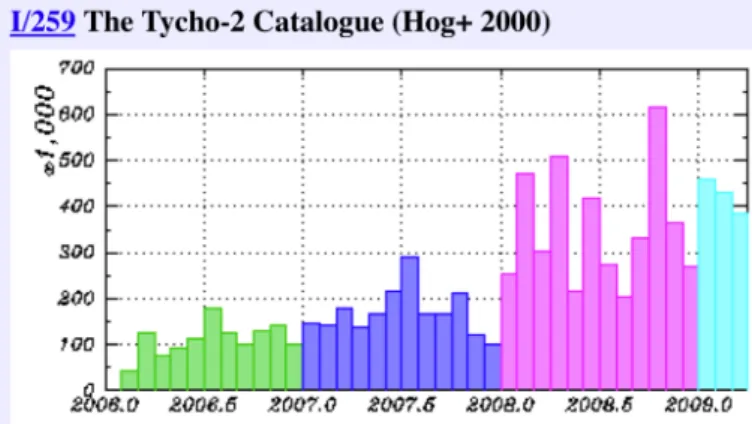
Use of the Tycho-2 Catalogue. The citations of the Høg et al. paper describing the Tycho-2 Catalogue are very numerous (total citations: 587 at the end of March 2009, among which 537 refereed papers), and the history of citations, as given in the ADS database, is quite interesting because it shows a nearly constant rate of citation over the last six years at a level of about 60 ci-tations per year. As a comparison, the cici-tations of the Hipparcos Catalogue are about five times more numerous and show a nearly constant rate of citation over the past eleven years. The other interesting indicator of how the catalogue has been used are the statistics of monthly requests addressed to the Tycho-2 Catalogue on all VizieR mirrors (Ochsenbein et al. 2000), from 2006, as shown in Fig. 1. It is impressive to see that the num-ber of interrogations is increasing, with a maximum of 600 000 and an average of 230 000 per month. These numbers can be compared to similar numbers for the main Hipparcos Catalogue (Perryman et al. 1997): max 940 000, average 280 000, and for the UCAC2 Catalogue (Zacharias et al. 2004) which is the astro-metric reference catalogue for stars down to magnitude 16: max 220 000, average 63 000. Another noticeable effect is that the
in-2 C. Turon: Tycho-2, combining the most modern and the oldest astrometric data
Fig. 1. Monthly requests addressed to Tycho-2 Catalogue on all VizieR mirrors, from 2006
terrogation statistics of these three catalogues exhibit very simi-lar behaviour with a parallel and strong increase from 2008. This may be related to the introduction of a description of VizieR in Wikipedia at the end of October 2007, widening the public using VizieR facilities. Of course, this does not take into account the uses of the Hipparcos and Tycho-2 Catalogues directly from the dedicated ESA web page, where multi-parameter search tools are available on-line.
The uses of the Tycho-2 Catalogue are extremely varied: a small proportion of purely astrometric or catalogue compi-lation applications and a wide variety of astrophysical appli-cations, equally using the proper motions and the photometry, very often in conjunction with the trigonometric parallaxes from the Hipparcos Catalogue or from the new reduction of the raw Hipparcos data performed by van Leeuwen & Fantino (2005): kinematics of clusters, associations, moving groups, binary and individual stars; detection of binary stars by the comparison of the Tycho-2 and Hipparcos proper motions (the Tycho-2 proper motions being derived from observations covering a much longer time span than the Hipparcos ones); estimate of the spectral type from the Tycho two colours; cluster/association membership; characterisation of stars hosting planets; identifi-cation of sources detected in X- UV- or IR-rays; variability sur-veys; etc.
The performance of a space survey for astrometry and pho-tometry is underlined by the history and use of the Tycho-2 Catalogue. Had it not been part of the Hipparcos project, such a project would very probably never have been accepted in any space science programme. Yet, the all-sky accessibility along with a very stable environment provide the conditions for much more accurate and homogeneous data than from the ground, and has led to an impressive variety of astronomical and astrophysi-cal applications.
Remarks by E. Høg.
It is immensely rewarding that the Tycho-2 Catalogue has been such a success. On behalf of all participants in Tycho, I acknowledge the support we have received from ESA, the Hipparcos Science Team, and all national funding authorities.
It seems appropriate to outline the history of the photoelec-tric techniques used for the observations. The basic observation technique of Hipparcos was the counting of photoelectrons re-leased from photocathodes by the light of stars crossing slit sys-tems in the focal plane of Hipparcos. In fact, only one star could be measured at a time by each of the one-channel detectors: an
image-dissector tube for the main field and two photo-multiplier tubes serving the star mapper channels in the colours B and V. The development of photoelectric astrometry began with exper-iments by Bengt Str¨omgren in 1925 (see Høg 2009), using ana-logue amplification of the photo current. The photon counting was introduced by Høg (1960). This technique was outdated in the 1990s by CCDs, which could integrate on many stars simul-taneously and had much higher quantum efficiency than photo-cathodes.
The idea of using the star mapper signal to detect other than the 60 000 reference stars occurred to me in 1978, but I did not find time to work out the performance. When I did so in March 1981 and realised the enormous potential it was almost too late. Enhancements to an approved mission are usually out of the question for reasons of cost and complexity. But I immediately wrote three reports to the Hipparcos Science Team where the idea was enthusiastically supported. The technical impact of the proposal was to extend the length of the star mapper slits, to in-clude channels for two colours, B and V, instead of only one, and to transmit all photon counts to the ground.
The Tycho experiment as initially described (Høg et al. 1982) was expected to measure 400 000 stars with accuracies at B=10 mag of 0.03 arcsec for the positions and 0.03 mag for the B and V magnitudes. Proper motions would be obtained by means of the Astrographic Catalogue with an accuracy of 0.003 arcsec / year. A combined treatment of all available field crossings of each star from a large input catalogue would give better accuracy and additionally 800 000 detected stars, but this was impossible with the available computing power.
The expectations of 1982 were surpassed in the final Tycho-2 Catalogue since 2.5 million stars were obtained and the median accuracies at B=10 were about 0.02 arcsec and 0.03 mag, and 0.0015 arcsec / year for the proper motions at that magnitude. There were five reasons for a better performance for faint stars than predicted in 1982: twice as long star mapper slits, higher quantum efficiency, lower sky background, a better method for estimating the background, and the combined treatment of all transits.
References
Høg, E., 2009, Development of photoelectric astrometry including the Hipparcos mission. In: Proceedings of IAU Symposium No. 254, Eds. J. Andersen, J. Bland-Hawthorn & B. Nordstr¨om (2009), and at http://www.astro.ku.dk/∼erik/History.pdf
Høg, E., Fabricius, C., Makarov, V.V. et al. 2000, A&A, 355, L27 Høg, E., B¨assgen, G. Bastian, U. et al. 1997, A&A, 323, L57 Høg, E., Jaschek, C. and Lindegren, L. 1982, ESA SP-177, 21 Høg, E. 1960, Astron. Abh. der Hamb. Sternw., vol V, 263 Ochsenbein F., Bauer P., Marcout J. 2000, A&AS, 143, 221
Perryman, M.A.C. 2009, Astronomical Applications of Astrometry, Cambridge University Press, Cambridge
Perryman, M.A.C., Lindegren, L., Kovalevsky, J. et al. 1997, A&A, 323, L49 Turon, C. & Arenou, F. 2008, IAU Symp. 248, 1
van Leeuwen, F. & Fantino E. 2005, A&A, 439, 791