HAL Id: in2p3-00596878
http://hal.in2p3.fr/in2p3-00596878
Submitted on 20 Dec 2011
HAL is a multi-disciplinary open access
archive for the deposit and dissemination of
sci-entific research documents, whether they are
pub-lished or not. The documents may come from
teaching and research institutions in France or
abroad, or from public or private research centers.
L’archive ouverte pluridisciplinaire HAL, est
destinée au dépôt et à la diffusion de documents
scientifiques de niveau recherche, publiés ou non,
émanant des établissements d’enseignement et de
recherche français ou étrangers, des laboratoires
publics ou privés.
To cite this version:
T. Al Kalanee, J. Gibelin, P. Roussel-Chomaz, D. Beaumel, Y. Blumenfeld, et al.. Structure beyond
the neutron drip-line :
9He. French Japanese Symposium on Nuclear Structure Problems, Jan 2011,
Keywords: nuclear structure, direct reaction, virtual states,9He
Structure beyond the neutron drip-line: 9 He
T. Al Kalanee†‡, J. Gibelin†‡, P. Roussel-Chomaz‡, D. Beaumel∗, Y. Blumenfeld∗,
B. Fernandez-Dominguez‡, C. Force‡, L. Gaudefroy‡, A. Gillibert§, J. Guillot∗,
H. Iwasaki∗, N. Keeleyk, S. Krupko¶, V. Lapoux§, W. Mittig‡, X. Mougeot§,
L. Nalpas§, N. A. Orr†, E. Pollacco§, K. Rusekk, T. Roger‡, H. Savajols‡,
N. de S´er´eville∗, S. Sidorchuk¶, D. Suzuki∗and I. Strojekk
†LPC-ENSICAEN, IN2P3-CNRS et Universit´e de Caen, F14050 Caen Cedex, France ‡ GANIL, CEA/DSM-CNRS/IN2P3, BP55027, F14076 Caen Cedex 5, France
∗IPN Orsay, IN2P3-CNRS, Universit´e Paris Sud, F91406 Orsay, France §CEA-Saclay, DSM/IRFU SPhN, F91191 Gif-sur-Yvette Cedex, France ¶Flerov Laboratory of Nuclear Reactions, JINR, Dubna, RU141980, Russia kAndrzej So ltan Institute for Nuclear Studies, ul. Hoza 69, 00-681 Warsaw, Poland
In order to solve the nature of9
He ground state, additional information on this unbound nucleus with extreme N/Z ratio was needed. The present study was performed via the (d,p) reaction, a standard tool for determination of neutron single-particle distribution.
1. Introduction
Recent attempts to study the neutron unbound9He isotope have provided a number of conflicting observations concerning its level structure.1–4 One of the principal issues is the character of the ground-state and whether the parity inversion in the less exotic N=7 isotones, as predicted by Talmi and Unna,5 occurs in9He. In order to shed light on the level structure of9He, we have performed the 8He(d,p)9He reaction in inverse kinematics using the newly commissioned MUST2 Si-CsI array.
2. Experimental Setup
The experiment was performed at the GANIL facility. The secondary8He beam at 15.4 A.MeV was produced by the SPIRAL16 facility via the re-action of a ∼75 A.MeV13C beam into a thick carbon target. The beam was delivered to deuterium enriched polythene targets (CD2) 320 µg/cm2
or 546 µg/cm thick, located at the scattering chamber of the SPEG spec-trometer.
The beam spot on the target and incident angles were monitored by two sets of multi-wire low pressure chambers, CATS,7 placed upstream of the target. The energies and angles of the recoiling protons were measured by an array of four MUST2 telescopes8 located 15 cm upstream of the target. Each telescope, with an active area of 10 × 10 cm2, consisted of a 0.3-mm thick double-sided Si strip detector (DSSD) and a 4-cm thick 16-fold CsI calorimeter, which provided energy-loss (∆E) and residual-energy (E) measurements, respectively. The DSSD was divided into 128 strips in both x and y directions, providing position information on the array. The emission angle of the recoiling particles was thus obtained by combining the information on the beam.
The setup covered laboratory (center-of-mass) scattering angles lab (C.M.) of 120◦–180◦(0◦-21.2◦). The acceptance of the array for the present reaction was estimated by Monte-Carlo simulation, which took into account both detector geometry and beam profile. The acceptance has a maximum value of ∼80% at lab angles between 130◦–160◦(C.M. ∼ 6◦–16◦), while it gradually decreases toward smaller or larger angles. Particle identification was achieved using the E−TOF method.
The beam particles were detected by a 20 × 20 mm2plastic scintillator located 11 cm downstream of the target and covering the most forward angles up to 5.2◦. Higher angles up to 6.5◦were covered by a fifth MUST2 telescope located at 19 mm behind the plastic. Finally a sixth MUST2 module was placed at 15 cm, down to the target, away from the beam by an angle of 65◦ to measure the elastic scattering.
For more details on the experimental setup the reader is referred to Ref. 9–11.
3. Results
3.1. Test experiment
The 16O(d,p)17O test reaction at 15.5 A.MeV in reverse kinematics, was performed to validate our understanding of the setup and the analysis pro-cedures. Several single particle states of the17O were observed: the ground state (G.S.) and 870, 5084 and 5697 keV excited states with an overall devi-ation from tabulated energies smaller than 5 keV. Experimental resolution was measured between 250 keV (FWHM) for the G.S. to 430 keV to the highest excited states.
Using CH8912 optical potential parameterization, standard Distorted Wave Born Approximation (DWBA) calculations were carried out using the FRESCO13 code. For all the states of interest they well reproduce the experimental angular distributions. From them spectroscopic factors were deduced within 30% of the previously published ones, see Table 1.
Table 1: Comparison between our test results and tabulated energy E and spectroscopic factor S for single particle states in17O.
Tabuled values and Ref 14,15 This work Jπ E(keV) S E(keV) S 5/2+ 0 0.84 − 1.07 5±2 0.7 1/2+ 870±1 0.91 − 1.14 865±9 1.4 3/2+ 5084±9 1.2 5089±1 0.8 7/2− 5697±4 0.15 5692±7 0.13
All these results confirmed the methodological validity of our approach. 3.2. Helium-9 E (MeV) -4 -2 0 2 4 6 8 0 20 40 60 80 100 120 Carbon background He+n+p 8 He+d 8 He+3n+p 6 He+d 8 He+5n+p 4 He+d 8 C o u n ts/ 3 00 k eV
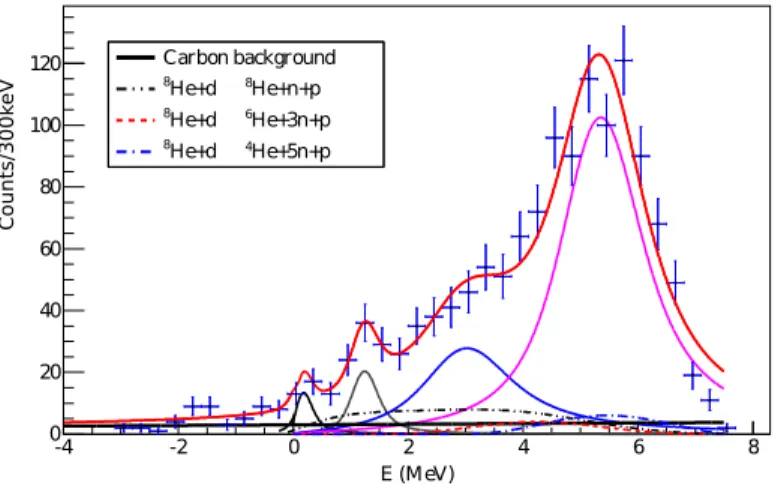
Fig. 1: Missing mass spectrum for the 8He(d,p) reaction.
The analysis method for the reaction on 8He was identical to the16O one. The missing mass spectrum of9He presented in Fig. 1 is obtained in coincidence with the identification of an 8He in the plastic beam dump.
(deg) θ 0 5 10 15 20 25 (mb/sr) Ω d σ d -2 10 -1 10 1
L=0
L=1
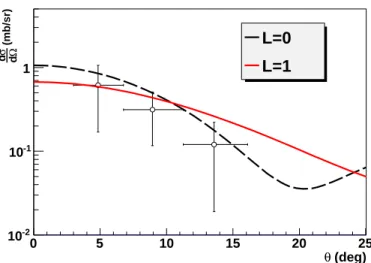
Fig. 2: Angular distribution for the ground state of9He.
This spectrum exhibits a structure around the8He neutron threshold, and two others around 1.3 MeV and 3 MeV. The large structure observed in the spectrum around 6 MeV (magenta line) is produced by the acceptance limitation of the experimental response of the detector. We analyzed the result assuming a G.S. near the neutron emission threshold and two excited states. The experimental resolutions obtained from the17O spectrum were included in the fit. Phase spaces of 3, 5 and 7-body were taken into account as well as the backgrounds due to the reactions of the beam with the carbon of the target and induced reactions in the plastic beam stopper.
Results from previous neutron transfer experiments on8He1,2were used to test the consistency of our obtained resonance parameters. The angular distributions were compared with DWBA calculations, where the ground state near the neutron threshold was considered weakly bound. We present experimental results in Fig. 2 for the ground state compared with theoretical L= 0 and L = 1 distributions. Results for the other states are also available.
4. Discussion
We focus in this article only on the G.S. of 9He: considering the limited statistics and angular coverage, it is difficult to clearly assign a multipolar-ity from the angular distribution presented in Fig. 2. We hence performed a multipole decomposition analysis, taking into account the background
an-gular distribution coming from events presenting excitation energies lower than the G.S. ones. This complementary analysis showed that any contri-bution from L = 1 should be at least an order of magnitude lower that the L= 0 one, thus confirming the s1/2nature of the9He ground state. Further details on the multipole decomposition analysis as well as the significance of the spectroscopic factors obtained using more complete CRC calculations will be given in a forthcoming publication.16
5. Conclusion
We performed a one-neutron transfer reaction on the neutron rich 8He in order to clarify the structure of the unbound 9He. Our results show a ground state located 0.2 ± 0.04 MeV above the neutron threshold, with a width of 0.2±0.49 MeV. From the results obtained by two different analysis performed on the corresponding angular distribution, we conclude that our results seem to be more in favor of a s1/2 state. Two other states, not discussed here, were found at around 1.3 and 3 MeV.
6. Acknowledgments
We wish to thank the GANIL technical staff. We wish to thank R. Raabe for fruitful discussions.
References
1. M. S. Golovkov et al., Phy. Rev. C 76, p. 021605 (2007). 2. S. Fortier et al., AIP Conf. Proc. Vol. 912 p. 3, (2007). 3. H. T. Johansson et al., Nucl. Phys. A 842, p. 15 (2010). 4. L. Chen et al., Phys. Lett. B 505, p. 21 (2001).
5. I. Talmi and I. Unna, Phy. Rev. Lett. 4, p. 469 (1960). 6. A. C. C. Villari, Nucl. Phys. A 693, p. 465 (2001). 7. S. Ottini et al., Nucl. Instr. Meth. A 431, p. 476 (1999). 8. E. Pollacco et al., Eur. Phys. J. A 25, p. 287 (2005).
9. T. Al Kalanee, PhD thesis, Univ. Caen, (Univ. Caen, 2010). and ref. therein, http://tel.archives-ouvertes.fr/tel-00557105/.
10. D. Suzuki, PhD thesis, Univ. Tokyo, (Univ. Tokyo, 2009). 11. D. Suzuki et al., Phys. Rev. Lett. 103, p. 152503 (2009). 12. R. L. Varner et al., Phys. Rep. 201, p. 57 (1991). 13. I. J. Thompson, Comp. Phys. Rep. 7, p. 167 (1988). 14. M. D. Cooper et al., Nucl. Phys. A 218, p. 249 (1974). 15. S. E. Darden et al., Nucl. Phys. A 208, p. 77 (1973). 16. T. Al Kalanee et al. To be submitted to Phys. Rev. C.